## I. INTRODUCTION
When the news broke over social media and other news outlets about the deadly virus popularly known as COVID-19 (Huang and Zhao, 2020). As early as December 2019, the virus started infecting people living in Wuhan, China spreading like wildfire from country to country and it became a pandemic (Wang et al., 2020 & Gilbert et al., 2020). The World Health Organization (WHO) announced on March 11, 2020, to the public that the virus was already a global threat to health as it causes illness, flu-like symptoms, and worst die. As of October 26, 2020, there have been 42,745,212 confirmed cases of COVID-19, including 1,150,961 deaths (WHO, 2020).
Philippine President Rodrigo Roa Duterte, as early as March 9, 2020, has already briefed the InterAgency Task Force (IATF) on COVID-19 (PCOO, 2020). The IATF together with the Department of Health (DOH) formed composite teams to ensure enhanced contact tracing and containment measures in all parts of the country in this time of COVID-19 pandemic (Joint Resolution Nos. 11 and 12 (s. 2020).
According to the Proclamation Nos. 929 and 922 (2020) and Republic Act 11332, effective March 17, 2020, classes and all school activities in all levels shall be suspended, mass gatherings shall be prohibited, a strict home quarantine shall be observed in all household, work from home arrangement shall be implemented, mass public transport facilities shall be suspended, and travel shall be restricted.
Despite the government efforts to contain the spread of COVID-19, the DOH recorded 370, 028 total cases, 35,015 active cases, and 6, 977 died as of October 25, 2020 (DOH, 2020). Still, many people ignored the government call to stay home, maintain social distancing, and avoid going to public places.
People were forced to stay home for their own safety and to avoid the spread and infection of the COVID-19 in public places. Adequate knowledge and a positive attitude on responding to the COVID-19 should be observed in this time of pandemic (Galicia, 2020). But prolonged confinement at home has a psychological effect on people in all socioeconomic aspects (Brooks et al., 2020). The latest studies revealed that the global pandemic had a substantial impact on the psychological well-being of every individual (Sim and Chua, 2004 & Wu et al., 2009).
The shift of traditional classroom setting to online instructions contributes to the emotional burden on the part of the students especially those who cannot afford to buy gadgets and other electronic devices, poor connectivity, and access to the computer needed for online classes (Khan and Abdou, 2020).
Thus, it is important to assess the mental health status of cruise ship students of the Iloilo State College of Fisheries during the COVID-19 pandemic to make a drastic intervention on the part of the government through the local government unit and higher education institution.
### a) Objectives
The objective of the study is to assess the mental health impact of the COVID-19 pandemic of the Cruise Ship Students of Iloilo State College of Fisheries in terms of depression, anxiety, and stress.
### b) Hypothesis
1. There is a significant difference in the mental health impact of the COVID-19 pandemic of the Cruise Ship Students of Iloilo State College of Fisheries in terms of depression, anxiety, and stress.
## II. THEORETICAL FRAMEWORK
Awareness is the first step towards effective implementation of any policy (Atulomah et al. 2010). Therefore, for effective implementation of the 2010 Manila amendments, it is pertinent to evaluate the level of awareness of the amendments in major Maritime Training Institutions. The level of awareness could necessitate the training and certification of seafarers to operate technologically advanced ship with high level of professionalism and global best practices. Hence, measuring awareness or knowledge of a given concept would create a platform for optimising responses based on collective knowledge of the concept rather than guessing or presuming that, a community or an individual is well versed with the provisions of the concept. This is similar to the provisions of the STCW convention and code, the collective knowledge of the STCW convention and code by stakeholders in Maritime Training Institutions could be away of enhancing its implementation.
Give the convention full and complete effect. These standards, if effectively implemented should provide the needed level of competence and professionalism required in achieving safer shipping environments.
The STCW (commonly termed STCW-78) was adopted by International Maritime Organisation (IMO) in 1978 and came into force in 1984, to ensure that, from the point of view of safety of life and property at sea and the protection of the marine environment, seafarers on board ships are qualified and fit for their duties. Okonna (2011) posited that, one of the major weaknesses identified in the STCW-78 convention was lack of quality standards.
Therefore, the STCW-78 could not achieve its objectives. Rojas (2002) reported that IMO members decided to amend the STCW 78 in the early 1990s, and the amended convention is now referred to as STCW-95. The focus of the STCW-95 was on developing practical skills and competence underpinned by theoretical knowledge.
According to Young (2002), 133 countries and shipping registries (representing over $78\%$ of the world's merchant fleet) were parties to the STCW-78 as amended in 1995.
The STCW-95 amendments came into force on the 1 February 1997, with a transition period that lated up to 1st February, 2002. The STCW- 95 was not without flaws, especially in relation to attention to the marine environment. For instance, Yoon (2011) identified lack of effective implementation and enforcement of treaty obligations as one of the challenges in the protection of the marine environment. An empirical study conducted in the coastal environment shows that, the extinction of marine life in the coastal environment of the Nigerian Niger Delta was largely due to ship borne pollutants (Evans, Evans, and John 2014). In order to address emerging issues as well as issues anticipated to emerge in the foreseeable future, amendments to the STCW- 95 were adopted by the IMO at a diplomatic conference in Manila in June, 2010. The amendments came into force on 1st January, 2012 (Ghosh et al. 2014; Berlingieri 2015). Also, the 1978 STCW codes which entered into force on 28th April, 1984 had undergone amendments thereto have been adopted in 1991, 1994, 1995, 1997, 1998, 2004, 2006 and 2010 (Anish 2010; IMO 2011).
This research is anchored on Stress Theory by K. Finsterbusch (1982), on Learned Helplessness Theory by Seligman, M. E. (1974), and on Psychoanalytic Theory by S. Freud (2003). According to the Stress Theory (K. Finsterbusch, 1982), it describes the process whereby environmental events or forces threaten an individual's well-being and the individual response. The threatening event is the stressor and the response is coping behavior which, if successful, leads to adaptation and/or adjustment and, if unsuccessful, leads to additional coping efforts. If the stress condition continues for a long enough time without relief it can lead to physical or mental disorders. On Learned Helplessness Theory, M.E Seligman (1974) explains depression whereby the individual gives up trying to influence their environment because they have learned that they are helpless as a consequence of having no control over what happens to them. On the other hand, according to the Psychoanalytic Theory by S. Freud (2003), anxiety serves as a signal when 'danger situations' tend to gravitate around the threats that arise from the prospect of being helpless and at the mercy of others: threats of losing a loved one, of losing another's love, or of being attacked. Freud claimed, these threats are manifestations of a more fundamental threat, the threat of castration.
## III. CONCEPTUAL FRAMEWORK
The study's paradigm shows the independent variable, BSCSM 111- Alpha, Bravo, Charlie, the intervening variable, Assessment the part of the ship, navigational equipment and lifesaving, and Training Plan.
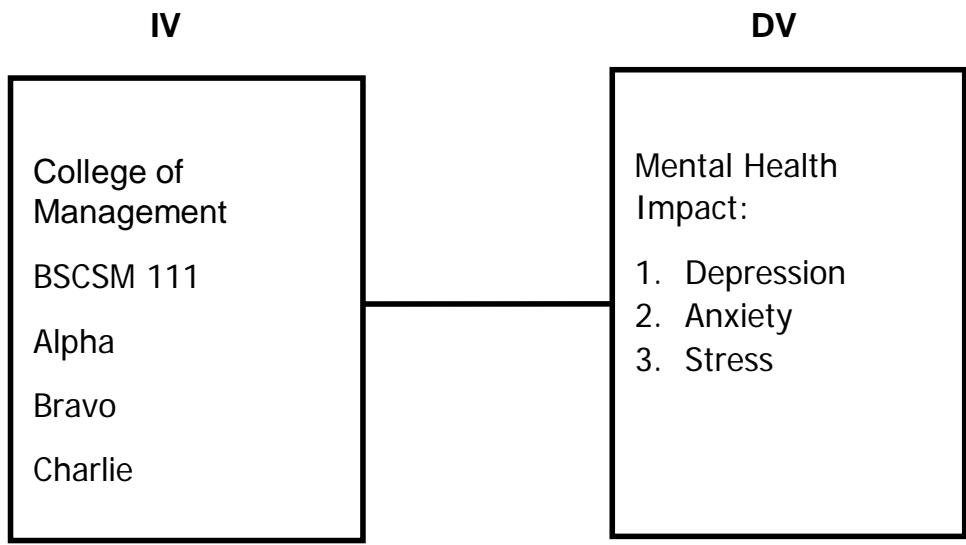
Figure 1: Paradigm of the Study
## IV. MATERIALS AND METHODS
### a) Research Design
The descriptive method of research will be employed in this investigation since the data will be collected to answer questions concerning the impact of the COVID-19 on the mental health of Cruise Ship students of Iloilo State College of Fisheries. Descriptive research, according to Gay, et al., involves collecting data to answer questions concerning the impact of the COVID-19 on the mental health of Cruise Ship students of Iloilo State College of Fisheries. In descriptive research, Gay, et al. add, determines, and reports the way things are (Gay, Mills, & Airasian, 2018).
#### Locale/Study Site
Iloilo State College of Fisheries, Tiwi, Barotac Nuevo, Iloilo.
#### Respondents
The respondent of this study is 117 student of Bachelor of Science in Cruise Management 111- Alpha, Bravo and Charlie of College of Management, Iloilo State College of Fisheries. Barotac Nuevo Iloilo.
#### Sampling Techniques
Random sampling using frequency and percentage.
#### Research Instrument
To assess the mental health impact of the COVID-19 pandemic of College of Management of Cruise Ship Student in terms of the level of depression, anxiety, and stress, the Depression Anxiety and Stress Scale (DASS - 21) will be adopted and administered. According to Lovibond, S.H. & Lovibond, P.F. (1995), DASS -21 is the most reliable tool when it comes to the assessment of the psychological distress of every individual.
### b) Data Gathering Procedure
The researcher will be requesting permission to administer the research instrument from the office of the Dean of the College of Management at the Iloilo State College of Fisheries. Upon approval of the permit, meticulous oral instructions both in English and Tagalog will be given to make certain that the participants accomplished the questionnaires properly. Since the Iloilo State College of Fisheries declared no face-to-face classes starting March 2020 up to now, the questionnaires will be created using google forms and it will be distributed to the respondents via social media such as Facebook, e-mail, and other online platforms.
### c) Data Analysis
Data gathered will be recorded and subject to statistical analysis. The accomplished questionnaires will be scored and subjected to appropriate computer-processed statistics using the Statistical Package for the Social Sciences (SPSS) software version 23. Percentage and frequency will be the descriptive statistical tools employed in the study.
## V. RESULTS AND DISCUSSIONS
### a) Findings with Analysis and Interpretation
The study aimed to assess the mental health impact of the COVID-19 pandemic of the Cruise Ship Students of Iloilo State College of Fisheries in terms of depression, anxiety, and stress.
### b) Adopted Questionnaires
<table><tr><td>DASS21</td><td>Name:</td><td>Date:</td></tr></table>
Please read each statement and circle a number 0, 1, 2 or 3 which indicates how much the statement applied to you over the past week. There are no right or wrong answers. Do not spend too much time on any statement.
The rating scale is as follows:
1. Did not apply to me at all
2. Applied to me to some degree, or some of the time
3. Applied to me to a considerable degree or a good part of time
4. Applied to me very much or most of the time
<table><tr><td>1</td><td>(s)</td><td>I found it hard to wind down</td><td>0</td><td>1</td><td>2</td><td>3</td></tr><tr><td>2</td><td>(a)</td><td>I was aware of dryness of my mouth</td><td>0</td><td>1</td><td>2</td><td>3</td></tr><tr><td>3</td><td>(d)</td><td>I couldn't seem to experience any positive feeling at all</td><td>0</td><td>1</td><td>2</td><td>3</td></tr><tr><td></td><td>(a)</td><td>I experienced breathing difficulty (e.g. excessively rapid breathing, breathlessness in the absence of physical exertion)</td><td></td><td></td><td></td><td></td></tr><tr><td>4</td><td></td><td></td><td></td><td></td><td></td><td></td></tr><tr><td>5</td><td>(d)</td><td>I found it difficult to work up the initiative to do things</td><td>0</td><td>1</td><td>2</td><td>3</td></tr><tr><td>6</td><td>(s)</td><td>I tended to over-react to situations</td><td>0</td><td>1</td><td>2</td><td>3</td></tr><tr><td>7</td><td>(a)</td><td>I experienced trembling (e.g. in the hands)</td><td>0</td><td>1</td><td>2</td><td>3</td></tr><tr><td>8</td><td>(s)</td><td>I felt that I was using a lot of nervous energy</td><td>0</td><td>1</td><td>2</td><td>3</td></tr><tr><td></td><td>(a)</td><td>I was worried about situations in which I might panic and make a fool</td><td></td><td></td><td></td><td></td></tr><tr><td>9</td><td>(d)</td><td>I felt that I had nothing to look forward to</td><td>0</td><td>1</td><td>2</td><td>3</td></tr><tr><td>10</td><td>(s)</td><td>I found myself getting agitated</td><td>0</td><td>1</td><td>2</td><td>3</td></tr><tr><td>11</td><td>(s)</td><td>I found it difficult to relax</td><td>0</td><td>1</td><td>2</td><td>3</td></tr><tr><td>12</td><td>(d)</td><td>I felt down-hearted and blue</td><td>0</td><td>1</td><td>2</td><td>3</td></tr><tr><td></td><td>(s)</td><td>I was intolerant of anything that kept me from getting on with what I was doing</td><td>0</td><td>1</td><td>2</td><td>3</td></tr><tr><td></td><td></td><td></td><td></td><td></td><td></td><td></td></tr><tr><td>13</td><td>(a)</td><td>I felt I was close to panic</td><td>0</td><td>1</td><td>2</td><td>3</td></tr><tr><td>14</td><td>(d)</td><td>I was unable to become enthusiastic about anything</td><td>0</td><td>1</td><td>2</td><td>3</td></tr><tr><td>15</td><td>(d)</td><td>I felt I wasn't worth much as a person</td><td>0</td><td>1</td><td>2</td><td>3</td></tr><tr><td>16</td><td>(s)</td><td>I felt that I was rather touchy</td><td>0</td><td>1</td><td>2</td><td>3</td></tr><tr><td></td><td>(a)</td><td>I was aware of the action of my heart in the absence of physical exertion (e.g. sense of heart rate increase, heart missing a beat)</td><td>0</td><td>1</td><td>2</td><td>3</td></tr><tr><td>17</td><td>(a)</td><td>I felt scared without any good reason</td><td>0</td><td>1</td><td>2</td><td>3</td></tr><tr><td>18</td><td>(d)</td><td>I felt that life was meaningless</td><td>0</td><td>1</td><td>2</td><td>3</td></tr></table>
Table 1: NB Scores on the DASS-21 will need to be multiplied by 2 to calculate the final score.
<table><tr><td></td><td>Depression</td><td>Anxiety</td><td>Stress</td></tr><tr><td>Normal</td><td>0-9</td><td>0-7</td><td>0-14</td></tr><tr><td>Mild</td><td>10-13</td><td>8-9</td><td>15-18</td></tr><tr><td>Moderate</td><td>14-20</td><td>10-14</td><td>19-25</td></tr><tr><td>Severe</td><td>21-27</td><td>15-19</td><td>26-33</td></tr><tr><td>Extremely Severe</td><td>28+</td><td>20+</td><td>34+</td></tr></table>
Table 2: Statistics
<table><tr><td></td><td>Stress_Rec</td><td>Anxiety_Rec</td><td>Depression_Rec</td></tr><tr><td>Valid</td><td>30</td><td>30</td><td>30</td></tr><tr><td>N</td><td>0</td><td>0</td><td>0</td></tr><tr><td>Missing</td><td></td><td></td><td></td></tr></table>
Table 3: Stress
<table><tr><td colspan="2"></td><td></td><td>Percent</td><td>Valid Percent</td><td>Cumulative Percent</td></tr><tr><td rowspan="3">Valid</td><td>Severe</td><td>11</td><td>36.7</td><td>36.7</td><td>36.7</td></tr><tr><td>Extremely Severe</td><td>19</td><td>63.3</td><td>63.3</td><td>100.0</td></tr><tr><td>Total</td><td>30</td><td>100.0</td><td>100.0</td><td></td></tr></table>
Table 4: Anxiety
<table><tr><td colspan="2"></td><td>Frequency</td><td>Percent</td><td>Valid Percent</td><td>Cumulative Percent</td></tr><tr><td>Valid</td><td>Extremely Severe</td><td>30</td><td>100.0</td><td>100.0</td><td>100.0</td></tr></table>
Table 5: Depression
<table><tr><td colspan="2"></td><td>Frequency</td><td>Percent</td><td>Valid Percent</td><td>Cumulative Percent</td></tr><tr><td rowspan="4">Valid</td><td>Moderate</td><td>3</td><td>10.0</td><td>10.0</td><td>10.0</td></tr><tr><td>Severe</td><td>22</td><td>73.3</td><td>73.3</td><td>83.3</td></tr><tr><td>Extremely Severe</td><td>5</td><td>16.7</td><td>16.7</td><td>100.0</td></tr><tr><td>Total</td><td>30</td><td>100.0</td><td>100.0</td><td></td></tr></table>
## VI. CONCLUSIONS
- In table 3 anxiety the impact of the COVID-19 pandemic on the mental health of the Cruise Ship Students the result show that 30 student got extremely severe is equivalent to 63.3 percent and 11 got a severe equivalent to 36.7 percent.
- In table 4 stress the impact of the COVID-19 pandemic on the mental health of the Cruise Ship Students the result show that 30 student got extremely severe that equivalent to 100 percent.
- In table 5 depression the impact of the COVID-19 pandemic on the mental health of the Cruise Ship Students the result show that 5 student got extremely severe that equivalent to 16.7 percent, 22 student got severe that equivalent to 73.3 percent and 3 student got moderate that equivalent to 10 percent.
## VII. RECOMMENDATIONS
The result of the research study, the following recommendations were drawn:
- The Crew Ship Student must always at the supervision of their parents.
- In terms of online classes the teacher must ask the side of the student regarding what are the problems on their class.
- Always listen about the part of the students to give them free from stress, anxiety and depression this time of pandemic.
- Encourage student that always think positive for their lives.
Generating HTML Viewer...
References
19 Cites in Article
L Gay,G Mills,P Airasian (2018). Mills, G. E., & Gay, L. R. (2016) Education research: Competencies for analysis and applications. London, England: Pearson Education..
S Lovibond,P Lovibond (1995). Depression Anxiety Stress Scales.
Kurt Finsterbusch (1982). Psychological Impact Theory and Social Impacts.
M Seligman (1974). Depression and learned helplessness.
Sigmund Freud (2003). The origin and development of psychoanalysis..
Cuiyan Wang,Riyu Pan,Xiaoyang Wan,Yilin Tan,Linkang Xu,Cyrus Ho,Roger Ho (2020). Immediate Psychological Responses and Associated Factors during the Initial Stage of the 2019 Coronavirus Disease (COVID-19) Epidemic among the General Population in China.
M Gilbert,G Pullano,F Pinotti,E Valdano,C Poletto,P Boëlle,E D'ortenzio,Y Yazdanpanah,S Eholie,M Altmann,B Gutierrez,M Kraemer,V Colizza (2020). Preparedness and vulnerability of African countries against importations of COVID-19: a modelling -8.
Yeen Huang,Ning Zhao (2020). Generalized anxiety disorder, depressive symptoms and sleep quality during COVID-19 outbreak in China: a web-based cross-sectional survey.
(2020). WHO Coronavirus Disease (COVID-19) Dashboard.
(2020). The Interagency Task Force for the Management of Emerging Infectious Diseases.
(2019). Emancipation Proclamation.
(2020). Declaring A State of Public Health Emergency Throughout the Philippines.
P Galicia (2020). Response measures toward COVID-19 among maritime students in the Province of Antique: Bases for a health intervention program.
S Brooks,R Webster,L Smith,L Woodland,S Wessely,N Greenberg,G Rubin (2020). The psychological impact of quarantine and how to reduce it: a rapid review of the evidence.
Charnicia Huggins (2020). Experiencing COVID-19 in the health-system pharmacy.
K Sim,H Chua (2004). The psychological impact of SARS: a matter of heart and mind.
Ping Wu,Yunyun Fang,Zhiqiang Guan,Bin Fan,Junhui Kong,Zhongling Yao,Xinhua Liu,Cordelia Fuller,Ezra Susser,Jin Lu,Christina Hoven (2009). The Psychological Impact of the SARS Epidemic on Hospital Employees in China: Exposure, Risk Perception, and Altruistic Acceptance of Risk.
Md. Khan,Benadjih Abdou (2020). Flipped Classroom: How Institutions of Higher Education (HEIs) of Bangladesh Could Move Forward During Covid-19 Pandemic.
No ethics committee approval was required for this article type.
Data Availability
Not applicable for this article.
How to Cite This Article
Dr. Sheila M. Picpican. 2026. \u201cThe Impact of the COVID-19 Pandemic on the Mental Health of Cruise Ship Students at Iloilo State College of Fisheries\u201d. Global Journal of Human-Social Science - H: Interdisciplinary GJHSS-H Volume 25 (GJHSS Volume 25 Issue H1): .
Explore published articles in an immersive Augmented Reality environment. Our platform converts research papers into interactive 3D books, allowing readers to view and interact with content using AR and VR compatible devices.
Your published article is automatically converted into a realistic 3D book. Flip through pages and read research papers in a more engaging and interactive format.
Our website is actively being updated, and changes may occur frequently. Please clear your browser cache if needed. For feedback or error reporting, please email [email protected]
Thank you for connecting with us. We will respond to you shortly.