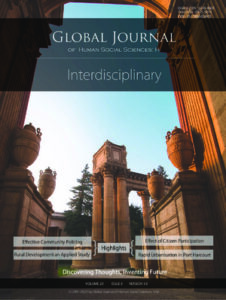
The Impediments to Effective Community Policing in Nigeria: A Case Study of Akwa Ibom State

α
Prof. Abomaye-Nimenibo Williams Aminadokiari Samuel
Prof. Abomaye-Nimenibo Williams Aminadokiari Samuel Ph.D., M.Sc., B.Sc. Economics, MBA Management and UD, Personnel Management and Industrial Relations, Director of Postgraduate Studies, School of Postgraduate Studies
σ
Dr. Umana
Dr. Umana
ρ
Emmanuel Amos
Emmanuel Amos
Ѡ
Past. Dr. Abomaye-Nimenibo
¥
Williams Aminadokiari Samuel
α to Ѡ Obong University Obong University

Send Message

To: Author

The Impediments to Effective Community Policing in Nigeria: A Case Study of Akwa Ibom State

Article Fingerprint

ReserarchID

E0Y7F

The Impediments to Effective Community Policing in Nigeria: A Case Study of Akwa Ibom State Banner

AI TAKEAWAY

Connecting with the Eternal Ground
  • English
  • Afrikaans
  • Albanian
  • Amharic
  • Arabic
  • Armenian
  • Azerbaijani
  • Basque
  • Belarusian
  • Bengali
  • Bosnian
  • Bulgarian
  • Catalan
  • Cebuano
  • Chichewa
  • Chinese (Simplified)
  • Chinese (Traditional)
  • Corsican
  • Croatian
  • Czech
  • Danish
  • Dutch
  • Esperanto
  • Estonian
  • Filipino
  • Finnish
  • French
  • Frisian
  • Galician
  • Georgian
  • German
  • Greek
  • Gujarati
  • Haitian Creole
  • Hausa
  • Hawaiian
  • Hebrew
  • Hindi
  • Hmong
  • Hungarian
  • Icelandic
  • Igbo
  • Indonesian
  • Irish
  • Italian
  • Japanese
  • Javanese
  • Kannada
  • Kazakh
  • Khmer
  • Korean
  • Kurdish (Kurmanji)
  • Kyrgyz
  • Lao
  • Latin
  • Latvian
  • Lithuanian
  • Luxembourgish
  • Macedonian
  • Malagasy
  • Malay
  • Malayalam
  • Maltese
  • Maori
  • Marathi
  • Mongolian
  • Myanmar (Burmese)
  • Nepali
  • Norwegian
  • Pashto
  • Persian
  • Polish
  • Portuguese
  • Punjabi
  • Romanian
  • Russian
  • Samoan
  • Scots Gaelic
  • Serbian
  • Sesotho
  • Shona
  • Sindhi
  • Sinhala
  • Slovak
  • Slovenian
  • Somali
  • Spanish
  • Sundanese
  • Swahili
  • Swedish
  • Tajik
  • Tamil
  • Telugu
  • Thai
  • Turkish
  • Ukrainian
  • Urdu
  • Uzbek
  • Vietnamese
  • Welsh
  • Xhosa
  • Yiddish
  • Yoruba
  • Zulu

Abstract

Community policing is a philosophy of full-service personalized policing, where the same officer patrols, and works in the same area permanently from a decentralized place, working in a proactive partnership with citizens to identify and solve problems. It is established at the bedrock of police-community partnership and communication to secure a safe environment for all and develop a longer-term solution to resolving criminal issues. The objective of this study was to assess the impediments against operative community policing in crime prevention with unusual reference to Akwa Ibom State. The theories use for this research were the democratic theory of community policing. The research adopted a Chi-Square analytical method for a statistical analysis questionnaire that was used6 for data collection from participants from 4 selected study areas -Ikot Abasi, Oron, Uyo, and Ikot Ekpene.

References

43 Cites in Article
  1. A Adeyemi (2001). Corruption in the Administration of Justice.
  2. T Akuul (2011). State Policing and National Security in Nigeria.
  3. E Alemika (1999). Police community relations in Nigeria: What went wrong? Paper presented at the seminar on role and function of the Police in a post-military era, organized by the Centre for Law Enforcement Education in Nigeria.
  4. S Arase,I Iwuofor (2007). Policing Nigeria in the 21st century.
  5. D Carter (2002). The police and community.
  6. I Chukwuma (2001). Police Transformation in Nigeria: Problems and prospects.
  7. J Dempsey,L Forst (2008). An introduction to policing.
  8. N Friedman (1992). Toward a comprehensive understanding of executive cognitive function in implicit racial bias.
  9. O Godwin,R Arop,A Ahmed (2009). POS102 -Police community relations and interpersonal relations and awareness.
  10. H Groenewald,G Peake (2004). Police reform through community -based policing: philosophy and guidelines for implementation.
  11. B Hess,E Markson,P Stein (1992). Sociology.
  12. J Heywood (2004). Job Satisfaction and Gender: An Expanded Specification from the NLSY.
  13. In Forward,V Jike The Nigeria police and the crisis of law and order, A Book of Readings.
  14. O Karimu (2015). Effects of Nigeria police force personnel welfare condition on performance.
  15. D Kelly,E Clarke (2003). Deviant behaviour: A text-reader in the sociology of deviance.
  16. J Lubuva (2004). Community Approach to Security, Social Inclusion and Development in Tanzania.
  17. K Lukman (2014). Wochenrückblick: Google Books, Content ID, Verwaiste Werke.
  18. C Macpherson (1962). The Political Theory of Possessive Individualism: Hobbes to Locke.
  19. R Morgan (1996). The Comparative Advantage Theory of Competition: SD Hunt.
  20. Markus-Michael Müller (2010). Community Policing in Latin America: Lessons from Mexico City.
  21. (2011). ‘Your police – my police’: the informal privatisation of policing.
  22. E Nwachukwu (2012). Security Challenges and the reform of Nigeria Police.
  23. A Obaro (2014). The Nigeria police force and the crises of legitimacy: Re-defining the structure and function of the Nigeria police.
  24. R O'block,J Donnermeyer,S Doeren (1991). Security and Crime Prevention: Second Ed.
  25. M Olong,J Agbonika (2013). Reawakening the state police controversy in Nigeria: Need for rethinking.
  26. A Onwuka (2009). Why Nigeria Police is Corrupt and Ineffective.
  27. G Ordu,M Unam (2017). Community Policing: The Case of Informal Policing in Nigeria.
  28. S Otu,G Aro (2013). Dealing with professionalism and acquiring and managing legitimacy in a constitutional democratic policing in Nigeria: Where goes the procedural justice approach.
  29. O Oyegoke (2003). Private security management in Nigeria.
  30. C Oyemwinmina,S Aibieyi (2016). Analysis towards Effective Policing in Nigeria.
  31. Carole Pateman (1979). The Problem of Political Obligation: A Critical Analysis of Liberal Theory.
  32. N Poulantzas (1978). State, Power, and Socialism.
  33. S Qadri (2005). Criminology: Problems and perspectives.
  34. R Quinney (1974). Critique of legal order: Crime control in capitalist society.
  35. V Ramaswamy (2004). Co-creating unique value with customers.
  36. R Reiner (1993). Police accountability: Principles, patterns and practices.
  37. R Reiner (2000). The Politics of the Police.
  38. C Stone,J Miller,M Thorton,Trone (2005). Supporting Security, Justice, and Development: Lesson for a new era.
  39. L Sullivan (2005). Encyclopaedia of Law Enforcement.
  40. G Sykes (1978). Criminology.
  41. Matthias Matthias (2004). A Review of The Blind Spot of Section 12 (1) of the Constitution of the Federal Republic of Nigeria 1999 (As Amended).
  42. L Walker (1992). Discovery and presentation of evidence in adversary and non-adversary proceedings.
  43. M Weber (1968). The Concept of Rationality.

Funding

No external funding was declared for this work.

Conflict of Interest

The authors declare no conflict of interest.

Ethical Approval

No ethics committee approval was required for this article type.

Data Availability

Not applicable for this article.

How to Cite This Article

Prof. Abomaye-Nimenibo Williams Aminadokiari Samuel. 2020. \u201cThe Impediments to Effective Community Policing in Nigeria: A Case Study of Akwa Ibom State\u201d. Global Journal of Human-Social Science - H: Interdisciplinary GJHSS-H Volume 20 (GJHSS Volume 20 Issue H8): .

Download Citation

Issue Cover
GJHSS Volume 20 Issue H8
Pg. 25- 41
Journal Specifications

Crossref Journal DOI 10.17406/GJHSS

Print ISSN 0975-587X

e-ISSN 2249-460X

Keywords
Classification
GJHSS-H Classification: FOR Code: 149999
Version of record

v1.2

Issue date

August 11, 2020

Language
en
Experiance in AR

Explore published articles in an immersive Augmented Reality environment. Our platform converts research papers into interactive 3D books, allowing readers to view and interact with content using AR and VR compatible devices.

Read in 3D

Your published article is automatically converted into a realistic 3D book. Flip through pages and read research papers in a more engaging and interactive format.

Article Matrices
Total Views: 2310
Total Downloads: 1158
2026 Trends
Related Research

Published Article

Community policing is a philosophy of full-service personalized policing, where the same officer patrols, and works in the same area permanently from a decentralized place, working in a proactive partnership with citizens to identify and solve problems. It is established at the bedrock of police-community partnership and communication to secure a safe environment for all and develop a longer-term solution to resolving criminal issues. The objective of this study was to assess the impediments against operative community policing in crime prevention with unusual reference to Akwa Ibom State. The theories use for this research were the democratic theory of community policing. The research adopted a Chi-Square analytical method for a statistical analysis questionnaire that was used6 for data collection from participants from 4 selected study areas -Ikot Abasi, Oron, Uyo, and Ikot Ekpene.

Our website is actively being updated, and changes may occur frequently. Please clear your browser cache if needed. For feedback or error reporting, please email [email protected]

Request Access

Please fill out the form below to request access to this research paper. Your request will be reviewed by the editorial or author team.
X

Quote and Order Details

Contact Person

Invoice Address

Notes or Comments

This is the heading

Lorem ipsum dolor sit amet, consectetur adipiscing elit. Ut elit tellus, luctus nec ullamcorper mattis, pulvinar dapibus leo.

High-quality academic research articles on global topics and journals.

The Impediments to Effective Community Policing in Nigeria: A Case Study of Akwa Ibom State

Dr. Umana
Dr. Umana
Emmanuel Amos
Emmanuel Amos
Past. Dr. Abomaye-Nimenibo
Past. Dr. Abomaye-Nimenibo Obong University
Williams Aminadokiari Samuel

Research Journals