I. INTRODUCTION
Construction projects development depend on effective documentation for success because they require complex interactions of multiple stakeholders and participants. Effective documentation of projects requires synthesis and integration of contributions from all parties involved in ownership, use, design, estimation, construction, operation, management, oversight and maintenance, who must work together in structured, organized and collaborative manner in the project documentation chain (Ajator, 2012, 2012a; Ajator et al, 2011) to ensure success.
The conceptual questions in effective documentation for successful contract administration and management include among others:
What level of quality is exercised in structuring project briefs/ requirements by the client, his agent and user?
What level of quality is exercised in producing geotechnical, architectural, civil, structural, mechanical/electrical designs transformed into physical structures by contractors?
What level of quality is applied in documenting for contractors and consultants procurement?
How accurate and comprehensive are the project cost estimate/bills of quantities?
Does planning for execution provide specific, accurate, real-time details on scope, work breakdown structure (WBS), schedule, networks, milestones, budgets, cash flow analysis, labour, material and equipment requirements and safety/risk control standards?
Are there control/reporting system that provide for monitoring and feedback at all stages and which enables comparison of schedules, budgets and standard performance with actual achievements and project goals?
To what extent are these imperative documentation issues elaborately covered in the four documentation phase requirements of pretender documentation, Tender documentation, contract administration and monitoring/evaluation documentation and interfaced to ensure ultimate project success?
The objective of this research is thus to attempt to expose some of the key techniques and knowhow of these imperative documentation paradigms in contract management.
| Documentation Quality Variable (DQVS) | Weighed Rating | |||
| No. of Resp W | Score% S | Imp Index WXS | ||
| 1 | Project Brief/ Requirements Documentation | 32 | 70 | 22 |
| 2 | Project Design | 33 | 80 | 26 |
| 3 | Cost Engineering/BOQ Preparation | 36 | 89 | 32 |
| 4 | Construction Plan Documentation | 35 | 75 | 26 |
| 5 | Implementation Sequence Documentation | 33 | 60 | 20 |
| 6 | Budgeting/Cashflow Documentation | 31 | 65 | 20 |
| 7 | Earned Value Management Documentation | 25 | 61 | 15 |
| 8 | Labour/Plant/Equipment Statements | 33 | 60 | 20 |
| 9 | Control/ Report System Documentation | 25 | 56 | 14 |
| 10 | Project Inspections/Site Meetings/ Minutes Documentation | 26 | 58 | 15 |
| 11 | Valuation/Certificates Documentation | 30 | 62 | 19 |
| 12 | Change Orders (variations)/ Other Instructions Documentation | 29 | 78 | 23 |
| 13 | Price Fluctuation Documentation | 26 | 50 | 13 |
| 14 | Day Works Claims Documentation | 18 | 50 | 9 |
| 15 | Accidents/Force Majure/Weather Change/Dispute Documentation | 16 | 45 | 7 |
II. LITERATURE REVIEW
Most projects require the use of basic contract documents. These include (IBRD,1999,Langdon, 2007); articles of agreement, conditions of contract with all necessary deletions/ amendments if standard form is used, drawing/or specifications of work to be done. Cost estimates/ priced bills of quantities including post-tender negotiation documentation, and contract programme/ progress charts. Other basic documentations required in projects include pre-tender documentations, early warning charts, quality performance charts, minutes of site meetings, project instructions, valuations/ certifications, cash flow and earned value management among others. Ajator (2012) recorded the importance index of some project documentation variables (see Table 2.1) in which professionals ascribed high percentage ratings of 32,26,26 and 23 to BOQ preparation, project design, construction plan and change orders (variation) documentations respectively.
When these variables are efficiently documented, they provide relevant databases for resolution of disputes at project delivery.
Other researches (Ajator, 2007, 2000a, 2000b; Project Documentation Certification Taskforce, 1997; Galo, et al 2002; Tilly, et al 2000, 2002; Love et al, 2000, 1996) have identified declining quality of these documentations and disregard of due processes and inefficiencies which have resulted in increased project cost, time, risk, delay and disputes. Tilley, et al (2002), Gallo, et al (2002) and Ajator (2012) specifically identified issues associated with documentation failings and its manifestations, some of which are consequential on others and some involving more than one stakeholders.
Client-Related Causes of Documentation Failings Include:
Unclear, vague and uncoordinated brief
➢ Inadequate knowledge of the implications of their expectations, demands and directions, inadequate recognition of life cycle implications at briefing and design phases.
▶ Penchant for low initial capital cost.
- Lowest price mentality in engagement of designers/professionals.
➢ Unrealistic expectations about time and cost impacts/constraints.
➢ Defensive approach to Variations and claims for increased cost and time.
➢ Failure to appoint overall project manager or commission design team at appropriate stages of a project.
a) Designer-Related Causes
These Include:
➢ Inexperienced design personnel, inappropriate design and design checking, conservative design, build ability problems.
Legally/ statutorily non-complaint design, quick-fix/rushed design.
"Cut and paste" design syndrome and consequent ambiguities due to lack of integration, and quest to reduce design time to agreed fee.
➢ Shedding of design cost risks rather than providing quality documentation.
Inadequate checking of details and insufficient reviews with relevant parties and inadequate coordination between geotechnical/structural engineering, architectural, electrical and mechanical design disciplines, result in "design-by-crisis" approach leaving design issues to be sorted out in the construction process and compounding constructability issues.
➢ Design documentation issued with known deficiencies. Professional impunity and disregard for ethics.
- Design draft men expertise displaced by fledging CAD-operators' service, thus impacting documentation quality in the short run.
➢ Reluctance to allocate experienced staff to projects because of inadequate fees agreed with clients, result in optimum project solution not provided and job not done right first time, thus increasing disputes, time and cost levels.
b) Estimator-Related/Other Documentation Failings
Cost estimate documentation failings largely arise from inadequate project design/definition, use of quacks and inexperienced estimators and non professional quantity surveyors/cost engineers.
Accuracy of estimate must base on bottom-up approach/WBS and activity cost coding/cost accounts. Relevant executory personnel must be used to analyze cost at the lowest possible work units or finest detail with minimal provisional items and estimator bias. Ineffective estimate documentation result from inadequate cost data bases, poor understanding and experience of the terrain, the technologies, various currencies/conversion rates, the duties, Ports' charges, transport systems (both local and international) available and costs of finance and funding system. Apart from possible inaccuracy of analyzed benchmark cost and factoring errors, there is often problem of improper planning and non-inclusion of all work items for which cost/prices must be allocated (Ajator, 1989, 1999, Aliyu, 2006).
In high "import-factor" infrastructure projects, other important cost consideration must include cost of shipping, stacking in the factory (demurrage charges, by manufacturers), marine insurance, clearing costs at ports, duties, insurance, warehousing, local transportation etc. These real costs where not documented can cause disputes and project failure.
c) Tender/Other Documentation Failings
Tendering procedures involving multiple notices to tenderers and question/answer steps erode document accuracy due to short time available for amendments. Bidders withhold important questions that may reveal their competitive edge especially in complicated warped award processes and short tender times.
d) Contractor-Related Documentation Issues
Contractors strive to redistribute risk to other sake holders, engage low cost and low skilled subcontractor, choose to withhold useful tender information (RFIS). Make spurious unsubstantiated claims' submissions to recover losses arising from initial low bids, inflate invoices, insurance and bond claims to cover perceived risks and difficulties in maintaining skill levels. The general causes impeding effective documentation involving all parties include; inadequate time for project planning, relevant parties not involved in project planning (eg project monitoring consultants) early enough, especially at concept and decision times; slow responses by most clients and their agents to questions/ queries from bidders at tender, and contractors at construction stage, worsen rather than improve documentation quality, and adversarial attitude embedded in the procurement culture.
e) Relevance of Effective Documentation in Procurement
The vehicle for achieving national development is efficient procurement. But this must obtain through monitoring which inturn depends on Effective Documentation.
Procurement is viewed by Ajator and Agusiobu (2007) and Eze (2009) as the acquisition of goods, works and/or services at the best possible total cost of ownership, in the right quantity and quality at the right time, in the right place for the direct benefit or use of Government, corporation/organization or individuals. The key to the achievement of effective procurement is monitoring and evaluation. To monitor, there must be well documented plan of activities, standards and cost baselines against which the actual is compared or benchmarked. Hence to monitor is to keep under observation and check for possible deviations from plans, standards and cost levels. So effective documentation which provides these plans, standards and baselines; becomes of paramount importance.
The importance of documentation can be seen from project procurement monitoring steps which include among others checking the:
Existence of need-driven procurement plan (project preparation/ Formulation documentation).
Documented projects to ensure that only appropriated projects are implemented.
Adequacy of prepared document.
Advertisement of project.
Transparency of prequalification (visible from the documents) and
Transparency of bids and bid evaluation (both Technical/Financial bids)
Transparency of awards of contracts (to lowest competitive bid).
Effective project documentation must therefore provide requirements that cover four main phases:
■ Documentation for Project Preparation/Formulation (Pre-tender documentation)
■ Documentation for Project Procurement (Tender documentation)
■ Documentation at Project Implementation (Contract Admin documentation)
■ Documentation for Contract Oversight/Audit (Monitoring/Evaluation documentation).
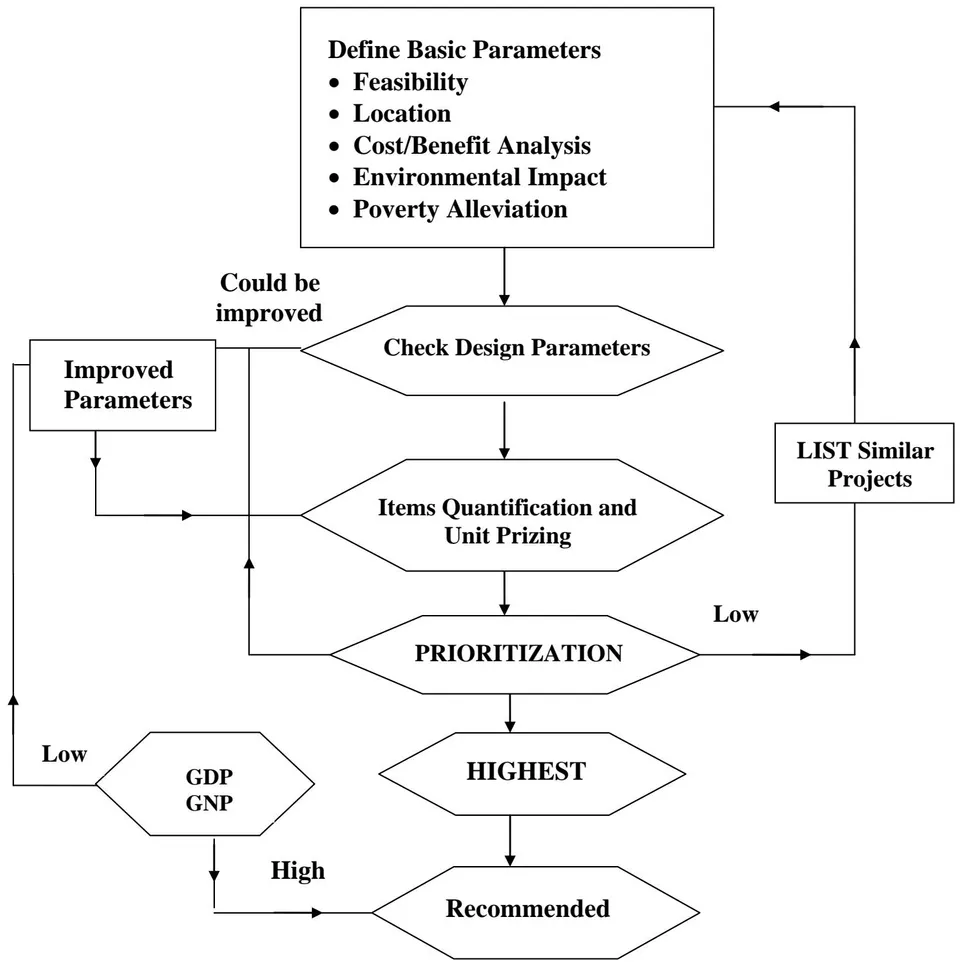
f) Documentation for Project Preparation/Formulation
This must cover the key problems/needs of the project, expected benefits, alternatives/options, alignment of the projects with Federal Government of Nigeria (FGN) Sectoral projects' preferences, competitiveness of project costs, their feasibility, financial/economic analysis, environmental impact, and detailed project designs, future operation/maintenance requirements, implementation plans and proper packaging (Ajator,2012a).
Efficient documentation of these subjects provides clear guidelines, standards and cost targets to facilitate examining their adequacy to achieve national goal and objectives.
The content of these documents constitute approved guidelines/ standards for monitoring the activities and projects at execution stage. Failure of documentation at this stage renders abortive monitoring and evaluation at execution stage.
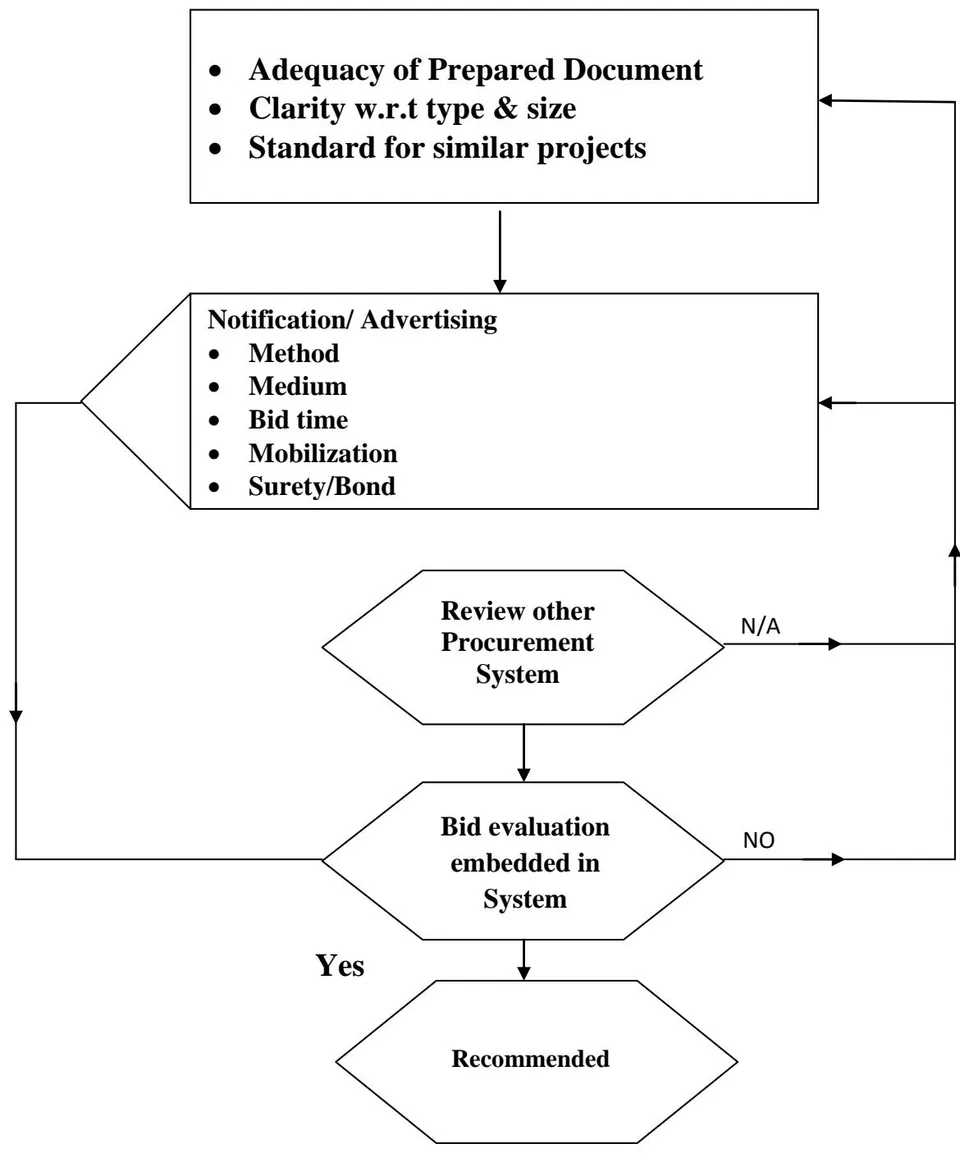
g) Documentation for Project Procurement
For Project procurement, documentation must encompass; preparation of tender documents/requirements; contract drawings, contract conditions and bills etc. notification/advertising methods and medium. Pre-qualification exercise, setting appropriate bid time, special bid process (if any) in line with FGN's procurement guidelines which harps on open competitive and transparent bid process, bid evaluation/tender report and award template. Appropriate tender board size and structure. Objective negotiation and approval of selection criteria. Mobilization, Surety or bonds requirements. And compliance assessment template. All in line with FGN extant procurement guidelines. These documentations will facilitate checking or monitoring transparency of procurement process as necessary building block for cost-effective project implementation.
h) Documentation at Project Implementation
Here the appropriated funds for the project(s) and planned tranche releases from contract conditions are documented. Periods of site visits by project consultants/supervisors, residency plans, prescriptive specifications and performance specifications and agencies'/statutory organizations' obligations to the contract as documented in the contract conditions are highlighted. Project Evaluation and Control documents widely dominate the documentation at project implementation stage (Ajator & Onyechi, 2011). They encompass documentation of interim valuations, paid and unpaid certificates, valuation of variations, claims, fluctuations, records of unanticipated site/work conditions, day works, projects' instructions confirmed and unconfirmed, weather conditions, records of notices, wavers, omissions, accidents, minutes of site meetings, catastrophic event, riot, war etc.
They equally include project goal, plan, cost estimate, network schedule, budget, control and management objectives, implementation programmes (PPC), Cash flow documentations and earned value analysis and management.
Evaluation and Control documents seek to facilitate regular monitoring of project achievement by comparing actual performance and progress against planned performance and progress. So that when deviations from planned progress occur, corrective actions/ re-plan are implemented. The intent of this documentation (especially earned value management) is for early discovery of current/future departure from planned course, so that adjustments can be made in good time.
Essentials of Effective Evaluation/ Control System (Austen & Neal, 1984, Ajator, et al 2015).
It should draw immediate attention to significant deviations from what is planned.
It should enable true and meaningful comparison to be possible.
The information should indicate necessary corrective action and by whom.
It should be expressed in simple form, so that it is readily understood by those who have to make use of it.
Key areas of control must be chosen with care, so that the results of control are worth the time and effort expended.
Monitoring and control baselines, cost performance standard or critical condition for success must be set and periodically updated applying appropriate cost/price indices (Ajator,2012a; Ajator, etal 2015; Onyechi,1991).
i) Extended Benefits of Effective Documentation
Part of the extended benefits of effective documentation which we must reflect as we produce documentation for projects is that it must provide seat for achievement of good public procurement which manifest in:
Prudent use of resources to achieve development priority at record time.
- Projects executed as planned to the benefit of people.
➢ Promotion of professionalism. Efficiency, innovation, optimal cost and value for money.
- Reduce contract/project disputes, arbitration and/or litigation.
Elimination of tendency for project abandonment and debt burden on the part of contractors, consultants and Governments.
Elimination of rent-seeking, eye-service, laziness and influence peddling.
- Guarantee of investor' confidence, private/public partnership and co-operation in capital delivery.
Provide ample opportunities for competition, transparency and public confidence in governance and rebranding of national image.
j) For States and Local Governments
Effective documentation where it drives effective procurements:
➢ Ensures that development projects are planned (involving community Development Associations (CDAS) and adequately provided for in the budget.
➢ Frees available resources to accommodate many projects.
Promotes growth of use of local materials, local contractor/ industries and engender respect for hard work.
➢ Support the winning of public contracts by only honest professionals and competent contractors.
➢ Promote fast and even spread of social amenities to towns and villages.
➢ Reduce the tendency for delayed payment/performance on the part of Government/ contractor or both.
➢ Guarantee service delivery, accountability and reward for excellence.
➢ Promote fast and even development, even at the grass root as ripple-effects of effective documentation.
III. IMPERATIVES OF EFFECTIVE
DOCUMENTATION
Evident from the foregoing is that:
Success of physical and social infrastructure development contract must obtain through control.
But control cannot be achieved without project monitoring.
And monitoring must be achieved through proper project documentation including components cost definitions, programming and budgeting.
For efficient and effective project documentation to emerge, Project partnering spirit (openness) must be exhibited by all project participants/ stakeholders (Ajator, etal 2008).
Contract cash flow documentations must be accurate, both professional quantity surveyors' /contractors' cash flows.
Consultants and contractors must be less insular and exercise/disclose accurate valuations; budgeted cost of work performed (BCWP), and Budgeted cost of work scheduled (BCWS).
Authentic verifiable cost expenditure profile which culminate in actual cost of work performed (ACWP) must be presented.
All these are necessary for the location of cost variance (CV) and schedule variance (SV) and projection of future performance indices (cost performance index (CPI) and schedule performance index (SPI).
These are essential metrics for measuring current and future performances of the administered projects
There must be proper contract oversight/audit documentation.
Effective Documentation will Facilitate the Resolution of the Usual Contract Dispute Variables:
◆ Whether or not work is to the specified standards.
◆ Whether work is or not a variation
- Whether method for pricing of variations is followed
Whether Architect instructions are adequate or late or whether contractor has abided by the provisions of giving prompt notices.
- Whether a valuation or financial certificate is adequate or late
◆ Whether completion is likely to be delayed
◆ Whether regular progress is being disrupted
- Accurate or inaccurate ascertainment of loss and/or expense
◆ Changes in ground condition.
a) Documentation-Dependent Actions by Contractor, Quantity Surveyor and Architect to Reduce Disputes.
√ The Contractor:
■ Re-examine all pre-contract letters, and carefully recheck all signed documents concerned prior to the execution of contract.
Examine all pre-contract photographs of the site and/or adjacent properties and make sure that actual site corresponds to the drawings and levels shown on the contract drawings or agree and correct any errors before the work commences in the case of difference.
Photograph site on the day of possession, if necessary to reveal fly-tipping, refuse dumping, flooding and any other items over which there may be subsequent argument.
During progress, constantly compare work being executed with the itemized works in the bills to ascertain conformity in condition and/or character.
Make certain that all depths to drainages and foundation works have been corroborated before concreting and that all extra digging for isolated soft sports and any excavation below contract datum has been agreed in writing and included in the correct nomenclature of the S.M.M.
Keep records of materials used for filling soft sports.
Maintain records of hours spent on pumping out water in foundations.
Keep records of all "breaking out" of block work, masonry, timber, concrete, reinforced concrete and steel piling etc, making certain that the records were signed and agreed by both parties to the contract.
Remeasure all provisional quantities and obtain all signed records necessary for evidence and agreement.
Maintain records of original and revised drawings to prove facts concerning any later items of possible disputes.
■ Make all notifications for claiming star rates and star items in accordance with clause 11(4), on time.
■ Similarly for claims under clause(s) 1(2), 11(6), 12, 21, 23, 24, 26, 27, 28, 29, 32, 33, 34 and for arbitration 35 etc.
■ Make weekly or daily returns of all labour, subcontractors, specialist plants and materials involved for cost records or day works.
Keep records of all Architect certificates, instructions and variations and prompt for variation orders when the need arises.
Obtain authority for day works and similarly overtime works.
Confirm all Architect's oral instructions in writing
Attend site meetings, maintain and read records of resolutions and other correspondences arising during work progress.
■ Back all claims with appropriate claim clauses and maintain up-to-date price fluctuation records.
Claim against nominated subcontractors/suppliers for loss/expense caused through their delay and other contra-charges.
Give notices providing details as soon as actual or likely delay to progress is reasonably apparent, indicate what can be done to avoid/alleviate the delay. Notify subcontractors etc.
b) The Quantity Surveyor
The Quantity Surveyor should ensure:
➢ That only drawings on which the tender is based form part of the contract with endorsements certifying them as drawings on which the bills of quantities are based.
Similar check should be extended on all other contract documents e.g. articles of agreement is fully filled as well as the appendix and preliminaries.
➢ Ensure that deletions/omission/ alternations to the standard condition are minimized and all amendments fully signed by both parties.
➢ Avoid over or under measurement of billed works and at all times comply strictly with the rules of the S.M.M.
That bills of quantities reflect all agreed amendments to rates with any agreed percentage adjustment endorsed by the parties before a witness(es).
➢ That prescribed copies of the contract documents are issued to the contractor.
During post award management, maintain comprehensive records that will facilitate smooth, speedy interim valuation, valuation of variations, claims, fluctuations and preparation of final accounts.
c) The Architect
The Architect should maintain a log of what is going on, what is present on site and the apparent effect of any unusual occurrences and delays etc.
Obtain better understanding of manufacturers' dimensions, current range of components, fixing details and the site problems of tolerances, handling and fixing.
Become more aware of site practices, construction sequencing, continuity problems and the influence of the site environment on design and cost.
Effect closer consultation with site management and operatives involved in construction.
Provide explanatory notes, component details and promptly issue instructions as and when the need arises.
Make use of feedback information and avoid over optimistic and spuriously short programmes sensitive to time and cost over runs.
d) Documentation for Contract Oversight/ Audit
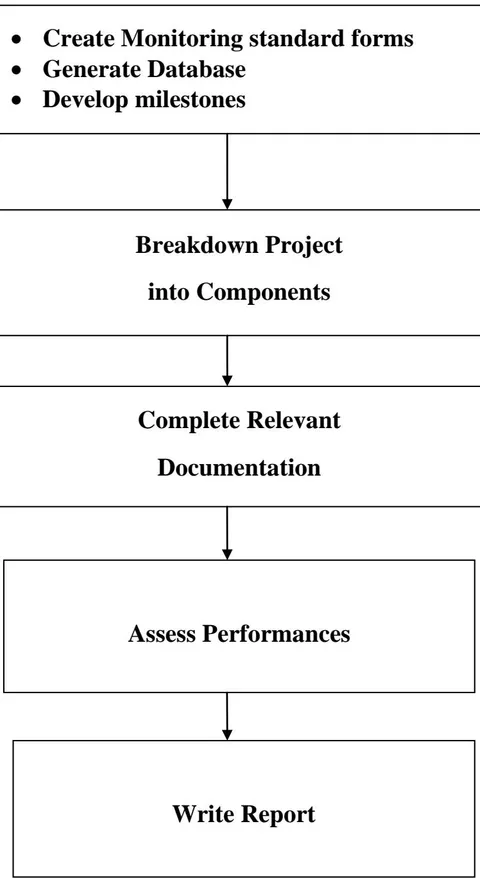
Oversight and audit have become embedded in our public procurement Act. Oversight to be effective requires confluence and interface of efficient documentation by both project actors and monitoring and evaluation consultants. Monitoring consultants shall design and document project monitoring standard forms appropriate for the projects being evaluated. This shall span from project inception to the project closure and in some cases project use life (see Appendices A1-A3 and Appendix B, monitoring Standard Forms).
This underlines the need for early appointment of monitoring consultants. The information to be elicited using these standard forms include project title, contractor, contract period, elapsed time, target time, target output, performance indices; index of work done, value of work done, payment to date, cash flow index, input of beneficiary, problems and suggested solutions, performance of project participants (project consultants, in-house professionals, manufacturers, suppliers and contractors).
These documentations by monitoring consultants to be effective, require formalizing of relationship with all project participants in order to ensure objective data collection.
Project monitors shall work in collaboration with other project consultants, in-house project co-ordinators or desk officers, the contractor, the project co-ordinating taskforce members, other specialist consultants, funding and donor officials by assigning clearly defined duties and assessing their capabilities and outputs from time to time.
e) Documentation of Action Plans, Milestones and Construction Programme
Monitoring consultants' documentation shall break down the project tasks into stages and milestones to facilitate monitoring (see Appendix A3 and Appendix B). These will enable the evaluation of progress and financial position periodically for effective audit report.
Adhering to documented dates of site visit enables the project monitors to accredit or refute the reports of project consultants regarding size of time and cost variances of projects. This facilitates effective documentation of breach of work ethics and its transmission to the client and possibly to statutory authorities.
Documentation for monitoring is synonymous with generation of standardized data collection format, to facilitate assessment of performance of each project/participant at pre-determined stages in relation to time performance, cost performance, cash flow levels, and quality performance as illustrated in appendix B, tables 1-13. This will ensure financial discipline, avoid/reduce delays, cost overruns and project abandonment, increase output of construction industry and add value to the national economy.
IV. CONCLUSION AND RECOMMENDATION
The study concludes that for documentation to be effective in realizing project success, it must span amply through four documentation phases of pretender documentation, tender documentation, contract administration documentation and monitoring/evaluation documentation.
It posits that success of physical and social infrastructure development contracts must obtain through control and that control cannot be achieved without project monitoring which in itself relies on effective documentations to add value to the economy.
For efficient and effective project documentation to emerge, project partnering spirit (openness) must be exhibited by all project participants/stakeholders. Contract cash flow documentations must be accurate, consultants and contractors must be less insular and exercise/disclose accurate valuations, and authentic verifiable cost expenditure profile.
These are sina-qua-non for the emergence of contract performance measuring metrics and monitoring standard forms to support proper contract oversight/audit processes.

(A3) Documentation Action Steps for Monitoring of Project Implementation
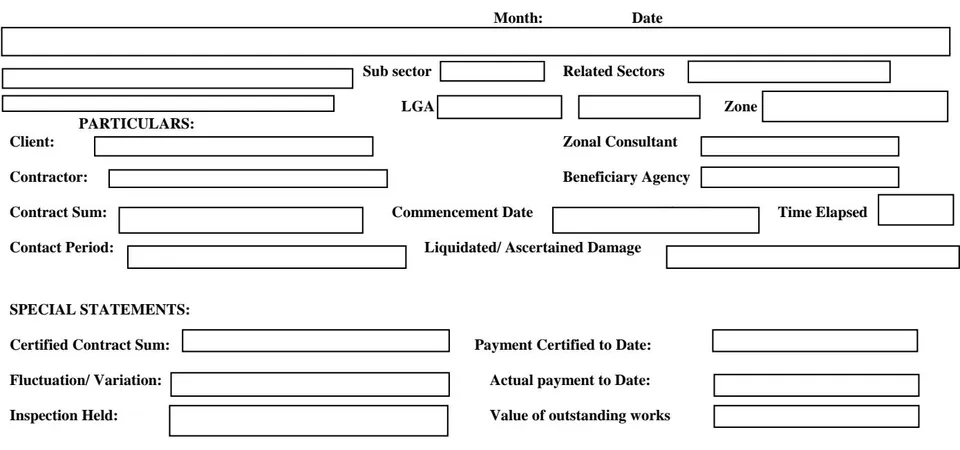
Payment Certified to Date: Actual payment to Date: Value of outstanding works
| S/N | STAGES | TARGET (WEEKS) | ACTUAL (WEEKS) | REMARKS |
| 1 | ||||
| 2 | ||||
| 3 | ||||
| 4 | ||||
| 5 | ||||
| 6 | ||||
| Cumulative to date | ||||
| S/N | STAGES | TARGET (=N=) | ACTUAL (=N=) | REMARKS |
| 1 | ||||
| 2 | ||||
| 3 | ||||
| 4 | ||||
| 5 | ||||
| 6 | ||||
| Cumulative to date | ||||
| S/N | STAGES | TARGET(=N=) | VALUE OF WORK DONE(=N=) | REMARKS |
| 1 | ||||
| 2 | ||||
| 3 | ||||
| 4 | ||||
| 5 | ||||
| 6 | ||||
| Cumulative to date | ||||
| S/N | STAGES | TARGET (=N=) | ACTUAL | REMARKS |
| 1 | ||||
| 2 | ||||
| 3 | ||||
| 4 | ||||
| 5 | ||||
| 6 | ||||
| Cumulative to date | ||||
| S/N | DATE | ORDER NO. | DESCRIPTION | AMOUNT CLAIMED | AGREED COST | REMARKS |
| 1 | ||||||
| 2 | ||||||
| 3 | ||||||
| 4 | ||||||
| 5 | ||||||
| 6 | ||||||
| Cumulative to date | ||||||
| S/N | DATE | LABOUR OR MATERIALS | DESCRIPTION | AMOUNT CLAIMED | AGREED COST | REMARKS |
| 1 | ||||||
| 2 | ||||||
| 3 | ||||||
| 4 | ||||||
| 5 | ||||||
| 6 | ||||||
| Cumulative to date | ||||||
| S/N | DESCRIPTION OF INTEREST | REMARKS |
| 1 | ||
| 2 | ||
| 3 | ||
| S/N | NATURE OF PROBLEMS | SOLUTIONS DEVISED | REMARKS |
| 1 | |||
| 2 | |||
| 3 | |||
| PERFORMANCE INDICATOR | CONTRACTORS | SUB CONTRACTORS | MANUFACTURERS | SUPPLIERS | PC | CLIENT |
| Adherence to time | ||||||
| Quality of work Compliance with deliveries | ||||||
| Quality of staff (Qualification) | ||||||
| Adequacy of staff (No) | ||||||
| Co-operation with other participants | ||||||
| Ability to put project on course | ||||||
| Adequacy of project reports Timeliness of project reports | ||||||
UA Unacceptable O: NS Not Satisfactory I. FS = Fairly Satisfactory 2, SA- Satisfactory:3; VS- Very Satisfactory 4.
- General Remarks and Comments on Submission from Project Consultants (PC).
11. Comment by Project Desk Officer (PDO)
12. Comment by Beneficiary Project Officers (BPO)
a. Signature & Date ____
1. BPO
13. Comment by Project Monitoring and Evaluation Unit (PMEU) Signature & Date ____
PMEU
PROJECT MONITORING AND EVALUATION UNIT Table 10: Summary of Programme Monitoring Report.... Sector Month:.... Date....
| PROJECT TITLE/CONTRACT SUM ETC | THIS MONTH | CUMULATIVE | Comments | ||||||||
| Contract period (Month) | Time Elapsed (months) | Target Output | Actual Output | Perf. Index | Forecast output | Actual output | Perf. Index | Value of payment Work Done | Cash flow Index | ||
Perf = Performance
PROJECT MONITORING/EVALUATION UNIT
| S/N | Name of Organization | Value of total No. of Equipment | Capacity Utilization | ||
| Contractors, manufacturers | Prior Engagement N | Current value N | Prior Engagement% | Current Utilization &% | |
PROJECT MONITORING/EVALUATION UNIT
| No. of Personnel | ||||||
| S/N | Name of Firm | Address | Specialization e.g Arch. Engr. Q/S etc | Prior to Engagement | Current | |
| Professionals Others | Prof. | Others | ||||
PROJECT MONITORING/EVALUATION UNIT
| No. of Personnel | |||||||
| S/N | Name of Firm | Address | Specialization Building, Civil Manufacturers etc | Prior to Engagement | Current | ||
| Prof. | Others | Prof. | Others | ||||