Plant establishment depends on the ability of seeds and seedlings to adapt to adverse environmental conditions. Thus, the objective of this study was to evaluate the influence of the increase in air temperature (with variations throughout the day) the emergence and initial growth of sorghum cultivars (Sorghum bicolor L. Moench). The experiment was conducted in growth chambers in a 7×3 factorial scheme with a completely randomized design using seven sorghum cultivars (AGRI 002E, BRS 506, BRS 716, SF15, IAC Santa Elisa, BRS Ponta Negra and, Volumax) and three temperatures: T1 (20.0-26.0-33.0°C); T2 (24.8-30.8-37.8°C); T3 (27.8-33.8-40.8°C), with four replications of ten seeds. The following aspects were evaluated: emergence percentage, emergence speed index, average emergence speed, average emergence time, length, and fresh and dry mass of seedlings.
## I. INTRODUCTION
Temperature is one of the climatic elements that most restrict agriculture (IPCC, 2018), and it can affect the emergence and initial growth of seedlings (Reis et al., 2017), thereby determining plant establishment in the field. According to climate projections by the Intergovernmental Panel on Climate Change (IPCC), an increase of up to $4.3^{\circ}\mathrm{C}$ in average air temperature could occur, with extreme weather events such as heat waves and prolonged droughts becoming frequent (IPCC, 2021). It is noteworthy that semi-arid regions are identified as being more vulnerable to changes in climate and extreme temperature events (Marengo et al., 2020). Thus, selecting plant specimens that present satisfactory performance in the initial development through vigorous seed germination and uniform establishment of seedlings can be considered a strategic step for maintaining agricultural production, especially in these regions (Parmoon et al., 2015; Barros et al., 2020).
Temperature directly interferes with seed germination, being able to hinder or boost the germination process (Barros et al., 2020). In addition, it affects the germination speed, which is an important parameter because the higher the seed germination speed, the faster the seedlings will grow, and the shorter the exposure time of the seeds to adverse environmental conditions, which can harm the germination process (Baskin e Baskin, 2014; Gazola et al., 2013).
Sorghum stands out among the most relevant crops in the Brazilian semi-arid region; which is grass used for multiple purposes, from fodder for animal feed to human consumption (Tabosa et al., 2020). It has recently become an alternative for generating energy by directly burning its biomass, in addition to being an alternative source in manufacturing second-generation ethanol (Pimentel et al., 2017; Silva et al., 2018). Sorghum shows better germination between 21 and $35^{\circ}\mathrm{C}$ (Peacock, 1982). Thus, it is of fundamental importance to evaluate how the increase in air temperature can influence seed germination and the growth of sorghum seedlings, since this step can significantly contribute to high crop yield in the field.
Thus, studies evaluating the initial development of sorghum under increased air temperature conditions are scarce in the literature. In addition, studies with sorghum evaluating this climatic element were carried out using only constant temperatures (Silva et al., 2016; Chopra et al., 2017; Chiluwal et al., 2018). Simulating temperature increases with variations throughout the day can represent a methodological advance in scientific research, allowing us to more accurately present results that represent environmental conditions (Barros et al., 2020; 2021). Thus, the objective of this study was to evaluate the influence of an increase in air temperature with variations throughout the day the emergence and initial growth of sorghum cultivars.
## II. MATERIAL AND METHODS
The study was conducted at Embrapa Semiarid located in the municipality of Petrolina, PE, Brazil. Fitotron growth chambers with temperature, humidity, and photoperiod control were used. The design was in a
7x3 factorial scheme (cultivars x temperature), with four replications. Seven sorghum cultivars were evaluated, of which five were of the dual purpose type (AGRI 002E, BRS 506, SF 15, BRS Ponta Negra, and Volumax) and two biomass sorghum cultivars (BRS 716 and IAC Santa Elisa) which were conserved in a cold chamber to reduce possible alterations in seed quality. The temperature regimes used were: 20.0-26.0-33.0°C; 24.8-30.8-37.8°C; 27.8-33.8-40.8°C (Table 1), simulating temperature variations throughout the day, with a photoperiod of 12 hours and relative humidity ranging from 50 to 70%.
Table 1: Temperature Regimes, with Minimum, Average, and Maximum Temperature Variation Throughout the Day
<table><tr><td rowspan="2">Temperature Regimes</td><td colspan="4">Hour/Temperature (°C)</td></tr><tr><td>6h às 10h</td><td>10h às 15h</td><td>15h às 20h</td><td>20h às 6h</td></tr><tr><td>T1 (20,0 - 26,0 - 33,0°C)</td><td>26,0</td><td>33,0</td><td>26,0</td><td>20,0</td></tr><tr><td>T2 (24,8 - 30,8 - 37,8°C)</td><td>30,8</td><td>37,8</td><td>30,8</td><td>24,8</td></tr><tr><td>T3 (27,8 - 33,8 - 40,8°C)</td><td>33,8</td><td>40,8</td><td>33,8</td><td>27,8</td></tr></table>
The temperature regimes were determined from the average daily temperature of the Sub-medium region of the São Francisco Valley in the last 30 years, including the minimum, average, and maximum temperature of the day, ranging from 18-22, 25-27 and, $32 - 34^{\circ}C$, respectively. Temperature simulations increasing from the average temperature by $4.8^{\circ}C$ and $7.8^{\circ}C$ were performed.
First, ten seeds were sown in pots with a volumetric capacity of eight liters at a depth of two centimeters. The pots were filled with gravel at the base and completed the volume with Eutrophic Yellow Argisol. Seedling emergence was then evaluated daily for 12 days. The following parameters were assessed: emergence percentage (E%) (Brazil, 2009); mean emergence time (MET) and mean emergence speed (MES) (Labouriau, 1983); and emergence speed index (ESI) (Maguire, 1962).
The fresh and dry mass was evaluated 12 days after sowing, as well as the length of the seedlings. The seedling length was determined with a ruler, and then the weight of the fresh mass was obtained on an analytical scale (in grams). Then, the plant material was stored in paper bags in a forced air circulation oven at $65^{\circ}\mathrm{C}$ for drying. After reaching constant mass after $\pm 72$ hours, the samples were weighed on an analytical scale to obtain the dry mass (expressed in grams). The obtained data were submitted to analysis of variance (ANOVA), and the means were compared using the Scott Knott test at $5\%$ significance.
## III. RESULTS AND DISCUSSION
The temperature x cultivar interaction was insignificant for the emergence percentage, emergence speed index, mean emergence time or mean emergence speed (Table 2). However, the emergence percentage varied according to the sorghum cultivars (Tables 2 and 3). In addition, there was an isolated effect of temperature and cultivars on the emergence speed index (ESI), on the mean emergence time (MET), and the mean emergence speed (MES) of seeds (Tables 2 and 3).
Table 2: Summary of Analysis of Variance, by the Mean Square, of Seedling Emergence Parameters Evaluated in Different Sorghum Cultivars Submitted to Different Temperature Regimes
<table><tr><td rowspan="2">Source of Variation</td><td colspan="5">Medium Square</td></tr><tr><td>GL</td><td>%E</td><td>ESI</td><td>MET</td><td>MES</td></tr><tr><td>Temperature (T)</td><td>2</td><td>122,619ns</td><td>4,499 **</td><td>9,183 **</td><td>0,056 **</td></tr><tr><td>cultivars(Ct)</td><td>6</td><td>1650,000 **</td><td>2,389 **</td><td>1,297 **</td><td>0,012 **</td></tr><tr><td>Tx Ct</td><td>12</td><td>147,619ns</td><td>0,289ns</td><td>0,266ns</td><td>0,001ns</td></tr><tr><td>Residue</td><td>63</td><td>178,571</td><td>0,275</td><td>0,253</td><td>0,002</td></tr><tr><td>CV%</td><td></td><td>16,36</td><td>20,21</td><td>15,05</td><td>13,35</td></tr></table>
DoF = degree of freedom; Emergence percentage (E%), emergence speed index (ESI), mean emergence time (MET), and mean emergence speed (MES); CV = coefficient of variation; ns = not significant, \*\* significant at the level of 1% probability by the F test
The emergence percentage of sorghum seedlings did not differ with increasing temperature, and only presented variation between cultivars. According to the Rules for Seed Analysis (RAS), the minimum commercial value established for seed germination is $80\%$ (Brasil, 2009); thus, the AGRI 002E, BRS 506, and BRS Ponta Negra cultivars showed an emergence percentage below the minimum established value (Table 3). This result may be related to the physiological quality of the seeds, as according to Pádua et al. (2010), changes in physiological potential affect seed germination and vigor.
Genetic variability among cultivars can directly interfere with a seed's response to abiotic stresses (Maia et al., 2011). This was evidenced in this work, where the IAC Santa Elisa cultivar presented emergence percentage $(E\%)$ and emergence speed index (ESI) with values above $97\%$ and 3.29, respectively (Table 3).
Table 3: The Emergence of Sorghum Cultivars
<table><tr><td>Cultivars</td><td>%E</td><td>ESI</td><td>MET</td><td>MES</td></tr><tr><td>AGRI 002E</td><td>75,83 c</td><td>2,46 c</td><td>3,27 b</td><td>0,31 b</td></tr><tr><td>BRS 506</td><td>70,00 c</td><td>2,11 d</td><td>3,63 a</td><td>0,29 c</td></tr><tr><td>BRS 716</td><td>84,17 b</td><td>2,94 b</td><td>2,83 b</td><td>0,37 a</td></tr><tr><td>SF 15</td><td>93,33 a</td><td>2,59 c</td><td>3,85 a</td><td>0,27 c</td></tr><tr><td>BRS Ponta Negra</td><td>65,83 c</td><td>2,04 d</td><td>3,42 a</td><td>0,30 c</td></tr><tr><td>IAC Santa Elisa</td><td>97,50 a</td><td>3,29 a</td><td>3,18 b</td><td>0,33 b</td></tr><tr><td>Volumax</td><td>85,00 b</td><td>2,75 b</td><td>3,23 b</td><td>0,32 b</td></tr><tr><td>CV%</td><td>16,36</td><td>20,21</td><td>15,05</td><td>13,35</td></tr></table>
Means followed by the same lowercase letter in the column do not differ from each other by the Scott Knott test at $5\%$ probability. Emergence Percentage $(E\%)$, Emergence Speed Index (ESI), Mean Emergence Time (MET), and Mean Emergence Speed (MES).
High emergence percentage is an important parameter to be evaluated for the choice of a cultivar, as it favors its productivity by enabling fast fixation of the species in the environment, ensuring plant development even under adverse conditions (Melo et al., 2018). The highest emergence speed was observed in the BRS 716 cultivar seeds. As mentioned above, the germination speed is an important parameter in the choice of cultivar, since a delay in emergence can directly interfere with the uniformity of the final stand (Pádua et al., 2010).
The increase in temperature also accelerated the emergence speed index, with values ranging from 0.33 to 0.34 (Figures 1A and B). The lowest ESI values were observed in the temperature regime of 20.0-26.0- $33.0^{\circ}\mathrm{C}$, with an average of 0.26 (Figure 1A). The beginning of sorghum seedling emergence took two days in the temperature regimes of 24.8-30.8-37.8°C and 27.8-33.8-40.8°C, while it was three days for the regime of 20.0-26.0-33.0°C (Figure 1C). It is observed that the increase in temperature promoted a reduction in the mean emergence time (Figure 1C) in 1 day.
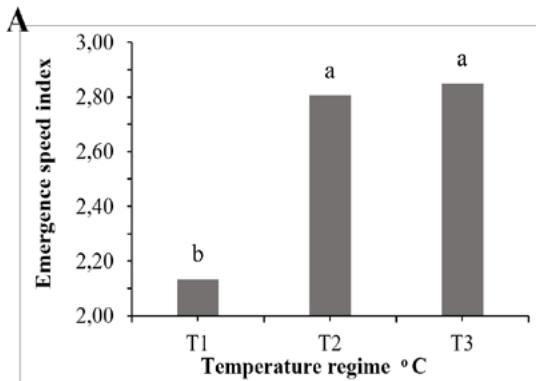
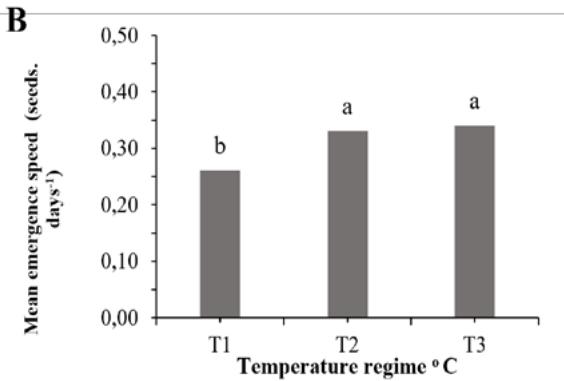
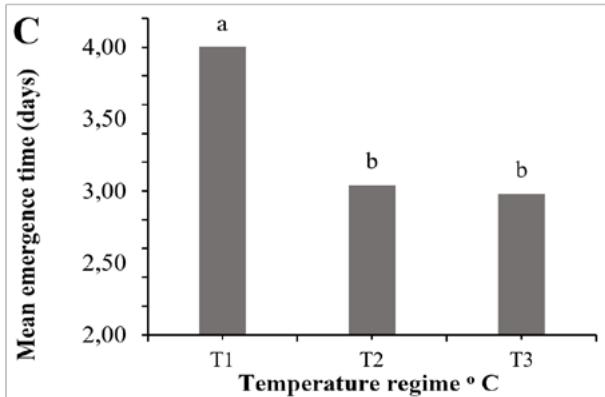 Figure 1: Emergence speed index (A), mean emergence speed (seeds. days $^{-1}$ ) (B), and Mean Emergence Time (Days) (C) of Sorghum Cultivars Sown in Three Temperature Regimes: T1: 20.0-26.0-33.0°C; T2: 24.8-30.8-37.8°C; T3: 27.8-33.8-40.8°C
The higher seed emergence speed in the regimes of 24.8-30.8-37.8°C and 27.8-33.8-40.8°C can be explained by the influence of the increase in temperature, since high temperatures favor an increase in the speed of water absorption and chemical reactions (Carvalho & Nakagawa, 2012). The germination process becomes more efficient in this scenario since the seeds that have a higher emergence speed will be more effective at initially establishing seedlings and therefore, capable of developing more vigorous plants and guaranteeing the harvest (NIMIR et al., 2015).
It was verified that the temperature of the installation affected the corn seed germination, presenting an increase in the germination percentage from $94.33\%$ at $(28 - 30^{\circ}\mathrm{C})$ to $98.33\%$ at $(31 - 33^{\circ}\mathrm{C})$ (Wawo et al., 2020). However, temperatures above $35^{\circ}\mathrm{C}$ reduce in the germination percentage of six lots of corn seeds (Sbrussi e Zucarelli, 2015). It is worth noting that these studies were carried out using constant temperatures, while in natural conditions, there is variation in air temperature throughout the day. Thus, experiments using different temperature regimes can more accurately simulate temperature variations in the environment, allowing better evaluation of the interference of this element in the germination rate (Liu et al., 2013).
From the ESI, MES, and MET results for the temperature regimes of 24.8-30.8-37.8°C and 27.8-33.8-40.8°C, which represent an increase of 4.8 and $7.8^{\circ}\mathrm{C}$ in the average temperature of the semi-arid region, it was found that this increase did not negatively affect the seedling emergence process and may be related to the ecological adaptation of the species to air temperature fluctuations throughout the day.
The interaction between temperature and cultivar was significant for the fresh mass of sorghum seedlings. However, the isolated effect of temperature and cultivar was observed for dry mass and seedling length (Table4).
Table 4: Summary of Analysis of Variance by Mean Square to Evaluate Initial Growth in Different Sorghum Cultivars Submitted to Different Temperature Regimes
<table><tr><td rowspan="2">Source of Variation</td><td colspan="4">Medium Square</td></tr><tr><td>GL</td><td>Freshmass(g)</td><td>Drymass(g)</td><td>Seedling length (cm)</td></tr><tr><td>Temperature (T)</td><td>2</td><td>0,2559 **</td><td>0,0021 **</td><td>260,6278 **</td></tr><tr><td>Cultivars (Ct)</td><td>6</td><td>0,1285 **</td><td>0,0032 **</td><td>124,5324 **</td></tr><tr><td>T × Ct</td><td>12</td><td>0,0145 **</td><td>0,0002ns</td><td>17,0246ns</td></tr><tr><td>Residue</td><td>63</td><td>0,0068</td><td>0,0001</td><td>23,0147</td></tr><tr><td>CV%</td><td></td><td>21,14</td><td>21,44</td><td>18,54</td></tr></table>
The BRS 716 cultivar presented higher seedling fresh mass in the temperature regime of 20.0-26.0-33.0°C (Table 5). The AGRI 002E, BRS 716, and Volumax cultivars showed a higher fresh mass with an increase of $4.8^{\circ}\mathrm{C}$ in air temperature, corresponding to the regime of 24.8-30.8-37.8°C. The increase in the average air temperature above $4.8^{\circ}\mathrm{C}$ may reduce the fresh seedling mass of the BRS 716 cultivar (Table 5).
Moreover, there was a reduction in the seedling fresh mass of the AGRI 002E, BRS Ponta Negra, IAC Santa Elisa and Volumax cultivars in the 27.8-33.8-40.8°C regime compared to the 24.8-30.8-37.8°C. However, compared to the 20.0-26.0-33.0°C regime, there was no significant difference in any of these cultivars, meaning that the fresh matter production was statistically similar in both the $20.0 - 26.0 - 33.0^{\circ} \mathrm{C}$ and $27.8 - 33.8 - 40.8^{\circ} \mathrm{C}$ regimes.
Table 5: Fresh Mass of Sorghum Cultivars Subjected to Different Temperature Regimes
<table><tr><td colspan="8">Freshmass(g)</td></tr><tr><td>Temperature regimes</td><td>AGRI 002E</td><td>BRS 506</td><td>BRS 716</td><td>SF 15</td><td>BRS Ponta Negra</td><td>IAC Santa Elisa</td><td>Volumax</td></tr><tr><td>20,0-26,0-33,0 °C</td><td>0,34 Cb</td><td>0,27 Ca</td><td>0,55 Aa</td><td>0,25 Ca</td><td>0,33 Cb</td><td>0,31 Cb</td><td>0,43 Bb</td></tr><tr><td>24,8-30,8-37,8 °C</td><td>0,59 Aa</td><td>0,33 Ca</td><td>0,67 Aa</td><td>0,29 Ca</td><td>0,51 Ba</td><td>0,41 Ca</td><td>0,65 Aa</td></tr><tr><td>27,8-33,8-40,8 °C</td><td>0,32 Ab</td><td>0,29 Aa</td><td>0,38 Ab</td><td>0,20 Ba</td><td>0,36 Ab</td><td>0,24 Bb</td><td>0,37 Ab</td></tr><tr><td>CV%</td><td colspan="7">21,14</td></tr></table>
Means followed by the same lowercase letter in the column and uppercase in the row do not differ from each other by the Scott-Knott test at $5\%$ probability.
The fresh mass of BRS 506 and SF 15 cultivars did not show a statistical difference between the temperature regimes tested. This result may be related to the water adjustment of these cultivars to adapt to the conditions imposed by the thermal increase. According to Li et al. (2017), plants that present partial closure of the stomata have a greater ability to use water, and therefore have reduced water loss through transpiration. The transpiration through the stomata may play a crucial role in tolerance to warmer environments (Zhou et al., 2015; Feller, 2016).
The highest dry mass value found in the temperature regime of 24.8-30.8-37.8°C was 0.07 g (Figure 2A), with a 14% reduction in the dry mass of seedlings submitted to the regimes of 27.8-33.8-40.8°C and 20.0-26.0-33.0°C, with no statistical difference between them (Figure 2A). A similar result was observed for seedling length, with a reduction of 18% (Figure 2B).
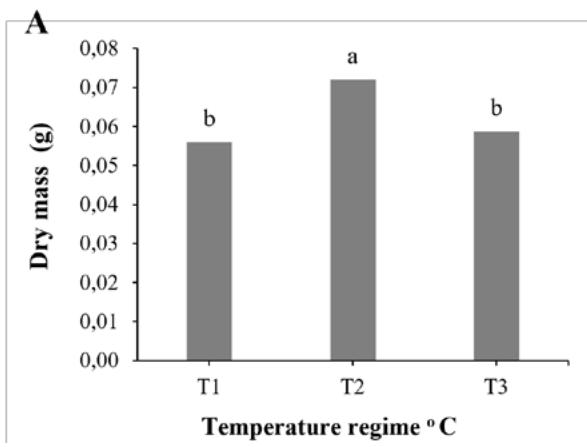
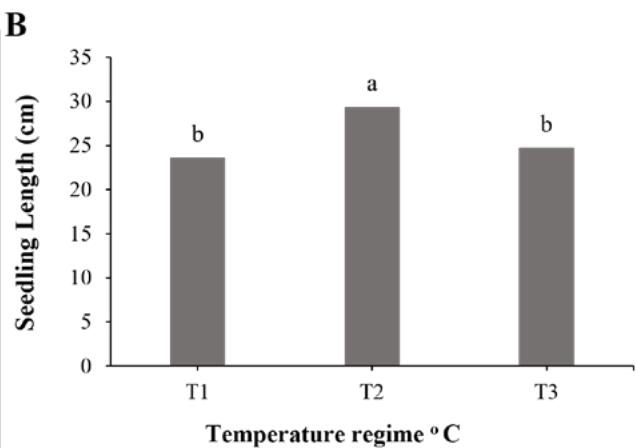 Figure 2: Dry Mass (A) and Seedling Length (B) of Sorghum Subjected to Different Temperature Regimes.
\*Equal Letters Do Not Differ by the Scott Knott Test at 5% Probability In evaluating the effect of air temperature on the initial phase of sugarcane growth, Guerra et al. (2014) observed that plants subjected to higher temperatures $(33^{\circ}\mathrm{C}$ daytime and $27^{\circ}\mathrm{C}$ night) had the highest plant height compared to the treatment with a lower temperature regime $(29^{\circ}\mathrm{C}$ during the day and $23^{\circ}\mathrm{C}$ at night). However, exposing seedlings to higher temperatures $(30 - 40^{\circ}\mathrm{C})$ can cause severe cell damage that limits the growth of sorghum seedlings (Yamasaki et al., 2002). The 20.0-26.0-33.0 and 27.8-33.8-40.8°C regimes provided a reduction in dry mass and seedling growth compared to the 24.8-30.8-37.8°C regime. Temperatures above the upper basal of the species in C4 plants cause a reduction in enzymatic activity and changes in the fluidity of thylakoid membranes (Bergamaschi e Bergonci, 2017). On the other hand, lower than optimal temperatures during planting can decrease the concentration of reserves and reduce the growth rate (Cruz et al., 2007). The nutrient reserves of seeds are stored in the cotyledons and the cell walls of the endosperm. After germination, these reserves are decomposed and carried to the growing seedling until it becomes autotrophic (Taiz et al., 2017).
It should be noted that the initial growth of sorghum varied with the cultivar analyzed (Table 6). The BRS 716 cultivar presented higher dry mass, while the lowest performance for seedling length occurred for the BRS 506 and SF 15 cultivars (Table 6).
Table 6: Initial Growth Parameters of Sorghum Cultivars Subjected to Different Temperature Regimes
<table><tr><td>Cultivars</td><td>Drymass(g)</td><td>Seedling length(cm)</td></tr><tr><td>AGRI 002E</td><td>0,064 c</td><td>25,817 a</td></tr><tr><td>BRS 506</td><td>0,053 c</td><td>21,293 b</td></tr><tr><td>BRS 716</td><td>0,089 a</td><td>28,945 a</td></tr><tr><td>SF 15</td><td>0,040 d</td><td>21,908 b</td></tr><tr><td>BRS Ponta Negra</td><td>0,057 c</td><td>25,845 a</td></tr><tr><td>IAC Santa Elisa</td><td>0,053 c</td><td>29,130 a</td></tr><tr><td>Volumax</td><td>0,077 b</td><td>28,222 a</td></tr><tr><td>CV (%)</td><td>21,44</td><td>18,54</td></tr></table>
The emergence of seeds and the initial growth of seedlings are essential stages for the establishment of plants in the field, as they are periods dependent on environmental conditions, such as high temperatures. The $4.8^{\circ}\mathrm{C}$ increase in air temperature had a positive response in the emergence and initial growth of sorghum seedlings, while the $7.8^{\circ}\mathrm{C}$ increase in air temperature did not affect these parameters. Therefore, studies on the impacts of increased air temperature on the initial development of sorghum plants are essential.
## IV. CONCLUSIONS
Temperature can interfere with the emergence and initial development of sorghum seedlings, with different responses among cultivars. The $4.8^{\circ}\mathrm{C}$ increase in air temperature results in a higher emergence speed index and mean emergence speed, favoring the dry mass and the length of the seedlings. The rise in air temperature by $7.8^{\circ}\mathrm{C}$ did not affect the dry mass response and the size of sorghum seedlings.
### ACKNOWLEDGEMENTS
To the Foundation for Support to Science and Technology of the State of Pernambuco (FACEPE), for promoting it (PBPG-0640-5.01/20), and for funding the postdoctoral fellowship (BFP-0113- 5.01/21). This study was financed in part by the Coordenação de Aperfeçoamento de Pessoal de Nível Superior - Brasil (CAPES) - Finance Code 001.
Generating HTML Viewer...
References
33 Cites in Article
Juliane Barros,Miguel Guimarães,Rodrigo Silva,Maydara Rêgo,Natoniel Melo,Francislene Angelotti (2021). INITIAL GROWTH OF COWPEA CULTIVARS WITH AN INCREASE OF 4.8 ° C IN AIR TEMPERATURE / CRESCIMENTO INICIAL DE CULTIVARES DE FEIJÃO-CAUPI COM AUMENTO DE 4,8 ° C NA TEMPERATURA DO AR.
Juliane Barros,Francislene Angelotti,Jéssica Santos,Rodrigo Silva,Barbara Dantas,Natoniel Melo (2020). Optimal temperature for germination and seedling development of cowpea seeds.
C Baskin,J Baskin (2014). Seeds: Ecology, Biogeography, and Evolution of Dormancy and Germination.
H Bergamaschi,J Bergonci (2017). As plantas e o clima: Princípios e aplicações.
Ministério Brasil,Da Agricultura,Pecuária E Abastecimento (2009). Regras para análise de sementes.
N Carvalho,J Nakagawa (2012). Sementes: ciência, tecnologia e produção.
A Chiluwal (2018). Integrated aerial and destructive phenotyping differentiates chilling stress tolerance during early seedling growth in sorghum.
Ratan Chopra,Gloria Burow,John Burke,Nicholas Gladman,Zhanguo Xin (2017). Genome-wide association analysis of seedling traits in diverse Sorghum germplasm under thermal stress.
Helen Cruz,Cibele Ferrari,Geri Meneghello,Valmor Konflanz,Paulo Zimmer,Patrícia Vinholes,Maria Castro (2007). Avaliação de genótipos de milho para semeadura precoce sob influência de baixa temperatura.
Urs Feller (2016). Drought stress and carbon assimilation in a warming climate: Reversible and irreversible impacts.
A Guerra (2014). Efeitos da temperatura do ar na fotossíntese da cana-de-açúcar na fase inicial do desenvolvimento.
Ipcc (2018). Global Warming of 1.5°C.
Intergovernmental Panel On Climate Change (ipcc) (2021). Climate Change 2021 – The Physical Science Basis.
L Labouriau (1983). A germinação das sementes.
Kun Liu,Jerry Baskin,Carol Baskin,Haiyan Bu,Guozhen Du,Miaojun Ma (2013). Effect of Diurnal Fluctuating versus Constant Temperatures on Germination of 445 Species from the Eastern Tibet Plateau.
Lucas Maia,Camila Silva,Magno Ramalho,Ângela Abreu (2011). Variabilidade genética associada à germinação e vigor de sementes de linhagens de feijoeiro comum.
James Maguire (1962). Speed of Germination—Aid In Selection And Evaluation for Seedling Emergence And Vigor<sup>1</sup>.
Jose Marengo,Ana Cunha,Carlos Nobre,Germano Ribeiro Neto,Antonio Magalhaes,Roger Torres,Gilvan Sampaio,Felipe Alexandre,Lincoln Alves,Luz Cuartas,Karinne Deusdará,Regina Álvala (2020). Assessing drought in the drylands of northeast Brazil under regional warming exceeding 4 °C.
Luan Melo,João Junior,Vilma Ferreira,João Neto,Maria Neves (2018). Biometric characterization and seed germination of giant mimosa (Mimosa bimucronata (DC) O. Kuntze).
Nimir Nimir,Shiyuan Lu,Guisheng Zhou,Wenshan Guo,Baoluo Ma,Yonghui Wang (2015). Comparative effects of gibberellic acid, kinetin and salicylic acid on emergence, seedling growth and the antioxidant defence system of sweet sorghum (Sorghum bicolor) under salinity and temperature stresses.
Gilda Pádua,Roberto Zito,Neylson Arantes,José França Neto (2010). Influência do tamanho da semente na qualidade fisiológica e na produtividade da cultura da soja.
Ghasem Parmoon,Seyed Moosavi,Hamed Akbari,Ali Ebadi (2015). Quantifying cardinal temperatures and thermal time required for germination of Silybum marianum seed.
J Peacock (1981). Response and tolerance of Sorghum to temperature stress.
Leonardo Pimentel,Vanessa Batista,Angélica Barros,Reinaldo Teófilo,Luiz Dias (2017). Chemical and bioenergetic characterization of sorghum agronomic groups1.
Daíse Reis,Junia Carvalho,José Bezerra,Camila Guimarães,Ítalo Santos (2017). Simulação do efeito da variação da temperatura ambiente na germinação de variedades de milho.
Cesar Sbrussi,Claudemir Zucareli (2015). Germinação sob altas temperaturas para avaliação do potencial fisiológico de sementes de milho.
M Silva (2018). Evaluation of the potential of lines and hybrids of biomass sorghum.
R Silva (2016). Germinação e avaliação de plântulas em lotes de sementes de Sorgo (Sorghum bicolor (L.) Moench.
J Tabosa,Org (2020). Sorgo: Cadernos do Semiárido -riquezas e oportunidades.
L Taiz,E Moller,A Murphy (2017). Fisiologia e desenvolvimento vegetal.
Albert Wawo,Verina Sumbogo,Peni Lestari (2020). Comparison on seed germination and seedling growth between Indonesian local corn cultivars for decide the quality of seed.
Takenobu Yamasaki,Tomokazu Yamakawa,Yoshihiro Yamane,Hiroyuki Koike,Kazuhiko Satoh,Sakae Katoh (2002). Temperature Acclimation of Photosynthesis and Related Changes in Photosystem II Electron Transport in Winter Wheat.
Rong Zhou,Xiaqing Yu,Katrine Kjær,Eva Rosenqvist,Carl-Otto Ottosen,Zhen Wu (2015). Screening and validation of tomato genotypes under heat stress using Fv/Fm to reveal the physiological mechanism of heat tolerance.
No ethics committee approval was required for this article type.
Data Availability
Not applicable for this article.
How to Cite This Article
Francislene Angelotti. 2026. \u201cThe Increase in Air Temperature and its Interference in the Emergence and Initial Growth of Sorghum Cultivars\u201d. Global Journal of Science Frontier Research - D: Agriculture & Veterinary GJSFR-D Volume 23 (GJSFR Volume 23 Issue D2): .
Explore published articles in an immersive Augmented Reality environment. Our platform converts research papers into interactive 3D books, allowing readers to view and interact with content using AR and VR compatible devices.
Your published article is automatically converted into a realistic 3D book. Flip through pages and read research papers in a more engaging and interactive format.
Plant establishment depends on the ability of seeds and seedlings to adapt to adverse environmental conditions. Thus, the objective of this study was to evaluate the influence of the increase in air temperature (with variations throughout the day) the emergence and initial growth of sorghum cultivars (Sorghum bicolor L. Moench). The experiment was conducted in growth chambers in a 7×3 factorial scheme with a completely randomized design using seven sorghum cultivars (AGRI 002E, BRS 506, BRS 716, SF15, IAC Santa Elisa, BRS Ponta Negra and, Volumax) and three temperatures: T1 (20.0-26.0-33.0°C); T2 (24.8-30.8-37.8°C); T3 (27.8-33.8-40.8°C), with four replications of ten seeds. The following aspects were evaluated: emergence percentage, emergence speed index, average emergence speed, average emergence time, length, and fresh and dry mass of seedlings.
Our website is actively being updated, and changes may occur frequently. Please clear your browser cache if needed. For feedback or error reporting, please email [email protected]
Thank you for connecting with us. We will respond to you shortly.