### CHAPTER 1
## I. INTRODUCTION
### a) Background of the Study
The very competitive marketing scene forces companies to develop creative ideas to stand out. Conventional marketing techniques sometimes have to catch up today's consumers, who are inundated with many advertising channels. Social media's development presents companies with the difficulty of properly using these channels to reach and impact possible consumers. Social media influencers have opened a fresh channel for companies to interact with consumers more truthfully and interestingly. According to a 2019 Mediakix research, $80\%$ of marketers think influencer marketing is a good strategy for involving intended markets.
In this competitive market, one has to understand and influence purchase intention. Actual sales depend on purchase intention, or the probability that a consumer will decide to purchase a good or service. Given consumers' abundance of options, a company's success can be much influenced by the purchasing intention of its customers. Companies are thus paying more and more attention on developing strong marketing campaigns capable of influencing consumer decisions. Reflecting this change, world digital ad spending actually exceeded $600 billion in 2022 (Statista, 2023). In fact, global digital ad spending surpassed$ 600 billion in 2022, reflecting this shift (Statista, 2023).
Influencers with large number of following on social media platforms like Facebook, Instagram, YouTube, and TikTok, can significantly impact consumer perceptions and choices. Influencers are perceived as authentic and relatable, making their endorsements more credible than traditional advertisements. Research substantiates the effectiveness of influencer marketing; for example, a study in the Journal of Consumer Research revealed that influencers markedly influence consumer purchasing decisions, especially when their expertise corresponds with the product category (Wang, Y., & Liu, X., 2021). Local tendencies may reflect worldwide patterns, based on analysis by the Philippine Institute for Development Studies, suggesting that social media influencers can greatly affect consumer behavior in this area (Philippine Institute for Development Studies, 2023). Local companies who want to create winning marketing plans must first understand this influence. These results revealed how social media influencers affect consumer buy intentions and contribute to modern marketing methods.
Given the rising internet penetration and social media usage in General Santos City, Philippines, social media influencers play especially significant role there. A study from the Philippine Institute for Development Studies show that local inclinations may mirror world trends, implying that social media influencers could significantly affect consumer behavior in this area (Philippine Institute for Development Studies, 2023). Local businesses who want to develop effective marketing plans must first understand this influence.
The study centers on how General Santos City consumers' purchasing intentions are influenced by social media influencers. The study offers insightful analysis of local consumer preferences and trends that would help companies wishing to use influencer marketing. This is especially critical for engaging millennials, who are a significant demographic in the area and are known to be heavily influenced by social media. Nielsen's 2014 Global Trust in Advertising report indicates that $92\%$ of consumers worldwide trust the recommendations from people they know over all other forms of advertising. This trust also crosses influencers, therefore stressing the power of influencer marketing in raising consumer involvement and altering purchase decisions. $71\%$ of customers believe commercials, comments, and product placements from influencers.
The results will help neighborhood businesses and small enterprises to use social media influencers' ability to boost their marketing campaigns, increase customer involvement, and keep a competitive edge in the market. For social media influencers, they will also offer insightful analysis that will allow them to maximize their influence on consumer behavior. Moreover, social media managers and marketing experts will also benefit from this study since it provides techniques to work with influencers and properly maximize campaigns. Future studies on influencer marketing may find great reference in this paper as well.
### b) Statement of the Problem
This study explores the effect of social media influencers on the buying decisions of millennial consumers in General Santos City.
Specifically, it covered the following questions:
#### 1. What is the profile of the respondents in the following:
1. Age;
2. Gender;
3. Monthly Income;
4. Employment;
5. Educational Attainment; and
6. Religion?
2. What is the extent to which the characteristics of local social media influencers influence the purchase intentions of millennial consumers in General Santos City in terms of the following:
1. Authenticity;
2. 2.1 Engagement;
3. Expertise;
4. Number of Followers; and
5. Trustworthiness?
3. What is the extent of purchase intention of millennials consumers in General Santos City?
4. What is the significant difference between:
1. Profile of respondents and extent of social media influencers;
2. Profile of respondents and extent of purchase intention?
3. Is there a significant difference between local social media influencers and millennial purchase intentions?
### c) Significance of the Study
Businesses, brands, and influencers can make more informed decisions and enhance their strategies by understanding these factors. The following groups will significantly benefit from these insights:
Businesses and Brands Seeking Influencer Partnerships: Businesses and brands can use the findings to figure out which qualities in influencers, like how genuine they seem, how they engage with their audience, their expertise, how many followers they have, and how trustworthy they appear, are most important for influencing purchases. This study helps them choose the right influencers to work with, making their marketing efforts more effective and likely to bring in customers.
Marketing Professionals and Social Media Managers: This study clarifies how different factors, including the respondent's profile and influencer attributes, influence consumer behavior. This information helps them design marketing strategies that are more likely to connect with their audience and help bring more sales.
Social Media Influencers: This study helps social media influencers to understand what makes them more successful and appealing to their followers. Knowing which aspects of their persona and interactions have more influence helps them to improve their content and engagement strategies, so enhancing their relations with their online audience and will increase their impact.
Academic Researchers and Students: This study can serves as resources for people studying who are studying consumer behavior, social media influencers and marketing in the marketing field. It may be used as a reference for future related research, that will help researchers and students to understand more of influencer marketing, social media marketing and its effect on consumer purchasing decisions. This research can contribute to academic discussions and the development of new theories in the field.
Contribution to SDG 8: Decent Work and Economic Growth: This study supports Sustainable Development Goals 8 by emphasizing the role of influencer marketing in creating economic opportunities through digital platforms. By empowering local influencers and small businesses to participate in the growing digital world. It encourages sustainable economic growth and employment, particularly for young professionals and young business owners.
### d) Scope and Delimitation
This study focuses on local social media influencers' influence on millennials' purchase intention in General Santos City. This study is focused only on millennials. They are individuals born from 1981 to 1996 and between the ages of 28 and 43 in 2024. This age group was selected by the researcher in order to concentrate on members of the millennial generation, who are known for their skill with digital technologies and high levels of social media participation. Moreover, the study was confined to General Santos City to ensure a focused investigation into the influence of local social media influencers on millennials in General Santos City. The study was conducted over a period of six months due to the challenges encountered in locating and reaching the target respondents.
#### CHAPTER 2
## II. REVIEW OF RELATED LITERATURE
### a) Concept of Social Media Influencer
Social media platforms created the social media influencers. This individual became famous by sharing a content who made them popular. These contents can be their day-to-day life opinions, and expertise in fields such as fashion, beauty, politics and gaming and others. The social media platforms allow influencers to engage with a wider reach and audience through visually appealing content (Freberg et al., 2011; Khamis, Ang, & Welling, 2017).
Influencers on social media have certain qualities that set them apart from conventional celebrities that we used to know. They are actually known for being relatable, authentic, and actively involved with their followers. Influencers normally provide their audience with contents like behind-the-scenes content and "a day in my life". This kind of contents fosters a feeling of community and trust with their followers compared to traditional celebrities. Many influencers are also seen as experts in their fields, further boosting their credibility and influence on consumer behavior and brand perception (Abidin, 2016; De Veirman et al., 2017).
Social media celebrities are brand champions and opinion leaders in addition to content creators. Frequently working with businesses to advertise goods and services, they use their reputation to change consumer attitudes and behavior. Particularly in cases when the influencer's values coincide with those of the brand, their recommendations can greatly affect brand impression. Opinion leaders and influencers also shape public conversation on different subjects, therefore increasing awareness and involvement on political and social concerns (Campbell & Farrell, 2020; Lou & Yuan, 2019).
The effect of social media influencers is vast, affecting marketing strategies and consumer behavior. With the businesses leveraging influencers to increase brand awareness, engagement, and sales, influencer marketing has become a very important part of digital marketing in this generation. According to studies, influencers can significantly impact customer preferences and purchase decisions and get a higher return on investment than traditional advertising methods. Additionally, influencers actually shape cultural trends and societal norm. They effect everything from social and political engagement to standards of beauty and fashion. (Godey et al., 2016; Casaló et al., 2020).
### b) Celebrity Endorsers vs. Social Media Influencers
The modern social media platforms and digital marketing changed the traditional way of advertising and consumer engagement. Traditionally, celebrities - individuals renowned for their achievements in television, film, music, or sports - have long been employed as endorsers due to their broad public appeal and established credibility (Kapitan & Silvera, 2016). Their promotional influence has typically been exerted through conventional media such as television commercials, magazine features, and billboard advertising, offering wide but often impersonal exposure (Schouten et al., 2020).
However, the rise of social media has introduced a new kind of endorser: the social media influencer. Traditional celebrities gained fame from the traditional or established broadcasting or publishing outlets like the television, while the social media influencers build their reputation and number of followings through their consistent content creation and audience engagement on platforms such as Instagram, YouTube, TikTok, and Facebook (Abidin, 2016). These influencers stay in closer, more personal contact with their audience and continued the engagement. This kind of behavior increased their persuasive power in terms of purchase intention by fostering a sense of authenticity and trust (Freberg et al., 2014).
One key distinction lies in the perceived relatability of social media influencers. According to Djafarova and Rushworth (2017), consumers, particularly millennials, are more likely to perceive influencers as "real people," which makes their endorsements appear more credible and attainable. In contrast, celebrity endorsements may be viewed as less authentic due to the commercial and often scripted nature of their brand associations (Kapitan & Silvera, 2016).
Moreover, the effectiveness of endorsement is not solely determined by fame but also by traits such as credibility, authenticity, and the endorser-product fit (Schouten et al., 2020). Accoring to Abidin (2016), social media influencers often outperform celebrities in generating higher engagement and influencing purchase intentions among niche audiences due to their perceived expertise and genuine interactions.
### c) Social Media Influencers and Consumer Behavior
In recent years, social media influencers (SMIs) have gained prominence as key players in shaping consumer behavior, particularly among millennials. SMIs are individuals who have built a massive number of followers different social media platforms by consistently producing engaging, authentic, and quality content. They frequently portray themselves as authorities or connoisseurs in a certain field, such as fashion, sports, lifestyle, food, shopping, and more. In contrast to the frequently aloof and polished image of traditional celebrities, their apparent sincerity, knowledge, and accessibility are what give them their influence.
Compared to traditional celebrity endorsers, SMIs tend to foster deeper emotional connections with their audiences through regular interaction, behind-the-scenes content, and personal storytelling (Freberg et al., 2011; Thornton, 2018). This form of parasocial interaction - one-sided relationships where followers feel closely connected to the influencer - plays a critical role in building trust (Horton & Wohl, 1956; Labrecque, 2014). When followers view influencers as relatable and genuine, they are more likely to internalize their opinions and purchase recommendations.
Moreover, while celebrities often use social media for self or brand promotion and corporate partnerships, SMIs usually focus on engaging with their followers. They respond to comments, interact with them and create content that normally suggestion by their followers so they resonates with their communities. This community-oriented behavior contributes to a perception of sincerity and trustworthiness, which in turn enhances their persuasive power (Abidin & Ots, 2015; Schouten et al., 2020). Research also shows that audiences regard SMIs as credible and trustworthy sources of product information, particularly when the influencer's content appears consistent with their usual posts and interests (Lou & Yuan, 2019; Djafarova & Rushworth, 2017).
For millennial consumers- those born between 1981 and 1996- this influencer dynamic is particularly significant. Millennials are digital natives who frequently turn to social media for advice, reviews, and inspiration before making purchasing decisions. Studies suggest that this generation values peer recommendations and authentic experiences over traditional advertising methods (Williams et al., 2012; Nielsen, 2015). Consequently, SMIs have become really important when it comes to setting trends, implat opinions and encourage purchase intention.
In essence, the power of SMIs lies in their ability to blend relatability with persuasive communication, offering content that resonates emotionally and socially with their audiences. The power of SMIs essentially resides in their capacity to provide audiences with content that speaks to them on an emotional and social level by fusing relatability with persuasive communication. Because of this, they are quite successful at influencing customer behavior, especially in fields related to fashion where trends, aesthetic appeal, and individual identity are crucial.
### d) Social Influence and Purchase Intention
Social influence plays very important in influencing consumer behavior and purchase intention.
It refers to the way individuals' thoughts, feelings, and actions are affected by others, particularly in a consumer context. This influence is often categorized into informational influence and normative influence (Kaplan & Miller, 1987). Accepting information from others as proof of reality causes people to adopt other people's viewpoints or decisions as their own. This phenomenon is known as informational influence. This is particularly important when customers are unsure about a product or don't know enough about it. On the other side, normative influence results in adherence to perceived social norms and expectations and is motivated by the desire to fit in or be accepted by a group.
These two forms of influence manifest strongly in digital and offline environments alike. Online reviews, unboxing videos, influencer endorsements, and peer recommendations are all common forms of informational impact in the era of social media and digital communities. Customers often look to other people's experiences to reduce the perceived risk of a purchase. Normative influence is evident when consumers seek recognition or approval from their peers, leading to brand choices that express social standing or group affiliation.
Online communities, particularly on platforms like Facebook, Instagram, TikTok, and We Chat, further amplify social influence. These spaces serve not only as hubs for product discovery but also as arenas where social proof (e.g., likes, shares, endorsements) significantly affects purchasing decisions. According to Wiedmann et al. (2010), social identification and word-of-mouth communication in digital contexts strongly correlate with consumers' willingness to buy. Peng et al. (2019) also noted that customers' purchasing intentions are probably going to rise when they identify with societal norms endorsing a brand or product.
### e) Effect of Social Media Influencers on Consumers' Purchase Intention
Social media influencers have become a powerful force in shaping consumer behavior, particularly in influencing purchase intentions. SMIs have a unique ability to resonate with their social media audience on a personal level and provide genuine recommendations makes them effective marketing tools. Research indicates that consumer more likely to buy products or services base on the recommendation of the influencers that they follow compared to traditional advertisements. Lou and Yuan's (2019) research showed that how real and relatable influencers are seen by consumers has a big effect on their trust and purchase intentions. This shows how important real and relatable material is in influencer marketing (Lou & Yuan, 2019). Teenagers and young adults from Generation Z and millennials are big fans of social media and are especially affected by leaders on those sites. Before making a purchase, these people often look for reviews and opinions online because they trust the knowledge and impartial advice of influencers. According to Djafarova and Rushworth (2017), social media influencers have a great effect on this generation's young women's buying power. This clearly shows how influencer's recommendation increases sales.
Furthermore, the strategic use of influencers can enhance brand visibility and credibility. Influencers act as intermediaries who introduce products to their followers in a way that feels organic and trustworthy. It was mentioned by Influencer Marketing Hub (2023), businesses that collaborate with influencers often see a substantial return on investment due to the high level of engagement and reach that influencers provide. This report underscores the effectiveness of influencer marketing in driving consumer interest and purchases (Influencer Marketing Hub, 2023).
# f) The Concept of Influencer Marketing
Because of the popularity of social media, people who share their personal experiences, views, and knowledge about things like fashion, beauty, and gaming have become known as social media influencers. In the beginning, influencers were well-known on blogs and YouTube. Now, apps like Instagram and TikTok have made them even more popular. Influencers can connect with more people through visually appealing material on these sites (Freberg et al., 2011; Khamis et al., 2017).
Social media influencers have unique characteristics that make them different from traditional celebrities. They are known for being relatable, genuine, and actively involved with their followers. In contrast to conventional celebrities, influencers normally provide their audience with behind-the-scenes content, share about their personal experience, which helps them get the community trust. Many influencers are also seen as experts in their fields, further boosting their credibility and influence on consumer behavior and brand perception (Abidin, 2016; De Veirman et al., 2017).
Beyond creating content, social media influencers also serve as brand ambassadors and opinion leaders. Using their reputation to change consumers' thoughts and behavior, social media influencers often collaborate with different businesses and brands to promote goods and services. Particularly if the influencer shares the same values as the business, their support can significantly affect people's opinion of a brand. Additionally, individuals who are expert in giving opinions, influencers drive public discourse on various topics, raising awareness and engagement on social and political issues (Campbell & Farrell, 2020; Lou & Yuan, 2019).
The effect of social media influencers is vast, affecting marketing strategies and consumer behavior. Influencer marketing has become an important tool digital marketing nowadays. Brands are using influencers to increase sales by brand awareness, and engagement. Research shows that influencers can achieve higher ROI compared to traditional advertising methods and significantly influence consumer preferences and purchase decisions. Moreover, influencers shape societal norms and cultural trends, they actually influence everything - from fashion, food, sports and beauty standards. (Godey et al., 2016; Casaló, Flavián, & Ibanez-Sánchez, 2020).
### g) Factors Contributing to the Influence of Social Media Influencers
SMIs play an important role in consumer behavior and brand perceptions in digital marketing. That is why, it is important to study the factors that contribute to their influence in order to develop a working marketing strategies.
Authenticity: Authenticity is foundational to influencer credibility and effectiveness. Lee and Watkins (2020) found that influencers who are perceived as genuine and transparent tends to be trusted more by their followers. According De Veirman, Cauberghe, and Hudders (2017).
The genuineness of SMI has a big impact on consumers' intentions to purchase the things that the influencer recommends. According to Lim et al. (2017), an influencer's perceived lack of authenticity might reduce their effectiveness and credibility. Influencers with high engagement rates that are measured by likes, comments, shares, and other interactions relative to their follower count- demonstrate a robust relationship with their audience, which is crucial for effective marketing (Jin et al., 2019; Ki et al., 2020). High engagement rates enhance visibility and credibility for brands, making it easier for them to achieve their marketing goals through organic reach and word-of-mouth promotion (Jacobson et al., 2020; Beckers et al., 2018).
Influencers sometimes use different tactics such producing relevant and high-quality information, keeping an engaged and real online presence, and actively joining in chats with their followers to encourage involvement (Ki et al., 2020; Audrezet et al., 2018). These behaviors inspire followers to engage more regularly and meaningfully by helping to foster trust and loyalty. Influencers can increase higher degrees of connection by regularly interacting with their audience and creating material that speaks to them, therefore strengthening their impact on marketing campaigns (Childers et al., 2019; De Veirman et al., 2017).
Using influencers with high engagement rates helps businesses since these people provide a more real and efficient means to reach target markets (Kim and Kim, 2020; Schouten et al., 2020). By focusing on influencers that shine in attracting their followers, businesses can guarantee that their message reaches an open and active audience and thereby enhance the performance of their campaigns. In influencer marketing, therefore, participation becomes not only a statistic but also a strategic benefit that drives reach and conversion.
Expertise: The relevance of an influencer's content to their expertise within a specific niche are critical for maintaining engagement and influence. Chen, Fay, and Wang (2021) mentioned that SMIs with deep knowledge in a particular area are more likely to be trusted and followed by consumers. Lee and Youn (2020) demonstrated that niche expertise enhances an influencer's credibility and ability to affect purchase decisions. Moreover, Lim et al. (2017) emphasized the requirement of particular knowledge since absence of expertise of an influencer affects consumer attitudes and perceived validity.
Number of Followers: SMIs with great number of followers are more successful in increasing brand awareness and customer engagement, as shown by Gupta, Kim, and Shin (2019). This conclusion was corroborated by Bae and Lh ee (2019), who pointed out that having a sizable following increases perceived impact and credibility. Furthermore, Lim et al. (2017) found that the number of followers, when combined with perceived credibility and expertise, significantly impacts consumer attitudes and purchase intentions.
Trustworthiness: Trustworthiness is a key element in social media influencer (SMI) advertising because it directly impacts how consumers feel about promoted products and the influencers themselves (Balaban and Mustaţea, 2019). Trustworthiness means the honesty and reliability of the influencer, which is crucial for their effectiveness (Hudders et al., 2020; Shan et al., 2019).
Studies show that when influencers are open about their sponsorships, it can affect how likely people are to buy the products, stay interested in the influencer, and trust them more (Liljander et al., 2015; Colliander and Erlandsson, 2015). For influencers to successfully promote products, they need to be seen as trustworthy (Schouten et al., 2020).
People's trust in an influencer is a major factor in how they will behave in the future (Berger, 2014; Swanepoel, Lye, and Rugimbana, 2009). If followers believe an influencer is trustworthy, they are more likely to remain involved and faithful. This trust builds over time through consistent and honest interactions.
According to Balaban and Mustaţea (2019), consumer decisions are significantly influenced by SMI advertising's credibility. Shan, Chen, and Lin (2019) and Hudders et al. (2020) also note that in order for influencers to effectively market items, they must continue to be trustworthy. This is highlighted by Schouten et al. (2020), who point out that an influencer's perceived credibility plays an important role in shaping followers' actions.
### h) Engaging Influencers in Business Marketing
In the world of digital marketing, the involvement of social media influencers as a strategy in marketing has changed how the businesses connect with consumers. Influencer marketing is an important tool in reaching and influencing individuals who have built massive number of followings on social media platforms helps the brands to leverage their credibility and audience connection (Freberg et al., 2011; Khamis et al., 2017).
Sponsored Content: One of the cornerstone strategies in influencer marketing is sponsored content. This means that businesses work with influential people to make videos and other content that promotes their products or services. These partnerships are set up to fit in perfectly with the influencer's feed, so their fans know that the content is real and important. Businesses can successfully reach certain groups and increase brand visibility through reliable endorsements by collaborating with influencers whose values coincide with their own (De Veirman et al., 2017; Campbell & Farrell, 2020).
Affiliate Marketing: Affiliate marketing is when influential people use special tracking links to push goods or services. Influencers are urged to promote the brand because they get paid a commission for every sale that comes from one of their links. In addition to increasing sales, this performance-based strategy enables companies to gauge the immediate financial impact of influencer collaborations. Brands seeking to optimize their marketing expenditures and attain quantifiable results favor it since it offers a clear return on investment (ROI) indicator (Godey et al., 2016; Lou & Yuan, 2019).
Brand Ambassadorships: A smart way to build lasting brand support is to form long-term partnerships with influential people who can act as brand ambassadors. Brand ambassadors regularly promote the brand over a long period of time, making content that their audience enjoys over time. This method helps build stronger relationships with customers because influencers become valued representatives who live up to the brand's principles and values. Businesses can build brand loyalty and get their target audience to interact with them again and again by fostering these relationships (Khamis, Ang, & Welling, 2017).
Product Reviews and Giveaways: Partnering with celebrities on product reviews or giveaways is a common way to get people excited about new products. Businesses give influencers free items so they can try them out and tell their audience about the good things about them. Influencers use their knowledge and honesty to give honest reviews that affect people's decisions to buy and get them interested in the product.
Followers enter giveaways held by influencers for a chance to win sponsored products, which also helps users interact with and grow their audiences (Freberg et al., 2011; Lou & Yuan, 2019).
Event Collaborations: Including influential people in brand events like product launches, shop openings, or marketing campaigns makes brand messages stronger and reaches more people. Influencers go to events, record live content, or share event updates with their fans, which makes the events more visible and gets more people involved. Their appearance adds credibility and excitement, which brings in more people and makes the event more successful. Working with influential people in event marketing lets you use their power to make experiences that people will remember and build good brand associations among customers (De Veirman et al., 2017; Campbell & Farrell, 2020).
Content Co-Creation: Influencers and businesses can work together to make interesting and useful material by combining their creativity and knowledge. When people work together, the material is more likely to connect with the influencer's audience and meet the marketing goals of the brand. By working together to make content, brands can use the influencer's unique storytelling skills and engagement strategies to get their ideas across in a more meaningful and powerful way (Godey et al., 2016; Casaló et al., 2020).
Takeovers and Guest Posts: Allowing influencers to partially take over a brand's social media accounts of a business or brand. They sometimes write guest posts for blogs can help both brands and their followers. Influencers bring their own style and point of view to a brand's channels, which is a real and interesting way for their followers to get to know the brand. Influencer takeovers and guest posts use the influencer's reputation and the audience's trust in the brand to help raise awareness of the particular brand and bring more people to its digital platforms. Both companies can reach new customers and improve their online presence through this collaborative method (Khamis et al., 2017; Lou & Yuan, 2019).
These different tactics show how flexible and useful influencer marketing is for reaching different marketing goals. Businesses can increase brand awareness, get customers more involved, and eventually affect buying decisions in today's competitive digital market by working together with influencers in these smart ways.
### i) Regulatory Framework for Influencer Marketing in the Philippines
Influencer marketing is regulated in the Philippines to protect consumers, make sure there is openness, and promote fair competition in digital advertising. The Advertising Standards Council (ASC) and the Department of Trade and Industry (DTI) are very important in making sure these rules are followed. Influencers must make it clear and easy to see if they have any important relationships with brands. This includes any money, free goods, or other benefits they get in exchange for promoting products or services. This information must be shared in order to keep customers from being misled and to keep trust in SMI contents.
To stress how important it is to be honest and real, the ASC has rules about endorsements and suggestions. People expect influencers to only push products that they have tried and can honestly say are good. In this way, they can be sure that their fans don't get sucked into bad ideas. These rules are meant to protect people from false or exaggerated claims in advertising and to keep ethical standards in the field.
Underpinning these regulations is the Consumer Act of the Philippines (Republic Act No. 7394), which safeguards consumers against deceptive, unfair, or unconscionable sales acts and practices. The purpose of this law is to encourage fair trade and give customers the power to make smart choices based on correct and honest information. Both influencers and brands can help keep influencer marketing efforts honest and level the playing field in the market by following these rules.
### j) Millennials
## i. Characteristics of Millennials: Relating to Influencer Marketing in the Philippines
Particularly, with social media's arrival, millennials- also known as Generation Y- represent a sizable population that has changed marketing approaches. Born between 1981 and 1996, that is why this generation is distinguished by its digital nativity, respect of authenticity, and inclination for experience rather than financial purchases. Millennial consumption of and interaction with content Based on their analysis of millennial content consumption patterns, Fractl and BuzzStream find that a sizable fraction spends a lot of time weekly interacting with internet material. Social media serves as a gateway for accessing diverse content types, including video, music, entertainment, gaming, and informational content, as well as news and brand communications. Nearly all millennials use the internet, with a significant percentage relying solely on smartphones for online access (Content Science, 2023).
Growing up during the digital revolution, millennials are quite tech-savvy and social media platform adept. They are always connected, consuming and distributing material online at hitherto unheard-of rates because of their digital fluency. For companies, this presents the perfect setting for influencer marketing since millennials are more likely to find and interact with brands through their preferred influencers on sites like Instagram, YouTube, and TikHub (Smith, 2011).
Millennials are also known for preferring honesty and openness and for suspicion of traditional advertising. Recommendations from influencers they believe to be real and relevant will probably be more trusted by them. Influencer marketing thrives in this context as influencers who are transparent about their brand partnerships can build strong, trust-based relationships with their audience. Higher engagement and a better chance of millennials making purchase decisions depending on influencer endorsements translate from this trust (Fromm & Garton, 2013).
Unlike previous generations, millennials prioritize experiences over material possessions. They are drawn to brands and products that offer unique, shareable experiences. Brands and goods that provide distinctive, sharing experiences appeal to them. Influencers can successfully draw in millennials by producing interesting, experience-focused content that appeals to their need. Influencers can appeal to millennial values by emphasizing how goods and services improve experiences through interactive social media challenges, lifestyle advice, and trip vlogs (Gibson, 2013).
Millennials also tend to support brands that align with their values, particularly those that demonstrate social responsibility and environmental sustainability. Millennials' shopping habits can be greatly influenced by influencers who support these issues and endorse companies with strong ethical positions. This is in line with Philippine regulations, which place a strong emphasis on honest and moral advertising (Smith, 2011; Department of Trade and Industry, n.d.).
## ii. Millennial Consumer Behavior
The Millenials' has unique tastes and habits and because of that, it caused change on how companies approach digital marketing and customer interaction. The importance that Millennials place on sustainability and authenticity when selecting products is crucial to comprehending them. They favor goods that reflect their ideals, such as ethical behavior and environmental awareness (Fromm & Garton, 2013). Transparency and honesty in marketing messaging are valued, and this taste for authenticity extends beyond product features to how brands connect and communicate with consumers.
Millennials' shopping behavior reflects in great part technology. Being digital natives, they are quite skilled at gathering knowledge and making decisions on what to buy by using social media and cellphones. Influential outlets where they search for peer reviews and base their decisions on influencer recommendations are platforms like Instagram, YouTube, and Tiktok (Gibson 2013). This level of digital fluency changes not only what they buy, but also how they see and connect with brands online. They are very good with technology, which affects not only how they shop but also how they think about and interact with brands online.
Additionally, Millennials value events more than things. They are interested in brands that offer one-of-a- kind and important experiences, like personalized services, immersive events, or interesting content that fits with their way of life (Gibson, 2013). People often talk about these events on social media sites, which gives them a social currency that boosts their social identity and affects their peers.
Understanding these fundamental aspects of Millennial consumer behavior is important for business owners if they want to connect to consumer and obtain wider market. They should align their marketing strategies with Millenial trends, and leverage social media platforms so they can foster lasting relationships and build brand loyalty.
### k) Review of Related Studies
Lim et al. (2017) investigated how social media influencers affect purchase intention, highlighting that product match-up and meaning transfer significantly influence millennials' attitudes and buying decisions. Although source credibility and attractiveness showed weak effects, consumer attitude was found to mediate the relationship between influencer traits and purchase intention. This supports the importance of selecting influencers who align well with the product and target audience.
Ao et al. (2023) conducted a meta-analysis of 62 studies with over 22,000 respondents, revealing that influencer traits like trustworthiness, credibility, expertise, and entertainment value significantly impact customer engagement and purchase intention. Trust and credibility had the strongest link to purchase intention, while entertainment value most influenced engagement. The study highlights the importance of choosing influencers who align well with the brand and connect authentically with their audience.
Dr. Fred Chan's (2022) study emphasizes that emotional and affective experiences, influencer credibility, and audience loyalty are more impactful on consumer buying behavior than follower counts or likes. It highlights that smaller influencers with engaged, loyal audiences may be more effective for high-end products. Citing Yang and Ha (2021), the study also notes that strong parasocial relationships can lower persuasion awareness, increasing purchase intentions through emotional connection and trust.
Erwin et al. (2023) examine how social media influencers affect Generation Z consumer behavior in Indonesia, finding that authenticity and transparency are key to building trust and driving purchases. Genuine endorsements are more effective than obvious sponsorships, with Instagram and TikTok being the preferred platforms. The study advises brands to focus on authentic influencer partnerships and stay updated on platform trends to engage this active and dynamic demographic effectively.
According to Fouzi et al. (2024), young adults' purchase intentions are strongly influenced by perceived information quality, trustworthiness, source attractiveness, and entertainment value. The strongest influence is seen in source attractiveness, which includes physical appeal, personality, and lifestyle. In order to increase trust and authenticity, the report advises marketers to choose aesthetically pleasing influencers who produce current, captivating content and make sure they have received proper training in brand messaging.
### i) Research Gap
While previous studies have explored various influencer traits such as credibility, attractiveness, and emotional connection in shaping purchase intentions, most research has focused on broader or international contexts, leaving a gap in understanding how these factors operate at a local level, especially within specific cultural settings like General Santos City. Lim et al. (2017) and Fouzi et al. (2024) highlight important influencer characteristics but do not address how local influencers' unique lifestyles and community ties may affect millennial consumers differently. The 2023 meta-analysis by Ao et al., for example, emphasizes general influencer attributes but skips over details on local market dynamics or platform preferences unique to Filipino millennials. While Erwin et al. (2023) focus on Generation Z in. And it is important to look into cultural peculiarities and generational differences in influencer efficacy because Dr. Fred Chan's (2022) focus on luxury items and Western audiences misses the buying habits of millennials in developing areas. Therefore, this study fills a critical gap by investigating how local social media influencers impact millennials' purchase intention within the distinct socio-cultural environment of General Santos City, providing valuable insights for both marketers and researchers focused on localized influencer marketing strategies.
### j) Theoretical Framework
Several theories contribute to shaping the theoretical framework for understanding the impact of
### k) Conceptual Framework
local social media influencers on millennials' fashion preferences.
1. Social Influence Theory: Social media influencers exert significant influence over consumer behavior by leveraging their credibility, authority, and likability. According to this theory, influencers shape consumer attitudes and purchasing decisions through their perceived expertise and trustworthiness (Hsu & Tsou, 2011). Consumer more likely to trust recommendations from influencers who are perceived as credible and authentic (Chen & Sharma, 2020). This aligns with the study's findings, which showed that authenticity and trustworthiness were the most influential traits driving millennials' purchase intentions.
2. User Engagement and Gratification: Influencers fulfill consumer needs for entertainment, information, and social interaction, as outlined by uses and gratifications theory. This theory suggests that consumers actively seek out and engage with influencer content that meets these needs, fostering strong follower engagement and loyalty (Katz, Blumler, & Gurevitch, 1973). This is supported by the study's results, where engagement was found to be one of the top traits influencing millennials, highlighting their active role in choosing content that resonates with their preferences and needs.
3. Technology Adoption and Accessibility: The technology acceptance model (TAM) explains how consumers adopt and interact with influencer content based on perceived usefulness and ease of access on social media platforms. Consumers are drawn to influencer content that they find useful and easy to engage with, which influences their decision-making processes (Davis, 1989). The findings of the study also reflect this model, as millennials were more likely to trust and act on influencer content that was easy to access and felt relevant to their daily lives.
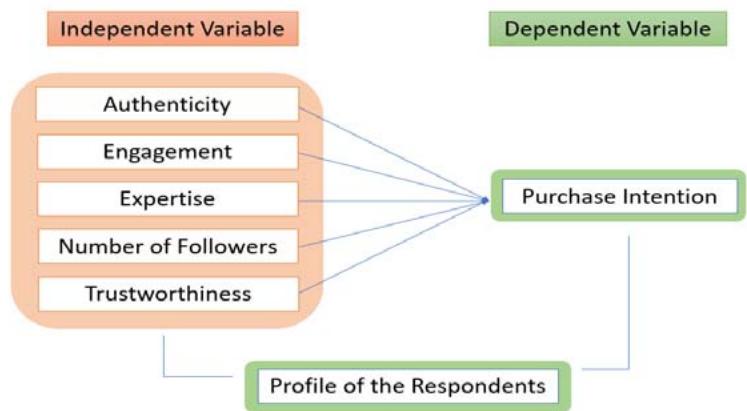
Figure 1
Purchase intention is the dependent variable in this research. It refers to the likelihood or willingness of millennial consumers in General Santos City to buy products or services based on the influence of social media influencers. Purchase intention is a powerful predictor of actual purchasing behavior since it shows how consumers make decisions. The traits that help social media influencers affect these buying intentions are known as independent variables. These factors include the following: authenticity, or the degree of genuineness and honesty that the influencer is perceived to have; engagement, or the amount of interaction between the influencer and their followers; expertise, or the influencer's perceived knowledge and credibility in their product category; number of followers, which indicates the size of the influencer's audience and potential reach; and trustworthiness, which captures the honesty and dependability that customers attribute to the influencer's recommendations. When taken as a whole, these separate factors offer important insights into the dynamics of influencer marketing in a local setting and help explain how social media influencers impact millennial consumers' propensity to buy.
### l) Hypothesis of the Study
- H0: Local social media influencers do not significantly influence millennials' purchase intentions in General Santos City.
- H1: Local social media influencers significantly influence millennials' purchase intentions in General Santos City.
- H0: There is no significant difference between profile of the respondents and social media influence
- H1: There is a significant difference between profile of the respondents and social media influence
- H0: There is no significant difference between profile of the respondents and purchase intention
- H1: There is a significant difference between profile of the respondents and purchase intention
### m) Definition of Terms
The terms used in the study are defined conceptually and operationally as follows;
Age: It refers to the respondent's numerical age in completed years. For this study, only individuals aged 29 to 44 years old (classified as millennials) are included in the sample.
The years needed for an individual to develop similarly to an average person are used to measure an individual's level of development.
Authenticity: This is the perceived genuineness, honesty, and reliability of social media influencers in their interactions and recommendations to their audience. It also enhances trust and credibility among followers (Hsu & Tsou, 2011).
It is the perception that an individual or message is genuine, honest, and consistent with personal values. In social media, it reflects how real and relatable an influencer appears to their audience. (Audrezet, de Kerviler, & Moulard, 2018).
Consumer Behavior: It is the decisions and actions that individuals or households take while selecting, purchasing, utilizing, and discarding a good or service are referred to as consumer behavior. Numerous sociological, psychological, and cultural factors influence how customers interact with the marketplace. (Bhat, 2024)
This refers to the actions and decision-making processes individuals engage in when selecting, purchasing, using, or disposing of products and services. It is influenced by psychological, social, and cultural factors (Solomon, 2018).
Content Creation: It refers to the production and sharing of digital materials - such as photos, videos, reels, and posts- by local social media influencers.
Content creation is the process of sharing and creating original material- such as text, images, videos, or audio-intended to inform, entertain, or engage an audience, especially through digital and social media platforms (Kumar & Gupta, 2016).
Educational Status: It is the highest level of formal education completed by the respondent at the time of the survey. It helps assess whether educational attainment has a relationship with fashion preferences and the influence of local social media influencers. Responses were categorized as high school graduate, college level, college graduate, or postgraduate.
It refers to the highest level of formal education an individual has completed, which often serves as an indicator of knowledge, skills, and social position (UNESCO, 2012).
Employment: It refers to whether the respondent is currently engaged in any form of work or livelihood activity at the time of the survey.
Employment refers to the state of having a paid job or being engaged in work under formal or informal arrangements, contributing to an individual's economic productivity and livelihood (International Labour Organization [ILO], 2020).
Engagement: Influencer Engagement is a metric that measures how an influencer and their audience connect. It is any interactions a user has with a particular social post including likes, shares, comments, and clicks. (Alain 2023)
It refers to the level of interaction, attention, and emotional involvement an individual shows toward content, a brand, or an online community, often expressed through likes, comments, shares, or active participation (Brodie et al., 2011).
Expertise: It is the perceived knowledge, competence, and specialized skills demonstrated by social media influencers within their specific niche or industry. Influencers with expertise are seen as more credible and trustworthy sources of information (Chen & Sharma, 2020).
It is the extent to which an individual is perceived as knowledgeable, skilled, and experienced in a particular area, contributing to their credibility and persuasive ability (Ohanian, 1990).
Gender: It refers to the identified gender of the respondent. It will be categorized as male, female, or prefer not to say, and used to examine potential variations in fashion preferences and influencer effectiveness.
It refers to the socially constructed roles, behaviors and characteristics that a society considers appropriate for individuals based on their perceived sex, typically categorized as masculine or feminine (World Health Organization [WHO], 2023).
Income: Income refers to the respondent's average monthly personal income, recorded in Philippine pesos. It will be grouped in ranges to assess how economic capability influences purchasing behavior and responses to influencer content.
It refers to the total earnings received by an individual or household from all sources- such as wages, salaries, business profits, and investments- used to support consumption and savings (OECD, 2020).
Influencer Marketing: This is a kind of social media marketing that makes use of product mentions and endorsements from influencers or people with a big number social media following. Fenton (2023)
A technique known as influencer marketing entails collaborating with famous people in different social media platforms to market goods and services using their reach and reputation to influence the opinions and actions of their audience. (De Veirman et al., 2017).
Millennials (Generation Y): These are individuals born between the early 1980s and the late 1990s. They are member of Generation Y (Oxford) making them 28 to 43 years old as of 2024. They are also known as Generation Y, characterized by their digital savininess, familiarity with social media, and strong influence on consumer trends.
Millennials is known as Generation Y. They are born between 1981 and 1996, characterized by their digital nativeness, social media usage, and distinct consumption patterns shaped by technology and connectivity (Dimock, 2019).
Number of Followers: This is the quantitative measure of the audience size that follows and engages with a social media influencer. Higher follower counts often indicate greater reach and potential influence over consumer behavior (Hsu & Tsou, 2011).
Number of followers refers to the total count of users who subscribe to or regularly view an individual's social media profile, indicating the size of their audience and potential reach (De Veirman, Cauberghe, & Hudders, 2017).
Purchase Intention: It is a customer's willingness to purchase a particular good or service. Different factors influence the dependent variable of purchase intention. The respondent's attitude toward making a purchase or using a service is gauged by their purchase intentions. (MBA Skool Team, 2024).
Purchase intention refers to the likelihood or willingness of a buyer to buy a product or service based on their attitudes, preferences, and perceptions (Fishbein & Ajzen, 1975).
Religion: It refers to the respondent's declared religious affiliation, categorized as Muslim, Christian, or Others. This aims to examine if religious background has an effect on purchase intention or receptiveness to influencer content.
It is a system of beliefs, practices, and values centered around questions of existence, spirituality, and morality, often involving a belief in a higher power or divine being and expressed through rituals and community (Durkheim, 2008).
Social Media Influencers (SMI): These are individuals who have gained a massive number of following on social media platforms. They are recognized by their ability to affect the opinions, attitudes, and purchase intentions of their followers through consistent their engagement, relatability, and perceived authenticity. Only local influencers based in Philippines are considered for this research.
They are individuals who have built a dedicated following on social media platforms and can shape their audience's attitudes or behaviors through content that appears credible, relatable, and persuasive (Freberg et al., 2011).
Social Media Marketing: It is also referred to as digital marketing and e-marketing, is the process of utilizing social media platforms- platforms that enable users to create social networks and exchange information- to enhance a company's brand, boost sales, and increase website traffic.
According to Tuten and Solomon (2017), social media marketing is the practice of using social media platforms to advertise goods, services, or brands by interacting with users, producing content, and fostering brand loyalty and consumer connection. (Tuten & Solomon, 2017).
Social Media: This refers to digital platforms or applications- such as Facebook, Instagram, TikTok, and
YouTube- that enable users to create, share, and interact with content. It serves as the primary medium through which local influencers engage with millennial audiences in General Santos City.
Social media refers to digital platforms like Facebook, Tiktok, and Instagram that enable users to create, share, and interact with content and each other in real-time through virtual communities and networks (Kaplan & Haenlein, 2010).
Trustworthiness: This is the extent to which social media influencers are perceived as reliable, honest, and dependable sources of information and recommendations. Trustworthy influencers influence the consumer attitudes and behaviors according to Hsu & Tsou (2011).
It is the perceived quality of being honest, reliable, and credible, which encourages confidence and reliance from others (McKnight, Carter, Thatcher, & Clay, 2011).
#### CHAPTER 3
## III. METHODOLOGY
In addition to the research design, respondents, research instrument, validation procedure, data collection method, and statistical treatment, this chapter discussed the methodological techniques used in this study. By emphasizing the systematic approach to data collection and processing, it ensured a thorough and accurate investigation of the study's objectives.
### a) Research Design
This study uses a correlational research methodology to investigate the relationship between Cochran's Formula for Infinite Populations:
millennials' purchasing intentions in General Santos City and the factors influencing social media influencers. It takes a quantitative approach, gathering information from respondents using a structured questionnaire. Purchase intention is the dependent variable, and the independent factors being examined are the influencers' legitimacy, level of experience, number of followers, likeness, and reliability. To investigate the degree to which these factors affect millennials' propensity to buy goods or services that influencers advocate, data analysis employs statistical techniques.
### b) Sample Size Determination
To determine the appropriate sample size for this study, Cochran's formula was utilized. Given the absence of prior data regarding the proportion of millennials in General Santos City who are influenced by local social media influencers in their purchase intentions, a conservative estimate of $50\%$ $(p = 0.5)$ was used. This choice reflects the maximum variability in the population, thereby yielding the largest possible sample size, which in turn enhances the accuracy and reliability of the results (Cochran, 1977).
A confidence level of $95\%$ was selected, corresponding to a Z-value of 1.96, and a significance level of $\alpha = 0.05$. This implies that the researcher is $95\%$ confident that the sample proportion will represent the true population proportion. A margin of error (e) of $\pm 5\%$ was also chosen, which is widely accepted in social science research to maintain a balance between statistical precision and practicality.
$$
n _ {0} = \frac {Z ^ {2} \cdot p \cdot (1 - p)}{e ^ {2}} \quad \begin{array}{c} \text {W h e r e :} \\\bullet \quad n _ {0} \end{array}
$$
Where:
- $n_0 =$ required sample size
- $Z = Z$ -value (1.96 for $95\%$ confidence)
- $p =$ estimated proportion of the population (0.5)
- $e =$ margin of error (0.05)
$$
n _ {0} = \frac {1 . 9 6 ^ {2} \cdot 0 . 5 \cdot (1 - 0 . 5)}{0 . 0 5 ^ {2}} = \frac {3 . 8 4 1 6 \cdot 0 . 2 5}{0 . 0 0 2 5} = \frac {0 . 9 6 0 4}{0 . 0 0 2 5} = 3 8 4. 1 6 \approx 3 8 5
$$
Therefore, the ideal sample size for this study is approximately 385 respondents, assuming an infinite population. If the actual target population is known and finite, the sample size may be adjusted using the finite population correction (FPC) formula.
### c) Locale of the Study

This research was conducted in General Santos City, Philippines. Due to the fact that the researcher is a local resident, it is chosen for this reason. Additionally, its populace is diversified and actively participates in internet forums. General Santos City provided a good setting to explore the connections between local Social Media influencers and millennials regarding purchase intentions.
### d) Respondents
Selecting appropriate respondents is key component in ensuring the relevance and reliability of the study. In this section, we highlighted the criteria applied to select millennials for this study.
Criteria for Selecting Millennials:
Age Range (28 to 43): The researcher intentionally chose the age range of 28 to 43, aligning with the widely accepted definition of millennials (born between the early 1980s and early 2000s). This age group is familiar with digital technologies. This ensured a comprehensive exploration of purchase intentions influenced by social media influencers.
Random Selection of 385 Millennials: This study randomly selected 385 millennials aged 28 to 43. This method ensured a diverse and representative sample. It enhances the generalizability of the findings to the broader population of digitally immersed millennials.
### e) Research Instrument
The main tool for gathering data for this study was a structured questionnaire. Both printed hard copies and an online survey through Google Form were used to disseminate the questionnaire. The researcher decided to use the dual distribution strategy in order to reach a diversified sample of millennials in General Santos City, increase convenience, and make responses easier and faster.
The questionnaire was designed to investigate how local social media influencers affect the purchase intentions of millennials. It consisted of various statements related to influencer characteristics such as expertise, trustworthiness, engagement, and number of followers. Respondents indicated their level of agreement or disagreement using a 5-point Likert scale. It is ranging from 1 (Strongly Disagree) to 5 (Strongly Agree). It allows nuanced measurement of perceptions and attitudes.
Table 1: Likert Scale Interpretation
<table><tr><td>Scale</td><td>Description</td><td>Interpretation</td></tr><tr><td>1</td><td>Strongly Disagree</td><td>Indicates strong disagreement with the statement.</td></tr><tr><td>2</td><td>Disagree</td><td>Suggests disagreement with the statement.</td></tr><tr><td>3</td><td>Neutral</td><td>Implies a neutral stance or neither agreement nor disagreement with the statement.</td></tr><tr><td>4</td><td>Agree</td><td>Indicates agreement with the statement.</td></tr><tr><td>5</td><td>Strongly Agree</td><td>Signifies strong agreement with the statement.</td></tr></table>
Table 1 uses a 5-point Likert scale to gauge the perceived relevance of elements how local social media influencers influence the millennials in their purchase intention. It ranges from "Strongly Disagree" to "Strongly Agree," the scale helped to provide a more complex picture of the respondents' preferences and behavior.
The questionnaire was adapted from previous studies including those by Mahrous and Abdelmaaboud (2017), Ohanian (1990), and Sievert and Jacob (2014). Some questions were developed by the researcher to match the specific context of this study.
To ensure content validity, the questionnaire was reviewed by an expert from the faculty of the College of Business Administration. The expert evaluated the instrument for clarity, relevance, and comprehensive coverage of the study's key variables.
The questionnaire is divided into two main sections aligned with the research objectives. The first section collects the demographic profile of respondents, including age, gender, monthly income, employment status, educational attainment, and religion. These demographic variables correspond directly to the first research question, which aims to describe the profile of millennial consumers in General Santos City.
The second section measures the characteristics of local social media influencers - authenticity, engagement, expertise, number of followers, and trustworthiness - as well as the purchase intentions of millennials. The study's main objective, the investigation of how influencer characteristics impact millennials' purchase intentions, was supported by the respondents' ratings of the statements on a 5-point Likert scale.
To ensure representativeness, 385 millennial respondents from General Santos City were chosen using a random selection technique. This sample size offers a strong basis for statistical analysis and the generalization of results.
### f) Data Gathering Procedure
The data collection for this study was conducted through both Google Forms (a digital survey platform) and printed hard copy questionnaires. Participants - identified as millennials residing in General Santos City - were provided with access to the questionnaire either via an online link or in printed form. This dual distribution approach was employed to increase accessibility and ensure a more inclusive and representative sample.
The Data Gathering Process Involved the Following Steps:
Participant Notification: Participants were informed about the study's purpose and objectives. They received either a link to the Google Forms questionnaire or a printed version of the survey, depending on accessibility and preference.
Questionnaire Completion: Participants completed the questionnaire independently, either online or in hard copy, at their convenience.
Clarification and Assistance: The option to contact the researcher for help or clarification was provided to participants during the survey time, regardless of whether they were filling out the printed or digital form.
Data Compilation: While responses from paper questionnaires were manually coded and combined, those entered via Google Forms were automatically collated. Combining both approaches guaranteed efficiency, accessibility, and broad participation—especially for the tech-savvy millennial group and others with limited internet access.
Initially, the researcher anticipated completing data collection within a couple of months. But difficulties finding respondents ready to answer the questionnaire caused the actual process to take more time than anticipated. To solve this, the researcher widened the audience by means of social media outlets like Instagram, which resulted in extended distribution channels and augmented internet efforts, along with printed questionnaires. These taken together raised response rates and enabled the goal sample size to be reached.
### g) Statistical Treatment
Descriptive statistics, including frequency counts, mean, and standard deviation, were used to analyze the data. The mean score for each statement was calculated, and an interpretation scale (Low, Moderate, High) was applied based on the Likert scale ratings. The scale used to interpret the mean scores was as follows:
Table 2: Mean Interpretation
<table><tr><td>Mean</td><td>Interpretation</td></tr><tr><td>1.00 - 1.99</td><td>Low Influence or Agreement</td></tr><tr><td>2.00 - 2.99</td><td>Low to Moderate Influence or Agreement</td></tr><tr><td>3.00 - 3.99</td><td>Moderate Influence or Agreement</td></tr><tr><td>4.00 - 4.49</td><td>High Influence or Agreement</td></tr><tr><td>4.50 - 5.00</td><td>Very High Influence or Agreement</td></tr></table>
This range was adapted from the study of Indian Journal of Psychology and Education (2022), which provides guidelines for interpreting Likert scale data.
#### Interpretation of the Mean Range
A mean score between 1.00 and 1.99 was interpreted as Low Influence or Agreement, suggesting that the trait or factor has minimal influence on millennials' fashion preferences.
A mean score between 2.00 and 2.99 was interpreted as Low to Moderate Influence or Agreement, indicating a weak but noticeable influence.
A mean score between 3.00 and 3.99 was interpreted as Moderate Influence or Agreement, suggesting a balanced influence.
A mean score between 4.00 and 4.49 was interpreted as High Influence or Agreement, reflecting a strong influence on purchase intentions.
A mean score between 4.50 and 5.00 was interpreted as Very High Influence or Agreement. It indicates a very strong influence of the influencer trait on millennials' fashion preferences.
#### Standard Deviation
To assess the variability in responses, the standard deviation was calculated. The standard deviation provides insights into the level of consistency or disagreement among respondents, as specified below:
High Standard Deviation (greater than or equal to 1.5): Signifies a wide range of responses, suggesting diverse opinions among millennials regarding the impact of influencers. This is suggesting divergent responses;
Moderate Standard Deviation (between 1.0 and 1.5): Indicates moderate agreement or consistency among respondents. This means opinions are relatively balanced. It indicates moderate variability in the responses; and
Low Standard Deviation (less than 1.0): Suggests a narrow range of responses, highlighting a high level of agreement among millennials. Preferences are more uniform. This means consistent responses.
By considering both the mean and standard deviation, the study offers a comprehensive understanding of the respondents' attitudes and the consistency of their perceptions toward local social media influencers.
### h) Ethical Consideration
This study was approved by the Institutional Ethics Review Committee (IERC) of Mindanao State
#### CHAPTER 4
## IV. RESULTS AND DISCUSSIONS
The results and discussions derived from the data gathered for this investigation are presented in this chapter. Tables with the results are displayed first, with commentary following. In addition, the issues mentioned in Chapter 1 are addressed with explanations that shed light on the goals of the study.
### a) Profile of Respondents
This section discusses the profile of the 385 millennial respondents from is research. The profile includes gender, monthly income, employment status, educational attainment and religion. These traits offer a framework for comprehending the elements impacting their intention to buy. Since the google form link, the distribution represents voluntary participation. Participants' answers differed according on online activity, interest, or accessibility. (See Appendix G for the full table of results.)
Table 3: Respondent's Profile (Gender)
<table><tr><td>Category</td><td>Subcategory</td><td>Frequency</td><td>Percentage (%)</td></tr><tr><td>Gender</td><td>Female</td><td>254</td><td>66.12%</td></tr><tr><td></td><td>Male</td><td>120</td><td>31.17%</td></tr><tr><td></td><td>Prefer not to say</td><td>11</td><td>2.86%</td></tr><tr><td>Total</td><td></td><td>385</td><td>100.00%</td></tr></table>
As presented in Table 2, the majority of respondents were female, accounting for 254 individuals or $66.12\%$ of the sample. Male respondents totaled 120 or $31.17\%$, while 11 respondents $(2.86\%)$ chose not to disclose their gender. The predominance of female respondents may indicate a greater level of engagement or willingness among women to participate in research involving social media usage and purchase behavior.
The finding above is similar with the previous studies conducted by Sax, Gilmartin, & Bryant (2003) and Smith (2008). It indicated that women are generally more responsive to online surveys, especially those involving consumer behavior and social media engagement. The gender distribution also shows the self-selected nature of voluntary online surveys where demographic imbalances can result from differing levels of internet activity and interest in the topic.
Table 4: Respondent's Profile (Income)
<table><tr><td>Category</td><td>Subcategory</td><td>Frequency</td><td>Percentage (%)</td></tr><tr><td>Income</td><td>₹ 0-5,000</td><td>14</td><td>3.64%</td></tr><tr><td></td><td>₹ 5,000-15,000</td><td>70</td><td>18.18%</td></tr><tr><td></td><td>₹ 15,000-30,000</td><td>152</td><td>39.48%</td></tr><tr><td></td><td>₹ 30,000-45,000</td><td>87</td><td>22.61%</td></tr><tr><td></td><td>₹ 45,000 and above</td><td>62</td><td>16.12%</td></tr><tr><td>Total</td><td></td><td>385</td><td>100.00%</td></tr></table>
According to the income distribution, the largest percentage of respondents-152 individuals or 39.48% reported a monthly income ranging from $15,000 to$ 30,000. This is followed by 87 respondents (22.61%) earning between $30,000 and$ 45,000, 70 respondents (18.18%) earning between $5,000 and$ 15,000, and 62 respondents (16.12%) who reported a monthly income of \)45,000 or more. A smaller segment, comprising 14 respondents (3.64%), indicated an income of less than \(5,000.
These findings show that a significant proportion of the respondents fall within the middle income category. This actually aligns with the Philippine Statistics Authority's classification of the middle income class in the country, which typically includes households earning between $15,000 and$ 90,000 per month (Albert et al., 2018). Additionally, the tendency for middle income earners to engage more actively in online platforms and consumer behavior studies may explain their higher representation in the dataset (Pew Research Center, 2019).
Table 5: Respondent's Profile (Employment)
<table><tr><td>Category</td><td>Subcategory</td><td>Frequency</td><td>Percentage (%)</td></tr><tr><td>Employment</td><td>Government Employees</td><td>141</td><td>36.61%</td></tr><tr><td></td><td>Private Employees</td><td>112</td><td>29.09%</td></tr><tr><td></td><td>Self-employed</td><td>56</td><td>14.53%</td></tr><tr><td></td><td>Students</td><td>15</td><td>3.89%</td></tr><tr><td></td><td>Teachers</td><td>60</td><td>15.58%</td></tr><tr><td>Total</td><td></td><td>385</td><td>100.00%</td></tr></table>
As reflected in the data, government employees comprised the largest group at $36.61\%$ (141 respondents), followed by private sector employees at $29.09\%$ (112 respondents). Teachers accounted for $15.58\%$ (60 respondents), self-employed individuals made up $14.55\%$ (56 respondents), and students represented the smallest group at $3.89\%$ (15 respondents). The data indicate that the majority of respondents were employed in either the public or private sector. This distribution may be attributed to the greater stability and opportunities offered by formal employment in urban areas like General Santos City.
According to the Philippine Statistics Authority (2021), formal sector employment- particularly in government and large private enterprises- continues to be a dominant source of livelihood for many Filipinos. Furthermore, a study by Ballon and Alampay (2019) highlighted that millennials in the Philippines tend to prioritize job security and stable income, which may explain the high participation of those in government and corporate roles in the present study.
Table 6: Respondent's Profile (Educational Attainment)
<table><tr><td>Category</td><td>Subcategory</td><td>Frequency</td><td>Percentage (%)</td></tr><tr><td>Educational Attainment</td><td>College Graduate</td><td>234</td><td>60.78%</td></tr><tr><td></td><td>College Undergraduate</td><td>27</td><td>7.01%</td></tr><tr><td></td><td>Doctorate</td><td>10</td><td>2.60%</td></tr><tr><td></td><td>Highschool</td><td>13</td><td>3.38%</td></tr><tr><td></td><td>Elementary</td><td>2</td><td>0.52%</td></tr><tr><td></td><td>Masters</td><td>99</td><td>25.70%</td></tr><tr><td>Total</td><td></td><td>385</td><td>100%</td></tr></table>
A significant majority of the respondents, $67.01\%$ (234 individuals), reported holding a college degree. Those with a master's degree followed at $25.70\%$ (99 respondents). Other educational levels included college undergraduates at $7.01\%$ (27 respondents), high school graduates at $3.38\%$ (13 respondents), doctorate holders at $2.60\%$ (10 respondents), and elementary-level graduates at $0.52\%$ (2 respondents).
These findings suggest that the sample population is generally well-educated. This aligns with observations made by Tumas and Lising (2016), who noted that higher education attainment among Filipino. Additionally, data from the Commission on Higher Education (CHED, 2020) highlighted that college education continues to be a priority among Filipino youth. This contributes to a highly educated millennial workforce in areas such as General Santos City.
Table 7: Respondent's Profile (Religion)
<table><tr><td>Category</td><td>Subcategory</td><td>Frequency</td><td>Percentage (%)</td></tr><tr><td>Religion</td><td>Islam</td><td>135</td><td>35.16%</td></tr><tr><td></td><td>Christianity</td><td>220</td><td>57.14%</td></tr><tr><td></td><td>Others</td><td>30</td><td>7.79%</td></tr><tr><td>Total</td><td></td><td>385</td><td>100%</td></tr></table>
In terms of religious affiliation 135 individuals were identified as Muslims and 220 as Christians. $7.79\%$ of the remaining 30 respondents said they practiced another religion. While religion was not a primary variable in this study, it provides additional demographic context that may help understand underlying cultural values, especially in a diverse city like General Santos.
Medina (2001) asserts that in Filipino society, religion has a major influence on values, identity, lifestyle, and buying intention. Moreover, the two largest religious groups in the southern Philippines are Muslims and Christians according to Philippine Statistics Authority (PSA 2020). The sample's demographic balance was reaffirmed by this.
b) Extent of Social Media Influencers' Influence on Millennial Consumers in General Santos City in Terms of Authenticity, Engagement, Expertise, Number of Followers, and Trustworthiness
This section looks at how social media influencers affect millennial consumers in General Santos City. It focuses on five factors: authenticity, engagement, expertise, number of followers, and trustworthiness. The results show how these factors influence millennials' opinions and buying decisions. (See Appendix H for the full table of results.)
Table 8: The Extent of Influence that Social Media Influencers have on Millennial Consumers in General Santos City in Terms of Authenticity
<table><tr><td>Authenticity</td><td>Mean</td><td>Standard Deviation (SD)</td><td>Interpretation</td></tr><tr><td>Influencers are genuine in their recommendations.</td><td>3.27</td><td>0.99</td><td>Moderate Influence, Low Variability</td></tr><tr><td>I feel that influencers are sincere in their reviews</td><td>3.23</td><td>1.00</td><td>Moderate Influence, Moderate Variability</td></tr><tr><td>Influencers present honest opinions about products.</td><td>3.20</td><td>0.97</td><td>Moderate Influence, Low Variability</td></tr><tr><td>Mean</td><td>3.23</td><td>0.87</td><td>Moderate Influence, Low Variability</td></tr></table>
The statement "I feel that influencers are sincere in their reviews" with a mean score of 3.23 and 1.0 SD, reflecting a moderate level of perceived sincerity, albeit with slightly more variability. While many respondents believe influencers are sincere, the variation suggests some skepticism. This aligns with Casaló et al. (2018) who reported that while sincerity is critical to influencer credibility, it can be undermined by excessive commercial intent. Additionally, Jin, et al. (2019) emphasized that influencer transparency affects follower trust, noting that audiences react negatively when they perceive reviews as overly scripted or profit-oriented. De Veirman et al. (2017) further supported that perceived sincerity affects engagement, particularly when influencers disclose sponsorships and maintain transparency.
The third statement, "Influencers present honest opinions about products," had a mean score of 3.20 (SD = 0.97), showing moderate agreement. The relatively low standard deviation again indicates consistent perceptions. According to Lee and Eastin (2021), honesty in influencer content enhances engagement and strengthens purchase intention, particularly when content appears experience-driven. In addition, Martínez-López et al. (2020) highlighted that honesty in influencer communication boosts trust and long-term brand relationships. Evans et al. (2017) also pointed out that authenticity and honesty in sponsored posts significantly contribute to message effectiveness and consumer trust.
Overall, with a total mean score of 3.23 ( $SD = 0.87$ ) for the authenticity factor, respondents perceive local influencers as moderately authentic. The low variation indicates stable agreement across respondents. This proves that the role of authenticity as a key factor in influencer effectiveness. As shown by Djafarova and Trofimenko (2019), authentic influencers are more persuasive, particularly in fashion and lifestyle, where audiences seek relatability. Furthermore, Glucksman (2017) and Ki et al. (2020) both concluded that authenticity is a major determinant of influencer success, especially among younger audiences like millennials who value realness over commercial intent.
Table 9: The Extent of Influence that Social Media Influencers have on Millennial Consumers in General Santos City in Terms of Engagement
<table><tr><td>Engagement</td><td>Mean</td><td>Standard Deviation (SD)</td><td>Interpretation</td></tr><tr><td>I often like or comment on posts made by influencers I follow.</td><td>2.86</td><td>1.30</td><td>Low to Moderate Influence, Moderate Variability</td></tr><tr><td>I frequently share content from influencers.</td><td>2.60</td><td>1.22</td><td>Low to Moderate Influence, Moderate Variability</td></tr><tr><td>I regularly engage with influencer posts.</td><td>2.57</td><td>1.22</td><td>Low to Moderate Influence, Moderate Variability</td></tr><tr><td>Mean</td><td>2.68</td><td>1.12</td><td>Low to Moderate Influence, Moderate Variability</td></tr></table>
The statement "I often like or comment on posts made by influencers I follow" had the highest mean score of 2.86 ( $SD = 1.30$ ), suggesting a low to moderate level of engagement. This indicates that while some millennials interact with influencer posts occasionally, overall interaction is inconsistent. The high standard deviation with score of 1.30 suggest diverse engagement behaviors. That means some respondents actively participating and others remaining passive. This finding aligns with De Veirman et al. (2017), who noted that engagement depends on content relevance, personal resonance, and interaction style. Similarly, Dessart et al. (2015) found that emotional and cognitive brand engagement affects social media interaction frequency. Marwick and Boyd (2011) also highlighted that users tend to engage more when they perceive a sense of closeness or familiarity with influencers, frequently made possible by casual and relatable contents.
The statement "I frequently share content from influencers" with 2.60 mean score indicated a lower level of interaction. This means that content sharing is not a really common behavior among respondents. This supports findings by Lim et al. (2017) who stated that content sharing reflects deeper emotional engagement, which may be lacking among general audiences. Berger and Milkman (2012) also emphasized that content is more likely to be shared when it elicits strong emotional reactions such as awe, anger, or amusement- emotions that may not have been triggered in this case. Additionally, Katz and Lazarsfeld's (1955) and their two-step flow theory implies that only a select few audiences, particularly opinion leaders, are inclined to share content with their networks, while most act as passive receivers.
The statement "I regularly engage with influencer posts" scored the lowest, with a mean of 2.57 $(SD = 1.22)$. This result further reinforces the notion that most millennials consume influencer content passively, with only limited direct engagement. According to Hwang and Zhang (2018), even when influencers are seen as credible, this does not always lead to high engagement unless posts evoke a personal or emotional connection. Similarly, Chu and Kim (2011) reported that while social networking sites increase exposure to influencer content, routine interaction still depends heavily on users' motivations and involvement levels. Schivinski et al. (2016) also found that while brand-related content from influencers may attract attention, actual engagement (likes, shares, comments) remains limited unless there is a perceived value exchange or relevance to the user's interests.
The overall mean score of 2.68 ( $SD = 1.12$ ) indicates a generally low engagement level among millennials with influencer content, though some participation exists. This confirms earlier findings by De Veirman et al. (2017), who pointed out that engagement depends largely on the relevance and emotional resonance of content. Though with somewhat more variation, the mean score of 3.23 ( $SD = 1.00$ ) for the comment "I feel that influencers are sincere in their reviews" reflects a modest degree of perceived sincerity. Although many of the respondents say influencers are honest, the differences imply some doubt.
Table 10: The Extent of Influence that Social Media Influencers have on Millennial Consumers in General Santos City in terms of Expertise
<table><tr><td>Expertise</td><td>Mean</td><td>Standard Deviation (SD)</td><td>Interpretation</td></tr><tr><td>Influencers have extensive knowledge about their field.</td><td>3.39</td><td>1.08</td><td>Moderate Influence, Moderate Variability</td></tr><tr><td>I think influencers have experience in their area of interest.</td><td>3.43</td><td>1.00</td><td>I Moderate Influence, Moderate Variability</td></tr><tr><td>I think influencers have specialized knowledge about their field.</td><td>3.39</td><td>1.01</td><td>I Moderate Influence, Moderate Variability</td></tr><tr><td>Mean</td><td>3.40</td><td>0.95</td><td>Moderate Low Influence, Moderate Variability</td></tr></table>
The statement "I think influencers have experience in their area of interest" received the highest mean score of 3.43 with 1.0 standard deviation. This indicated a moderate level of agreement among respondents that influencers are experienced in their area of interest. This also means that respondents perceive influencers to possess just fair amount of hands on involvement or background knowledge which enhances their credibility. Casaló et al. (2018) assert that followers are more likely to accept recommendations from influencers when their endorsements are viewed as having greater credibility. In a similar vein, Sokolova and Kefi (2020) highlighted that influencers who are seen as experts have a more persuasive effect on their followers because of their increased authority and credibility. This is in line with the study by Freberg et al. (2011) who discovered that influencers' perceived knowledge strengthens their position as reliable opinion leaders by favorably influencing brand perceptions and attitudes. Xiao et al. (2018) further observed that influencer expertise is a key determinant of social media advertising effectiveness, especially among millennials who are tech-savvy and somewhat selective about the content they engage with.
The statements "Influencers have extensive knowledge about their field" and "I think influencers have specialized knowledge about their field" both obtained a mean score of 3.39, with standard deviations of 1.08 and 1.01, respectively. These findings also show significant heterogeneity and a moderate degree of perceived knowledge. The standard deviations reveal that even though a large number of respondents agree with these assertions, some still hold other opinions. This can be the result of differences in the types of influencers that they follow. This suggest that certain influencers can be seen as genuinely informed, while others might not have as much nuance in their writing. This result is consistent with Lou and Yuan's (2019) observation that consumers' perceptions of influencers' expertise boost their trust and the message's legitimacy, which in turn influences their opinions about the brand or product. Djafarova and Trofimenko (2019) also asserted that influencers with demonstrated knowledge and consistent messaging were more likely to be trusted and partic.
The overall mean score for this category was $3.40$ ( $SD = 0.95$ ), which falls under the interpretation of "Moderate Low Influence", despite individual items showing "Moderate Influence." This slight downgrade in interpretation may reflect that while millennials generally recognize the knowledge and experience of influencers. Strong influence is not implied by this impression. A moderate level of variability is shown by the standard deviations which range from 1.00 to 1.08. This showed that even while a large portion of respondents agreed with the claims, still a big portion of the respondents had doubts about the knowledge of influencers. This variability may be influenced by factors such as the type of influencer followed (e.g., micro vs. macro), the nature of the content, or prior negative experiences.
Table 11: The Extent of Influence that Social Media Influencers have on Millennial Consumers in General Santos City in Terms of Number of Followers
<table><tr><td>Number of Followers</td><td>SMean</td><td>Standard Deviation (SD)</td><td>Interpretation</td></tr><tr><td>An influencer with a large following is more credible.</td><td>3.61</td><td>1.08</td><td>Moderate Influence, Moderate Variability</td></tr><tr><td>The number of followers an influencer has impacts my perception of their reliability.</td><td>3.60</td><td>1.05</td><td>Moderate Influence, Moderate Variability</td></tr><tr><td>I tend to trust influencers with more followers.</td><td>3.41</td><td>1.15</td><td>Moderate Influence, Moderate Variability</td></tr><tr><td>Mean</td><td>3.54</td><td>0.99</td><td>Moderate Influence, Moderate Variability</td></tr></table>
With a mean score of 3.61 and 1.08 standard deviation, the statement "An influencer with a large following is more credible" has the highest mean score. This suggested that a large number of followers is correlated with credibility among General Santos City's respondents. The findings suggest that having a large number of followers is linked to an influencer's credibility. This finding is consistent with the work of Jin and Phua (2014), who pointed out that follower count can be a proof of how credible an influencer could be. Similarly, Lou and Yuan (2019) emphasized that follower count serves as a mental shortcut- or heuristic- that helps people assess an influencer's expertise, which in turn strengthens their credibility. Additionally, Casaló et al. (2018) observed that while follower count plays a role in building credibility, the level of audience engagement also shapes how authentic followers perceive an influencer to be.
Closely following is the statement "The number of followers an influencer has impacts my perception of their reliability" with a mean of 3.60 and 1.05 standard deviation. This suggest that follower count affects how millennials view the influencer's trustworthiness. According to Freberg et al. (2011), influencers with a high follower base are seen as more reputable. This supports the study of Djafarova and Rushworth (2017) emphasized that millennials often equate large followings with expertise and social status, which directly impacts perceived reliability. However, the study also highlighted that followers increasingly seek transparency and genuine interaction beyond mere numbers.
The statement "I tend to trust influencers with more followers" had a slightly lower mean of 3.41 (SD = 1.15), suggesting that while follower count plays a role, trust is not automatically granted based on numbers alone. Individual variations in the respondents' perceptions of the value of follower count as a gauge of credibility are also reflected in the somewhat greater standard deviation. This aligns with findings from Ki et al. (2020), who reported that trust towards influencers is multifaceted, with follower count being only one among several factors such as content relevance, expertise, and emotional connection.
The overall mean score of 3.54 (SD = 0.99) reveals a moderate level of influence based on follower count, with moderate variability in responses. This implies that while a large following positively affects influencer credibility among millennials, it is not the sole determining factor- content quality, consistency, and perceived authenticity still matter. This notion echoes the research of De Veirman et al. (2017), who argued that although follower count can attract initial attention, influencers must maintain engagement and authenticity to sustain credibility.
Table 12: The Extent of Influence that Social Media Influencers have on Millennial Consumers in General Santos City in Terms of Trustworthiness
<table><tr><td>Trustworthiness</td><td>Mean</td><td>Standard Deviation (SD)</td><td>Interpretation</td></tr><tr><td>I trust influencer's review and recommend more than traditional ads.</td><td>3.31</td><td>1.01</td><td>Moderate Influence, Low Variability</td></tr><tr><td>I am more inclined to buy products that are promoted by my favorite influencer.</td><td>3.24</td><td>1.12</td><td>Moderate Influence, Low Variability</td></tr><tr><td>I think the promises made by an influencer are likely to be reliable.</td><td>3.16</td><td>1.03</td><td>Moderate Influence, Low Variability</td></tr><tr><td>Mean</td><td>3.24</td><td>0.95</td><td>Moderate Influence, Low Variability</td></tr></table>
The statement "I trust influencer's review and recommendations more than traditional ads" received the highest mean score of 3.31 (SD = 1.01), indicating that respondents moderately agree that influencer content is more credible and persuasive than the traditional advertisements. This bolsters the findings of Djafarova and Rushworth (2017), who highlighted that, especially among younger viewers, social media influencers are frequently seen as more relatable and reliable than traditional celebrities or marketing forms. Supporting this, Balaban and Mustaţea (2019) found that consumers, especially millennials, perceive influencers as more authentic and unbiased than traditional marketing sources, largely due to the informal and personal style of social media communication. Similarly, De Veirman et al. (2017) noted that influencers with a high number of followers and congruent brand partnerships tend to be perceived as more credible and persuasive by consumers.
The statement "I am more inclined to buy products that are promoted by my favorite influencer" followed with a mean of 3.24 (SD = 1.12), suggesting that influencers have a meaningful, though not overwhelming, impact on respondents' purchase decisions. According to Sokolova and Kefi (2020), trust in an influencer's recommendations significantly contributes to purchase intention, especially when followers feel a personal connection or parasocial relationship with the influencer. Additionally, Lim et al. (2017) highlighted that the attractiveness and perceived expertise of influencers directly impact consumers' attitudes toward endorsed products, which in turn influence their buying behaviors.
With the lowest mean score of 3.16 (SD = 1.03), the statement "I think the promises made by an influencer are likely to be reliable" demonstrated a somewhat more cautious attitude. There is still a lot of skepticism regarding the accuracy of advertising promises, despite the fact that the majority of respondents trust influencers. According to Hwang and Zhang (2018), excessive commercialization can erode trust, especially if the influencer is seen as being too promotional or inauthentic. This is consistent with their findings. This is echoed by Lee and Kim (2020), who emphasized that consumer skepticism increases when influencers are perceived to promote products merely for profit rather than genuine endorsement, thus reducing perceived message credibility.
The standard deviations (ranging from 1.01 to 1.12) indicate moderate agreement among respondents, with some variability in perceptions. This suggests that while influencers are generally trusted more than traditional ads, trust levels vary depending on the perceived authenticity and consistency of the influencer's messaging.
### c) The Extent of Purchase Intention of Millennials Consumers in General Santos City
<table><tr><td></td><td>Mean</td><td>SD</td><td>Interpretation</td></tr><tr><td>I am more likely to buy a product recommended by the accounts I follow on social media like Facebook, Tiktok etc I feel the urge to buy the products after watching a review or post about it.</td><td>3.42</td><td>1.06</td><td>Moderate Influence, Moderate Variability</td></tr><tr><td>I am more likely to buy a product recommended by the accounts I follow on social media like Facebook, Tiktok etc I feel the urge to buy the products after watching a review or post about it.</td><td>3.60</td><td>1.10</td><td>Moderate Influence, Moderate Variability</td></tr><tr><td>It is likely that I will purchase the products featured on an influencer's account.</td><td>3.24</td><td>1.11</td><td>Moderate Influence, Moderate Variability</td></tr><tr><td>Mean</td><td>3.42</td><td>1.09</td><td>Moderate Influence, Moderate Variability</td></tr></table>
<table><tr><td></td><td>Mean</td><td>SD</td><td>Interpretation</td></tr><tr><td>I am more likely to buy a product recommended by the accounts I follow on social media like Facebook, Tiktok etc I feel the urge to buy the products after watching a review or post about it.</td><td>3.42</td><td>1.06</td><td>Moderate Influence, Moderate Variability</td></tr><tr><td>I am more likely to buy a product recommended by the accounts I follow on social media like Facebook, Tiktok etc I feel the urge to buy the products after watching a review or post about it.</td><td>3.60</td><td>1.10</td><td>Moderate Influence, Moderate Variability</td></tr><tr><td>It is likely that I will purchase the products featured on an influencer's account.</td><td>3.24</td><td>1.11</td><td>Moderate Influence, Moderate Variability</td></tr><tr><td>Mean</td><td>3.42</td><td>1.09</td><td>Moderate Influence, Moderate Variability</td></tr></table>
This study used three statements graded on a 5-point Likert scale to gauge millennials' purchase intentions toward goods recommended by regional social media celebrities. Understanding the participants' overall trends and response consistency is possible thanks to the calculated means and standard deviations.
The statement "I feel the urge to buy the products after watching a review or post about it" obtained the highest mean score of 3.60, with a standard deviation of 1.10. This reflects a moderate influence of influencer content on millennials' purchase behavior with moderate variability in responses. This suggest that contents shared by influencers can effectively stimulate interest and drive the desire to purchase of their audiences. This supports the findings of Erkan and Evans (2016), who emphasized the impact of electronic word-of-mouth (eWOM) in increasing trust and perceived usefulness of online information. Similarly, Chetioui et al. (2020) concluded that influencer credibility and message informativeness significantly shape millennials' purchasing decisions, especially in digital environments. Djafarova and Trofimenko (2019) also found that social media personalities effectively
influence younger consumers by presenting relatable and lifestyle-oriented content, making product endorsements feel more organic and persuasive.
With a mean of 3.42 (SD = 1.06), the second statement, "I am more likely to buy a product recommended by the accounts I follow on social media," likewise shows a modest influence and reasonable variability. This implies that although millennials are typically open to influencer suggestions, the familiarity and perceived trustworthiness of the influencer influence their chance of purchase. Lou and Yuan (2019) underlined how greatly customer trust is enhanced by message value and influencer credibility, thereby raising the possibility of purchase. Likewise, Boerman et al. (2017) observed that transparency in influencer content (such as proper labeling of sponsored posts) maintains trust and supports continued consumer engagement. In addition, Jin et al. (2019) highlighted that influencers perceived as authentic and knowledgeable can positively shape follower attitudes toward brands that actually enhancing purchase intent.
The third statement, "It is likely that I will purchase the products featured on an influencer's account" had a mean of 3.24 and a standard deviation of 1.11. This is still reflecting a moderate influence and moderate variability. This indicates that millennials demonstrate a reasonable inclination to purchase especially when the featured product aligns with their interests or needs. Lim et al. (2017) observed that influencer-product fit and authenticity mediate the effectiveness of such promotional content. Additionally, Casaló et al. (2020) emphasized that influencers who consistently deliver valuable, engaging content are more likely to foster loyalty and purchase intentions among followers. Similarly, Schouten et al. (2020) argued that the emotional connection and parasocial relationships formed with influencers play a significant role in driving purchase decisions, especially among younger consumers who seek identity expression through consumption.
These findings reveal generally that local social media influencers in General Santos City have a modest degree of influence on the buying intentions of millennials. Although influencer material improves decision-making, the modest standard deviations between 1.06 and 1.11- indicate some variation in opinion and imply that customer response is shaped in part by personal preferences, the authenticity of the influencer, and alignment between the influencer's image and the promoted product. De Veirman et al. (2017) noted that influencer popularity and content relevance increase purchase likelihood, particularly when followers feel that the influencer is relatable and genuinely endorses the product. Additionally, Marques et al. (2022) emphasized that influencers' persuasive power is in their capacity to forge social and emotional connections with followers, which dramatically raises purchase intention. Freberg et al. (2011) also found that perceived influencer expertise and likeability serve as strong predictors of positive brand associations and consumer trust, while Reinikainen et al. (2020) suggested that authenticity and value congruence with influencers can enhance message effectiveness and lead to higher engagement and purchase behavior.
## i. Relationship Between Respondents' Profiles and the Extend of Social Media Influencers
This section presents the results of the analysis of variance (ANOVA) tests conducted to examine the influence of demographic variables on participants' perceptions of influencer traits. The demographic factors that were considered in this study include gender, income, employment status, educational attainment, and religion. The ANOVA test was used to determine whether there were significant differences in the means of influencer traits based on these variables. (See Appendix I for the full table of results.)
Table 14: Gender and its Influence on Perceptions of Social Media Influencers
<table><tr><td>Dimension</td><td>Mean (Female)</td><td>Mean (Male)</td><td>Mean (Prefer not to say)</td><td>F - Value</td><td>P - Value</td><td>Results</td></tr><tr><td>Authenticity</td><td>3.24</td><td>3.15</td><td>4.06</td><td>5.676</td><td>0.004</td><td>Significant</td></tr><tr><td>Engagement</td><td>2.57</td><td>2.77</td><td>4.03</td><td>10.319</td><td><0.001</td><td>Significant</td></tr><tr><td>Expertise</td><td>3.45</td><td>3.25</td><td>4.52</td><td>4.241</td><td>0.015</td><td>Significant</td></tr><tr><td>Number of Followes</td><td>3.52</td><td>3.49</td><td>4.27</td><td>5.639</td><td>0.004</td><td>Significant</td></tr><tr><td>Trustworthiness</td><td>3.2</td><td>3.22</td><td>4.27</td><td>6.974</td><td>0.001</td><td>Significant</td></tr></table>
The analysis of the relationship between gender and perceptions of influencer attributes shows differences across several characteristics of influencers -authenticity, engagement, expertise, number of followers, and trustworthiness.
The mean authenticity score for female respondents was significantly higher (Mean = 3.24) than for male respondents (Mean = 3.15), with a p-value of 0.004, indicating a significant difference in their perceptions of influencer authenticity. According to Audrezet et al. (2020), who highlighted the importance of authenticity in building customer trust, this shows that women can place a higher value on influencers' genuineness. The greater perception of authenticity by
females could be attributed to a higher preference for relatable content, which is often seen as more genuine by this demographic (Djafarova & Rushworth, 2017).
In terms of engagement, female respondents showed a more significant level of engagement with influencer content, with mean Mean 2.77 compared to male respondents with Mean 2.57. As indicated by a p-value of less than 0.001. This finding aligns with research by De Veirman et al. (2017), who argued that female consumers tend to engage more actively with influencer posts. The higher mean score among females suggests that they are more likely to interact with influencer content through likes, comments, or shares, which could be linked to the emotional connection that women often develop with influencers.
Regarding expertise, the 3.45 mean for female respondents was slightly higher than for 3.25 male respondents with a p-value of 0.015. This finding supports the study by Lou and Yuan (2019). Their study demonstrated that expertise enhances consumer trust and increases the likelihood of purchase. Female respondents seem to value the knowledge and expertise of influencers more than males. This suggests a tendency to follow influencers who exhibit credible and specialized knowledge in their field.
For the number of followers, female respondents (Mean= 3.52) also had a higher perception of the importance of the number of followers an influencer has compared to male respondents with mean of 3.49 and a p-value of 0.004. The result is similar with the work of Casaló et al. (2018) who mentioned that the quantity of followers can impact the influencer's perceived credibility and reach. This makes them more influential in purchasing decisions.
In terms of trustworthiness, there was a significant difference between genders with females with a higher mean with score of 3.2 compared to males with 3.22 mean and a p-value of 0.001. Wang and Zhang (2018) discovered that women appear to have greater faith in the counsel, recommendations and suggestions made by influencers. As a result, it is suggested influencers' trustworthiness is an important factor in determining whether or not a consumer will buy something. This tendency can have a huge effect on how a customer buys things in general.
That means differences between men and women have a big effect on how millennials see influencers. Women tend to have a higher level of trust, engagement, and perception of expertise and authenticity compared to men, which highlights the importance of tailoring influencer content to resonate with different demographic groups.
Table 15: Income Differences and Its Influence on Perceptions of Social Media Influencers
<table><tr><td>Dimension</td><td>Mean (P0-5,000)</td><td>Mean (P5,000 -15,000)</td><td>Mean (P15,000-30,000)</td><td>Mean (P30,000-45,000)</td><td>Mean (P45,000 and above)</td><td>F-Value</td><td>P-Value</td><td>Results</td></tr><tr><td>Authenticity</td><td>3.43</td><td>3.15</td><td>3.13</td><td>3.49</td><td>3.19</td><td>2.813</td><td>0.025</td><td>Significant</td></tr><tr><td>Engagement</td><td>2.98</td><td>2.58</td><td>2.58</td><td>2.91</td><td>2.64</td><td>1.616</td><td>0.17</td><td>Not Significant</td></tr><tr><td>Expertise</td><td>3.9</td><td>3.38</td><td>3.41</td><td>3.46</td><td>3.22</td><td>1.698</td><td>0.15</td><td>Not Significant</td></tr><tr><td>Number of Followers</td><td>3.83</td><td>3.54</td><td>3.5</td><td>3.61</td><td>3.47</td><td>0.531</td><td>0.713</td><td>Not Significant</td></tr><tr><td>Trustworthiness</td><td>3.74</td><td>3.2</td><td>3.12</td><td>3.43</td><td>3.18</td><td>2.525</td><td>0.041</td><td>Significant</td></tr></table>
Authenticity: The mean authenticity score for female respondents was significantly higher (Mean = 3.24) than for male respondents (Mean = 3.15), with a p-value of 0.004, indicating a significant difference in their perceptions of influencer authenticity. According to Audrezet et al. (2020), who highlighted the importance of authenticity in building customer trust, this shows that women can place a higher value on influencers' genuineness. The greater perception of authenticity by females could be attributed to a higher preference for relatable content, which is often seen as more genuine by this demographic (Djafarova & Rushworth, 2017). Additionally, women may interpret influencer transparency and behind-the-scenes posts as signals of honesty and sincerity. This is supported by Marwick and Boyd (2011), who noted that authenticity is shaped by perceptions of intimacy and accessibility in social media. Similarly, Duffy and Hund (2015) emphasized how female audiences value influencers who portray a "real-life" persona, which drives deeper trust and loyalty.
Engagement: Female respondents showed a more significant level of engagement with influencer content with mean score of 2.77 than male respondents with mean score 2.57 and a p-value of less than 0.001. This finding is similar with research by De Veirman et al. (2017) who noted that female consumers tend to engage more actively with influencer posts. The higher mean score among females means that they are more likely to interact with influencer content through engagement - likes, comments, or shares, which could be linked to the emotional connection women often develop with influencers. Additionally, studies by Alalwan et al. (2017) and Yilmaz and Arslan (2021) show that emotional appeal and personal resonance contribute to stronger digital engagement, especially among female audiences. These studies affirm that women are more inclined to engage when content is emotionally relevant, interactive and visually appealing.
Expertise: Regarding expertise, the 3.45 mean score for female respondents was higher than for male respondents with 3.25 mean score and a p-value of 0.015. This finding supports the study of Lou and Yuan (2019) who demonstrated that expertise enhances consumer trust and it also increases the purchase intention among consumers. It looks like female respondents value the knowledge and expertise of influencers more than males. This means they have a bigger chance to follow influencers who are credible and have a specialized knowledge in their field. This is echoed by Freberg et al. (2011), who found that perceived expertise is one of the strongest predictors of influencer effectiveness. Furthermore, Schouten et al. (2020) emphasized that consumers- particularly females -are more likely to trust and be persuaded by influencers who are seen as authorities or professionals in specific niches.
Number of Followers: Female respondents (Mean = 3.52) perceived the number of followers as more important than male respondents with 3.49 mean and p-value of 0.004. This is similar with the study of Casaló et al. (2018), who argued that follower count can significantly impact perceived credibility and influencer effectiveness. A larger follower base may be viewed as a form of social proof, especially for female respondents, reinforcing the influencer's popularity and authority. Lee and Watkins (2016) also found that follower count influences perceived status and trustworthiness, particularly among younger female consumers. Similarly, Jin and Phua (2014) observed that consumers were more persuaded by influencers with high follower counts, associating them with greater legitimacy and popularity.
Trustworthiness: Trustworthiness showed a significant gender difference, with female respondents scoring slightly higher (Mean = 3.20) than males (Mean = 3.22), and a p-value of 0.001. Hwang and Zhang (2018) noted that trust is a critical determinant of purchase behavior. Women may place greater trust in influencer content due to their sensitivity to consistent and ethical communication. This finding was found similar with the research of with Sokolova and Kefi (2020) who found that trust mediates the relationship between influencer traits and consumer intention especially among women. Likewise, Reinikainen et al. (2020) concluded that female consumers are more likely to assess the honesty and moral behavior of influencers before acting on recommendations.
To sum up, gender plays a significant role in shaping the millennials' perceptions of social media influencers. Women demonstrate higher sensitivity to authenticity, engagement, expertise, and trustworthiness -suggesting that they form more emotionally connected and trust-based relationships with influencers. These insights are consistent with prior research and supported by a wide range of studies (Audrezet et al., 2020; Lou & Yuan, 2019; Hwang & Zhang, 2018; Marwick & Boyd, 2011; Sokolova & Kefi, 2020). Understanding these gender-based preferences allows marketers to better tailor influencer campaigns by matching influencer characteristics with the audience's expectations and values.
Table 16: Employment Status and its Influence on Perceptions of Social Media Influencers
<table><tr><td>Dimension</td><td>Mean (Government Employees)</td><td>Mean (Private Employees)</td><td>Mean (Self-employed)</td><td>Mean (Students)</td><td>Mean (Teachers)</td><td>F-Value</td><td>P-Value</td><td>Results</td></tr><tr><td>Authenticity</td><td>3.28</td><td>3.15</td><td>3.26</td><td>3.31</td><td>3.24</td><td>0.371</td><td>0.868</td><td>Not Significant</td></tr><tr><td>Engagement</td><td>2.55</td><td>2.79</td><td>2.64</td><td>2.91</td><td>2.74</td><td>0.985</td><td>0.427</td><td>Not Significant</td></tr><tr><td>Expertise</td><td>3.38</td><td>3.32</td><td>3.44</td><td>3.58</td><td>3.54</td><td>0.658</td><td>0.656</td><td>Not Significant</td></tr><tr><td>Number of Followers</td><td>3.55</td><td>3.49</td><td>3.48</td><td>3.76</td><td>3.62</td><td>0.426</td><td>0.83</td><td>Not Significant</td></tr><tr><td>Trustworthiness</td><td>3.15</td><td>3.25</td><td>3.32</td><td>3.6</td><td>3.24</td><td>0.839</td><td>0.523</td><td>Not Significant</td></tr></table>
For authenticity, government employees, private employees, self-employed individuals, students, and teachers, all had means close to each other, with no significant difference in their perceptions (F-value =
0.371, p-value = 0.868). This is similar with the findings of Marwick (2015) that suggest the perception of authenticity in influencers is not heavily influenced by the occupational status of their audience. Authenticity often transcends such variables, with influencers typically relying on relatability and trustworthiness to maintain audience engagement (Djafarova & Rushworth, 2017). This view is further supported by Audrezet et al. (2020), who emphasized the role of perceived sincerity in building authentic influencer personas, and Reinikainen et al. (2020), who found that authenticity significantly shapes consumer-influencer relationships across various demographics.
Similarly, engagement did not show significant variation across employment categories (F-value = 0.985, p-value = 0.427). These results align with the work of Sokolova and Kefi (2020), who noted that engagement, while an important factor in influencer marketing, is often more affected by the influencer's content and communication style than by demographic traits such as employment status. Supporting this, Lou and Yuan (2019) found that message value and communication style are key drivers of consumer engagement. Additionally, Schouten et al. (2020) highlighted that the personal relevance of content contributes more to engagement than the audience's professional background.
The group variations were likewise not statistically significant with a 0.656 p-value for experience and a 0.658 F-value. This implies that, regardless of their professional background, respondents often assess influencers' competency based more on their presumed knowledge or expertise than on their own job roles. According to Hwang and Zhang (2018), expertise perceived by followers is typically more about content quality and the influencer's ability to convey information effectively than about the followers' occupation. Jin and Phua (2014) also found that perceived expertise is influenced by how well an influencer communicates their knowledge, while Casaló et al. (2018) stressed the importance of consistent, high-quality content in establishing expertise.
When considering the number of followers, the analysis again revealed no significant differences with 0.426 F-value and 0.83. This result is similar with research by Lim et al. (2017) who found that while the number of followers can signal an influencer's popularity. It does not necessarily correlate with differences in how followers from different occupational backgrounds view influencers. Marwick and Boyd (2011) similarly noted that social metrics like follower count can be performative and may not reflect perceived influence. Furthermore, De Veirman et al. (2017) showed that beyond a certain threshold, follower count has diminishing impact on perceived credibility and influence.
Finally, trustworthiness also showed no significant variation across employment categories (F-value = 0.839, p-value = 0.523). Trust remains a crucial factor in influencer marketing, but it appears that millennials' trust in influencers is less influenced by their employment status and more dependent on the perceived authenticity, transparency, and consistency of the influencer's content (Casaló et al., 2018). Freberg et al. (2011) noted that personality traits and consistent communication influence trust more than audience demographics. Moreover, Lee and Watkins (2016) demonstrated that emotional connection and consistent branding were stronger trust factors than social background.
In conclusion, the results suggest that millennials' perceptions of social media influencers are largely consistent across different employment statuses. This finding reinforces the idea that the effectiveness of influencer marketing is more closely related to the attributes of the influencer and the nature of the content rather than the demographic characteristics of the audience (Marwick, 2015; Sokolova & Kefi, 2020; Reinikainen et al., 2020). Therefore, marketers should focus on maintaining authenticity, engagement, and trustworthiness in their influencer partnerships, as these factors resonate strongly with millennials, regardless of their employment background.
Table 17: Educational Attainment and its Influence on Perceptions of Social Media Influencers
<table><tr><td>Dimension</td><td>Mean (Elementary)</td><td>Mean (High School)</td><td>Mean (College Undergrad uate)</td><td>Mean (College Graduate)</td><td>Mean (Masters)</td><td>Mean (Doctorate)</td><td>F-Value</td><td>P-Value</td><td>Results</td></tr><tr><td>Authenticity</td><td>3.33</td><td>3.13</td><td>3.37</td><td>3.16</td><td>3.42</td><td>2.81</td><td>1.892</td><td>0.095</td><td>Not Significant</td></tr><tr><td>Engagement</td><td>2.67</td><td>2.9</td><td>2.67</td><td>2.67</td><td>2.64</td><td>2.04</td><td>1.234</td><td>0.292</td><td>Not Significant</td></tr><tr><td>Expertise</td><td>3.5</td><td>3.49</td><td>3.37</td><td>3.37</td><td>3.44</td><td>2.56</td><td>2.553</td><td>0.027</td><td>Significant</td></tr><tr><td>Number of Followers</td><td>2.67</td><td>3.67</td><td>3.53</td><td>3.53</td><td>3.54</td><td>2.89</td><td>1.726</td><td>0.128</td><td>Not Significant</td></tr><tr><td>Trustworthiness</td><td>3.67</td><td>3.46</td><td>3.22</td><td>3.22</td><td>3.21</td><td>2.52</td><td>1.972</td><td>0.082</td><td>Not Significant</td></tr></table>
The results from the analysis showed that educational attainment had varying effects on the respondents' views of these attributes, with significant differences found only for expertise.
For authenticity, there were no significant differences across educational levels (F-value = 1.892, p-value = 0.095), which suggests that perceptions of an influencer's authenticity are largely consistent, regardless of the respondent's level of education. This result is in line with previous research by Djafarova and Rushworth (2017). He stated that authenticity in influencers is mainly associated with relatability and transparency rather than with the educational and professional background of the followers. Similarly, Audrezet et al. (2020) emphasized that the perceived genuineness of influencers stems from personal storytelling and emotional connection, factors that transcend educational differences. Moreover, Ki et al. (2020) found that authenticity positively influences trust and engagement across diverse demographic groups, supporting the notion that education level does not significantly alter authenticity perceptions.
In terms of engagement, no significant differences were observed between educational groups (F-value = 1.234, p-value = 0.292), implying that engagement levels from influencers are seen similarly across educational backgrounds. This finding mirrors the work of Sokolova and Kefi (2020), who emphasized that engagement is often more about how influencers interact with their followers and the content they produce, rather than the educational status of their audience. Supporting this, Lou and Yuan (2019) demonstrated that engagement - comments, likes and shares are primarily driven by content relevance and influencer responsiveness, which appeal broadly regardless of followers' education. Additionally, Marwick and Boyd (2011) highlighted that social media engagement is rooted in social interaction patterns and network dynamics that do not vary significantly by education.
Regarding expertise, a significant difference was found between educational levels (F-value = 2.553, p-value = 0.027), particularly between respondents with different educational backgrounds. This means that individuals with higher educational attainment such as those with a master's or doctorate degree may be more likely to value expertise in influencers. This is similar with the findings of Hwang and Zhang (2018). They suggested that followers with higher educational backgrounds seems to value the importance on the professional or informational content provided by influencers, as they may be more discerning in evaluating the credibility and authority of the influencer's expertise. Alongside this, Lou et al. (2019) demonstrated that educated consumers value evidence-based material and give knowledge and trustworthiness top priority when selecting influencers. Furthermore, as educated followers look for reliable and authoritative sources to make informed decisions, expertise plays a big role in influencing their purchase intentions, according to Lee and Watkins (2016).
For number of followers, no significant difference was found with 1.726 F-value and 0.128. This result suggests that the number of followers is not perceived differently based on educational attainment. Lim et al. (2017) argued that while the number of followers can indicate popularity, it does not necessarily correlate with perceived credibility or the effectiveness of an influencer across different educational categories. Similarly, Casaló et al. (2018) found that follower count alone is not a decisive factor in influencing followers' attitudes or behaviors regardless of demographic differences. Moreover, Ki et al. (2020) reinforced that follower numbers are often viewed skeptically by audiences with quality and content relevance outweighing popularity metrics.
Lastly, trustworthiness showed no significant difference across educational groups (F-value = 1.972, p-value = 0.082). This indicates that, regardless of their educational background, respondents perceive influencers' trustworthiness similarly, which supports the view that trust is a fundamental attribute for influencers, often influenced by their transparency and consistency in content delivery (Casaló et al., 2018). Consistent with this, Ki et al. (2020) emphasized that trust is built through consistent and honest communication, resonating equally across educational segments. Moreover, Lee and Watkins (2016) argued that trustworthiness is a key driver for influencer effectiveness and remains constant across follower demographics including educational attainment.
To sum up, educational attainment influenced expertise perception but had little effect on other dimensions such as authenticity, engagement, number of followers and trustworthiness. These findings pointed out the importance of content quality and the perceived expertise of influencers rather than the educational background of their audience. Influencer marketing, therefore, should focus on building credibility and demonstrating expertise to appeal to a broad audience, irrespective of their educational level.
Table 18: Religion and Its Influence on Perceptions of Social Media Influencers
<table><tr><td>Dimension</td><td>Mean (Islam)</td><td>Mean (Christianity)</td><td>Mean (Others)</td><td>F-Value</td><td>P-Value</td><td>Results</td></tr><tr><td>Authenticity</td><td>3.3</td><td>3.19</td><td>3.24</td><td>0.594</td><td>0.553</td><td>Not Significant</td></tr><tr><td>Engagement</td><td>2.78</td><td>2.58</td><td>2.97</td><td>2.481</td><td>0.085</td><td>Not Significant</td></tr><tr><td>Expertise</td><td>3.56</td><td>3.31</td><td>3.34</td><td>2.95</td><td>0.054</td><td>Not Significant</td></tr><tr><td>Number of Followers</td><td>3.63</td><td>3.47</td><td>3.61</td><td>1.236</td><td>0.292</td><td>Not Significant</td></tr><tr><td>Trustworthiness</td><td>3.3</td><td>3.16</td><td>3.49</td><td>2.005</td><td>0.136</td><td>Not Significant</td></tr></table>
For authenticity, the analysis showed no significant differences across religious affiliations with 0.594 and 0.553 p-value. This suggested that the perceived authenticity of influencers is consistent regardless of the respondent's religious beliefs. This is consistent with previous research by Djafarova and Rushworth (2017), which suggested that authenticity in influencers is perceived based on their transparency and relatability, rather than the religious background of their followings. Similarly, Audrezet de Kerviler and Mouillard 2020, found out that authenticity originated from emotional connection and personal storytelling, factors that transcend religious identity. Additionally, Ki et al. (2020) emphasized that authenticity builds trust and engagement across diverse demographic groups, including varying religious affiliations.
In terms of engagement, the data also indicated no significant differences between religious groups (F-value = 2.481, p-value = 0.085). This suggests that engagement levels, such as how influencers interact with their followers, are viewed similarly across different religious groups. This finding supports the view of Sokolova and Kefi (2020), who noted that engagement is more a function of the quality of interactions and the content influencers produce, rather than the religious background of their audience. Supporting this, Lou and Yuan (2019) argued that engagement depends on relevance and responsiveness, appealing broadly across different belief systems. Furthermore, Marwick and Boyd (2011) highlighted that social media engagement patterns are shaped by interpersonal
## ii. Profile of Respondents and Extent of Purchase Intention
interactions, which are consistent across various religious demographics.
Expertise, number of followers, and trustworthiness also showed no significant differences (Expertise: F-value = 2.95, p-value = 0.054; Number of Followers: F-value = 1.236, p-value = 0.292; Trustworthiness: F-value = 2.005, p-value = 0.136), reinforcing the idea that religious identity does not significantly affect how followers perceive characteristics of influencers. This show that factors such as individual consumer preferences, the characteristics of a social media influencer or different demographic aspects may significantly influence these judgments more than religious background. This corresponds with the research of Casaló et al. (2018), which demonstrated that credibility is established through consistency and transparency among various audiences. Likewise, Ki et al. (2020) observed that expertise and trust are evaluated based on content quality rather than followers' religious affiliations. Lim et al. (2017) also suggested that follower count is a popularity metric with limited impact on perceived credibility regardless of profile differences including religion.
In summary, these findings propose that religious affiliation may not actually influence the perceptions of social media influencers in terms of the following characteristics of an influencer Authenticity, engagement, expertise, number of followers or trustworthiness. Instead, the key factors influencing these perceptions may be related to personal content preferences and influencer characteristics.
Table 19: Profile of respondents and Extent of Purchase Intention
<table><tr><td>Profile</td><td>Mean</td><td>F</td><td>p-value</td><td>Result</td></tr><tr><td>Gender</td><td>3.61</td><td>2.971</td><td>0.052</td><td>Not Significant</td></tr><tr><td>Income</td><td>3.44</td><td>1.222</td><td>0.301</td><td>Not Significant</td></tr><tr><td>Employment</td><td>3.45</td><td>0.549</td><td>0.739</td><td>Not Significant</td></tr><tr><td>Educational Attainment</td><td>3.43</td><td>0.801</td><td>0.549</td><td>Not Significant</td></tr><tr><td>Religion</td><td>3.43</td><td>0.352</td><td>0.703</td><td>Not Significant</td></tr></table>
The relationship between various demographic factors and purchase intention was analyzed across different groups, focusing on gender, income, employment, educational attainment, and religion. The results indicated that these factors did not have a
significant impact on purchase intention, with most differences being non-significant.
Gender showed no significant difference in purchase intention (F-value = 2.971, p-value = 0.052). This suggests that both female and male respondents share same levels of purchase intention. This is actually similar with prior studies such as that of Dholakia in 2001, which found that gender alone does not significantly affect purchase behavior especially in the context of online purchases where other factors such as product type and personal preferences may play a larger role. Similarly, Venkatesh et al. (2003) highlighted that gender differences in technology acceptance and related purchasing decisions are often mediated by other variables like perceived ease of use and usefulness. Moreover, Wang and Sun (2010) noted that in digital consumer behavior, gender differences tend to diminish when product involvement is high, indicating more similarity in purchase intention across genders.
For income, no significant differences were found across the different income brackets with 1.222 F-value and 0.301 p-value. This specify that regardless of the income level of the respondents, they had similar purchase intentions. This finding contrasts with previous research, such as Huang and Benyoucef (2013) which suggested that income levels could influence purchase intention, as higher income may have more enough money to spend in shopping. However, in this case, there is a lack of significant difference and this could imply that there could be many factors aside from income, such as personal preferences or brand loyalty, may have a greater influence on purchase decisions. Supporting this, Zhang et al. (2014) found that income had a minimal effect on purchase intention when brand trust and product quality were strong predictors. Likewise, Kim and Forsythe (2008) argued that income may be less predictive of online purchase intention than psychological factors such as perceived risk and shopping enjoyment.
Regarding employment, the analysis also revealed no significant differences (F-value $= 0.549$, p-value $= 0.739$ ). This suggests that the employment status of respondents, whether government employees, private employees, self-employed, students, or teachers, did not significantly affect their purchase intentions. This is in line with Cheung et al. (2003), who found that employment status alone is not a strong predictor of online consumer behavior, with other variables like online shopping experience and personal interest in the products being more impactful. In addition, Pavlou and Gefen (2004) suggested that employment categories do not strongly predict e-commerce behavior compared to trust and perceived usefulness. Similarly, Limayem et al. (2000) concluded that employment status is not a significant factor in the intention to buy online goods.
When considering educational attainment, no significant differences were found in purchase intention across educational levels with 0.8.1 F-value and 0.549 p-value. This result was found to be aligned with the findings of Kim et al. 2011, which shows that educational level can influence the consumer behavior, but it is not always a big decisive factor in purchase intention among them. There are factors like the product familiarity or perceived value that may also play a more important role in shaping purchase intentions than education alone. Additionally, Rai and Medha (2013) observed that education level does not consistently predict online purchase intention, especially in markets where digital literacy is widespread. Furthermore, Agarwal and Prasad (1999) found that education influences technology adoption but does not directly translate into purchase intention unless mediated by attitudes toward the product or platform.
Finally, for religion, no significant differences were found in purchase intention between followers of Islam, Christianity or other religions with 0.352 F-value, and 0.703 p-value. This finding was found to be consistent with Berg et al. (2015) who propose that while religion can influence consumer behavior, it may not always directly affect purchase intention, especially in contexts where products are not linked to religious beliefs or practices. Similarly, Vitell et al. (1993) found that religion influences ethical consumption but has a limited direct effect on general purchase intention. Moreover, Vitell and Muncy (2005) argued that religious affiliation impacts moral attitudes but purchase intention is often more closely related to individual values and situational factors than to formal religious identity.
### d) Significant Differences between Local Influencers and Millennial Purchase Intentions
Table 20: Examining the Influence of Local Social Media Influencers on Millennial Purchase Intentions
<table><tr><td>Influencer Traits</td><td>Standardized Coefficient</td><td>p-value</td><td>Significance</td></tr><tr><td>Authenticity</td><td>0.170</td><td>0.004</td><td>Significant</td></tr><tr><td>Engagement</td><td>0.176</td><td>0.001</td><td>Significant</td></tr><tr><td>Expertise</td><td>0.003</td><td>0.960</td><td>Not Significant</td></tr><tr><td>Number of Followers</td><td>0.057</td><td>0.332</td><td>Not Significant</td></tr><tr><td>Trustworthiness</td><td>0.351</td><td><0.001</td><td>Significant</td></tr></table>
The relationship between influencer traits and millennial purchase intentions reveals that authenticity, engagement, and trustworthiness are significant predictors of consumer behavior, while expertise and the number of followers seems to have no significant influence on purchase intention among online consumers. Authenticity with 0.004 p-value and engagement with 0.001 p-value were found to have significant influence in purchase intentions. This emphasizes how crucial it is for influencers and their audience to engage actively and be seen as sincere. These results are in line with earlier studies by Djafarova and Rushworth (2017), who came to the conclusion that an influencer's genuineness is a key factor in customer engagement and purchase behavior. Similar to this, Sokolova and Kefi (2020) contended that consumers like influencers' direct communication and responsiveness since it increases their trust and encourages them to make a purchase. Additionally, Audrezet et al. (2020) highlighted the importance of authentic self-presentation by influencers as a key factor in building long-term consumer relationships. Lou and Kim (2019) also found that authenticity increases perceived influencer credibility, leading to higher consumer engagement and intention to purchase. Recently, Lou et al. (2022) confirmed that influencer authenticity fosters stronger emotional connections and purchase intention among young consumers, reinforcing the central role of real communication among influencer and followers.
Trustworthiness with 0.001 p value also appeared as a significant factor influencing purchase decisions. The findings from Lou and Yuan (2019) supports this. They stated that trust in an influencer is a very important component in shaping consumer behavior. Trustworthiness drives the sense of credibility, thus making consumers more likely to act on recommendations provided by local influencers. These results align with previous studies by Kim and Ko (2012) who suggested that consumers' purchasing behavior is always driven by their perceived credibility and reliability of influencers that they follow online. Moreover, Ki et al. (2020) emphasized that trustworthiness enhances emotional connection and reduces consumer skepticism in influencer marketing. De Jans et al. (2018) also found that trustworthiness significantly predicts consumer willingness to follow influencer recommendations and suggestions. Casaló et al. (2020) supports this. Their findings highlighted the important role trustworthiness plays in the success of influencer marketing campaigns by revealing that it actually mediates the relationship between consumer purchase intention among consumer and the influencer credibility.
In contrast, expertise $(p = 0.960)$ and the number of followers $(p = 0.332)$ did not significantly influence millennial purchase intentions. This suggests that while followers may perceive influencers with large audiences as popular, their perceived expertise and follower count do not directly translate into purchasing behavior. These results resonate with De Veirman et al. (2017), who found that a high follower count or perceived expertise alone does not guarantee consumer influence. Furthermore, the findings by Freberg et al. (2011) emphasize that the number of followers is less important than the influencer's ability to create trust and engage meaningfully with their audience. Supporting this, Djafarova and Trofimenko (2019) argued that perceived expertise is less impactful unless combined with authentic communication, and Casaló et al. (2018) showed that follower count is often less relevant than the quality of the influencer-audience relationship. Additionally, Lim et al. (2017) noted that microinfluencers with smaller but highly engaged audiences often achieve better marketing outcomes than those with large follower counts, highlighting the limited role of follower quantity alone.
To sum up, the findings indicate that millennials are influenced by influencers who appear authentic, engage actively with their followers and are perceived as trustworthy by their followers rather than those with high levels of expertise or a large number of followers.
#### CHAPTER 5
## V. SUMMARY OF FINDINGS, CONCLUSION AND RECOMMENDATION
A summary of the results obtained from the data gathered is provided in this chapter, providing an overview of the main points of the investigation carried out for this study. The summary is followed by the conclusion, which includes information on how the study goals were met and how the problem statement was resolved in light of the results. Finally, recommendations and ideas for additional or future research were given in order to build on the results of the current study and advance our understanding of this area.
### a) Summary of the Findings
The data collected about the effect of local social media influencers on purchase intentions of millennial customers in General Santos City is presented, investigated and analyzed in this chapter. The analysis is organized in accordance with the particular issues mentioned in the study and seeks to shed light on the respondents' profiles, the degree of millennial purchase intention, the perceived effect of social media influencers and finally the statistical correlations between these above factors.
First, the respondents' profile was established by taking into account their profiles- age, gender, monthly income, employment position, level of education, and religion. According to the findings, the majority of respondents were between the ages of 25 and 29. This indicates that this group of millennials is actively involved in social media and consumer behavior. A possible gendered reaction to influencer content was suggested by the gender distribution, which revealed a modest preponderance of female responders.
The majority of respondents had monthly incomes between PHP 10,000 and PHP 20,000, which might have an impact on their buying habits and the affordability of things that they recommend online. The fact that a big percentage of respondents had full-time jobs indicates their capacity to make their own purchase decisions. Moreover, the majority of respondents had college degrees, suggesting a high degree of media literacy that might influence their evaluation of influencer trustworthiness. Religion was also documented, though it showed minimal variation and did not display significant relevance to purchase intention in this context.
Regarding the extent of influence exerted by local social media influencers, the study measured five key traits: authenticity, engagement, expertise, number of followers and trustworthiness. Among these, authenticity recorded the highest mean score. This shows that millennials value influencers who are known to be genuine and relatable. Engagement followed closely, this shows that the interactive nature of influencers such as responding to comments, sharing, message reply or posting relatable content enhances their impact in their followers. Expertise also yielded a high mean, showing that millennials respect influencers who demonstrate knowledge in the products or services they promote. The number of followers was viewed as moderately influential; while a large following can add to their perceived credibility although it was not the primary factor. In addition, the mean number for trustworthiness was pretty high. This backs up the idea that millennials' trustworthiness and willingness to be open are big factors in how open they are to influencer material.
The extent of millennials' purchase intention was also measured. Statements related to trust in influencer reviews, preference for products endorsed by favorite influencers, and perceived reliability of influencer claims were rated. The statement "I trust influencer's review and recommendations more than traditional ads" received the highest mean score of 3.31 with 1.01 standard deviation. This indicates a moderate agreement among Millenial respondents and highlighting the growing credibility of influencer marketing compared to conventional advertising. This was followed by the statement "I am more inclined to buy products that are promoted by my favorite influencer," with a mean of 3.24 (SD = 1.12), suggesting a meaningful, although not overwhelming, influence on purchasing behavior. Meanwhile, the lowest mean score of 3.16 (SD = 1.03) was attributed to the statement "I think the promises made by an influencer are likely to be reliable," showing some level of skepticism remains despite general trust.
Further statistical tests were conducted to examine significant differences between the respondents' profiles and their perceptions of influencer traits and purchase intention. The results indicated that certain demographic factors particularly the age, educational attainment, and employment status. They were significantly associated with how respondents perceived influencer attributes. For instance, younger respondents and those with higher educational attainment showed stronger preference for authenticity and engagement. There is also a significant difference found between the profile of the respondent and their purchase intention. This shows how factors like income and gender can affect susceptibility to influencer marketing.
Lastly, the correlation analysis revealed a positive relationship between influencer characteristics and millennials' purchase intentions. The trustworthiness and authenticity showed the strongest correlations. That means influencers who appear genuine and credible are more likely to persuade millennials to consider or buy the products and services that they endorse. These findings affirm the critical role that local social media influencers play in shaping consumer behavior among millennials in General Santos City.
In summary, the results of this chapter confirm that millennials are significantly influenced by local social media influencers particularly when these influencers are seen as authentic, engaging and trustworthy. The demographic factors also influence how millennials respond to influencer content but the overall data supports the conclusion that influencer traits play a key role in shaping purchase intentions.
### b) Conclusions
Based on the findings of this study, the conclusions regarding the influence of local social media influencers and the relationship between respondents' profiles and their perceptions and purchase intentions can be summarized as follows:
Influence of Local Social Media Influencers on Millennials' Purchase Intentions: The study showed that local social media influencers significantly influence the purchase intentions of millennials in General Santos City. Local social media influencers who are perceived as authentic, trustworthy, and engaging are effective in influencing millennials to consider and make purchases. This also pointed out the importance of influencer marketing as a powerful strategy in social media marketing and influencing consumer behavior among the millennial demographic.
Relationship between Respondents' Profiles and Social Media Influence: The findings showed a significant difference between the profile characteristics of respondents and their perceptions of social media influence. Factors such as age, education, and employ ment status affect how millennials respond to and engage with influencer content. This suggests that individual demographic variables play a critical role in shaping how social media influence is perceived across different segments of the population.
Relationship between Respondents' Profiles and Purchase Intentions: The study also found a significant difference between respondents' profiles and their purchase intentions. Respondents profile including the gender, income and education, they influence the likelihood of millennials acting upon social media influencer recommendations. This pointed out the importance of considering the personal background in analyzing consumer buying intention in the context of social media influence.
### c) Recommendations
Several suggestions can be made to different stakeholders based on the study's overall findings in order to improve their marketing strategies and optimize the effect of local social media influencers on millennials' purchasing inclinations:
It is recommended that local social media influencers may focus on enhancing their engagement with followers like responding to their advised to collaborate with influencers as part of social media marketing and they should not only focus on influencers that have a genuine in their contents.
Business owners may partner with influencers who are more authentic and engage with their followers. Millennials are more likely to trust and respond positively to influencers who are seen as real and relatable. Choosing influencers who actively interact with their followers can foster stronger brand loyalty and customer trust.
Rather than focusing on influencers with massive followings, business owners can benefit from partnering with influencers who have a smaller but highly engaged audience. These niche influencers, especially those with expertise in specific areas, can drive more targeted and impactful purchasing decisions.
Social media managers can use the study's findings to create personalized marketing strategies as part of social media marketing that resonate with the millennials and other groups. By aligning campaigns with the attributes of influencers that millennials trust such as engagement and expertise social media managers can enhance the effectiveness of their marketing efforts and increase the likelihood of conversion.
Instead of one-off influencer collaborations, businesses and social media managers may also focus on long term relationships with influencers. This strategy can lead to more regular and reliable endorsements and fostering greater trust as well as influencing purchase decisions.
Influencers may aim to maintain the consistency in their contents and authenticity. This includes staying true to their values and being transparent with their followers particularly when promoting products and services. Establishing a reputation for reliability will increase followers' trust. This will make them more likely to act on product recommendations of the influencer that they are following.
Influencers may continue to foster strong connections with their followers by engaging in meaningful interactions. This can include responding to comments, conducting polls, and addressing followers' concerns or feedback. Strong engagement helps deepen the connection with the audience, increasing the influencer's impact on purchase decisions.
Future research can further explore the specific traits of influencers that drive consumer behavior across different demographics. Expanding on this study's findings could help create a more comprehensive understanding of the influencer-consumer dynamic, especially as it relates to various industries and product categories.
Researchers may also want to examine the long-term influence of influencer marketing on consumer trust. This could offer deeper insights into the lasting effects of influencer partnerships and whether they lead to sustained behavior change or merely short-term sales increases.
#### ACKNOWLEDGMENT
Firstly, the researcher thanks Allah (SWT), because whenever she begins to feel proud or confident in her own abilities, He humbles her by reminding her of her limitations. For this, the researcher is truly thankful, for she recognizes that she cannot achieve anything on her own. It is only through His guidance and support that all things become possible.
The researcher also wants to express her deepest gratitude to her husband, for his never-ending support, encouragement, and for never giving up on her even when the journey was tough. To her two special children - thank you for making her a special parent and giving her the strength to conquer every challenge. To her middle child, Dambo, a very supportive son and little "panganay" at just seven years old, your love and encouragement mean the world to me.
To her mother, though we may not always be on the best terms, know that I always pray for your welfare, and I am forever grateful to you. To her siblings, thank you for always being there for me.
The researcher would also like to extend her sincere thanks to her superior at DAR, MARPO Helbert E. Alliligay, for his selflessness in allowing the researcher to file for a study leave so she could pursue this research, even when she was needed at the office.
To all the people who participated in the survey, especially those the researcher do not personally know but still shared the survey link to help, thank you from the bottom of my heart.
Special thanks, to Prof. Mosour Pelmin, for being strict, straightforward, and honest with the researcher, pushing her to become better, give her best, and to be proud of this work. To Prof. Kenneth Sanido, her adviser, thank you for your guidance and for helping her understand this paper more deeply. Thank you for trusting her and giving her the chance to prove herself.
The researcher is also deeply grateful to her statistician, validator, and proofreader - thank you for partnering with her and supporting her through this process.
And finally, to herself - girl, you are the best! I cannot believe you finished this paper despite everything you've been through. Every day was a fight, yet you persevered and made it to the finish line.
#### Dedication
I have always dedicated my achievements to everyone around me. But this time, this paper is for me.
Every day has been a battle, wearing many masks - as an employee, a mother to special children, a regular mom, a student, a businesswoman, a learner, and a practicing Muslimah. There were countless moments when giving up felt like the only option. Some days, I felt like I was so "bobo" and didn't know what to do, but every day, I made progress because giving up was never an option. Mornings were chaotic, lasting until night, and yet, I can hardly believe I managed it all together.
They never saw me cry. I cried alone, overwhelmed by everything but somehow, I always gathered myself, stepped out, and faced the world with the same calm face with just my lip tint on, as if nothing had happened.
I am proud of myself. This is for me. I deserve this. This is Allah's gift for me.
#### 1. Gender
- Male
- Female
#### Age
- 28-32
- 32-38
- 38-43
#### Religion
- □ Islam
- Christianity
- □ Others
#### Income (monthly)
- P0toP5,000
- 5,000-P15,000
- P15,000-P30,000
- 30,000 - 45,000
- 45,000 above
Educational Attainment
- Elementary level
- Highschool
- College Undergraduate
- College Graduate
- Masters Degree
- Doctorate Degree
- □ Others
#### Demographic segments
- Teachers
- Students
- Private Employees
- Government Employees
- Self-Employed/Business Owners
<table><tr><td>Variables</td><td>Source</td><td>Measurement Item</td><td>1</td><td>2</td><td>3</td><td>4</td><td>5</td></tr><tr><td></td><td></td><td></td><td>Strongly Disagree</td><td>Disagree</td><td>Neutral</td><td>Agree</td><td>Strongly Agree</td></tr><tr><td rowspan="3">Purchase Intention</td><td rowspan="3">Model and Questions: Mahrous and Abdelmaaboud (2017), cited in Lipi Batra, et al. (2022)</td><td>I am more likely to buy a product recommended by the accounts I follow on social media like Facebook, Tiktok etc</td><td></td><td></td><td></td><td></td><td></td></tr><tr><td>I feel the urge to buy the products after watching a review or post about it</td><td></td><td></td><td></td><td></td><td></td></tr><tr><td>It is likely that I will purchase the products featured on an influencer's account</td><td></td><td></td><td></td><td></td><td></td></tr><tr><td rowspan="3">Authenticity</td><td rowspan="3">Developed by the Researcher</td><td>Influencers are genuine in their recommendations.</td><td></td><td></td><td></td><td></td><td></td></tr><tr><td>I feel that influencers are sincere in their reviews</td><td></td><td></td><td></td><td></td><td></td></tr><tr><td>Influencers present honest opinions about products.</td><td></td><td></td><td></td><td></td><td></td></tr><tr><td rowspan="3">Expertise</td><td rowspan="3">Model: Ohanian, 1990 Spake & Questions: Megehee cited in Lipi Batra, et al. (2022)</td><td>Influencers have extensive knowledge about their field.</td><td></td><td></td><td></td><td></td><td></td></tr><tr><td>I think influencers have experience in their area of interest.</td><td></td><td></td><td></td><td></td><td></td></tr><tr><td>I think influencers have specialized knowledge about their field.</td><td></td><td></td><td></td><td></td><td></td></tr><tr><td rowspan="3">Number of Followers</td><td rowspan="3">Developed by the Researcher</td><td>An influencer with a large following is more credible.</td><td></td><td></td><td></td><td></td><td></td></tr><tr><td>The number of followers an influencer has impacts my perception of their reliability</td><td></td><td></td><td></td><td></td><td></td></tr><tr><td>I tend to trust influencers with more followers</td><td></td><td></td><td></td><td></td><td></td></tr><tr><td rowspan="3">Similarity</td><td rowspan="3">Model: Sievert & Jacob, 2014 Questions: Casalo Flavian & C.Ibanes-Sanchez, cited in Lipi Batra, et al. (2022)</td><td>My favorite influencer shares the same interest as me.</td><td></td><td></td><td></td><td></td><td></td></tr><tr><td>My favorite influencer's personality is similar to me.</td><td></td><td></td><td></td><td></td><td></td></tr><tr><td>Influencers post relatable content from their everyday life.</td><td></td><td></td><td></td><td></td><td></td></tr><tr><td rowspan="3">Trustworthiness</td><td rowspan="3">Model and Questions: Mahrous and Abdelmaaboud (2017), cited in Lipi Batra, et al. (2022)</td><td>I trust influencer's review and recommend more than traditional ads.</td><td></td><td></td><td></td><td></td><td></td></tr><tr><td>I am more inclined to buy products that are promoted by my favorite influencer.</td><td></td><td></td><td></td><td></td><td></td></tr><tr><td>I think the promises made by an influencer are likely to be reliable.</td><td></td><td></td><td></td><td></td><td></td></tr></table>
Sittie Khayra B,
Fermin
#### CONTACT
Phone: +63 917 IOO 8549 Email: s Address: Summerlite, Magsaysay, Polomolok
$\backslash$
[email protected] South Cotabato
## PROFESSIONAL EXPERIENCE
Senior Agrarian Reform Program Technologist | 2023-2025
- Assisted in planning, implementing, and monitoring agrarian reform programs.
- Conducted field validations and supported land acquisition and distribution.
- Provided technical support to agrarian reform beneficiaries (ARBs) and their organizations.
- Coordinated with LGUs and partner agencies for program delivery.
- Prepared reports, proposals, and documentation of project activities.
- Supported implementation of agrarian reform projects and land tenure programs.
- Conducted fieldwork, data gathering, and beneficiary validation.
- Provided assistance to ARBs and helped strengthen ARB organizations.
- Coordinated with LGUs and stakeholders to ensure smooth project delivery.
- Assisted in preparing technical reports and monitoring project progress.
### EDUCATION
#### SKILLS
#### ADDITIONAL INFORMATION
- Marketing & Promotion
- Social Media Management
- Creative Design
- Writing & Content Creation
- Technology & Innovation
- Entrepreneurial Mindset
#### 2025-Present: Café Owner and Freelance Creative
Manages café operations, branding, and marketing while offering freelance services in digital content, design, and admin support.
#### 2022-2024: Social Media Manager and Virtual Assistant
Provided content creation, page management, and administrative support for various clients and small businesses.
#### 2016-2022: Online Seller and RTW Supplier
Operated an online business selling ready-to-wear clothing, handling sourcing, inventory, and customer relations.