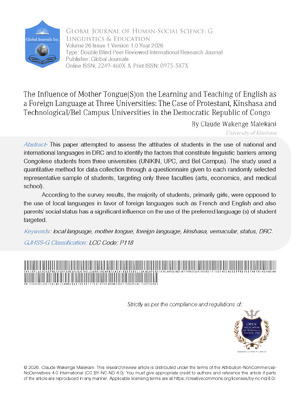
The Influence of Mother Tongue(s)on the Learning and Teaching of English as a Foreign Language at Three Universities: The Case of Protestant, Kinshasa and Technological/Bel Campus Universities in the Democratic Republic of Congo
## I. INTRODUCTION
### a) The Problem
We all know that a mother tongue has an impact or influence on learning additional languages, particularly in an EFL context like the Democratic Republic of Congo, and choosing the dominant language among different background languages of students to use in class to enable those students with low levels of English or French to understand the lesson may be a challenging task.
Given the short study time- once or twice a week and other considerations, some Congolese students of English find it challenging to master English because it is studied in the DRC as a foreign language.
While French is used throughout the nation as an official language in the government, the media, the courts of justice, and other formal situations, it is also taught for a longer period of time.
Therefore, the majority of students at Universities of Congo including foreigners (African students from neighbouring countries) studying in
Kinshasa do not have a unique and the same mother tongue, but study in a language (English) both as a subject and medium of instruction that they do not have the command of it. As an illustration, there are cases where a person speaks different basic languages, including a Congolese one and a second Congolese language, or a Congolese and a foreign language. That is to say a person who has been greatly exposed to a non Congolese language such as French since birth alongside the Congolese language(s), may become more competent in the second language.
We cannot deny the reality that some students have a very difficult time reading or even writing in English correctly, particularly when it comes to completing a scientific work like a bachelor's or final term research paper.
People generally use one language in tandem with another in a multilingual environment like the DRC because we are exposed to many languages at once as children, making it challenging to speak only one language. Thus, the idea of mother tongue is delicate.
The concept 'mother tongue' initially defined by UNESCO (1953) in terms of chronology and language competence. In some cases, it is not always easy to identify the dominant language especially where a multilingual person uses several languages alternatively for different circumstance.
Many people develop different mother tongues and are exposed to several languages. These several languages may be grouped into four categories: vernacular languages, national languages, official language and one foreign one. At the vernacular (tribal) level, they are dispatched geographically throughout the country such as Kilega, Kipende, Kinande and so on.
The second level includes the four national languages, i.e kikongo, Kiswahili, lingala and Ciluba. The official language, French, is at the third level, and the foreign language, English, is at the fourth level. If we are to use the UNESCO definition of competence, it is vital to keep in mind that some students have two mother languages because of things like the rural exodus, travel, etc.
## II. AIM OF THE RESEARCH
The study used four objectives, which are:
1. What language do they use most the time at the university
2. To evaluate students' opinions on the national and international languages they use.
3. To look into how social standing affects language learning.
4. Identifying circumstances (factors) that might make learning or using a foreign language difficult.
## III. A REVIEW OF LITERATURE
Due to the differing viewpoints of instructors, educators, and researchers, the use of the mother tongue (MT) in EFL classes continues to be a hot topic of discussion.
The use of the first language is widespread and natural in foreign language instruction, according to certain academics like Carless (2001), and it appears to positively affect the learning process.
The absence of the mother tongue is also viewed by Macaro (1997) as being unworkable and depriving learners of a crucial instrument for language learning.
Nunan and Lamb (1996) claim that foreign language instructors are unable to forbid the use of the mother tongue in their classes.
Because there are few opportunities to utilize the foreign language outside of the classroom, Lu (1985) notes that it is strongly advised to speak in your mother tongue.
Sharma references Auerbach (1993) in 2006:81) not only recognises the usefulness of the mother language in the classroom but also offers suggestions for its application in managing the class, addressing intercultural challenges, giving directions, clarifying mistakes, and assessing comprehension.
While promoting the use of Mother tongue in FL education, it is crucial to remember that there are no standards for the appropriate dosage of Mother tongue use.
Cook (2001) lists the efficiency, learning, naturalness, and external relevance criteria for using the Mother tongue.
Efficiency refers to using the Mother tongue to complete a task more successfully.
The use of the students' Mother tongue raises the question of whether Foreign Language (FL) learning is improved by it. In terms of specific topics, naturalness refers to whether students prefer to use their Mother tongue or FL.
The mother tongue's ability to assist students with FL applications they may require outside of the classroom is the final indicator of external relevance.
The last criterion may be connected to using English for communication; it may speak to commonplace subjects, practical knowledge, and pragmatic language like speaking or taking part in internet discussions in English.
Despite the fact that these criteria may be helpful in clarifying the general teaching circumstances for using the MT with regard to a particular class or topic, they are in no way a replacement for the formal guidelines, which should be defined practically and in terms of particular topics, situations, and frequency.
The two trends in language policy in post-colonial Africa that are evident in sociolinguistic literature are those that outright reject colonial Western languages because they are thought to be incompatible with African interests and those that aim to coexist or compromise between Western and African languages. Professor Malekani has demonstrated both of these trends in his article.
The leaders of the first trend include James Nguzi and Franz Fanon, whereas Professor Ayo Bambose and others have backed the second approach (1991).
The promotion of a national language that could be made official and the preservation of a certain level of national multilingualism are two more themes that may be found within the realm of local African languages.
Belgian language disputes were frequently imported into Belgian Congo during the colonial era, as described in Wardhaugh (1986) and Kutumisa (1983).
As part of its divide-and-rule colonial strategy, Belgium saw any proposal for the creation of a single Congolese language as harmful for fear that it might serve as justification for national unification in the event of independence.
Indigenous languages were not established because, on the one hand, they would be a logistical nightmare and, on the other, they were intended to communicate the traditional traditions that the colonial authority had vowed to defend alongside the Christian church.
Due to their cultural neutrality and demographic representation, the inter-ethnic or regional languages Ciluba, Kikongo, Kiswahili, and Lingala were thought to be intriguing.
Thus, texts for schools and newspapers were published in these four languages, with a focus on the first three given that Lingala was then thought to have a smaller demographic proportion.
The Belgians permitted only a small number of Congolese to receive an education in French while permitting only restricted usage of these vernacular languages in primary schools (for the same reason mentioned above).
The four languages' sociolinguistics followed the same pattern as the language policy:
Lingala for the army, as military bases were typically built in Lingala-speaking regions:
In Kivu's plantations, Ciluba and Kiswahili were spoken and Eastern Province, while Bandundu's crops and railway building sites employed Kikongo.
According to Fabian (1989), there were three guiding ideas for Belgian colonial language policy:
Limiting multilingualism, which poses a challenge to the administrative order; rationally developing the major indigenous languages to prevent the emergence of a sense of national identity;
As a result of these three guiding principles, a language policy with three tiers of languages was developed, including:
a) French at the top as a contact language used only by a small number of Congolese;
b) The four common vernacular languages used as official languages in the various provinces of the nation;
c) Local dialects that are not featured in official media.
In contrast to the Belgians, the British and Portuguese permitted local indigenous languages to develop further in line with their cultural values, whilst the French allowed an African elite from the French colonies to develop this language in the same way as the French themselves.
The post-colonial era (1960-) Seminars, seminars, and conferences have been held to address the language issue, primarily, as previously indicated, focussing on the potential selection of a national language to replace French as the official language (Polome 1968; Bokamba 1976; Huta-Mukana 1984).
Due to political, economic, and social considerations, the sociolinguistics of the four common languages has significantly evolved since then.
For obvious reasons, Lingala has grown significantly in importance under the Mobutu dictatorship, much as Kiswahili has for both the same and opposite reasons.
Some studies have advocated for a single national tongue.
### a. The selection of Lingala
In a well-researched article, Professor Ntahwakuderwa (1986) promotes Lingala as the national language and one of the official languages and elaborates on Lingala's main asset, that of supporting the political leadership of the time, as the attitude of politicians has always played a significant role in the choice of a national language, citing the example of Kiswahili in Tanzania and making comments on the Arusha Declaration where Tanzanian citizens would have equal rights
It is crucial to note additional significant Lingala advantages, which are likewise supported by numerous earlier publications:
1. The music of the Congo uses it.
2. The Army's use of it.
3. Its use in Kinshasa, the nation's capital.
4. Many
students' impressions of the Lingala language are that it is a simple language.
### b. The decision to choose Kiswahili
For his side, Professor Kamwangamalu (1997) argues for the following reasons in support of Kiswahili as the country's official second language and national language:
1. Since Kiswahili was brought to Congo from Tanzania and Kenya and the majority of persons who speak it also speak other indigenous languages—many of which are not one of the four national languages—no one in Congo can claim that Kiswahili is an ethnic language.
Thus, Kiswahili would be regarded as a universally neutral language.
2. Kiswahili has a wider national and international distribution and diffusion than the other national languages.
3. Even though the literary tradition of Kiswahili is not more developed than that of other national languages in the DRC, it is developed outside the DRC and includes dictionaries, grammars, journals, poems, courses at foreign universities, and broadcasts on foreign radio stations.
As a result, the government would spend less money purchasing instructional materials to teach Kiswahili. Without outright disagreeing with Professor Ntahwa's viewpoint on Lingala, it is nevertheless critical to place them in some context:
a. Even though Lingala is still primarily used in Congolese music, it is important to remember that other languages have been used in the past, most notably Kiswahili with Wendo, Bombenga, and other musicians; additionally, phrases from other languages are still used in Congolese music today.
b. Its use in the army is now shared with Kiswahili from the AFDL (politico military party for liberation of the Democratic Republic of Congo);
No language is completely easier than others, depending on the psycholinguistic, sociolinguistic, and pedagogical aspects unique to the situations concerned. The capital Kinshasa is gradually importing other national languages, as can be seen in buses and other public areas.
Without disputing the core of Professor Kamwangamalu's argument in regards to Kiswahili, it is crucial to clarify its boundaries:
1. There is ongoing disagreement among scientists on the precise timing of the arrival of Kiswahili into the Congo.
2. According to some analysts, such as Professor Nkulu (1984), this introduction must have happened much earlier than the 19th century, given the prosperous trade interactions that must have occurred centuries
ago between chiefs of Katange and Tanzania who all spoke Kiswahili.
3. The Congolese ethnicity of Kiswahili is effective, despite the fact that it is more recent than certain others, according to this argument.
4. Although it should not be overstated, the use and spread of a language abroad may have some influence at home. The establishment of a single official national language is more influenced by national factors.
5. The pedagogical benefit is still restricted in that even in its standardized form, the variety of Kiswahili taught in schools shouldn't stray too far from everyday usage, bringing Kiswahili back up to par with other languages.
6. In the end, Kiswahili continues to have an undisputed political edge over other languages due to its broader circulation and internal diffusion in Congo.
Additionally, in post-colonial Congo, the sociolinguistic status of the four Congolese languages has undergone a significant transformation.
Lingala has gained recognition as a genuine contender to become a distinct national and official language throughout this time.
The continuous use of Lingala in the army, music, and the military coup in 1965 are some of the most important political, social, and economic reasons that have raised the sociolinguistic status of the language (Kutumisa, 1987; Malekani, etc.).
The sociolinguistic pyramid.
The explanation above leads to the conclusion that the languages spoken to some extent in the Democratic Republic of Congo (DRC) can be arranged in a pyramid with the following four levels:
1. The 240-250 vernacular languages, comprising several dialects, at the bottom.
2. The second-level study of the four national languages
3. Third-level French, the official language
4. And at the fourth, with brackets, the foreign language, English! (why?)
French and the four national languages have a diaglossic relationship, with French being the High (H) and the National languages being the Low (L).
One of the hallmarks of diaglossia, according to Ferguson (1954), is that H is more prestigious than L and has more specialized roles and areas of application in the community.
Despite the increasing use of national languages in some official institutions and the fact that, according to some researchers, only a small portion of Congolese people use French (for example, Rubengo: only $30\%$ speak it and only $25\%$ write it correctly), French continues to be very popular in the present.
The four national languages and the vernacular languages are believed to share a similar relationship since during the two years of primary school, the national languages were used as the medium of instruction.
Despite the proposals made to some previous governments by a number of Congolese scientists who gathered at conferences and colloquia in one or more cities of the Democratic Republic of Congo (DRC), the debate on the use of the first language in the teaching of foreign languages, particularly at the university level, has not yet been resolved in this country.
In order to put into practice what UNESCO advises, which states that "the child learns best exclusively in his mother tongue," the focus was placed on using the mother tongue in higher education and achieving official status similar to that of French.
The use of L1 is either rejected or ignored by certain teachers in the English-speaking world at the moment. Teachers in the English-speaking world today can be divided into two groups: those who heavily employ L1 and those who reject it or fail to see the advantages or possibilities of the home tongue. More importantly, mistakes made by pupils can help teachers better understand the interlanguage abilities of their students.
An article by Professor MALEKANI (2001) on Mother tongue effect published in African review of educational sciences after investigation, revealed that students (in Kisangani) are trilingual, as seen by the MT-effect aggregate scores, which clearly demonstrate that despite the small appearance of France, the scores for the three languages are roughly equal.
It may seem strange that a foreign language (in this case, French) may serve as an MT for another language, but this is understandable when you consider how dominant French is in modern Congolese classrooms.
This result has the effect that any CA, EA, IL, or other applied linguistics study that includes the Congolese area covered by this study will need to account for three MTs instead of one.
## IV. METHODS
In order to use the quantitative method and collect data, the researcher has made use of tools like a questionnaire and observation. The data will be presented in the form of tables.
This questionnaire was divided into two main parts: Sociolinguistic and psycholinguistic. The questionnaire is an important tool in this data collection process, though it is mainly used in quantitative and survey research.
This study targeted three universities, one of which was a public state university (UNIKIN) and two private ones (UPC and Campus). The researcher collected the data from a questionnaire given to this randomly selected sample of students, and the tables below show the exact number of these students distributed according to the classes and faculties chosen.
To collect data, we used a total of 416 randomly selected students from various universities. Each student was given a survey questionnaire to complete, and we also watched the students as they took classes in the study room to see how they used the language or handled the use of the English language.
## V. PRESENTATION AND ANALYSIS OF RESULTS OF THE SURVEY
Description of Variables: Sex, Age, Number, Major, Level.
Table 1: Gender of the respondents
<table><tr><td>Gender</td><td>Number of respondents</td><td>Percentage</td></tr><tr><td>Male</td><td>236</td><td>56,7</td></tr><tr><td>Female</td><td>180</td><td>43,3</td></tr><tr><td>Total</td><td>416</td><td>100</td></tr></table>
In all these three universities chosen for the study, which are listed in this table, there are more boys than girls overall among survey respondents.
Table 2: Age Group of the Respondents
<table><tr><td>Age</td><td>Number of Respondents</td><td>Percentage</td></tr><tr><td>18-24</td><td>297</td><td>71,4</td></tr><tr><td>25-32</td><td>119</td><td>28,6</td></tr><tr><td>Total</td><td>416</td><td>100</td></tr></table>
As the percentage in the table above clearly shows, the majority of participants in this table appear to be young, that is, between the ages of 18 and 24.
Table 3: Institutions/Universities
<table><tr><td>Universities</td><td>Number of Respondents</td><td>Percentage</td></tr><tr><td>UNIKIN</td><td>208</td><td>50</td></tr><tr><td>UPC</td><td>175</td><td>42,1</td></tr><tr><td>BEL CAMPUS</td><td>33</td><td>7,9</td></tr><tr><td>Total</td><td>416</td><td>100</td></tr></table>
Most of the students attending the three universities chosen for the study come from Unikin, next UPC, and finally Bel Campus.
Table 4: Different Faculties at these Three Institutions.
<table><tr><td>Faculties</td><td>Number of Respondents</td><td>Percentage</td></tr><tr><td>Arts</td><td>208</td><td>50</td></tr><tr><td>Economics</td><td>175</td><td>42,1</td></tr><tr><td>Medical School</td><td>33</td><td>7,9</td></tr><tr><td>Total</td><td>416</td><td>100</td></tr></table>
Students from the faculty of Arts (UNIKIN), next those from Economic Sciences (UPC), and finally those from Medical school (Bel Campus), were those who responded to the survey the most, as was the case, according to our observation.
Table 5: Various Classes Selected from these Three Universities for Investigation.
<table><tr><td>Classes/Level of Study</td><td>Number of Respondents</td><td>Percentage</td></tr><tr><td>First year</td><td>124</td><td>29,8</td></tr><tr><td>Fourth year</td><td>146</td><td>35,1</td></tr><tr><td>Final year</td><td>146</td><td>35,1</td></tr><tr><td>Total</td><td>416</td><td>100</td></tr></table>
Looking at the table above, we can see that there are two classes (fourth year and last year) with an identical number of participants, which means that these two classes have more students than the first year.
## VI. RESULTS AND DISCUSSION
The study revealed that most of the respondents (mainly men) think that learning a foreign language does not require having a native language, and French is by far their most frequently used language (90%). The majority of respondents (70%) are students at the University of Kinshasa, followed by those at UPC (20%) and Bel Campus (10%). 100% of the respondents from these three target universities disagreed in the slightest with the idea of learning a foreign language using the local language. Two faculties' respondents strongly disagreed, and most of them respondents who agreed came from the Faculty of Arts.
In terms of age, the majority of responders are between the ages of 18 and 24, with only a small number in the 25–35 range. Ninety percent of our respondents are fourth and final year students at undergraduate level.
The study also found that students can use two or more foreign languages, (48%), primarily at the University of Kinshasa, while others not (40%) at UPC or Bel Campus or Bel Campus (12%).
The study confirmed what the vast majority of respondents to our questionnaires indicated that the use of the national language is significantly influenced by the social position of the parents. At this level, it's likely that the majority, if not all, of respondents in these universities concur that speaking a native language is a barrier to learning a foreign language.
## VII. CONCLUSION
Even though they occasionally speak local languages in or outside of the classroom (study room), the majority of students (especially female students) prefer to follow lessons or courses in foreign or international languages, according to the same questionnaire. The respondents' ages ranged from 25 to 32 years.
Additionally, regardless of their university, every respondent felt that using two or more national or foreign languages in the study room helps them understand the lecture.
We also see that the use of the preferred language(s) in some academic and social contexts is significantly influenced by the social position of the parents.
Generating HTML Viewer...
References
23 Cites in Article
D Atkinson (1987). The mother tongue in the classroom: a neglected resource?.
Olugbenga Orisasona,E Ajani,S Babatunde,B Omitoyin,E Osho,O Kareem (1994). Operational characteristics and financial performance of African catfish hatcheries under different management systems in Ibadan, Nigeria.
D Buhmann,B Trudell (2008). The Mother Tongue and Second Language Learning.
B Chittaranjan (2014). Role of Mother tongue in Teaching -Learning English.
D Dalby (1985). THE LINGUISTIC ASPECT OF STYLE IN AFRICAN LANGUAGES.
P Garret (2010). Attitudes to language.
M Georgieva (2014). Introducing sociolinguistics.
John Gumperz,Jenny Cook‐gumperz (2012). Interactional Sociolinguistics: Perspectives on Intercultural Communication.
A Kim,S Kim (2008). Bistnupriya (Manipuri) speakers in Bangladesh: A Sociolinguistic Survey.
B Kimputu (1978). Sociolinguistic situation in Kinshasa.
K King,C Benson (2004). Indigenous Language Education in Bolivia and Ecuador: Contexts, Changes, and Challenges.
David Klaus (2003). The Use of Indigenous Languages in Early Basic Education in Papua New Guinea: A Model for Elsewhere?.
K Kosonen (2004). Local languages in education in Southeast Asia: Comparartive analysis.
W Labov (1972). Sociolinguistic Patterns.
Tshisalasala Nyembwe-Ntita (1981). De l'utilisation des langues au Zaïre : cas de la chanson.
O Oyewole (2017). Influence of Mother Tongue in the Teaching and Learning of English language in selected secondary schools in Ondo State, Nigeria.
S Pahrina (2014). The influence of mother tongue in speaking English of the Third semester students of English Education study Program of stain Palang Karaya.
Casmir Rubagumya (1991). Language promotion for educational purposes: The example of Tanzania.
P Sabourin (2017). Projections demolinguistiques des populations Francophones, Anglophones et Allophones au Canada: Une analyse par microsimulation.
K Sharma (2006). Mother Tongue use in English classroom.
R Sibanda (2019). Mother Tongue education in a multilingual township: Possibilities for recognizing lok'shin lingua in South Africa.
M Sulaiman,S Husna (2017). The influence of Mother tongue on learning English language by Arab learners.
J Swift (1953). THE USE OF VERNACULAR LANGUAGES IN EDUCATION: THE REPORT OF THE UNESCO MEETING OF SPECIALISTS, 1951.
No ethics committee approval was required for this article type.
Data Availability
Not applicable for this article.
How to Cite This Article
Dr. Claude Wakenge Malekani. 2026. \u201cThe Influence of Mother Tongue(s)on the Learning and Teaching of English as a Foreign Language at Three Universities: The Case of Protestant, Kinshasa and Technological/Bel Campus Universities in the Democratic Republic of Congo\u201d. Global Journal of Human-Social Science, Global Journal of Human-Social Science - G: Linguistics & Education GJHSS-G Volume 26 (GJHSS Volume 26 Issue G1): .
Explore published articles in an immersive Augmented Reality environment. Our platform converts research papers into interactive 3D books, allowing readers to view and interact with content using AR and VR compatible devices.
Your published article is automatically converted into a realistic 3D book. Flip through pages and read research papers in a more engaging and interactive format.
Our website is actively being updated, and changes may occur frequently. Please clear your browser cache if needed. For feedback or error reporting, please email [email protected]
Thank you for connecting with us. We will respond to you shortly.
Lorem ipsum dolor sit amet, consectetur adipiscing elit. Ut elit tellus, luctus nec ullamcorper mattis, pulvinar dapibus leo.
The Influence of Mother Tongue(s)on the Learning and Teaching of English as a Foreign Language at Three Universities: The Case of Protestant, Kinshasa and Technological/Bel Campus Universities in the Democratic Republic of Congo
Dr. Claude Wakenge Malekani<p>University of Kinshasa</p>