
I. INTRODUCTION
As SARS-CoV-2 is highly infectious virus that impacts communities around the globe, vaccines are the most significant measure of public health and the most effective approach for protecting the population against COVID-19. The competitive effort for the discovery and development of COVID-19 vaccines against the spread and disastrous consequences of the illness is ongoing with the creation of new, more effective vaccinations as the pandemic passes. The distribution of vaccines is in the process and the acceptance of COVID-19 immunizations by the community must be investigated.
Bangladeshi officials approved. On 27 January 2021 the Bangladeshi authorities decided to utilize the Indian vaccination Covidshield; Runu (A Nurse) was the first COVID-19 receiver.
Bangladeshi officials approved. However, there is a large debate among the general people of Bangladesh over COVID-19 vaccines. A fraction of the people of Bangladesh hesitate to take the Indian vaccination so that they are not infected. A worldwide COVID-19 research showed that 48 percent of the study population had misunderstandings with the COVID-19 vaccines and were doubtful about their vaccination.
In this study our main goal is to evaluate the Knowledge, Attitude and Practice of taking Covid-19 vaccination among the rural and urban people in Patuakhali District.
II. OBJECTIVE
- To assess the Knowledge, Attitude and Practice of taking Covid-19 vaccination among the rural and urban people.
III. METHODOLOGY
a) Types of study
- It was a cross sectional study.
b) Place and period of the study
- The study place was carried out at Tertiary medical College Hospital, Patuakhali District. Bangladesh. Where data were collected from July 2020 to May 2021.
c) Study population
- A total of 120 participants where in rural 60 participants and in urban 60 participants were included in the study. Sample were collected through purposive sampling as per inclusion criteria.
d) Method
- Data were collected by using a pre designed questionnaire. The questionnaire was prepared reviewing literature and consulting with medical research experts.
e) Data analysis
- All collected data were coding and input in SPSS-25 for further analysis. Both descriptive and inferential statistics done. Descriptive statistics included frequency distribution, percent, mean, standard deviation; graph, tables, figures and inferential statistics.
IV. RESULTS
In table-1: Shows distribution of the respondents by age where in rural group highest 23 (38.33%) respondents belong to 32-43 years and in urban group highest 31 (51.66%) respondents belong to 44-55 years. The following table is given below in detail:
| Age group | RuralFrequency (n=60)(%) | UrbanFrequency (n=60)(%) |
| 20-31 years | 13 (21.67) | 06 (10) |
| 32-43 years | 23 (38.33) | 16 (26.67) |
| 44-55 years | 18 (30) | 31 (51.66) |
| 55 above years | 06 (10) | 7 (11.67) |
| Total | 60 (100%) | 60 (100%) |
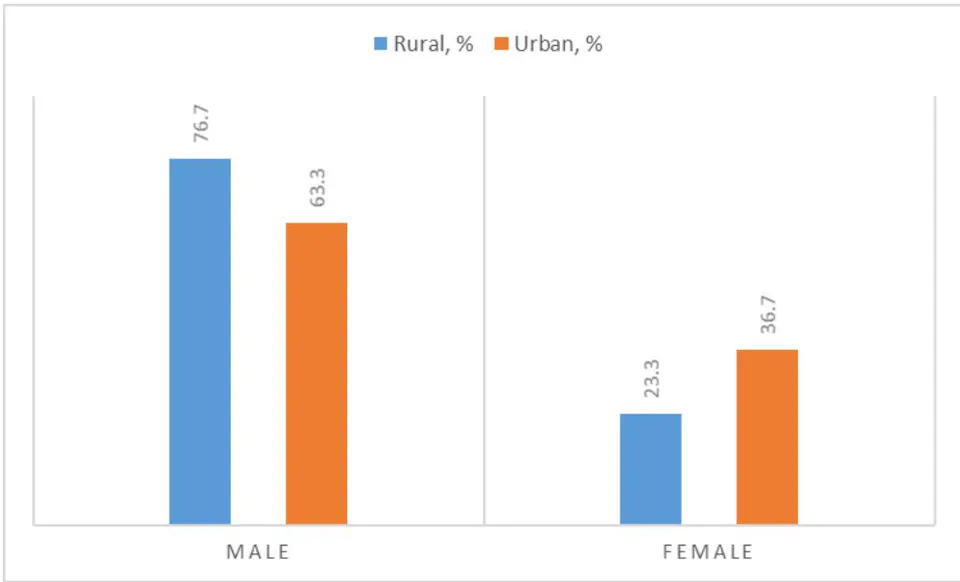
It was found from the table no. 2 that in rural area highest 30 (50%) respondents were HSC passed followed by primary 13 (21.7%) and in urban area highest 25 (41.25%) respondents were HSC followed by graduate 18 (30%). The bellow table is given in details.
| Education | RuralFrequency (n=60)(%) | UrbanFrequency (n=60)(%) |
| Primary | 13 (21.7) | 05 (8.33) |
| SSC | 05 (8.33) | 12(20) |
| HSC | 30 (50) | 25 (41.67) |
| Graduate | 12 (20) | 18 (30) |
| Total | 60 (100%) | 60 (100%) |
Table-4 Explores the distribution of the respondents by knowledge related factors and association with gender of rural & urban area. The association of Covid-19 infected status between rural & urban respondents were highly significant (P=0.00), similarly knowledge regarding first vaccine in Bangladesh also highly significant (p=0.02) between rural & urban respondents. Another findings regarding knowledge related factor regarding the lowest age range for this vaccination was moderately significant (p=0.03), finally knowledge related factor regarding the way to take the vaccine was also significantly associated (p=0.04) between the respondents of rural & urban area, beside the knowledge related factors the other variables were not significantly associated. The following table is given below in detail:
| Knowledge items | Rural | Urban | P value | ||
| Male Frequency (n=46) (%) | Female Frequency (n=14) (%) | Male Frequency (n=38) (%) | Female (n=22) (%) | ||
| Have you ever been infected to covid-19? | |||||
| Yes | 22 (47.8) | 8 (57.14) | 22 (57.89) | 12 (54.54) | 0.00 |
| No | 24 (52.2) | 6 (42.86) | 16 (42.11) | 10 (45.46) | |
| Any of your family member ever got infected to covid-19? | |||||
| Yes | 25 (54.35) | 7 (50) | 20 (52.63) | 8 (36.36) | 0.584 |
| No | 21 (45.65) | 7 (50) | 18 (47.37) | 14 (63.64) | |
| Do you have any Knowledge of covid-19 vaccination? | |||||
| Yes | 38 (80.61) | 10 (71.73) | 34 (89.47) | 19 (86.36) | 0.317 |
| No | 8 (19.29) | 4 (28.27) | 04 (10.53) | 03 (13.64) | |
| When did Bangladesh started corona vaccination? | |||||
| January 2021 | 33 (71.73) | 8 (57.14) | 30 (78.95) | 18 (81.81) | 0.210 |
| February 2021 | 13 (28.27) | 6 (42.86) | 8 (21.05) | 4 (18.19) | |
| What is the name of first corona vaccine in Bangladesh? | |||||
| COVISHIELD-Oxford | 30 (65.22) | 8 (57.14) | 30 (78.94) | 19 (83.36) | 0.002 |
| Sputnik V-Russia | 6 (13.04) | 3 (21.42) | 8 (21.06) | 3 (16.64) | |
| Pfizer-USA | 8 (17.39) | 2 (14.28) | 00 | 00 | |
| Sinovac-China | 2 (4.33) | 1 (7.16) | 00 | 00 | |
| How many corona vaccines dose need to take in this country? | |||||
| 1 dose | 5 (10.86) | 4 (28.57) | 3 (7.89) | 4 (18.18) | 0.591 |
| 2 doses | 41 (89.14) | 10 (71.43) | 35 (92.11) | 18 (81.81) | |
| After the first dose of vaccination how many days it takes for the second dose? | |||||
| 60 days | 40 (86.95) | 12 (85.71) | 35 (92.10) | 22 (91.66) | 0.378 |
| 45 days | 06 (3.05) | 02 (14.29) | 3 (7.90) | 02 (8.34) | |
| What is the lowest age range for this vaccination?• 25 years• 40 years | 20 (43.47)26 (56.53) | 4 (28.57)10 (71.43) | 8 (21.05)30 (78.95) | 05 (22.72)17 (77.28) | 0.03 |
| What is the way to take this vaccine?• Present directly to the health center• Firstly, to register on the web website• I don't know | 8 (17.39)34 (73.91)04 (8.70) | 04 (28.57)08 (57.14)02 (14.29) | 8 (21.06)30 (78.94)00 | 4 (18.18)18 (18.82)00 | 0.041 |
Table-5 Find out the distribution of each attitude and practice item and gender of rural & urban area. The association of Covid-19 vaccine taken status between rural & urban respondents were highly significant (P=0.00), similarly the opinion regarding so many rumors about corona vaccine also moderately significant (p=0.03) others attitude and practice related factors were not significantly associated. The following table is given below in detail:
| Description | Rural | Urban | P value | ||
| Male n=46% | Female n=14% | Male, n=38% | Female n=22% | ||
| Have you taken the vaccine?YesNo | 16 (34.78)30 (65.22) | 5 (35.71)9 (64.29) | 25(65.79)13 (34.21) | 17 (77.27)5 (22.73) | 0.00 |
| Is there any side effect of corona vaccination?YesNo | 14 (30.43)32 (69.57) | 4 (28.57)10 (71.43) | 8 (21.05)30 (78.95) | 4 (18.18)18 (81.82) | 0.148 |
| After taking the vaccine is there any side effect seen?FeverBody achePain in inject areaOthers | 09 (19.56)15 (32.61)20 (43.48)02 (4.35) | 02 (14.29)03 (21.43)08 (57.14)01 (7.14) | 06 (15.79)10 (26.32)22 (57.89)00 | 02 (9.09)08 (36.36)12 (54.55)00 | 0.256 |
| There are so many rumors about corona vaccine, do you believe those?YesNo | 12 (26.09)34 (73.91) | 5 (35.71)9 (64.29) | 03 (7.89)35 (92.11) | 4 (18.18)18 (81.82) | 0.039 |
| Are you tensed about the side effect of corona vaccine?YesNo | 12 (26.09)34 (73.91) | 5 (35.71)9 (64.29) | 05 (13.16)33 (86.84) | 04 (18.18)18 (81.82) | 0.120 |
| Do you think the related person should be more concern about corona vaccine?YesNo | 32 (69.57)14 (30.43) | 9 (64.29)5 (35.71) | 33 (86.84) 05 (13.16) | 18 (81.82)04 (22.73) | 0.119 |
| Would you share the right information to your family friends and society?YesNo | 46 (100)00 | 14 (100)00 | 38 (100)00 | 22 (100)00 | 0.163 |
V. DISCUSSION
During the study, knowledge was significantly associated with education, monthly income of a family, and previous vaccine uptake experience. However, attitudes were significantly associated with only gender and earlier vaccine administration experience. Importantly, the majority of participants showed positive attitude towards COVID-19 vaccine.
Knowledge regarding COVID-19 vaccinations negative correlation observed in terms of participants' gender. This finding is similar to studies concerning knowledge towards COVID-19 (not vaccinations) conducted in Bangladesh which reported that males had marginally higher scores in knowledge regarding COVID-19 than females.
However, this finding is inconsistent to studies concerning knowledge towards COVID-19 (not vaccinations) conducted in Bangladesh which reported that males had marginally higher scores in knowledge regarding COVID-19 than females.
These discrepancies of knowledge found in our study on COVID-19 vaccinations are possibly due to limited government exposures to information or publicity on COVID-19 vaccinations since the vaccine rollout started. In addition, the potential under-reporting or misinformation of data on the seriousness of incidence and mortality of COVID-19 may reduce concerns about vaccine safety or indeed make residents of Bangladesh reluctant to seek information on either COVID-19 or related vaccinations. Thus, it is essential to support community members by providing easy access to trusted, evidence-based vaccine information.
According to our study, participants with a higher level of education were found to have more knowledge about COVID-19 vaccinations, which is also supported by previous research. Similar scenarios were found in other earlier studies in Bangladesh, illustrating that individuals with a higher educational background showed more knowledge regarding COVID-19.
It may be the case that more educated people are more knowledgeable and concerned about their health and well-being, through access to more information sources, and become more engaged in life events that could impact them, such as COVID-19 vaccinations.
People who have received any vaccine earlier were found to have more knowledge regarding COVID-19 vaccinations in this study. A recent study in China evaluating COVID-19 vaccine acceptance found that people who were previously vaccinated against influenza were more likely to accept the COVID-19 vaccine, which was also demonstrated in a study in Hong Kong.
This tendency among people may be due to previous positive experiences from vaccination. The level of knowledge about COVID-19 vaccinations were significantly higher among people living in the urban areas, compared to rural areas. This is supported by an earlier study in Bangladesh which demonstrated significant correlation between COVID-19 knowledge and urban location. However, our finding is inconsistent with a recent study which found more accurate knowledge about COVID-19 among people in rural areas in Bangladesh.
In the present study, over 80% of participants had more positive attitudes towards COVID-19 vaccine. This association is in line with a previous study on attitudes towards dengue vaccination conducted in Indonesia [35] and attitudes towards COVID-19 carried out in Bangladesh.
In our study, in participants assumed that the recently discovered COVID-19 vaccine (the vaccine currently being used in Bangladesh) could have some side-effect, which is similar to a study in the US. A study in China found that 48% of respondents postponed vaccination before confirmation of the safety of the vaccine, which shows their doubt regarding vaccine safety. Worryingly, the exceptionally rapid pace of vaccine development, the skepticism of certain groups of science and health experts might elevate doubt about COVID-19 vaccine.
VI. CONCLUSION
The COVID-19 pandemic is still experiencing worldwide disasters and lives, but a possible ray of hope for the future can be found with the COVID-19 vaccine. The findings recommend immediate programs of health education and that the respective health authorities should provide more accurate information. In order to decrease vaccine relief enabled and promoted by disinformation in the media, policymakers should take efforts to provide appropriate understanding, favorable attitudes and views of COVID-19 immunization.