
I. INTRODUCTION
Fires continue to tear apart our planet. Such types of fires as forest fires are becoming an increasingly acute problem around the world affecting life on our entire planet. In just the past few years, large fires have besieged a number of countries, including the United States, Canada, Ukraine, Australia, Spain, Portugal, Russia, Turkey, and Brazil, and even such regions as Greenland and Northern Europe [1-6].
According to the National Fire Protection Association (NFPA), over the past 3 years, 40,000 buildings have been destroyed in the United States alone, 100 people have died and almost $ 40 billion in insured losses have been paid due to wildfires.
According to preliminary estimates, the United States spends no less than $ 2 billion a year on fighting wildfires.
As it gets hotter and drier in the world, most experts believe wildfires will become even more intense in such regions as Australia, California, the Mediterranean, and Central Eurasia.
Global fire protection associations are working on new standards and practices that address wildfires. One of the ways to increase efficiency of fighting against forest fires and fires in general is the use of automated systems for detecting and extinguishing fires.
The aim of this article is working and studying the method for extinguishing fire with the use of automated fire safety system based on reactive fire systems.
The following tasks are solved herein:
- Drawing up an analytical review of the use of liquid rockets to extinguish fires.
- Development of a new method of extinguishing a fire.
- Creation of an automated system for use in the method of reactive fire systems.
II. ANALYTICAL REVIEW OF THE USE OF LIQUID Rockets TO EXTINGUISH FIRES
It is known that in cases of firefighting in hard-to-reach places (such as forest fires) in our country and abroad use helicopters, light and medium aircraft that discharge water or special liquid for fire, such as AN-32P (Ukraine), SN-415 Canada) and even heavy transport aircraft S-130, DM-6 (USA), IL-76 (Russia) [1- 6] The disadvantage of this method is the low efficiency due to the high values of the resistance of the aerodynamic and output streams of combustion products from fire at a small plane of extinction.
It is known the air delivery of the water in special suspended tanks and targeted discharge of water into the centre of the forest fire when the helicopter hovers over the centre [7].
The disadvantage of this method is the weak and uneven spraying of water, which leads to a small area of effective extinguishing, significant non-target water losses due to constant rocking of the water tank. The presence of powerful ascending and descending air currents affects the accuracy of the aircraft relative to the fire zone, as the helicopter can rarely fly at an altitude of less than above the forest fire due to this.
There is a method of extinguishing fires using a number of devices from launchers with fire extinguishers. They are launched with a single or volley launch. The fire extinguishers have equipped with an explosive fire extinguishing agent. A satellite tracking system to extinguish the fire is used.
Necessary aeration and scattering of explosives are provided by the rupture of the charge remotely at a height of from the ground level to extinguish from above the tops of the forest. They are can use contact breakers. They are triggered by contact with trees or the ground, providing extinguishing ground fire [8].
The disadvantage of this method is the high dependence of the speed of fire extinguishing on the time of arrival of fire extinguishers from storage to starting devices and staff readiness. Personnel carry out work to prepare and launch fire extinguishers.
There is a method of using traditional high-explosive and high-explosive munitions to extinguish forest fires.
The disadvantage of this method is the danger of its use due to the possibility of re-ignition [9].
III. PROBLEM DEFINITION THE ANTIFIRE ROCKETS AUTOMATED MULTIPLE LAUNCH ROCKET SYSTEM
A method of extinguishing fires using an automated safety system based on multiple launch rocket systems is working [10].
The Global fire protection associations are working on new standards and practices that address wildfires. One of the ways to increase efficiency of fighting against forest fires and fires in general is the use of automated systems for detecting and extinguishing fires.
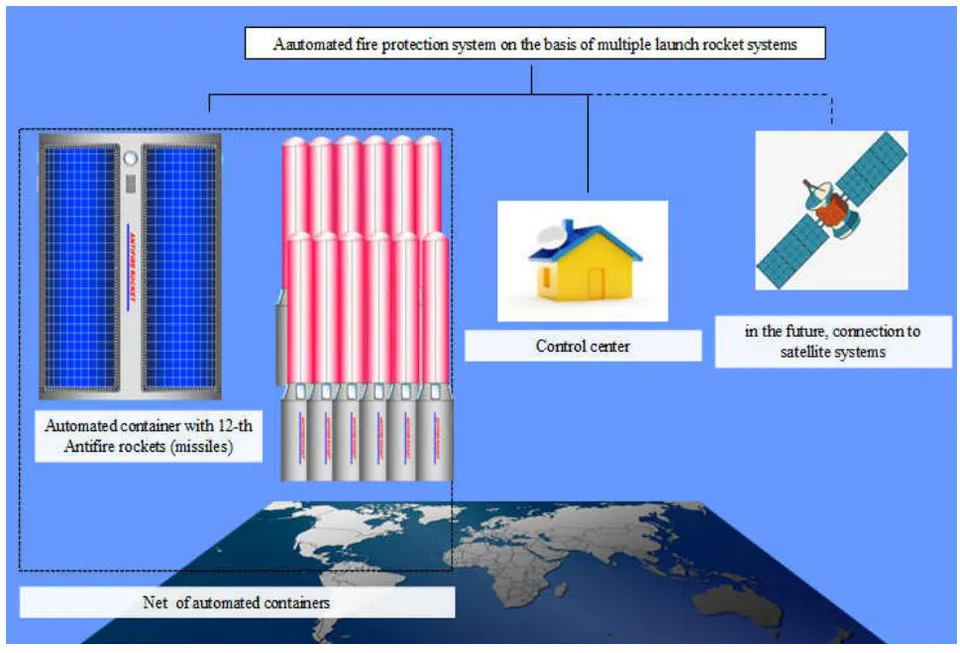
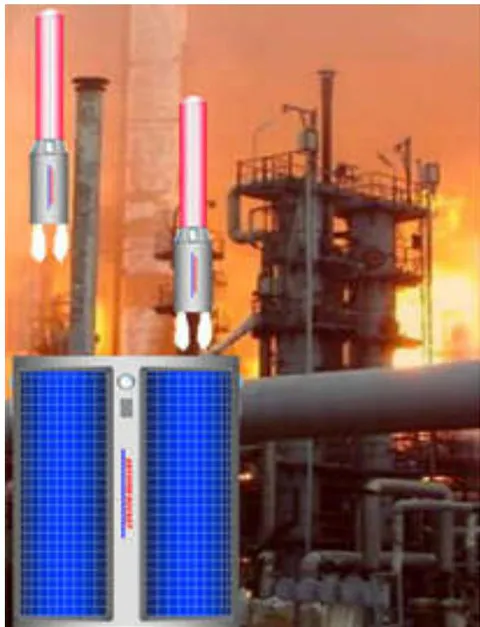
The «Antifire Rockets» automated multiple launch rocket system is a network of transport-launch containers. This network of transport-launch containers is managed by the Center for Remote Monitoring and Control, and if necessary, information from Earth remote sensing satellites can be used.
At the same time, the autonomy of the transport-launch container while identifying and launching missiles in the automatic mode for extinguishing fires is preserved. System composition are depicted in Fig. 1.
The "smart" firefighting missile it self consists of two units: a unit with a fire extinguishing agent and a reusable jet drone.
System composition the Transport and Launch Container are depicted in Fig. 2.
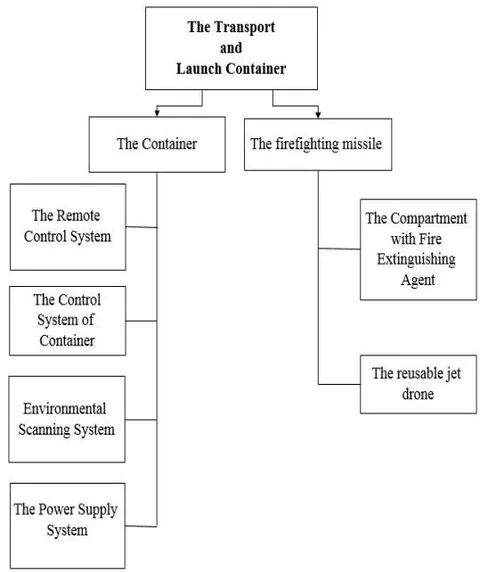
The jet drone is equipped with the necessary sensors, smart avionics, and controlled jet engines, which allows the firefighting missile to bypass obstacles while flying to the target.
Launch of Antifire Rockets are depicted in Fig.
The "charge" of one robotic firefighting missile is capable of spraying a fire extinguishing agent over an area of ( square feet). One container contains twelve robotic firefighting missiles, which makes it possible to extinguish twelve ignitions or a forest fire with an area of ( square feet).
In the event of lacking firefighting missiles when extinguishing a fire from one transport-launch container, neighboring transport-launch containers from the network will be connected to extinguish the fire.
The "charge" of one robotic firefighting missile is capable of spraying a fire extinguishing agent over an area of ( square feet).
One container contains twelve robotic firefighting missiles, which makes it possible to extinguish twelve ignitions or a forest fire with an area of ( square feet). In the event of lacking firefighting missiles when extinguishing a fire from one transport-launch container, neighboring transport-launch containers from the network will be connected to extinguish the fire.
The compact dimensions of the transport-launch container allow it to be transported in the back of a conventional pickup truck.
Initially, the system was considered as a means of extinguishing fires in high-rise buildings. But it can also be safely put in defense of densely populated areas and megacities, in industrial areas.
There are dangers of contamination with hazardous substances during a fire, as well as objects on the water surface.
Unlike existing vehicles for extinguishing fires, «Antifire Rockets»:
- Do not depend on the state of the road surface, traffic jams, and landscape drops, like the fire fighting vehicles;
- Do not depend on weather conditions, like firefighting aircrafts;
- Do not require preparatory measures and deployment of fire brigades.
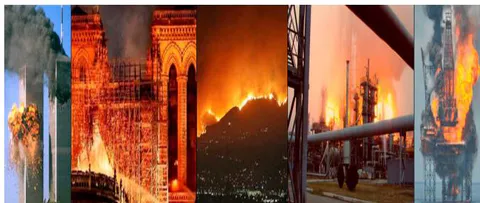
Types of fires are depicted in Fig. 4.
Along the way, this system can not only monitor the surrounding area in order to detect ignitions, but also provide relevant information in real time for law enforcement agencies, hydrometeorological services, as well as provide sparsely populated areas with wireless communication, etc.
Achievements of Ukrainian scientists will help to solve the issue of prompt fire extinguishing at the stage of ignition and thus save the population and business from more global damage and, as a result, colossal insurance payments.
IV. CONCLUSION
The research papers dedicated the method for extinguishing fire with the use of automated fire safety system based on reactive fire systems.