## I. INTRODUCTION
Entrepreneurial orientation (EO) is the behavior, structure, and process of an organization characterized by risk-taking, proactiveness, and innovativeness (Lumpkin & Dess, 1996; Wiklund & Shepherd, 2003; Walter et al. 2006). It is an important notion applied by business leaders in creating strategies to venture into novel things and take up opportunities strategically ahead of other organizations (Bonillo, 2017; Lumpkin and Dess 1996).
Entrepreneurial Orientation represents one construct that is connected to firm's success (Palmer et al., 2019; Semrau et al., 2016; Wales et al., 2013). The entrepreneurial orientation appears to be focal construct in entrepreneurship and strategic management fields in recent years (Morris and Kuratko, 2002; Palmer et al., 2019). Knight et al. (2004) argues that entrepreneurial Orientation is seen as a cultural construct consisting of a firm's level of risk-taking, innovativeness and proactiveness (Covin and Slevin, 1989; Miller, 1983).
Within the economy, there are several challenges facing SMEs which tend to undermine their growth and market penetration. Some of the notable challenges include lack of access to finance which tend to limit business expansion and growth. The only available finances from commercial banks attract huge interest and possess complex conditions which are impossible for the SMEs to meet. It therefore means SMEs will require grants and support from the government to succeed in the market. In addition, SMEs also face the challenge of lack of training and managerial skills at the leadership level. It means employees lack necessary training that will equip them with modern business operations in the market. Training for the employees can be done by the government or non-profit organizations.
In Nigeria, there is no precise and straightforward definition for small and medium scale business. Through its Monetary Policy Circular No. 22 of 1988, The Central Bank of Nigeria defined small-scale enterprises as having an annual turnover not exceeding 500,000 naira. The Nigeria Bank of Industry (BOI) define micro businesses as those with less than or equal to 10 employees, less than or equal to 5 million naira total asset value and turnover of less than 20 million naira. The Bank of Industry further classified small enterprises as those with greater than 11 but less than 50 employees and, total assets of more than 5 million but less than or equal to 100 million naira with an annual turnover of less than 100 million naira. Medium businesses are classified by BOI as those with between 51 to 200 employee, 100 to 500 total assets and 100 million annual turnover (Bank of Industry, Nigeria 2020).
There is also an expanding literature among the scholars which explores the theory of social capital and its relation to firm's performance (Appiah-Gyimah, 2018; Criado-Gomis et al., 2017; Hernandez-Carrion et al., 2017). Studies state that through social capital, individuals in a business network can harness their resources to create competitive advantages over other businesses. Accordingly, all firms are always searching for business strategies that can generate a competitive edge over rivals. Previously, firms become successful by having good managers, clear division of labor and well-designed procedures. But as has been observed by (Appiah-Gyimah, 2018), these orthodox techniques are quickly becoming obsolete in the current world of dynamic businesses. Consequently, social capital is becoming relevant.
The business market is now changing very fast. Businesses need leaders or owners who are innovative, creative, and critical thinkers. The leaders also need to think independently and to establish business relations that will lead to collaboration. The benefits associated with the growth of SMEs to the local Nigerian economy are increasing each year. Stam (2014) also indicated that; social capital indirectly affects firms' performance by giving the business owners access to competitive abilities, access to information, legitimacy, emotional support, and capital inform of finances. Social capital is also known to enhance the internal resources of a business.
Introduction of capacity development strategies such as financial management, human resource and talent development as well as information management system have a direct connection with organization performance. For example, financial management is defined as the process of managing different financial resources to ensure profit maximization goal is attained (Boma, 2018). Its goal is to ensure that available financial resources are utilized to maximize the outcomes of business. It therefore means that capacity development has a great effect on entrepreneurial orientation towards business performance. Organizational performance can mostly be improved by training the employees and system automation that helps to increase employees' motivation levels (Serrat, 2017). This study empirically demonstrates how entrepreneurial orientation (EO) affects Business Performance (BF), in the context of Social capital and capability development in Nigeria.
## II. LITERATURE REVIEW
# a) The
Entrepreneurial orientation is defined as the behaviors, structures, and processes of an organization characterized by risk-taking, being proactive, and innovativeness. It is a crucial concept applied by business leaders in creating strategies to venture into novel things and take up opportunities out of the rich of other organizations (Bonillo, 2017; Lumpkin and Dess 1996).
The term entrepreneurial orientation became famous with growing literature on organizational performance and entrepreneurship in the 1980s. But up to the early 2000s, researchers yet have divergent opinions on what constitutes entrepreneurship, let alone entrepreneurial orientation. George & Marino (2011) however argued, this disagreement was due to the weakness in measuring variables that the researchers used, but even with this struggle, the progress in the field of entrepreneurship research has been promising.
Furthermore, Dess & Lumpkin (2005) defined entrepreneurial orientation as the process that organizations use in creating strategies for entrepreneurial and decision undertakings. Entrepreneurial orientation has borrowed a lot from other disciplines, including entrepreneurship and strategic decision making. Studies like that of Wiklund Patzelt & Shepherd (2009) have shown that the firms that go the EO way are faced with several issues. Most of the problems that these firms face are in the form of scarce resources and risk-taking. There are always significant problems associated with risk-taking with a limited amount of resources. Therefore, Wiklund Patzelt & Shepherd (2009) indicated that it is not sufficient to have the mere knowledge of the negative and positive effect of firm performance. Estimating the expected magnitude of the use of EO on a business's performance is also crucial.
In addition, a 2012 study on Strategic Entrepreneurial Orientation: Development of a Multi-Dimensional Construct, the researcher highlighted that courses in the fields of organizational strategy and entrepreneurship have, in most cases, developed to separate from each other without collaborations. The two disciplines are focused on two different but related paths. Strategic management focuses on moves that bring about good behavior while entrepreneurship focuses on activities that create opportunities.
### b) Social capital Theory
The concept of social capital was appreciated in the academic field and policy debates in the last two decades (Dubos, 2017). Over the years, the importance of social capital has increased in deciphering social and economic phenomena. Development experts and social scientists have, for years, struggled to explain why development and economic growth often differ across nations or geographical areas that have roughly equal access to market, resources, and technology.
The main argument supporting Social Capital Theory is that embedded and innate in the specific network ties of various social entities are resources, which can be used to the advantage of the individual entity for the achievement of desired goals or predetermined outcomes (Liao & Welsch, 2005; Tsai &Goshal, 1998). Specially, supporters of this theory observed that regular interactions with other actors in the target entity's network generates perceived common norms, codes, common interpretations and understanding (Tsai & Ghoshal, 1997; Woolcock, 2001). This leads to developing honesty, mutual respect, trust and subsequent non-opportunistic behavior thus placing the target business in the position to boost its capability for value creation, resource conversion and resultant performance.
Several attempts have been made to proffer a definition of SC. These capture combinations of the effect, substance and source of social capital (Adler & Kwon, 2002) e.g. "The goodwill available to individuals or groups that is derived from the structure and content of an actor's social relations" (Acquah, Amoako-Gyampah, & Nyathi, 2014) and "the sum of actual and potential resources embedded within, available through, and derived from the network of relationships possessed by individuals or social units (Nahapiet & Ghoshal, 1998, p. 243). Although there is no formal definition for the word social capital, there are commonalities in the existing reports. Social Capital, therefore, relates to the social structures and relationships. It encompasses people knowing each other and building on kindness, trust, respect, and reciprocity. In a recent study, Appiah-Gyimah (2018) defined social capital as the cumulative potential and actual resources present, derived, and embedded from the mesh of the relationships owned by a social unit or an individual.
### c) Conceptual Framework of the Study
The independent variables used are the five dimensions of entrepreneurial orientation: innovativeness, risk-taking, competitive aggressiveness, autonomy, and Proactiveness (Lumpkin & Dess, 1996). Business performance represents the dependent variables, as shown below.
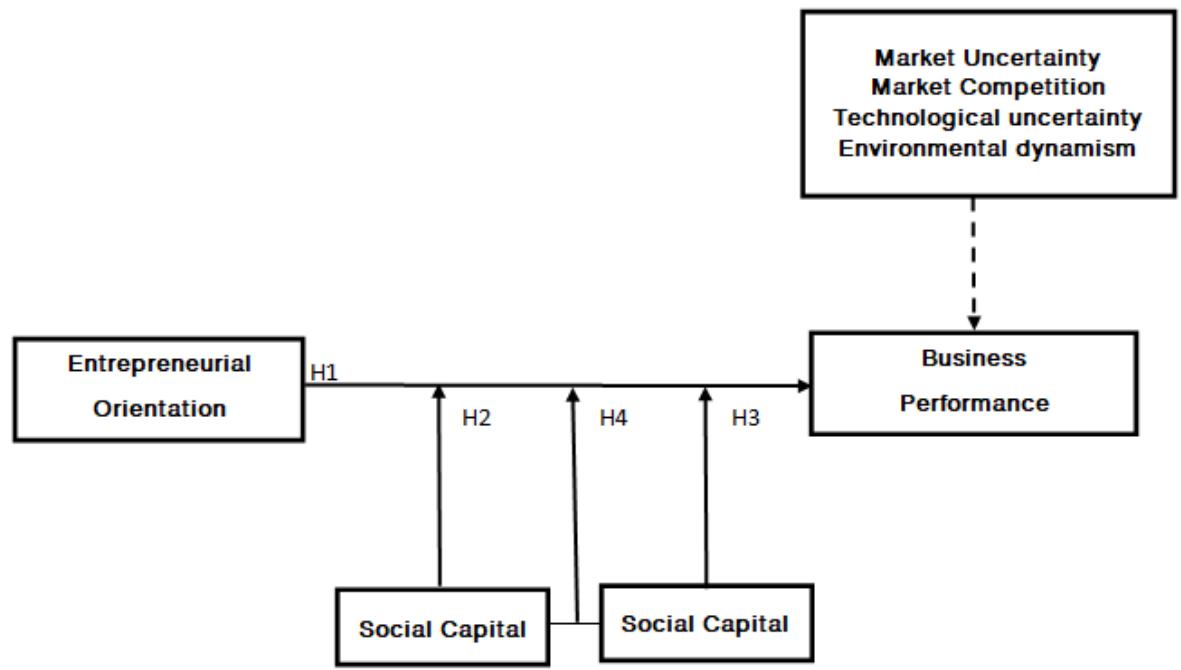
The variables moderating the relationship between entrepreneurial orientation dimensions and organizational performance are social capital and capability development. Also, there are control variables such as market competition, market uncertainty, technological uncertainty and environmental dynamism.
### d) The relationship between Entrepreneurial Orientation and Business Performance
Entrepreneurial orientation is defined as the behaviors, structures, and processes of an organization characterized by risk-taking, being proactive, and innovativeness, autonomy and competitive aggressiveness. It is a crucial concept applied by business leaders in creating strategies to venture into novel things and take up opportunities (Bonillo, 2017;
Lumpkin and Dess 1996). It is also useful for the nation's business propensity for small-scale business owners to be couched and educated to successfully grow their business and contribute to the nation's economic well-being.
The study sought to test the following hypothesis (dependent vs independent variables);
$H_{1}$: Entrepreneurial Orientation can positively affect business performance
# e) The
Entrepreneurs in SMEs are key decision makers, especially in developing economies. Their responsibility includes overcoming resources constraints, which limits the successful execution of the organization's business agenda and may even lead to its extinction. Especially in a volatile and frequently changing business environment, which necessitates the adoption of a management strategy that will position the firm for competitive advantage (Lumpkin & Dess, 1996; Martins & Rialp, 2011; Covin & Slevin, 1989; Cao, Simsek, & Jansen, 2015) the entrepreneur's ability to acquire leading strategic information and resources through his relationships positively affect the firm's business performance.
Further, the study sought to test the following hypothesis (dependent vs. moderating variables - Social Capital);
$H_{2}$: The moderating effect of social capital will enhance the positive relationship between EO and BP.
### f) The relationship between Capability Development of the entrepreneur and Business Performance
Businesses operate in a dynamic and unpredictable environment, these dynamics lead them to revise their routines due to the volatility of the environment (March, 1991). The new routines that the firms develop form the foundation of their knowledge bases. However, along with these new capabilities, the firm also develops the capacity to change routines and integrate them into their operations. The capability that a business owner possesses will play a pivotal role in the business success or failure especially in a period of rapid change and disruptions. We measured Capability Development using a 5 point Likert scale adapted from Madsen, E.L. (2012)
Further, the study sought to test the following hypothesis (dependent vs. moderating variables - capability development);
$H_{3}$: The relationship between EO and BP will be strengthened by capability development as a moderator.
Due to the connection between SC and CD towards business performance, Criado-Gomis et al. (2017) assert the essence of the relationship between social capital and capability development as effectors towards boosting enterprise performance leading to the fourth hypothesis:
$H_{4}$: The combined effect of social capital and capability development as moderators can enhance business performance
## III. METHODOLOGY
Research philosophy refers to assumptions and beliefs about the development of knowledge (Wahyuni, 2012). The effect of new knowledge is not as dramatic as developing a new theory of human motivation but in the sense of answering specific queries. According to Killam (2013), knowingly or not, a researcher makes several assumptions in areas such as epistemology, ontology, and axiology. Epistemology deals with human knowledge. Ontology deals with the realities that a researcher encounters during the research process, and axiology deals with the ways and extent of researchers' values on the research process. The three assumptions are said to be contributing factors in influencing the understanding of the research questions. This study chooses to go the pluralism way decided by several philosophies. Each of the research philosophies is useful in its measure. These are ontology, epistemology, and axiology.
### a) Ontological perspective
This work researched the effect of entrepreneurial orientation on firm's performance and the moderating role of social capital and capacity development, this study uses both the subjective and objective ontological perspectives. The Ontology of the researcher is focused on the nature of its reality (Ward Sr, 2015; Kivunja, 2017). The assumption affects how the researcher sees and studies the research object. It is a proven fact that some scholars think that the ontological perspective is far removed from the intended research project.
The ontological question enables researchers to set a fact-finding mission about the views or what is already known (Adil & Khalid, 2016). In this study, and from the assumption above, business performance is greatly influenced by entrepreneurial orientation, especially through social capital and capability development. Therefore, when viewed subjectively, the social phenomena (business performance) are intrinsically determined by the entrepreneurial orientation factors, i.e., social capital and capability development.
Objectivism accommodate the assumptions in natural sciences claiming that the social reality that researchers investigate is that of external actors (MacLeod, 2015). In other words, objectivism endorses the assumption of ontology. By extension, this is because ontology portrays social reality to be composed of physical entities as part of the natural world. The two exist separately in terms of how a researcher labels them, thinks or knows about them. Objectivism is at the direst form of belief which asserts that all actors share in the only existing way of social reality. That is caused by the experiences and expectations of the social actors that have no influence on the social world's presence.
Subjectivism on the other hand, integrates humanities and arts assumptions, claiming that social reality is caused by human perception and the actors' implications in the social environment (MacLeod, 2015). The main social actors that shape reality are human beings. The viewpoint of ontology through subjectivism is called conventionalism, which is what is regarded as standard. The extremist form of conventionalism considers the structures and order of things in social reality areas due to researchers and other social actors actions. The social actors create a social reality through actions, perceptions, language, and the consequence of their actions. This wise is followed by people who believe that there is no underlying reality of the social world past what social actors make (MacLeod, 2015). Each person has different perceptions regarding existence. As such, there are multiple realities instead of a single reality.
### b) Epistemological perspective
Given that both objective and subjective ontology has been adopted, the researcher used the mixed method research paradigm, the assumptions made include knowing what makes up legitimate and acceptable know-how and how it is shared with others (Marshall & Rossman, 2014). This perspective takes into the shape of what constitutes knowledge through the use of ontology. The legitimate use of ontology epistemology is based on the different forms of experience, including fictional accounts, stories, and narratives, facts of interpretation, visual data, and text. Other social scientists adopt different epistemologies in their investigations (Hofmann, 2013).
Positivism refers to the philosophical standpoint of natural science. It describes the working with an observable social reality to make new generalizations that are law-like. Positivism pushes for accurate and accurate know-how (Marshall & Rossman, 2014).
The origin of interpretivism was from the researcher against the philosophy of positivism (Packard, 2017). As a critic of positivism, interpretivism spans the subjectivist assumptions. The philosophy asserts that humans are not like the physical phenomena due to their essential features of creating meanings. The philosophy of interpretivism claims that people cannot be studied with their social world the same way that scientists learn physical things in their environment. Therefore, the study of the social world needs a take a different perspective.
The pragmatism philosophy postulates that concept should only be used where they support actions (James, 2017). Some people think pragmatism was developed by those who were busy or against using the different options of philosophy available. The origin of the philosophy is traced back to the early years of the US's twentieth century. It is evident (James, 2017) in various philosophers, including John Dewey, James William, and Charles Pierce. It nullifies the inclusion of research concepts, theories, hypotheses, and findings when they do not serve an abstract purpose.
The paradigm emphasizes on the outcomes. The pragmatist study may vary in terms of objectivism and subjectivism (Nissen, 2015). The research approach to the topic or subject is generally characterized by doubts and the urgent sense that something is not going in the right way. It naturally recreates the same beliefs of distrust after the research problem has been determined and resolved. The most crucial part of pragmatist research is the research problem. The resultant research questions also adopt the pragmatic sense regarding the outcome (Sparkes, 2012; (Dewey, 2016).
This study will use the pragmatic philosophy because it appreciates the different approaches and interpretations of the world. It also recognizes that no single point of view can give the entire picture of a subject. It does not entertain the idea that social reality can be explained in a singular tone as pragmatism studies uses mixed methods to study a problem. The chosen methods are only those that are well-founded, credible, reliable, and relevant in collecting data (James, 2017).
### c) Axiology perspective
Axiology focuses on the part of values and ethics in a study process. The stance integrates how social scientists handle personal as well as participant's costs. This stance claims human costs as the guiding reason for all human actions. Rescher (2013) argues that the researcher uses their values as the guiding mantra for all the research practices. A researcher also integrates axiology skills by making judgments regarding the type of research based on values.
### d) Research approach
There are three basic approaches that a researcher can adopt for his research project. These are the abductive approach, deductive and the inductive style.
The Abductive research style is focused on the explanation of puzzles and incomplete observations. The other alternative is the inductive approach, which uses research questions, aims, and study objectives without the inclusion of hypotheses (Imenda, 2014). The deductive approach evaluates the validity of the study hypothesis, theories, or assumptions at hand. It begins with puzzles that lead to research based on explanations (Repko & Szostak, 2020). The study will also take the mixed methods design in which quantitative and qualitative data will be utilized to explore the research question rigorously.
## IV. RESULT DISCUSSION
### a) Initial Data Preparation
Six hundred (600) questionnaires were administered to the Nigeria small and medium enterprises (SMEs); out of which four hundred and two (402) were filled and returned, representing a response rate of $67\%$. The responses were coded and entered into the SPSS software (version 23) where the data was sorted and cleaned. Outliers were identified by employing its command on SPSS software and outliers found were treated by deleting the corresponding responses. The responses were rated on a 5-points
Likert scale where: $5 =$ Strongly Agree $4 =$ Agree $3 =$ Neutral, $2 =$ disagree and $1 =$ strongly disagree.
Normality tests were conducted by examining Kurtosis, Skewness, Shapiro-Wilk test and Komogorov-Smirnov test. It is required that for normality condition to be met, the Sig. value of the Shapiro-Wilk and Kolmogorov-Smirnov is expected to be greater than 0.05 and if less than 0.05, then the data significantly deviate from normal distribution. The result of this study shows that the Shapiro-Wilk and Kolmogorov-Smirnov Test is less than 0.05, hence, the data is not normally distributed. According to Pallant (2013, p.59), the skewness value provides "an indication of the symmetry of distribution" while the kurtosis value provides "information about the "peakness" of the distribution".
### b) Confirmatory Factor Analysis
This study adapted validated scales used by researchers from reputable studies. A confirmatory factor analysis (CFA) was conducted using AMOS 23 to confirm the usability and validity of the measurement constructs. The diagrammatic connections of the interrelationship among the variables is presented in figure 2 below. The variables that made the threshold of 0.5 will be accepted in the CFA. The result shows that variables accepted in the CFA are confirmed and made the threshold of $>0.5$.
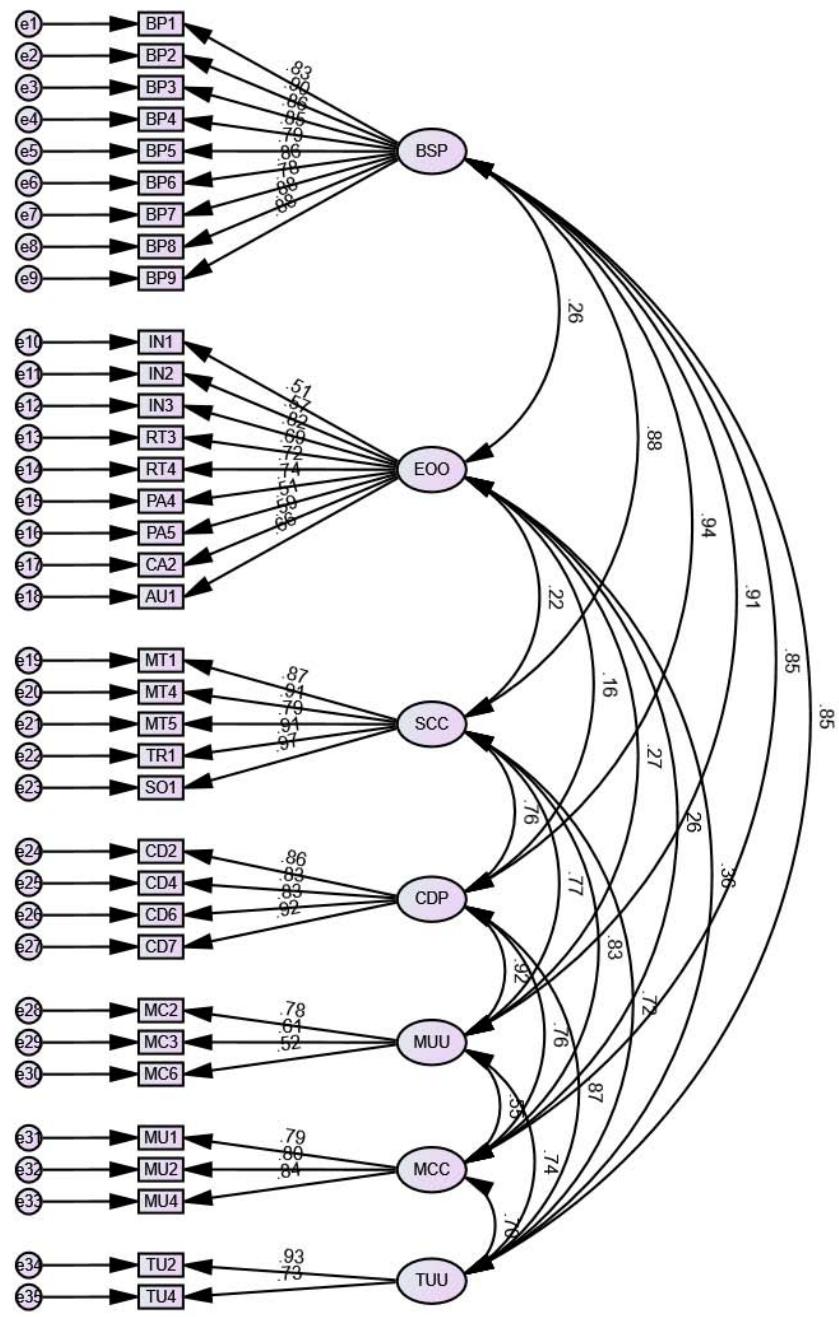 Figure 2: Confirmatory Factor Analysis (CFA)
BP = Business Performance, IN,IR,PA,CA,AU = Entrepreneurial Orientation, MT,TR,SO = Social Capital, CD = Capability Development, MC = Market Competition, MU = Market Uncertainty and TU = Technology Uncertainty.
## V. VALIDITY AND RELIABILITY
Subsequently, the model was tested to determine if it satisfies the requirement for discriminant validity, convergent validity and reliability. The factor loadings from the CFA result was used to compute the Composite Reliability (CR), Average Variance Extracted (AVE) for each individual construct (Fornell & Larcker, 1981; Hjorth, 1993). Factors loadings of 0.5 are accepted, Cronbach alpha $(\alpha)$ values should be 0.6 and above for each of the constructs, which met the recommendation by Nunnally (1978).
The result of reliability and convergent validity test is presented in Table 2
### a) Business Performance
The variable of business performance was measured by using nine items. The construct achieved a Cronbach alpha of 0.958, composite reliability of 0.958 and average variance extracted of 0.72. Subsequent to these findings, convergent validity is met for the variable of business performance.
### b) Entrepreneurial Orientation
The variable of entrepreneurial orientation was measured by using nine items. The construct achieved a Cronbach alpha of 0.807, composite reliability of 0.868 and average variance extracted of 0.50. Given this result, it can be concluded that the variable meets the condition for reliability and validity.
### c) Social Capital
The variable of social capital was measured by using five items. The construct achieved a Cronbach alpha of 0.946, composite reliability of 0.950 and average variance extracted of 0.79. Subsequent to these findings, convergent validity is met for the variable of social capital.
### d) Capability Development
The variable of capability development was measured by using four items. The construct achieved a Cronbach alpha of 0.912, composite reliability of 0.919 and average variance extracted of 0.74. Subsequent to these findings, convergent validity is met for the variable of capacity development.
### e) Market Competition
The variable of market competition was measured by using three items. The construct achieved a Cronbach alpha of 0.665, composite reliability of 0.70 and average variance extracted of 0.50. Given this result, it can be concluded that the variable meets the condition for reliability and validity.
Market Uncertainty
The variable of market uncertainty was measured by using three items. The construct achieved a Cronbach alpha of 0.846, composite reliability of 0.852 and average variance extracted of 0.65. Subsequent to these findings, convergent validity is met for the variable of market uncertainty.
### g) Technology Uncertainty
The variable of technology uncertainty was measured by using two items. The construct achieved a Cronbach alpha of 0.846, composite reliability of 0.809 and average variance extracted of 0.69. Subsequent to these findings, convergent validity is met for the variable of market uncertainty.
Table 2: Reliability and Convergent Validity
<table><tr><td colspan="6">Model Fit Indexes: x2 = 221.870; d.f. = 125; x2/d.f. = 1.775; RMSEA = 0.046; GFI = 0.938; CFI = 0.930; IFI = 0.932; TLI = 0.915; SRMR: 0.069</td></tr><tr><td>Constructs</td><td>Label</td><td>Factor Loadings</td><td>Cronbach's Alpha</td><td>Composite Reliability (CR)</td><td>AVE</td></tr><tr><td>Business Performance</td><td></td><td></td><td>0.958</td><td>0.958</td><td>0.72</td></tr><tr><td></td><td>My firm is usually satisfied with return on investment</td><td>0.837</td><td></td><td></td><td></td></tr><tr><td></td><td>My firm is usually satisfied with return on equity</td><td>0.901</td><td></td><td></td><td></td></tr><tr><td></td><td>My firm is usually satisfied with return on assets</td><td>0.857</td><td></td><td></td><td></td></tr><tr><td></td><td>My firm is usually satisfied with sale growth</td><td>0.851</td><td></td><td></td><td></td></tr><tr><td></td><td>My firm is usually satisfied with employee growth</td><td>0.783</td><td></td><td></td><td></td></tr><tr><td></td><td>My firm is usually satisfied with market share growth</td><td>0.861</td><td></td><td></td><td></td></tr><tr><td></td><td>My firm is usually satisfied with return on sales</td><td>0.786</td><td></td><td></td><td></td></tr><tr><td></td><td>My firm is usually satisfied with net profit margin</td><td>0.88</td><td></td><td></td><td></td></tr><tr><td></td><td>My firm is usually satisfied with gross profit margin</td><td>0.88</td><td></td><td></td><td></td></tr><tr><td>Entrepreneurial Orientation</td><td></td><td></td><td>0.807</td><td>0.868</td><td>0.50</td></tr><tr><td></td><td>In this organization, entrepreneurial behavior is a central principle</td><td>0.51</td><td></td><td></td><td></td></tr><tr><td></td><td>In this organization, innovation is emphasized above all.</td><td>0.571</td><td></td><td></td><td></td></tr><tr><td></td><td>In this organization, people are very dynamic</td><td>0.815</td><td></td><td></td><td></td></tr><tr><td></td><td>In this organization, people are willing to take risks</td><td>0.69</td><td></td><td></td><td></td></tr></table>
<table><tr><td>Owing to the nature of the environment, bold, wide-ranging acts are necessary to achieve the firm's objectives</td><td>0.722</td></tr><tr><td>In our organization, information is often spontaneously exchanged.</td><td>0.739</td></tr><tr><td>In general, the top managers of my firm have a strong tendency to be ahead of others in introducing novel ideas or products</td><td>0.512</td></tr><tr><td>My firm makes no special effort to take business from the competition</td><td>0.602</td></tr><tr><td>My firm has the independent action of an individual or a team in bringing forth an idea or a vision and carrying it through to completion</td><td>0.658</td></tr></table>
Table 2: Reliability and Convergent Validity Cont'd
<table><tr><td>Constructs</td><td>Label</td><td>Factor Loadings</td><td>Cronbach's Alpha</td><td>Composite Reliability (CR)</td><td>AVE</td></tr><tr><td>Social Capital</td><td></td><td></td><td>0.946</td><td>0.950</td><td>0.79</td></tr><tr><td></td><td>During the past three years, you and other top managers at your company have heavily utilized personal ties, networks, and connections with Top managers at buyer firms</td><td>0.87</td><td></td><td></td><td></td></tr><tr><td></td><td>During the past three years, you and other top managers at your company have heavily utilized personal ties, networks, and connections with Political leaders in various levels of the government.</td><td>0.912</td><td></td><td></td><td></td></tr><tr><td></td><td>During the past three years, you and other top managers at your company have heavily utilized personal ties, networks, and connections with Officials in industrial bodies.</td><td>0.785</td><td></td><td></td><td></td></tr><tr><td></td><td>Prior to seeking information/advice from a key contact in my network (e.g., customers, suppliers, and competition) I assumed that he or she would always look out for my interests.</td><td>0.908</td><td></td><td></td><td></td></tr><tr><td></td><td>Prior to seeking information/advice from a key contact in my network (e.g., customers, suppliers, and competition) I felt like he or she cared what happened to me.</td><td>0.966</td><td></td><td></td><td></td></tr><tr><td>Capability Development</td><td></td><td></td><td>0.912</td><td>0.919</td><td>0.74</td></tr><tr><td></td><td>The employees are encouraged to learn from their experience</td><td>0.859</td><td></td><td></td><td></td></tr><tr><td></td><td>The firm has routines which systemize the employees experiences</td><td>0.82</td><td></td><td></td><td></td></tr><tr><td></td><td>Continuous work to be more efficient to gain profit</td><td>0.844</td><td></td><td></td><td></td></tr><tr><td></td><td>The firm accept to a large extent tolerance of error in association with development of new ideas</td><td>0.915</td><td></td><td></td><td></td></tr><tr><td>Market Competition</td><td></td><td></td><td>0.665</td><td>0.676</td><td>0.50</td></tr><tr><td></td><td>There are many "promotion wars" in our industry.</td><td>0.77</td><td></td><td></td><td></td></tr><tr><td></td><td>Anything that one competitor can offer, others can match readily.</td><td>0.612</td><td></td><td></td><td></td></tr><tr><td></td><td>Our competitors are relatively weak.</td><td>0.532</td><td></td><td></td><td></td></tr><tr><td>Market Uncertainty</td><td></td><td></td><td>0.846</td><td>0.852</td><td>0.65</td></tr><tr><td></td><td>Customer needs and product demand change rapidly</td><td>0.79</td><td></td><td></td><td></td></tr><tr><td></td><td>In our sector it is difficult to forecast changes in customer needs and demand.</td><td>0.803</td><td></td><td></td><td></td></tr><tr><td></td><td>New customers tend to have product needs that are different from existing customers.</td><td>0.839</td><td></td><td></td><td></td></tr><tr><td>Technology Uncertainty</td><td></td><td></td><td></td><td></td><td></td></tr><tr><td></td><td>Technological changes provided big opportunities in our industry.</td><td>0.926</td><td>0.809</td><td>0.820</td><td>0.69</td></tr><tr><td></td><td>There have been major technological developments in our industry.</td><td>0.734</td><td></td><td></td><td></td></tr></table>
### h) Correlation and Discriminant validity
The correlation result shows that the highest correlation coefficient was 0.611, which was the correlation between entrepreneurial orientation and social capital, whereas, the correlation between capability development and market uncertainty recorded
the lowest correlation with 0.022. Using the benchmark specified by various authors (Gujarati, 2003; Hair et al., 2010), which indicates that when the correlation coefficient between two regressors is high, that is, greater than 0.8, then there is a problem of multicollinearity. None of the correlation matrix between the variables is close to 0.8, hence, we conclude that the variables are free from multicollinearity problem.
## VI. CONCLUSION
An implication for practice established by this study is that it is important for entrepreneurs to note that capability development should not be targeted at employees alone. It is pertinent to understand that business decision making does not rely solely on the employees but on the entrepreneur himself. Entrepreneurs must attend trainings and develop skills that relates to their businesses. The implication of this is that making informed decisions will enhance the growth and sustainability of the business. As the business environment is highly specialised and competitive, capability development in the chosen field is required to sustain business continuity.
Another significant implication of our findings is in the area of social capital. The access to social networks by entrepreneurs needs to be nurtured, failure to recognise and exploit the embedded resources in social capital will limit the performance in business. Exploring available social capital is expected to expand entrepreneur's social network, hence, the importance of utilizing the available ones.
It has also been revealed from the quantitative study that both social capital $(P <.10)$ and capability development $(P <.10)$ have significant impact on SME performance and positive. The outcome provides key information to entrepreneurs and owners of SME businesses in positioning their firms to take advantage of the benefit of their business social capital and inherent capabilities since such embedded resources has significant impact in improving the fortune of the business.
Interestingly, it has further been revealed from the quantitative study that the effect of social capital and capability development and entrepreneurial orientation was different; the effect of social capital and entrepreneurial orientation is significant and negative, this shows that the relationship between the interaction of social capital and entrepreneurial orientation does not lead to improved business performance. In a similar discovery, the relationship between capability development and entrepreneurial orientation is significant and negative; this also reveals that the congruence of capability development and entrepreneurial orientation will deter growth in business performance. For entrepreneurs that rely on social capital alone or capability development alone as a way of establishing business, the result of the study is a deterrent to them as, social capital alone or capability alone is not sufficient to delve into SME business and expect that the business will perform well.
However, the quantitative study revealed an interesting twist to the above conversation as the combined effect of social capital and capability development on entrepreneurial orientation was significant and positive. This shows that when the duo of both are combined, it will enhance business performance. Business owners therefore can draw from this implication and strive to ensure that in the quest for entrepreneurial activity, they are mindful of who they know, the association they belong to and the contacts and goodwill they have built but, they must also be mindful of the presence of the requisite capabilities required to carry out the business venture they have embarked on.
Finally, the findings of this study revealed that social capital and capability development is a major supportive resources for the execution of entrepreneurially oriented agenda of SMEs. Indeed, in poorly regulated and structured business environments such as exists in Nigeria and many developing nations, social capital accruing from intra and extra industry connections and capability development arising from training of personnel and deliberate empowerment with relevant skills may well be the differentiator between successful and failed SMEs. SMEs are encouraged to actively pursue these and other source of social capital and capabilities to improve their business in a competitive manner. This researcher however highlights the need for SMEs to closely monitor their allocation of resources in the pursuit of social capital and capability development. There is the need to maintain a delicate balance so that SME performance is not sacrificed on the altar of social capital resources and capability development.
Generating HTML Viewer...
References
59 Cites in Article
Adil Abdul Rehman,Khalid Alharthi (2016). An Introduction to Research Paradigms.
Paul Adler,Seok-Woo Kwon (2002). Social Capital: Prospects for a New Concept.
R Appiah-Gyimah (2018). Social Capital and Small and Medium-Sized Enterprises Performance in Ghana: The Moderating Role of Emotional Intelligence.
M Arief,A Thoyib,A Sudiro,F &rohman (2013). The effect of entrepreneurial orientation on the firm performance through strategic flexibility: A study on the SMEs cluster in Malang.
E Babbie,Iii Wagner,W,J (2018). Adventures in social research: Data analysis using IBM SPSS statistics.
J Brown (2002). The Cronbach alpha reliability estimate.
Qing Cao,Zeki Simsek,Justin Jansen (2015). CEO Social Capital and Entrepreneurial Orientation of the Firm.
Jeffrey Covin,Dennis Slevin (1989). Strategic management of small firms in hostile and benign environments.
Ana Criado-Gomis,Amparo Cervera-Taulet,Maria-Angeles Iniesta-Bonillo (2017). Sustainable Entrepreneurial Orientation: A Business Strategic Approach for Sustainable Development.
Gregory Dess,G Lumpkin (2005). The Role of Entrepreneurial Orientation in Stimulating Effective Corporate Entrepreneurship.
J Dewey (2016). 3 John Dewey.
R Dubos (2017). Social capital: Theory and research.
Andreas Engelen,Gupta,Vishal,Strenger,Malte Lis (2015). Unknown Title.
Anthony Eniola (2014). The Role of Sme Firm Performance in Nigeria.
E Gbandi,G Amissah (2014). Financing options for small and medium enterprises (SMEs) in Nigeria.
Bradley George,Louis Marino (2011). The Epistemology of Entrepreneurial Orientation: Conceptual Formation, Modeling, and Operationalization.
Gerard George,D Robley Wood,Raihan Khan (2001). Networking strategy of boards: implications for small and medium-sized enterprises.
Jörg Henseler,Christian Ringle,Marko Sarstedt (2015). A new criterion for assessing discriminant validity in variance-based structural equation modeling.
C Hernández-Carrión,C Camarero-Izquierdo,J Gutiérrez-Cillán (2017). Entrepreneurs' social capital and the economic performance of small businesses: The moderating role of competitive intensity and entrepreneurs' experience.
T Hewitt,D Wield (1992). Industrialization and development.
Charles Hill,Robert Hoskisson (1987). Strategy and Structure in the Multiproduct Firm.
Marko Hofmann (2013). Ontologies in Modeling and Simulation: An Epistemological Perspective.
S Imenda (2014). Is there a conceptual difference between theoretical and conceptual frameworks?.
William James (2017). What pragmatism means (From Pragmatism)..
Ashkan Khalili (2011). Examining the Relevance of Emotional Intelligence and Organizational Commitment among Employees of Small and Medium Enterprise in Private Sector.
L Killam (2013). Research terminology simplified: Paradigms, axiology, ontology, epistemology, and methodology.
Charles Kivunja (2018). Distinguishing between Theory, Theoretical Framework, and Conceptual Framework: A Systematic Review of Lessons from the Field.
G Knight,S (2004). Innovation, organizational capabilities, and the born-global firm.
G Lumpkin,Gregory Dess (1996). Clarifying the Entrepreneurial Orientation Construct and Linking It to Performance.
Andrew Macleod (2015). Well-Being: Objectivism, Subjectivism or Sobjectivism?.
M Magaji,R Baba,H Entebang (2017). Entrepreneurial orientation and financial performance of Nigerian SMES.
C Marshall,G Rossman (2014). Designing qualitative research.
M Morris,D Kuratko (2002). Corporate entrepreneurship: Entrepreneurial development within organizations.
O Mugenda,A Mugenda (2011). Research methods.
S Muriithi (2017). African small and medium enterprises (SMEs) contributions, challenges, and solutions.
M Nissen (2015). Social Workers and the Sociological Sense of Social Problems: Balancing Objectivism, Subjectivism, and Social Construction.
Helen Noble,Joanna Smith (2015). Issues of validity and reliability in qualitative research.
Chinelo Oribhabor,Chioma Anyanwu (2019). Research Sampling and Sample Size Determination: A practical Application.
Mark Packard (2017). Where did interpretivism go in the theory of entrepreneurship?.
Carolin Palmer,Thomas Niemand,Christoph Stöckmann,Sascha Kraus,Norbert Kailer (2019). The interplay of entrepreneurial orientation and psychological traits in explaining firm performance.
Allen Repko,William Newell,Rick Szostak (2020). Case Studies in Interdisciplinary Research.
Nicholas Rescher (2013). Value Matters.
Thorsten Semrau,Tina Ambos,Sascha Kraus (2016). Entrepreneurial orientation and SME performance across societal cultures: An international study.
A Shehu,R Mahmood (2015). The moderating role of business environment in the relationship between entrepreneurial orientation and business performance among Nigerian SMEs.
Ajay Singh,Micah Masuku (2004). Sampling techniques & determination of sample size in applied statistics research: an overview.
A Sparkes (2012). The Paradigms Debate: An Extended Review and a Celebration of Difference: Andrew C. Sparkes.
Wouter Stam,Souren Arzlanian,Tom Elfring (2014). Social capital of entrepreneurs and small firm performance: A meta-analysis of contextual and methodological moderators.
W Tsai,S Ghoshal (1998). SOCIAL CAPITAL AND VALUE CREATION: THE ROLE OF INTRAFIRM NETWORKS..
Sr Ward,M (2013). Integrating Quantitative and Qualitative Data in Analysis and Interpretation.
D Wahyuni (2012). The Morris Water Maze (is not a Maze) Franroise Schenk.
William Wales,Vishal Gupta,Fariss-Terry Mousa (2013). Empirical research on entrepreneurial orientation: An assessment and suggestions for future research.
Achim Walter,Michael Auer,Thomas Ritter (2006). The impact of network capabilities and entrepreneurial orientation on university spin-off performance.
J Wiklund,D Shepherd (2003). Knowledge-based resources, entrepreneurial orientation, and the performance of small and medium-sized businesses.
Johan Wiklund,Holger Patzelt,Dean Shepherd (2009). Building an integrative model of small business growth.
J Willemse (2010). The forum SA. SME failure statistics.
(2012). ICT for Greater Development Impact: World Bank Group Strategy for Information and Communication Technology, 2012-2015.
Philip Yeboah,Fna Odoi,M Teye,T Yangtul (2015). The growth performance and carcass characteristics of broiler guinea fowls (Numida meleagris) fed on diets containing RE3™ probiotics.
Xiao Zhang,Xufei Ma,Yue Wang (2012). Entrepreneurial orientation, social capital, and the internationalization of SMES: Evidence from China.
No ethics committee approval was required for this article type.
Data Availability
Not applicable for this article.
How to Cite This Article
Blessing Ayemhere. 2026. \u201cThe Moderating Factor of Social Capital and Capability Development as Entrepreneurial Orientation Enablers for SMEs Business Performance in Nigeria\u201d. Global Journal of Management and Business Research - A: Administration & Management GJMBR-A Volume 22 (GJMBR Volume 22 Issue A7).
Explore published articles in an immersive Augmented Reality environment. Our platform converts research papers into interactive 3D books, allowing readers to view and interact with content using AR and VR compatible devices.
Your published article is automatically converted into a realistic 3D book. Flip through pages and read research papers in a more engaging and interactive format.
Our website is actively being updated, and changes may occur frequently. Please clear your browser cache if needed. For feedback or error reporting, please email [email protected]
Thank you for connecting with us. We will respond to you shortly.