A soil hydraulic capacitance is a new physical property related to the interactions between the agro eco-system components soil, water, plant and atmosphere. It gives new quantitative details about the processes control the plant water uptake, ascending of sap and soil response toward the root water uptake under a certain soil moisture regime and climatic changes. The soil hydraulic capacitance, a tank like a plant water reservoir, is being controlled by signals, valves like switches. Three types of signaling devices, Geo, Bio, and weather controlled were discussed. The soil hydraulic capacitance property was first discovered by the author when modeling the wheat root water uptake under saline and drought conditions. Under the latter extreme conditions, treating plants with silica products was the managerial practice used for enhanced plant growth and water uptake. A split-split plot experimental design with four replicates was used to conduct the research in Oraby Village, Maryout area, Alexandria, Egypt in the last year of the most water-scarce decade.
## I. INTRODUCTION
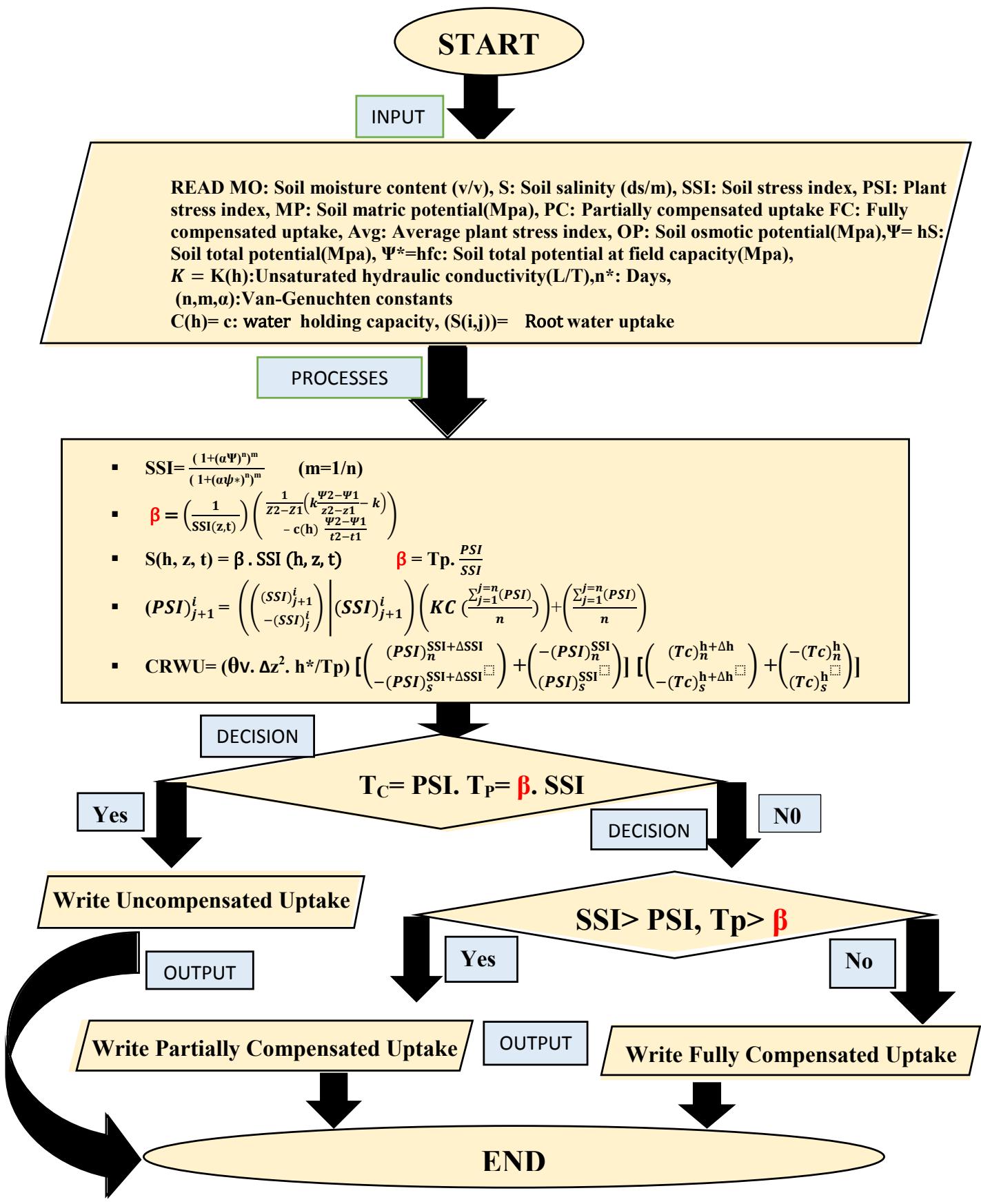 Figure 1: Graphical abstract of AMUN_SHC pseudo-code.
The world will be conquered by exacerbated cycles of drought due to global climatic changes. Shortages in rain-fed agriculture and crops' yield will be caused, unless a restricted environmental policy is followed (FAO, 2020a). As global climatic changes have been blown, rises in the temperature and decreases in precipitation patterns would have attacked earth taking it from the fascinated greenish optimum conditions toward the terrible relative extremes yellow ones. Lots of environmental catastrophes will have threatened the existence of mankind on planet earth due. Worldwide, the U.S. concurrent information system indicated a deteriorating climate situation. $47.81\%$ of the U.S. and $57.06\%$ of the lower 48 states were in a drought in the last week of February 2022. In addition, 200.6 million acres of crops in the U.S. were experiencing drought conditions, 93.1 million people in the U.S. and 91.8 million in the lower 48 states were affected by drought. 32 U.S. states were experiencing moderately worse drought at the latter week (NIDIS, 2022).
Sea level rises, temperature rises, storm surges, floods, and droughts are the main effects of global climatic changes. Moreover, climatic changes hold a series of interrelated side-effects to agriculture such as the deteriorated soil fertility, soil salinization, land degradation, shrunk crops' yields, rise of the freshwater's demand and decrease of the available water's supply (Fig. 2a) (IPCC, 2013). The agricultural drought is determined by dividing the precipitation by evapotranspiration in order to characterize states of moisture's regime. The conceptual definitions of drought focus on the physical processes involved in drought, such as the scarcity of precipitation (meteorological drought), regime in soil moisture (agricultural drought), lack of overland flow (hydrological drought) and shortage of municipal water (socioeconomic drought) (Hereher et al., 2022). Soil faces short periods of wetting cycles and long periods of drying ones now and again. The reason is the increase in soil evaporation due to the rising in air temperature and therefore increasing in plant transpiration (Schoups et al., 2010). Accordingly, the net capillary movement of soil water will have a much moving upward pull during the growing season which accelerates soil salinization. Hence, hydrological systems, especially soils, have been considered as sensitive elements to climatic changes (Hopmans et al., 2008).
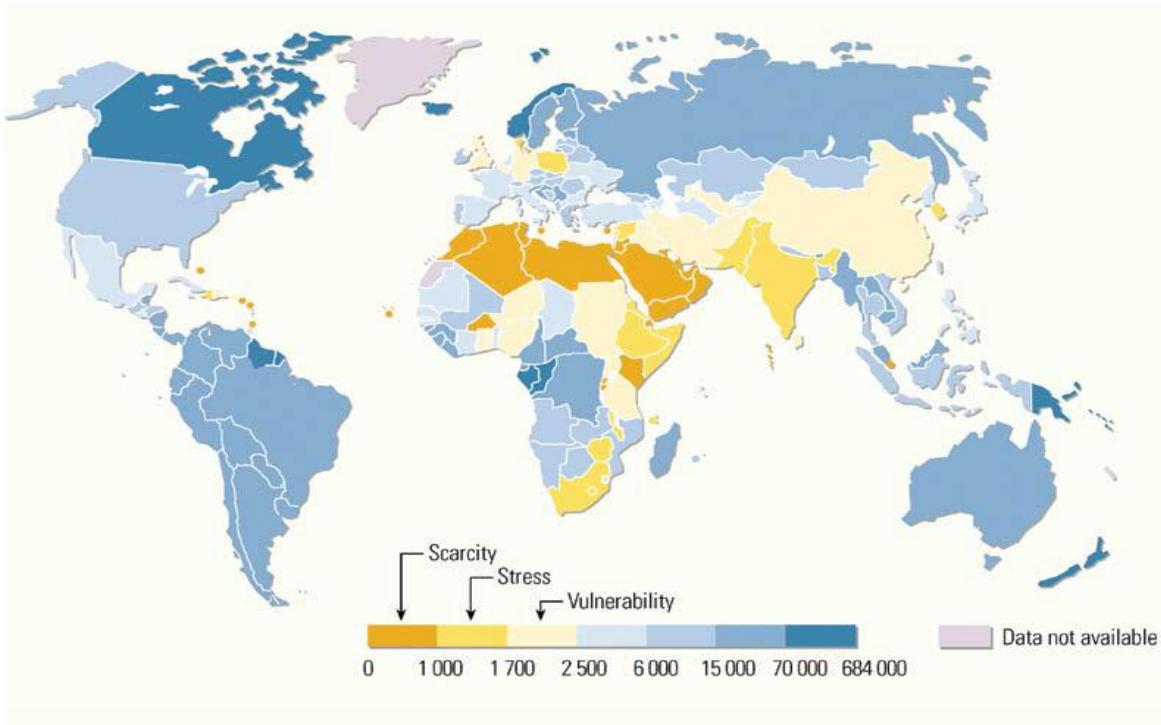
All countries receive drought waves but their frequency, severity and duration may vary from one to another and from region to region. The non-sustainable uses of natural resources, weather variability and climatic changes are the main factors responsible for the drought (Miyan, 2015). Most of the region WANA falls within the hyper-arid, arid and semi-arid zones (Fig.2). As the region is subject to frequent droughts, agriculture is a major and sensitive sector of the economy and consumes most of the water resources. The rain-fed crops are strongly affected by fluctuated precipitations to a degree of an extent that the era between 2000- 2010 is nominated as the decade of water scarcity (ASCAD, 2011). The total number of the people affected by the drought attack in WANA countries between 1970- 2009, is about 38.09 million (Abu Swaireh, 2009). Egypt (Hegazy, 2020), Mauritania, Sudan (Hamid and Eltayeb 2011), Syri a (ASCAD, 2011), and Comoros Islands are examples, not a survey. In the most dried year, a localized famine attacked parts from south Sudan (Hamid and Eltayeb, 2011). In the cropping season of 2009/2010, most of the world's croplands faced severe drought waves which negatively affected the crops' productivity especially where no renewable water resources exist.
Drought, salinity and desertification are the negative consequences of global climatic changes. They are interrelated and common in MENA region as it is located in arid and semi-arid zones where the precipitation are regimes (Fig. 2). The land degradation by salinization and desertification are spreaded where no renewable water resources exist such as in Libya (Abaghandura et al., 2017). Saudi Arabia (Elhag, 2016) and Kuwait (Alsulaili et al., 2022). The Agricultural exploitation of Aridisols under global climatic changes requires special managerial practices to reach the sustainable use. Mapping and monitoring drought and land degradation are vital to keep track and anticipate further degradation and essential for properly and timely interventions to adjust the managerial practices or undertake suitable reclamation and rehabilitation measures especially under climatic changes conditions which increase the shrinkage of mud (Nwer et al., 2013). In the 1970s there were about 1 billion hectares of salt-affected soil worldwide. This survey is still under consideration till 2020 despite the current global climatic changes and their series consequences on agro-ecosystems and food security. For sustainable management and economic exploitation of saline soils, a new survey about their features and distribution should be adopted (FAO, 2020b).
Water is being added in a measure or in some cases a deficit during the sustainable water saving techniques. There is not enough water to rinse the salinans formed either by the irrigation with saline water or by the capillarity rise of water table. It's the water scarcity, which obligates the pedologists to use the deficit irrigation or the low water quality resources for irrigation. The reuse of treated municipal and agricultural waste water, mixing fresh water with saline water, mulching, antitranspirants, silicate fertilizers, shifting to the cultivation of crops that require less quantities of irrigated water and using the concept of virtual water for importing the high water demand crops instead of cultivating them are examples. Saudi Arabia leads the concept of agricultural investments in various countries where the agricultural inputs are available and have a low pricing such as Sudan, Ethiopia, Egypt and Pakistan.
The climatic changes, cause the temperature rises, enhance the subsurface capillarity rises and surface evaporation. Accordingly, salts accumulate in the topsoil. Other factors in that manner are the seawater intrusion, poor drainage system and pedogenic processes related to the parent material (Hereher et al., 2022). The Joaquin valley, California, USA is an example in that context. Approximately 47,000 hectares have been retired due to regional drainage problems and pedogenic factors. On the other wards, the parent materials of marine and lacustrine depositions, being rich in natural salts and shalls, are the primary sources of salinization beside the poor drainage and water scarcity. Another example is the marine and lacustrine depositions in Egypt such as the lacustrine depositions of the lake Maryout and Abees. The water scarcity in these regions brings the agro-ecosystem toward the relative extremes more than that of the non-saline or even saline aeolian depositions widely spread in the African Sahara desert, northern China, southern central Asia, central Europe, Argentina, Alaska and central United States.
It was being believed that water is a priceless resource and it was being forbidden to pay for using it. As a consequence, low water use efficiencies in all fields of municipalities and agro-lands were estimated. The Pricing water is needed not as a punishment to use but as a kind of financial support for the giant projects which deliver the trans-boundary fresh water from where it is a useless renewable resource to where it is a useful one. These projects are unaffordable to be implemented by the developing countries. Although the water pricing is an effective way to achieve the best water use efficiency, sharing the costs of trans-boundary water systems is easier to be implemented in arid and semi-arid zones. By taking Egypt as an example, a pipeline connects the river Nile with the river Congo saves 887MCm being lost with the Congo river's up-stream toward the Atlantic ocean. The 4MCm from the Egyptian cuta being lost in the Mediterranean sea, need to be damned opposite to the surface land flow of Nile's freshwater toward the sea and slurry walled against of the subsurface intrusion of Mediterranean sea. The 11MCm being lost by the evaporation from the lake of Nasser need to be saved by finding another lake in the northern Egypt. The water delivery through pipelines is not a recent idea but a simulation to the Libyan great manmade river implemented by Muammar Gaddafi. As the price of that pipeline is unaffordable, it needs a financial solidarity from all MENA countries which will put its water under exploitation. Arab water and the Peace water are examples (Hegazy, 2022b).
The water holds dissolved salts in a form of soil solution at a high state of energy or high osmotic potential. As the processes of sinking soil moisture take place, the regime of soil wetness causes a negative matric which limits the easy uptake of water and nutrients with plant roots (FAO, 2020b and Ma et al., 2020). The total high energy state of soil water negatively affects the plant growth, plantation properties and yield of many plants but in less degree of extent in halophytes (FAO, 2020b and Hereher et al., 2022). The sink term of modified Richard's equation consists of two components. The first is the soil stress index, SSI, and the second is the soil hydraulic capacitance, $\beta$. The two latter terms are being multiplied to produce the root water uptake. $\beta$ reveals the interaction between the continuum components of soil, water, plant and atmosphere. All degrees of continuum's response and interaction to abiotic stressors fall under the first law of thermodynamics. Soil hydraulic capacitance can be measured with time and depth, $\beta$ (z,t), using two types of probes. The first probe for detecting moisture with time and depth, $\Theta$ (z,t), by the resistivity (Ganiyu et al., 2020). The second for detecting electrical conductivity with time and depth, EC (z,t). The collected datasheet of signals with time and depth are inserted in AMUN_SHC. Improving soil hydraulic capacitance under drought and saline conditions requires a successful in farm and out farm managerial practices for soil, water, plant and continuum's canopy.
(A)
2007
 (B)
1995 - 2025
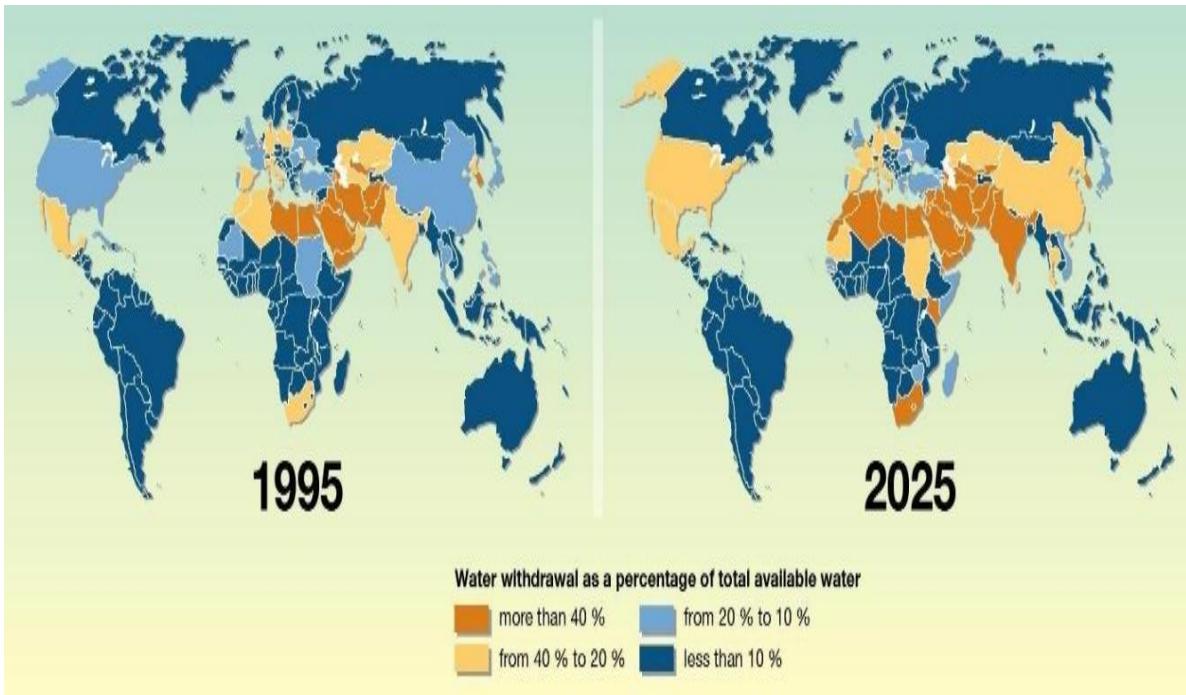 Figure 2: (A): The fresh water availability cubic meters per person per year. (Source: EL-Ashry et al., 2010). (B): The worldwide water stress change from the year 1995 to 2025. (Source: ecomena.org).
The combined abiotic stresses of drought and salinity make the main components of the agro-ecosystem, plant and soil, start their response functions on $(0/1)$ to save the life on planet earth. The soil water becomes less or even unavailable for plant machinery systems in spite their cumulative actions whether they are either additive or multiplicative. The wheat's hydraulic signal could roll leaves in order to reduce the leaf area index and net radiation (Nar et al., 2009) and could inhibit the root growth in the dry topsoil as a response to applied stress. Silicon, the second most abundant element in the earth's crust, can act as plants' first aid for healing the stressed parts to overcome the abiotic extremes (Epstein, 2009). As a response to a highly energetic soil solution, plants increase the uptake of silicon to alleviate the damaging effects of abiotic stresses. The negative interaction between silicon and sodium and the positive interaction between silicon and basic nutrients may stimulate plants to alleviate the side effects of abiotic stresses. Its deposits in roots enhance the elasticity, in tricombs enhance their function in cooling leaves and in leaves increase the water use efficiency under optimal conditions (Elsokkary, 2018) and enhance the transpiration under sub-optimal conditions. Silicon enhances the process osmoregulation which makes the suction head inside the plants' roots to be in a higher negative potential in order to overcome the total potential of soil solution (Hegazy, 2020). Despite of the natural abiotic stresses produced by global climatic changes, the siliceous nutrition of plants is not only scientifically intriguing but also important in a world where more food will have to be wrung from a finite area of land, especially for the deficit irrigation and partial root-zone drying scenarios which will put crops under artificial stress. (Epstein, 2009 and Elkhatib et al., 2017). The aims of this research are to use the stress form of modified Richard's equation to achieve a set of equations, AMUN_SHC. The latter is used to calculate, analyze and discuss the soil hydraulic capacitance and therefore determines the water uptake under stress conditions. Moreover, this research studies the forces control $\beta$, the stress strain relationship, and therefore the ascending of sap under the relative extreme combined stresse conditions.
## II. MATERIALS AND METHODS
All the equations used in the materials and methods section are owned to the author In the present investigation, a field experiment was carried out in Egypt as a major country in the African Sahara desert. An open field experiment was conducted at Oraby village, Maryout area, Alexandria between latitudes $30^{\circ}$: $31^{\circ}$ degree north and between altitudes 30:32 east during the latest most drying year, 2009/2010 (Natural drought and salinity treatments (Fig. 3). Wheat grains, Sakha 94, were sown on November 27th in all field experimental plots and harvested in the first week of May. Fertilization was managed according to the recommendations of the ministry of agriculture this year.
Natural drought and salinity were managed by silica fertilization. The response of wheat to silicon doses was investigated by its addition as potassium silicates and sodium silicates in three concentrations 0.0, 30.6, and $40.8~\mathrm{ppm}$. All of them were foliar sprayed at the ages of 40, 60, and 75 days from seed emergence at the early morning. The 6 treatment combinations were distributed in three salinity levels for saturated soil paste, $\mathrm{ECe} = 6.4$, 9.7 and $10.3~\mathrm{mS / cm}$, in a split-split plot design with four replicates.
In order to calculate soil stress index, soil hydro-physical properties were estimated by HYDRUS- 1D (Vr. 4.17) at depth z dimension (Simunek et al., 2013). $\mathrm{ET}_{\mathrm{C}}$ was calculated from meteorological data according to FAO (2002). The irrigation interval is each 20: 25 day.
Soil moisture values were estimated gravimetrically in two dimensions x and y then converted to soil matric potential. The parallel soil electrical conductivity values were estimated in saturated soil paste and in 1:2.5 suspension, ECe and EC, respectively (Jackson, 1973) using EC meter, at $25^{\circ}\mathrm{C}$ then converted to soil osmotic potential. The soil total potential was calculated using the additive function taking into account the SI unites and prefixes which figurate the states of soil water each day in the wetting and drying cycles.
The soil stress index was calculated from equation (1). The plant stress index was calculated from equation (2). The soil hydraulic capacitance was calculated from equation (3). The strain of straw sap was calculated from the change of straw sap water potential between two days divided by the straw sap of the first one. The FORTRAN programing language was used to model the relation between the soil hydraulic capacitance and plant response functions which start to do on, $(0/1)$, compensation according to. SSIMOD (Hegazy, 2022a). The model assumes that the soil-moisture profile is as a series of capacitors (each of which represents water storage in a given layer), which are linked via the variable (potential-dependent) resistance of unsaturated Darcian flow. When current flows from the atmosphere downward (analogous to infiltration), it charges up the capacitors, causing soil wetting up. That storage is subsequently discharged by continued downward drainage beyond the bottom of the root zone or by upward flow in response to atmospheric evaporation of moisture from the soil surface. Each layer in the root zone is also discharged by roots present within it, and the extracted water thus flows toward and through the stem to the canopy and then to the atmosphere in the process of transpiration, now and then, each wetting-drying cycle (Hillel, 2002). The latter evapotranspiration is weather controlled by the water's upward forces in plant and soil, the surface tension and capillarity (Fig. 4). As the salinity treatments are natural, the salinity levels 10.3 and $9.7\mathrm{mS/cm}$ are combined because both of them are approximately clayey texture and convergent to a similar salinity level.
### a) The AMUN_SHC
$$
\mathrm{SSI} = \frac{1}{1} \quad \begin{array}{l l} & \mathrm{nm} \\& \psi * \end{array} \quad (\mathrm{m} = 1 / \mathrm{n}) \tag{1}
$$
Where
SSI: soil stress index. $\mathbf{\mu}_{\cdot}$ n, m: hydraulic parameter could be predicted by HYDRUS 1D.-4.17 (Simunek et al., 2013). $\Psi$ $\Psi^{*}$: total soil potential at a given temporal or spatial condition and at optimum condition for wheat growth in the field under investigation, respectively. $\Psi^{*}$ could be predicted by HYDRUS 1D.-4.17 (Simunek et al., 2013)
$$
(PSI)_{j+1}^{i} = \left(\frac{(SSI)_{j+1}^{i}}{-(SSI)_{j}^{i}}\right)\left(KC\left(\frac{\sum_{j=1}^{n}(PSI)}{n}\right)\right) + \left(\frac{\sum_{j=1}^{n}(PSI)}{n}\right)
$$
SSI: soil stress index. Kc: crop coefficient. PSI: ratio between actual and potential transpiration. i: soil depth (cm). j: time (days).
$$
\beta = \left(\frac{1}{\operatorname{SSI} (\mathbf{z} , \mathrm{t})}\right) \binom{\frac{1}{Z 2 - Z 1} \left(k \frac{\Psi 2 - \Psi_ {1}}{z 2 - z 1} - k\right)}{ - \mathbf{c} (\mathbf{h}) \frac{\Psi 2 - \Psi_ {1}}{t 2 - t 1}} \tag{3}
$$
- Equation (3) is the stress form of Richard's equation (Hegazy, 2022b)
Where t, z: time and depth respectively (t, l), SSI: dimensionless soil stress index, c(h): soil water holding capacity $(\mathrm{l}^{-1})$, K: unsaturated hydraulic conductivity $(\mathrm{l} / \mathrm{t})$. $\beta$: soil hydraulic capacitance. $\Psi$: soil potential.
$$
\mathrm {S} (\mathrm {z}, \mathrm {t}) = \mathrm {S S I}. \beta = \mathrm {P S I}. \mathrm {S} _ {\max } \tag {4}
$$
$$
Tc_{(z,t)}=SSI.\beta=PSI.Tp
$$
Where
S, Smax: actual and potential water uptake, respectively, Tp: actual and potential transpiration, respectively. The factors affecting the soil hydraulic capacitance are TP, PSI and SSI. The term $\beta$ allows us to study, analyze and compare different groups of soil types, plant species, varieties and atmospheric conditions. This comparison may be either inter, intra or in combination between them. Such a comparison allows us to select from the latter groups the types of components which cause the maximum crop yield with minimum agricultural precise inputs in order to choose the good from the best.
There are three special cases from the soil hydraulic capacitance: as follows:
$\mathbf{Tc}_{(z,t)} = \boldsymbol{\beta} = \mathbf{Tp}, \mathbf{SSI} = \mathbf{PSI} = 1$
This means that soil moisture reservoir of the continuum hydraulic capacitance is able to meet the required potential transpiration and there is no stress and the uptake is uncompensated.
SSI> PSI, Tp> β
This means that the soil moisture reservoir of the continuum hydraulic capacitance is unable to meet all the needs of the plant hydraulic machinery system. Plant roots respond to this moisture deficit by compensatory root growth for compensating water uptake from another layer which has a higher soil moisture reservoir of the continuum hydraulic capacitance (Hegazy, 2022). This type of compensation is called partially compensated water uptake.
SSI< PSI, Tp< β
$\beta$ this means that the soil moisture reservoir of the continuum's hydraulic capacitance is unable to meet all the needs of the plant hydraulic machinery system and there is another soil reservoir that can recover the moisture deficit actually by compensated root growth for compensated water uptake. This type of compensation is called fully compensated water uptake.
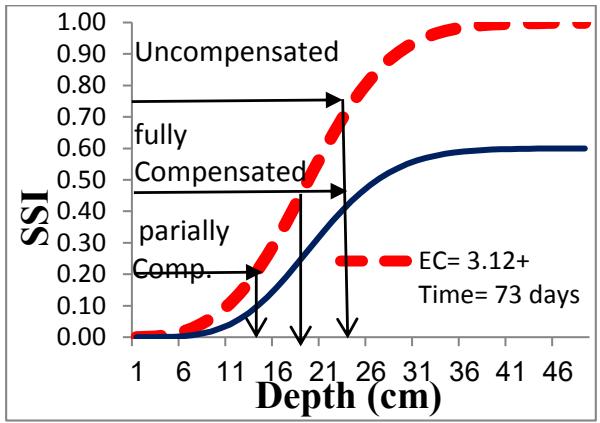
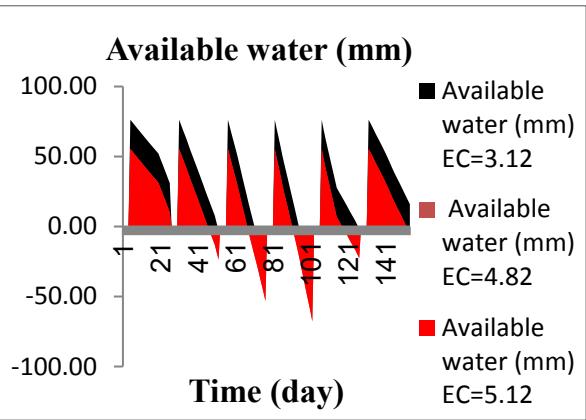 Figure 3: The S shaped SSI with depth (Left). Available water as a response to the combine stress (right).
$$
\mu = (\mathrm{dPSI}|\mathrm{dSSI}) = 1/\omega
$$
Where:
$\mu$: first order derivative of $\mathrm{PSI} = f(\mathrm{SSI})$. dSSI: change in soil stress index. dPSI: change in plant stress index.1/ $\omega$ C: the compensation factor.
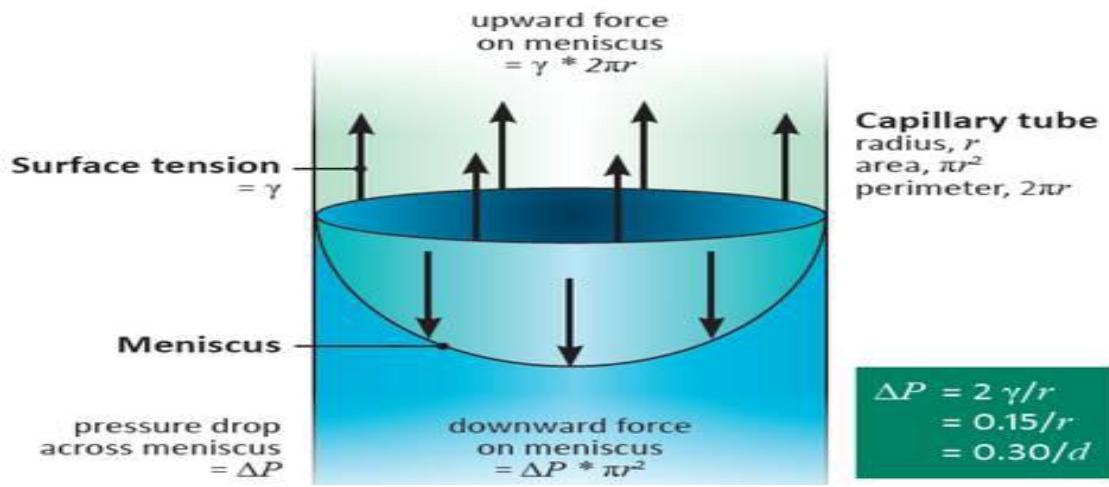 Figure 4: A fully-developed meniscus in a cylindrical tube showing the equality between the upward pull of surface tension and the downward pull of the suction in the water from which the relation $\Delta P = 2\gamma/\mathrm{r}$ can be derived (Bazaraa, 2015).
### b) Modeling the root response to harch extreme moisture regime
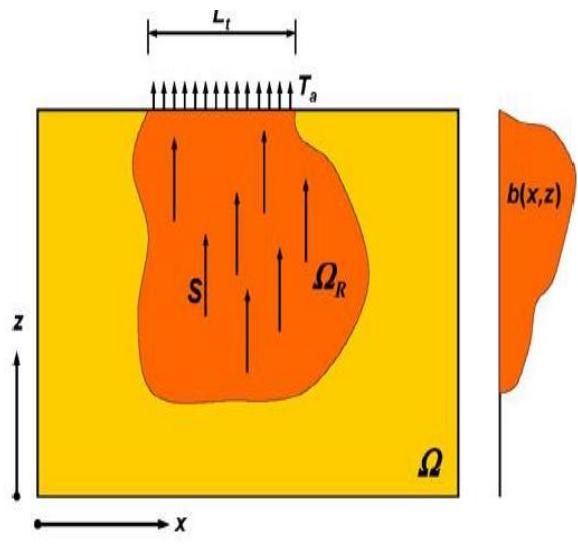
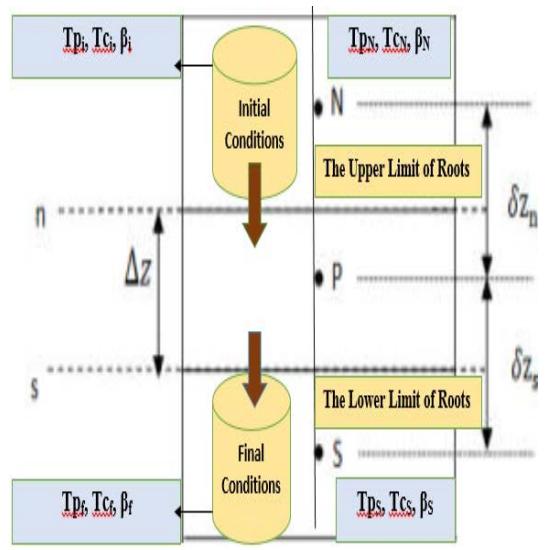 Figure 5: Schematic of the potential water uptake distribution function, $\mathrm{b(x,z,t)}$, in the soil root zone (Left). A control volume from root zone (Right).
$$
\mathbf {S} _ {(z, t)} = \mathbf {S S I}. \boldsymbol {\beta} = \mathbf {P S I}. \mathbf {S} _ {\max }
$$
$$
\mu = d P S I / d S S I
$$
i. Root navigation bath = ∫n,(SSI+ΔSSI) μ dSSI dz= ∫n,(SSI+ΔSSI)(dPSI/
$$
\begin{array}{l} d S S I) d S S I d z = \int_ {s} ^ {n} (\mathrm {P S I} ^ {\mathrm {S S I} + \Delta \mathrm {S S I}} - \mathrm {P S I} ^ {\mathrm {S S I}}) d z \\= \left[ \binom {(P S I) _ {n} ^ {\mathrm {S S I}} + \Delta \mathrm {S S I}} {- (P S I) _ {s} ^ {\mathrm {S S I}} + \Delta \mathrm {S S I}}\right) + \binom {- (P S I) _ {n} ^ {\mathrm {S S I}}} {(P S I) _ {s} ^ {\mathrm {S S I}}} \rbrack (\Delta z). \tag {6} \\\end{array}
$$
ii. Domain root for Compensation $\Omega_{\mathrm{RC}} = \iint_{\pmb {s},(\pmb {h})}\pmb {\mu}\mathrm{d}\pmb{h}$
$$
\mathrm{d}\mathbf{z} = \iint_{s,(h)}^{n,(h+\Delta h)} \left(\frac{d\mathrm{PSI}}{d\mathrm{SSI}}\right) dh dz \tag{7}
$$
## iii. Compensated root water uptake =
$$
\left(\theta \mathrm {v}. \Delta \mathrm {z} ^ {2}. \mathrm {h} ^ {*} / \mathrm {T p}\right) \left[ \binom {(P S I) _ {n} ^ {\mathrm {S S I}} + \Delta \mathrm {S S I}} {- (P S I) _ {s} ^ {\mathrm {S S I}} + \Delta \mathrm {S S I}}\right) + \binom {- (P S I) _ {n} ^ {\mathrm {S S I}}} {(P S I) _ {s} ^ {\mathrm {S S I}}} \rbrack \left[ \binom {(T c) _ {n} ^ {\mathrm {h}} + \Delta \mathrm {h}} {- (T c) _ {s} ^ {\mathrm {h}} + \Delta \mathrm {h}}\right) + \binom {- (T c) _ {n} ^ {\mathrm {h}}} {(T c) _ {s} ^ {\mathrm {h}}} \rbrack \tag {8}
$$
## III. RESULTS AND DISCUSSIONS
# a) The
The plant response under environmental abiotic stressed conditions could be discussed from the side of dynamics in plant roots and shoots used to minimize stress, reduce consumed energy, and maintain water and nutrient uptake. (Arsova et al., 2020 and Munns et al., 2020b). Firstly, plant enhances the uptake of nutrient element responsible for combating abiotic stress, silicon. Secondly, the beneficial functional element, silicon, interact positively with macro and micronutrient and stimulate the biophysical functions inside plant's tissues (Epstein, 2009). Thirdly, Plant responds to applied stress by accumulating osmolytes (Tuna et al., 2008), Silicon also appears to be a part of the osmoregulation within cells subjected to drought stress which enables the plant to uptake and transpirate more water for combating the stressed conditions. (Figs. 6 and 7) (Amin et al., 2014). Fourthly, the wheat's hydraulic signal reduces water loss via transpiration by decreasing leaf area index and increasing leaves rolling (Nar et al., 2009). Fifthly, the adaptive root growth (Clausnitzer and Hopmans 1994), the compensated root water uptake (Simunek and Hopeman, 2009) and root hydraulic redistribution to cope with the heterogeneity in soil moisture regime (Thomas et al., 2020).
The soil system under drought cycles shrinks its energy to the half of its value at the wetting cycles to save plant's life and prevent the plasmolysis (Homaee et al., 2002, Wang et al., 2020, and Hegazy, 2022a). The shrinkage of soil energy exceeds with the existence of salinity beside drought (Hegazy, 2020). Drought concentrates the soil solution, increases its conductivity which is already high due salinity, decreases the thickness of electric double layer, increases the diffused ions swarm (Sposito, 2008) which satisfies the remaining charges of the soil particles electrostatically, and therefore reduces the surface potential of highly energetic clayey particles. Accordingly, drought reduces the free energy of the background soil solution. In fact, it reduces the free energy responsible for the capillarity phenomenon (Fig. 4). Therefore, the in-vitro geo-regulated abiotic stress signal causes two in-vivo strains, the strain of osmoregulation achieved by osmaticum on one hand and the strain of cell turgidity on the other hand supporting plant growth (Nassar and Horton, 1997). At equilibrium, the latter strains are balancing each other to make the biological system holds minimum free energy and maximum entropy.
Silicon increases the water potential of the root's sap (Gong and Chen, 2012 and Amin et al., 2014) and leaf area index (Hegazy, 2022b) which enables plants to uptake and transpirate more water for combating the stressed conditions. Therefore silica enhances the latter in vivo strains (Figs. 6 and 7). The turgor strain causes cell wall expansion, rigidity, and optical growth which enable Plant roots to penetrate the soil system categorizing the energy states of soil water seeking the easiest available water to compensate with minimum plant consumed energy.
In tillering crops such as wheat, a drying non-friable soil was found to limit root growth at the top $30~\mathrm{cm}$ using the hydraulic signal for increasing cell wall elastic modulus and maintaining turgidity strain while promoting root extension and growth into depth. As dry soil was re-watering, it would become moist and friable, and the plant would be converting the fast root growth to the topsoil instead of the deep. As a result of the latter turgidity strain, plant roots elongated started to absorb water from less stressful parts of root zones (Albasha, 2015). Si depositions in the roots can increase cell wall elasticity during root cell elongation (Laing et al., 2007). Therefore, silicon makes the roots penetrate the soil system in a smoothly way which enables roots to click the easiest bath, the moist wide friable planar voids, in searching and categorizing moisture to water and nourish (Peter, 2016). This is the reason that silicon saves plant energy under stress conditions. The latter biophysical functions are controlled by the weathered induced stress-strain relationship, the soil hydraulic capacitance (Eq. 5).
As drought and salinity increased, the water inside plant became less strained (Fig. 6), uncompensated water uptake decreased. Silica fertilization has an ameliorative effect on both main agro-ecosystem components, plant and soil (Epstien, 2009 and Choobbasti et al., 2015), under such conditions. As a result of this effective management practice, silicon concentrate the straw sap, creates a more negative water potential inside it, and makes the osmotic pressure is balanced by, the adhesive strain (Almeras and Gril, 2007).
water inside the plant more strained which creates an effective suction force that introduces downward to the roots and supports wheat water uptake (Fig. 7) (Kirkham, 2004). Then the signal transmits back to back toward the leaves as a diluted hydraulic signal by the act of high tensile strength of water. It's the hydrogen bonding of water molecules which acts as a rope tying water molecules each to other, causing the high tensile strength, and therefore the ascending of sap from root to shoot by vascular tissues (Tyree and Zimmermann, 2002). On the other wards, they are strains generated by water tension delivered water from soil through plants to the atmosphere to satisfy the driving force of evaporative demands, the cohesive strain. Moreover, they transmitted to the cell wall in which they contained causing turgidity, a mechanical pressure in the living cells, where the
At the optimum conditions, SHC should equal the Tp in order to direct the osmolytes for building the crop biomass. Unless SHC may either overcome or downcome the Tp according to root adaptability to the adverse effects of abiotic stresses. Estimating the plant response toward the moisture regimes is illustrated in figures (8 and 9). As moisture becomes less available, the soil hydraulic capacitance and therefore compensation decreases. Whereas slightly saline soils have SHC much more than saline ones and so as in the case of irrigation water. Accordingly, seawater intrusion diminishes the SHC with the exception for the case of special soil, water, and plant managerial practices such as leaching and drainage for soil, magnetism for water, and silicon foliar application and gene transfer for the plant which use to raise SHC in some degree of extend. In halophytes, PSI is always greater than SSI. Accordingly, SHC exceeds the Tp and the opposite is true in sensitive plants. As silicon concentrates straw sap, it makes the root sap more strained. Therefore silicon allowed plants to withstand abiotic stress by shaking down the limits of actual stress plant roots may bear from the log phase until disappear. SHC in control treatment is higher than Tp on silicon treatments. The latter means that SSI is greater than PSSI. Moreover, a little pulse of environmental abiotic stress will cause a greater negative response on crop yield without silica fertilization. Potassium silicate is better than sodium silicate in the latter manner because the soil under investigation is rich in clay mineral fixes potassium between its layers, Attapolgite (Fig. 8).
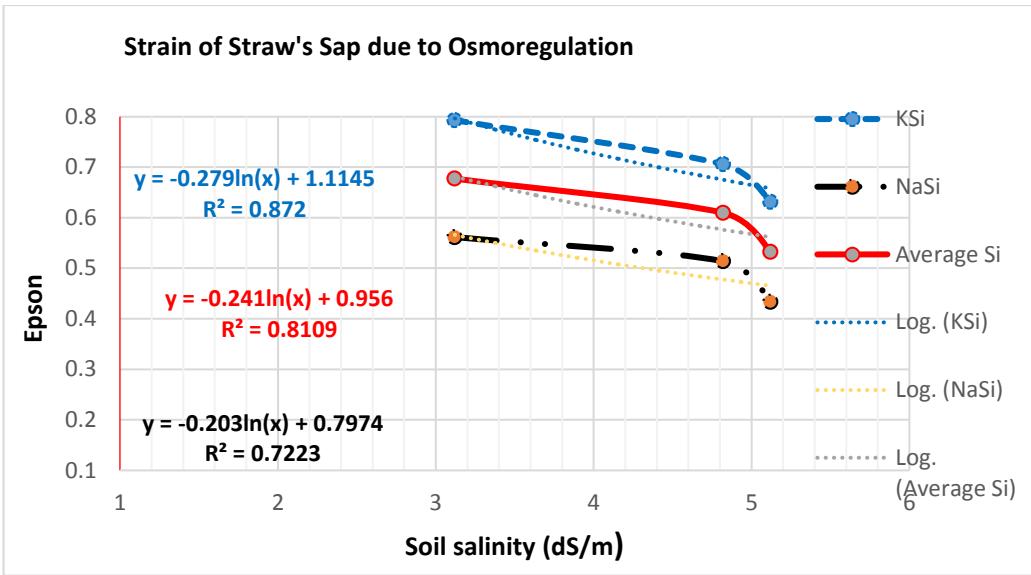 Figure 6: Variation in the strain of wheat's straw sap due to osmoregulation with respect to soil drought and salinity under silica fertilization.
Each type of water uptake takes place over a range of soil water potential and accordingly SSI (Fig. 4). As, h, SSI, PSI, Tc, Tp and $\Delta Z$ are known, the root navigation bath, $\Omega \mathbb{R}\mathbb{C}$ and the compensated uptake are easily estimated.
The AMUN_SHC assumes the variably saturated zone contains layered soil moisture capacitors connected each to other with the potential guidance of Darian flow. As precipitation infiltrates the soil system, each capacitor charges up according to its pedotransfer function of sand, silt and clay. Root navigates soil layers, categorizing their energy states,
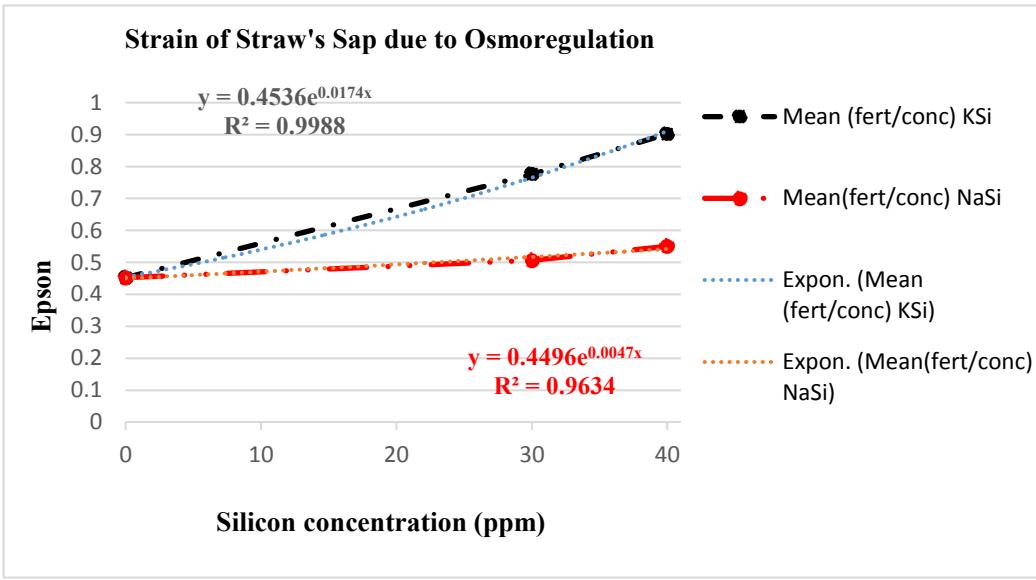 Figure 7: Variation in the strain of wheat's straw sap due to osmoregulation with respect to Si foliar application under combined stress conditions
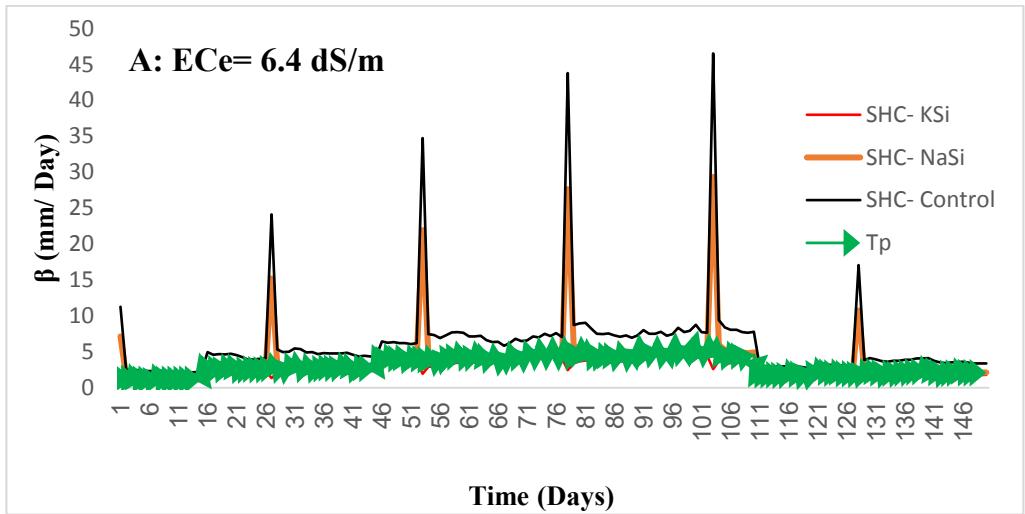
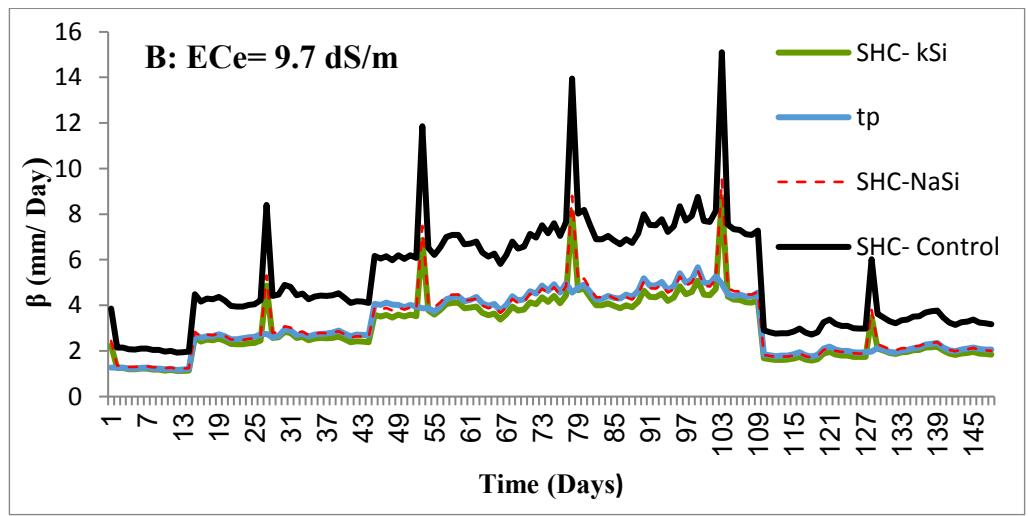
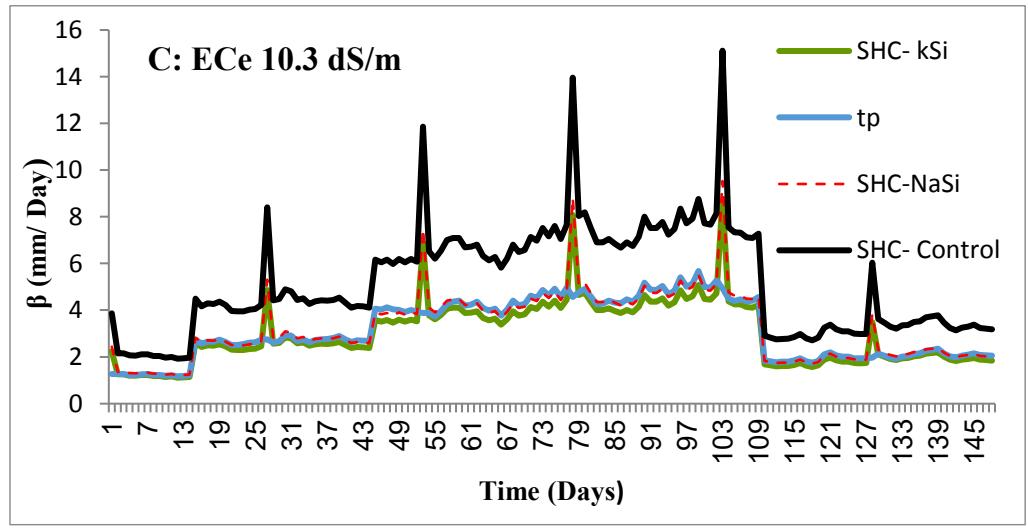 Figure 8: Soil hydraulic capacitance for A: Control soil $\mathrm{ECe} = 6.4\mathrm{dS / m}$, B: Saline soil $\mathrm{ECe} = 9.7\mathrm{dS / m}$ and C: Saline soil $\mathrm{ECe} = 10.3\mathrm{dS / m}$, respectively.
preferring the conditions that make their overall SHC in a state of equilibrium by the potential transpiration with a minimal consumed mechanical energy in order to achieve the potential yield. As SHC reveals the overall interaction between the ecosystem components (Eqs. 6, 7 and 8), the managerial practices affect the plant, soil and atmosphere and their interaction each to other may affect it. Treating the plant and soil with silica affects SHC (Figs. 8). The anti-transpirants cause roots hydraulic redistribution, magnetic water causes stress signals reduction, genetic transfer from halophytes to salt sensitive plants creates a new plant variety able to concentrate its root sap and increase its strain, organo-nanoparticles conditioners maintain the soil bed, harvest the atmospheric humidity and reduce the water losses via evaporation, leaching and deep percolation (Hegazy, 2002), treating the atmosphere with chemtrial gas causes a reduction in global warming and climatic changes and...etc. may all affect the SHC in many degrees of extend start in vivo by increasing the strain signal of root sap and extend in vitro by lowering the environmental abiotic stress signals but their quantitative responses should have put under the macroscopic point of view in another research.
In the agro-lands of MENA countries with marine and lacustrine origins, the overexploitation of groundwater under the conditions of water scarcity and global climatic changes causes the intrusion of seawater. As the saline water intrudes the variably saturated zone under a harsh extreme condition, the potentially guided Darian flow charges the capacitors from the bottom upwardly. Charging the capacitors in the electrical model defined by Hillel (2002) is different than that of the AMUN_SHC electrical model as the former did not consider that water quality affects its uptake. For instance, the water salinity decreases the availability of irrigation water. AMUN_SHC model takes the concept of total energy states into consideration. Assessing the impact of specific ion toxicity has a certain value of salt index under abiotic stress conditions may be achieved by making SSI speciation. The latter speciation may be done in order to know the combined stress of drought, salinity and specific ion toxicity such as in the case of using potassium chloride instead of potassium sulfate fertilizers. SSI speciation, SSIS, is still under investigation. Moreover, SSIS needs to be validated when assessing the impact of saline contaminated groundwater with iron and manganese on plant growth under deficit irrigation scenario.
## IV. CONCLUSION
Estimating the root water uptake when using the stress form of modified Richard's equation, $\mathrm{SSI^{*}B}$, involves the term soil hydraulic capacitance. SHC represents the response of the soil moisture reservoir toward a certain plant water demand under a certain atmospheric condition. Soil profile consists of layered capacitors. Each of which is recharged during the infiltration by precipitation, irrigation or both forming the constant shaped soil moisture profile. The easy available water is being stressed by discharging the soil capacitors during the root water uptake creating the variably saturated zone. In between the sink: source terms of Richard's equation, the discharge: recharge terms of soil capacitors or the root uptake: hydrological release terms, root navigates soil capacitors categorizing their energy states to select what has the easiest available water and bath to pass in order to water by exerting a minimum consumed energy. SHC depends on soil genesis, plant species, varieties, ages and adaptability, atmospheric conditions and the high tensile strength of liquid phase. Under deficit irrigation and or the harsh extreme conditions of aridsols, SHC determines the types of water uptake in accordance with weathering induced stress- strain signaling devices. The latter devices are being regulated for the sake of preventing the hydrological release and complete the life cycle. Silicon enhances the overall signaling devices to be in a favorable states under the abiotic stress conditions. The result from that research clarifies the types of environmental managerial practices should have been adopted when dealing with the natural abiotic stress of drought and salinity due to global climatic changes or artificial one due to irrigation deficit scenario because of the three incoming reasons:
- Since the geo-signal is being induced by more compacted electric double layer, hysteretic behavior and the Albert Ainkhtien's relativity of clayey lattice.
- As the bio signal is being induced by osmoregulation strain and turgidity strain.
- As the weather controlled signaling device is being induced by canopy evaporative demand.
Analyzing soil system under saline and drought conditions using AMUN_SHC showed the merciful behavior of soil toward plant under abiotic stress conditions. This is because the plots were treated with silicon, the second abundant element in the earth's crust
Generating HTML Viewer...
References
49 Cites in Article
G Abaghandura,D Park,D White,W Bridges (2017). The levels of soil degradation and soil pollution.
Abu Swaireh,L (2009). Disaster risk reduction global and regional context", regional workshop on climate change and disaster risk reduction in the arab region "Challenges and future actions.
Rami Albasha,Jean-Claude Mailhol,Bruno Cheviron (2015). Compensatory uptake functions in empirical macroscopic root water uptake models – Experimental and numerical analysis.
T Almeras,J Gril (2007). Mechanical analysis of the strains generated by water tension in plant stems. Part I: stress transmission from the water to the cell walls.
A Alsulaili,M Alkandari,A Buqammaz (2022). Assessing the impacts of meteorological factors on freshwater consumption in arid regions and forecasting the freshwater demand.
M Amin,R Ahmad,S Basra,G Murtaza (2014). Erratum: Determination of morpho-physiological and yield traits of maize inbred lines (Zea mays L.) under optimal and drought stress conditions.
B Arsova,K Foster,M Shelden,H Bramley,M Watt (2020). Dynamics in plant roots and shoots minimize stress, save energy and maintain water and nutrient uptake.
Ascad (2011). Drought vulnerability in the Arab region a case Study-Drought in Syria.
H Bekhit (2015). Introduction to computer programing using FORTRAN.
A Choobbasti,A Vafaei,S Kutanaei (2015). Mechanical properties of sandy soil improved with cement and nano-silica.
H Nar,A Saglam,R Terzi,Z Várkonyi,A Kadioglu (2009). Leaf rolling and photosystem II efficiency in Ctenanthe setosa exposed to drought stress.
V Clausnitzer,J Hopmans (1994). Simultaneous modeling of transient three-dimensional root growth and soil water flow.
M El-Ashry,N Saab,B Zeitoon (2010). ESCWA water development report 5.
Mohamed Elhag (2016). Evaluation of Different Soil Salinity Mapping Using Remote Sensing Techniques in Arid Ecosystems, Saudi Arabia.
Ibrahim. Elsokkary (2018). Silicon as a Beneficial Element and as an Essential Plant Nutrient: An Outlook (Review).
H Elkhatib,S Gabr,A Roshdy,M Al-Haleem (2017). The Impacts of Silicon and Salicylic Acid Amendments on Yield and Fruit Quality of Salinity Stressed Tomato Plants.
E Epstein (2009). Silicon: its manifold roles in plants.
Daniel Juhn,Hedley Grantham (2002). Sustainable Biofuel Crops Project, Final Report.
Daniel Juhn,Hedley Grantham (2020). Sustainable Biofuel Crops Project, Final Report.
S Ganiyu,O Olurin,M Oladunjoye,B Badmus (2020). Investigation of soil moisture content over a cultivated farmland in Abeokuta Nigeria using electrical resistivity methods and soil analysis.
Haijun Gong,Kunming Chen (2012). The regulatory role of silicon on water relations, photosynthetic gas exchange, and carboxylation activities of wheat leaves in field drought conditions.
A Hamid,Y Eltayeb (2011). Space borne Technology for drought monitoring in Sudan.
El-Sh Hegazy (2002). Conditioners, Effect on Soil Physical Properties.
Gheith El-Sayed,Ola El-Badry (2020). Response of wheat yield and its components to zinc and iron application under different levels of nitrogen.
El-Sh Hegazy (2022). Modelling of root uptake under drought and saline conditions.
El-Sh Hegazy (2022). A Modified Richard’s Equation for Assessing the Impact of Drought and Salinity in Arid and Semi-Arid Zones.
Mohamed Hereher,Ahmed Alghmdi,Khalil Mseddi,Ahmed El Kenawy (2022). Remote sensing of vegetation prolonged drought at the salt playas of Hail – Saudi Arabia.
D Hillel (2002). Environmental Soil Physics.
M Homaee,R Feddes,C Dirksen (2002). Simulation of root water uptake.
J Hopmans,E Maurer (2008). Impact of climate change on irrigation water availability,crop water requirements and soil salinity in the SJV, CA.
Ipcc (1973). Summary for policymakers.
M Kirkham (2004). Mechanisms of silicon alleviation of abiotic stresses in higher plants: A review.
Ying Ma,Maria Dias,Helena Freitas (2020). Drought and Salinity Stress Responses and Microbe-Induced Tolerance in Plants.
A Miyan (2015). Droughts in asian least developed countries: Vulnerability and sustainability.
Rana Munns,John Passioura,Timothy Colmer,Caitlin Byrt (2020). Osmotic adjustment and energy limitations to plant growth in saline soil.
H Nar,A Saglam,R Terzi ; Nassar,I,R Horton (1997). Heat, water, and solute transfer in unsaturated porous media: I -Theory development and transport coefficient evaluation.
B Nwer,H Zurqani,K Jadour (2013). Soil productivity rating index model using geographic information system in Libya.
A Peter (2016). Modified conceptual model for compensated root water uptake – A simulation study.
G Schoups,E Maurer,J Hopmans,J (2010). Climate change impacts on water demand and salinity in California's irrigated agriculture.
J Simunek,M Sejna,H Saito,M Sakai,M Th,Van Genuchten (2013). The HYDRUS-1D Software Package for Simulating the One-Dimensional Movement of Water, Heat, and Multiple Solutes in Variably-Saturated Media.
J Simunek,Hopmans (2009). Modelling compensated root water and nutrient uptake.
G Sposito (2008). The Chemistry of Soils.
Anooja Thomas,Brijesh Yadav,Jiří Šimůnek (2020). Root water uptake under heterogeneous soil moisture conditions: an experimental study for unraveling compensatory root water uptake and hydraulic redistribution.
S Tignor,J Allen,A Boschung,Y Nauels (2013). The Physical science basis. Contribution of working group to the fifth assessment report of the intergovernmental panel on climate change.
Al Tuna,Cengiz Kaya,David Higgs,Bernardo Murillo-Amador,Salih Aydemir,Ali Girgin (2008). Silicon improves salinity tolerance in wheat plants.
Melvin Tyree,M Zimmermann (2002). Xylem Structure and the Ascent of Sap.
Xiaowen Wang,Huanjie Cai,Zhen Zheng,Lianyu Yu,Zishen Wang,Liang Li (2020). Modelling root water uptake under deficit irrigation and rewetting in Northwest China.
No ethics committee approval was required for this article type.
Data Availability
Not applicable for this article.
How to Cite This Article
El-Shazly M. M. Hegazy Gazouly. 2026. \u201cThe Modified Richardos Equation for Assessing the Impact of Drought and Salinity in Arid and Semi-Arid Zones. Part Two A Soil Hydraulic Capacitance\u201d. Global Journal of Science Frontier Research - D: Agriculture & Veterinary GJSFR-D Volume 23 (GJSFR Volume 23 Issue D1): .
Explore published articles in an immersive Augmented Reality environment. Our platform converts research papers into interactive 3D books, allowing readers to view and interact with content using AR and VR compatible devices.
Your published article is automatically converted into a realistic 3D book. Flip through pages and read research papers in a more engaging and interactive format.
A soil hydraulic capacitance is a new physical property related to the interactions between the agro eco-system components soil, water, plant and atmosphere. It gives new quantitative details about the processes control the plant water uptake, ascending of sap and soil response toward the root water uptake under a certain soil moisture regime and climatic changes. The soil hydraulic capacitance, a tank like a plant water reservoir, is being controlled by signals, valves like switches. Three types of signaling devices, Geo, Bio, and weather controlled were discussed. The soil hydraulic capacitance property was first discovered by the author when modeling the wheat root water uptake under saline and drought conditions. Under the latter extreme conditions, treating plants with silica products was the managerial practice used for enhanced plant growth and water uptake. A split-split plot experimental design with four replicates was used to conduct the research in Oraby Village, Maryout area, Alexandria, Egypt in the last year of the most water-scarce decade.
Our website is actively being updated, and changes may occur frequently. Please clear your browser cache if needed. For feedback or error reporting, please email [email protected]
Thank you for connecting with us. We will respond to you shortly.