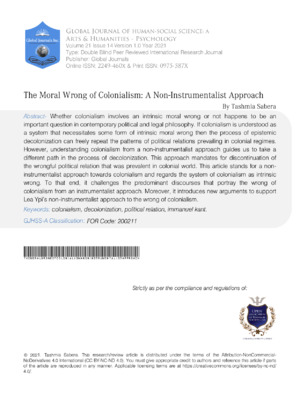
The Moral Wrong of Colonialism: A Non-Instrumentalist Approach

1
Tashmia Sabera
Tashmia Sabera

Send Message

To: Author

GJHSS Volume 21 Issue A14

Article Fingerprint

ReserarchID

978B4

The Moral Wrong of Colonialism: A Non-Instrumentalist  Approach Banner
  • English
  • Afrikaans

  • Albanian
  • Amharic
  • Arabic
  • Armenian
  • Azerbaijani
  • Basque
  • Belarusian
  • Bengali
  • Bosnian
  • Bulgarian
  • Catalan
  • Cebuano
  • Chichewa
  • Chinese (Simplified)
  • Chinese (Traditional)
  • Corsican
  • Croatian
  • Czech
  • Danish
  • Dutch
  • Esperanto
  • Estonian
  • Filipino
  • Finnish
  • French
  • Frisian
  • Galician
  • Georgian
  • German
  • Greek
  • Gujarati
  • Haitian Creole
  • Hausa
  • Hawaiian
  • Hebrew
  • Hindi
  • Hmong
  • Hungarian
  • Icelandic
  • Igbo
  • Indonesian
  • Irish
  • Italian
  • Japanese
  • Javanese
  • Kannada
  • Kazakh
  • Khmer
  • Korean
  • Kurdish (Kurmanji)
  • Kyrgyz
  • Lao
  • Latin
  • Latvian
  • Lithuanian
  • Luxembourgish
  • Macedonian
  • Malagasy
  • Malay
  • Malayalam
  • Maltese
  • Maori
  • Marathi
  • Mongolian
  • Myanmar (Burmese)
  • Nepali
  • Norwegian
  • Pashto
  • Persian
  • Polish
  • Portuguese
  • Punjabi
  • Romanian
  • Russian
  • Samoan
  • Scots Gaelic
  • Serbian
  • Sesotho
  • Shona
  • Sindhi
  • Sinhala
  • Slovak
  • Slovenian
  • Somali
  • Spanish
  • Sundanese
  • Swahili
  • Swedish
  • Tajik
  • Tamil
  • Telugu
  • Thai
  • Turkish
  • Ukrainian
  • Urdu
  • Uzbek
  • Vietnamese
  • Welsh
  • Xhosa
  • Yiddish
  • Yoruba
  • Zulu

Whether colonialism involves an intrinsic moral wrong or not happens to be an important question in contemporary political and legal philosophy. If colonialism is understood as a system that necessitates some form of intrinsic moral wrong then the process of epistemic decolonization can freely repeat the patterns of political relations prevailing in colonial regimes. However, understanding colonialism from a non-instrumentalist approach guides us to take a different path in the process of decolonization. This approach mandates for discontinuation of the wrongful political relation that was prevalent in colonial world. This article stands for a noninstrumentalist approach towards colonialism and regards the system of colonialism as intrinsic wrong. To that end, it challenges the predominant discourses that portray the wrong of colonialism from an instrumentalist approach. Moreover, it introduces new arguments to support Lea Ypi’s non-instrumentalist approach to the wrong of colonialism.

Funding

No external funding was declared for this work.

Conflict of Interest

The authors declare no conflict of interest.

Ethical Approval

No ethics committee approval was required for this article type.

Data Availability

Not applicable for this article.

Tashmia Sabera. 2021. \u201cThe Moral Wrong of Colonialism: A Non-Instrumentalist Approach\u201d. Global Journal of Human-Social Science - A: Arts & Humanities GJHSS-A Volume 21 (GJHSS Volume 21 Issue A14): .

Download Citation

Analyzing the moral implications of colonialism from an anti-instrumentalist perspective in social sciences.
Issue Cover
GJHSS Volume 21 Issue A14
Pg. 61- 65
Journal Specifications

Crossref Journal DOI 10.17406/GJHSS

Print ISSN 0975-587X

e-ISSN 2249-460X

Keywords
Classification
GJHSS-A Classification: FOR Code: 200211
Version of record

v1.2

Issue date

December 24, 2021

Language

English

Experiance in AR

The methods for personal identification and authentication are no exception.

Read in 3D

The methods for personal identification and authentication are no exception.

Article Matrices
Total Views: 1931
Total Downloads: 900
2026 Trends
Research Identity (RIN)
Related Research

Published Article

Whether colonialism involves an intrinsic moral wrong or not happens to be an important question in contemporary political and legal philosophy. If colonialism is understood as a system that necessitates some form of intrinsic moral wrong then the process of epistemic decolonization can freely repeat the patterns of political relations prevailing in colonial regimes. However, understanding colonialism from a non-instrumentalist approach guides us to take a different path in the process of decolonization. This approach mandates for discontinuation of the wrongful political relation that was prevalent in colonial world. This article stands for a noninstrumentalist approach towards colonialism and regards the system of colonialism as intrinsic wrong. To that end, it challenges the predominant discourses that portray the wrong of colonialism from an instrumentalist approach. Moreover, it introduces new arguments to support Lea Ypi’s non-instrumentalist approach to the wrong of colonialism.

Our website is actively being updated, and changes may occur frequently. Please clear your browser cache if needed. For feedback or error reporting, please email [email protected]
×

This Page is Under Development

We are currently updating this article page for a better experience.

Request Access

Please fill out the form below to request access to this research paper. Your request will be reviewed by the editorial or author team.
X

Quote and Order Details

Contact Person

Invoice Address

Notes or Comments

This is the heading

Lorem ipsum dolor sit amet, consectetur adipiscing elit. Ut elit tellus, luctus nec ullamcorper mattis, pulvinar dapibus leo.

High-quality academic research articles on global topics and journals.

The Moral Wrong of Colonialism: A Non-Instrumentalist Approach

Tashmia Sabera
Tashmia Sabera

Research Journals