
I. THE COMPLEXITY OF REVENUE RECOGNITION IN THE ANGLO-SAXON MARKET
The focus of this article is on the implementation of revenue recognition in the Anglo-Saxon market. Presently, both boards indicate there are some existing areas of financial reporting challenges and weaknesses under USGAAP and IFRS. Guidelines under Rules-based and principles-based have been prepared for particular industries to report revenue as governed under each accounting setting format.
The five steps of the revenue recognition process are designed to support the core principles of business contract and the accountability of major business entities. The five steps are: (a) identify a contract with a customer, (b) identify separate performance obligations, (c) determine the transaction price, (d) allocate the transaction price to separate performance obligations, and (e) recognize revenue when or as performance obligations are satisfied. "The main objective of the joint revenue recognition project is to consolidate the financial reporting inconsistencies that exist under the Financial Accounting Standard Board (FASB) and the International Accounting Standard Board (IASB)" (Lemus, 2014, p. 1). Financial users will require more comprehensive training and guidance to deal with the new revenue recognition contract in the near future (Tysiac, 2017).
In 2016, Bell, Kalavacherla, and Thompson conducted an accounting survey by analyzing the results of the new revenue recognition in different business sectors and find the need of aligning customer business contract service. The implementation of the new revenue recognition standard will bring new financial challenges to the operating aspects of both public and private companies. According to the results of a survey of more than 140 companies, where the majority of the companies are public and carrying revenue of $1 billion would face operational and financial challenges (Bell et al., 2016).
II. REVIEW OF THE LITERATURE
a) New Revenue Recognition Historical Timeline Approach
In 2011, the FASB and the IASB issued an Exposure Draft (ED) detailing the necessary steps to implement the new revenue recognition from contracts with customers. In 2014, both boards agreed the earliest date to adopt the new revenue recognition would be January 1, 2015. The ED that was presented by the FASB and the IASB was similar to the Exposure Draft (ED) issued in 2010. As a result, the revised ED is consistent with the five steps of revenue recognition mentioned previously (Holzmann & Ramnath, 2013).
In 2014, the FASB and the IASB began the convergence effort toward revenue recognition by bringing alignment to the revenue from contracts with customers. The Transition Resource Group (TRG) was established by the FASB and IASB. Revenue recognition under USGAAP and IFRS continues to experience some accounting technical challenges such as revenue recognition in the financial statement consolidation process (Kepple, 2016).
In 2016, the FASB issued several standards to clarify and propose a new set of principles guidance interpretation related to revenue recognition. Public companies are expected to adopt the new revenue recognition guidance by January 1, 2018. Non-public companies should engage in the transition to the new revenue adoption guidance a year later. The new revenue recognition guidance promotes principles-based standards. Therefore, public companies are finding the need to make changes in their accounting policies and auditing settings (Bell et al., 2016).
In 2018, public companies should commence the new revenue recognition adoption and by 2019 nonpublic companies should commence this new financial effort. The FASB, with the new revenue recognition standard, will bring a global vision to the world financial sector. For example, one industry that is expected to be affected by the revenue recognition change is the health care industry. Therefore, the companies that will be affected directly by this change are companies that follow specific guidance under USGAAP as it relates to their industry (Munter, 2016).
b) Concerns or Weaknesses in Existing Revenue Recognition Standards
Table 1 (Munter, 2016, p. 31) shows some areas of financial reporting weaknesses under USGAAP and IFRS.
| USGAAP | IFRS |
| Contains a large number of individual standards or codification topics, making it difficult to determine which standard or topic is applicable in some situations.Some standards/topics focus on completion of the earnings process while others focus on activities.There is a lack of comparability among entities because similar transactions are accounted for differently as different standards/topics apply.Some of the guidance contains bright lines, giving rise to a significant difference in the accounting outcome for similar arrangements.Some of the guidance was developed from an antiabuse perspective, establishing implicit bright lines through rebuttable presumptions that are difficult to overcome.There is limited guidance on applicable disclosures, resulting in boilerplate disclosure about revenue by some entities.The separation guidance for multiple element arrangements differs among standards/topics, which results in different units of account and therefore different revenue recognition patterns for similar arrangements. | There is limited guidance—one general standard for goods and services and one for construction-type activities—supplemented by a few interpretations.The general standard focuses on completion of the earnings process, whereas the standard on construction-type activities focuses on activities.There is a lack of comparability among entities because the lack of guidance results in different conclusions reached by companies about the accounting for similar transactions.There is limited guidance on applicable disclosures, resulting in boilerplate disclosures about revenue by some entities.There is limited guidance on separation for multiple element arrangements, which results in diversity in practice and a lack of comparability among entities in accounting for similar arrangements. |
| Most of the specific guidance has been developed for particular industries such as insurance, the health sector, and other service industries. In the health care industry, revenue is recognized at the time when the service is rendered. As mentioned by Munter (2016), “According to ASC paragraph 954-605-45-4, if the patients do not pay, the providers present the resulting bad debts as an adjustment to revenue” (p. 31). Other health care services guarantee the collectability of the service provided prior to recognizing revenue. At this point in time, there are limited disclosure items related to revenue recognition. Financial statement users are primarily concerned with the limited disclosure items under the revenue recognition governed by USGAAP (Munter, 2016).c) Five Steps of the Revenue Recognition ProcessFinancial users will require more comprehensive training and guidance to deal with the new revenue recognition contract. The following five steps of the revenue recognition process will support the core principles of business contract and the accountability of major business entities. The five steps are: (a) identify a contract with a customer, (b) identify separate | performance obligations, (c) determine the transaction price, (d) allocate the transaction price to separate performance obligations, and (e) recognize revenue when or as performance obligations are satisfied.Step 1. A contract should exist when a service is rendered to a customer where it can be legally enforceable and create a commitment of future cash flows. Also, liability will remain in the contract until all conditions are met.Step 2. The contract should specify how the customer can benefit from the service and how to identify the promises in the contract as they relate directly to performance obligation.Step 3. It is imperative that the entity indicate whether the transaction price is fixed or variable, because the new revenue recognition standard states that if there is fluctuation in the price, adjustment should be in accordance with the concession of the price changes indicated in the contract by not necessarily altering the cost of goods sold reported in the income statement.Step 4. The transaction price should be identified as distinct and meet the performance obligations of the contract. |
Step 5. All obligations should be satisfied as anticipated in the performance obligation at a point in time.
The implementation of the new revenue recognition by the FASB is raising a number of challenges for financial users as well as for auditors in public companies. The American Institute of Certified Public Accountants (AICPA) mentioned that the new revenue recognition is expected to provide specific guidance on an industry basis and auditors require a degree of adaptability to the new accounting measurement changes in the financial market. In the aerospace and defense industry, entities are expected to deal with step 5 under the new guidelines of revenue recognition, which is to “recognize revenue when (or as) the entity satisfied a performance obligation.” This is related to FASB Accounting Standards Codification (ASC) Topic 606. In the aerospace and defense industry, the nature of contracts tends to vary across the board. The satisfaction selection progress should reflect the timing and service delivery. As a result, in the aerospace industry, revenue can be measured as straight-line revenue recognition and cost-to-cost for the service to be rendered to the customer (Tysiac, 2017).
In the case of asset management, financial preparers deal with step 1, which is to identify the contract with a customer. Financial Reporting Executive Committee (FinRec) developed the following characteristics for financial users when dealing with asset management:
Legal entities such as corporations, partnerships, and business trusts should be recognized as legal entities
The board of directors should have full control of the entity governance
Investors should have the availability to negotiate their advisory fees
Investors' diversity will contribute to the expansion of the entity
Investors who register through a third party will have a lack of visibility as to who is the ultimate investor in the company
Investment companies in the United States should be regulated
The asset manager should have different contractual services (Tysiac, 2017)
The fact is that the changes related to the new revenue recognition will affect industries in the private sector. Professionals in the accounting and financial sector are aware of the topic of ASC 606. Public companies should prepare for the upcoming changes in the financial sector. In 2018, non-public organizations will commence making changes in their financial reporting. This will involve assessing the company's day-to-day operations and streaming the process of revenue recognition activity. As a result, the implementation of the new revenue recognition should commence at the organizational level because organizational leaders will have to use their best judgement to adopt the principles-based standards for optimization purposes (Arms & Bercik, 2015).
The FASB recommends that public entities adopt the new revenue recognition standard by December 15, 2017. Public companies are not permitted to engage in early adoption. Moreover, all other major companies are expected to adopt the new revenue recognition after December 15, 2018, with interim periods of annual reporting by December 15, 2019 (Holloway, Sutton, & Swafford, 2017).
The new revenue recognition standard presents two methods as important rules. The FASB will have a degree of flexibility with public companies in electing either two of the rules. The first method is to allow an organization to adopt retrospectively the new revenue recognition at the end of each reporting period. The second method is for an organization to recognize the opening balance at the initial date of the application of the period. It is anticipated that the new revenue recognition will replace some of the rules written under USGAAP. As a result, the adoption is overwhelming for both organizations and practitioners in the accounting industry. Therefore, in order to advance and comply with the time table of deadlines proposed by FASB, organizations should have dual-reporting capabilities in place (Holloway et al., 2017).
The AICPA noted that financial sustainability can be attributed to the relationships that exist among business members in the community, industry services, and the government. Financial users are recommended to visit the FASB website (www.fasb.org) to explore the most recent updates and developments as they pertain directly to the new revenue recognition convergence standard. The purpose of the new revenue recognition is easy to understand and serves as the financial communication process for revenue recognition by industry. The FASB revealed that the revenue treatment and related transactions of recognition differ from industry to industry (James, 2016).
The SEC commented that the new revenue recognition is a new era for fraud in the U.S. capital market. On the other hand, IFRS have two standards of revenue recognition and including minimal guidance of interpretation. For instance, experts on revenue recognition have criticized the elements arrangements that exist under IFRS. The accounting software that should be updated includes OneSource, Corp Tax, and other related tax accounting software. Also, during the tax evaluation process of the adoption of the new revenue recognition, different stages should be considered. As a result, effective communication is paramount so optimal results can be achieved. The implementation of the new revenue recognition should depart from comparability and consistency, most importantly in different governing jurisdictions around the globe. It is recommended that the Joint Transition Group for Revenue Recognition (TRG) create a public forum as an educative avenue for stakeholders, internal and external auditors, and users of financial statements (Levin-Epstein, 2015).
Historically, changes in the financial market have been the main driving force for progress in business development. By 2019, it is expected that public and private companies will have embraced the new guidelines of revenue recognition under ASC 606. The AICPA stated that the adoption of accounting guidelines will have an impact on day-to-day business operations. The FASB's top priority is to create new guidelines for future investors. Bell et al., (2016) International Accounting Survey study results revealed responded to the implementation process that will have results by seeking harmonization from USGAAP to IFRS. Furthermore, of professionals in the finance industry have not begun to assess the technicality aspect of revenue recognition under ASC 606, do not have a plan for implementing the changes, and are confident new change may affect the accounting industry. Organizational leaders will have to conduct an extensive review to find comparability in the accounting policies and at the same time be innovative. Therefore, the global economy is constantly changing and operational challenges are in the horizon (Bredehoft, 2016).
Organizations are running out of time to meet the deadlines proposed by the FASB. Organizations have not completed as of yet the assessment of new accounting system changes. According to Steve Thompson, consultant at KPMG, some companies are undermining the time effort needed to implement the new revenue recognition (Bell et al., 2016).
d) Revenue Implementation Status
Public companies are behind schedule. Regulators in the United States have expressed a degree of concern because 80% of public companies have not yet began the assessment phase (Bredehoft, 2016). The delayed process will have an impact on the bottom line finances of companies because the operation costs are expected to be inefficient and increase risks across the board, and identify new strategic role settings. Also, 60% of public companies as participants surveyed acknowledged they were running behind schedule (Bell et al., 2016).
Status of revenue recognition implementation – Public companies
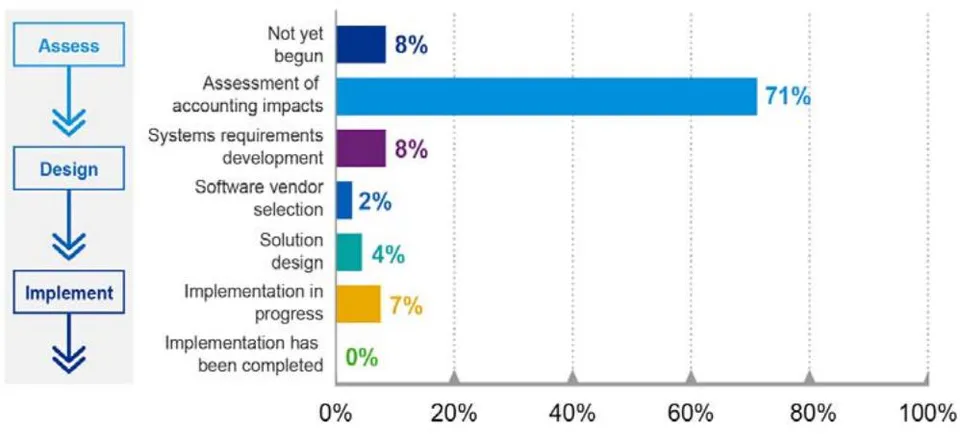
Bell et al.'s (2016) survey study results indicate that 80% have not commence as of yet the new adoption assessment phase of revenue recognition. Figure 1. Status of revenue recognition implementation- Public companies (Bell et al., 2016, p. 4).
e) Revenue Accounting Systems
Changes to revenue accounting systems Note: Refers to number of respondents
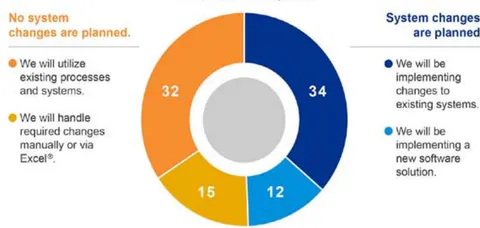
The configuration of software to be implemented through the new revenue recognition adoption can take approximately 9 to 12 months. Participants in the survey study anticipated that 49% will process accounting data manually. As a result, the software that should be considered in the adoption of the new revenue recognition is SAP, Rev Pro, Rev Stream, and Oracle (Bell et al., 2016). Figure 2. Changes to revenue accounting systems (Bell et al., 2016, p. 6).
The configuration of software to be implemented through the new revenue recognition adoption can take approximately 9 to 12 months. Participants in the survey study anticipated that 49% will process accounting data manually. As a result, the software that should be considered in the adoption of the new revenue recognition is SAP, Rev Pro, Rev Stream, and Oracle (Bell et al., 2016).
f) Revenue Adoption Cost
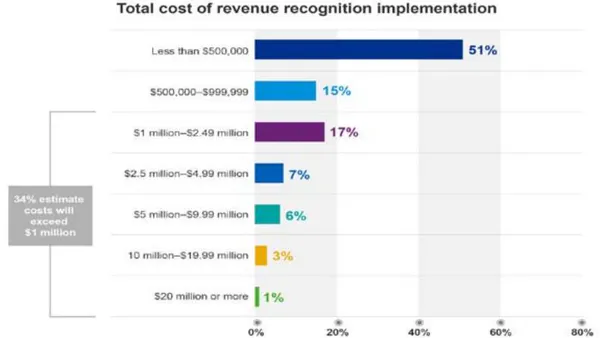
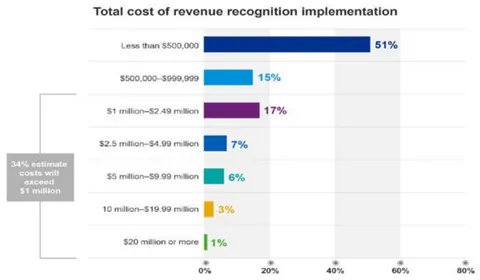
When calculating the adoption cost, it will be significant to consider internal and external resources in the budget. Bell et al. (2016) noted 34% of the survey participants anticipated that the total cost of the new revenue recognition guidance would be in excess of 1 million.
g) Revenue and Business Impacts
In terms of business impacts, companies are expected to consider three major key drivers: comparability trends, financial reporting consistency, and systems reliability. The key drivers mentioned previously will bring uniformity to the new convergence of revenue recognition (Bell et al., 2016).
h) Revenue and Tax Implications
The participation of tax professionals in the adoption of new revenue recognition standards is minimal. Business are expected to be affected directly by the lack of tax professional participation. Bell et al.'s (2016) survey results demonstrated the areas that may lead to roadblocks from the taxable aspect are as follows:
Existing tax compliance processes
Taxable income
Accounting for income taxes (ASC 740)
Tax accounting method changes
Other areas of tax, including transfer pricing (p. 11)
Furthermore, organizations are expected to rely on one or more accounting tax methods for financial reporting purposes. However, a careful analysis should be considered when treating the calculation of accounting policies related to revenue recognition. Therefore, tax professionals are expected to assess the tax compliance needs and evaluate the systems in a timely manner (Bell et al., 2016).
i) New Revenue Recognition Road Map Implementation
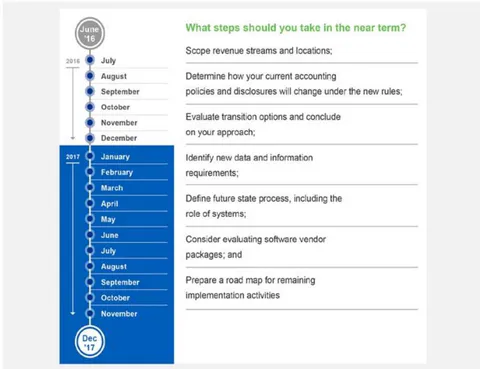
Figure 4 shows a new revenue recognition road map timeline to illustrate a proposed chronological event for the new revenue recognition guidelines by meeting the approaching deadline of December 2017.
The new revenue recognition will soon be a reality for businesses and CPA firms. Experts in the accounting industry suggest businesses and CPAs should commence familiarizing themselves with the new guidance and standards. The FASB has played an important role in aligning the new revenue recognition. The FASB and IASB have invested 10 years into simplifying the new revenue recognition approach. The anticipated implementation effective date is December 15, 2017. The accounting standards update comprises 700 pages announcing changes in relation to this topic. Moreover, the accounting standards codification consists of 130 pages under revenue topic 606 and other related amendments describing the principles of revenue recognition in 300 pages (Schmutte & Duncan, 2016).
Susan Callahan, CPA for Ford Motor Corporation directing the American market, suggested the new revenue recognition will bring, to some degree, more uncertainty in the U.S. market among business practitioners. The FASB and IASB had already begun a convergence process to harmonize the two accounting standards into one universal accounting language. For example, Callahan indicated the FASB and IASB created a joint transition group to help companies seek clarity when implementing the new revenue recognition. Both accounting standard boards shared common ground about the implementation of the new revenue recognition standard (Tysiac & Murphy, 2015).
III. CONCLUSION
In conclusion, public companies are finding the need to make changes to their accounting policies. The implementation of the new revenue recognition should commence at the organizational level, because organizational leaders will have to use their best judgement to adopt the principles-based standards for optimization purposes. As a result, in order to advance and comply with the time table of deadlines proposed by the FASB, organizations will need to have a dual-financial reporting system in place. Financial statement users are primarily concerned with the limited disclosure items under the revenue recognition governed under USGAAP. Major companies are expected to adopt the new revenue recognition after December 15, 2018, with interim periods of annual reporting by December 15, 2019.
IV. RECOMMENDATIONS FOR FUTURE STUDIES
The author of this article suggests the following aspects be considered for future studies into the implementation of revenue recognition in the Anglo-Saxon market:
The FASB should consider the following four industries as early adopters of the new revenue recognition standard: airlines, gaming, hospitality, and time-share.
The IASB should evaluate the effectiveness and disclosure requirements of the new revenue recognition guidelines approach under principles-based.
Companies should allocate performance obligations under the new revenue recognition standard by creating new lines of revenue.