The paper aims at the educational priorities and teaching practices implemented in the Greek school that support the development of 21 st century skills. The approach to this central issue is attempted in the context of a global perspective. In specific, we focus on curricula, subject areas, the school’s mission and the learning environments. In our analysis we draw on the KSAVE model (Binkley et.al., 2012) and argue that any educational endeavor to cultivate skills at the school level should be an outgrowth of organic interconnection and alignment of the above factors rather than a decontextualized practice.
## I. INTRODUCTION
Educational policies in various countries, as well as the Organization for Economic Co-operation and Development (OECD), have prioritized the acquisition of skills in their agendas for the future of education, enabling students to tackle complex future challenges. In this context, the design of learning environments should start from questions such as: What knowledge and skills do students need for the $21^{\text{st}}$ century? What educational practices encourage 21st-century learning? How can technology support the pedagogy of collaborative learning? How can the classroom and the school in general foster $21^{\text{st}}$ century skills? (https://education.ec.europa.eu/sites/default/files/document-library-docs/et-monitor-report)
It is clear that modern schools must use practices for creating "critically and creatively thinking citizens" who can evolve, adapt, and think critically beyond dysfunctional views and perceptions. Therefore, the role of teaching becomes central, as it serves as a recognized, institutionalized and systematized environment for acquiring knowledge and developing skills. The goal is not merely for students to possess knowledge, but to utilize that knowledge to think critically, use appropriate learning tools, coexist and collaborate effectively.
## II. THE CONCEPT OF SKILLS AND THEIR TYPOLOGY: THE KSAVE MODEL
For over two decades, researchers, educators, and policymakers have emphasized the need to cultivate the $21^{\text{st}}$ century skills (Kasimatis, Kouloumpis, & Papageorgiou, 2019). Critical Thinking, Creativity, Collaboration, and Communication, known as the 4Cs, are the learning skills of the $21^{\text{st}}$ century that enable us to adapt to the characteristics of our world and express our innovative ideas (http://users.sch.gr/hgoutsos/files/dejiotites/2-6a.pdf).
Skills are usually treated as individual characteristics. In the educational context they are described as part of learning objectives (knowledge-skills-statistics/behaviors) and/or learning outcomes and are acquired through formal education and vocational training rather than through more specific training and informal learning (Krasadaki et al., 2023: 23).
According to Krasadaki et al. (2023) skill is the application of knowledge in practice in order for a person to meet the requirements and goals in his/her professional, social and personal life. In the New Skills Agenda for Europe (Lintzeris, 2017), the term skills is used to describe what a person knows, understands and can do. According to the OECD (OECD, 2019:16), a skill is defined as the ability of an individual to use acquired knowledge in a responsible way in order to achieve a goal. Skill is, also, described as the competence to complete a knowledge-based process to achieve a goal but enriched with the moral value of responsibility. With regard to the 2030 competences, the OECD advocates their holistic dimension, which consists of the activation of knowledge, skills, attitudes and values in order to tackle complex problems.
Skills are usually treated as individual characteristics. In the educational context they are described as part of learning objectives (knowledge-skills-behaviors) and/or learning outcomes that are acquired through formal education and vocational training rather than through specific training and informal learning (Krasadaki et al., 2023: 23).
A skill is the ability to apply knowledge and use know-how to perform tasks and solve problems (Cedefop, 2010). Skills help individuals to participate in social and political life and have a direct link to their daily life and the problems they are asked to solve (OECD, 2019). Karanikola and Panagiotopoulos (2019) describe skills as a set of knowledge, personal characteristics and achievements that make individuals able to be employed and succeed and in this sense they are linked to employability. Finally, Javrh, Mozina and colleagues (2018:7) use the term basic skills to describe an individual's ability to effectively use acquired knowledge and skills in complex and unpredictable situations.
In texts we find three types of skills (Krasadaki et al., 2023; Haste, 2018; World Bank, 2018): a. basic skills (writing, reading, reading, text comprehension, numeracy and digital literacy); b. technical-vocational skills, related to specific job functions; c. horizontal skills or life, personality, socio-emotional or soft skills. These skills are transversely related to all professional-social and personal activities. Such skills include cooperativeness, adaptability, time management, empathy, problem solving, leadership, etc. (Krasadaki et al., 2023: 24). In 2018 the "Updated European Reference Framework for Key Competences in Lifelong Learning" emphasizes (as mentioned in Krasadaki et al., 2023) on life skills that help people to adapt to today's multicultural environment and to cope with modern life challenges and demands. In EU texts of recent years, soft or social skills have been replaced by the term life skills.
The OECD (2017, as cited in Krasadaki, 2023) distinguished skills into a. cognitive and b. noncognitive, while their combination constitutes techniques. Cognitive skills include literacy, numeracy and problem solving, while non-cognitive skills include our behavioral and technical characteristics. Finally, technical skills are the combination of cognitive and non-cognitive skills and are used to accomplish a task.
Another classification of skills is the distinction between hard skills and soft/social/transversal/horizontal skills. Hard skills are associated with specific technical skills or knowledge required to perform a job and can be defined by the phrase 'what one knows' (Hunt, 2007). Soft skills are difficult to measure and refer to an individual's personality traits such as communication, creativity, teamwork, time management, conflict management, empathy and leadership. Personal characteristics also include personality, empathy and organizational skills (Parsons, 2008). Soft skills can be classified as a subset of generic skills and are transferable between different occupations.
In the DeSeCo project, skills theory is based on three areas of action a. knowledge, b. skills, c. attitudes and values. The learning of competences takes place in appropriate learning environments, with appropriate actions and goes through existence itself. Knowledge can be about a field, science or process. Skills can be divided into cognitive, metacognitive, social/emotional and practical/physical. Regarding attitudes and values, these can be personal or related to the national and international environment (Krasadaki et al., 2023).
Many organizations and researchers have focused their studies on the importance of defining $21^{\text{st}}$ century skills (Voogt & Pareja, 2010), attempting to cover a broad range of knowledge and skills that are not easy to define, codify, or categorize precisely. This paper utilizes the $21^{\text{st}}$ century skills framework presented by Binkley et al. (2014) as a reference point.
Binkley et al. (2012) developed the KSAVE model which is an acronym of the initial letters of the words Knowledge, Skills, Attitudes, Values and Ethics (Binkley et.al, 2012). Within the model they identified ten core skills necessary for $21^{\text{st}}$ century education, considering for each skill the dimensions of Knowledge, Skills, Attitudes, Values and Ethics.
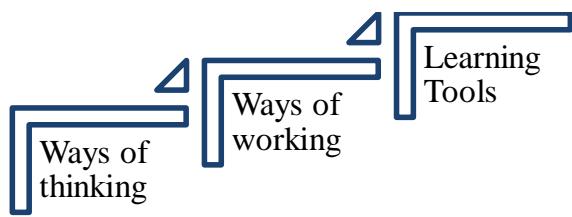
The $21^{\text{st}}$ century skills, according to the KSAVE model, organized in four categories of ways of thinking, ways of working, learning tools and social life skills, (Knowledge, Skills, Attitudes, Values, & Ethics), are interconnected with the modern school's educational mission, constituting an undeniable challenge and need for both students and teachers (Figure 1).
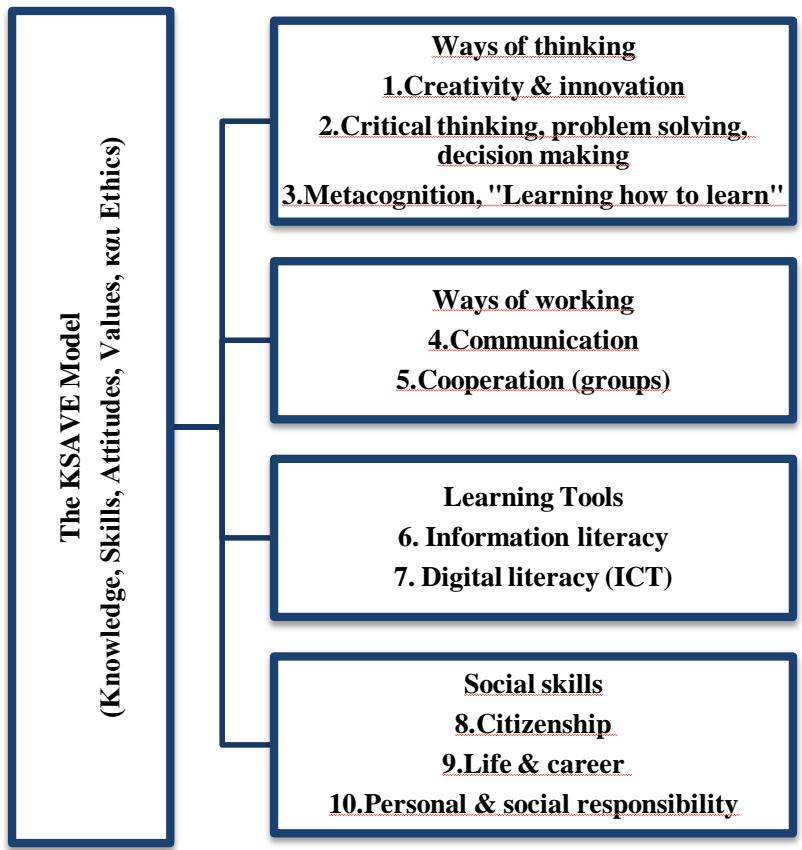
Figure 1: The KSAVE Model
(Knowledge, Skills, Attitudes, Values, & Ethics)
Binkley et al (2012) pointed out that the $21^{\text{st}}$ century skills should be taught in order for learners to develop new ways of thinking, learning, working and living in the modern world.
## III. CURRICULA AND THE EDUCATIONAL
### PROCESS
The ongoing public dialogue regarding $21^{\text{st}}$ century skills highlights the need for a systemic perspective on the structures and practices that can support skill development. This approach ensures that skill-oriented education is not just rhetoric added to the educational intentions of the modern school but represents a core connection between the teaching system, structures and practices.
The goal of contemporary teaching practices and curricula has been to create appropriate learning environments that foster open learning. A review of new curricula (iep.edu.gr) reveals their underlying philosophy. They aim to establish an effective, innovative, and creative school that promotes quality education, adapting to societal changes, new cultural conditions, and scientific advancements, while connecting theory with practice through systematic and effective work.
The objective is for students to acquire reflective skills, learning how to learn, how to research and how to become creative and effective. Students are encouraged to develop skills to apply their knowledge, make science-based decisions, take initiative, and act independently both in the classroom and in life. Furthermore, they should gain self-esteem, confidence, empathy and resilience, enabling them to communicate effectively, recognize values and principles develop a sense of responsibility, and prepare as active citizens who participate in addressing significant challenges facing contemporary societies, such as pollution, migration, epidemics etc.
Additionally, active participation and cooperation among all students are encouraged through environments and practices that foster self-directed learning, teamwork, inquiry-based learning, experiential approaches, collaborative problem-solving, communicative approaches, and transformational logic. These approaches promote metacognitive and reflective skills and encourage students to envision the future by exploring issues such as sustainability and citizenship in response to rapid technological growth and the ever-evolving social environment. However, given the skills focus of the new curricula, certain questions arise.
- How can these goals be translated into teaching practice?
- Do these curriculum directives focus on pedagogical interventions and practices so that skills education spans across subject areas?
For this reason, we sought institutional educational initiatives supporting the integration of skills into the school system. Our research showed that these practices are supported primarily by "Skills workshops," the only formalized framework for skill integration. This framework includes guidelines for each school unit's action plan, specifying the inclusion and development of an action plan by each school, the purposes and methodology of the action plan, the steps preceding the faculty's planning session for the annual action plan and references to documenting the school's actions.
As can be seen, the innovation of institutionalizing skills workshops operates in a context of autonomy, as it is developed at specific times beyond the subject matter. At this point, a reflection on the continuities and discontinuities that may arise in the context of this educational practice emerges, given that the specific educational activities are distinguished by a framed process of educating students on a number of issues such as: Nutrition, Mental Health, Sex Education, Self-care, Safety and Prevention, Road Safety, Prevention of Addictions;
2. Caring for the Environment: ecological awareness, Climate Change, Prevention and Protection from Natural Disasters, Global Natural Heritage and Sustainability, Cultural Heritage.
3. Interest and action: Human Rights and Inclusion, Volunteering, Respect and Diversity; and 4. I create and innovate: Create, Innovate, Entrepreneur, STEM/STEAM, Robotics, Entrepreneurship, New Technologies, Learning about Professions (OPS Training - IEP: All actions).
- But how could educational continuity be ensured so that skills training is organically integrated into everyday educational practice, so that the learner effortlessly acquires the necessary skills?
- In the context of a teaching unit can the teacher highlight skills and lead students to master them and how?
The answer to these questions is related to teacher education and training, flexibility and the possibilities of overcoming entrenched and inflexible teaching practices. The teacher, aware of current development and educational requirements, should draw up a list of skills to be trained, identify themes for reflection and organize a portfolio of activities. Moreover, the teacher should formulate a teaching method based on the principles of pedagogical and teaching methodology.
If we really value as important the integration of skills into everyday teaching practice, we must go beyond the narrow content coverage and move to skill-oriented teaching processes. We need to set specific and clear teaching goals, inform and train our students in ways of working that promote skills and cultivate their sense of belonging by organizing communities of interest and learning (Kafka, 2022).
## IV. CONSIDERATION OF TEACHING INTEGRATION
The educational function of the school today shifts the focus from the possession of knowledge to the all-round development of the student. In this context, the school is called upon to create learning environments that place the learner at the center of the learning process (Wiater, 1999:50).
In the context of teaching, the cultivation and acquisition of skills is a long-standing issue for the scientific community. Their identification is related to the particular socio-cultural context with its respective goals and educational priorities. Despite its timelessness, the issue of skills remains topical because of the need for constant updating and their interconnection with teaching and learning.
The role of teaching therefore becomes central, since it is an identifiable, institutionalized and systematized environment for the acquisition of knowledge and the cultivation of skills. In the spirit of post-modern pedagogy, the concept of autonomous learning becomes a matter of interest and priority. According to Simon (1992) students should:
- Play an active role in learning, engaging their attention and taking advantage of every learning opportunity offered to them.
- Understand and retain new knowledge, be able to monitor the learning process and verify learning outcomes.
- To choose appropriate strategies that lead to learning.
- To monitor and evaluate their learning progress.
A learning environment, in order to be effective and able to respond to contemporary reality, should provide opportunities for the learner to utilize his/her 'cognitive load', to enrich and transform it in challenging learning conditions.
We therefore conclude that, the acquisition of skills is related to and dependent on the learning environment, the educational experiences provided by the teaching environment, the continuous engagement of students in purposeful practices leading to the acquisition of skills. Equally important, however, is the role of the teacher, who must be creative, reflective and self-evaluative.
In his study on reflection, Lee (2005) makes a three-level categorization. The recall level in which the teacher, by recalling his/her experiences, tries to interpret situations and express general concerns about his/her teaching task. The justification level (rationalization level), in which the teacher, seeking the "why", tries to interpret situations based on cause and effect in order to formulate new instructional principles; and the reflective level (critical analysis level) in which the teacher analyzes his/her experience and action and makes appropriate changes and improvements where necessary (Lee, 2005).
It is therefore evident that the teacher's reflective process shapes a broad framework of positive consequences for education and the effectiveness of the educational work, as through reflection he/she observes, reflects, makes corrective interventions in his/her teaching behavior and makes informed decisions in order to meet the needs of his/her students (Lee, 2005). Utilizing Lee's categorization of the three levels, we note that, also in the case of the integration of skills in the educational process, the teacher, by recalling experiences, interprets learning situations that focus on skills, justifies situations and formulates guiding principles that lead to the acquisition of skills, and finally makes a critical analysis about how and to what extent skills are acquired in the educational process. On this basis, we formulate indicative indicators of teacher reflection with the aim of activating the teacher in the direction of "Skills Education" (Figure 2).
Figure 2: Indicative Indicators of Teacher Reflection
<table><tr><td>Indicator 1:</td><td>Have I integrated 21st century skills into my educational agenda?</td></tr><tr><td>Indicator 2:</td><td>Based on the assessment of my students, what should my goals be in terms of cultivating skills?</td></tr><tr><td>Indicator 3:</td><td>Are the subjects I teach suitable for the cultivation of skills?</td></tr><tr><td>Indicator 4:</td><td>In the context of the subjects, which ways of thinking, of working and learning tools do I focus on?</td></tr><tr><td>Indicator 5:</td><td>Do the teaching practices I use contribute to the cultivation of skills?</td></tr><tr><td>Indicator 6:</td><td>Do I assess the acquisition of skills?</td></tr></table>
## V. INDICATIVE TEACHING ENVIRONMENT[^1] FOR CULTIVATING AND PROMOTING SKILLS BASED ON THE KSAVE MODEL
The Focus of the Teaching Intervention
Implementation Environment
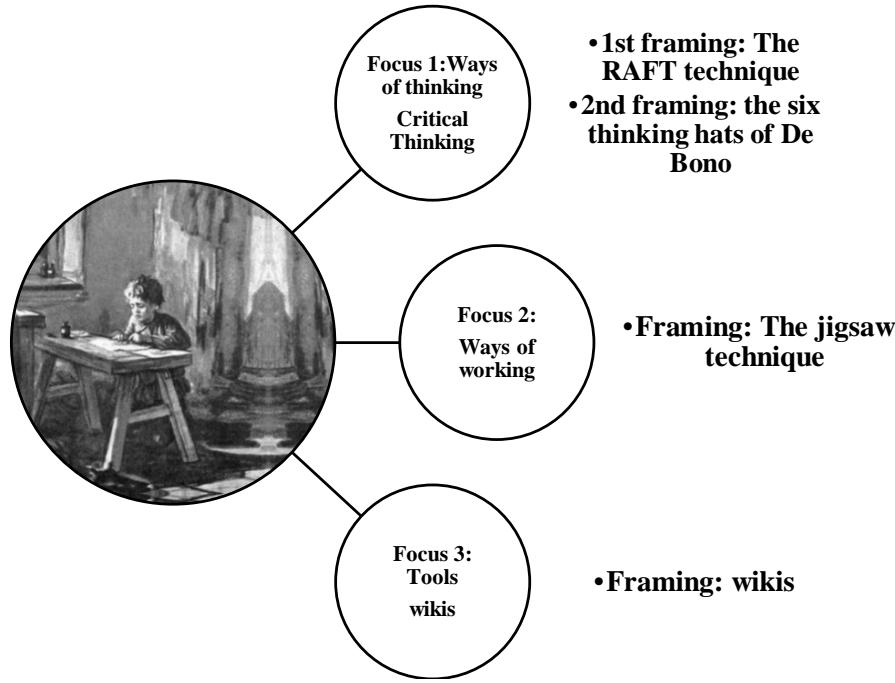
$\odot$ 1<sup>st</sup> focus: Ways of thinking. Critical thinking: Problem solving, decision making.
Theme: Child Labor
Reference: Modern Greek Literature Texts for 7th Grade, "Vanka" by Anton Chekhov
Summary of the Text: In this story, Anton Chekhov presents the issue of child labor with realism and sensitivity. Vanka, a nine-year-old orphaned boy, experiences the hardships of life away from his beloved grandfather, enduring social injustice and the harshness of survival, all through his innocent perspective.
The teacher presents the theme of child labor, highlighting the issue through Chekhov's text as a foundation. They guide students to formulate and analyze questions, such as:
- What problem do you identify in the text?
- What other issues arise from this problem?
- Does the issue of child labor exist nowadays?
- Can you explain your thoughts?
- How would you suggest addressing this problem?
Students discuss and analyze the issue of child labor based on their experiences and prior knowledge. Moreover, they examine sources provided by the teacher. Each student individually or as a member of a group suggests solutions, and these views are synthesized and presented to the class. Additionally, students may engage in activities such as writing letters to relevant authorities, thereby acting as active citizens.
$2^{nd}$ Framing the theme using the RAFT Technique The RAFT technique (Table 2) encourages the organization of evidence-based discourse. It helps students understand their role as writers by taking on roles, considering the audience they will address, the form of the text they will create, and the topic they will approach from a point of view. RAFT is the acronym for the words, Role: the role of the writer (journalist, observer, eyewitness, narrator, etc.), Audience: the audience (the one who will read the text, classmates, parents, people in the community, etc.), Format: the format of the text (letter, article, essay, poem, advertisement, etc.), Topic: the subject (the subject of the text, a theme, a concept, etc.), Theme: the subject of the text, a topic, a concept, etc. (Valianti & Neophytou, 2017).
In this case, the student taking on the role of a child worker, sends a letter to the Ministry of Labor exposing the issue of child labor, the conditions under which he/she works, his/her deprivations and issues related to the violation of their rights.
Table 3: Learning Activity
<table><tr><td>Role</td><td>Audience</td><td>Form</td><td>Topic</td></tr><tr><td>Child</td><td>Υπουργεύ</td><td>Letter</td><td>Child Labour</td></tr></table>
2nd Framing: Using De Bono's "Six Thinking Hats" Technique
The analysis of topics through the lens of the "Six Thinking Hats" highlights multiple perspectives, fostering divergent and creative thinking, enhancing interaction, and thereby maximizing the outcomes of the learning process. In the context of the topic "Child Labor and its Effects on Children," the teacher encourages students to argue about the issue.
Topic for Discussion: Child labor and its impact on children.
The White Hat represents neutral, objective knowledge. Users of this hat process available information, focusing on facts without drawing conclusions.
The Red Hat expresses emotional and intuitive thinking. The user reveals spontaneous, subjective emotional responses (fears, desires, etc.) without rational justification.
The Black Hat represents caution, highlighting the negative aspects of a decision (disadvantages, risks, consequences). The role relies on logic. The black hat balances impulsive subjectivity and strict logical reasoning, sparking the search for alternative solutions and thus promoting creative thinking.
The Yellow Hat represents an optimistic approach, projecting a positive and well-founded assessment of the problem's parameters.
The Green Hat symbolizes creative thinking and encourages the user to experiment and propose open, innovative solutions.
The Blue Hat expresses organizational thinking. The user comprehensively examines each problematic situation, identifies its aspects, defines the goals of the action plan, and organizes action steps.
$\odot$ 2nd Focus: Working Methods
Framing: The Jigsaw Technique
The Jigsaw Technique (Aronson et al., 1978) is one of the most popular methods for promoting collaboration and discussion within a community. This method unfolds in seven stages, and as in a puzzle, each student contributes to completing the "learning puzzle" through individual, cooperative effort and study.
Steps
<table><tr><td>Step 1
Organization of groups that will serve as the foundation for the jigsaw.</td></tr><tr><td>Step 2
Selection of a topic and defining areas of study.</td></tr><tr><td>Step 3
Assignment of study-work areas to each group member.</td></tr><tr><td>Step 4
Formation of new groups, the "experts." In these new groups, students investigate, discuss, exchange opinions and thoughts and argue.</td></tr><tr><td>Step 5
Each member, as a representative of their team, must transfer the new knowledge acquired in the "experts" group back to the members of their original group.</td></tr><tr><td>Step 6
When the "expert" groups have completed their work, the students are brought back and reassembled in their original groups. Each student, returning to his/her original group, analyses the main points of the study topic that was the subject of work in the 'expert' group.</td></tr><tr><td>Step 7
The teacher, who monitors the development of the process and acts as a facilitator throughout the process, records the points made by the students, evaluates the main points of the presentation, poses questions, creates new concerns and synthesizes the axes of the topic (Kafka et al., 2015: 3-13, 2022).</td></tr></table>
In the context of the topic on child labor, the teacher asks students to study aspects of the issue, examining materials related to child labor in the past and today (https://foundation.parliament.gr/el/dimokratia-kai-ekpaideysi).
One member from each group is assigned to study an issue to be worked on in the "expert" group. When the study of the issues is completed, the members return to their original teams and communicate the research results. The activities are concluded with a paper in which each group will summarize its conclusions on the issues analyzed.
In the context of the thematic units, students are asked to distinguish between the causes and conditions of child labor in the past and in the present day, to recognize the rights that children who work are deprived of, to relate the phenomenon of child labor to the general socio-economic conditions of each era and to challenge the view that child labor only concerns children from the so-called third world or minority social groups such as migrants and Roma.
### 3rdFocus: Tools
Framing:Wikis In wikis environments students develop language skills (Forte & Bruckman, 2006). The learning process expands across space and time, evolving in a familiar learning environment. In the open wiki environment, participants create content, share it, edit the work of others, and contribute to idea production. The teacher can trace each student's participation and contributions within this collaborative process.
In particular, the use of the wikis at the level of a learning community leads students to make the appropriate communicative adjustments and change their perspective, to operate in two-way transmitter-receiver environments and to be guided in self-evaluation and peer evaluation processes (Mazaraki, et al., 2017). In the context of the topic on child labor, the teacher asks students to write texts on child labor. They should intervene and add material, improve their text and creatively intervene in the texts of others.
In wikis environments students can, for example, take on the roles of: a. researchers on child labor, b. cartographers, representing the places with the highest increase in child labor, etc. In an initial phase, the students' assignments-roles and the time to complete their work are agreed upon. The students then co-construct a first draft of their text in the wiki environment. Through the development of asynchronous dialogue both with each other and with the teacher - a tool provided by the wiki platform - they reflect on the initial structure of their text, rework it and gradually work their way towards more complex forms of the initial text. In this way, students are engaged in a continuous process of collective reflection until the final version is produced. It becomes clear that in the wikis environments different perspectives and approaches are revealed and global approaches and mappings are created.
## VI. CONCLUSIONS - PROPOSALS
Cultivating $21^{\text {st }}$ century skills requires a new approach. Integrating educational practices with institutional educational skill practices ensures that achieving $21^{\text {st }}$ century competencies emerges from connected educational actions rather than isolated practices. In Greece the curricula aim at the acquisition of knowledge with the help of which students will develop cognitive, social and metacognitive skills, encouraging their active involvement in both individual and group activities. Learning environments should create the conditions for learning to be a social and group experience. New technologies, which are increasingly being used to create digital learning environments and simulate real-life situations, can contribute to this.
Skills workshops can be a place where modern teaching techniques can be applied and contribute to the development of skills in students, as through their participation in them students will be able to develop life, technology and science skills. In addition, students will practice learning through a collaborative, creative and critically reflective teaching methodology, where the aim is to enhance life skills, mediation and responsibility (Government Gazette B/3567/2021). Through learner-centred techniques that promote the active participation of learners and offer them the opportunity to discover, and above all to experience, change before being called upon to put it into practice, learners will be able to develop the skills necessary for their adult lives (Phillips, 2005).
[^1]: The Teaching Proposal is based on Material used in the Greek School. _(p.5)_
Generating HTML Viewer...
References
24 Cites in Article
E Aronson,C Stephan,J Sikes,N Blaney,M Snapp (1978). The Jigsaw Classroom.
Marilyn Binkley,Ola Erstad,Joan Herman,Senta Raizen,Martin Ripley,May Miller-Ricci,Mike Rumble (2012). Defining Twenty-First Century Skills.
(2010). Learning outcomes approaches in VET curricula. A comparative analysis of nine European countries.
A Forte,A Bruckman (2006). From wikipedia to the classroom: Exploring online publication and learning.
H Haste (2018). Attitudes and Values and the OECD Learning Framework 2030: A critical review of definitions, concepts and data.
S Hunt (2007). Hiring Success: The Art and Science of Staffing Assessment and Employee Selection.
D Kafka,A Dakopoulou,E Maniati (2015). Collaborative Adult Learning: From Theoretical Foundations to Practical Implications.
D Kafka (2022). Teaching Methods and Techniques.
Z Karanicola,N Panagiotopoulos (2019). Skills: A Pathway to Employability and Prosperity.
M Panagiotopoulos,G Human Resources Development. Training and International Policies.
K Kasimatis,D Kouloumpis,T Papageorgiou (2019). Cultivation of 21 st -century skills: Creating and implementing rubrics for assessing projects.
E Krasadaki,S Triantari,K Zopounidis (2023). Social/communication and digital skills in education and work in the 21st century.
Hea-Jin Lee (2005). Understanding and assessing preservice teachers’ reflective thinking.
P Lintzeris (2017). Skills policies. Highlights on the role of skills in the economy, employment and training.
D Mazarakis,K Papanikolaou,A Makri (2017). Pedagogical Utilization of Web 2.0 Tools in Educational Scenarios by Prospective Teachers.
(2019). OECD Future of Education and Skills 2030 Anticipation-Action-Reflection Cycle for 2030.
T Parsons (2008). Definition: Soft skills.
N Phillips (2005). The contribution of experiential education to the development of social skills.
Herbert Simon (1992). What is an “Explanation” of Behavior?.
S Valianti,L Neofytou (2017). Differentiated Teaching.
Joke Voogt,Natalie Pareja Roblin (2010). Curriculum and 21st century skills.
R Watkins,M Corry (2005). Online Student Success.
W Wiater (1999). Von schüler her unterrichten.
(2018). Spotlight 3: The multidimensionality of skills, στο World Development Websites.
No ethics committee approval was required for this article type.
Data Availability
Not applicable for this article.
How to Cite This Article
Dimitra Kafka. 2026. \u201cThe Pedagogy of Skills in the 21st Century: Practices for Integrating Them into the Teaching Process\u201d. Global Journal of Human-Social Science - G: Linguistics & Education GJHSS-G Volume 24 (GJHSS Volume 24 Issue G9): .
Explore published articles in an immersive Augmented Reality environment. Our platform converts research papers into interactive 3D books, allowing readers to view and interact with content using AR and VR compatible devices.
Your published article is automatically converted into a realistic 3D book. Flip through pages and read research papers in a more engaging and interactive format.
The paper aims at the educational priorities and teaching practices implemented in the Greek school that support the development of 21 st century skills. The approach to this central issue is attempted in the context of a global perspective. In specific, we focus on curricula, subject areas, the school’s mission and the learning environments. In our analysis we draw on the KSAVE model (Binkley et.al., 2012) and argue that any educational endeavor to cultivate skills at the school level should be an outgrowth of organic interconnection and alignment of the above factors rather than a decontextualized practice.
Our website is actively being updated, and changes may occur frequently. Please clear your browser cache if needed. For feedback or error reporting, please email [email protected]
Thank you for connecting with us. We will respond to you shortly.