
I. INTRODUCTION
In 1905, Albert Einstein first proposed that light, which had been considered electromagnetic waves, must also be particles. American chemist Gilbert Lewis later coined the term photon for the light particle.[1][2] As one of the subatomic particles, having no electric charge and one unit of spin, photons are bosons that are carriers of electromagnetic energy. [1][2]
The energy of a photon depends on radiation frequency, from high-energy gamma-rays and X-rays, through visible light, to low-energy infrared and radio waves. All photons travel at the speed of light.[3] But the photon has not been fully and correctly understood. For example:
Electromagnetism needs to be re-examined.
The idea of a positron annihilating an electron, producing gamma-rays, is disputable.
The above statement that the energy of a photon depends on radiation frequency should be a reverse causation: the frequency of a photon depends on its energy.
More misconceptions (see later sections) have been prevalent since the photon's discovery. Therefore, the nature of the photon needs a more profound and distinct perspective, from the fundamental principles of matter and the origin of the photon, as follows.
II. THE PRINCIPLES OF MATTER - THE LAWS OF UNITY
Here are the Principles of Matter or the Laws of Unity, updated from my original version:[4][5][6][7]
Matter is any substance that has mass (m) and energy. Mass and energy are properties of matter, not physical entities. Matter's energy is scalar, not vector.
Matter shows its energy as forces. A force is a vector that transfers energy.
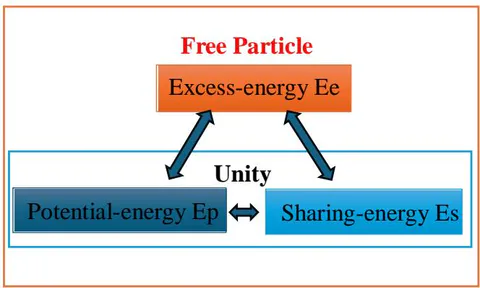
Matter keeps its internal potential-energy (Ep) and sharing-energy (Es) as a (part of a) unity, until being forced out of the unity by external excess-energy (Ee >= Es) as a free particle (see Figure 1: Matter).
- 3.1. Matter shows its sharing-energy (Es) as gravity (F) or weight (W) or inertia-at-rest to its unity centre: Es = F = W.
- 3.2. Matter does not show its potential-energy but transfers it between its sharing-energy and excess-energy (As shown in Figure 1: Matter). For example, when going up in an airplane, our weight is decreasing while our potential-energy is increasing , while the plane's external excess-energy also increases our potential-energy . When going even higher in a spaceship, we become "weightless" (weighing less). When landing on the Moon or Earth, our potential-energy is decreasing while our weight is increasing .
- Unity force or inertia is matter's tendency to be unity, expressed as attracting while energy sharing in a unity , as gravity or weight or inertia-at-rest to its unity centre; or repelling while excess-energy transferring out of the unity , as inertia-in-motion or heat.
- 4.1 A free particle oscillates away from the external excess-energy (Ee >= Es) as particle waves, transferring the excess-energy as heat or inertia-in-motion (Ee ) - such as light if the particle is almost massless (like a photon or a neutrino) or electron waves with magnetic effects if the particle is an electron - until returning or joining to a unity (Ee = 0).
- 4.2 In the unity , matter orbits or gravitates to its unity centre, attracting while energy sharing, like an electron orbiting an atomic nucleus or a planet orbiting a star. The orbit is the path where , leaving Es as the gravity (F) or weight (W) or inertia-at-rest to its unity centre: .
- 4.3 Breaking a unity (or inertia-at-rest) requires strong enough external excess-energy ( ), leading to inertia-in-motion and a new unity in the new situation ( or ). The more energy is shared ( , such as in a nuclear fusion), the tighter the formed unity (such as the produced nucleus unity), the more external excess-energy is required to break the unity, and vice versa (such as in beta decay).
In his first law of motion, Isaac Newton described inertia as the natural tendency of objects in motion to stay in motion and objects at rest to stay at rest, unless a force causes the velocity to change.[8]
Asproposedabove:
Gravity is redefined as matter's attraction to its unity centre, caused by its sharing-energy.
Inertia is redefined and generalised to matter's unity force, caused by its sharing-energy (as inertia-at-rest or gravity) and its excess-energy (as inertia-in-motion or heat).
So, the Principles of Matter or the Laws of Unity can be described by the unity force or inertia:
Es = F = W = mg, where m is the mass, g is the acceleration by gravity [8],
Ee = ma, where m is the mass, a is an acceleration by external force.
Therefore,
cycling through the following states:
(in unity),
(out of unity),
(return or join to unity).
III. THE ORIGIN OF THE PHOTON
According to the Big Bang model, the universe began 13.8 billion years ago by expanding from a single point of infinite density and heat, known as the singularity.[9] As the universe expanded and cooled, matter formed, as four kinds of base particles: proton, electron, neutrino, and photon, in descending order of mass.[4][5][6][7]
Then, each free proton (p) shares energy with a free neutrino (v) as a proton unity (pv) because their mass fit each other to be a unity:
Each free electron (e) shares energy with a free photon as an electron unity , also because their mass fit each other to be a unity:
Proton unities (pv) and electron unities (eγ) are called base unities.
The light could not propagate because each photon bonded with an electron as a unity. The base unities also made the universe opaque (Cosmic Dark Age).
So, I propose and summarise:
The Big Bang created the photon as one of the four base particles.
A photon tends to be in an electron unity , circling the electron as the unity centre.
IV. THE PHOTON IN NUCLEAR FUSION
In a nuclear fusion centre, the base unities have been so dense and hot that they have become more energy sharing (Ep Es) and have begun nuclear fusion. That is, nuclear fusion is unity force in action, mainly through the proton-proton chain reaction[10], in the following simplified steps, updated from my original version:[4][5][6][7]
- Two proton unities and two electron unities share energy to form a hydrogen-2 nucleus called deuterium, transferring out a high-energy neutrino , a high-energy electron or positron) and a high-energy photon or gamma ray) as excess-energy:
- The deuterium pvey shares energy with another proton unity to form a helium-3 nucleus, transferring another high-energy photon ( or gamma ray) as excess-energy:
- Two helium-3 nuclei share energy to form one helium-4 nucleus and transfer two proton unities to continue the process:
The helium-4 nucleus, , becomes repelling while transferring the excess-energy mentioned above and moves out of the fusion centre to the outer core as the nucleus unity, and the product of the fusion.
Or the helium-4 nucleus shares more energy with other nuclei or proton unities to form a heavier nucleus unity: , where atomic number n > 2, if the situation permits.
Therefore, in a newly formed nucleus unity from nuclear fusion, every electron shares energy with two protons and one neutrino as , where the atomic number . Although isotopes happen, this is the main composition.
Most fusion centres transfer out their excess-energy as high-energy neutrinos, photons, and electrons:
- 7.1. The high-energy neutrinos and photons and carry their excess-energy away directly as light (invisible in the beginning due to high energy).
- 7.2. The high-energy electrons bump into outside normal electron unities , transferring the excess-energy to their bonded photons (no "annihilation"), producing gamma rays as light:
- The rest, extra-large fusion centres could not transfer out their excess-energy in the inner core but use it instead for energy sharing of tighter unities. Without repelling by excess-energy transferring, these extra-large fusion centres become black holes with much stronger attracting unity forces (gravities) of their respective galaxies.
- So, I propose and summarise:
Nuclear fusion is the unity force in action, creating nucleus unities so that every electron shares energy with two protons and one neutrino as , where atomic number . In a nucleus unity, neutrinos and electrons are energy-sharing agents, orbiting protons to share and distribute energy. Thus, unity force replaces strong force[11] and quantum chromodynamics.[5][6][7]
In a nucleus, every pair of (pe) shows as a neutron.
A "positron" is redefined as a high-energy electron. Matter's energy is scalar, not vector. Any "antimatter" is a misconception, including the
concept of a "positively charged electron" and the idea of "annihilation".
Excess-energy transferring is an essential aspect of unity force, to maintain the newly produced unities. As an excess-energy-transferring agent in nuclear fusion, the photon is not in a nucleus.
In the universe, most nuclear fusion centres with excess-energy-transferring form stars and planets. The rest, extra-large fusion centres with inner cores unable to transfer out excess-energy as a repelling force, form black holes with much stronger attracting unity forces (gravities) of their respective galaxies.[6][7]
In a black hole, matter transfers its potential-energy completely into sharing-energy , so that , and sharing-energy becomes infinity: , making the black hole into a physical singularity.
Mass and energy are properties of matter, not physical entities, and not exchangeable, not even in nuclear fusion. The concept of mass-energy equivalence is deemed a mis-conception.
Every galaxy is a unity, the ultimate unity with its ultimate unity force, with at least one black hole as the unity centre. If two or more black holes exist in one galaxy, they are close enough to attract each other and will eventually merge into one.[6][7]
Unity force or inertia (its sharing-energy E's showing as gravity) forms the hierarchical structure of each galaxy, making the black hole its unity centre. Under a galaxy, each star is the unity centre of the star system. Under a star system, each planet is the unity centre of its moons. Then, each atomic nucleus is the unity centre of the atom. Inside the nucleus, every proton is a unity centre. Outside the nucleus, each electron is the unity centre of the electron unity .[6][7]
V. THE PHOTON IN ATOM FORMATION
Around 380,000 years after the Big Bang, out of the fusion centres in the disks of the star systems, the temperatures were eventually cool enough for the nuclei to capture electron unities , forming the first atoms and making the cosmos transparent:[5][6][7]
Absent from nuclear fusion, each free proton unity attracts and shares energy with an electron unity in its orbit, forming a hydrogen atom: , producing most of the light elements in the universe.
Created in the fusion centres and moved out, each helium-4 nucleus shares energy with two electron unities in its orbit, forming a helium atom: , producing the rest of the light elements in the universe.
The heavier nuclei form atom unities the same way, with exact numbers of protons and electrons in an atom: , where atomic number .
When getting excess-energy from the environment, like nearby fusion centres, the outermost electron unity (eY) of an atom oscillates out of the atom, becoming a free electron unity again, and in turn transfers the excess-energy to its bonded photon, producing light:
together with the light produced from nuclear fusion, bringing the dawn of the universe.[5][6][7]
So, I propose and summarise:
In atom formation, absent from nuclear fusion, each free proton unity (pv) shares energy with an electron: unity (eY) in its orbit, forming a hydrogen atom: .
Created in fusion centres and moved out, those nuclei share energy with electron unities in their orbits, forming atom unities: , with the same number of protons and electrons, but only half the number of photons and neutrinos. The other half of photons and neutrinos are transferred out as excess-energy in nuclear fusion, as free photons and neutrinos (visible and invisible light) in the universe.
VI. THE PHOTON IN BETA DECAY
As stated in the section of Nuclear Fusion, the nuclei of helium and heavier atoms are created in nuclear fusion centres by every electron sharing energy with two protons and one neutrino as , where atomic number .
In a nucleus, every (pe) shows as a neutron. In the following beta decay processes, electron emission breaks a neutron (pe) into ; while electron capture is a reversal: .
According to the Laws of Unity, breaking a unity requires strong enough external excess-energy (Ee >= Es), although some very unstable unities (with more potential-energy but less sharing-energy) can break easily, almost spontaneously.
In the case of beta decay, the external excess-energy mostly comes from random environmental sources (besides manually induced in nuclear fission), including cosmic rays, high-energy photons (gamma rays, X-rays), neutrinos or electrons. Most of the sources are nearly untraceable.
Beta decays happen in two types:
- Electron emission[13]. The external excess-energy breaks free an electron and a neutrino shared with a proton, causing one less neutron and one more proton:
The broken-free neutrino carries the excess-energy away as invisible light. The broken-free electron or positron) transfers the excess-energy to a normal electron unity (eY), producing a gamma ray or X-ray depending on the energy level.
- Electron capture[14]. The external excess-energy can also energise an electron in the orbit of an unstable nucleus. The energised orbiting electron can break the unity of its nucleus, forming a new unity with a proton, causing one less proton and one more neutron:
transferring out a high-energy neutrino as excess-energy and invisible light.
So, I propose and summarise:
Beta decay is also unity force in action: external energy breaks an unstable nucleus unity, leading to a more energy-sharing and hence more stable nucleus unity, while transferring out the excess-energy either as a neutrino and an electron (electron emission) or just as a neutrino (electron capture). Thus, unity force also replaces weak force.[5][7][15]
In beta decays, as agents for excess-energy transfer gamma ray or X-ray), photons maintain the newly produced unities.
In beta decays, electron emission breaks a neutron (pe) into ; while electron capture is a reversal: .
As stated before, the concept of a "positively charged electron" is a misconception. Beta decays should be categorised into electron emission and electron capture, instead of "negative or minus" and "positive or plus".
In beta decays (including nuclear fissions), the transferred energy comes from the potential-energy of the source nuclei, not from their mass. The excessive potential-energy stored in the source nuclei from nuclear fusion makes them unstable.
VII. THE PHOTON AS GAMMA RAY AND X-RAY
As stated in the above sections:
- A gamma ray is a very-high-energy photon is used in this section to indicate higher energy than ) transferred out from nuclear fusion:
- Either directly as the photon
- or as a very-high-energy electron or positron) that transfers its energy to a normal electron unity (eY), also producing a very-high-energy photon :
- An X-ray is a high-energy photon produced from a high-energy electron or positron) transferred out from beta decay and met a normal electron unity (eY):
So, I propose and summarise:
When a positron meets a normal electron unity (eγ), the excess-energy transfers from the positron to the bonded photon, producing a gamma ray ( ) or an X-ray ( ), depending on the positron's excess-energy level. "Annihilation" is a misconception.
After transferring all its excess-energy, the positron becomes a normal electron (e).
VIII. THE PHOTON IN ELECTROMAGNETISM
According to current knowledge, electromagnetism or electromagnetic radiation[16] is the flow of energy at the speed of light through space or a material medium in the electric and magnetic fields that make up electromagnetic waves such as radio waves, visible light, and gamma rays. In such a wave, electric and magnetic fields are mutually linked with each other at right angles and perpendicular to the direction of motion. An electromagnetic wave is characterised by its intensity and the frequency of the electric and magnetic fields. In quantum theory, electromagnetic radiation is the flow of photons through space.
According to the Principles of Matter, electromagnetic radiation is just electron waves transferring excess-energy as photon waves.[4][5] In an electric field or a conductor, when electron unities (eY) get excess-energy from an electric source that has a potential difference (voltage) for direction of motion, the energised electron unities oscillate away from the electric source as electron waves (the wave-particle duality) with magnetic effects (the wave property), perpendicular to the simultaneously caused electric current (the particle property), and in turn oscillating away their bonded photons as light , at right angles to the electrons:
The electron unities oscillate away from their external energy (the electric source) as far away as possible, which is perpendicular to the direction of the simultaneous electric current.
The photons also oscillate away from their external energy (the electrons) as far away as possible, which is at right angles to the electrons. That is why the magnetic waves (photon waves actually) are at right angles to the electron waves.
So, I propose and summarise:
1. Without external forces:
1.1. In most materials, most electrons are in atom unities; the rest, occasional free electrons,


make random waves that cancel each other out without magnetic effects.
1.2. In the rest materials, like iron, more free electrons can be aligned, showing some magnetic effects. A magnet has many more free electrons that are already aligned when created.
- External electric forces can oscillate away those outermost electrons from the atom unities of a conductor, align and energise them as stronger electron waves with magnetic effects, and simultaneously cause them to flow along the potential difference as electric currents. Electricity is the synchronized repelling force of the electric currents, in which each electron transfers its excess-energy to an electrical device, or to its bonded photon causing light.[5]
- Magnetic effects result from stronger electron waves aligning weaker electron waves. The aligned electron waves synchronise attractions and repulsions: while aligning is energy sharing, the aligned electrons all repel in the same direction, forming an electric current or potential difference. For example, a magnet or an electric source with stronger electron waves align and then attract small iron pieces with weaker electron waves.[5]
- Electromagnetism is electron waves showing magnetic effects while transferring excess-energy as photon waves. So, electromagnetism is the unity force of free electrons and should be called electronism.[5]
- Therefore, there are no such things as magnetism, magnetic fields, or magnetic waves. They are just electron fields with electron waves transferring excess-energy as photon waves.[5]
IX. THE PHOTON AS THE AGENT FOR EXCESS-ENERGY TRANSFER
When not bonded in an electron unity (eY), as agents for excess-energy transfer, free photons are vitally important to the universe (as shown above), as well as to human beings.
We have used free photons as waves and particles in countless applications. One small example is the photovoltaic (PV) cells, also known as solar cells[17]. They are electronic devices that absorb and convert excess-energy from high-energy free photons , producing electrical currents. These cells are the foundation of solar panels to generate electricity from sunlight.
Light absorption: The PV cells comprise materials that can absorb high-energy photons efficiently from the sun.
High-energy electron generation: The absorbed high-energy photons excite electron unities (eV) within the material, oscillating them free as high-energy electron unities :
- Current flow: These high-energy electron unities oscillate away to electrical contacts of the device, and flow through an external circuit, producing an electrical current.
This process of converting light into electricity is called the photovoltaic effect.[17]
X. CONCLUSION
Matter keeps its internal potential-energy (Ep) and sharing-energy (Es) as a (part of a) unity, until being forced out of the unity by external excess-energy (Ee >= Es) as a free particle.
Matter shows its sharing-energy (Es) as gravity (F) or weight (W) or inertia-at-rest to its unity centre:
Unity force or inertia is matter's tendency to be unity, expressed as attracting while energy sharing in a unity , as gravity or weight or inertia-at-rest to its unity centre; or repelling while excess-energy transferring out of the unity , as inertia-in-motion or heat.
That is, gravity is redefined as matter's attraction to its unity centre, caused by its sharing-energy.
Inertia is redefined and generalised to matter's unity force, caused by its sharing-energy (as inertia-at-rest or gravity) and its excess-energy (as inertia-in-motion or heat).
The Big Bang created four kinds of base particles: proton (p), electron (e), neutrino (v), and photon (γ), in descending order of mass.
The photon tends to be in an electron unity (eγ), oscillating around its electron (the unity centre), attracting while energy sharing, as gravity (F) or weight (W) or inertia-at-rest. Its orbit is the equilibrium of its unity force .
When getting external excess-energy (Ee Es), the photon oscillates out of the unity as a free photon with wave-particle duality, leaving the external energy at the speed of light, as a gamma ray, X-ray or light particle, repelling while excess-energy transferring. After transferring all its excess-energy, the photon shares energy with an electron that lost its photon previously, forming an electron unity (eY) again.
In a nuclear fusion centre, the base unities (pv and eγ) are so dense and hot that their sharing-energy is raised so high from their potential-energy (Ep → Es), they become energy sharing (nuclear fusing).
Nuclear fusion is the unity force in action, creating nucleus unities so that every electron shares energy with two protons and one neutrino as , where atomic number n . In a nucleus unity, neutrinos and electrons are energy-sharing agents, orbiting protons to share and distribute energy. Thus, unity force replaces strong force and quantum chromodynamics.
The photon is not in an atomic nucleus, because in nuclear fusion, the photon is transferred out as excess-energy - the gamma ray .
Excess-energy transferring is an essential aspect of unity force, to maintain the newly produced unities, in nuclear fusion, beta decay, or any other reactions.
In the universe, most nuclear fusion centres with excess-energy-transferring form stars and planets. The rest, extra-large fusion centres with inner cores unable to transfer out excess-energy as a repelling force, form black holes with much stronger attracting unity forces (gravities) of their respective galaxies.
In a black hole, matter transfers its potential-energy completely into sharing-energy , so that , and sharing-energy becomes infinity: , making the black hole into a physical singularity.
Mass and energy are properties of matter, not physical entities, and not exchangeable, not even in nuclear fusion or beta decay. The concept of mass-energy equivalence ( ) is deemed a misconception.
Every galaxy is a unity, the ultimate unity with its ultimate unity force, with at least one black hole as the unity centre. If two or more black holes exist in one galaxy, they are close enough to attract each other and will eventually merge into one.
Unity force (its sharing-energy Es showing as gravity) forms the hierarchical structure of each galaxy, making the black hole its unity centre. Under a galaxy, each star is the unity centre of the star system. Under a star system, each planet is the unity centre of its moons. Then, each atomic nucleus is the unity centre of the atom. Inside the nucleus, every proton is a unity centre. Outside the nucleus, each electron is the unity centre of the electron unity (eY).
In atom formation, absent from nuclear fusion, each free proton unity (pv) shares energy with an electron unity (ey) in its orbit, forming a hydrogen atom:
Created in fusion centres and moved out, those nuclei share energy with electron unities in their orbits, forming atom unities:, with the same number of protons and electrons, but only half the number of photons and neutrinos. The other half of photons and neutrinos are transferred out as excess-energy in nuclear fusion, as free photons and neutrinos (visible and invisible light) in the universe.
Beta decay is also unity force in action: external energy breaks an unstable nucleus unity, leading to a more energy-sharing and hence more stable nucleus unity, while transferring out the excess-energy either as a neutrino and an electron (electron emission) or just as a neutrino (electron capture). Thus, unity force also replaces weak force.
In a nucleus, every (pe) shows as a neutron. In beta decays, electron emission breaks a neutron (pe) into p + e; while electron capture is a reversal:
A "positron" is redefined as a high-energy electron. Matter's energy is scalar, not vector. Any "antimatter" is a misconception, including the concept of a "positively charged electron" and the idea of "annihilation". Therefore, beta decays should be categorised into electron emission and electron capture, instead of "negative or minus" and "positive or plus".
When a positron meets a normal electron unity (eγ), the excess-energy transfers from the positron to the bonded photon, producing a gamma ray or an X-ray, depending on the positron's excess-energy level. After transferring all its excess-energy, the positron becomes a normal electron.
External electric forces can oscillate away the outermost electrons from the atom unities of a conductor, align and energise them as stronger electron waves with magnetic effects, and simultaneously cause them to flow along the potential difference as electric currents. Electricity is the synchronized repelling force of the electric currents, in which each electron transfers its excess-energy to an electrical device, or to its bonded photon causing light.
Magnetic effects result from stronger electron waves aligning weaker electron waves. The aligned electron waves synchronise attractions and repulsions: while aligning is energy sharing, the aligned electrons all repel in the same direction, forming an electric current or potential difference.
Electromagnetism is electron waves showing magnetic effects while transferring excess-energy as photon waves. So, electromagnetism is the unity force of free electrons and should be called electronism.
Therefore, there are no such things as magnetism, magnetic fields, or magnetic waves. They are just electron fields with electron waves transferring excess-energy as photon waves.