
I. INTRODUCTION
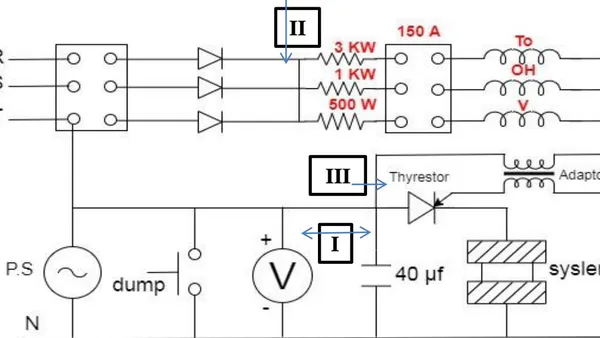
BATORM is the first toroidal plasma machine designed and operated in our lab at EAEA [1]. It was designed and built in 1998 depending on an idea to produce plasma in two ranges. In beginning, a low pressure DC glow plasma discharge is produced. After that, the excited magnetic trap in toroidal chamber are used to confine the energy and charged particles of the plasma to produce toroidal plasma confinement (as in the to kamaks devices [2]).
In this work, we are going to study and investigate experimentally the different parameters of the plasma of low pressure toroidal glow discharge in radial magnetic field [3]. The magnetic field has two orthogonal components: one that is created by a system of current-carrying coils around the plasma (toroidal magnetic field (TF)) and the other is created by a current that is induced in the plasma (poloidal magnetic field (PF)). The resulting magnetic field lines spiral around a set of nested toroidal flux surfaces, providing an effective plasma-confinement system, which can heat the plasma [4]. There is a weak vertical field is added by two separate set of external coils parallel to the Ohmic coil [5-7] provides additional stabilizing forces which required to prevent the radial expansion of the plasma column.
The Batorm is considered as one of the small and low cost devices. The first one (from 1998 to 2003) had aspect ratio (R/a) 1.68 with R = 6.125 cm and a = 3.625 cm. The toroidal coil consisted of 48 turns while the Ohmic coil had 22 turns and the vertical coil had 5 turns. In that work, there are four electrical circuits was designed and demonstrated to produce toroidal plasma inside the vacuum and magnetic vessel. The discharge energy was in the range between 45 J to around 384 J. It was during discharge time around 0.68 msec to 1.6 msec. The plasma current was between 3.4 KA to 12.75 KA with electron temperature from 2.25 eV to 9 eV by double electric probe [1].
Recently, updating Batorm configuration is beginning to increase the plasma properties (current, temperature and magnetic field). The new updating one will be explained in details in next section. Our study gives some preliminary results and makes complete survey to the plasma properties from this system. Also, it is considered as the first step to make use this plasma in different industry applications in future plan.
II. DESIGN AND OPERATION OF THE BATOM
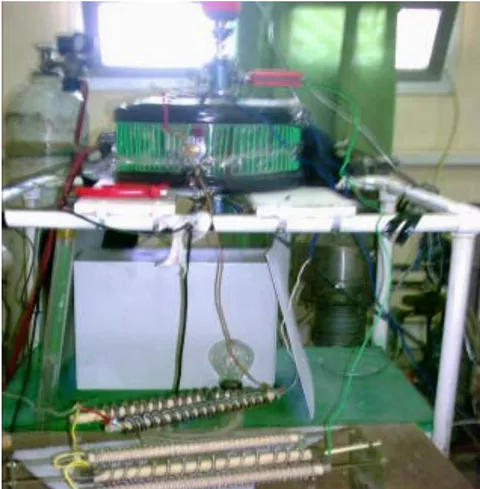
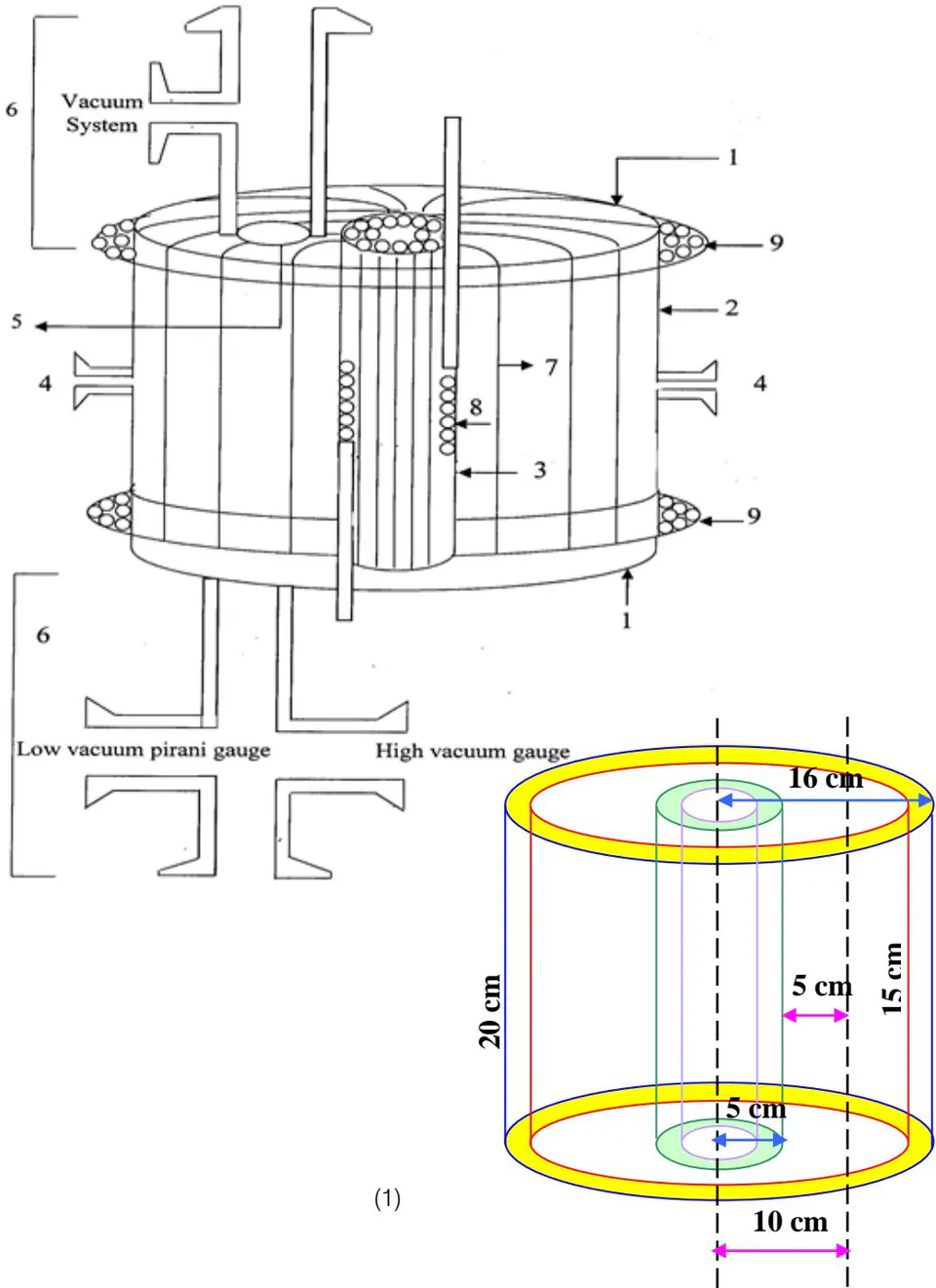
The BATORM consists mainly of vacuum chamber, vacuum system, magnetic vessel and electric circuit . The photographic view of the new Batorm is illustrated in figure (1). The vacuum chamber consists of two parallel aluminum plate electrodes, which is fixed at Pyrex glass discharge chamber of 15 cm length, and 32 cm inner diameter. At the center of it there is another glass tube of 15 cm length, and 10 cm outer diameter. So, the aspect ratio of this device R/a = 2. The working gas pressure of helium is Torr.
The inductances of the toroidal, ohmic and vertical coils are calculated from the following equations (1) and (2) as [8]:
is the permeability constant, n is the number of turns per unit length and A is the area of one turn. Therefore,
| 1- Two parallel aluminum plate electrodes | 6- Two (T) connections |
| 2- Pyrex glass discharge chamber | 7- Toroidal Coil |
| 3- Glass tube | 8- Ohmic coil |
| 4- Three small ports | 9- Vertical coil |
| 5- Two large ports |
So, the total inductance of the all coils: 934.4 H.
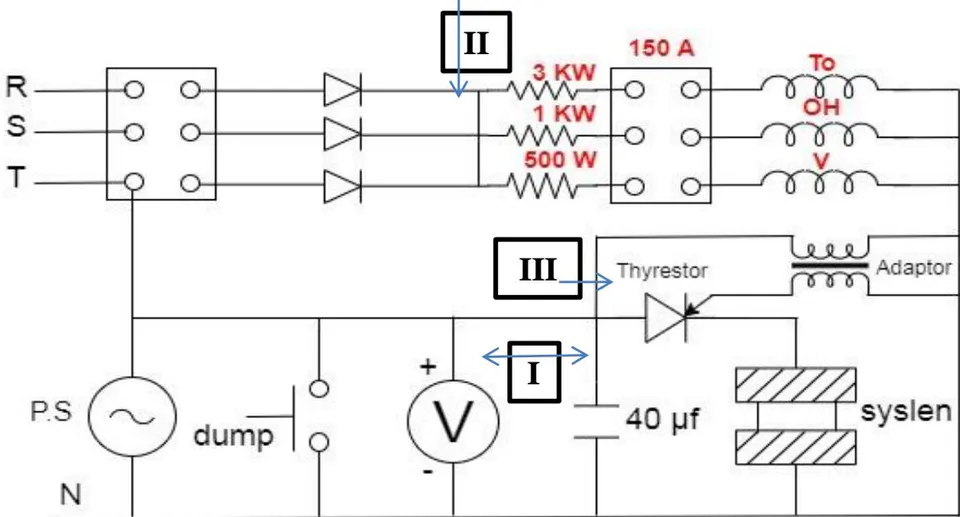
The discharge period and the discharge current can be calculated from equations (3) and (4) as follows [1]:
Where, C is the capacity of the capacitor bank. Therefore, .
b) Double Probe Method
The double electric probe is a diagnostic tool to measure the electron plasma temperature and ion density. It consists of two identical probes, normally cylindrical configuration, biased with respect to each other by an external source voltage ( ) with an associated current ( ), but the entire system floats with the plasma potential. Its technical data is illustrated in table (1). The double probe has an advantage that it can be used in plasma, with high space potential and it could disturb the plasma only at its location [9, 10].
If the potential difference between the probes is increased, then the relatively positive probe collects more electrons, until at a certain potential it reaches saturation.
| Probe material | Tungsten |
| Tip length | 4mm |
| Tip diameter | 1.5 mm |
| Tip area | 9.87 |
| Insulating material | Glass |
| DC power supply | From 0 V to 27 V |
IV. THE EXPERIMENTAL RESULTS AND DISCUSION
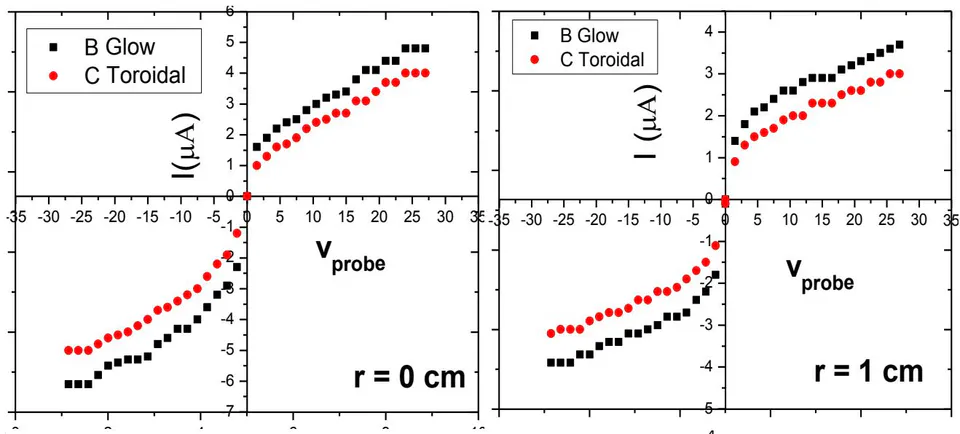
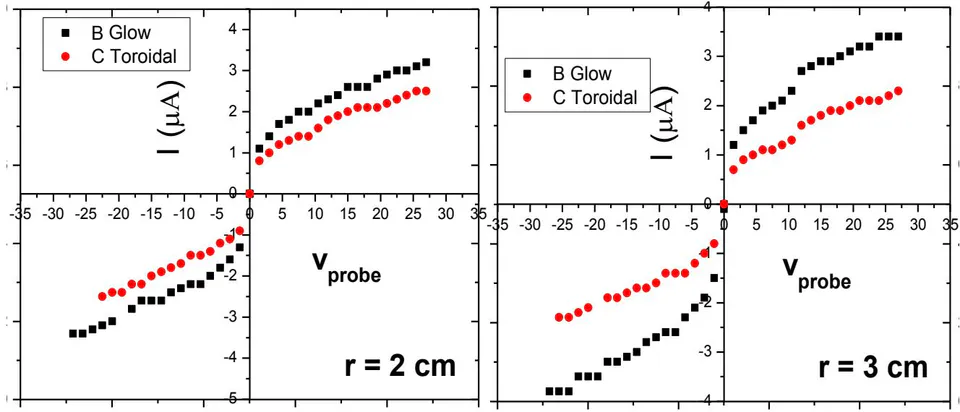
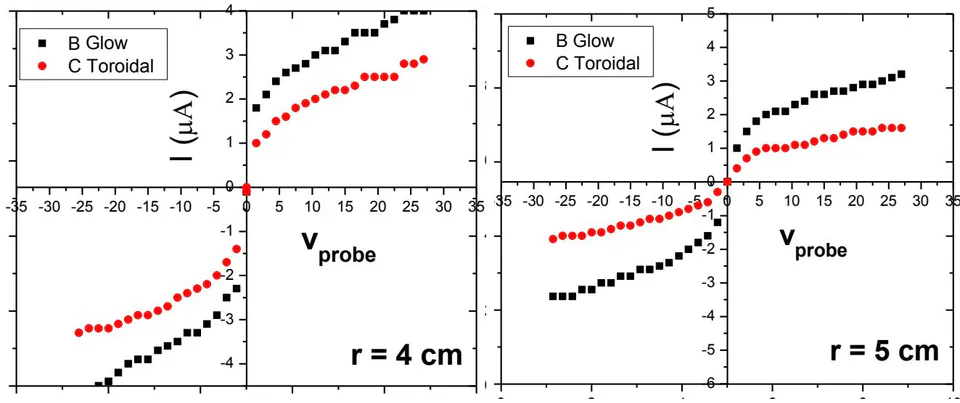
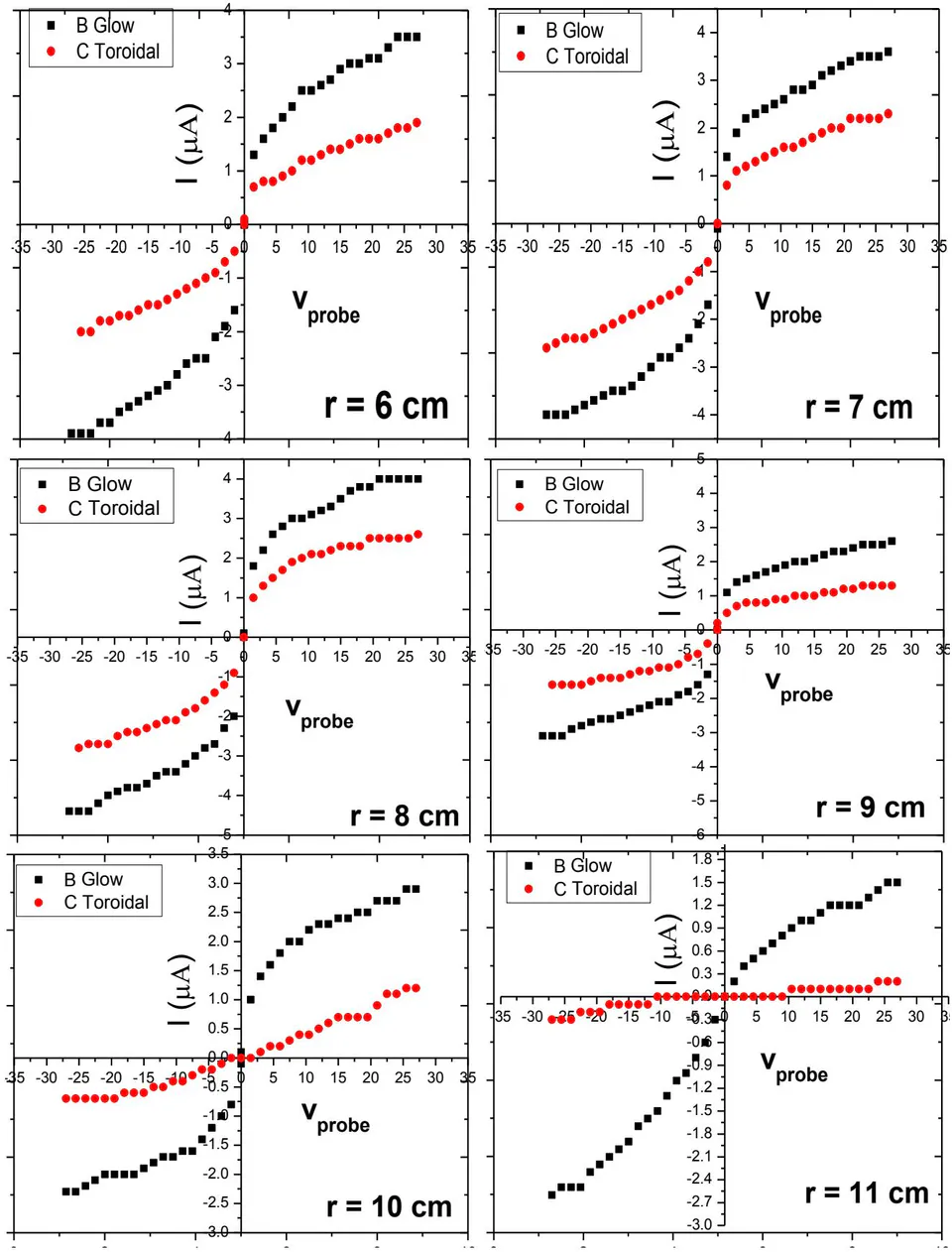
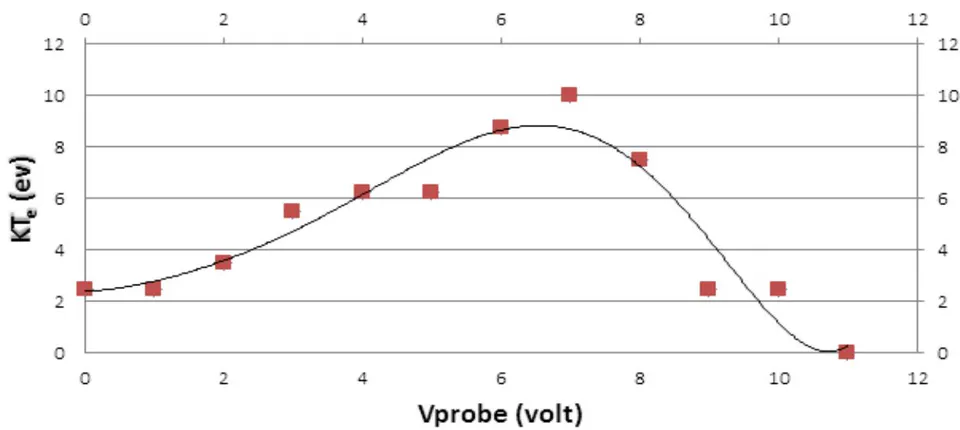
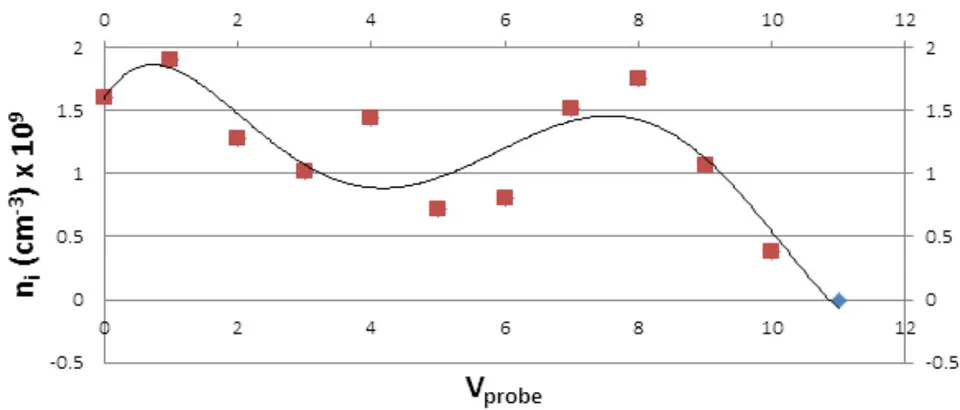
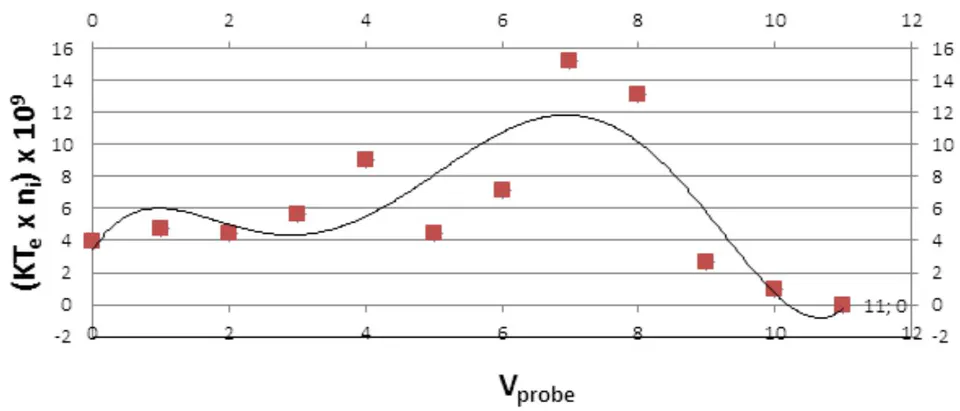
The (I-V) characteristics of double Langmuir probe at each cm of the length of the plasma inside the BATORM are shown in figure (4). In this figure the (I-V) characteristics for glow discharge drown by black points, while for toroidal confinement by red points. This figure illustrated that the confinement success to move the plasma far from the inner wall of the BAtorm (r = 11 cm) more than the outer wall (r = 0 cm).
| r (cm) | (ev) | ( ) x | x |
| 0 | 2.5 | 1.6 | 3.99 |
| 1 | 2.5 | 1.89 | 4.7 |
| 2 | 3.5 | 1.28 | 4.48 |
| 3 | 5.5 | 1.02 | 5.61 |
| 4 | 6.25 | 1.44 | 8.98 |
| 5 | 6.25 | 0.72 | 4.5 |
| 6 | 8.75 | 0.81 | 7.1 |
| 7 | 10 | 1.52 | 15.2 |
| 8 | 7.5 | 1.75 | 13.1 |
| 9 | 2.5 | 1.06 | 2.7 |
| 10 | 2.5 | 0.38 | 0.947 |
| 11 | 0 | 0 | 0 |
Figure (5) shows the variation of plasma temperature, plasma density and plasma energy density at deferent distances from 0 to 11 cm. From the results, it is clear that, the plasma has maximum temperature and density at distance 7 cm from the outer wall. Plasma is found around the minor axis but there are run away electrons which escape in direction of the outer wall. From knowing the energy density, the biggest value of plasma kinetic pressure is ; at 7 cm from the outer wall.
V. CONCLUSION
BATORM is the first toroidal plasma machine designed and operated in our lab at EAEA. This device is the first step to build small and not expensive plasma toroidal devices. The aim from them is to produce plasma in different properties by using available equipment and facilities. On condition, this plasma is in high accuracy to useful in different applications. By this way our lab will open contacts with the universities to explain experimentally and simply the plasma technology for students. Adding to contact with any destination need to use these sources of plasma in different applications such as industry, archeology, petroleum, medicine, agriculture, environment and etc. according to plan will stomach for each application.
It is clear that from the values of ion density, it could be increased the dc glow discharge voltage in future to give maximum values for . Besides, it is possible to connect more capacitor banks with ohmic coil circuit to increase poloidal magnetic field. This work has been considered as the first step to produce a good view for Batorm system. This will be used as a source of toroidal plasma machien which very useful in different applications related to material science.