Matter is any substance with mass and energy. Matter keeps its internal potential-energy (Ep) and sharing-energy (Es) as a (part of a) unity, until being forced out of the unity by external excess-energy (Ee >= Es) as a free particle. Matter shows its sharing-energy (Es) as gravity (F) or weight (W) or inertia-at-rest to its unity centre: Es = F = W. Matter does not show its potential-energy but transfers it between its sharing-energy and excess-energy; until and unless in a black hole, where matter transfers its potential-energy completely into sharing-energy Ep → Es, so that Ep = 0, and sharing-energy becomes infinity: Es = W = F → ∞, making the black hole into a physical singularity. Unity force or inertia (Fu = Es + Ee) is matter’s tendency to be unity, expressed as attracting while energy sharing in a unity (Ee = 0), as gravity or weight or inertia-at-rest to its unity centre; or repelling while excess-energy transferring out of the unity (Ee → Ee → 0), as inertia-in-motion or heat. That is, gravity is redefined as matter’s attraction to its unity centre, caused by its sharing-energy. Inertia is redefined and generalised to matter’s unity force, caused by its sharing-energy (as inertia-at-rest or gravity) and its excess-energy (as inertia-in-motion or heat). Matter moves relative to its unity centre, as its reference point, nullifying the base of the observational reference frame [7], making relativity a misconception. Matter moves to be unity by its unity force, in three dimensions, leaving a record or a trail. Space is the three dimensions of matter and of matter’s movements. Time is the record or trail of matter’s movements, not a dimension. Our timing systems and timers are based on matter’s time and are simulations of matter’s time. Space and time are properties of matter, not physical entities. Spacetime [8] is only a mathematical concept, not a physical one. Physically, a spacetime only pinpoints an event of matter’s movements. The universe only comprises matter and its movements in its three dimensions.
## I. INTRODUCTION
The universe is simple and beautiful, with simple and beautiful principles of matter, space, and time.
The universe comprises billions of beautiful galaxies. Each galaxy is centred on at least one black hole, circled with star systems. Each star system is centred on a beautiful star, circled with planets. Each planet is also the centre of its moons or rocks. The universe is hierarchically organized.[1][2][4]
The hierarchical units are called unities (defined further in the Principles of Matter).
Inside the centre of stars and planets (nuclear fusion centres), unity force (also defined in the Principles of Matter) creates atomic nuclei, comprising each proton circled with a neutrino or an electron.[1][2][3][4][5] When moved out of the nuclear fusion centres, each created atomic nucleus becomes the centre of an atom, circled with electron unities. Each of the electron unity is centred on the electron, circled with a photon.[1][2][3][4][5]
Therefore, the universe comprises nested unities.
In his first law of motion, Isaac Newton described inertia as the natural tendency of objects in motion to remain in motion and objects at rest to remain at rest, unless a force causes the velocity to change.[6]
So, Newton had realised that inertia has two states: inertia at rest and inertia in motion, although their causes were unknown.
Through the following Principles of Matter, Space and Time, this paper explains inertia and the universe the way it is.
## II. THE PRINCIPLES OF MATTER
Here are the Principles of Matter or Laws of Unity, updated from my original version: [1][2][3][4][5]
1. Matter is any substance that has mass $(m)$ and energy. Mass and energy are properties of matter, not physical entities. Matter's energy is scalar, not vector.
2. Matter shows its energy as forces. A force is a measurable vector that transfers energy.
3. Matter organises itself into hierarchical units, called unities, through its energies: matter retains its potential-energy (Ep) and sharing-energy (Es) within a unity as a unity member, until it becomes a free particle with sufficient excess-energy (Ee ≥ Es) from external excess-energy (see Figure 1: Matter).
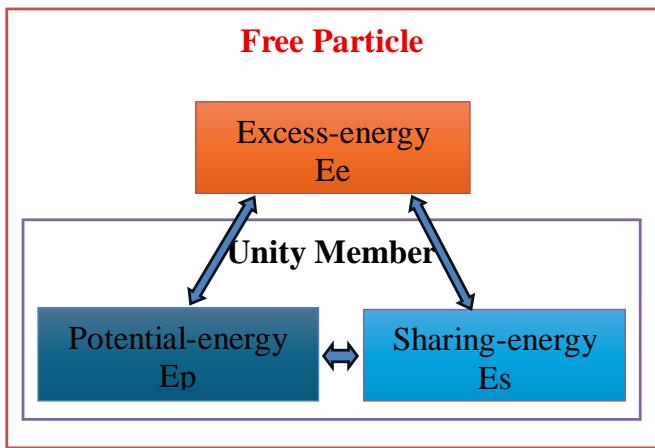
Figure 1: Matter
### 4. Matter forms and maintains unity with its unity force or inertia:
$$
F u = E s + E e,
$$
where Es causes an active and constant pull, as inertia-at-rest or gravity $(F)$ or weight $(W)$, towards the unity centre $(\mathrm{Es} = \mathrm{F} = \mathrm{W})$; and Ee produces inertia-in-motion or heat, away from the external excess-energy.
- 4.1. Matter oscillates away with the excess-energy (Ee $\geq$ Es) as a free particle, transferring the Ee as inertia-in-motion or heat (Ee $\rightarrow$ Ee $\rightarrow 0$ )—such as light waves if the particle is a photon or a neutrino, or electron waves with magnetic effects if the particle is an electron—until returning or joining a unity (Ee = 0).
- 4.2. In the unity, $\mathrm{Ee} = 0$, leaving only Es in its unity force, matter orbits or gravitates to the unity centre, like an electron orbiting an atomic nucleus or a planet orbiting a star, showing as inertia-at-rest or gravity (F) or weight (W): $\mathrm{Fu} = \mathrm{Es} = \mathrm{F} = \mathrm{W}$.
5. Matter does not show its potential-energy but converts its potential-energy between its sharing-energy and excess-energy (As shown in Figure 1: Matter). For example, when going up in an airplane, our weight is decreasing while our potential-energy is increasing $(\mathrm{Es} \rightarrow \mathrm{Ep})$. At the same time, the plane's external excess-energy also increases our potential-energy $(\mathrm{Ee} \rightarrow \mathrm{Ep})$. When going even higher in a spacecraft, we become "weightless" (weighing less). When landing on the Moon or Earth, our potential-energy is decreasing while our weight is increasing $(\mathrm{Ep} \rightarrow \mathrm{Es})$.
6. Breaking free a member with Es from a unity requires sufficient external excess-energy (Ee ≥ Es), causing inertia-in-motions and heat transfers (Ee → Ee), leading to new unities. The more energy is shared (Ep → Es, such as in a nuclear fusion), the tighter the formed unity (such as the produced nucleus unity), the more external excess-energy is required to break the unity, and vice versa (such as in beta decay).
#### Therefore:
1. Gravity or weight or inertia-at-rest is redefined as matter's active and constant pull towards its unity centre due to its sharing-energy.
2. Inertia is redefined and generalised as the unity force resulting from both sharing-energy (as inertia-at-rest or gravity or weight) and excess-energy (as inertia-in-motion or heat).
3. Matter moves relative to its unity centre, as its reference point, nullifying the base of the observational reference frame [7] and relativity.
4. The Principles of Matter or Laws of Unity is governed by matter's unity force or inertia:
$$
Fu = Es + Ee, where,
$$
Es = F = W = mg, where m is the mass of the matter, g is the acceleration by the Es or F or W,
Ee = ma, where m is the mass of the matter, a is the acceleration by the Ee.
Hence,
$\mathrm{Fu} = \mathrm{mg} + \mathrm{ma} = \mathrm{m(g + a)}$ cycling through the following states:
$a = 0$ (the matter is in its unity),
$\mathsf{a}\geq \mathsf{g}$ (the matter is out of the unity), a $\rightarrow 0$ (the matter is returning or joining a unity).
## III. THE PRINCIPLES OF SPACE
1. Matter moves in three dimensions, to form and maintain unity by its unity force: $\mathrm{Fu} = \mathrm{Es} + \mathrm{Ee}$, where Es causes orbits or gravitation (or inertia-at-rest or weight) towards the unity centre; and Ee produces inertia-in-motion or heat away from the external excess-energy.
2. Space is the three dimensions of matter and its movements.
3. Matter's space is three-dimensional only.
### Therefore:
1. Space is not preexisting. Space is wherever matter moves.
2. No vacuum exists in space. Matter shows its Ee as an active and constant pull towards its unity centre mediated or transferred by any member in between and shows its Ee as a direct push to other matter away from the external excess-energy.
3. In physics, mathematics is a necessary tool, can use more or fewer dimensions, but must conclude matter's three dimensions.
## IV. THE PRINCIPLES OF TIME
1. A time is an event in which a free particle (as heat) bumps into a unity, transferring the heat.
2. Time is a series of heat transfers.
### Therefore:
1. Matter experiences its own time, with or without changes in its composition or configuration due to the heat transfers.
2. A timer is matter or a device that experiences heat transfers regularly. For example:
- A clock or a watch experiences a heat transfer every second, or in a shorter interval.
Each part of the Earth experiences photonic heat from the sun regularly. Although the sun is transferring photonic heat all the time, the rotation and revolution of Earth make the Sun-Earth group a perfect timer, resulting in year, season, month, day, night, hour, to the divisions of a second.
3. Timers produce standardised time. We use timing systems based on timers to quantify and control heat transfers (as time), including photonic heat and electronic heat in lights and computers, plus atomic and molecular heat in engines and living organisms.
4. As a series of heat transfers, time is accumulative, so that it only moves forward. For example, matter can move back to its original (old) position, while adding a new event of heat transfer (a time).
5. Since it cannot move backward, time is not a dimension, as a dimension requires moving forward and backward (bi-directional movements).
6. Spacetime [8] is proposed as a mathematical model that combines the three dimensions of space and the one dimension of time into a single four-dimensional continuum. Since time is not a dimension, spacetime can only be a mathematical construct, not a physical reality.
## V. CONCLUSION
1. Matter is any substance with mass and energy.
2. Matter organises itself into hierarchical units, called unities, through its energies: matter retains its potential-energy (Ep) and sharing-energy (Es) within a unity as a unity member, until it becomes a free particle with sufficient excess-energy (Ee ≥ Es) from external excess-energy.
3. Matter forms and maintains unity with its unity force or inertia: $\mathrm{Fu} = \mathrm{Es} + \mathrm{Ee}$, where Es causes an active and constant pull, as inertia-at-rest or gravity (F) or weight (W) towards the unity centre; and Ee produces inertia-in-motion or heat away from the external excess-energy.
4. That is, gravity or weight or inertia-at-rest is redefined as matter's active and constant pull towards its unity centre due to its sharing-energy.
5. Inertia is redefined and generalised as the unity force resulting from both sharing-energy (as inertia-at-rest or gravity or weight) and excess-energy (as inertia-in-motion or heat).
6. Matter converts its potential-energy between its sharing-energy and excess-energy; until and unless in a black hole, where matter converts its potential-energy completely into sharing-energy $\mathrm{Ep} \rightarrow \mathrm{Es}$, so that $\mathrm{Ep} = 0$, and sharing-energy becomes infinity:
Es = W = F → ∞, producing infinite pull towards the centre, making the black hole into a physical singularity.[1][2]
7. Matter moves relative to its unity centre, as its reference point, nullifying the base of the observational reference frame [7] and relativity.
8. Matter moves to form and maintain unity by its unity force, in three dimensions.
9. Space is the three dimensions of matter and its movements.
10. Space is not preexisting.
11. No vacuum exists in space. Matter shows its Ee as an active and constant pull towards its unity centre mediated or transferred by any member in between and shows its Ee as a direct push to other matter away from the external excess-energy.
12. A time is an event in which a free particle (as heat) bumps into a unity, transferring the heat.
13. Time is a series of heat transfers.
14. Matter experiences its own time, with or without changes in its composition or configuration due to the heat transfers.
15. A timer is matter or a device that experiences heat transfers regularly. For example, the Sun-Earth group is a perfect timer, in which each part of the Earth experiences photonic heat from the sun regularly, resulting in year, season, month, day, night, hour, to the divisions of a second.
16. Timers produce standardised time. We use timing systems based on timers to quantify and control heat transfers (as time), including photonic heat and electronic heat in lights and computers, plus atomic and molecular heat in engines and living organisms.
17. As a series of heat transfers, time is accumulative, so that it only moves forward, not backward. As a dimension requires moving forward and backward (bi-directional movements), time is not a dimension.
18. As time is not a dimension, spacetime [8] can only be a mathematical construct, not a physical reality.
19. Space and time are properties of matter, not physical entities.
20. The universe comprises only matter and its movements in three dimensions, experiences heat transfers, resulting in its evolution and revolution.
Generating HTML Viewer...
References
2 Cites in Article
Changming Wang (2025). The Photon and the Principles of Matter.
Changming Wang (2025). The Nature of the Neutrino.
No ethics committee approval was required for this article type.
Data Availability
Not applicable for this article.
How to Cite This Article
Changming Wang. 2026. \u201cThe Principles of the Universe\u201d. Global Journal of Science Frontier Research - A: Physics & Space Science GJSFR-A Volume 25 (GJSFR Volume 25 Issue A6): .
Explore published articles in an immersive Augmented Reality environment. Our platform converts research papers into interactive 3D books, allowing readers to view and interact with content using AR and VR compatible devices.
Your published article is automatically converted into a realistic 3D book. Flip through pages and read research papers in a more engaging and interactive format.
Matter is any substance with mass and energy. Matter keeps its internal potential-energy (Ep) and sharing-energy (Es) as a (part of a) unity, until being forced out of the unity by external excess-energy (Ee >= Es) as a free particle. Matter shows its sharing-energy (Es) as gravity (F) or weight (W) or inertia-at-rest to its unity centre: Es = F = W. Matter does not show its potential-energy but transfers it between its sharing-energy and excess-energy; until and unless in a black hole, where matter transfers its potential-energy completely into sharing-energy Ep → Es, so that Ep = 0, and sharing-energy becomes infinity: Es = W = F → ∞, making the black hole into a physical singularity. Unity force or inertia (Fu = Es + Ee) is matter’s tendency to be unity, expressed as attracting while energy sharing in a unity (Ee = 0), as gravity or weight or inertia-at-rest to its unity centre; or repelling while excess-energy transferring out of the unity (Ee → Ee → 0), as inertia-in-motion or heat. That is, gravity is redefined as matter’s attraction to its unity centre, caused by its sharing-energy. Inertia is redefined and generalised to matter’s unity force, caused by its sharing-energy (as inertia-at-rest or gravity) and its excess-energy (as inertia-in-motion or heat). Matter moves relative to its unity centre, as its reference point, nullifying the base of the observational reference frame [7], making relativity a misconception. Matter moves to be unity by its unity force, in three dimensions, leaving a record or a trail. Space is the three dimensions of matter and of matter’s movements. Time is the record or trail of matter’s movements, not a dimension. Our timing systems and timers are based on matter’s time and are simulations of matter’s time. Space and time are properties of matter, not physical entities. Spacetime [8] is only a mathematical concept, not a physical one. Physically, a spacetime only pinpoints an event of matter’s movements. The universe only comprises matter and its movements in its three dimensions.
Our website is actively being updated, and changes may occur frequently. Please clear your browser cache if needed. For feedback or error reporting, please email [email protected]
Thank you for connecting with us. We will respond to you shortly.