

I. INTRODUCTION
According to Wikipedia, a property tax or millage rate is an ad valorem tax on the value of a property, usually levied on real estate .
The levyon real estate tax has a long history, which can be traced back to ancient times and the Medieval times . The Chinese government currently only levies commercial real estate tax, and does not formally levy residential real estate tax, just pilots to levy residential real estate tax in two megacities Shanghai and Chongqing since January 28 , 2011.
Many countries in the world levy individual resident real estate tax, that is to say, the number of countries that levy individual resident real estate tax is large, the number of countries that do not levy individual resident real tax is small. Such a situation shows the rationality and necessity of levying individual resident real estate tax. We can analyze this kind of rationality and necessity from many perspectives. However, this paper is focusing on the perspective of monogamy.
II. LITERATURE REVIEW
As mentioned in the introduction, the levy on real estate tax can be traced back to ancient times. "In pre-commercial agricultural areas the property tax was a feasible source of local government revenue and equal taxation of wealth was consistent with the prevailing equalitarian ideology." However, theoretical analysis of the levy on real estate tax can be traced back to Adam Smith at least. Adam Smith in his Wealth of Nation book V Chapter II proposed four maxims with regard to taxes in general, i.e., equality, certainty, convenience, and economy, also expressed such a view: the landlord and tenant shared the tax on the rent of house .
The main thoughts of Georgism are that people should own the value they produce themselves, but the economic value derived from land (including natural resources) should belong equally to all members of society, and a single tax on land would create a more productive, more just society .
Although economists love property taxes, homeowners don't . Friedman thinks, the reason that the homeowners dislike the property taxes is that "It's the only tax left on the books for which people have to write a big check."
SegÚ (2020) studies the impact of introducing a tax on vacant units in the French housing market, and finds that 1999 vacancy tax decreased vacancy rates by 13% in taxed municipalities compared to a control group, the tax was especially effective in reducing long-term vacancy, and most previously vacant units were turned into primary residences.
Guilfoyle (2020) thinks the theoretical property tax literature does not offer a clear answer on the effects of the property tax on house prices, the property tax's effect on house prices must be measure edempirically.
Poghosyan (2016) analyzes the relationship between property tax rates and house price volatility based on the data of property tax rates in U.S. states and metropolitan statistical areas over the 2005–2014 period, and finds that property tax rates have a negative impact on house price volatility, then suggests that property taxation could be used as an important tool to dampen house price volatility.
From a historical and natural perspective, the polygamy system had occupied the mainstream position for a long time. According to survey statistics : among mammals, just 9 percent of species are monogamous; among primates, just 29 percent are; and before Western imperialism, 83 percent of indigenous human societies were polygynous, 16 percent monogamous, and 1 percent polyandrous.
Monogamy can be traced back to ancient Greece and ancient Rome , for example, Solonian reforms of the early sixth century BCE defined the monogamous conjugal family as the sole legitimate family form and barred the legalization of children born out of wedlock (Scheidel, 2009).
The creation and spread of Christianity promoted monogamy's spread in the West, although no Biblical passages explicitly prohibit plural marriage. But mainstream Christianity has always endorsed and enforced monogamy, Genesis 2:24: Therefore shall a man leave his father and his mother, and shall cleave unto his wife: and they shall be one flesh. Matthew 19:6: Wherefore they are no more twain, but one flesh. What therefore God hath joined together, let not man put asunder. Matthew 19:7: They say unto him, Why did Moses then command to give a writing of divorcement, and to put her away? Matthew 19:8: He saith unto them, Moses because of the hardness of your hearts suffered you to put away your wives: but from the beginning it was not so. So, at the beginning, Gods ideal for marriage is monogamy.
Normative and legally enforced monogamy in most west countries can be tracked back to the early of Middle ages. "As Herlihy notes, 'The great social achievement of the early Middle Ages was the imposition of the same rules of sexual and domestic conduct on both rich and poor. The King in his palace, the peasant in his hovel: neither was exempt.'" (Mac Donald, 1995, p.17).
The Western world's conquest and colonization of non-Western worlds also promoted the implementation of monogamy worldwide. Laws prohibiting polygyny were adopted in Japan in 1880, China in 1953, India in 1955 and Nepal in 1963. (Henrich, et al., 2012).
In addition, monogamy has been supported by multiple arguments. Henrich, et al. (2012) argued that the norms and institutions of monogamy have been favored by cultural evolution due to their group-beneficial effects, i.e. promoting success in inter-group competition.
Although "both empirical and evolutionary considerations suggest that large absolute differences in wealth should favour more polygynous marriages." (Henrich, et al., 2012, p.657), "Three components influence the occurrence of social monogamy: the amount of paternal care, the access mode to resources, and partner choice." (Reichard, 2003, p5).
Betzig (1993) used division of labor theory to argue the rationality of monogamy: wealthy, powerful males adopt monogamy in order to elicit cooperation from others whose services are both essential and irreplaceable, industrialization has given rise to specialization, industrialization may also have brought on reproductive concessions. Alexander (2017) expressed some views as following: monogamous groups were advantaged militarily over polygynous groups, imposing monogamy would make fewer men to leave a group to search for wives elsewhere, and then would make men be available to fight in battles and pay taxes; Christianity emerged in the Roman Empire in the first centuries AD, and embraced monogamy; Christianity spread monogamy throughout the Western world.
III. SIMILARITIES BETWEEN MARRIAGE NEEDS AND HOUSING NEEDS
a) Both sex part of marriage needs and housing needs belong to Maslow's first level need
Abraham Maslow divided the needs of human beings hierarchically into five levels at the beginning of his career and six levels during his later years: (a) physiological, (b) safety, (c) social belonging, (d) esteem, (e) self-actualization, and (f) self-transcendence.
Maslow's first level needs, i.e., physiological needs, include breathing, water, food, sleep, clothing, and shelter . In the example of physiological needs, shelter is included in the physiological needs.
Maslow distinguished two types of physiological needs, one is the unusual type with somatic base, another is more common type. "It can be seen upon a closer analysis that the hunger drive is more a special case of motivation than a general one. it is less common than other motivations; and finally it is different from other motivation in that it has a known somatic base which is unusual for motivational states." (Maslow, 1943a, P85). "What are the more common immediate motivations? We can find these easily enough by introspecting during the course of an average day. The desires that flit through consciousness are most often desires for clothes, automobiles, friendliness, company, praise, prestige, and the like." (Maslow, 1943a, P85). "That is to say, they are relatively independent of each other, of other motivations, and of the organism as a whole, and, in many cases, it is possible to demonstrate a localized, underlying somatic base for the drive. This is true less generally than has been thought(exceptions are fatigue, sleepiness, maternal responses), but it is still true in the classic instances of hunger, sex, and thirst."(Maslow, 1943b, P373). "Sex may be studied as a purely physiological need."(Maslow, 1943a, P381). From Maslow's above discussion, we can see that both sex part of marriage and housing belong to the first level of physiological need.
b) Both sex part of marriage needs and housing needs belong to the level of Alderfer's Existence need
Alderfer (1969) wanted to further develop Maslow's hierarchy of needs and proposed his ERG theory, i.e., Existence, Relatedness and Growth.
Alderfer's ERG theory is characterized by four points: (1) categorizing Maslow's five hierarchies of needs into three hierarchies, i.e., Existence, Relatedness, and Growth. Referring to relationships between Maslow's and Alderfer's needs, Table 1 shows a comparison of Maslow's categories and Alderfer's ERG categories. (2) Alderfer put forward the idea that all needs are satisfied at the same time. (3) Alderfer also put forward the regression idea, i.e., when needs in a higher category are not met, individuals will redouble the efforts invested in a lower category need . (4) Alderfer's ERG theory is more suitable to be used to guide empirical research due to an inadequate conceptualization of Maslow theory which does not readily facilitate the development of operational indicators, and the initial orientation of Maslow's theory which was not specifically aimed toward organizational settings (Schneider& Alderfer, 1973).
| Maslow Categories | Alderfer Categories |
| Physiological | Existence |
| Safety—material | Relatedness |
| Safety—interpersonal | Growth |
| Belongingness (social) | |
| Esteem—interpersonal | |
| Esteem—self-confirmed | |
| Self-actualization |
Viewing from above Table1, we can know that: (1) Existence needs are equivalent to all of the physiological needs, and include those aspects of safety that are related to material ends. (2) Relatedness needs include interpersonal safety need, belongingness (love) needs, and interpersonal esteem needs. (3) Growth needs include the self-actualization need and self-confirmed esteem need.
Viewing from Alderfer's needs structure, we can see that both sex part of marriage and housing belong to the level of Existence need.
c) Viewing family part of marriage need from the perspective of Alexander's theory
Maslow's third hierarchy of needs is social belonging need, which include love need, affection need and belongingness need. Maslow thought, if both the physiological and the safety needs are well gratified, the person will feel keenly the absence of friends or sweetheart or a wife or children, and will strive with great intensity to gratify this need (Maslow, 1943b). it is obvious that family part of marriage need belongs to the third hierarchy of Maslow's needs.
Alderfer's Relatedness need is about social and family needs what are to feel loved and belong somewhere. Therefore, family part of marriage need belongs to Alderfer's relatedness need.
However, viewing from the perspective of Alexander's theory, perhaps we can think that family part of marriage need could be belonged to more important or lower need hierarchy.
People are pursuing interests. "A theory of interests is a theory of lifetime." (Alexander, 2017, p. 33). Pound (1941) defines the interest as "a demand or desire which human beings either individually or in groups or in associations or in relations, seek to satisfy, of which, therefore, the ordering of human relations must take account." (Alexander, 2017, p. 33). Then what is the human interest? Alexander's answer is: "Lifetimes have evolved so as to promote survival of the individual's genetic materials, through individuals producing and aiding offspring" (Alexander, 2017, p. 37). Due to human interest as reproductive, that means marriage need is the most important need for humankind.
d) Compared with needs, housing supply and marriage supply are insufficient
The economics definition of Lionel Robbins is generally accepted in the field of economics. "Economics is the science which studies human behaviour as a relationship between ends and scarce means which have alternative uses." (Robbins, 1935, p. 15). Economics is "a certain aspect of behaviour, the form imposed by the influence of scarcity." (Robbins, 1935, p. 16–17). "Economics is entirely neutral between ends;... in so far as any end is dependent on scarce means," (Robbins, 1935, p. 24). "The ends may be noble or they may be base. They may be 'material' or 'immaterial'—if ends can be so described. But if the attainment of one set of ends involves the sacrifice of others, then it has an economic aspect." (Robbins, 1935, pp. 24-25).
Compared with housing need and marriage need, housing supply and marriage supply are insufficient, especially when people treat houses as wealth. This is determined by the laws of natural economy, because the amount of land is fixed and the ratio of men to women in the population is almost fixed.
IV. THE RATIONALITY OF CHINA'S REAL ESTATE TAX LEVY
a) How to solve the interest conflict caused by polygyny
It is said that the net benefits of additional mates are usually greater for males than for females (Alexander, 2017), then males tend to invest more in mating effort, that means polygyny is much more popular than polyandrous. "Intensive polygyny by wealthy, powerful males would appear to be a theoretically optimal male strategy in a stratified society (i.e., behavior that optimizes individual male reproductive success)." (MacDonald, 1995, p3), levels of polygynous marriage reached extremes in the earliest empires whose rulers assembled immense harems (Henrich, et al., 2012).
Polygyny must be bringing the interest conflicts to society, "the opportunity for sexual selection was greatest in the early 1830s (0.667), dropped by 42.4% in the ensuing two decades (0.384 in the early 1850s) and converged towards one-quarter at the end of the 19th century (0.279 in the early 1890s). Thus, the opportunity for sexual selection, , lost 58.2% of its strength coincident with the change in mating system from polygyny to monogamy" (Moorad, et al., 2011, p151).
Riley (2015) makes the following description :
Polygynist cultures need to create and sustain an underclass of unmarried and undereducated men, since in order to sustain a system where a few men possess all the women, roughly half of boys must leave the community before adulthood. Such societies also spend more money on weapons and display fewer social and political freedoms than do monogamous ones. When small numbers of men control large numbers of women, the remaining men are likely to be willing to take greater risks and engage in more violence, possibly including terrorism, in order to increase their own wealth and status in hopes of gaining access to women.
The purpose of the moral system is to solve the interest conflicts (Alexander, 2017), the norms of monogamy belong to the moral system, "socially or legally imposed monogamy is a way of leveling the reproductive opportunities of men, thereby reducing their competitiveness and increasing their likelihood of cooperativeness. The imposition of monogamy by custom or law has the interesting effect of reducing both male-male and male-female conflicts to a minimum." (Alexander, 2017, p71).
Tertilt (2005) made a statistical analysis on data from highly polygynous, less polygynous and comparable monogamous countries. Highly polygynous country means that more than married men have more than two wives. Tertilt's analysis results are shown in Table 2.
| Variables | Highly Polygynous Countries | Comparative Monogamous Countries | Other Sub-Saharan Africa | North America/Western Europe |
| Number of countries | 28 | 58 | 20 | 24 |
| Total fertility rate, 1980 | 6.78 | 4.62*** | 5.97** | 1.84*** |
| Surviving 1 year, 1980 | 5.46 | 3.64*** | 4.96* | 1.79*** |
| Surviving 5 years, 1980 | 5.01 | 3.57*** | 4.57* | 1.76*** |
| Annual population growth1960–85 | 2.7% | 2.2%*** | 2.5% | 0.8%*** |
| Infant mortality rate, 1980 | 12.2% | 6.9%*** | 11.5% | 1.2%*** |
| Child mortality rate, 1980 | 19.4% | 11.6%*** | 18.3% | 1.4%*** |
| Male age at first marriage | 26.2 | 27.8*** | 26.6 | 29.6*** |
| Female age at first marriage | 19.9 | 25.0*** | 22.7*** | 27.1*** |
| Age gap | 6.4 | 2.8*** | 3.9*** | 2.4*** |
| % population under 16, 1985 | 46 | 40*** | 44* | 20*** |
| S/Y, average 1960–85(domestic prices) | 12.8 | 19.4** | 11.0 | 23.0*** |
| I/Y, average 1960–85(international prices) | 8.7 | 16.2*** | 14.3** | 26.2*** |
| K/Y, 1985 | 1.1 | 1.9*** | 1.6* | 3.0*** |
| GDP per capita, 1985 | $975 | $2,798*** | $1,574* | $11,950*** |
| * Reject the hypothesis that means are equal to col. 1 at the 10 percent level. ** Reject the hypothesis that means are equal to col. 1 at the 5 percent level. *** Reject the hypothesis that means are equal to col. 1 at the 1 percent level. | ||||
Viewing from the Table 2, we can infer that normative monogamy increases gross domestic product per capita; reduces the spousal age gap, gender inequality and fertility; increases paternal investment and improves childhood outcomes.
b) The
It is well known that Chinese real estate prices have experienced a skyrocketing process.
| Year | Sales Amount (Billion Yuan) | Sales area (Ten thousand square meters) | Average selling price of Commercial housing(Yuan/square meter) | The percentage of house price change (%) |
| 1998 | 2513.3 | 12185.3 | 2063 | 3.3 |
| 1999 | 2987.9 | 14556.5 | 2053 | -0.1 |
| 2000 | 3835.4 | 18637.1 | 2058 | 0.2 |
| 2001 | 4862.7 | 22411.9 | 2170 | 5.4 |
| 2002 | 6032.3 | 26808.3 | 2250 | 3.7 |
| 2003 | 7955.7 | 33717.6 | 2359 | 4.8 |
| 2004 | 10375.7 | 38231.6 | 2714 | 15 |
| 2005 | 17576 | 55486 | 3167 | 16.7 |
| 2006 | 20826 | 61857 | 3367 | 6.3 |
| 2007 | 29889.1 | 77355 | 3864 | 14.8 |
| 2008 | 25068.2 | 65970 | 3800 | -1.6 |
| 2009 | 44355.2 | 94755 | 4681 | 23.2 |
| 2010 | 52721.2 | 104765 | 5032 | 7.5 |
| 2011 | 59119.1 | 109946 | 5377 | 6.8 |
| 2012 | 64456 | 111300 | 5791 | 7.7 |
| 2013 | 81428 | 130551 | 6237 | 7.7 |
| 2014 | 76292 | 120649 | 6323 | 1.38 |
| 2015 | 87281 | 128495 | 6793 | 7.43 |
| 2016 | 117627.05 | 157348.53 | 7476 | 10.05 |
| 2017 | 133701.31 | 169407.82 | 7892 | 5.56 |
| 2018 | 149614.42 | 171464.60 | 8736.90 | 10.71 |
| 2019 | 159725.12 | 171557.87 | ---- | ---- |
| Year | Beijing's average selling price of commercial housing | The percentage of house price change of Beijing (%) | Shanghai's average selling price of commercial housing | The percentage of house price change of Shanghai (%) | Shenzhen's average selling price of commercial housing | The percentage of house price change of Shenzhen (%) |
| 2000 | 4557.00 | 3565.00 | ||||
| 2001 | 4716.00 | 3.49 | 3866.00 | 8.44 | ||
| 2002 | 4467.00 | -5.28 | 4134.00 | 6.93 | 5802.00 | |
| 2003 | 4456.00 | -0.25 | 5118.00 | 23.80 | 6256.00 | 7.82 |
| 2004 | 4747.14 | 6.53 | 5855.00 | 14.40 | 6756.37 | 8.00 |
| 2005 | 6162.13 | 29.81 | 6842.00 | 16.86 | 7582.27 | 12.22 |
| 2006 | 7375.41 | 19.69 | 7196.00 | 5.17 | 9385.34 | 23.78 |
| 2007 | 10661.24 | 44.55 | 8361.00 | 16.19 | 14049.69 | 49.70 |
| 2008 | 11648.00 | 9.26 | 8195.00 | -1.99 | 12665.00 | -9.86 |
| 2009 | 13224.00 | 13.53 | 12840.00 | 56.68 | 14615.00 | 15.40 |
| 2010 | 17151.00 | 29.70 | 14464.00 | 12.65 | 19170.00 | 31.17 |
| 2011 | 15517.90 | -9.52 | 14603.24 | 0.96 | 21350.13 | 11.37 |
| 2012 | 16553.48 | 6.67 | 14061.37 | -3.71 | 19589.82 | -8.24 |
| 2013 | 17854.00 | 7.86 | 16420.00 | 16.77 | 24402.00 | 24.56 |
| 2014 | 18499.00 | 3.61 | 16787.00 | 2.24 | 24723.00 | 1.32 |
| 2015 | 22300.00 | 20.55 | 20949.00 | 24.79 | 33942.00 | 37.29 |
| 2016 | 28489.00 | 27.75 | 24747.00 | 18.13 | 45146.00 | 33.01 |
| 2017 | 34117.00 | 19.75 | 23804.00 | -3.81 | 47936.00 | 6.18 |
| 2018 | 37420.19 | 9.68 | 26890.08 | 12.96 | 54132.44 | 12.93 |
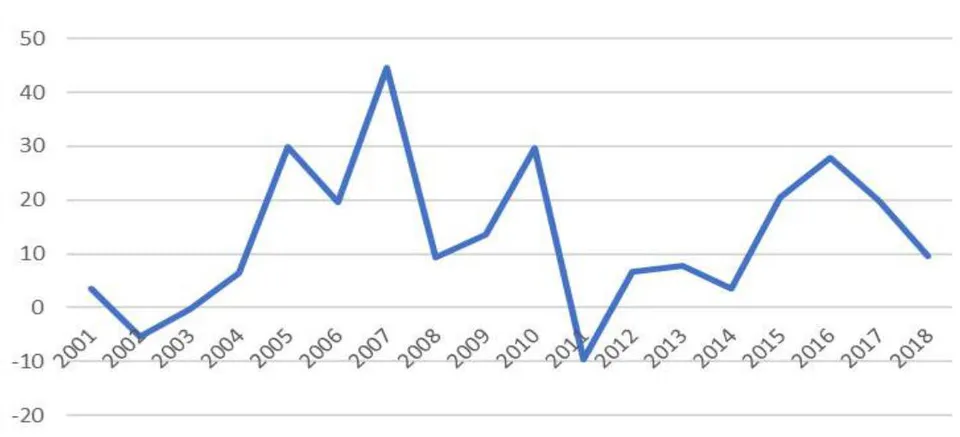
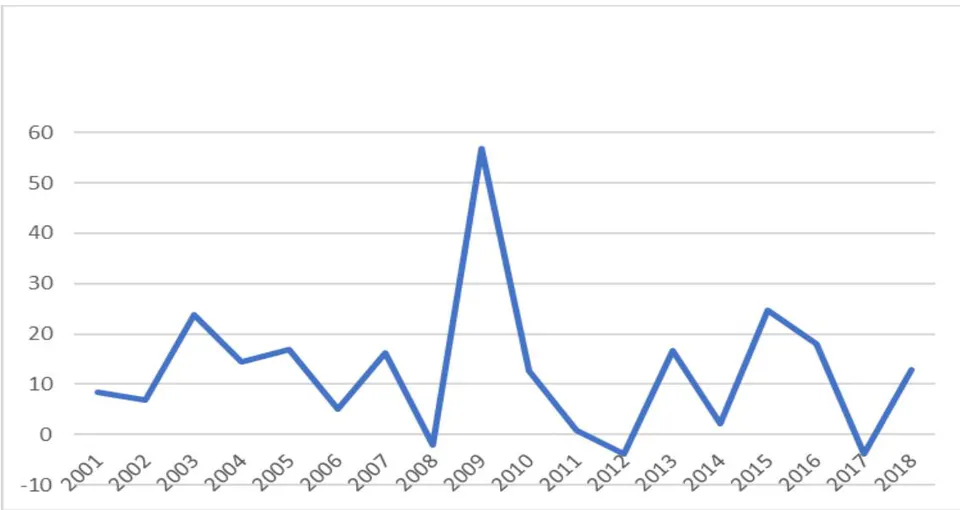
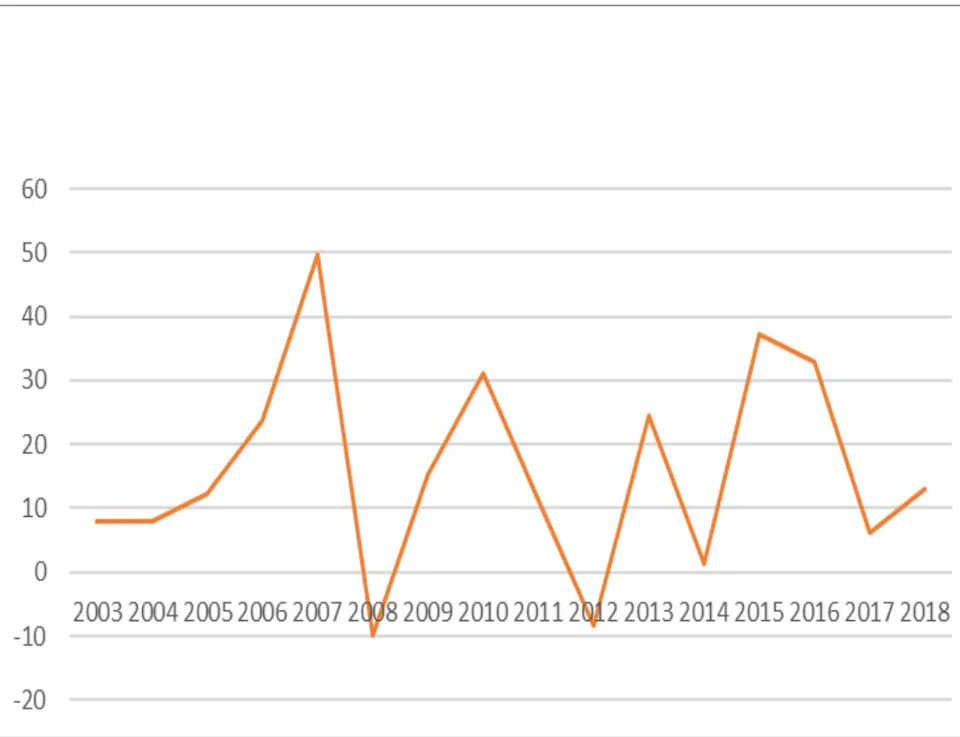
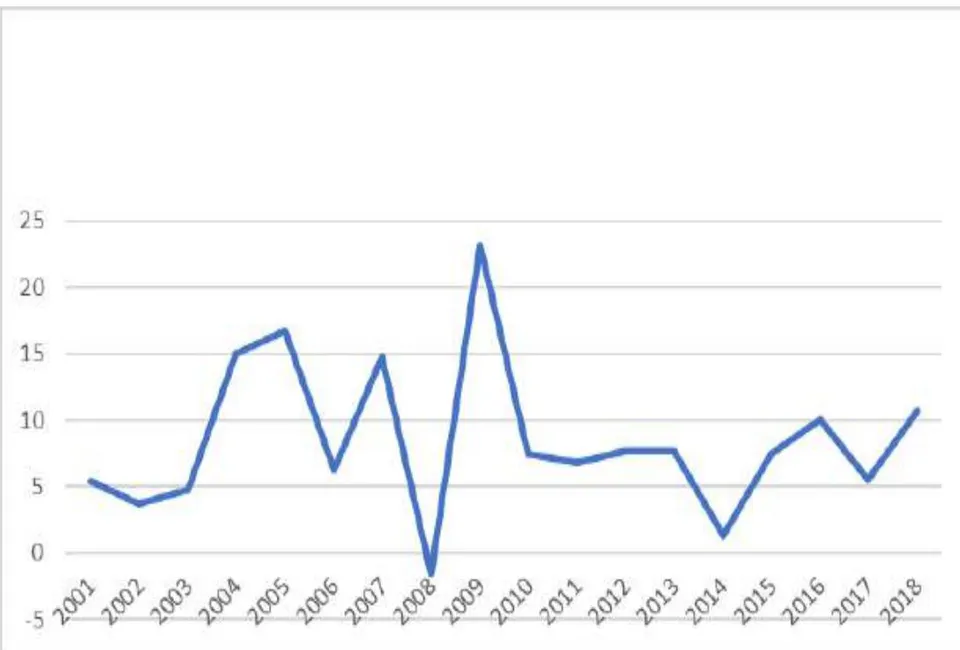
Viewing from above data and figures, we can know that China's commercial real estate prices have risen sharply since 2000, and the prices of commercial real estate in metropolises have risen even more. The average selling price of commercial housing in China in 2018 was 4.14 times that of 2000; the average selling price of commercial housing in Beijing in 2018 was 8.21 times that of 2000; the average selling price of commercial housing in Shanghai in 2018 was 7.54 times that of 2000; the average selling price of commercial housing in Shenzhen in 2018 was 9.33 times that of 2002.
According to economics theory, in general, an increase in the price of a commodity will prompt people to reduce their demand for this commodity. If people do not reduce their demand for this commodity, they will have to pay more money. Because the demands or needs of resident housing belong to existence needs and physiological needs, then the substantial increase in the price of commercial housing for Chinese residents has greatly reduced the happiness of most people, in details:
(1) High house prices emptied people's saving accounts. In 2018, a Chinese famous economist with official status proposed six wallet theories , which means that a young couple need take money from their parents, grandparents' wallets to pay the down payment for the house. It has become a social phenomenon for the Chinese to use the debt of several generations to buy houses.
(2) After buying a house, the buyer become a slave of house, because the buyer will bear the great pressure of housing loans of 20 or 30 years, the buyer's life will be difficult.
(4) High housing prices have led to a sluggish consumption of Chinese residents, and the Chinese government has repeatedly tried to activate residents' consumption to stimulate China's economic growth, but failed. Real estate has indeed overdrawn the wealth of many people in the next 20 to 30 years.
c) Measures to control housing price speculation and wealth gap
i. U.S. all transaction housing price index
We should know the transaction housing price changes' situation of the USA. "The FHFA HPI is the nation's only collection of public, freely available house price indexes that measure changes in single-family home values based on data from all 50 states and over 400 American cities that extend back to the mid-1970s." we download the FHFA House Price Index data from www.fhfa.gov. This data time range is between the first quarter 1975 and the second quarter 2020. The first data of the House Price Index is 59.84, the last data of the House Price Index 456.56. then we can calculate the average annual house price increase rate. Provided that the average quarterly house price increase rate is x, then we have the equation as the following:
the average annual house price increase rate=
Then we know that the average annual house price increase rate of the USA from 1975 to the second quarter 2020 is 4.56%.
We can also calculate the average annual house price increase rate of China, Beijing City, Shanghai City, and Shenzhen City.
Provided that the average annual house price increase rate of China is , then we have the equation as the following:
So, the average annual house price increase rate of China from 2001 to 2018 is 7.89%.
Provided that the average annual house price increase rate of Beijing City is , then we have the equation as the following:
So, the average annual house price increase rate of Beijing City from 2001 to 2018 is 11.7%.
Provided that the average annual house price increase rate of Shanghai City is , then we have the equation as the following:
So, the average annual house price increase rate of Shanghai City from 2001 to 2018 is 11.23%.
Provided that the average annual house price increase rate of Shenzhen City is , then we have the equation as the following:
So, the average annual house price increase rate of Shenzhen City from 2003 to 2018 is 13.96%.
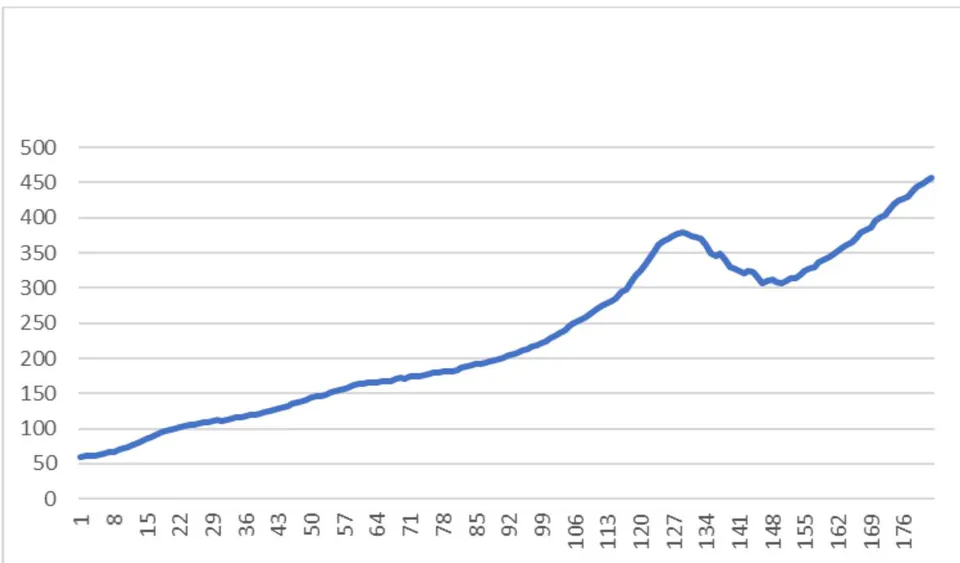
Data source: www.fafa.gov
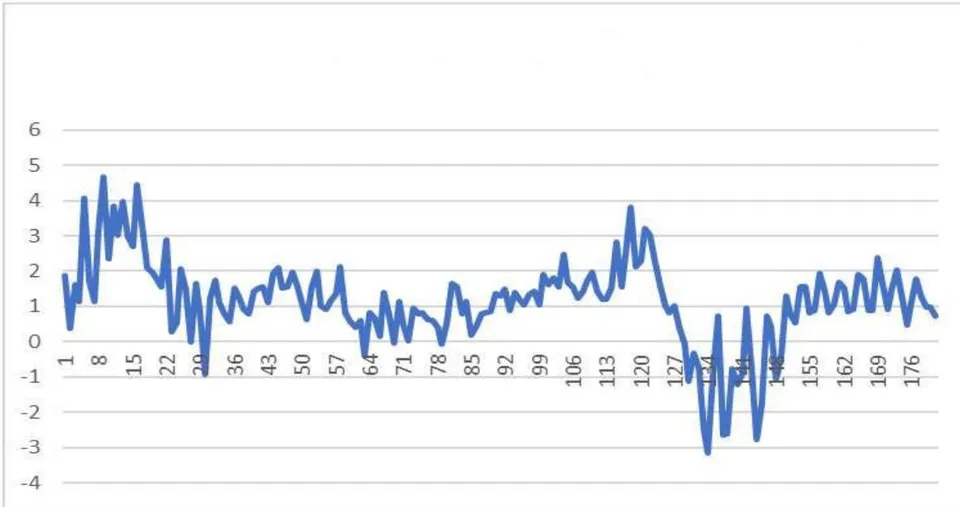
d) Using real estate tax levy to control housing price speculation and wealth gap
Housing demand and marriage demand are the most basic needs of mankind, and are related to human existence. Relative to these needs, the supplies are limited. Therefore, power and wealth cannot be allowed to be unscrupulous and unconstrained in the fields of housing demand and marriage demand. The customs, institutions and moral constraints should all play a role in these fields. Practices have proved that monogamy is a very good system for balancing the supply and demand of marriage. Mormonism advocated polygamy at the beginning of the founding of Mormon Church at the eastern United States. Mormons were hostile and impacted by non-Mormon groups in the east region of the USA. Mormons had been migrating in the eastern region, and finally moved to Salt Lake City, the deserted land in 1847. At last, the anti-polygamy policies of the federal government of the United States, and most especially the Edmunds–Tucker Act of 1887 which dis incorporated the LDS Church and authorized the federal government to seize all of the church's assets forced the Mormon saints to abandon the plural marriage system .
Since 2000, China's real estate market has developed rapidly and housing has received a large amount of supply, but at this time there is a situation in which a small number of people own a large number of housing. This situation has led to a substantial increase in housing prices, which has severely eroded the housing demand and well-being of the middle and low classes. Both economic theory and practice have proved that real estate tax is a very effective means to restrain this situation, because real estate taxes can greatly increase the cost of holding houses for people who own multiple houses or large numbers of houses.
V. CONCLUSION
It is said, the purpose of emerging moral system is to solve the humankind's interest conflicts. When human supply and demand are out of balance, conflicts of interest arise. According to Maslow's theory, human needs are hierarchical. Conflicts are more likely to occur if the areas of human low-level needs are not met. Marriage needs and housing needs are similar, because both they belong to the category of physiological needs and existence needs, which are fields prone to conflict of interest, then marriage needs and housing needs are both needed to be adjusted by the moral system, rather than to allow power and wealth to be unscrupulous and unconstrained inside. Both empirical and evolutionary references suggest that large absolute differences in wealth should favor more polygyno us marriages, and the real estate market is also a gathering place for the rich. Since 2000, China's real estate market has developed rapidly, but at this time China real estate field has also accumulated great conflicts of interest, due to a substantial increase in housing prices. In the first eighteen years of 21st century the average annual house price increase rate of China, Beijing City, Shanghai City, and Shenzhen City are 7.89%, 11.7%, 11.23%, and 13.96% respectively based on the calculation of the data from China Statistical Yearbooks, which has severely eroded the housing demand and well-being of the middle and low classes. Monogamy has been proved an effective means to solve the interest conflicts in marriage needs, both economic theory and practice have proved that real estate tax is a very effective means to restrain the rapid increasement of housing price, because real estate taxes can greatly increase the cost of holding houses for people who own multiple houses or large numbers of houses, so, the average annual house price increase rate of the USA is just 4.56% from 1975 to the second quarter 2020, which is not high, because the USA levy the real estate taxes each year. Therefore, China government should levy the real estate tax as soon as possible.