
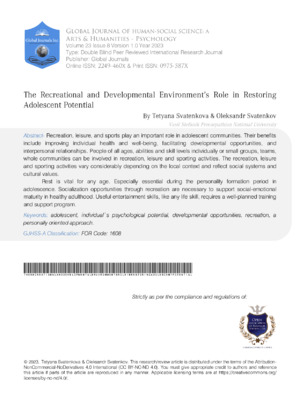
The Recreational and Developmental Environment`s Role in Restoring Adolescent Potential

Article ID

0B12S

Adolescent development, psychology, social sciences, journal, research, teens, mental health, education, neuroscience, psychology journal, youth development, academic research, scholarly article, global research, scientific studies.

The Recreational and Developmental Environment`s Role in Restoring Adolescent Potential

Tetyana Svatenkova
Tetyana Svatenkova
Oleksandr Svatenkov
Oleksandr Svatenkov
DOI

Abstract

Recreation, leisure, and sports play an important role in adolescent communities. Their benefits include improving individual health and well-being, facilitating developmental opportunities, and interpersonal relationships. People of all ages, abilities and skill levels individually or small groups, teams, whole communities can be involved in recreation, leisure and sporting activities. The recreation, leisure and sporting activities vary considerably depending on the local context and reflect social systems and cultural values. Rest is vital for any age. Especially essential during the personality formation period in adolescence. Socialization opportunities through recreation are necessary to support social-emotional maturity in healthy adulthood. Useful entertainment skills, like any life skill, requires a well-planned training and support program. The article reveals the development environment’s organization peculiarities for the individual`s psychological potential activation within the adolescent recreation process framework.

The Recreational and Developmental Environment`s Role in Restoring Adolescent Potential

Recreation, leisure, and sports play an important role in adolescent communities. Their benefits include improving individual health and well-being, facilitating developmental opportunities, and interpersonal relationships. People of all ages, abilities and skill levels individually or small groups, teams, whole communities can be involved in recreation, leisure and sporting activities. The recreation, leisure and sporting activities vary considerably depending on the local context and reflect social systems and cultural values. Rest is vital for any age. Especially essential during the personality formation period in adolescence. Socialization opportunities through recreation are necessary to support social-emotional maturity in healthy adulthood. Useful entertainment skills, like any life skill, requires a well-planned training and support program. The article reveals the development environment’s organization peculiarities for the individual`s psychological potential activation within the adolescent recreation process framework.

Tetyana Svatenkova
Tetyana Svatenkova
Oleksandr Svatenkov
Oleksandr Svatenkov

No Figures found in article.

Tetyana Svatenkova. 2026. “. Global Journal of Human-Social Science – A: Arts & Humanities GJHSS-A Volume 23 (GJHSS Volume 23 Issue A8): .

Download Citation

Journal Specifications

Crossref Journal DOI 10.17406/GJHSS

Print ISSN 0975-587X

e-ISSN 2249-460X

Issue Cover
GJHSS Volume 23 Issue A8
Pg. 37- 44
Classification
GJHSS-A Classification: FOR Code: 1608
Keywords
Article Matrices
Total Views: 987
Total Downloads: 17
2026 Trends
Research Identity (RIN)
Related Research
Our website is actively being updated, and changes may occur frequently. Please clear your browser cache if needed. For feedback or error reporting, please email [email protected]

Request Access

Please fill out the form below to request access to this research paper. Your request will be reviewed by the editorial or author team.
X

Quote and Order Details

Contact Person

Invoice Address

Notes or Comments

This is the heading

Lorem ipsum dolor sit amet, consectetur adipiscing elit. Ut elit tellus, luctus nec ullamcorper mattis, pulvinar dapibus leo.


High-quality academic research articles on global topics and journals.

The Recreational and Developmental Environment`s Role in Restoring Adolescent Potential

Tetyana Svatenkova
Tetyana Svatenkova
Oleksandr Svatenkov
Oleksandr Svatenkov

Research Journals






























































