I. INTRODUCTION
Recreation, like leisure, is a complex concept (Lee et al., 1994), scientists and researchers have tried to define its essence and relevance in adolescent development (Kleiber et al., 1986; Caldwell, Witt, 2011). Teresa Freire et al. (2016) have highlighted the leisure expertise as linked to everyday subjective experience, focusing on understanding how manage and conceptualize the real world in the context of life, activities, social relations, and individual characteristics expressed and affects the adolescent's personality psychosocial constructs (in ecological perspective).
Communicating with others is the main reason teenagers participate in entertainment and recreational activities. This can lead to the social intelligence development, an increase in communicative competence, and well-being general indicators (Hoffer, 2011). Through participation in recreational and developmental activities, adolescents learn who they are as individuals and who they are as members of a group. They learn manners and customs, relationships skills, and to maintain friends. Adolescents also learn what activities bring them joy, passion, and life meaning. Teenagers get new experiences, become more fully involved in life, and develop healthy lifestyle skills thanks to recreation.
Recreation is one of the most critical situations in teenagers' life, especially outside the home and family. The leisure benefits, understood as a context, activity, or experience, are well documented in the literature, with evidence that it (leisure) can be both beneficial, and detrimental (Caldwell, 2005; Caldwell and Faulk, 2013; Freire, 2018). Through these opposing views, researchers consider internal (individual and perceived characteristics) and external (activities, contexts, and environments) conditions that influence future life trajectories beginning in adolescence (Witt and Crompton, 2003; Freire et al., 2016). Research on leisure activities and related life experiences shows: there are different consequences in adolescents' growth and development terms depending on the leisure activities type (Mahoney et al., 2005; Witt, Caldwell, 2005; Freire, 2013). According to studies that confirm the role of leisure in adolescents' development, it becomes more than relevant to analyze the relationships between variables in depth, which can, from a psychological point of view, add knowledge and evidence about the developmental processes that underlie everyday leisure and the teenagers' new psychosocial experience acquisition.
II. DEVELOPMENTAL MEANINGFUL LEISURE ENVIRONMENT CONCEPT
Adolescence has long been considered a pivotal moment in the development and personality formation trajectories beyond recreation and leisure and from a psychological point of view. A new recreational approach is the positive adolescents' psychological potential development in the implementing a purposeful planned process, and emphasizes the developmental assets' role in the situation's leisure potential (Benson, 2007; Scales et al., 2017). Researchers have tried to find and test the factors' type that can increase or decrease positive life experience, or can promote the psychological potential development and prevent risks. One helpful factor that helps to understand better the adolescent's well-being and development process is the ecological perspective (Bronfenbrenner, 1994). Leisure and its components also appear to be one of these significant factors that intersect developmental experiences with life contexts, contributing not only to youth problems prevention but also to the flourishing and growing processes that emerge on the way to adulthood (Witt, Crompton, 2003; Freire, Stebbins, 2011).
The attitude concept to recreational activities was developed by Ragheb M. G. and Beard J. G. (1982). The authors tried to understand people's willingness or inclination to participate in recreational activities. The readiness or propensity formation, as they found, is influenced by people's attitudes toward the relevant measures concerning to their cognitive, affective, and behavioral components. The same authors developed the "pleasure from leisure" concept (Beard, Ragheb, 1980), which they defined as a positive perception or feeling formed (evoked or acquired) as a participation result in leisure. In their own words, "[leisure satisfaction] is the degree to which a person is currently satisfied with his/her overall situational leisure experience" (Beard, Ragheb, 1982, 22). Leisure satisfaction is related to six dimensions: psychological, educational, social, relaxation, physiological and aesthetic dimensions, they become a measure of determine the personal needs' satisfaction level through leisure. (Beard, Ragheb, 1980).
Several studies have shown how leisure enjoyment relates to other individuals' life dimensions, highlighting these associations' importance in adolescent development. Satisfaction derived from participating in leisure activities, and having a positive attitude towards recreational activities, were associated with increased self-esteem according to Kim et al. (2015). Trainor S., Delfabbro P., Anderson S., and
Winefield A. (2010) investigated the relationship between adolescent leisure participation and psychological well-being. They interpreted well-being as increased self-esteem and life satisfaction, positive mood states, and the absence of depression, anxiety and stress. According to research, it is clear that recreational activities, and leisure enjoyment in particular, can be influential in improving positive functioning expressed in self-esteem, psychological potential actualization, life satisfaction, and psychological well-being terms, with apparent relationships between them.
III. THE DEVELOPMENTAL LEISURE ENVIRONMENT CONCEPT'S
IMPLEMENTATION IN THE CHILDREN'S CAMP
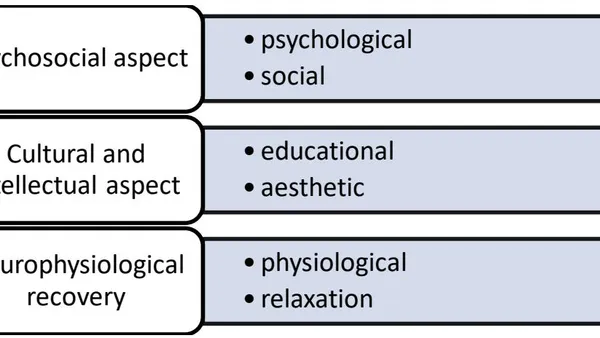
Taking into account the psychological science's development aspect and practical psychology as a supporting and corrective component of the child's modern upbringing and education system, my husband and I developed an experimental new approach to working with children in temporary children's associations in 2015, in particular in children's camps. The program was initially designed based on the Ragheb M. G. and Beard J. G. (1980) concept, taking into account the recreational and leisure process relevant dimensions based on the experience of numerous studies on the recreational and leisure activities relevance and unprecedented importance for the teenager's personality development (Fig. 1):
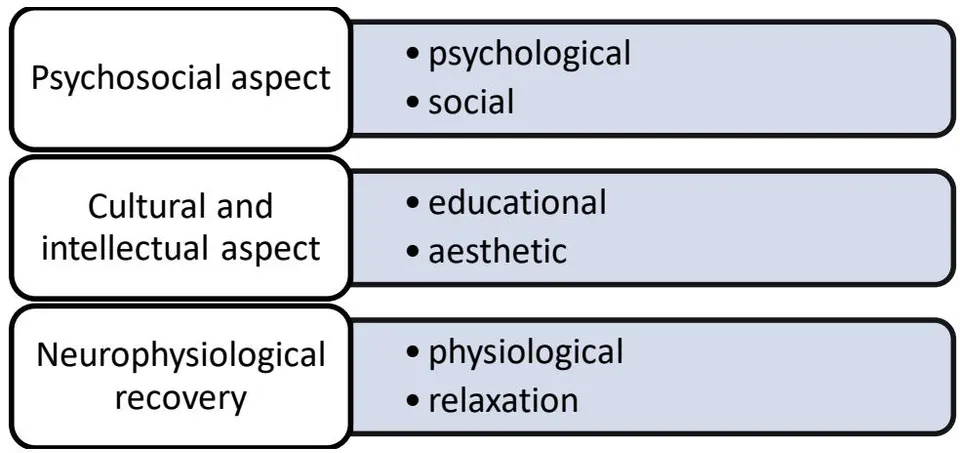
The program, which has been implemented since 2016 based on the recreation program "Children's Camp Zephyr", takes into account all the concept's dimensions to meet children and adolescents' needs in meaningful recreation and varied leisure. They are accordingly implemented as follows:
- Psychological: Aimed at reducing the psychological tension and stress symptoms, increasing resilience
skills, developing communicative and leadership qualities, the ability to behave in conflict situations, etc. It is implemented through the training exercises use in the childrens work program, direct trainings according to age, evening "candles" - emotional state and impressions discussions, psychological quests, psychological club for teenagers and film therapy.
- Social: Aimed at improving social intelligence, developing independence, adaptability, assertiveness, mentoring, and support skills. It is implemented through alternating different types of activities, staying in different ages
mixed groups, trying mentoring and leadership position in competitive activities under senior mentors and counselorssupport. - Educational: Obtaining new relevant knowledge on various topics. It is implemented through taking part in intellectual games, quests, quizzes, competitions, and meaningful communication with mentors and peers.
- Aesthetic: Aimed at the aesthetic feelings' development, cultural assimilation through using native people's traditions in program, communication culture education. It is implemented through thematic events ("Ukrainian traditions", "Fashion is my profession"), handmade studios, costumes and scenery creation, video and photo quests, competitions and themed hairstyles, face art.
- Relaxation: Aimed at switching kinds of activities, different from everyday duties, restoring children's internal resources. It is implemented through the day precise schedule's observance, different types of activities alternation: walks in the fresh air, watching cartoons, dancing, sports, animation, book and game clubs.
- Physiological: Physical skills development in multiple directions, physiological resistance to various types of loads increase, healthy eating culture's observance. We use multiple kinds of physical activity (dancing, sports, swimming, tourism), hold sports competitions (tennis, chess, checkers, football, volleyball, etc.), offer studios wide selection (stretching, dancing, gym, outdoor games, swimming pool, chess, checkers, etc.).
A teenager needs to be a member of a small group (whose values he accepts and behavior norms and assessment he chooses as a reference point). Membership in a small group ensures the social need realization in communication, self-realization and protection. Teenagers seek to understand not only relationships and their significance in environment, but also the self-improvement, self-development, ways to reveal inner potentials in a support and trust safe environment. And they willingly, although not always skillfully, engage in self-discovery and self-education. A properly organized and structured developmental recreational and leisure environment becomes a favorable basis for the individual's psychological potential actualization and development in adolescence. This situation requires the help of a reliable adult who understands and wants to believe in child, who is interesting to them as individuals. Senior mentors, psychologist, coach and other adults become such essential adults in the children's health camps work system. The older teenager's self-disclosure situation can be observed right here because being in a temporary group positively contributes to this. The child is here for the first time, feels support, attention and encouragement, has the opportunity to express himself, without worrying that somebody punish him. That is why it is crucial for senior mentors to remember: the psychological atmosphere in the group is essential; it is vital to control their behavior towards children.
IV. A PERSONALLY ORIENTED APPROACH
A personally oriented approach to the recreational environment's organization creates conditions where the senior mentor's position is humanism as a goal and value, when each respects the personal dignity and worth others.
A personally oriented psychosocial environment forms with cooperation senior mentors and children, when they have equal conditions: the individual can demonstrate thought's independence, individual's independence, and choose his position. Orientation is provided with identifying the child's potential development models, specific to his cognitive and creative activity. It's achieved thanks to reorientation the process to recreation and education active methods, involving senior mentors and children in search and research activities, diagnostics and psychological prognostication, designing the child's personality development:
- The senior creates various situations for children (choice, empathy, guaranteed success, advanced trust, creativity, etc.). These situations correspond to specific age characteristics of the child, for example, the need for informal friendly communication. From the beginning, they make clear and compelling demands on the child. This leads to forms' versatility, flexibility, and various types of activities: individual, pair, group, collective;
- Personal-oriented communication is actively implemented (contact with a senior mentor, human dignity affirmation, the individual's desire maintenance to join the human culture world, "I want" and "I can" harmonization;
- Conditions for realizing one's humanity, individuality, and uniqueness are created;
- Orientation aims to identify the child's development models - the most effective ways to learn activities. This involves content, methods, and forms interaction's variability with team and mentor;
- Dialogic forms of educational interaction are cultivated as the academic communication's dominant form, which encourage the thoughts and impressions exchange.
A person-oriented approach is carried out most effectively if:
- The elder sees a personality in each child;
- The senior mentor relies on the child's emotional sphere level development, develops his humanity feelings.
V. DEVELOPMENTAL FORMS FOR WORKING WITH A GROUP
The long-term practice of organizing recreational and leisure activities allows us to state that the effectively solving tasks in a temporary children's group is a collective creative case (CCC). Shelestova L. and Chirenko N. consider the CCC's characteristic features: the relationships organization on open trust, the cultivation caring about others habit, the five "self-" (self-organization, self-activity, self-education, self-management, self-analysis), the high responsibility each about other, creativity and collectivism. According to the leading activity's nature, scientists define the following types of collective creative work (Shelestova, Chirenko et al. 2010):
A labor nature's CCC provides for labor culture's assimilation, developing moral attitude to work, enriching children's knowledge about the environment, and forming skills and abilities to work independently, etc.
A cognitive nature's CCC aimed to form surrounding environment knowledge need, and to develop personal qualities as: the desire for knowledge, purposefulness, perseverance, creative imagination, observation, curiosity, social concern, etc.
An artistic and aesthetic nature's CCC aimed to contribute each child's artistic and aesthetic tastes development, to strength the desire for spiritual culture, to involve creative activities, nurture sensitivity, and soul's nobility.
Sports and wellness CCC provide for caring attitude towards one's health, getting used to a healthy lifestyle, and the physical culture development.
Socially beneficial (humanistic, socially significant) CCC aim to form a valuable attitude towards people, state, and family.
Organizational CCC precede others, because any activity can't be carried out without organization.
We used individual and group forms in psychological-pedagogical process to work with teenagers. It should be noted that discussion is the most attractive and exciting for teenagers among the group forms. "Talk show" is a group form of work which allows you to include many people in the discussion process. The show's purpose is to form the public speaking and discussion skills in teenagers; to develop skills to express and defend one's point of view; to form the healthy self-esteem,
and the ability to respect other's right to their point of view.
We consider it reasonable to use the following means and methods to create a discussion problem in the discussion process: role-playing a problem situation, analysis a real-life situation, the man "in a mask" story, fragments from video films, letters from TV viewers, problematic situations from letters or stories from newspapers and magazines.
When conducting a discussion, it is necessary to follow the basic rules. Among them (Svatenkova, 2018):
- The presenter determines the participants' performance order;
- Show respect for yourself and others;
- Discuss a point of view and a position, not a person's personality;
- To express your opinion, you need to raise your hand;
- Do not interrupt the one currently expressing his point of view.
To prepare teenagers for self-discovery and self-realization in the children's health and recreation facility conditions, we recommend including them in the project work. Project activity can be defined as specially organized teenagers' collaboration to solve a specific problem - achieving the project's goal. In turn, for the projects' development and implementation, it is necessary to divide teenagers into several teams, which will be able to interact in the future to achieve a positive result. In addition, each team should be familiar with the instructions for creating social projects. So, this instruction can have the following form:
To create your project, you are given a certain period to solve a specific problem that your project highlights. It is essential to determine the following components: project topic; the purpose and main project's tasks; target audience (for whom the project was created); necessary resources (material, equipment, premises, etc.); work plan; implementation's terms; expected results.
It is necessary to observe the main project's stages:
Preparatory: to determine the topic, goal, and main project's tasks; make a work plan;
Basic: collect all necessary information; distribute bindings among group members; draw up a project.
Final: preparation for project presentation.
- The results of your project activity can be an exhibition fair, an organized thematic event, a promotion, a booklet, a book, a wall newspaper, an advertisement, an interview, etc.
Teenagers can be involved in the thematic social advertising creation (posters, booklets, brochures) to form a life position and value orientations in the children's health and recreation facility. We believe that it is necessary to provide the primary information before including teenagers in the creating social advertising process:
Explain the "social advertising" definition and forms of its possible distribution. Social advertising is any kind of information, disseminated in any form that is aimed at achieving socially beneficial goals and popularizing universal human values, and dissemination is not aimed at making a prof according to Ukraine's Law "On Advertising" (Ukraine Law on Advertising, 1996 with changes and additions). Social advertising can be created and distributed in different forms: a poster, booklet, video clip, demotivation, etc.
Define the social advertising structure. To create social advertising, you need to define the following components:
- topic
- target audience (for whom this social advertisement is intended);
- distribution places (except for summer health facilities);
- advertising influence methods (creating contrasts with different colors, comparison, a slogan used, etc.);
- expected results.
- Familiarize teenagers with social advertising examples and analyze the provided advertising samples.
It is advisable to divide teenagers into working groups (4-5 people each) in creating social advertising process to achieve more productive results. Teenagers were also offered to take part in training for successful self-realization in the children's health and recreation facility. This work involves interaction of all group members to gain positive experience, form specific skills, and solve problem situations.
It is advisable to choose and approve the training group's basic rules from the beginning. At the same time, each teenager's opinions and suggestions should be considered. So, for a more productive result, we used the following work rules (Svatenkova, 2019):
be active in the discussion process - do not hesitate to express your thoughts or suggestions during the particular topic's discussion;
show courtesy - respect the others` opinions, be patient, and do not interrupt each other;
confidentiality - everything that will be discussed in this session (personal information, experiences) should not go beyond this group's boundaries;
the rule "Here and now" - we discuss only those issues and problems that relate to the present time;
the "STOP" rule - everyone has the right to use this rule: skip a specific training exercise without explaining the reasons;
the raised hand's rule - to express your opinion or supplement the answer, you must give the host a signal raise your hand;
listen and hear - to listen and understand the interlocutor.
Role-playing games, group discussions, art therapy exercises, brainstorming were used in the training work process. It should be noted that participation in role plays is extremely interesting for teenagers. Yes, the role-playing game is an effective technique that can solve the following tasks:
- gaining some experience in using the necessary skills;
- methods of alternative action analysis, ways of solving problems, which are proposed to fulfill the game's tasks;
- behavior practical training in the role-playing process for confident application in real situations;
- gaining self-confidence in the performing practical actions process or rehearsing a specific event;
- learned material's-consolidation by using feedback (Bevs, Hlavnik, 2005).
We used role-plays in forming the ability to constructively solve problem situations' context. First, possible ways out of conflict situations were analyzed working with teenagers (evading a conflict situation, making concessions, looking for a compromise, oppressing the interlocutor). Secondly, eight conflict situations were chosen, which became the basis of the role play. Thus, teenagers, united in pairs, had to demonstrate possible options for solving these situations. In addition, teenagers also play conflict situations using different behavior styles (aggressive, confident, confused). After each performance, the participants shared their impressions and discussed what they had seen.
VI. DISCUSSION
The experience of the teenager's psychological potential developing technology implementation in the recreational development environment confirmed the previous research results. In particular, the fact that socially active leisure time in adolescence was associated with mental disorders lower frequency, and a change in the adolescent's social position in the group, an increase in self-esteem and psychological potential actualization; similarly, socially inactive leisure time was associated with increased mental disorders incidence, frequent depressed states, lower self-esteem, and reduced social engagement (Timonen, Niemelä, Hakko et al., 2021).
These results remain significant even after controlling for well-known familial risk factors for youth mental illness, such as parental mental health disorders (Merikukka et al., 2018), parental education level (Paananen et al., 2013), and living with one of the parents (Amato, 2000). The current study results can be interpreted as emphasizing the developmental recreational organization's relevance and leisure space for teenagers using a person-oriented approach and technology for the psychological potential development as a protective factor not only against mental disorders but also for the personality's comprehensive development in adolescence, psychological potential actualization and ensuring the need for recovery in psychosocial, cultural-intellectual and neurophysiological aspects.
This agrees with previous research that participation in recreational activities within the community has a positive effect on mental health for young people, seen as increased psychological well-being and improved social health(Rochelle et al., 2013).
Of course, not all teenagers are actively involved in the collective activities due to character traits and individual preferences. Teenagers may also lose the community's and reference group's potential protection because of hobbies that are not socially popular. Also, it is possible that some peer groups do not admit anxious or introverted individuals as group members at the level of temporal association. Accumulated loneliness and being left out experiences in peer groups can be a source of anxiety and other problems (Cantor-Graae, Selten, 2005). That is why a person-oriented approach with a wide selection of options for recreational and developmental activities for teenagers takes into account everyone's characteristics and helps assimilate children into the temporary group space and actualize psychological potential through the individual needs effective implementation in the leisure time dimensions: psychological, social, relaxation, educational, aesthetic and physiological.
VII. CONCLUSION
Using the recreational and developmental environment potential in working with teenagers is relevant and vital now. Individual's psychological potential is activated in the temporary group because of this activity's developmental content and the projected situation. The design of work based on the creation of developmental interaction in a brief children group in the children's camp framework is subject-subject interaction as a whole system, which components are (Svatenkova, 2016):
intellectual's psychological diagnosis, the child's personality physical, psychological, and spiritual development;
setting personal and emotional development tasks, adjusting existing plans;
children's activities organization (self-organization);
the study of children's social activity levels dynamic;
analysis of intersubjective interaction's situations and forecasting at the individual and group levels.
The focus is not on some child, but on each person, and a person in their uniqueness. The approach itself is changing: not from pedagogical influences on the child, but from the child himself, who has the right to express his attitude to everything, selectively relate to these influences, and correct them. The child's recognition as the central active figure in the entire social-psychological process is the beginning of a personally-oriented influence. The interpersonal interaction's process construction according to the integrated type corresponds to the person-oriented education's tasks, as it makes it possible to identify the child's attitude main types to the surrounding world, which is holistic, multifaceted, and dynamic for him.
Organizational-educational, social-psychological, and animation work is based on the following principles:
- the individuality development goals priority when creating the necessary conditions for the personal qualities' realization in the creative activity;
- taking into account the personal needs and interests of each child;
- different age groups` creation to include children in creative activities;
- psychological support and assistance provision in the child's self-determination process, favorable interpersonal and intergroup relations' formation;
- constant concern about the surrounding improvement.