## I. CHAPTER ONE
### a) Introduction
Planaria are known for having amazing regenerative abilities. Scientists have studied planaria before in hopes of finding ways to apply planarian regenerative abilities to humans. Planaria are able to fully regenerate even when they are split in half. When cut into a tiny piece, planaria can grow the rest of their body back. The purpose of this research project is to find what most positively impacts the regeneration of planaria. Because they have such phenomenal regeneration capabilities, planaria have often been studied in hopes of finding links for regeneration in other species. Studying planaria regeneration helps us better understand how it works and can potentially be used towards regeneration in humans. During a study done on neural regeneration, researchers looked into regenerating the optic nerve using peripheral nerve tissue. They were able to take the peripheral nerve tissue that stemmed from the spinal cord down the leg and used it to replace the optic nerve. Science is currently able to replace the nerves of tissue. The thing about nerves is that some of them (specifically the ones connected to the central nervous system) specify with a certain function and cannot be replaced by just any random nerve. Due to this, not all nerves can be replaced, and those nerves are crucial which in turn makes neural regeneration so important. Looking into stem cells, they noticed their ability to regenerate any type of cell. The main problem being that the cells they regenerate are still more of the basic standard cells that are not specific in their function but rather just go with the rest of the single function cells. Better understanding regeneration can greatly benefit by helping people recover from major injuries. Studying what positively effects planaria regeneration builds a guideline for what to continue looking for future research. The question being studied is "Which planarian will regenerate with the best quality when kept in regular spring water, creatine solution, caffeine solution, and green tea solution?" It is hypothesized that after being split vertically in half, planarian in the creatine solution will grow the best compared to planarian kept in the other solutions.
## II. CHAPTER TWO
a) Materials
- 120 black planarian
- Scalpel
- Petri dishes
- 2 gallon of spring water
- 5.1 oz creatinol serum
- 240 mL liquid caffeine
- 16 oz bottle of unsweetened green tea
- Disposable pipettes
- Stereomicroscope
- Distilled water
- Phone camera
- Hard-boiled egg yolk
- Ruler
### b) Procedures
1. Prep the creatine, caffeine, and green tea solution in 3 different beakers. Label the beakers so the solutions are not mixed up. The creatine should be made with a $5\%$ concentration while the caffeine and green tea solution will be $15\%$. Keep the planaria in the jar they came in but replace the water every couple days to keep it fresh. Make sure the planaria are well fed before starting the trials.
2. Fill nine petri dishes with the solutions using a pipette. Each solution should have three petri dishes. Three other petri dishes should be prepared, but with spring water. Make sure the pipettes are only used for one solution and do not touch the lab bench. Everything needs to be as sterile as possible to prevent any chances of the planaria dying.
3. Turn on the stereoscope and use the second light setting. Place a planaria on the lid of the petri dish with some water, then place the lid on the stereoscope. Using a phone camera, record the planaria next to a ruler for scale. This allows for the full length of the planaria to be measured as planaria are able to bunch up to an extremely small size, then expand to a larger length. Watch the video and wait for the frame that shows the planaria at its full extended length. Record the measurement.
4. Once the original length is recorded, use the scalpel to split the planaria horizontally in half. One piece should be the head while the other piece is the tail. Using the phone camera, record the planaria with the ruler next to it. Watch the video and freeze at the frame that shows the planaria at its extended length, then record the measurements.
5. Place the two planaria pieces into the petri dish with the creatine solution. Repeat steps 3-5 until the other eleven petri dishes have planaria in them. Twelve planaria from the jar should be used, and the petri dishes should have 21 total planaria pieces in them.
6. After the trial is over, create a $10\%$ bleach solution to dump the planaria in. This will kill them painlessly and disintegrate them so there is not solid waste. Once killed, dump the bleach solution down the
Pre-Trial Measurements Figure 1: Three planaria were placed in each solution. Planaria were measured for their original length before being split. This table shows the measurements for each planaria for the first trial
<table><tr><td>Creatine</td><td>Caffelne</td><td>Green Tea</td></tr><tr><td>1.45 cm</td><td>1.50 cm</td><td>1.75 cm</td></tr><tr><td>2.10 cm</td><td>1.45 cm</td><td>1.45 cm</td></tr><tr><td>1.70 cm</td><td>2.00 cm</td><td>1.10 cm</td></tr></table>
drain. Clean all glassware thoroughly with soap. The stereoscope should be wiped down. Dispose the pipettes in the trash can.
7. Repeat steps 2-6 for the next two trials.
### c) Planaria Maintenance
Planaria will be fed once a week with egg yolk. A fresh petri dish with egg yolk should be prepared. Planaria will be transferred to this petri dish with a pipette. Planaria will be left with the food for only thirty minutes. They should not be left with the food for any longer than that. In that time, a fresh environment with new solutions will be prepped for the planaria. After they are done feeding, the planaria will be moved to these new petri dishes. Air should be blown into the petri dishes once a week.
### d) Data Methodology
Pictures of planaria will be taken twice a week during each trial. A ruler will be placed next to the planaria for scale and a phone camera will be used to take the picture. Pictures of the planaria in the jar and under the stereoscope will be taken. Planaria will be compared by looking at the quality they grew back in and the size. A rough estimate of their size will be guessed based on their length next to the ruler. The focus of this research is more on the quality of the planaria growth, rather than the length, so exact measurements of the planaria will not be needed. The estimated length of each planaria group will be averaged, then compared using the t-test. The p-value will also be calculated to determine the random chance that will prove the hypothesis true.
## III. CHAPTER THREE
### a) Data
Before starting the trials, the lethal dosage was tested for each solution. Planaria were found dead in the $10\%$ creatine solution, therefore making $5\%$ their lethal dosage. Planaria were able to survive in $15\%$ solutions of both green tea and caffeine. Planaria were measured before being split, then measured after being split in half. The length of the planaria were measured on Tuesdays and Thursday.
Figure 2: This table shows the measurements for each planaria for the second trial
<table><tr><td>Creatine</td><td>Caffeine</td><td>Green Tea</td></tr><tr><td>2.00 cm</td><td>1.60 cm</td><td>1.80 cm</td></tr><tr><td>1.80 cm</td><td>1.50 cm</td><td>1.55 cm</td></tr><tr><td>1.75 cm</td><td>1.50 cm</td><td>1.15 cm</td></tr></table>
<table><tr><td></td><td>P1</td><td>P2</td><td>P3</td></tr><tr><td>Spring Water</td><td>1.60 cm</td><td>1.40 cm</td><td>1.50 cm</td></tr></table>
Figure 3: This table shows the recorded original Lengths of the three planaria used as control in the spring water for the first trial Figure 5: The planaria were split into 6 pieces. Each piece was measured prior to being placed in the different solutions. This table shows the measurements for the first trial
<table><tr><td>Creatine</td><td>Caffeine</td><td>Green Tea</td></tr><tr><td>1.30 cm</td><td>1.2 cm</td><td>1.10 cm</td></tr><tr><td>0.95 cm</td><td>0.85 cm</td><td>0.90 cm</td></tr><tr><td>0.60 cm</td><td>0.60 cm</td><td>0.50 cm</td></tr><tr><td>0.75 cm</td><td>0.80 cm</td><td>0.50 cm</td></tr><tr><td>0.90 cm</td><td>0.60 cm</td><td>0.65 cm</td></tr><tr><td>0.80 cm</td><td>0.70 cm</td><td>0.30 cm</td></tr></table>
<table><tr><td></td><td>P1</td><td>P2</td><td>P3</td></tr><tr><td>Spring Water</td><td>1.50 cm</td><td>1.25 cm</td><td>1.40 cm</td></tr></table>
Figure 4: This table shows the original planaria length in spring water as the control for the second trial Figure 6: This table shows the measurements for the planaria in the second trial. The original planaria were split into a total of 6 pieces.
<table><tr><td>Creatine</td><td>Caffeine</td><td>Green Tea</td></tr><tr><td>1.10 cm</td><td>0.70 cm</td><td>0.80 cm</td></tr><tr><td>0.50 cm</td><td>0.90 cm</td><td>0.90 cm</td></tr><tr><td>1.00 cm</td><td>0.70 cm</td><td>0.60 cm</td></tr><tr><td>0.60 cm</td><td>0.80 cm</td><td>1.00 cm</td></tr><tr><td>0.80 cm</td><td>0.70 cm</td><td>0.90 cm</td></tr><tr><td>0.70 cm</td><td>0.75 cm</td><td>0,45 cm</td></tr></table>
First Week Measurements Figure 7: The length of the planaria were measured two days after being split. This table shows data for the first trial
<table><tr><td>Creatine</td><td>Caffeine</td><td>Green Tea</td></tr><tr><td>0.90 cm</td><td>0.80 cm</td><td>0.60 cm</td></tr><tr><td>0.70 cm</td><td>0.75 cm</td><td>0.60 cm</td></tr><tr><td>0.80 cm</td><td>0.85 cm</td><td>0.70 cm</td></tr><tr><td>1.35 cm</td><td>0.90 cm</td><td>0.55 cm</td></tr><tr><td>1.00 cm</td><td>0.80 cm</td><td>0.95 cm</td></tr><tr><td>1.10 cm</td><td>0.80 cm</td><td>1.10 cm</td></tr></table>
Figure 8: This table shows planaria length after two days for the second trial
<table><tr><td>Creatine</td><td>Caffeine</td><td>Green Tea</td></tr><tr><td>1.10 cm</td><td>0.90 cm</td><td>1.00 cm</td></tr><tr><td>0.85 cm</td><td>0.70 cm</td><td>1.10 cm</td></tr><tr><td>1.20 cm</td><td>0.75 cm</td><td>0.70 cm</td></tr><tr><td>0.95 cm</td><td>0.80 cm</td><td>0.90 cm</td></tr><tr><td>0.70 cm</td><td>0.70 cm</td><td>0.50 cm</td></tr><tr><td>0.75 cm</td><td>0.75 cm</td><td>1.00 cm</td></tr></table>
Planaria in the creatine solution were hyperactive and moving much quicker than the planaria in the other solutions. They were much more active than the other planaria. Planaria in the green tea solution were moving a little slower than usual. They were thought to be dead at first but started moving around. Planaria in the caffeine and spring water solution were moving at a normal pace.
Second Week Measurements Figure 9: The length of the planaria were measured seven days after the second measurements. This table shows the measurements for the first trial
<table><tr><td>Creatine</td><td>Caffeine</td><td>Green Tea</td></tr><tr><td>1.30 cm</td><td>0.80 cm</td><td>0.70 cm</td></tr><tr><td>1.10 cm</td><td>0.50 cm</td><td>0.60 cm</td></tr><tr><td>0.90 cm</td><td>0.80 cm</td><td>1.10 cm</td></tr><tr><td>0.85 cm</td><td>1.10 cm</td><td>0.95 cm</td></tr><tr><td>1.40 cm</td><td>0.90 cm</td><td>0.60 cm</td></tr><tr><td>1.00 cm</td><td>0.95 cm</td><td>0.70 cm</td></tr></table>
Figure 10: This table shows the measurements of planaria seven days after the second measurements for the second trial
<table><tr><td>Creatine</td><td>Caffeine</td><td>Green Tea</td></tr><tr><td>0.80 cm</td><td>0.75 cm</td><td>0.60 cm</td></tr><tr><td>1.00 cm</td><td>0.80 cm</td><td>0.70 cm</td></tr><tr><td>1.50 cm</td><td>1.00 cm</td><td>1.00 cm</td></tr><tr><td>0.90 cm</td><td>0.95 cm</td><td>1.10 cm</td></tr><tr><td>0.80 cm</td><td>0.85 cm</td><td>1.00 cm</td></tr><tr><td>1.10 cm</td><td>0.80 cm</td><td>1.00 cm</td></tr></table>
<table><tr><td>Spring Water</td><td>2-Apr</td><td>4-Apr</td><td>11-Apr</td></tr><tr><td>P1</td><td>0.70 cm</td><td>0.75 cm</td><td>0.85 cm</td></tr><tr><td>P2</td><td>0.90 cm</td><td>1.00 cm</td><td>1.15 cm</td></tr><tr><td>P3</td><td>0.60 cm</td><td>0.70 cm</td><td>0.75 cm</td></tr><tr><td>P4</td><td>0.75 cm</td><td>0.80 cm</td><td>0.90 cm</td></tr><tr><td>P5</td><td>0.80 cm</td><td>0.85 cm</td><td>1.00 cm</td></tr><tr><td>P6</td><td>0.75 cm</td><td>0.85 cm</td><td>0.95 cm</td></tr></table>
Figure 11: Three planaria were split into a total of six pieces and placed in spring water as the control. The table above shows the measurements taken over the nine days for the first trial
<table><tr><td>Spring Water</td><td>2-Apr</td><td>4-Apr</td><td>11-Apr</td></tr><tr><td>P1</td><td>0.50 cm</td><td>0.55 cm</td><td>0.65 cm</td></tr><tr><td>P2</td><td>0.90 cm</td><td>1.05 cm</td><td>1.15 cm</td></tr><tr><td>P3</td><td>0.60 cm</td><td>0.70 cm</td><td>0.85 cm</td></tr><tr><td>P4</td><td>0.70 cm</td><td>0.75 cm</td><td>0.90 cm</td></tr><tr><td>P5</td><td>0.75 cm</td><td>0.85 cm</td><td>0.90 cm</td></tr><tr><td>P6</td><td>0.60 cm</td><td>0.65 cm</td><td>0.75 cm</td></tr></table>
Figure 12: Three planaria were split in half and placed in spring water for the control group. The table above shows the measurements for trial two
Planaria in the creatine solution were still moving at an increased rate. The planaria were moving in a similar fashion to the observations from the first week. Planaria did seem a little less energetic, probably because they had not been fed in a while. It was unsure if the planaria were still going to be alive but were perfectly fine when checked.
### b) Results
Trial One
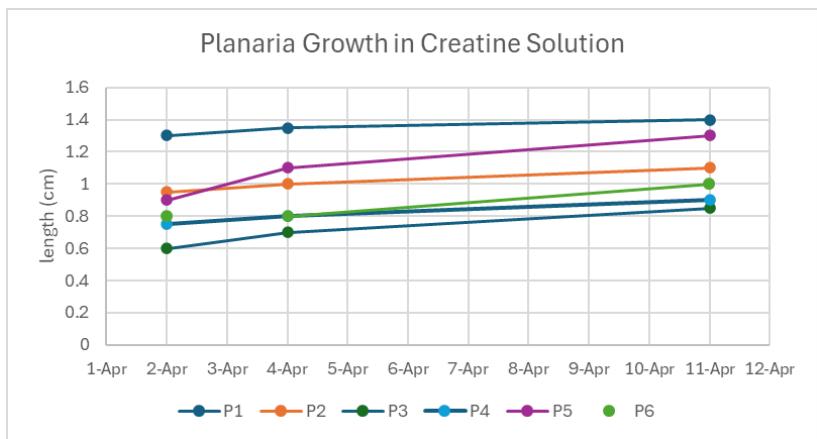
Figure 13: Planaria were measured two days after being split, then measured 7 days after the second measurement. This graph shows the growth of the planaria in the first trial. Each line represents the planaria pieces that were split in half
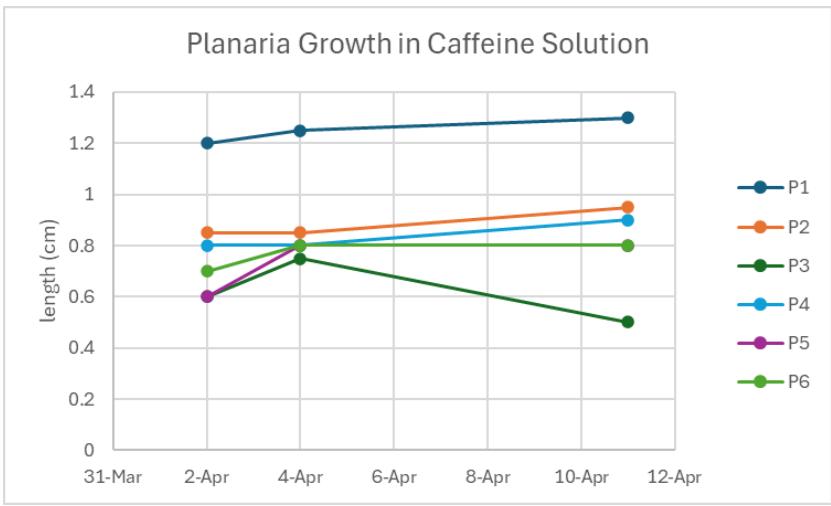
Figure 14: This graph shows the length of the caffeine solution planaria after they were split in half for the first trial. The lines represent the six planaria pieces
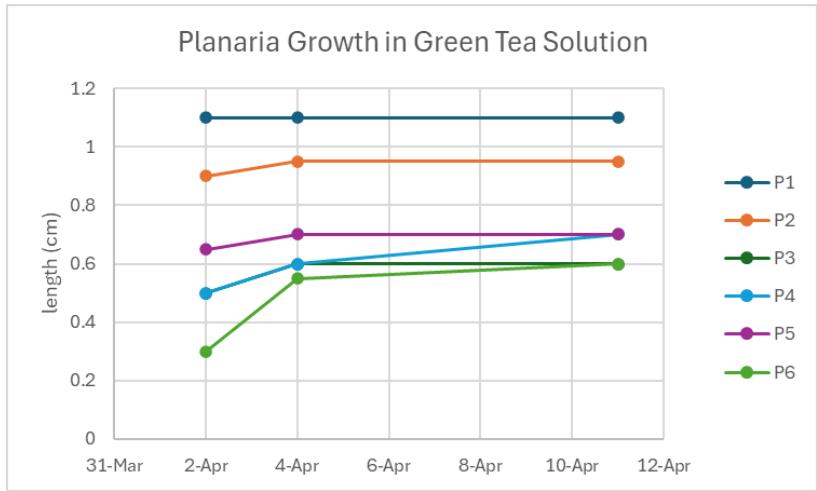
Figure 15: The lines represent the different planaria in the green tea solution. This graph shows the measurements of each piece after being split for trial one
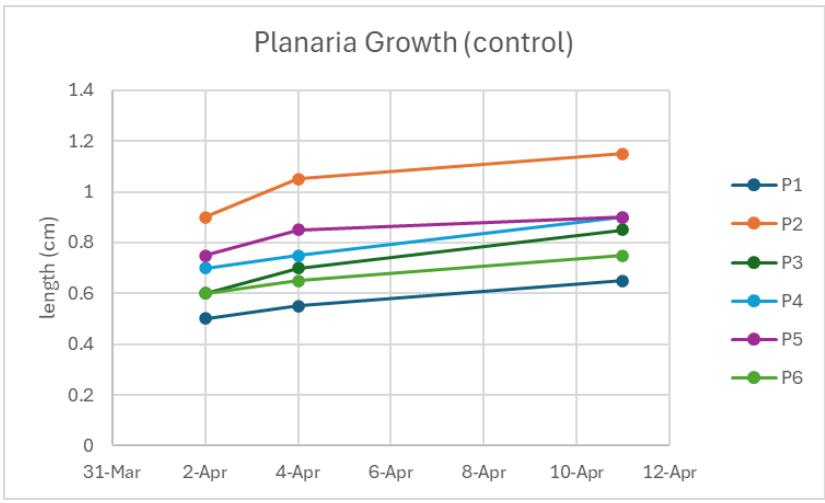
Figure 16: The graph shows the growth of the planaria in the control group over nine days. Each line represents a different planaria piece
<table><tr><td></td><td>Creatine</td><td>Caffeine</td><td>Green Tea</td></tr><tr><td>P1</td><td>0.10 cm</td><td>0.10 cm</td><td>0 cm</td></tr><tr><td>P2</td><td>0.15 cm</td><td>0.10 cm</td><td>0.05 cm</td></tr><tr><td>P3</td><td>0.25 cm</td><td>-0.10 cm</td><td>0.10 cm</td></tr><tr><td>P4</td><td>0.15 cm</td><td>0.10 cm</td><td>0.20 cm</td></tr><tr><td>P5</td><td>0.40 cm</td><td>0.20 cm</td><td>0.05 cm</td></tr><tr><td>P6</td><td>0.20 cm</td><td>0.10 cm</td><td>0.30 cm</td></tr><tr><td>Average</td><td>0.208 cm</td><td>0.083 cm</td><td>0.117 cm</td></tr></table>
Figure 17: The total growth of each planaria in all the solutions was calculated. Using that data, the average growth was found for each variable group
<table><tr><td></td><td>Spring Water</td></tr><tr><td>P1</td><td>0.15 cm</td></tr><tr><td>P2</td><td>0.25 cm</td></tr><tr><td>P3</td><td>0.25 cm</td></tr><tr><td>P4</td><td>0.20 cm</td></tr><tr><td>P5</td><td>0.15 cm</td></tr><tr><td>P6</td><td>0.15 cm</td></tr><tr><td>Average</td><td>0.192 cm</td></tr></table>
Figure 18: The table above shows the total growth each planaria in the control had. That data was used to calculate the average growth Panel label: Trial Two.
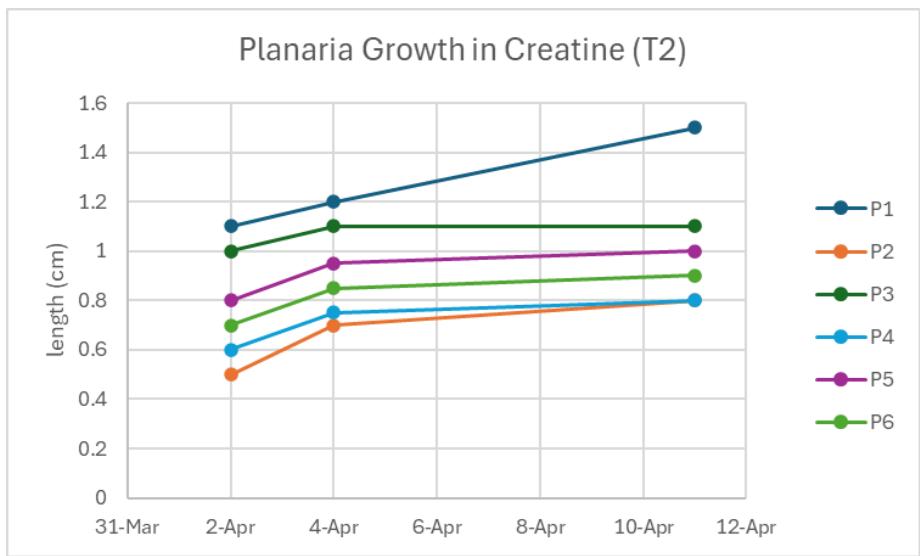
Figure 19: Planaria growth in the creatine solution was measured over nine days. The data in this graph was from trial two
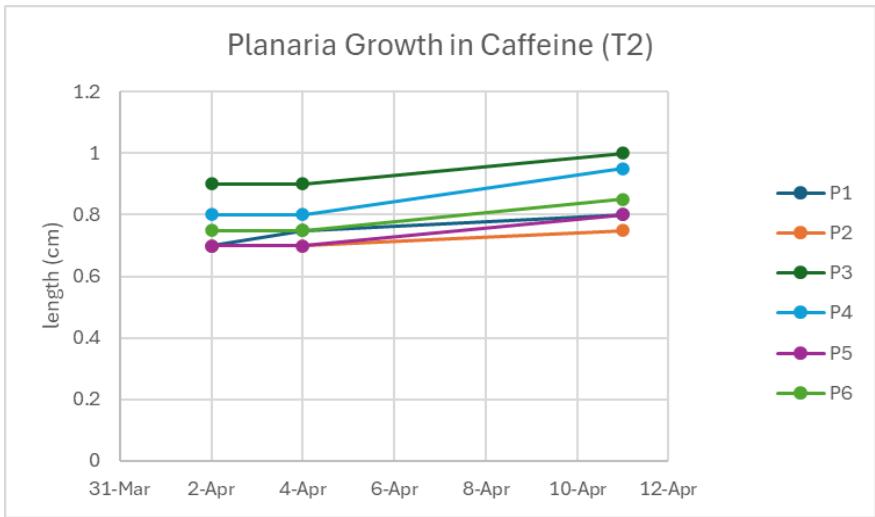
Figure 20: Planaria growth in the caffeine solution was measured over nine days. Each line represents the different planaria piece for trial two
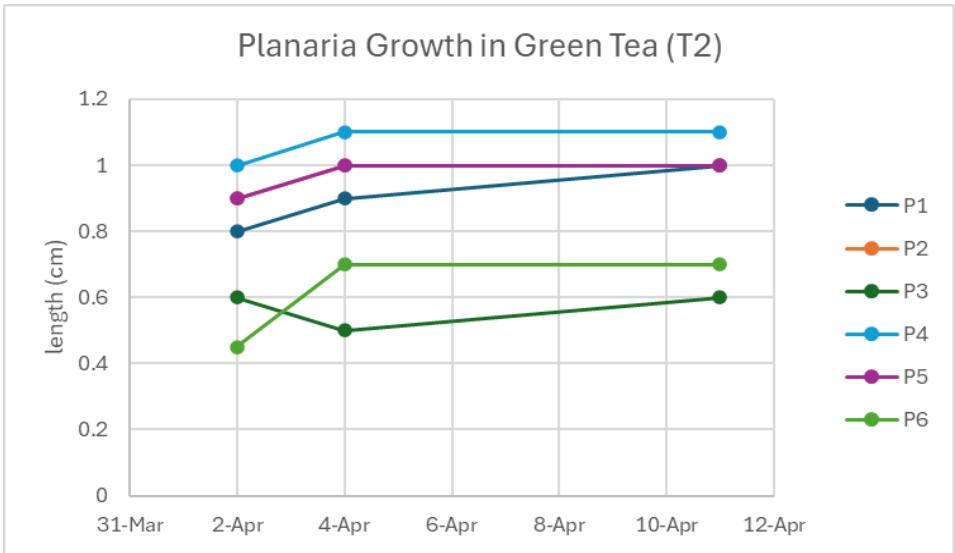
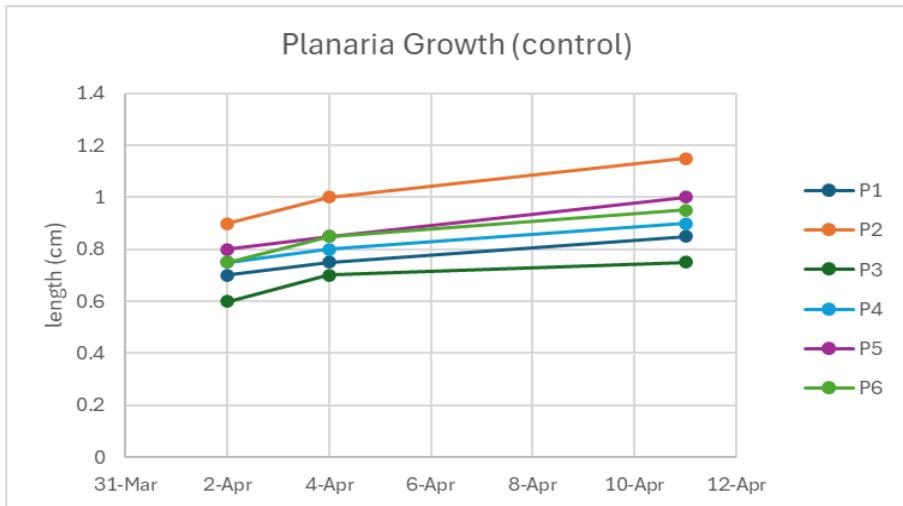
Figure 21: Planaria growth in green tea solution was measured over nine days. That graph above represents the planaria in trial two Figure 22: The graph shows the growth of the planaria in the control group over nine days. Each line represents a different planaria piece
<table><tr><td></td><td>Creatine</td><td>Caffeine</td><td>Green Tea</td></tr><tr><td>P1</td><td>0.40 cm</td><td>0.10 cm</td><td>0.20 cm</td></tr><tr><td>P2</td><td>0.30 cm</td><td>0.05 cm</td><td>0.10 cm</td></tr><tr><td>P3</td><td>0.10 cm</td><td>0.10 cm</td><td>0.00 cm</td></tr><tr><td>P4</td><td>0.20 cm</td><td>0.15 cm</td><td>0.10 cm</td></tr><tr><td>P5</td><td>0.20 cm</td><td>0.10 cm</td><td>0.10 cm</td></tr><tr><td>P6</td><td>0.20 cm</td><td>0.10 cm</td><td>0.25 cm</td></tr><tr><td>Average</td><td>0.233 cm</td><td>0.10 cm</td><td>0.125 cm</td></tr></table>
Figure 23: The total growth of each planaria piece was calculated for trial two. Using this data, the average growth for each variable group was found:
<table><tr><td></td><td>Spring Water</td></tr><tr><td>P1</td><td>0.15 cm</td></tr><tr><td>P2</td><td>0.25 cm</td></tr><tr><td>P3</td><td>0.15 cm</td></tr><tr><td>P4</td><td>0.15 cm</td></tr><tr><td>P5</td><td>0.20 cm</td></tr><tr><td>P6</td><td>0.20 cm</td></tr><tr><td>Average</td><td>0.183 cm</td></tr></table>
Figure 24: This table shows the total growth shown by the planaria in the control group. That data was used to calculate the average growth
## IV. CHAPTER FOUR
### a) Discussion
Analysis of the data from this experiment concluded that the creatine solution had the most regenerative capacity. This matches with what was hypothesized before the experiment. The researchers had hypothesized creatine to be more successful due to the extensive study that has been done on it to help show its benefits. Creatine had been known to be useful in supplying energy. Due to the difference in consumer, they had to adjust the concentrations of the creatine. They had conducted error trials to determine the lethal concentrations of the variables to the planaria. It showed them that $5\%$ creatine solution and $15\%$ green tea and caffeine solutions would be the limit of the planaria to test out on. After they completed their error trials, they noticed the many planaria remaining in beaker A had almost disappeared. Also, beaker B which was right next to it with a $5\%$ concentration of creatine solution had gone from a light shade of pink to a foggy solution that appeared to have looked dirty. At first, they had thought that the planaria escaped into the beaker next to them. After analyzing the solution and talking with Dr. Romano, the biology professor at Governor's School, they had concluded that the planaria in the creatine solution had built up bacteria over the weekend and that is what caused the foggy appearance in the beaker. The beaker with spring water and planaria had been left with chunks of the boiled egg in the water which had ended up choking the planaria and caused them to disintegrate into the water which is what gave the appearance of almost no planaria in there. After looking around the beaker and filtering and diluting some of the spring water. Only five of the planaria had been recovered out of the 24 that should have still been in the beaker.
In their caffeine solution, they had noticed the main increase in growth being in the beginning but even for typical planaria most growth tends to occur in the beginning stages of regeneration so the growth from the creatine is not significantly impressive. Caffeine had originally been selected for its ability to increase activity. It is a stimulant and can increase circulation. These traits appeared promising as planaria already possess regenerative potential, it could speed up its regeneration time. The caffeine had not met the expectations and showed negative effects on the planarian's regeneration time as the average growth of the planaria in spring water was still higher than with the caffeine solution. During the error trials, they had noticed the activity of the planaria in a concentration that ended up lethal be a lot more active than the planaria in the other solutions. After the set experiment concentrations, the planaria in the creatine solution became the most active. During one of the data collection labs, the researchers noticed that the planaria in the caffeine solution had decreased as much as it has increased in the collection lab before.
In the green tea solution, they had noticed that there was a large increase in size in the beginning which was already expected but the increase had quickly decreased and became insignificant. As the experiment reached the final days, they noticed another significant increase in size in the end. The significance of the increase is in comparison to its previous data, and it compares to how the trajectory of the planarian growth was heading towards. The increase was unexpected but promising. They had not had enough time to complete another trial or lengthen the trials they were running but for future research it could be promising to look into. Green tea had been selected for naturally being known to have healing properties. The properties were being tested on the planaria and although it did take some time, it has the potential to have a significant effect on planarian regeneration. Unfortunately, its capacity to regenerate could not be fully studied. In place, the capacity of the creatine was promising and apparent. It quickly showed its effectiveness, especially in comparison to the constant trial. Overall, this experiment has been able to highlight creatine's healing features and possibilities. Through further research, it could be modified to have regeneration as an updated version's specific purpose.
### b) Dedication
I dedicate this work to my friends Mahika, Tvisha, Rania, Alina, and Leul who have supported me throughout this year. Thank you for getting through chem together with me. I also thank Dr. Patanarut for teaching me and helping me learn. - Rosangela Le
I dedicate this work to Dr. P for teaching me for my first semester at the governor's school. Thank you for getting me through this tough transition from regular high school to college classes. - Leul Wondwossen
#### ACKNOWLEDGEMENTS
I wish to thank my advisor, Dr. Alexis Patanarut, for guiding me through this research project. Thank you for teaching us everything we need to know. She has been a tremendous mentor throughout this entire experience. This research project would not have been possible without her.
Generating HTML Viewer...
References
5 Cites in Article
Carolyn Adler,Chris Seidel,Sean Mckinney,Alejandro Sánchez Alvarado (2014). Selective amputation of the pharynx identifies a FoxA-dependent regeneration program in planaria.
A Barreiro-Iglesias,Karolina Mysiak,Angela Scott,Michell Reimer,( Yang,杨宇 婕)y,Catherina Becker,T Becker (2015). Serotonin Promotes Development and Regeneration of Spinal Motor Neurons in Zebrafish.
Y Ben Khadra,C Ferrario,C Benedetto,K Said,F Bonasoro,M Candia Carnevali,M Sugni (2015). Re-growth, morphogenesis, and differentiation during starfish arm regeneration.
Peter Reddien (2018). The Cellular and Molecular Basis for Planarian Regeneration.
No ethics committee approval was required for this article type.
Data Availability
Not applicable for this article.
How to Cite This Article
Leul Wondwossen. 2026. \u201cThe Regeneration and Growth of Planaria: A Study Testing Planarian Regeneration Effectiveness in Different Solutions\u201d. Global Journal of Medical Research - C: Microbiology & Pathology GJMR-C Volume 24 (GJMR Volume 24 Issue C1): .
Explore published articles in an immersive Augmented Reality environment. Our platform converts research papers into interactive 3D books, allowing readers to view and interact with content using AR and VR compatible devices.
Your published article is automatically converted into a realistic 3D book. Flip through pages and read research papers in a more engaging and interactive format.
Our website is actively being updated, and changes may occur frequently. Please clear your browser cache if needed. For feedback or error reporting, please email [email protected]
Thank you for connecting with us. We will respond to you shortly.