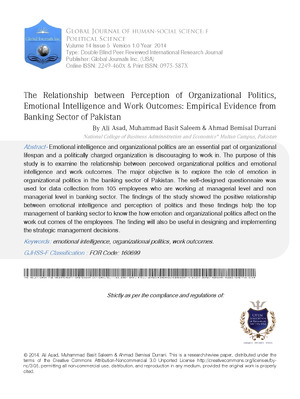
The Relationship between Perception of Organizational Politics, Emotional Intelligence and Work Outcomes: Empirical Evidence from Banking Sector of Pakistan

§ National College of Business Administration and Econ...

Send Message

To: Author

The Relationship between Perception of Organizational Politics, Emotional Intelligence and Work Outcomes: Empirical Evidence from Banking Sector of Pakistan

Article Fingerprint

ReserarchID

30S9V

The Relationship between Perception of Organizational Politics, Emotional Intelligence and Work Outcomes: Empirical Evidence from Banking Sector of Pakistan Banner

Key Research Insights

Synthesized scholarly intelligence & interactive research assistant
  • English
  • Afrikaans
  • Albanian
  • Amharic
  • Arabic
  • Armenian
  • Azerbaijani
  • Basque
  • Belarusian
  • Bengali
  • Bosnian
  • Bulgarian
  • Catalan
  • Cebuano
  • Chichewa
  • Chinese (Simplified)
  • Chinese (Traditional)
  • Corsican
  • Croatian
  • Czech
  • Danish
  • Dutch
  • Esperanto
  • Estonian
  • Filipino
  • Finnish
  • French
  • Frisian
  • Galician
  • Georgian
  • German
  • Greek
  • Gujarati
  • Haitian Creole
  • Hausa
  • Hawaiian
  • Hebrew
  • Hindi
  • Hmong
  • Hungarian
  • Icelandic
  • Igbo
  • Indonesian
  • Irish
  • Italian
  • Japanese
  • Javanese
  • Kannada
  • Kazakh
  • Khmer
  • Korean
  • Kurdish (Kurmanji)
  • Kyrgyz
  • Lao
  • Latin
  • Latvian
  • Lithuanian
  • Luxembourgish
  • Macedonian
  • Malagasy
  • Malay
  • Malayalam
  • Maltese
  • Maori
  • Marathi
  • Mongolian
  • Myanmar (Burmese)
  • Nepali
  • Norwegian
  • Pashto
  • Persian
  • Polish
  • Portuguese
  • Punjabi
  • Romanian
  • Russian
  • Samoan
  • Scots Gaelic
  • Serbian
  • Sesotho
  • Shona
  • Sindhi
  • Sinhala
  • Slovak
  • Slovenian
  • Somali
  • Spanish
  • Sundanese
  • Swahili
  • Swedish
  • Tajik
  • Tamil
  • Telugu
  • Thai
  • Turkish
  • Ukrainian
  • Urdu
  • Uzbek
  • Vietnamese
  • Welsh
  • Xhosa
  • Yiddish
  • Yoruba
  • Zulu
Reading Preferences
Font Size
Line Spacing
Background
This converted HTML version may contain rendering inconsistencies. Please refer to the PDF for the authoritative version, or click here to provide feedback.

Abstract

Emotional intelligence and organizational politics are an essential part of organizational lifespan and a politically charged organization is discouraging to work in. The purpose of this study is to examine the relationship between perceived organizational politics and emotional intelligence and work outcomes. The major objective is to explore the role of emotion in organizational politics in the banking sector of Pakistan. The self-designed questionnaire was used for data collection from 105 employees who are working at managerial level and non managerial level in banking sector. The findings of the study showed the positive relationship between emotional intelligence and perception of politics and these findings help the top management of banking sector to know the how emotion and organizational politics affect on the work out comes of the employees. The finding will also be useful in designing and implementing the strategic management decisions.

References

22 Cites in Article
  1. C.-H Chang,C Rosen,P Levy (2009). The relationship between perceptions of organizational politics and employee attitudes, strain, and behavior: A meta-analytic examination.
  2. R Chiva,J Alegre (2008). Emotional intelligence and job satisfaction: the role of organizational learning capability.
  3. G Ferris,M Arthur,H Berkson,D Kaplan,G Harrell-Cook,D Frink (1998). Toward a social context theory of the human resource management-organization effectiveness relationship.
  4. Y Ganzach (1998). INTELLIGENCE AND JOB SATISFACTION..
  5. David Gilmore,Gerald Ferris,James Dulebohn,Gloria Harrell-Cook (1996). Organizational Politics and Employee Attendance.
  6. Robert Kerr,John Garvin,Norma Heaton,Emily Boyle (2006). Emotional intelligence and leadership effectiveness.
  7. Y Liu,G Ferris,D Treadway,M Prati,P Perrewé,W Hochwarter (2006). 10 The emotion of politics and the politics of emotions: Affective and cognitive reactions to politics as a stressor.
  8. J Mayer,R Roberts,S Barsade (2008). Human abilities: Emotional intelligence.
  9. Galit Meisler (2013). Empirical exploration of the relationship between emotional intelligence, perceived organizational justice and turnover intentions.
  10. Galit Meisler,Eran Vigoda-Gadot (2014). Perceived organizational politics, emotional intelligence and work outcomes.
  11. M Mikolajczak,D Nelis,M Hansenne,J Quoidbach (2008). If you can regulate sadness, you can probably regulate shame: Associations between trait emotional intelligence, emotion regulation and coping efficiency across discrete emotions.
  12. David Ralston,Robert Giacalone,Robert Terpstra (1994). Ethical perceptions of organizational politics: A comparative evaluation of American and Hong Kong managers.
  13. C Rosen,K Harris,K Kacmar (2009). The emotional implications of organizational politics: A process model.
  14. P Salovey,M Brackett,J Mayer (2004). Emotional intelligence: Key readings on the Mayer and Salovey model.
  15. J Silvester (2008). 4 The Good, the Bad and the Ugly: Politics and Politicians at Work.
  16. Thomas Sy,Susanna Tram,Linda O’hara (2006). Relation of employee and manager emotional intelligence to job satisfaction and performance.
  17. Dana Vashdi,Eran Vigoda‐gadot,Dvir Shlomi (2013). ASSESSING PERFORMANCE: THE IMPACT OF ORGANIZATIONAL CLIMATES AND POLITICS ON PUBLIC SCHOOLS' PERFORMANCE.
  18. Eran Vigoda‐gadot,Galit Meisler (2010). Emotions in Management and the Management of Emotions: The Impact of Emotional Intelligence and Organizational Politics on Public Sector Employees.
  19. Eran Vigoda (2000). Organizational Politics, Job Attitudes, and Work Outcomes: Exploration and Implications for the Public Sector.
  20. C.-S Wong,K Law (2002). The effects of leader and follower emotional intelligence on performance and attitude: An exploratory study.
  21. Kelly Zellars,Pamela Perrewé,Wayne Hochwarter,Kenneth Anderson (2006). The interactive effects of positive affect and conscientiousness on strain..
  22. Suzanne Zivnuska,K Kacmar,L Witt,Dawn Carlson,Virginia Bratton (2004). Interactive effects of impression management and organizational politics on job performance.

Funding

No external funding was declared for this work.

Conflict of Interest

The authors declare no conflict of interest.

Ethical Approval

No ethics committee approval was required for this article type.

Data Availability

Not applicable for this article.

How to Cite This Article

Ali Asad, Ahmad Bemisal Durrani. 2014. "The Relationship between Perception of Organizational Politics, Emotional Intelligence and Work Outcomes: Empirical Evidence from Banking Sector of Pakistan". Global Journal of Human-Social Science - F: Political Science GJHSS-F Volume 14 (GJHSS Volume 14 Issue F5).
Download Citation

Journal Specifications

Crossref Journal DOI 10.17406/GJHSS

Print ISSN 0975-587X

e-ISSN 2249-460X

Keywords
Classification
GJHSS-F Classification FOR Code: 160699
Version of record

v1.2

Issue date
October 8, 2014

Language
English
Order Article Reprint
Experiance in AR

Explore published articles in an immersive Augmented Reality environment. Our platform converts research papers into interactive 3D books, allowing readers to view and interact with content using AR and VR compatible devices.

Read in 3D

Your published article is automatically converted into a realistic 3D book. Flip through pages and read research papers in a more engaging and interactive format.

Article Matrices
Total Views: 1.9K
Total Downloads: 166
All Trends

Request Access

Please fill out the form below to request access to this research paper. Your request will be reviewed by the editorial or author team.
X

This is the heading

Lorem ipsum dolor sit amet, consectetur adipiscing elit. Ut elit tellus, luctus nec ullamcorper mattis, pulvinar dapibus leo.


High-quality academic research articles on global topics and journals.

The Relationship between Perception of Organizational Politics, Emotional Intelligence and Work Outcomes: Empirical Evidence from Banking Sector of Pakistan

Ali Asad
Ali Asad <p>National College of Business Administration and Economics</p>
Ahmad Durrani
Ahmad Durrani