
I. INTRODUCTION
Today's generation has been taken over by digital media and the internet in general. Spreading information and creating awareness has become easy. Taking advantage of this technological advancement, South Korea has been trying to develop its 'soft power'.
According to Joseph Nye, 'soft power' is a way to shape other's preferences through appeal and attraction. It is the intangible power that a nation creates through its image and influence, rather than through hard force.
The world calls it the 'Hallyu wave' or the 'Korean wave', which implies the remarkable growth and rising popularity of South Korean culture around the world and includes their pop culture, music, movies, dramas, cuisines, fashion, makeup, etc. The Korean wave has been there since the 1990s. However, the digital media and video streaming platforms gave it a push, large enough that now around 81.19 million fans of K-dramas and Korean wave in general12. The South Korean government made it their top priority since there was a realization of potential achievement of soft power as well as higher GDP and in turn, an economic growth. Thus, South Korea has become a major exporter of not only popular culture, but also tourism since the audience abroad who are being influenced by this unique culture also now want to visit the mainland that gives rise to this culture. The Korean wave has been a boost for Korea's businesses and has contributed to almost of South Korea's GDP in 2004, which is equivalent to US 12.4 in 20192.
This popularity of the Korean culture began around mid-1990s, initially spreading to its neighbours, China, and Japan, then to the entire Southeast Asia. The factors that contributed to Korean wave's evolution involve the Korean government lifting the ban on foreign travel for Koreans around 1990s. This gave them new perspectives specially about art, cinema, and music. Another factor was that the Asian financial crisis forced the Korean chaebols3 to restructure their business models & divest many of their businesses which eventually provided many opportunities to small business players to enter different ventures. The government believed that information technology and popular culture would be key to put Korea on a path of success. In the same decade, major chaebols like LG and Samsung focused on quality, and marketing globally. Hence, international acceptance of these popular brands is improving the perception of its country-of-origin image.4 Overall, Korea made it their key aim to provide superior goods to the world, thus improving their image. Entertainment products like, dramas, music and movies have been recognised as excellent quality of production and they're rivalling Hollywood movies and shows.
The success of Korean wave on a global scale has been tremendous, especially in the past 5 years. Korean producers can source capital for their movies from different countries, like Japan, Vietnam, Singapore, China, etc. 'Parasite' was named the best picture at the Oscars 2020, becoming the first non-English film to have achieved that, and additionally it won 3 other Academy awards. 'Train to Busan' is another film that gained a lot of recognition globally & the film even premiered in the Midnight Screenings section of the 2016 Cannes Film Festival.
Even the K-dramas have penetrated the western market.5 They are known for having intense storylines and high production value as well as and quality acting. Korean content viewership across Asia increased to about four times in 2020 as compared to 2019. Japan saw the blockbuster K-drama 'Crash landing on You' in the top 10 for almost a year and took the sixth spot in the list of most watched shows on Netflix in the United States in 2020. Recently, 'Squid Game', which is a survival K-drama has taken the world by storm and ranked no. 1 in all 83 countries of Netflix, including India where it beat the locally loved show 'Kota Factory'. All of this proves the increasing authenticity & quality of Korean entertainment products.
The Korean pop culture has been on a rise since 2000s but reached next level heights in the past 10 years. K-pop artists like Big Bang, Super Junior, PSY, or Girl's generation have sold more than 230 million records globally. However, post 2015, bigger K-pop groups like BTS and Black pink have gained success globally and they do regular world tours, are brand ambassadors for many big brands globally like Gucci, Samsung, etc. and, have made appearances in American shows and music awards. K-pop rose with the help of YouTube and is being heavily accepted in the mainstream since these K-pop music and albums are very often mentioned in music charts. There are many other popular K-pop groups now who have been recognised because of BTS's success.
More recently, the Korean wave's success gave way to 26 Korean words being added to the official Oxford English dictionary and this was done to show the shift in language used by English speakers. The most important thing to note is that the success of Korean Wave has had its spill over effects such as increased interest of viewers in visiting the country. Korean government has been planning to make use of this tourism growth and earn revenues up to US $35 billion a year by 2030.4 The Korean Wave has also given rise to
the increased popularity of Korean cuisine as well as their fashion industry. Korean food including ramen, Kimchi and Tteokbokki, etc. are gaining popularity. The celebrity status and influence has risen so much that viewers are imitating the fashion. Not only fashion, but Korean style makeup has gained so much importance and identity that it's been given a separate name, K-beauty. In fact, South Korea's cosmetics total exports were around US $7.58 billion in 2020 and it sustained even with the Covid-19 pandemic.
Slowly, this Korean wave has reached the Indian mainland. Even though, the effects began to be visible before 2019, yet the lockdown due to Covid-19 established many new audiences who decided to binge-watch K-dramas with the help of their impressive presence on Indian OTT platforms and listen to K-pop, on the music streaming platforms. K-dramas have gotten very popular on Netflix India, and their viewership on OTT platforms in India rose more than 370 percent in 2020 over 2019.
This sudden popularity of the Korean culture has given rise to a fondness towards the food eaten by the celebrities, or that are seen in the dramas, the fashion, language they speak and the beauty products they use to look phenomenal. This has now started to change Indians' consumption habits. What this means is that with the rise of Korean wave, the demand for Korean products has seen a steep rise. The Korean noodle brand Nong Shim is paying attention to the Indian market. E-commerce platforms like Amazon, Flipkart, etc have these popular Korean noodles brand available. Since, BTS is so popular in India, McDonald's India (as a part of global campaign) collaborated with the boyband and introduced a special BTS meal for a week.
Korean beauty products are also being demanded by the urban population and are very much available on e-commerce platforms like Amazon, Myntra and Nykaa, as well as in malls.
Korikart, a marketplace providing imported Korean products in India states that they have seen a growth6 monthly ever since the pandemic hit. Not only the tangible products, but there has been an increase in the enrolment of Korean language courses.
Hence, this paper revolves around analysis of one of the spillover effects of the Korean wave i.e., analysing the consumer behaviour of Indians with the increase in consumption of Korean products and the potential of Korean consumer goods brands in India.
II. LITERATURE REVIEW
The literature has been reviewed through a total of five themes including Korean wave influence on consumer products purchasing, Country of origin image and its impacts, Influence of K-dramas and K-pop on purchasing, Consumer Attitudes towards KoreanCelebrity & brand endorsements, and Cultural hybridity and influence.
a) Korean Wave Influence on Consumer Products Purchasing Decisions
Chen Jason D. (2011) discusses the globalizing effect of Korean pop culture and its economic effects. Discussing the evolution of Korean wave, he discusses the impact of Korean wave in in specifically China, stating that a new generation of consumers in China adopted the Korean lifestyle, including cuisines, fashion, and even plastic surgeries. Chen D. believes the reason for Koran wave being accepted easily in China is because of the history of cultural interaction for thousands of years, similar values and a fascination for the urban lifestyle depicted in these K-dramas.
Most importantly, according to him, the Korean wave's penetration into various Asian countries and beyond had visible effects on purchasing. The interest in K-dramas and K-pop advanced to the Korean culture, food, and demand for Korean language classes increased.
Also, the Korean wave improved the national image of South Korea from being the land of military regimes, to becoming the land with modern technology and creative entertainers. The Korean celebrity power has also been advantageous for selling Korean products across the continent.
Involving the 4 Ps of marketing, the paper (Tan, D. et. al., 2020) using quantitative research tries to analyse the relationship between Korean Wave, and the 4 Ps of marketing, with the purchase intention Malaysian women have for Korean beauty products. The multiple regression results in this study prove that the above-mentioned variables influence the purchasing intention of Korean beauty products significantly. Further the paper assessed each variable impact on purchasing intention through hypothesis testing. The findings were that Korean wave, product quality, price, and promotion were significant in influencing the purchase intention of Korean beauty products, with product quality being the strongest variable. On the other hand, brand and place were insignificant in influencing the purchase intention. The results imply that Korean beauty brands should focus more on product quality, like introducing a distinctive ingredient consumers feel would be beneficial for them. Additionally, promotion is a very important influencer for beauty products with most of the respondents getting affected by TV and internet advertisements.
A similar result is concluded by Sembiring V. & Prabandari W. (2021) who analyse the impact of Korean wave on purchasing decisions at a Korean restaurant in Indonesia. The study adopted quantitative research and surveys. The study has used Korean wave as the independent variable and Purchasing decision as the dependent variable. In real life, the restaurant has gotten popular for K-pop fanbase groups celebrations thus proving that Korean wave has a positive influence on purchasing decisions in the restaurant. Through simple regression of purchasing decision on Korean wave, it was concluded that the Korean wave has a significant impact on the purchasing decisions of people. The coefficient of determination was moderate i.e. factors other than Korean wave such as the prices, promotions and quality also play an equivalent role in determining purchase decisions.
Covering a different region, Ocheing H. & Kim S. (2019) discuss Korean wave's impact in East Africa and the potential effects on other commercial exchanges. A survey method was adopted, and regression used independent variables such as exposure to Korean culture, while influence to buy Korean products (or desire to visit the country) were the dependent variables.
The study shows that educated respondents agreed that Korean language's knowledge influenced their attitude towards the country, since it enhances the understanding of the Korean lifestyle, and values. Most respondents confirmed that a positive image of Korea is projected through the Korean cultural products. Additionally, the study shows that the Korean cultural products7 confirm a potential tourist effect on the viewers. Africans perceived proximity with Korea due to the values portrayed in Korean media. With the help of regression, the paper concludes that an exchange of cultural products between Korea and the East Africa have a positive and significant influence on buying other Korean conventional products, since consumers of Korean cultural products would develop a positive attitude towards Korea and hence, would likely prefer products 'Made in Korea'.
Another paper highlighted the relationship between Korean cultural products exports and Korean consumer products export (Kim H., et. al., 2021) and analysed the impact of exports of music, films, and broadcasting on export of consumer goods such as clothing, cosmetics, foodstuffs, automobile, etc. with the help of regression and gravity model. The paper found the exports of Korean cultural goods had a positive and significant impact on the exports of Korean consumer goods, hence proving that the cultural goods have a very high drag effect on the consumer goods exports. Additionally, the effects were significant for IT products, cosmetics, clothing, and foodstuffs i.e., mainly for nondurables and the Asian region seems to be more interested in these consumer goods. For region-wise analysis, Asian region saw the influence of cultural goods as opposed to Europe, where the effect was low.
Finally, the paper reemphasises the main idea pointed out by others that the cultural products may enhance the national brand status, thus helping the consumer goods exports.
b) Country-of-Origin Image and its Impacts
Results from analysing the codes and sorting them into themes of Made in Korea, Image, Quality, and Effect, show that image and quality were the major attributes that formed consumer attitudes. The "Made in Korea" tag was directly affecting purchasing intentions. Korea's cognitive country image8 was strong, and participants considered Korea as the preferred country for purchasing beauty products. Thus, respondents associated product quality with Korea proving country-of-origin to be relevant. Also, it was seen in the responses that consumers with good exposure to the Korean Wave conveyed positive attitudes as well as purchasing behaviour towards K-beauty. Quality was also important in decision making and since consumers linked Korea to good quality, hence they preferred these beauty products. Finally, a new link of K-beauty with Korean Wave and an affective country image9 may be creating a separation in the country image. This means that the Korean Wave may be facilitating the propagation of Korean culture through all Korean products.
Another study which focused on the Korean cosmetics and the country-of-origin image was (Kim K. & Tjoe Z., 2016), which aimed to examine the impact of Korean wave towards consumer purchase intention of Korean cosmetics in Indonesia, and to see if image of Korean can impact consumer purchasing intentions. The paper described ethnocentrism10, cultural image11, country image12, and country-of-origin13 image, and developed various hypotheses. Online surveys collected data and multiple regression was performed.
The results show that Korean wave is positively related to purchasing intention of Korean products in
Indonesia. Also, among the variables of ethnocentrism, country-of-origin image, cultural image, purchase intention towards Korean products and, country image, mean value of country image was the highest followed by cultural image and then country-of-origin image. The hypotheses proved that country-of-origin image and cultural image positively affect the purchase intention, whereas ethnocentrism negatively affects the purchase intention of Korean products. Additionally, image of Korea and cultural wave have a positive and significant relation with its country-of-origin image. Thus, positive perceptions towards Korea's country image and Korean wave image can help Korea build its country-of-origin image.
Similarly, Son S. & Kijboonchoo T. (2016) also try to look at the impact of Korean wave on purchase intention of Korean cosmetics and country image of Korea. For the research, 4 groups of variables were categorised into Korean wave, Country Image, Brand attitudes, and Purchase intention. The paper also consists of hypothetical relationship development uses a survey questionnaire method. The results of the research highlight that all the independent variables (sympathy, empathy, attractiveness) representing Korean wave and (affective, cognitive image) representing country image of Korea have a significant relationship between each other. Empathy from K-drama have a positive correlation with the effective image of Korea, thus proving that Korean wave indeed has an impact on Korea's country image.
Further, the country image of Korea has a positive and significant relationship with the purchase intentions of Korean products directly and indirectly via the mediating impacts of brand awareness. Thus, proving that positive country image can have a positive influence on purchasing intentions of Korean cosmetics.
Analysing the impact of country-of-origin image and K-drama on the brand image as well as purchase intention of Korean cosmetics, (Rinjani B. et.al, 2019) adopted explanatory research with surveys for university students and developed hypotheses for the same. The results show that with brand image mediation, K-dramas can indirectly influence the Purchase Intention of Korean cosmetic products i.e., female students are interested in buying Korean cosmetics by looking at the brand image of the cosmetic products. Thus, the results prove that K-dramas and country-of-origin are positively and significantly impacting Brand Image. The better the K-drama and the country-of-origin image, the better will be the brand image of Korean cosmetics. Similarly, K-drama and Country of Origin positively and significantly impact Purchase Intention. The better the K-drama produced and the better the image of South Korea as a cosmetic producing country, the better will be people's purchase intention of cosmetics. However, brand image has a more enhanced impact on purchasing intentions in the study.
Instead of focusing just on cosmetics, Lita R. (2012) discusses the impact of Korean wave on the acceptance and perception of Korean culture and products in Indonesia, as well as to see if the country-of-origin effect theory makes sense in this case. The study included hypotheses development, adopted a survey questionnaire structure, and focused on quantitative research to understand cause-effect relations.
The descriptive results showed that, Korean wave was one of the main causes for respondents to learn more about Korea. Multiple regression found that the overall attitude of people was significantly related with independent variables 'product', 'culture awareness', 'perception on class position' and 'level of strength attitude toward acculturation'. Further, this study proves that Korean wave influences people's preferences, thus suggesting the more people engaged to Korean wave via media consumption, the higher were their chances to purchase Korean product or learn about the Korean culture, which can change their attitudes. Also, peoples' perception of product by Korean wave positively relates to the willingness to purchase products linked with Korea thus supporting country-of-origin effect.
c) Influence of K-dramas and K-pop on Purchase Intentions
The paper (So W. & Kim H., 2020) analyses the relationship between Chinese people's motivation for watching K-dramas and their e-commerce purchase intention. Hypotheses development was adopted analysing the main motives that affect Chinese people to watch Kdramas such as cultural curiosity, drama attractiveness, cultural similarity, relational factors and viewing habits. Additionally, a hypothesis was developed to analyse the impact of Korean culture's attractiveness on purchase intention, and Chinese people were surveyed.
The hypotheses test proves that firstly, the five factors (cultural curiosity, drama attractiveness, cultural similarity, relational factors, and viewing habits) are important motivations for people to watch K-drama and these factors positively influenced Korean culture's attractiveness and Korean favourability. Chinese and Korean share history thus their cultures are similar. Secondly, this attractiveness of Korean culture positively impacts the e-commerce purchase intention of Korean products.
Similarly, Lee J. & Yu S. (2018) try to find out the aspects of K-drama which influence the favourability, viewing motivation and the purchase intentions of Korean products, targeting Chinese consumers. The three aspects of K-drama are the 'theme', 'leading actor', and 'production'. The study adopted an online-survey method and multiple regression to conclude results. By looking at the results of regression it was observed that only 'theme' was able to influence the favourability towards K-dramas. Whereas 'theme' and 'leading actor' aspect both had a meaningful influence on the viewing motivation. Most importantly, only 'theme' and 'production' aspect of K-dramas influenced the purchasing intentions of the Korean products. Thus, to promote Korean products through K-dramas, focus should be on theme and the quality of production, because this would lead to higher K-drama consumption, which in turn would lead to higher consumption of Korean products.
Looking into the K-drama consumption in India, Saha R. & Jacob J. (2020) discuss the specific aspects of K-dramas as visual content that influence youngsters and its impact on behavioural and lifestyle changes by using a mix of survey and focus group discussions. The main findings from the study were that more of behavioural changes occurred within female viewers such as adaptations of unique gestures, and behaviour. When it comes to associations, most of the respondents associated Ramen with Korean culture. There have been mixed cultural association with food. Food which is an essential part of K-drama led to more purchasing of big bowls, kitchen utensils, chopsticks, and ramen.
Also, people purchased more Korean products when their favourite celebrities endorsed it as compared to when they watched it in a drama. Trench coats and blazers are popular in the K-drama industry and majority of respondents stated their fascination towards these, but only some buy them. This can be because of the age factor, since the respondents were youngsters who weren't earning. Also, like other researchers found out, a high percentage of respondents preferred Korean cosmetics in comparison to western products.
Focusing on the Korean culture, Anh Dinh T. (2016) explains the influence of Korean wave (focusing on music and drama) on Vietnamese consumer behaviour. Consumer behaviour in the study is limited to analysing the expenditure of university students on Korean cosmetics and language courses. The study found various results. Firstly, from the data a high correlation was found between the time Vietnamese people spend on Korea dramas or listening to K-pop music, and their expenditure on cosmetics. Hence, the more someone is exposed to the Korean wave, the more they spend on Korean cosmetics. Second major result shows that, the higher the time of exposure to the Korean wave, the higher is the amount of money people spend monthly on cosmetics. Thirdly, the expenditure on Korean cosmetics differs for different age groups with younger age groups spending less than the slightly older ones due to income factor. Also, the time of exposure to Korean Wave can positively affect the desire to study Korean language. Finally, the period of residence in an urban city can also influence the average expenditure on Korean cosmetics and language courses. This is because urban cities provide everyone the access to modern lifestyles.
Further, another paper talks about the K-pop culture's influence on international audience's imitation intention, attitude towards the Korean culture and attitude towards the Korean products (Zhang R., et. al., 2020). Using a survey method, the study was undertaken, and hypotheses were developed.
It was found through hypotheses testing that the frequency of K-pop consumption was able to impact attitude towards Korean culture, imitation intention, and attitude towards Korean products positively and significantly. Also, the people's attitude towards Korean culture positively and significantly predicted the purchase intention of Korean products. Thus, implying that the international audiences' intentions to purchase Korean products are stimulated by K-pop media consumption. Additionally, although K-pop gives rise to cultural influence, yet a positive attitude towards Korean products implies that K-pop is the cause of sale of Korean products. Finally, both frequency and the hours of K-pop consumption significantly impacted the respondent's intention to imitate popular K-pop celebrities.
To get a deeper understanding of younger consumers in Taiwan, Qianqi Z. (2020) discusses the most influencing aspects of the Korean wave and how it affects the consumer behaviour through a questionnaire method. The major findings of the study were that a high percentage of people consume K-pop and K-dramas media. Secondly, the percentage of people watching and listening to K-pop and K-dramas are positively correlated with the frequency of people's purchase choice. This means that popularity of K-pop and K-dramas gave rise to popularity of Korean products. Thirdly, among the different genres of Korean products influenced by the Korean wave, the top three most purchased genres are food, music, and dramas.
Additionally, even cosmetics and outfits purchase of youngsters were heavily influenced by the Korean wave. Finally, the main reasons that affect purchase decisions have been concluded to be first, the presence of these products in the K-dramas and second, the admiration for Korean celebrities.
d) Consumer Attitudes Towards Korean Celebrity & Brand Endorsements
To understand the use of Korean celebrity brand ambassador as a marketing strategy, Pratami R. & Sari A. (2020) use a case study research method to examine how PT. Shopee Indonesia chose a K-pop girl band called 'Gfriend' as a brand ambassador and how it impacted their sales. Data was collected from interviews, observations, and stats. Shopee is an e-commerce platform in Indonesia, selling households products, equipment, fashion, etc. The author suggests that when choosing a brand ambassador, characteristics like visibility, credibility, attractiveness, etc. are important to appeal the consumers. And Shopee followed a similar technique when choosing 'Gfriend' as the brand ambassadors of Shopee Korea Fair and Shopee 11.11 Big Sale campaigns in 2019.
Shopee used an integrated marketing model including sales promotion, advertising, interactive marketing, and events & experience. By using sales promotion, they used strategies like the 11.11 Big sale, with great deals and offers. Shopee Indonesia also used public relations in Big Sale and Shopee Korean Fair by presenting GFRIEND in their ShopeeLive which was an exclusive online fan meeting. Then they went on to telecast a special 'Gfriend TV Show' for the big sale. In this tv show fans as well could interact and send messages. The results of this brand ambassador strategy were that the sales from the Koreanfair and Big Sale doubled as compared to the previous year. Thus, proving that choosing 'Gfriend' as their brand ambassador was the right strategy.
To understand the impact of brand ambassadors on brand image and consumers' purchasing decisions, Fawwaz I. (2019) analyses the case of Tokopedia, an Indonesian e-commerce which needed promotional strategies to enhance brand image by brand ambassador 'BTS', the most popular Korean boy band globally. The research adopted a quantitative method and it was found that 'BTS' brand ambassador have a positive and significant impact on Tokopedia's brand image. Similarly, brand ambassador has a positive and significant impact on consumers' purchasing decisions. Finally, it is seen that brand image also significantly and positively impacts the consumers' decision-making. Further, Hyunsu Y. (2021) in his article discusses how BTS' success in the music world has its spill over effects into the advertising business since more companies are trying to improve their brand images through the group's popularity. McDonald's collaborated with BTS to introduce a celebrity meal called the BTS meal which was accessible worldwide. The collaboration helped McDonald's sales significantly. Similarly, Louis Vuitton, Samsung, Hyundai, etc. are just few of the many brands that announced BTS as their brand ambassadors. The author believes the main aim of these brands is not just targeting their fans as consumers but also to create a buzz on social medias.
On a similar note, Yu H. & Yu L. (2020) assess the impact of celebrity endorsements on Chinese consumers' purchase intentions of clothing products. The paper used a quantitative research survey-method and tried to find the relationship between variables trustworthiness, attractiveness, congruency and expertise, and purchase intention.
The paper finds that, male respondents had more perception of trustworthiness as compared to the females, and age played a role in the sense that the younger a person and the higher their educational background, the more they have a perception of trustworthiness. About the Korean celebrity attractiveness, female tend to perceive attractiveness more than males, and older the person, more would they perceive attractiveness. Most importantly, the four variables of celebrity constructs had a positive and significant impact on the purchase intention when the hypotheses developed for their impacts on purchase intention were tested. In-fact celebrity expertise had the biggest impact, implying that the marketers should give knowledge and skills to Korean celebrities when they endorse their products.
(San L. et. al., 2020) studies the Malaysian Generation Y to understand how their purchase intentions of Korean products are affected by Korean entertainment, Korean celebrities, and social influences. The data collection was executed through questionnaires. The multiple regression results show that the independent variables Korean media, celebrities and social influence significantly and positively impact the purchase intention. While individually, Korean media and celebrities significantly impact the purchase intentions, yet the social influences have no significant role to play and the reason for this can be that people belonging to this generation are more individualistic compared to the previous generation. Thus, the study proves that consumers purchase intention of Korean products are significantly affected by the Korean entertainment and celebrities, implying that marketers should focus on celebrity brand endorsements to increase the penetration of their products.
Highlighting celebrity endorsements' importance, Ni G. (2019) tries to study the Malaysian consumer's behaviour under the influence of Korean popular culture, which leads them to consume Korean products, and how this behaviour differs when analysed individually as compared to group. The paper adopts in-depth interview to understand the perspective of the consumers.
The findings based on codes defined in the statements show that consumers are attracted to Korean products, especially cosmetics due to factors like good quality, attractive appearance, and idolism. Idolism being a very important factor since everyone wants to look as good as their favourite idols or actors in the industry. Celebrity endorsements of Korean products by K-drama actors or K-pop idols can influence the consumer's mind since it provides a credibility to the brand. However, it is important to note that consumers always keep quality as their topmost priority. Additionally, age can change brand preferences since as people grow older, they get serious with their purchases ensuring that their purchase is rational.
Further, the study shows that consumers behave differently in groups as compared to individually. Individually consumers tend to stick to their decisions and purchase based on their beliefs. They tend to research more to maximise their profits. Whereas socialisation can change the opinion to have a feeling of belonging in the group. Family and friends majorly influence an individual's decisions by conformity. Finally, the study shows that Korean wave has shaped the standard of beauty as celebrities always look their best with flawless skin and great fashion hence consumers feel like they need to match those standards.
e) Cultural Hybridity and Influence
To understand the nature of hybridity of the Korean wave, (Reimeingam M., 2014) studies the origin, transnational characteristics, and focuses on the impact of the wave in Manipur, India. According to him, the success of Korean wave in most Asian countries is due to cultural affinities between Korea and these countries. He states that the Korean wave is transnational and hybrid since it is not purely an authentic Korean culture, but rather a fusion of Korean and the westernised modernity. At the same time, even though the Korean wave is a boost to their culture, yet the hybrid modern Korean pop poses a threat to the classical Korean music which once had a higher popularity. Further, Manipur is said to be non-homogenous with different communities. Research shows that Bollywood movies in Manipur have been replaced by the so-called 'Hallyuwood', i.e. Korean movies and dramas, whose DVDs are available widely and the cable operators broadcast Korean channels like KBS TV and Arirang.
Thus, people in Manipur are adapting to the new culture of Korea leading to a process of acculturation, which is in turn giving rise to a blend of Manipur and Korean culture. And this acculturation is penetrating not just the youth but also the older population who take a keen interest in family values portrayed heavily in these Korean movies and dramas. Another important contributing factor for the same is the opening of India's economy with the liberalisation and globalisation via the India's Look East Policy which was adopted to develop and link Northeast India with Asian countries.
Discussing over similar themes, Kanozia R. & Ganghariya G. (2021) talk about the cultural proximity and hybridity of the Korean pop culture in India. According to them, cultural proximity of Asian countries with Korean culture made Korean wave a success. Further they discuss how India became familiar with the Korean wave, starting in Manipur, North-east of India, after Bollywood's ban. They then authors mention that cultural proximity is apt for describing the popularity of Korean media and culture in the north-east India. Additionally, they believe that for the rest of India, cultural hybridization can explain the popularity of Korean culture and media. This leads to a hybrid culture where the locals prefer dubbed movies and dramas of Korean origin.
Likewise, Akhtar S. (2019) studies the cultural influence of the Korean wave on Bangladesh and how it is leading to the cultural hybridization by qualitative in-depth interviews of the youth mainly. The paper finds that K-dramas and movies reflect Korea's cultural beliefs like familial relationships and friendships which portray respect for elders and love for one another, and viewers enjoy these themes since Bangladeshi are familiar with these themes. Thus, the hybridity of Korean popular culture is attracting Bangladeshi consumers since they're able to relate to their own culture. Similarly, K-pop's hybrid culture and songs about social and sentimental issues has made Korean music very popular among the youth.
Additionally, the study shows that Bangladeshi consumers have started using Korean language in their daily life to feel connected to the Korean culture. Finally, Korean fashion and beauty's influence also initiates cultural hybridization since youth of Bangladesh try to mix it with their own cultural fashion.
III. RESEARCH GAP
The literature reviewed in the paper pertaining to the Korean wave and its impact, show the different studies that have been conducted on consumers of the Korean culture and products in various countries to understand the general consumer behaviour. These literature reviews conclude that Korean wave, celebrity endorsements, Country-of-origin image, hybridity, the Korean cultural values, and its uniqueness, etc. affect the consumer's purchase intentions positively.
However, as mentioned before, the Korean wave gained popularity in India over the last year during the Covid-19 pandemic lockdown, and hence, there is a great need to understand the very diverse Indian consumers' purchasing patterns with respect to Korean products, and to see the potential of the growth of Korean products in India. Thus, capturing these as the research gaps, the paper has laid down research questions in the following section.
IV. RESEARCH QUESTIONS
Inferring the research gap from the existing literature, this paper will focus on two research questions:
Why are Indian consumers consuming Korean products and what are their purchasing patterns?
What is the growth potential of Korean products in India?
V. RESEARCH HYPOTHESES AND VARIABLES
The existing literature supports the impact of certain variables on the purchase intention of consumers when it comes to Korean consumer products like clothing, cosmetics, food, etc. To carry forward the study on Indian consumers' behaviour in a systematic manner, this paper has used certain variable constructs to see if they have any impact on the Indian consumers' purchase intention of Korean products, in accordance with the existing literature. This paper focuses on the purchase intention of Korean cosmetics/ skincare and Korean foodproducts (like Ramen, Korean snacks, etc.)
The dependent variables chosen in the study are 'Purchase Intention of Korean cosmetics/skincare' and 'Purchase Intention of Korean food products.'
For supporting the independent variables for this study, various existing literature were referred to, and consequently the hypotheses showing the relationships between the independent and dependent variables were proposed.
The first and the foremost independent variable was the 'Attractiveness of the Korean culture and Korean-wave'. The paper (Kim K. & Tjoe Z., 2016) concluded that Korean wave and its cultural image were positively related to purchasing intention of Korean products in Indonesia. Thus, the hypotheses proposed were
- H1: 'Attractiveness of the Korean culture and Korean-wave' has an impact on the purchaseintention of Korean cosmetics/skincare.
- H2: 'Attractiveness of the Korean culture and Korean-wave' has an impact on the purchaseintention of Korean food products.
The second variable used in the study was 'K-pop and K-Dramas Viewing habits and Attractiveness.' This variable was supported by the paper (Lita R., 012) that inferred from the study that he more people engaged to Korean wave via media consumption, the higher were their chances to purchase Korean products. Similarly, the paper (Anh Dinh T., 2016) proved that a high correlation was found between the time Vietnamese people spend on Korean dramas or listening to K-pop music, and their expenditure on cosmetics. Thus, the hypothesesproposed were-
H3: 'K-pop and K-Dramas Viewing habits and Attractiveness' has an impact on the purchase intention of Korean cosmetics/skincare.
H4: 'K-pop and K-Dramas Viewing habits and Attractiveness' has an impact on the purchase intention of Korean food products.
'Celebrity attractiveness and endorsements' was the third independent variable used, in line with the results supported by (San L. et. al., 2020) which stated that consumers purchase intention of Korean products are significantly affected by the Korean entertainment and celebrities. Ni G. (2019) showed that celebrity endorsements of Korean products by K-dramaactors or K-pop idols can influence the consumer's mind since it provides a credibility to the brand. Thus, the hypotheses proposed were-
H5: 'Celebrity attractiveness and endorsements' have an impact on the purchase intention of Korean cosmetics/skincare.
H6: 'Celebrity attractiveness and endorsements' have an impact on the purchase intention of Korean food products.
'Product Quality' and 'Product Price' were the next two independent variables used because these play a very important role in any product's purchase. The paper (Tan, D. et.al., 2020) studied and proved that product quality and price were significant in influencing the purchase intention of Korean beauty products, with product quality being the strongest variable. Thus, the hypotheses proposed were
H7: 'Product Quality' has an impact on the purchase intention of Korean cosmetics/skincare.
H8: 'Product Quality' has an impact on the purchase intention of Korean food products. H9: 'Product Price' has an impact on the purchase intention of Korean cosmetics/skincare.
H10: 'Product Price' has an impact on the purchase intention of Korean food products.
We live in a society and social influence (by friends, family, advertisements, or social media) plays some role when it comes to consumer purchase behaviour. The same has been proved by (Tjokrosaputro & Cokki, 2020), that social influence has direct effect on purchase intention. Even (San L. et. al., 2020) proved that social influence has a positive and significant impact on the Korean products' purchase. Hence, the sixth variable used was 'Social Influence'. Thus, the hypotheses proposed were
- H11: 'Social Influence' has an impact on the purchase intention of Korean cosmetics/skincare.
- H12: 'Social Influence' has an impact on the purchase intention of Korean food products.
The seventh and the last independent variable used in the study was 'Country of Origin Image'. This variable is even more important when it comes to Korean products' purchase and various studies including, Lita R. (2012), (Rinjani B. et.al, 2019), Son S. & Kijboonchoo T. (2016), Ingels L. (2020) and Kim K. & Tjoe Z. (2016) have proved that country of origin image positively and significantly impacts the Korean products purchase intention. Thus, the hypotheses proposed were-
H13: 'Country of Origin Image' has an Impact on the Purchase Intention of KoreanCosmetics/Skincare.
H14: 'Country of Origin Image' has an Impact on the Purchase Intention of Korean FoodProducts.
VI. RESEARCH METHODOLOGY
In line with the research questions, this paper follows two types of research methodology. The paper has employed a quantitative research methodology with the help of data collected via online questionnaires to analyse consumer behaviour while purchasing Korean products and test the hypotheses mentioned in the previous section. The online questionnaire was filled by a purposive sample, and results have been quantitatively inferred on the statistical software IBM Statistics SPSS Version 26, using several quantitative tools like regression, descriptive statistics, correlation, and graphical analysis.
The questionnaire captured all the variables mentioned in the previous section via different statement items which were in the form of the 5-point Likert scale. 3 to 4 statements itemswere used for each variable and then combined into 1 variable by taking a mean of all it's statement items' responses.
Further, to analyse the impact of each of the seven independent variables on the purchase intention of Korean cosmetics and food products, a multiple linear regression was conducted on SPSS. The equations of the multiple linear equation model are:
Also, graphical analysis using scattered plots were performed to see the how the purchase intention of Korean cosmetics and food were related with the predictors. Descriptive Statistics was also calculated, and Correlations were found out between all the independendant and dependent variables.
Additionally, qualitative research of the Indian consumer goods market and the Korean goods has been also adopted, to understand the growth of Korean products in the Indian market.
This would help understand how the Korean companies have evolved over a period and their growth potential.
VII. DATA
Data used in the paper for the secondary research of the consumer goods market was secondary data from external sources like websites, reports by companies and articles.
Data used for the quantitative research was primary data which was collected via an online questionnaire. The online questionnaire was circulated on all social medias like Instagram, Facebook, Twitter, LinkedIn, etc. The questionnaire revolved around Korean cosmetics/ skincare and Korean food products. The online questionnaire included questions on demographics like age, and gender, as well as questions on when people were introduced to the Korean wave and if they purchased Korean cosmetics and food.
Further, the next section included the 32 statement items which were based on the 5-point Likert scale, where 1 represented Strongly Disagree, 2 represented Disagree, 3 represented Neutral, 4 represented Agree and 5 represented Strongly Agree, and these statements captured all the dependent and independent variables. Like mentioned before, 3 to 4 statements items were used for each variable and then combined into 1 variable by taking a mean of the statement items' responses. For analysis, the Likert scale responses were used in the numeric form (1-5).
The quantitative research involved a purposive sampling technique as the questionnaire was filled by Indians who buy Korean cosmetics or Korean food products. The questionnaire was filled by 175 respondents and after the screening process, 15 responses which were the outliers were removed. Thus, the final sample size of the study was 160. Finally, the data collection process occurred for a period of 9 days and was collected online via Google forms.
VIII. RESULTS AND DISCUSSIONS
a) Reliability
The reliability of a questionnaire is a method of measuring the quality of the measurement approach used to gather data. To consider a result legitimate and valid, the measurement procedure first should be reliable. Cronbach's alpha estimates the internal consistency or reliability of the items forming variables in a questionnaire. The alpha coefficient has a value ranging from 0 to 1.
Hence, the Cronbach's Alpha values derived from SPSS calculations were used to conduct the reliability test for this study. According to Pallant (2001), an Alpha Cronbach's alpha value greater than 0.6 is regarded a high reliability and acceptable score. The Cronbach Alphascores for all the variables constructed are given in the Table 1.
Table 1
| Reliability Statistics | ||
| Variable | Cronbach's Alpha | No. of Items |
| All (overall reliability) | 0.922 | 32 |
| Purchase intention of Korean cosmetics | 0.908 | 4 |
| Purchase intention of Korean Food products | 0.893 | 4 |
| Attractiveness of the Korean culture and Korean wave | 0.773 | 3 |
| K-pop and K-Dramas Viewing habits and Attractiveness | 0.839 | 4 |
| Celebrity attractiveness and endorsements' | 0.775 | 4 |
| Product Quality | 0.751 | 3 |
| Product Price | 0.803 | 3 |
| Social Influence | 0.814 | 4 |
| Country of Origin Image | 0.770 | 3 |
The Cronbach's alpha values for overall all the variables and the individual variables (both dependent and independent) observed from the above table are significantly greater than 0.6, and thus all the variables constructed for the analysis are highly reliable qualified for future analysing.
b) Demographic Background and Basic Purchase Information
The respondents of the questionnaire belonged to the age groups i.e., below 15, 15-25, 25-35, and 35-45. None of the respondents fell in the category of age above 45 years. Looking at the age demographics in Figure 1, it can be observed that the highest percentage of of the respondents belonged to the category of 15-25 years. This was followed by a of respondents being from the category 25-35 years. The least picked age group was the below 15 years with only and the 35-45 years formed by of the respondents.
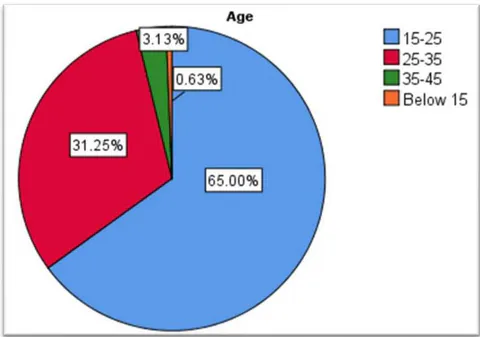
This shows that the youth is exposed a lot more to the Korean wave and Korean products than the older generations. This is justified because Gen Zs and Millennials are lot more liberal and open to new cultures, new changes than the older generations in India who are comparatively conservative. According to a Times of India article, people under the age of 25 are the main demographics for K-pop and Korean cuisine. Also,
Korean cosmetics and beauty products have piqued the interest of young people in India because of the power of social medias like Instagram, YouTube, etc. where K-beauty is being heavily advertised by influencers. On top of that since Korean food products and cosmetics are mostly sold online in India, the youth have more easy access to them.
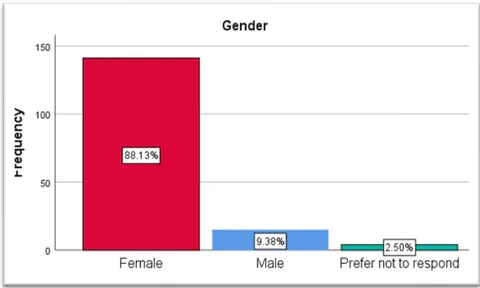
The gender demographics of the respondents shown in Figure 2 indicate that the majority respondents were females being of all the respondents. Males were only of the total respondents and chose not to respond. These age demographics prove that females are the dominant consumers of the Korean wave and Korean products. One reason can be because K-pop and Korean dramas are designed for females as the target audience. Also, Korean cosmetics and skincare are well purchased by even males in South Korea because skincare is an important aspect there. However, in India, mostly women associate themselves with makeup, cosmetics, and skincare.
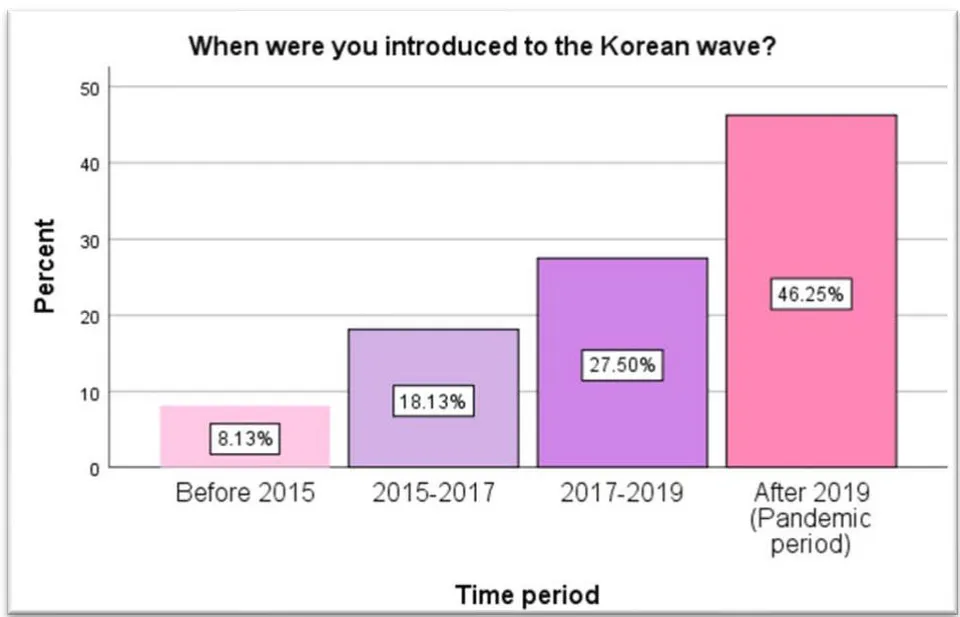
Figure 3 summarises the percentages of people for when were they introduced to the Korean wave. It is observed that most respondents were introduced to the idea of Korean Wave after 2019 (pandemic period), forming of the total. Around were introduced to the Korean wave in 2017-2019, in 2015-2017 and only about before 2015. These prove that even though the Korean wave may have been introduced globally way before, yet in India, the wave popularised only recently, specifically after 2019 when India was in a lockdown, and video streaming websites like Netflix India gained traffic and saw a spike in Korean content viewership. An article in the Times of India stated that Indians were led to experiment with content during the Pandemic and they went on to become addicted to Koreancontent, more because it led them to learn about new cultures, style, fashion, food, etc.
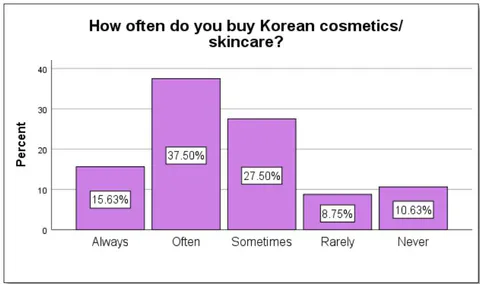
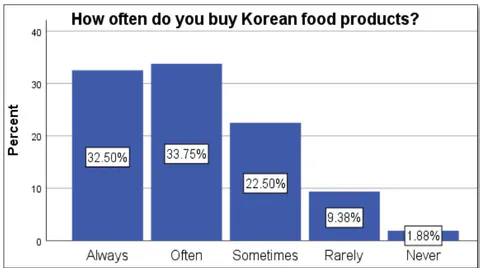
Figure 4 gives a summary of how many respondents buy Korean cosmetics and Korean food products. Additionally, Figure 5 summarises the respondents' frequency of buying Korean cosmetics and food products.
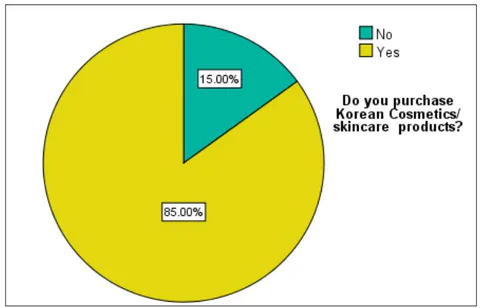
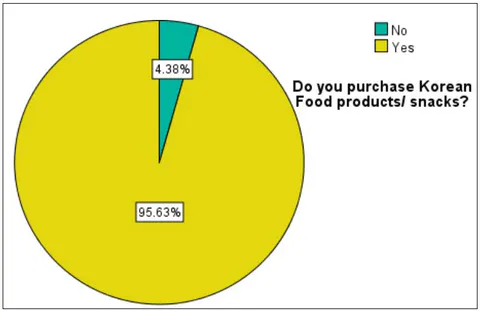
Figure 4 implies that a higher percentage of respondents buy Korean food products than Korean cosmetics i. e., of respondents buy Korean food products, while buy Korean cosmetics. This inference can be aligned with the age demographics to show that because most respondents of the questionnaire belonged to the younger age group of 15-25 and many of these younger respondents could still be students and not full-time employees, thus they wouldn't be able to spend a lot on relatively expensive products like cosmetics and skincare as compared to the cheaper products like food products. Also, cosmetics/skincare are products that are used more by women in the age range of 20-45, thus the percentage buying Korean cosmetics are lower.
Figure 5 given below elaborates further on to the frequency of respondents' buying behavior with respect to Korean cosmetics and food products. Figure 5 implies a similar idea. About of respondents buy Korean food 'Always' opposed to just buying Korean cosmetics 'Always'. About respondents buy Korean food 'Never', against the buying
Korean cosmetics 'Never'. Since cosmetics are more expensive than food products and the respondents' dominating demographic is the younger age group, hence we observe this difference in the buying frequency of Korean food and cosmetics.
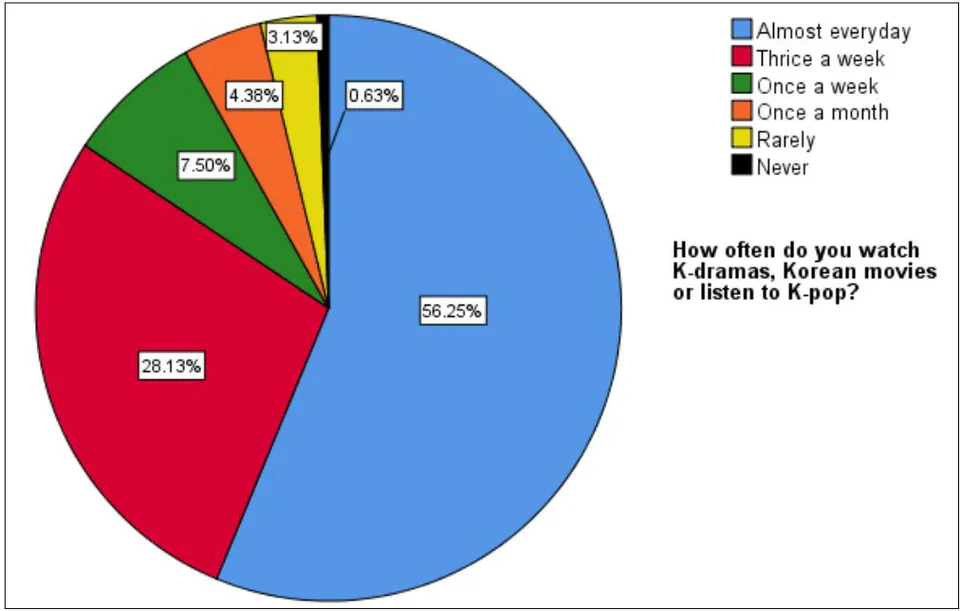
The frequency of respondents' consuming Korean entertainment content and watching Korean dramas, Korean movies and listening to K-pop music, is given in Figure 6 below. Evidently, the respondents are active viewers and a regular audience to the Korean content with majorly of them watching Korean content 'Almost everyday'. About watch Korean content 'Thrice a week', which is still a lot, considering the amount of competition Indian and Western entertainment content gives to the Korean content.
Only of the respondents 'Never' watch Korean content. Thus, the respondents of this questionnaire who are consumers of Korean products, are mostly also people who are aware of Korean entertainment and frequently consume it because they're the youth, who are also spending more time on video streaming sites and social media. This supports the idea that Indians are increasingly watching Korean content since the pandemic hit.
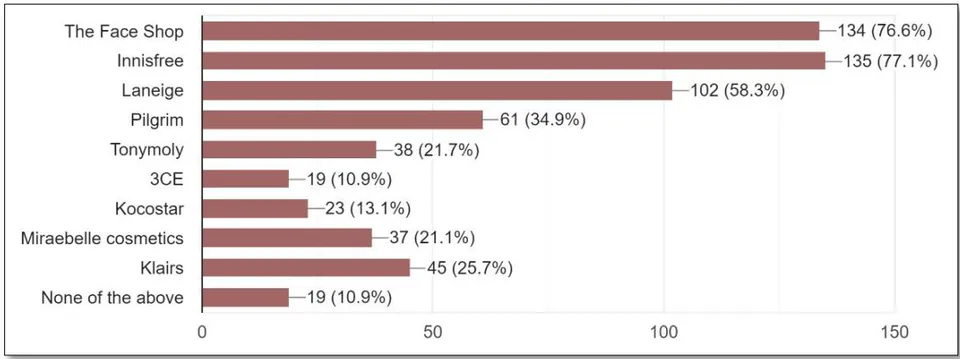
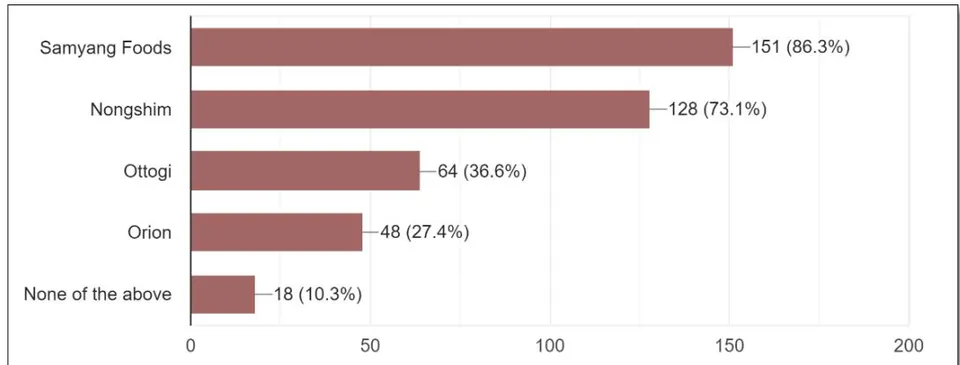
The below figures show that respondents were aware about a lot of Korean cosmetic and food brands. The Face Shop, Innisfree, Laneige, Pilgrim and Mirabelle cosmetics were the top 5 popular cosmetics brands.
While, in terms of Korean food, Samyang Foods and Nongshim were the most popular brands followed by Ottogi and Orion.
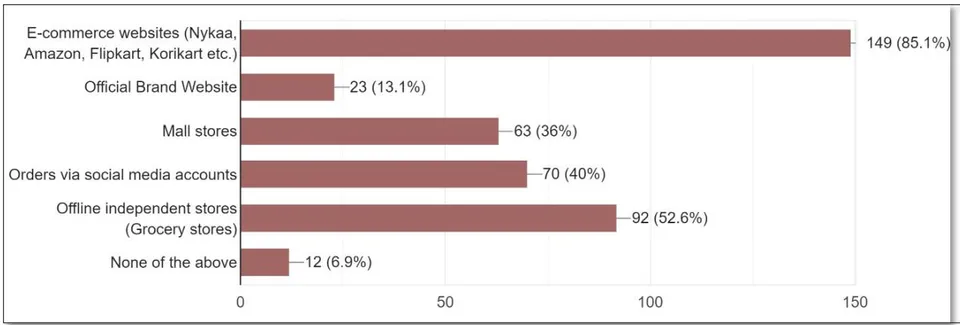
In reference to where respondents buy Korean products, buy these products from E- commerce websites like Nykaa, Amazon, Flipkart, etc. About buy from offline grocerystores and buy products via orders placed on social media accounts that import these products.
c) Descriptive Statistics and Correlations
Table 2 summarises the descriptive statistics of the constructed independent and dependent variables.
It includes the mean and standard deviations. The mean values are for the Likert scale based constructed variables are between the range 1-5. Except for the 'Product Price', all other variables have a mean around 3-4, which means respondents agreed to most of the statement items, except for the statement items under the Product Price variable.
Table 2
| Descriptive Statistics | |||
| Variables | N | Mean | Std. Deviation |
| Purchase intention of Korean cosmetics | 160 | 3.8281 | 0.87917 |
| Purchase intention of Korean Food products | 160 | 4.1453 | 0.80704 |
| Attractiveness of the Korean culture and Korean-wave | 160 | 4.3604 | 0.65180 |
| K-pop and K-Dramas Viewing habits and Attractiveness | 160 | 4.3500 | 0.66007 |
| Celebrity attractiveness and endorsements | 160 | 4.1078 | 0.74744 |
| Product Quality | 160 | 4.1875 | 0.68291 |
| Product Price | 160 | 2.6438 | 1.00740 |
| Social Influence | 160 | 3.3578 | 0.92681 |
| Country of Origin Image | 160 | 4.0042 | 0.85003 |
The highest average or mean was for 'Attractiveness of Korean culture and K-wave' with a value of 4.3604 followed by 'K-pop and K-Dramas Viewing habits and Attractiveness' with an average of 4.35. The standard deviations of all the variables are on the lower side showing that all data values are less spread out and very close to the mean or average.
Table 3
| Correlations | |||||||
| Attractiveness of the Korean culture and Korean wave' | K-pop and K-Dramas Viewing habits and Attractiveness | Celebrity attractiveness and endorsements' | Product Quality | Product Price | Social Influence | Country of Origin Image | |
| Purchase intention of Korean cosmetics | .415** | .432** | .518** | .518** | -0.013 | .306** | .515** |
| Purchase intention of Korean Food products | .529** | .519** | .547** | .588** | -.189* | .395** | .570** |
Table 3 summarises the Pearson correlation statistics between the independent and dependent variables of the study.
The Pearson correlation results show that except 'Product Price', the correlations between Purchase Intention of Korean cosmetics and all the remaining independent variables were positive and significant at the level (2-tailed). The highest correlation was found between Purchase intention of Korean cosmetics and Product Quality i.e., correlation value of 0.518. Thus, showing that if product quality rose, the cosmetics' purchase intention would also rise (both moving in the same direction). Even 'Celebrity attractiveness and endorsements' showed the highest correlation of 0.518 with the purchase intention. However, the 'Product Price' variable had no significant correlation with the 'Purchase Intention of Korean Cosmetics'.
The correlations between the 'Purchase intention of Korean Food products' and all the independent variables were significant at level (2-tailed). In-fact all the independent variables showed a positive significant correlation with the 'Purchase intention of Korean Food products' except the Product Price that showed a slightly negative and significant correlation. So, if the product price increased, then the purchase intention of Korean food products would fall. Product Quality and Country of Origin Image showed higher positivecorrelation of 5.88 and 5.70 respectively.
Overall, the correlations between the independent variables and 'Purchase intention of Korean Food products' were stronger and significant as compared to the correlations between the independent variables and 'Purchase intention of Korean Cosmetics/ Skincare'.
d) Regression Analysis
To test the proposed hypotheses, multiple linear regression was conducted using the two equations mentioned before. The regression results are given below:
i. Purchase Intention of Korean Cosmetics
The Model Summary given in Table 4 shows the results of the regression of 'Purchase Intention of Korean Cosmetics' on the independent variables. The model's value came out to be 0.358 or . This means that the predictors explain changes in the 'Purchase Intention of Korean Cosmetics'. The model is significant at significance level and the correlation value for the model is 0.598. The regression model's graph is given in Figure 7 and shows an overall positive and significant relation between the independent variables and the 'Purchase Intention of Korean Cosmetics'.
| R | R Square | Adjusted R Square | Std. Error of the Estimate | F | Sig. F | Durbin-Watson |
| .598 | 0.358 | 0.329 | 0.72037 | 12.119 | 0.000 | 1.993 |
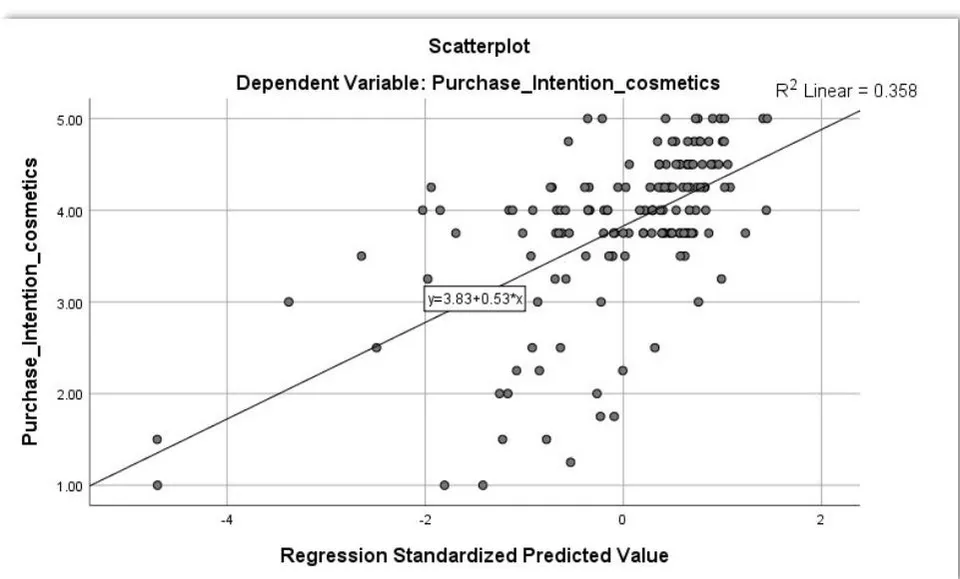
The model's Durbin Watson value is 1.993 thus showing that there is no autocorrelation in the model (for no autocorrelation the Durbin Watson value should be between 1.5 to 2.5).
The regression individual coefficient results are given in Table 5. The VIF (Variance Inflating Factor) is less than 10 all the variables so there is no multicollinearity in the model.
From the results below, it is observed that two of the independent variables have a significant impact on the 'Purchase Intention of Korean Cosmetics' at the significance level. 'Product Quality' has a significant and a positive impact on the Purchase Intention of Cosmetics with a positive regression coefficient . Also, 'Country of Origin Image' has a significant and positive impact with a positive regression coefficient .
Table 5
| Regression Results Dependent Variable- Purchase Intention of Korean Cosmetics | |||||
| Independent Variables | Unstandardized Coefficients | t | Sig. | VIF | |
| B | Std. Error | ||||
| (Constant) | 0.281 | 0.476 | 0.591 | 0.555 | |
| K-pop and K-Dramas Viewinghabits and Attractiveness | 0.083 | 0.181 | 0.458 | 0.648 | 4.049 |
| Attractiveness of the Koreanculture and Korean-wave | 0.018 | 0.176 | 0.101 | 0.920 | 4.357 |
| Celebrity attractiveness andendorsements | 0.223 | 0.137 | 1.619 | 0.108 | 3.236 |
| Country of Origin Image | 0.213 | 0.107 | 1.99 | 0.048 | 2.056 |
| Social Influence | 0.003 | 0.080 | 0.036 | 0.972 | 1.293 |
| Product Price | 0.024 | 0.064 | 0.366 | 0.715 | 1.693 |
| Product Quality | 0.309 | 0.120 | 2.575 | 0.011 | 2.601 |
- H7: 'Product Quality' has an impact on the purchase intention of Koreancosmetics/skincare.
- H13: 'Country of Origin Image' has an impact on the purchase intention of Koreancosmetics/skincare.
The justification for 'Product Quality' having a positive and significant impact on the Purchase Intention of Korean cosmetics is that ultimately, consumers care about the quality of products when purchasing. There are various brands from around the world manufacturing cosmetics, however the Korean Cosmetics are being preferred these days because they beat their competitors in terms of product quality.
When it comes to cosmetics, consumers pay attention to the ingredients of these because poorquality cosmetics can be harmful to the skin. With respect to this, when the questionnaire asked consumers if they pay attention to the ingredients of the Korean cosmetics, most of them agreed with the statement. The ingredients used by Korean cosmetic brands are known to be natural, gentle but highly effective. Korean skincare brands have been known to embrace natural ingredients and Indians always prefer the natural side to everything. As is visible, because of India's Ayurvedic roots, ingredients like neem, coconut, turmeric, etc., are important in Indians' skincare routines and products.
'Country of Origin Image' has a positive and significant impact on Purchase Intention of Cosmetics is because Indians perceive South Korea to be a well-developed country with its innovation, focusing on quality products. Also, Koreans are known to have the best skin in the world. Skincare is valued in the Korean culture and focuses on prevention, thus appearing to be more affective. Indian consumers prefer Korean cosmetics because the cosmetic comes from a country which has historically the best skincare methods and people with the best skin quality. Also, respondents mostly strongly agreed with the statement that they prefer Korean products because they like the country and its culture, food, and entertainment.14 Hence, this shows that Indian consumers also buy Korean cosmetics because they like South Korean culture, food and the entertainment aspect of the country.
Other variables didn't have a significant impact on the Purchase Intention of cosmetics. 'Social Influence' may have been insignificant because Korean skincare is still new and used by only certain age groups and females specifically. For social influence to act significantly, a higher population in terms of age would be required to adopt it. Korean celebrities' endorsements are not at all prominent in India at this point of time thus having no significant impact. Attractiveness of the Korean culture entails a lot of aspects and beauty is only a small part of it, thus that may not play much role currently. Similarly, 'K-pop and K-drama viewinghabits' are a very subjective thing and it may so be that people watch them purely because of the visuals and music. Also, they don't explicitly advertise Korean cosmetics. So, this may not have a significant impact on cosmetics purchase intention.
Also, Product Price has no significant impact on the Indian consumers' purchase intention of cosmetics because they would buy the cosmetics irrespective of the price of the product as consumers generally are ready to pay whatever the amount is if the product offers them the best quality. Mostly, respondents strongly disagreed with the statement that Korean cosmetics are reasonable. Thus, they purchase Korean cosmetics even if they are not that reasonable.
ii. Purchase Intention of Korean Food Products
The Model Summary given in table 6 shows the results of the regression of 'Purchase Intention of Korean Food Products' on the independent variables. The model's value came out to be 0.50 or . This means that the predictors explain changes in the 'Purchase Intention of Korean Food'. The of this model shows that the chosen independent variables are better predictors of the Purchase Intention of Korean food products than the purchase intention of Korean cosmetics. This model is significant at significance level and the R correlation value for the model is 0.707.
| R | R Square | Adjusted R Square | Std. Error of the Estimate | F | Sig. F | Durbin-Watson |
| .707 | 0.500 | 0.477 | 0.58376 | 21.700 | 0.000 | 1.877 |
The model's Durbin Watson value is 1.877 thus showing that there is no autocorrelation in the model (for no autocorrelation the Durbin Watson value should be between 1.5 to 2.5). Also, the regression model's graph is given in Figure 8 and shows an overall positive and significant relation between the predictors and the 'Purchase Intention of Food products'.
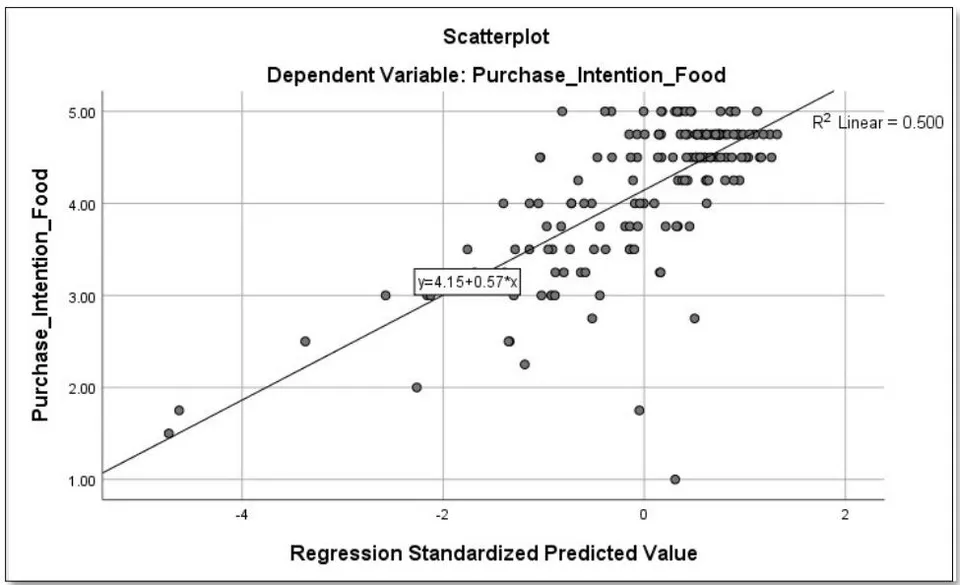
Table 7
| Regression Results Dependent Variable- 'Purchase Intention of Korean Food Products' | |||||
| Unstandardized Coefficients | t | Sig. | |||
| B | Std. Error | VIF | |||
| (Constant) | 0.459 | 0.385 | 1.190 | 0.236 | |
| Attractiveness of the Korean culture and Korean- wave | 0.351 | 0.143 | 2.453 | 0.015 | 4.049 |
| K-pop and K-Dramas Viewing habits and Attractiveness | 0.106 | 0.146 | 0.723 | 0.471 | 4.357 |
| Celebrity attractiveness and endorsements | 0.035 | 0.111 | 0.317 | 0.752 | 3.236 |
| Product Quality | 0.327 | 0.097 | 3.364 | 0.001 | 2.056 |
| Product Price | -0.157 | 0.052 | -3.002 | 0.003 | 1.293 |
| Social Influence | 0.044 | 0.065 | 0.671 | 0.503 | 1.693 |
| Country of OriginImage | 0.113 | 0.088 | 1.284 | 0.201 | 2.601 |
The regression individual coefficient results are given in Table 7. The VIF (Variance Inflating Factor) is less than 10 all the variables so there is no multicollinearity in the model.
From the results above, it is observed that three of the independent variables have a significant impact on the 'Purchase Intention of Korean Food Products' at the significance level. 'Product Quality' has a significant and a positive impact on the Purchase Intention of Korean food with a positive regression coefficient . The 'Attractiveness of the Korean culture and Korean-wave' has a significant and positive impact with a positive regression coefficient . Also, 'Product Price' has a significant and negative impact with a negative regression coefficient .
Thus, in terms of Hypotheses testing, the following Hypotheses are true and accepted:
- H2: 'Attractiveness of the Korean culture and Korean-wave' has an impact on the purchase intention of Korean food products.
- H8: 'Product Quality' has an impact on the purchase intention of Korean foodproducts.
- H10: 'Product Price' has an impact on the purchase intention of Korean food products.
'Attractiveness of the Korean culture and Korean-wave' consisted of statements like the respondents were attracted to the uniqueness of the Korean culture, food etc, and they were consumers of Korean entertainment content like K-pop, K-dramas, etc. Almost all respondents agreed to these statements. This variable has a significant and positive impact on Purchase intention of Korean Food products and is an indication to the fact that Indian consumers who have been into Korean entertainment and are attracted to the unique and contrasting Korean culture as opposed to the Indian culture, are also attracted to the different aspects of the Korean culture, the most physically visible in Korean shows being Korean food products and cuisine. Korean Ramen or noodles are the most popular form of the Korean food products that are being demanded and because Ramen as a concept has beenperceived to be originating from east Asian countries, it is no surprise that this variable impacts the consumers' intention to buy Korean food.
Like mentioned before, even though there are different factors to why consumers buy certain products yet one of the most important aspects is the product quality. Product quality positively and significantly impacts the purchase intention of Korean food products. If consumers feel the quality of the food product is not up to the mark, they will rather go for locally produced food. Korean food is known to be healthy and high in fibre, especially Kimchi, which is the staple fermented food and the large amounts of vegetables used in their food. It is also because of the perception that Korean food is very healthy, which leads Indian consumers to believe the quality would be great. Additionally, Koreans are known to be less obese, again creating the idea that their food habits must be healthy. Also, many respondents strongly agreed with the statements that they perceive Made in Korea products to be of good quality.
The Product Price variable has a significant and negative impact on Purchase intention of Korean food products. The possible logic for this can be because despite its uniqueness, Korean food products like Ramen have strong competition in India from noodles brands like Maggi, TopRamen, Chings' Secret, etc. and these brands have been in the market for a long time having a huge brand name. Most respondents were neutral when asked if they prefer Korean food products over other alternatives. This means that the consumers aren't price insensitive to towards the Korean food products and if they feel the prices are higher than the other locally produced brands, they would easily prefer the alternatives. This is because Indian consumers are price sensitive specially when it comes to food and would rather buy other alternatives if the price of Korean food products are higher or seem to rise.
In contrast, for cosmetics, respondents were price insensitive, because they know cosmetics are going to be expensive and are ready to pay any amount specially if a brand claims they use completely natural ingredients. However, for food products consumers know that there won't be much difference in the quality, except for a few ingredients and flavours of food.
Other variables don't have a significant impact on Purchase intention of Korean food. 'Celebrity attractiveness and endorsements' are not that significant because as of yet, no Korean celebrities' endorsements have been publicised and advertised in the Indian market. 'Social influence' is not significant because maybe the popularity of Korean food is not yet advertised much in India, and people are still experimenting with it. It would take some years before social influence would become significant, when almost everyone would be aware of Korean food products and influence others. 'K-pop K-drama viewing habits' could have been significant but humans are different from each other and hence, just because someone watches K-pop or K-dramas frequently, we can't infer from this idea that they would purchase more Korean food. This is because, they could be watching the content purely because of its production, visuals, or music.
The table below presents a summary of the Hypotheses testing.
| Hypothesis | Relation | Significance value 5% (regression) | Result |
| H1 | Attractiveness of Kculture→PI of Korean cosmetic | 0.920 | Rejected |
| H2 | Attractiveness of K-culture→PI of Korean food | 0.015 | Accepted |
| H3 | K-pop K-drama viewing habits→PI of Korean cosmetics | 0.648 | Rejected |
| H4 | K-pop K-drama viewing habits→PI of Korean food | 0.471 | Rejected |
| H5 | Celebrity attractive. Endorse.→PI of Korean cosmetics | 0.108 | Rejected |
| H6 | Celebrity attractive. Endorse.→PI of Korean food | 0.752 | Rejected |
| H7 | Product Quality→PI of Korean cosmetics | 0.011 | Accepted |
| H8 | Product Quality→PI of Korean food | 0.001 | Accepted |
| H9 | Product Price→PI of Korean cosmetics | 0.715 | Rejected |
| H10 | Product Price→PI of Korean food | 0.003 | Accepted |
| H11 | Social Influence→PI of Korean cosmetics | 0.972 | Rejected |
| H12 | Social Influence→PI of Korean food | 0.503 | Rejected |
| H13 | COI image→PI of Korean cosmetics | 0.048 | Accepted |
| H14 | COI image→PI of Korean food | 0.201 | Rejected |
e) Growth Potential of Korean Cosmetic and Food Brands in India
Korean cosmetics and Korean food brands are witnessing an increasing demand in India, specially post the pandemic. The unexpected growth in their demand has alerted Korean brands to notice the Indian land as a great market with a good population size for their products.
Innisfree India, a Korean cosmetics brand, saw an overall increase[20] in its demand for Korean beauty and skincare products in 2019 in comparison to 2018. The brand has thus, decided to open more physical stores in parts of Mumbai and Delhi, and further expand itself to the North-eastern side of India, where offline demand for their products is high.15 Innisfree India was first launched in 2013 with only one store in India. Also, it was the first K-beauty brand in India. With time, the brand saw great response from the Indian consumers, specially the Millennials and Gen Zs. After 2-3 years, they began opening more stores. As of now they're also available online on Nykaa, Myntra, Flipkart etc.
This evolution of Innisfree from 2013 to now has made their parent company's other brands like Laneige and Sulwhasoo popular in the India with triple digit growth. The brand is already planning to enter the hair category brand because of the huge market size of haircarein India.
Not just Innisfree, but even other brands are gaining market size and demand in India. Amazon India in 2018 decided to partner with the Korea Trade Investment Promotion Agency to introduce brands like The Face Shop, The Beauty Co Seoul, Mirabelle, etc., Flipkart used Korean products as a strategy to promote the buying of cosmetics and beautyproducts and saw a rise in demand.
Mirabelle cosmetics are also growing in India specially in the category of sheet face masks. Further, to cater to their large Indian consumer base, they launched products like face sheet masks in 2017 that are specially made for the Indian skin type, also the first ones to do so. Thus, with rising demand, they are customizing their products for the Indian market.
In terms of competition in the Indian beauty market, existing top brand names like Lakme, Garnier, Ponds, etc. and other brands that claim to manufacture organic beauty product may act as a competition to these growing Korean brands. Also, imitating trends and products is not very difficult task. Inspired from the Korean face sheet masks trend, Ponds and Garnier introduced their own face sheet masks, thus giving competition to Korean brands. Also, these well-established western brands along with certain Indian cosmetics brands invest intensively in advertisements and local celebrity endorsements. However, Korean cosmetics brands are yet to touch that aspect in advertising.
Even though strong competition exists in the beauty market of India, yet it is observed that Korean beauty companies are striving for a piece of India's lucrative beauty and personal care industry, which is estimated to be worth US20 billion by 2025 at a 25% CAGR.16 Overall, the Indian beauty industry is expanding because of the country's booming young and middle-class populations, who are very tech-savvy and trend-conscious, and who have far more disposable means. As the market expands, so, too, will the desire for unique and specialised brands and goods. Also, with pandemic came digitization and that has led to easy and quick access for consumers to Korean brands and has led to an easy way for Korean brands to be available to their consumer base in India. Thus, the Korean beauty market has huge potential in the Indian market, and Korean companies are prioritizing India now.
The Korean food market is also slowly growing in India. According to the Indian Ministry of Commerce and Industry, there has been a substantial increase in the consumption of Korean food in India following the 2020 lockdown, with Korean noodles alone enjoying a increase in volume in 2020 and a increase in 202117. In-fact, India's import of South Korean ramen nearly tripled from Rs 10.44 crore in FY20 to Rs 30.63 crore in FY21, representing a more than increase. Two very popular Korean food brands are Nongshim and Samyang. These brands offer Korean Ramen and have seen tremendous growth in the past 2-3 years. Domestic companies who distribute Korean packaged goods in India are now taking advantage of this upswing in demand by focusing on Indian customers. Rama Vision Ltd, the distributor of Nongshim products, had to discontinued various items within a year in 2014 owing to low demand and the Maggi scandal at the time. However, with the rise of Korean wave in India, the Korean food products started gaining popularity, and the Indian distributors of Korean food products are seeing this as an opportunity.
Nongshim now views India as a key market and is focused on items aimed towards Indian customers. Because of their high wealth and consumer awareness, Nong Shim and Samyang, are actively pursuing Tier 1 Indian markets. Both the companies now even have their official Indian Instagram accounts where they are promoting their products.
Orion, another South Korean packaged food company, is also investing in India. In 2021, the firm announced a 200 crore rupees investment in a manufacturing plant in Rajasthan and plans to expand up its India business through distribution expansion. Choco-pie, O'Rice cracker, and Custas Cup Cake are among the products available in India. Along with packaged food, the Korean wave is also giving rise to Korean restaurants in India. Mumbai alone has 10 restaurants specifically for authentic Korean food and the numbers are only growing.
In terms of competition, Korean food brands have a very tough competition in the Indian market from big noodle brands like Maggi (with the largest market share), Yippee noodles, TopRamen, Ching's Secret, etc. The only differentiating factors are the Korean flavours in
Korean ramen. These brands can be an even further threat to the Korean brands if they watch the demand for Korean cuisine carefully and try launching their own noodles in these new Korean flavours. Just like Ching's Chinese is a brand that focuses on Chinese cuisine, other brands could try incorporating Korean ingredients to offer to their already existing consumer base. Also, Korean food products are mostly non-vegetarian and may include meat in them, which may be avoided by some vegetarians.
Ultimately, the pandemic did end up creating a new marketplace for Korean food products and with the new age population, which is a lot more liberal and dynamic, they're wanting to jump on trends and currently, Korean food producers have the chance to extend their distribution and market among a specific group of consumers who are adventurous and prepared to pay a premium for noodles. The expansion of K-food in India, the entry of Korean companies, and how the local market adjusts to this acquired taste are all important developments to watch.
IX. CONCLUSION
This paper aimed to analyse the rise of Korean wave and its spillover effect i.e., growth of Korean cosmetics and food products in India. The paper first reviewed the existing literature revolving around the impact of Korean wave on consumers' purchase intentions of Korean products and found out that many variables including Korean wave, country-of-origin image, brand image, celebrity endorsements, K-dramas and their cultural values in general do have a positive and significant impact on the purchase intentions.
The paper's objectives were to understand which factors impact Indian consumers' purchase intention of buying Korean products, and thus followed a quantitative methodology via an online questionnaire. The online questionnaire had Likert scale-based statement items which were constructed into single independent and dependent variables. Then hypotheses were proposed for each variable's impact on purchase intentions. The sample size of the study was 160. Most respondents were Females and belonged to the age category of 15-25 years. Most of the respondents were introduced to the Korean wave during the pandemic period and a greater percentage of them purchased Korean food as compared to cosmetics. Also, E- commerce websites and offline grocery stores were the places where most respondents purchased these products from.
For analysis, multiple linear regressions were conducted to find out which variablesignificantly impact Indian consumers' purchase intentions.
Results of the regression proved that 'Country of origin image' and 'Product Quality' significantly and positively impacted the purchase intention of Korean cosmetics, because Indians perceive South Korea to be a well-developed country with its innovation, focusing on quality products. The ingredients used by Korean cosmetic brands are known to be natural, gentle but highly effective, and Indians always prefer the natural side to everything. For the impact on Purchase intention of Korean food products, the results proved that 'Product Quality', 'Attractiveness of the Korean culture and Korean wave', and 'Product Price' significantly impacted it. While Product quality and attractiveness of Korean culture had positive impacts because respondents were attracted to the Korean culture a major aspect of which is cuisine, and because Korean food quality is perceived to be high due to their usage of healthy and natural ingredients. Product Price had a negative impact because Indian consumers are price sensitive to food items and have a lot of alternatives to Korean food products.
The secondary research into the potential of Korean cosmetics and food showed that beauty brands like Innisfree, The face shop, and Mirabelle cosmetics, have evolved in India over time, and slowly have started to design and promote products in a customised way to India. They are willing to invest in India and have a good potential to become more popular among Indian consumers despite competition from well known western and Indian brands. Also, with pandemic came digitization and that has led to easy and quick access for consumers to Korean brands and has led to an easy way for Korean brands to be available to their consumer base in India.
Similarly, Korean food products have seen a sharp growth in demand specially Noodles. Even though demand for popular brands like Nongshim, and Samyang was negligible back in 2014, yet with the pandemic and recent growth of Korean content, the noodle's demands have picked up. Popular Korean food brands are now targeting the Indian urban market and focusing on their products' promotions. However, how far Korean food products would go in the future remains a question, considering the tough competitions from brands like Maggi, TopRamen, Yippee, etc.
The limitations of this paper were that respondents were not very diversified, owing to the resource constraints. Mostly respondents were based in a concentrated region of India, thus it missed out on a wider perspective specially from important places like North-Eastern India. Also, due to time constraints, the sample size was small and that would mean, the population wasn't represented in its best possible manner.
Finally, for better further research, these limitations could be worked around, by considering a larger sample size, and by conducting the study across all parts of India, including the North-eastern states. Additionally, since the research is in a subjective field, additional qualitative research via group discussions and interviews would help understand the mindset of the consumers in a better way.
APPENDIX
Variable constructs and questionnaire items for each:
| Variable | Statement Items in the Questionnaire |
| Purchase Intention of Korean skincare/cosmetics. | You willingly buy Korean cosmetics and skincare products frequently. |
| You prefer Korean cosmetics and skincare products over other alternatives. | |
| You enjoy using Korean cosmetics and skincare products. | |
| You intend to buy Korean cosmetics and skincare products even in the future. | |
| Purchase Intention of Korean food products andsnacks. | You willingly buy Korean food products and snacks frequently. |
| You prefer Korean food products and snacks over other alternatives. | |
| You enjoy consuming Korean food and snacks. | |
| You intend to buy Korean food and snacks even in thefuture. | |
| Attractiveness of the Korean culture and Koreanwave. | You are attracted to the uniqueness of the Korean culture in terms of its food, fashion, K-dramas, K-pop,etc. |
| You are a consumer of Korean entertainment contentinvolving K-pop, K-dramas, Korean movies, and reality shows. | |
| Korean culture is in contrast with the Indian culture and so you like to learn more about the Korean culture. (In terms of their people, their daily lives, their food, fashion, etc.) | |
| K-pop and K-Dramas Viewing habits andAttractiveness | You willingly watch K-dramas, movies and listen to K-pop music frequently. |
| You love to watch K-dramas because they're interesting, expressive, and different. | |
| You love K-pop because the music is unique, addictive and is accompanied by good quality dance performances. | |
| Presence of Korean snacks and Beauty products inthese Korean shows and videos make you want to consume/try them too. | |
| Celebrity attractiveness and endorsements. | You find Korean celebrities attractive and have favourites. |
| You are aware of Korean celebrities becoming brand ambassadors by endorsing a Korean product. | |
| Your favourite Korean celebrities can have an influence on you to buy a product. | |
| You want to be able to relate with your favourite Korean celebrities and use similar products like them. | |
| Product Quality | During purchase, you pay special attention to the quality of Korean products. |
| You pay attention to the ingredients of the Korean products. | |
| Your expectations from the Korean products arefulfilled after product usage. | |
| Product Price | During purchase, you pay special attention to the price of Korean products. |
| You buy Korean products because they're reasonable and affordable. | |
| Korean products have prices similar to other alternative brands. | |
| Social Influence | Your friends, family and acquaintances easily influence your buying decisions. |
| You purchase Korean products on your friends/family's recommendation. | |
| You purchase Korean products because a lot of people around you buy them (especially on social media). | |
| You purchase Korean products because of advertisements. | |
| Country of Origin Image | You believe South Korea is a developed country producing good quality products. |
| You attach value to all 'Made in Korea' products. | |
| You prefer Korean products because you like the country and its culture, food, and entertainment. |
Footnotes
Source: Livemint (p.2) ↩
Source: Statista (p.2) ↩
Highly diversified conglomerates operating in every sector of the economy (p.1) ↩
Represents the country of manufacture, production, or brand origin where a product comes from, and consumers tend to evaluate the products based on their country of origin. (p.4) ↩
Korean dramas are popularly known as K- dramas. Similarly Korean pop is known as K-pop. (p.1) ↩
Source: Financial Express (p.2) ↩
Korean Cultural products refer to the Korean media such as movies, dramas, and pop culture. (p.3) ↩
Cognitive country image refers to the knowledge and beliefs regarding a country (p.4) ↩
Affective country image refers to the feelings or emotional response towards a destination. (p.4) ↩
As attraction of people to the same culture people (p.4) ↩
As crystallization of culture of different ethnic and history in the long-term period (p.4) ↩
As informational and inferential beliefs of a given country (p.4) ↩
As country of manufacturer's products (p.4) ↩
Which was a statement item for the variable 'country of origin image'. (p.19) ↩
Source: Fashion Network. (p.22) ↩
Source: Ministry of External Affairs GOI. (p.22) ↩
Source: Euromonitor International. (p.23) ↩