The Role of a Robust Patent Policy in the Development of Renewable Energy in Nigeria: Intelectual Property Considerations for Development of Renewable Energy Technology in Nigeria
Introduction-Nigeria’s potential for renewable energy is not in dispute. Nigeria can leverage on intellectual property and conscious effort around its IP policies to utilise intellectual property and intellectual property rights (IPRs) protection and manipulation for the development of renewable energy. Development of renewables is multi-faceted, and so a holistic approach must be adopted by Nigeria to achieve its renewable energy goals, rather than isolate the energy sector. Renewable energy development is an area where energy law and intellectual property law meet as renewable energy is necessarily about the development of and access to renewable energy technology, bringing to fore intellectual property rights in patents.
## I. INTRODUCTION
Nigeria's potential for renewable energy is not in dispute. Nigeria can leverage on intellectual property and conscious effort around its IP policies to utilise intellectual property and intellectual property rights (IPRs) protection and manipulation for the development of renewable energy. Development of renewables is multi-faceted, and so a holistic approach must be adopted by Nigeria to achieve its renewable energy goals, rather than isolate the energy sector. Renewable energy development is an area where energy law and intellectual property law meet as renewable energy is necessarily about the development of and access to renewable energy technology, bringing to fore intellectual property rights in patents. As Omoregbe & Ordor have observed, law is central to the functioning of society, and the various areas of law that impact on a given environment can affect the quality of activities that take place within that environment[^2]. Patents come with each renewable energy technology in the market today, and Nigeria's policy affecting them is thus worthy of examination. Intellectual property law would examine how intellectual property principles could stimulate the use of existing or the development of appropriate technology solutions for improving energy access[^3]. Therefore, Nigeria, as a matter of urgency must position its patent policy in such a manner that will encourage investment in Renewable energy technology, and innovation, because it is through renewable energy technology that the benefits of RE are appropriated and made accessible. This will very much align with how Nigeria intends to achieve access to clean energy as a sustainable development goal pertinent to its peculiar energy and erratic electricity challenges and circumstances. In this article, Nigeria's Patent Law and Policy as at today, is examined and juxtaposed with the IP and Patent policy of other nations, including trends in patenting RE technology internationally, such as fast-tracking, with a view to highlighting to what extent a focus on a robust Patent Policy, may help Nigeria achieve its renewable energy objectives.
## II. INTELLECTUAL PROPERTY AND IPRS CONCEPTUALIZED.
The term intellectual property (IP) refers to creations of the mind: these include inventions, literary and artistic works, and symbols, names, images, and designs used in commerce[^4]. It is divided into two broad categories: industrial property and copyright. Copyright includes literary and artistic works such as novels, poems and plays, films, musical works; drawings, paintings, photographs and sculptures, and architectural designs, etc. Industrial property includes inventions (covered by patents), trademarks, industrial designs, and geographical indications of source. For the purpose of renewable energy technology (REt), our main focus will be on Patents.
Intellectual property rights (IPRSs) on the other hand, are rights capable of being exercised over creative works, and industrial property, by the creators and inventors, giving rise to copyright and industrial property rights (such as patents), respectively. IPR grants inventors certain exclusive rights over their creations to encourage creative activity for the benefit of society by allowing the inventors a fair return on their investments.
IPRs therefore, refer broadly to the ownership of intellectual findings in the industrial, scientific, literary and artistic fields[^5]. IPRs grant inventors certain exclusive rights over their creations to encourage creative activity for the benefit of society by allowing the inventors a fair return on their investments. The creation of new energy sources and optimal utilization of existing sources have always required innovative technologies and their diffusion to the end users of development[^6].
IPRs are provided for and protected under international law and treaties. Some of the more popular treaties are the Paris Convention for the Protection of Industrial Property; the Berne Convention for the Protection of Literary and Artistic Works; the Madrid Agreement Concerning the International Registration of Marks and the Protocol Relating to the Madrid Agreement; and the Agreement on Trade-Related Aspects of Intellectual Property Rights ("TRIPS"), including the WIPO-WTO[^7] Cooperation. For instance, the WTO-TRIPS provides that the protection and enforcement of IPRs should contribute to the promotion of technological innovation, and to the transfer and dissemination of technology, to the mutual advantage of producers and users of technological knowledge and in a manner conducive to social and economic welfare and to a balance of rights and obligations[^8]. IPRs are significant for several reasons, and their significance is essential for the development of REt (renewable energy technology) and access to modern energy services, a core objective of the UN SE4ALL Initiative 2030.
In addition, IPRs create an enabling environment for the promotion of technology innovation in environmentally sound technologies[^9]. IPRs give the holders of such rights the power to control the use of their works—this gives room for the manifestation of IPRs as a potential barrier to the diffusion and use of knowledge and technology, with implications for access to the very technologies they are designed to enable[^10]. The contending objectives of IPRs between encouraging access to and diffusion of knowledge on the one hand, and rewarding and incentivizing IP owners' investments in innovative endeavours by allowing them exclusive control over the use of their works on the other, makes balancing of interests a fundamental concern of IP law[^11].
## III. PATENTS AND THEIR LEGAL ASPECTS OF PROTECTION
The International Renewable Energy Agency (IRENA) has an interesting definition of patents and its significance. It describes 'patents' or 'a patent' thus:
A patent is the right granted to a patent holder by a state, or by a regional office acting for several states, which allows the patent holder, for a limited period, to exclude others from commercially exploiting his invention without his authorization. By granting such rights, patents provide incentives for innovators, offering them recognition for their creativity and enabling them to appropriate the returns of their investment. A patent may be a powerful business tool allowing innovators to gain exclusivity over a new product or process, develop a strong market position and earn additional revenues through licensing $^{12}$.
### Patents confer on the owner the following rights:
1. (a) where the subject matter of a patent is a product, to prevent third parties not having the owner's consent from the acts of: making, using, offering for sale, selling, or importing for these purposes that product;
- (b) where the subject matter of a patent is a process, to prevent third parties not having the owner's consent from the act of using the process, and from the acts of: using, offering for sale, selling, or importing for these purposes at least the product obtained directly by that process.
2. Patent owners shall also have the right to assign, or transfer by succession, the patent and to conclude licensing contracts[^13].
- Not all inventions are patentable under law. These are the legal requirements for inventions to be considered for patents at most Patent & Trademark Offices around the world $^{14}$.
a. The proposed invention must consist of a patentable subject matter: An invention must fall within the scope of patentable subject matter as defined by the applicable national law, which varies from one country to another[^15].
b. It must be new: An invention must show some new characteristic that is not known in the body of existing knowledge, referred to as "prior art", within the same technical field. While the definition of prior art may differ between countries, many countries consider any information disclosed to the public anywhere in the world in written form, by oral communication, by display or through public use, to constitute prior art[^16].
c. Must involve an inventive step. This is also described as 'non-obviousness': This requirement is meant to ensure that patents are granted essentially in respect of truly creative and inventive achievements, and not to inventions that could be easily deduced by a person with average knowledge in the technical field from what already exists[^17].
d. It must be capable of industrial application: This is also referred to as 'utility' in some countries. An invention must be of practical use, or capable of some kind of industrial application[^18]. It cannot be a mere theoretical phenomenon or an idea. It must be useful and provide obvious practical benefit in its end use application.
e. Lastly, it must be fully disclosed (full disclosure): A patent application must disclose the invention in a manner sufficiently clear and complete for it to be carried out by a person skilled in the relevant technical field. In some countries, the "best mode" known to the inventor for practicing the invention must also be disclosed. This is for obvious reasons although not so obvious. Inventors are not obligated and have never been obligated to disclose their inventions in inventions in history. There is no legal obligation however to disclose licensee information, contracts and agreements $^{19}$.
## IV. HOW PATENTS ENCOURGE INNOVATION IN TECHNOLOGICAL DEVELOPMENT
It has been noted that 'the development and diffusion of technologies is a fundamental and necessary element to ensuring that standards of living are maintained and poverty continuesto be reduced'20.
Patents are crucial for technological innovation in the context where they apply and can be used to generate revenues (from licences), encourage synergistic partnerships, or to create a market advantage and be the basis for productive activities[^21]. This way, they create strong incentives for innovation in market-based economies. The following flowchart eschews the significant role Patents play in the development of technology, or for RET (renewable energy technology). It is also known as the technology life cycle.
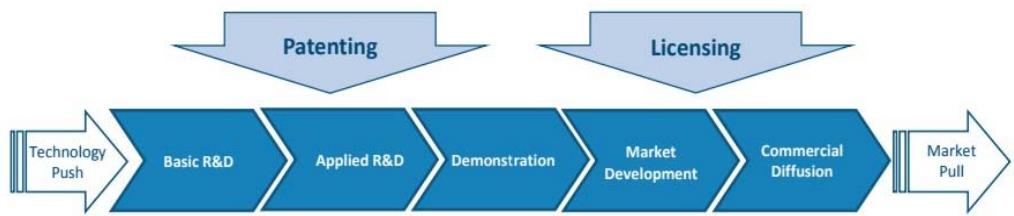
Illustration 1: Patents facilitate advances throughout the technology life cycle $^{22}$. Insert we see demand for technology leading to basic research and development, and the research and development leading to demonstrative activity for technology—this pushes technology into the market, and the market pull leads to commercial diffusion, bringing technology to the end-user, the consumer. All the while this activity is fuelled by pressure coming from patenting activity and licensing
Patent information is also very useful for tracking technology transfer which plays a key role in the diffusion of technology. A study in 2010 found evidence of significant climate change mitigation technology equipment and knowledge-flows across countries in the field of solar PV, wind power, biofuels and CO2 capture[^23]. Hascic, et al., used the count of patent applications filed with different patent offices, namely duplicate applications, as a proxy measurement for technology transfers. Given the significant expense in procuring patents, applicants are now able to use the patent information to file only in markets where there is significant competitive activity, or where they plan to manufacture or sell their product. This certainly helps in investment decisions. Therefore, developing a system of patent assessment for RETs in IP Offices of a country is a crucial way that the government can utilise its IP sector to create an enabling environment for investment in RET.
On a broader scale, patents are used as an indicator for monitoring the innovation of technologies, the technology competitiveness of a country and the economic performance of a company or country[^24]. Also patents can provide useful information for policy makers and investors on state-of- the-art technology information and identify R&D trends, allowing them to forecast innovation.
IRENA's 2013 Working Paper cites the example of Suntech Power and how it brought about the development of RET specifically for PV Solar cells in China. First off it must be mentioned that the US, Japan, and Europe are the origins of innovation or dominate innovation in RET. However, a huge amount of patents sourced from those countries are filed in developing economies like Brazil, China, South Korea, and South
Africa. Dr. Zhenrong Shi, the holder of several patents, worked as a university researcher in Australia, where he obtained his PhD. He decided to return to China, where he set up Sun Tech Power. Sun Tech Power grew quickly through acquiring other businesses, including a Japanese PV company, MSK, which became one of the world's leading companies producing PV cells. Key patents, technological capacity that was gained through technology transfer (in this case by acquiring companies), and the growing global market for PV all enabled rapid innovations in PV technology for China[^25].
## V. SIGNIFICANCE OF IPRS: WHAT A ROBUST PATENT POLICY WOULD MEAN FOR NIGERIA
IPRs play a significant role in foreign technology transfer through foreign direct investment (FDI). Authorities have recognised the dual role of IPRs to: promote access to energy-related technologies and to create barriers to such access by restricting their diffusion. Thus, the desire to reward the inventor or IPR holder, is the very instrument that could restrict access to technologies and affect their diffusion.
The above position would have varying implications for developed countries, developing and least developed countries (LDCs). For developed countries where technology is advanced and a knowledge-economy is established, tightening IP protection systems would be most beneficial. However, for least developing countries, who must necessarily catch-up with the developed countries, restricting access to technology through patents, may stunt technological advancement and development in such countries. These LDCs are usually in Africa. Much of the international instruments on renewable energy the world over affirm the importance of technology transfer in fostering development in developing countries[^26]. Technology transfer is seen as the solution to wider diffusion and use of energy-related technologies, and in helping African countries to surmount technological knowledge asymmetries and develop their innovative capacity $^{27}$. IPRs, particularly patents could support or hamper innovation and technology transfer, thereby facilitating or hindering access to modern energy, including renewable energy solutions. Developing local innovation capacity is recognized as a way out and premised on the ability of countries to 'access and deploy the relevant technologies' ${}^{28}$. Since developed countries are in possession of and control the vast technological knowledge, ditto in the renewable energy solutions sector, it follows that developing countries have to learn from them-the surest way to do this is to have access to developed countries' IP through technology transfer. If the IP protection systems of the developed countries are too tight, or robust, developing countries would have no way of accessing technology, and hopes of learning from such technology, through imitation or reverse engineering would be slim for developing countries. For example, U.S. and China are two countries with developed IP protection systems. China had not developed a robust patent policy until the 90s, and has in fact been accused of 'industrial espionage', and alleged stealing of IP in taciturn ways. On August 18, 2018, the US Trademark Office initiated an investigation under section 301 of the US Trade Act of 1974 into China's practices related to technology transfer, intellectual property, and innovation, claiming 'unfair treatment' of US companies and innovators doing business in China $^{29}$. US alleged that China was breaking WTO rules by denying U.S patent holders' basic patent rights to stop a Chinese entity from using the technology after a licensing contract ends $^{30}$. It was alleged that China used discriminatory practices to transfer technologies, from US to Chinese companies, and that China seeks to reduce its dependence on others by fostering both 'indigenous innovation' and 're-invention' of foreign technologies through its Medium and Long-Term Science and Technology Development Plan Outline(2006-2020), and the Made in China 2025 Notice $^{31}$. It can be seen from the foregoing, that because the U.S. has a robust patent policy with strong IPR protection, it is able to estop China from using its technological knowledge even while doing business in China. It is highly probable that if the aforementioned scenario had occurred in an LDC like Nigeria, who stand as no competition to US science and technology, US reaction would have been different.
There appears to be a shift in ground from one country to the other, depending on the industrialization level of the country. These flexibilities are regulated under international law, as most of the international instruments, relating to IP specify that developed countries should encourage development of least developing countries through technology transfer[^32].
The WTO's trade-related aspects of intellectual property (TRIPS Agreement), endorses these flexibilities for IPR protection, noting that member countries are at varying development levels. The TRIPS had transition[^33] deadline for developing countries which has since expired, but were extended to 2021 for least developed countries (LDCs)[^34]. These flexibilities would be discussed shortly. The point being established here is that IPRs are perceived to have dual potential: either to promote access to energy-related technologies, or to create barriers to such access by restricting their diffusion[^35]. At every point in time, developed and developing countries alike, may utilise IPRs to achieve either of the latter two objectives. Developed countries, with techno-nationalist tendencies would utilise IPR to restrict access to reinforce their technological advantage on the world stage, and developing countries like Nigeria would be interested in promoting access to technologies because of a need to 'catch-up', improve their economies, and meet development and energy challenges and would be pro-technology transfer. What follows therefore is that the notion of a Robust Patent Policy would be a subjective one for each country involved. For a developed country, in addition to other criteria that would be highlighted, a robust patent policy would mean a strong IP protection system, which would encourage and reward innovation. Conversely, in a developing country like Nigeria, a robust patent policy could mean encouraging access to technologies, thus aiding diffusion, through a less-stringent IP protection system. A survey of patent systems of 44 African countries, reveals that majority of them were unfit to safeguard a key purpose of patent protection, which is the diffusion of knowledge[^36]. Instead, due to a lack of patent examination and public access to patented knowledge, they had mainly served as 'dumping grounds', for unqualified patents[^37]. The challenges of the patent systems of African countries were unanimous: a lack of local capacity (including a dearth of patent lawyers and especially examiners), absence of efficient and organized systems for patent filing and storage, and for dissemination of knowledge about filed patents to potential innovators and other stake-holders. These challenges make it necessary for developing countries to engender flexibilities in their IP protection and innovative systems because of the need to grow technologically. Therefore, in view of the aforementioned, what would a robust patent policy mean for Nigeria? What are some of the features of a robust IP Policy, and considering its environmental, technical and economic limitations, how may Nigeria utilise or manipulate some of these features to address its developmental needs under international law, to aid the development of Renewable energy through intellectual property? In view of the limitations to Nigeria's IP/ Innovation system, what are some of the alternative pathways that Nigeria may adopt to encourage innovation in RET?
## VI. FEATURES OF A ROBUST PATENT POLICY
The first question therefore is 'what is a policy?'
A Policy is defined as a course of action that is adopted by a legal entity $^{38}$. The online Cambridge dictionary defines it as a set of ideas or a plan of what to do in particular situations that have been agreed to officially by a group of people, a business organisation, a government, or a political party $^{39}$. Omorogbe adds that policies are statements of intent and desired direction and provide guidance for a government: policies establish direction but the rules that the people and institutions are bound to follow are found in the law, which by definition is binding $^{40}$. A policy unaccompanied by legislation that gives effect to its contents remains as a statement of intent, not bound to be obeyed and unenforceable $^{41}$. Be that as it may, C. Sa et al have made a notable observation that: 'while a policy can exist without a law, a law cannot exist without a policy $^{42}$. Policy and law therefore go hand in hand, but a Policy must necessarily pre-exist before the law, otherwise such a law will be empty.
Nigeria's Patent Law, the Patent and Designs Act[^43], as we know it today, is not predicated on any policy. Our IP laws certainly did not spring from a policy direction, which is why it is unable as it were, to address or cater for the technological and scientific needs of today including emerging modern energy needs such as Renewable Energy. It can only be described as a colonial contraption, flowing into the body of Nigerian laws as a statute of general application. Patent law was first established in Nigeria in the early nineteenth century through the Patents Ordinance No. 17 of 1900 and the Patents Proclamation Ordinance No. 27 of 1900. The Statute initially only applied to the colony of Lagos and the Southern protectorate of Nigeria. It was later extended to the Northern protectorate through the enactment of the Patents proclamation Ordinance No. 12 of 1902. After the amalgamation of Northern and Southern Nigeria in 1914 it became necessary to have a single unified patent system. Both the Patent Ordinances and Patent Proclamations were repealed and a new patentsystem, the Patent Ordinance of 1916, was enacted and eventually renamed and re-established as the Registration of United Kingdom Patents Ordinance of 1925. One of the prominent features of the 1925 Ordinance was the extension of the validity of patents granted in the United Kingdom to Nigeria as long as the patent owner made an application to register the patent in Nigeria within three years of the grant of the patent in the United Kingdom. The 1925 Ordinance remained in force until 1970 when it was repealed and replaced by the Patents and Designs Decree No. 60 (and later renamed as the Patents and Designs Act). Such is the history of how Nigeria came by its patent law. However, since 1970, there has been no amendment to the Patent and Designs Act in no manner whatsoever, to reflect any technological, scientific and developmental goals of the country. This eschews the dearth of innovation and scientific activity in the country. This is certainly affecting the pace of economic growth and industrial activity in Nigeria, although, Ofili's findings indicate that IPRs protection has negative and insignificant relationship with the rate of innovation in developing countries notwithstanding whether the developing country is within the low or high GDP band[^44]. However, an x-ray of the countries examined in this research such as China and Canada, which were once developing countries, will show that a strong IP Policypoutlining a desire or vision by the country to be self-sufficient through innovation, propelled scientific advancement and consequently development of these countries.
The following will be the features of a robust patent policy identified from our discussions above, viz:
### a) Balance between a Strong IPR Protection and a Weak IPR Protection
Under the TRIPS agreement, member countries of the WTO are mandated to move their IP protection systems to a certain standard. Nigeria ratified the TRIPS in 1995, and a country like China only ratified it in 2001, yet China has developed a strong and robust IP culture way more than most countries of the world[^45]. The 21st century is largely a knowledge driven era where the manipulation and effective application of information sets nations apart[^46]. Developed nations are in control of cutting edge technologies in areas such as pharmaceuticals, biotechnology, telecommunications, information technology including the Internet, and space technology. Developed countries have strong IP systems, and are way advanced in technology which propels their economic growth. Developing nations on the other hand, have been described as playing catch up[^47], to these developed countries in today's global knowledge-based economy. Countries are therefore not at the same level of development, and the TRIPS Agreement recognises this, as most of the key provisions reflect flexibilities proposed by the TRIPS in achieving technology goals.
#### Article 1(1) of the TRIPS provides:
'Members shall give effect to the provisions of this Agreement. Members may, but shall not be obliged to, implement in their law more extensive protection than is required by this Agreement, provided that such protection does not contravene the provisions of this Agreement. Members shall be free to determine the appropriate method of implementing the provisions of this Agreement within their own legal system and practice.'
On the Standards Concerning the Availability, Scope and Use of $\mathsf{IPR}^{48}$, with regards to Patents, Article 27 of the TRIPS provides thus:
Subject to the provisions of paragraphs 2 and 3, patents shall be available for any inventions, whether products or processes, in all fields of technology, provided that they are new, involve an inventive step and are capable of industrial application. Subject to paragraph 4 of Article 65, paragraph 8 of Article 70 and paragraph 3 of this Article, patents shall be available and patent rights enjoyable without discrimination as to the place of invention, the field of technology and whether products are imported or locally produced'.
Articles 65, & 66 are worthy of examination with regards to recognized flexibilities. Article $65^{49}$, provides for general expectations required of different countries. Article 66 specifically provides for least developed country (LDCs) $^{50}$ members thus:
#### 'Least-Developed Country Members
In view of the special needs and requirements of least-developed country Members, their economic, financial and administrative constraints, and their need for flexibility to create a viable technological base, such members shall not be required to apply the provisions of this Agreement...for a period of 10 years from the date of application as defined under paragraph 1 of Article $65^{51}$.
2. Developed country Members shall provide incentives to enterprises and institutions in their territories for the purpose of promoting and encouraging technology transfer to least-developed country Members in order to enable them to create a sound and viable technological base $^{52}$.
Article 67 sheds light on the support that is expected of Developed countries for LDCs. 'Technical Cooperation- "In order to facilitate the implementation of this Agreement, developed country Members shall provide, on request and on mutually agreed terms and conditions, technical and financial cooperation in favour of developing and least-developed country Members. Such cooperation shall include assistance
- 49 Article 65
- Transitional Arrangements
1. Subject to the provisions of paragraphs 2, 3 and 4, no Member shall be obliged to apply the provisions of this Agreement before the expiry of a general period of one year following the date of entry into force of the WTO Agreement.
2. A developing country Member is entitled to delay for a further period of four years the date of application, as defined in paragraph 1, of the provisions of this Agreement other than Articles 3, 4 and 5.
3. Any other Member which is in the process of transformation from a centrally-planned into a market, free- enterprise economy and which is undertaking structural reform of its intellectual property system and facing special problems in the preparation and implementation of intellectual property laws and regulations, may also benefit from a period of delay as foreseen in paragraph 2.
4. To the extent that a developing country Member is obliged by this Agreement to extend product patent protection to areas of technology not so protectable in its territory on the general date of application of this Agreement for that Member, as defined in paragraph 2, it may delay the application of the provisions on productpatents of Section 5 of Part II to such areas of technology for an additional period of five years.
5. A Member availing itself of a transitional period under paragraphs 1, 2, 3 or 4 shall ensure that any changes in its laws, regulations and practice made during that period do not result in a lesser degree of consistency with the provisions of this Agreement.
- 50 Nigeria is an LDC as far as technological capacity is concerned.
- [^51] Goes further to add that: 'The Council for TRIPS shall, upon duly motivated request by a least-developed country Member, accord extensions of this period'.
- 52Article 66, TRIPS.
in the preparation of laws and regulations on the protection and enforcement of intellectual property rights as well as on the prevention of their abuse, and shall include support regarding the establishment or reinforcement of domestic offices and agencies relevant to these matters, including the training of personnel'.
The above sections of the TRIPS lends credence to the fact that varying degrees of IP capacity are recognised internationally and explains why some countries like Nigeria are taking their time in coming up with serious programs for the development of their IP. Technological transfer is recognised as a way to boost the technological capacity of LDCs, as it offers them an opportunity for imitation and reverse engineering, where for instance, registration of Technology through Nigeria's Technology Transfer Office is legal[^53]. While US could estop China from copying its technology, even in China, it will be against TRIPS principles for the US to do the same in Nigeria. If Nigeria operated a strong IPR protection system, and was at the same level with China, Nigeria would be accused of industrial espionage and copying. However, because of Nigeria's technological capacity level, a weak IPR protection is certainly most favourable to access foreign technology.
On the other hand, a strong IPR protection should be utilised with local companies, to encourage local innovation, but in relation to foreign technology, which Nigeria should be most interested in, particularly in relation to RET and emerging technology, it appears most beneficial to be liberal until we have perfected our knowledge and technology base.
Adewopo et al, have noted alternative pathways which Nigeria may leverage on, other than through an IP System, which as it currently stands in Nigeria today is grossly underdeveloped. While Nigeria is building its Patent Policy and IPRs Protection regime, Adewopo et al note that investigating alternative forms of knowledge transfer that focus on developing and sharing of local technological solutions is a also a valid pathway for IP development. They note that such forms of knowledge transfer are already practised in African rural communities as informal open access technology transfer[^54]. They are seen as important for the development and diffusion of indigenous innovations in biofuel in a sustainable and pro-development manner[^55]. For instance in Tanzania and Mozambique, informal open access technology transfer takes place between small-scale farmers in cold pressing methods.
There are however, arguments that are in favour of the notion that strong IPRs protection will bring about tangible economic growth in developing countries.
Saggi (2013) argues that developing countries and developed countries have varying technological needs. And that for the developed countries to keep investing and producing new technologies required by the developing countries, the developing countries must have reasonable protection of IPRs. Firms situated in developed countries in the absence of tight IPRs regime in the developing countries may decide to cut down their investment in research and development, make their products more difficult to imitate and at the end churn out less efficient technologies[^56]. These actions will reduce the volume of technology transfer to developing countries, a move that will invariably affect effective technology utilization, adoption and diffusion. This will further have adverse effect on the economic wellbeing of developing countries. Some authors are of the view that aside from the pressure from developed countries, developing countries may want to strengthen their IPRs systems to boost local economic growth[^57]. This argument is predicated on the assumption that some domestic innovation will only come about as a result of strong IPRs systems. They therefore, argue that it is imperative that a country establishes an IPRs system that balances the ability of a nation to imitate technologies from advanced countries and at the same time provide necessary incentives for local innovation (Chen & Puttitanun, 2005)[^58].
### b) Substantive Examination
The WTO recognised the varying degrees and capacities of member countries, and recognized flexibilities for categories of countries-meaning that standards were lowered for less developing and least developed countries (LDCs). The WIPO Policy Guide on Alternatives in Patent Search and Examination, identifies some of these flexibilities. They mostly relate to the patent system involving application, search and examination, and have put the special circumstance of each category of developed, developing, and LDCs into consideration. In general, patent search and examination can be categorized into three frameworks, which reflect TRIPS flexibilities. The WIPO identifies them thus:
a. Formality examination only;
b. Formality examination and prior art search, and
c. Formality examination, prior art search and substantive examination.
Formality Examination Only59
A patent may be granted, or refused following formality examination which will require an examination of formality requirements such as the form and contents of a patent application, and submission of required statements and documentation. No technical or scientific background is generally required to conduct formality examination.
Since no prior 1art search and substantive examination are conducted by a patent office, granted patents may or may not meet the substantive patentability criteria. If a patent does not comply with all the patentability requirements, third parties, such as competitors, can file a request for the review of the decision made by the patent office. Such a request is usually filed with a court either by an interested third party for nullification of a patent or by the alleged infringer, as a defense, in an action for infringement. This type of registration system defers substantive examination on patentability until a patent is actually litigated. This framework leads to considerable social cost-saving in terms of the patent office's spending, allowing the country to allocate its resources to other areas of priority Nigeria is classified amongst the countries with this simplistic registration system, which is usually associated with the utility model.
#### Formality Examination and Prior Art Search60
Once a patent application is filed and the formality requirements are checked, an examiner establishes a search report following a prior art search. If the formality requirements are met, a patent may then be granted without substantive examination as to the patentability of the invention, and the search report is published together with the granted patent. Although the procedure is less complex than that of a full substantive examination, the patent office must have the resources necessary to maintain up-to-date prior art databases. In general, technical or scientific background is required to conduct prior art search and Examiners should have ageneral understanding of the patentability requirements and the skill to interpret patent claim.
Formality Examination, Prior Art Search and Substantive Examination[^61] By substantive examination, we mean that the patents are examined to the extent that they comply with legal requirements for patents under the patent law of the country in question. Once formality as to content and form have been established and prior art search conducted, the examiners must then check conformity to legal requirements. It is not deferred until later or possible litigation as to the validity of the patent. Since compliance with legal requirements is fully examined before grant of a patent, granted patents enjoy a higher likelihood of validity if challenged. This provides legal certainty for both patentees and third parties, and increases confidence in the patent system by society at
large. The main characteristic of this type of registration system is that it is cost-intensive as maintaining a search and examination system requires substantial human and financial resources, for example, to hire and continuously train qualified examiners in all fields of technology, while maintaining and upgrading the technical infrastructure (such as databases) for prior art searches. Hence, this registration system is usually obtainable in developed industrialised countries such as the U.S. which provide for substantive examination under its patent law. Upon litigation, it is found that it is very rare that such patents will not be valid, because the patent office checks that they have fulfilled all legal requirements.
Nigeria's Patent and Designs Act, provides for legal requirements before the grant of Patents $^{62}$. An examination of section 4 shows that the patent system obtainable in Nigeria is formal examination only. Substantive requirements are spelled out in section 3(3). Section 4(2) provides:
1. Where the examination mentioned in subsection (1) of this subsection shows that a patent application satisfies the requirements of section 3(1) and (3) of this Act, the patent shall be granted as applied for, without further examination and, in particular, without examination of the questions as to-
a. whether the subject of the application is patentable under section 1 of this Act;
b. whether the description and claims satisfy the requirements of section 3(2) of this Act; and
c. whether a prior application, or an application benefiting from a foreign priority, has been made in Nigeria in respect of the same invention, and whether a patent has been granted as a result of such anapplication.
Section 4(4) goes further to cement a system of non-substantive examination by stating categorically thus:
This means that so long as formal requirements are fulfilled as spelled out in section 3(1) and (3), patents would be granted. There would be no prior search $^{63}$, and the patents would be deemed valid, until proven otherwise by litigation $^{64}$.
Given the lack of funds for priority search equipment, lack of technical capacity of examiners in Nigeria at the time of promulgation of the Patents and Designs Act, the utility model with no substantive examination seemed the best option for Nigeria. Has this technical capacity grown since 1970? It is doubtful, and Nigeria still needs to learn. Therefore, a robust patent policy for Nigeria would be one which allows Nigeria to leverage on the grace period given to LDCs till 2021[^65], to build its capacity, train examiners, and fund an innovation strategy.
The WIPO recognised the challenges member countries face with substantive examination, and recommended adjustments, where there are limited resources $^{66}$ thus:
a. Carrying out substantive examination, fully or partly, in cooperation with technical experts outside a patent office.
b. Limiting substantive examination to certain strategic fields of technology for the country concerned.
c. Restrict substantive examination to checking the compliance with some, butnot all, of the criteria to be met for a patent to be granted e.g. patentable subject matter, unity of invention and the disclosure requirement. In order to examine those requirements, patent offices do not need to maintain prior art search tools, which can be costly67. However, examiners need comprehensive knowledge of the applicable patent law in order to make sound decisions on compliance with the patentability requirements, which are not necessarily easyto apply68;
d. Limit substantive examination to compliance with novelty and industrial applicability, but not obviousness or inventive step.
Nigeria could introduce some form of prior art search and substantive examination in line with the above where financial resources and technical capacity are a challenge. For instance, being a member of a Regional Patent Office like the ARIPO, means that ARIPO has trained examiners so Nigeria's Intellectual Property Office (IPONigeria) can leverage on this.
### c) Utility Models and Traditional Patent Models
Most robust patent systems have a combination of utility models and traditional patent model systems. For example China, China's Patent Act has been amended severally to reflect its aspirations. The Act was first amended in 1972 to introduce....the next amendment was in year 2000, after that 2008, and then subsequently in 2009.
Historically patent systems began in Germany, and it was there that the utility model first surfaced. Utility models are an inexpensive way to get patents because they do not go through substantive examination which means that only examination as to presence of required documents is available[^69]. An examination of the provisions of Nigeria's patent system reveals that it is a form of utility model. This makes it quicker to start reaping the benefits of such a patent, and for speedy diffusion of technologies. This system in Nigeria has been described as a 'deposit system', where no rigorous examination is conducted on patent application and where patents are granted without guaranty of validity[^70]. It however has some advantages.
The burden of establishing the patentability of the invention is shifted from the Registrar to the one who challenges the validity of the patent. Therefore all costs of search falls on the claimant.
What can be done is to have an Act that provides for traditional patents, and the utility models. So that applicants can have the choice to exercise this option. This will also encourage foreign entities operating in Nigeria, as they are assured that patents obtained in Nigeria will meet standard elsewhere in the world.
#### Built on strong Science and Technology Policy
A robust patent policy is always built on a strong science and technology policy. That strong science and technology vision is what will usually inspire a desire to formulate a policy and subsequently law that will propel innovative activities. Two countries come to mind in hatching the theory of the power of a vision for technological development of a country: China and Canada. We are using China and Canada because both in history were never considered as technology hubs, and because of this were classified in the category of developing economies, being far behind from their contemporaries—the U.S., and Japan. Today China, home to the world's largest wind farm, and most advanced technological economy after the US, and then Canada, whose workforce often emigrated to the US for better opportunities, are now leading hubs of innovation with strong infrastructure and vibrant economies. How did they get here, and what can Nigeria learn as it seeks to improve its innovative capacity and economy?
China's technological progress is mainly as a result of conscious and deliberate effort by its leadership to utilise the country's resources and build. It is no wonder that today it has a robust Patent Law regime. China passed its Renewable Energy Law in 2005, and as at 2012, renewable and nuclear power accounted for $94\%$ of its electricity generation. Renewable energy industry is viewed as a critical area of Chinese national strategic emerging industries[^71].
In 2006, Hu Jintao and Wen Jiabao unveiled the National Medium- and Long-Term Program (MLP) for Science and Technology Development (2006-2020) (MLP), to rapidly advance 'indigenous innovation' in China. It was deeply concerned with the gap between China's 'Science and Technology (S&T) development'72 and that of developed countries. As the MLP stated, 'China's overall S&T level still has a fairly big gap to close, compared with that of developed nations'. As the MLP had noted, 'the nation will be for a long period of time underenormous pressures from developed nations [that] possess economic and S & T superiority', and acknowledged that it was difficult to acquire valuable technologies from other countries, viz: '[F]acts have proved that, in areas critical to the national economy and security, core technologies cannot be purchased'73. The report concluded that the only way China could advance its S & T, was to enhance its indigenous innovation capability in order to 'take the initiative in the fierce international competition'74. So far between 1978 to 2013, China has had 373 IPR policies regulating its renewable energy industry, among which there were 18 laws, 52 regulations, 293 department rules, 1 judicial interpretation, 5 group stipulations of the Central Committee of the Communist Party of China, and 4 industry stipulations75. Each of these policies were spread across Gao& Zao's identification of IPR core systems and IPR supporting systems. The former means systems or policies where the term "IPR" is in the title of the policy, and clearly puts forward to promote the creation, application, protection and management of renewable energy technologies IPR. An example is the 'Suggestions on Strengthening IPR Work of Strategic Emerging Industries' of China76. The latter on the other hand, refers to a policy whose title does not directly carry the word 'IPR', but which purpose can promote technology creation, use, protection and management, including all kinds of policies of finance, taxation, science and technology, education and industry $^{77}$. An example of such policy is the 'Instructions to Promote the Internationalization of Strategic Emerging Industries' $^{78}$, a policy issued by ten departments including the Commerce Department and the SIPO in 2011, which explicitly put forward that the creation, application, protection and management of IPR should be promoted $^{79}$.
China's science and technology policies on IP over the years, include but are not limited to the 1991 PRC $^{80}$ Ten-Year Plan of the National Economy and Social Development; and the Eighth Five-Year Program Outline before it appeared together with "Intellectual Property Rights" in the 1995 State Council's Decision on Accelerating Scientific and Technological Progress $^{81}$. Coupled with this, in 2001, China signed the WIPO-TRIPS agreement, and then followed with the strategic Medium and Long Term Program (2006-2025), where key sectors including biotechnology, nanotechnology, and renewable energy have been prioritised. It is evident that all of these policies spanning over 373 supra, have made for a robust Patent Regime in China, and propelled China as second most advanced hub of RE in the world.
Canada on the other hand, was lagging behind in terms of its technological development. Today it is a formidable hub of technology transfer activities and considered a developed economy. This had not always been the case. In 1969, the OECD had observed of Canada in its report: A Review of National Science Policy: Canada, that Canada had failed to co-ordinate research activities around clearly articulated priorities $^{82}$, at a time when it $^{83}$ had published international comparisons of national science policies and declared that the comprehensive planning of science according to state-defined objectives was necessary for successful economic policy $^{84}$. In 1963, the Canadian government was criticised for concentrating its resources on basic research, which was seen as too far removed from the industrial sector $^{85}$. The Royal Commission on Government Organization (the Glassco Commission) also observed that Canada's science failed to sufficiently support industry needs $^{86}$.
Following these criticisms, (including the situation of Canadians emigrating to the US for greener opportunities, and the import of American academics into Canadian university systems $^{87}$ ), Canada decided to strengthen its position in the international scheme of things by a series of policies that leveraged its advantage for rapid scientific growth and development. In 1968, the Canadian Science Council produced the document: 'Towards a National Science Policy', calling for the pursuit of multi-disciplinary mission-oriented R & D, involving not only government agencies and the universities but industry as well. The Lamontagne Commission or Special Senate Committee Report entitled: A Science Policy for Canada, also reiterated the positions of the Glassco Commission and the OECD. Following this, the FG of Canada appointed a Minister of State for Science and Technology in 1971. One of the first moves of the Minister of State was the push to contract government research needs to the Universities or industry rather than commissioning research to be undertaken in the national laboratories alone $^{88}$.
Canada adopted a techno-nationalist approach which saw concerted effort in strengthening its technological capacity and ability. As technological activities deepened, with success of international trade, Canada relaxed its techno-nationalist tendencies, and what followed was collaboration with the government, the university/research centres, and industry, culminating in massive diffusion of technology. The technique employed by Canada as it developed its technology policy over the years, was through the institutionalization of technology transfer in the University of Toronto, Canada's biggest university.
Thus for Nigeria, we see that our Patent Law has not flowed from a well-articulated science and technology policy, eschewing a vision of where we would like to be technologically and how we would utilise the development of science and technology for the growth of the economy. A Science and Technology Policy for Nigeria will certainly bring leverage internationally for Nigeria. Nigeria can learn from the tripartite collaboration as happened in Canada, where key players viz, the industry, the university, and government collaborate to boost scientific activity, and deepen its effects. If our universities are positioned as centers for research, then industry will be affiliated to the universities, and government can fund research activities. This would consolidate efforts rather than scattered efforts in Science and technology development, as well as increase opportunities for real internships and employment across the country $^{89}$.
### d) Balance between Techno-Nationalism and Technology Transfer
The term 'techno-nationalism' first surfaced in the writings of Robert Reich in 1987, where with a focus on US technology policy, he wrote in an essay for The Atlantic, that techno-nationalism was an attempt to 'protect future American technological breakthroughs from exploitation at the hands of foreigners, especially the Japanese'.[^90]
The relationship of nationalism and orientations towards science and technology is captured through the construct of techno-nationalism[^91]. Richard Samuels defines techno-nationalism as: 'the belief that technology is a fundamental element in national security; that it must be indigenized, diffused, and nurtured in order to make a nation rich and strong'[^92]. Atsushi Yamada writes that the point of technonationalist policies is 'to strengthen the competitiveness of domestic industries against foreign rivals'[^93]. Joan Johnson-Freese and Andrew Erickson defined it as 'the idea that technological strength is an effective determinant of national power in a harshly competitive world'[^94]. The proponents of techno-nationalism posit that a nation enjoys competitive advantage when it has in its custody, highly advanced technology. It gives prior attention to technology built at home and is not interested in technology transfer, because to do so would water down its scientific secrets, and thus economic or global power. advanced, industrialised countries advocate some sort of techno-nationalism to maintain their position as a world power. For instance, the Korean Intellectual Property Office (KIPO) only issues green patents to Note that once there has been technology transfer, patents would be obtained in the receiving country, and this would make the technology in question duplicable, through reverse engineering amongst others. Thus the majority of developing countries would naturally be interested in technology transfer, while technology emanating from its indigenous companies, and for national interest this is a form of techno-nationalism on the part of the Korean government.
One of the effects of a robust IP/Patent Policy is that it creates a balance between principles of techno-nationalism and technology transfer. When a country decides to be completely technologically sufficient, it does so in view of national interests. However, it must be exercised with caution, as no country can survive without international trade, and in the case of the developed country without the diffusion of its technologies through technology transfer.
In advancing technology and breakthrough discovery, countries still have to accept that some of the knowledge, even though protected would spill-over to other countries, through technology transfer. A balance must therefore be created between both principles. Again it is pertinent to highlight the experiences of China and Canada.
China's thinking about technological development including its renewable energy has been described as reflecting a pragmatic strain of technonationalism[^95]. China's MLP Strategy was seen as a threat by the US[^96] under Trump's administration. The USTR released the results of its inquiry in a report entitled Findings of the Investigation into China's Acts, Policies, and Practises related to Technology Transfer, Intellectual Property, and Innovation, noting that:
Among all major economies, the United States has the highest concentration of knowledge and technology intensive industries as a share of total economic activity. And in high-tech manufacturing, the United States leads the world with a global share of production of 29 percent, followed by China at 27 percent[^97].
The report further alleged that China used discriminatory practices to transfer technologies, from
US to Chinese companies and that China seeks to reduce its dependence on others by fostering both 'indigenous innovation' and 're-invention' of foreign technologies through its Medium and Long-Term Science and Technology Development Plan Outline (2006-2020), and the Made in China 2025 Notice. In view of the above, Zhang Qiang, deputy director of the Institute of International Technology and Economics at the State Council's Development Research Center, penned an essay for Global Times in October 2010, where he noted that: 'although China and the U.S. regard clean-energy technology as a focus of mutual exchange and cooperation, the U.S. government will not let China share in its key technologies'.
Zhang made a point therefore to recommend that China better 'make its own strategies for clean-energy technological development'.[^100].
It is believed that this fear and eclipse of American technological dominance is one of the real sources of Trump's trade war with China and that China may pursue its clean energy goals 'more aggressively' on the premise of techno-nationalism[^101]. These fears however are not unfounded as they may be premised on China's past antecedents[^102] and socialist inclinations. In 2011, US indicted China's largest wind turbine manufacturer, Sinovel, for stealing proprietary software and trade secrets. In 2013, a federal grand jury in the US indicted Sinovel, which exported turbines with allegedly stolen software to the US.
In view of the above, China has therefore maintained a liberalist stance rather than anautarkic approach towards its efforts at building its competitive edge in technology on the world stage[^103]. This would be seen in three instances, viz
2. Under its Wind Power Concession Project (WPCP) in 2003, China surprisingly cut back a requirement for local content for foreign wind- power firms of $50 - 70\%$ during the Obama administration.
3. For providing subsidies to domestic wind power firms, ranging from $6.7 million to$ 22.5 million, under its Special Fund for Wind power Equipment Manufacturing, China faced criticism. The USTR lodged complaint with the WTO under WTO rules $^{105}$. China terminated the program.
It is clear that China's leaders are trying to balance their desire to nurture domestic technology companies with their desire to maintain links with the outside world[^106]. How well has China balanced its techno-nationalist goals with its need for international co-operation and learning? Following China's ability to bend in the face of US criticism as discussed above, one would say that they have found a balance, and are doing well for themselves technologically boosting their economy. If China has no ulterior motive of advancing more than national interest then this should be worthy of emulation by developing countries like Nigeria.
Canada on the other hand, has one of the most robust patent regimes in the world today, with its Patent Act and Patent Rules, patent matters entirely under the purview of the Canadian Federal Court. Canada has recently ratified the Patent Cooperation Treaty and amended its Patent Rules to reflect obligations under the PCT[^107]. For Canada, research and innovation activities were always carried out in the interest of the public, or for public good, always to protect national interest; a total techno-nationalist approach. However, as research deepened Canada realised that it needed the money and the expertise to survive and so there was a gradual relapse from total techno-nationalism to the institutionalization of technology transfer[^108]. It all began with the work of John Fitzgerald, an Associate-Professor of Hygiene at the University of Toronto, producing a diphtheria antitoxin. The Board of Governors of the University were at first reluctant to lend him any support because of perceived commercial aspects of manufacturing and distributing pharmaceuticals. This reluctance stemmed from a concern that the university's status as a public institution would be compromised[^109].
Fitzgerald lobbied for FG support with his lab in the area of funds with the argument that: 'it would be a highly patriotic action for us to manufacture our own anti-tetanus toxins for the Canadian Expeditionary forces'110. The Canadian government supported Fitzgerald's lab as 'there was no other pharmaceutical company meeting this demand'111 at the time. Fitzgerald'slab emboldened, produced and distributed tetanus anti-toxin and vaccines for smallpox to Canadian troops at War, and for the general public. Eventually, the lab came to be seen as a way to generate funds for research at the University, and subsequently patenting of inventionswas considered. However, patenting of faculty inventions was still viewed as a way of 'safeguarding [them for] the public good'112. This was evident in 1921 when the university produced an extract composed of an 'antidiabetic hormone' which it trademarked as insulin. The Board of Governors of the University claimed to hold the patents for the purpose of preventing [the] commercial exploitation and uncontrolled manufacturing of the extract-this was the logic guiding the appropriation of intellectual property as at then113.
After the war, there was serious debate as to whether the insulin should be produced on a massive scale and sold to the public. The Scientists and researchers were circumspect about this because it was never the intention of the government to commercialize scientific breakthrough. Therefore in Canada, what followed was a gradual relapse or relaxation of this techno-nationalist policy to collaboration with the government, the university/research centres, and industry, culminating in massive diffusion of technology[^114]. The technique employed by Canada as it developed its technology policy over the years, was through the institutionalization of technology transfer in its biggest university, the University of Toronto. Nigeria can employ the same method as it establishes a patent policy, to explore ways through which there will be collaboration between industry, university and government. The NOTAP Industry Technology Transfer Fellowship has been designed to do this flowing from the office of the NOTAP, but there is no information as to the on-going success of the program or curriculum so as to assess the quality and relevance of the program to technology management in Nigeria.
### e) Fast-Tracking
Most robust patent regimes have introduced a practice in patent examination process known as 'fast-tracking'. Fast tracking is usually connected with green patents. Green patents $^{115}$ are those patents related to the sustainability of the environment, and to some extent to combat climate change $^{116}$, and are in connection to Climate Change Mitigation Technologies $^{117}$. The incorporation of green innovation into business models as well as the increase in the number of green patent applications has been a top trend since the past 5 years $^{118}$. The Johannesburg Plan of Implementation (JPOI) points to the enhancement of international and regional co-operation 'to improve access to reliable, affordable, economically viable, socially acceptable and environmentally sound energy services, as an integral part of poverty reduction programmes' $^{119}$. The UNFCCC also enjoined developed nations to assist developing nations through technology transfer, as part of a means to provide support for the JPOI adopted at the World Summit on Sustainable Development $^{120}$. This brought about an international agreement to 'support existing mechanisms, and where appropriate, establish new mechanisms for the development, transfer, and diffusion of environmentally sound technologies to developing countries and economies in transition $^{121}$. The aforementioned international instruments have largely influenced actions and policies by signatory countries to increase efforts to reduce their emissions of GHGs. This has led to what the researcher describes as 'green activism', from stakeholders and policy makers the world over, particularly in countries where 'innovation' is considered as the core or driving factor for 'growth', or 'economic growth'.
'Green activism' therefore spurred key patent or leading countries in innovation to come up with programmes in their various IPOs and Trademark Registries to 'fast track' or accelerate the 'delivery' of patents to the industry experts, innovators and those in R&D, all in a bid to aid diffusion of the technology sector, and contribute in aggregate to their emissions reductions commitments under international agreements.
Green patent fast-track schemes have been implemented in nine (9) countries the world over. They include the UK, the US, Canada, Australia, Israel, then China, Japan, Brazil, and South Korea. Patents coming from or registered in Japan, UK, and US, have been described as 'triadic' patents, because they are usually sought in the three countries first before anywhere else $^{122}$. Of course the IPOs of these countries are the strongest in the world today. Most of these fast-track programmes were established in 2009[^123]. The UK IPO was the first green patent fast track program as a follow up to the UNFCCC Conference at Copenhagen which led to the Kyoto Protocol. The patent application is considered and granted within 9 months, as opposed to normal examination procedure of 3-5 years. Australia's IPO followed next, in September 2009-patents here are examined within 4-8weeks. KIPO introduced its 'super-accelerated examination system for green technology' in October 2009, where 'first-office action' is usually within one-month of the request for accelerated examination. However the KIPO fast track system is only open to technologies funded or accredited by the Korean government, in relation to technology mentioned in relevant government environmental law, what can be described as 'techno-nationalism' which has already been addressed.
Japan (JPO) launched its fast track program in November of 2009. First- action is given within an impressive two (2) months, and it is to address 'green technology related applications', and the subject matter must have 'energy saving effects and contribute to CO2 reduction, like the other IPOs basically. Next established in history is the USPTO (United States Patent and Trademark Office), which launched its 'Green Technology Pilot Programme' in November 2009. This programme was initially designed for application under its USPC (US Patent Classification Codes) for 'green technologies', covering alternative energy, energy production, energy conservation, environmentally friendly purification and renewables, amongst others but energy and GHG emissions reduction. In early 2012, it later expanded to cover applications pertaining to environmental quality, energy conservation, renewable after its $3500^{\text{th}}$ application, the USPTO closed its Green Technology Pilot Programme, and now runs other fast track programs like the Prioritized Examination Program (Track 1); the Patent Prosecution Highway; the Accelerated Examination Program, and a petition-based on the applicant's age or health. Next in line is Israel. Israel launched its fast track program in December 2009, at first only applicable to cases of infringement. Canada IPO (CIPO) launched its program in March 2011, first office action given within 2 months, compared to normal 2-3 years. Brazil's INPI (National Institute of Industrial Property) launched its fast track Pilot in 2012 to accelerate green patent applications to less than 2 years as opposed to its standard 5years and 4 months. The SIPO (China's State Intellectual Property Office) was the last to launch a fast track programme in August 2012, where approvals are usually gotten within one year.
From the above it can be seen that the practise of fast-tracking has been around for quite some time. The question most nagging is if it actually helps or improves the diffusion of green technology, thereby contributing to its development and availability.
Dechezleprétre, in conducting his research[^124], highlights several advantages to a reduced examination process or fast-tracking. It allows patent applicants to start licensing their technologies sooner, thereby reducing the time to reach the market. Also, possessing a granted patent may help start-up companies to raise private capital or to license their technology and start making revenue. This will certainly be a welcome development for the investor looking to recoup gains as expected. However Dechezleprétre observed that despite these advantages of fast-tracking, the demand did not necessarily increase in some countries[^125]. Apart from a possible lack of awareness in those countries, it is very likely that companies or individuals who did not opt for fast-tracking have done so for the following reasons:
a. Innovators deem it to their advantage to enjoy a longer examination period in order to protect their monopoly of knowledge and increase their dominance in the market. When patents are granted, the particulars and processes of such inventions are published (revealing important R&D information to competitors), making it accessible to others in the industry, who quickly come up with improvements. This increases the risk of competitors being able to quickly design competing technology[^126].
b. When a patent application is filed in an IPO, it can be amended anytime from when it was filed to when it is granted. In a situation where they are fast-tracked, inventors are unable to amend or introduce developments, in particular the list of claims – during the examination process. Indeed, if granted too early, the design of the patent may not perfectly match the final version of the invention, thus facilitating circumvention[^127]. This puts them at risk of losing 'prior status' under the Patent and Trademark law of the country in question.
c. Fast-track procedures may be costly.
The above are some of the reasons why some companies or entities may not opt for a fast-track procedure.
However it has proven useful and necessary in cases of suspicion of infringement $^{128}$, capital- raising activity, and most importantly, in securing commercial partnerships. Antoine Dechezlepretre has noted that the value of 'fast-track' patents are higher than 'normal-track' patents, because they contain $31\%$ more claims than their normal counterparts. He noted that the value of a patent is determined by three (3) different factors or measures, viz: the number of countries in which each patent has been filed (also called the family size of patents); the likelihood of becoming a "triadic" patent; and thirdly, the number of claims made in the patent $^{129}$. Triadic patents are patents which have been filed in the three major patent offices in the world i.e. USPTO, JPO, and the EPO. If innovators see that the technology/technology solution they seek to patent is widely in demand the world over, they are better off requesting accelerated examination procedure as existing demand means that the technology will be commercially viable $^{130}$.
Also data shows that fast-growing start-up companies in the "green tech" industry, who can use a granted patent to raise capital or to license their technology and start making revenue, benefit most from fast-tracking. Given the increased demand for alternative sources of energy, particularly in developing countries, this is significant for new and budding companies who want to invest in availability of RE technology including solar, wind, and bio-energy sources.
The above are some of the features of a robust patent policy. It behaves on Nigeria's policy makers to imbibe or institutionalize if not all, but at least a majority of the above five (5) salient features. A burning issue is fast-tracking, which Nigeria can immediately begin to implement as it requires minimal funding.
## VII. NIGERIA'S PATENT LAW AND POLICY: WILL FAST-TRACKING ENCOURAGE INVESTMENT IN RETIN NIGERIA?
The big question is 'will fast-tracking procedure encourage investments in RET, and thereby accelerate the diffusion of RE technology in Nigeria? Should provision then be made for fast- tracking by the Intellectual Property Office of Nigeria (IPONigeria) or the NOTAP?
The issue is this- the life-span of patents in Nigeria is 20 years $^{131}$. This life-span is calculated not from the date of grant but from the date of filing of the application $^{132}$. This means that the exploitation period of the granted patent is already limited from the grant of the application, offering a reduced amount of time for investors to enjoy their 'monopoly' on the invention as it were. With no standard period for examination in the country (patent applications come out when they come out), investors, may be wary of investing or partnering with RE solution providers, and this could 'kill' innovative activity for RE, and indeed technological innovation in general, in the country. Recognising these markets, and creating these markets are the major way through which RE will be available for Nigerians. Therefore, there is need for the legislators to revisit the Patent Act 1970 to introduce methods and means for the process to be fast-tracked. Fast-tracking may not be favourable in all circumstances as highlighted above, but industry professionals should not be denied the option. Nigeria should key into global IP practise for acceleration of development of its renewable energy.
## VIII. TECHNO-NATIONALISM AND TECHNOLOGY TRANSFER: THE CASE OF NIGERIA
Has Nigeria being involved in any form of techno-nationalism?
The answer is positive but more work needs to be done to reach an equilibrium like developed and industrialised countries. Fair enough Nigeria has the National Office of Technology Acquisition and Promotion Act which provides the technology transfer requirement in section $5^{133}$. Also the Nigeria Oil and Gas Industry Content Development Act 2010 also makes it mandatory for foreign multinationals to have a certain percentage of its workforce as Nigerians[^134]-the main crux of this is to clearly prepare Nigerians to learn from the foreigners and develop the skills and know-how to carry out much of technological and industrial activity on their own through technology transfer[^135]. The principle of expropriation which occurred in the 70s and $80\mathrm{s}^{136}$; and the position of Nigeria as highest shareholder in the NNPC Shell Agip Joint Venture[^137] are all attempts at techno-nationalism.
In the early 2000s, Nigeria's attempt to launch its first satellite, Nigeria SAT $1^{138}$ was a form of technonationalism, giving Nigeria a position on space technology in Africa, and a boost to the growth of science and technology in the country[^139]. However, energy is the most crucial of any nation's attempts at providing for its needs and ensuring energy security in a sustainable manner. It is so central to the realisation of development plans of any country. Therefore, attention must be paid to the development of technology that makes access to clean energy top priority in Nigeria. Encouraging multinationals to set up factories in Nigeria would speed up RE technology development, growth and diffusion. Nigeria's technological capacity is very basic and weak, and it needs to be strengthened with robust science and technology policy, that will position the country for developing the capacity to innovate, manufacture and cater to much of its energy needs, like China. It is at this stage of production of technology, including RE technology that Nigeria can enjoy export earnings and a good position in International trade. This ultimately translates for better economies of scale and sustainable development.
## IX. SUMMARY
The lesson for Nigeria is this: for renewable technology development and diffusion, there must be a policy, a patent policy, which must have flowed from a science and technology policy. A policy represents a nation's vision, goals, plans, and direction, a nation's thinking on a particular issue, from which law would emerge. As has been noted, while a policy can exist without law, laws cannot exist without policies[^140]. The Patent and Trademark Act we have in Nigeria today has not flowed from a patent policy and most crucially has not flowed from a science and technology policy. It has not been subject to any amendments since 1970, and it can no longer cater to the current developments in Nigeria's technological climate and needs to be amended to include fast tracking procedure as an option. Nigeria must also have avision for science and technology. Having a Renewable Energy and Energy Efficiency Policy is good, but we must also infuse it with a vision for our technology sector to meet our pressing energy needs through renewable energy sources. This must necessarily then involve a tripartite collaboration between government (as the financier); the universities (as thecenters for research), and then finally
The industry players (companies who are involved in commercialization) must furnish the institutional and cultural cooperation that will facilitate the research, production, and commercialization of renewable energy technology in Nigeria.
[^2]: There shall be exclusive consideration to Nigerian Indigenous service companies which demonstrate ownership of equipment, Nigerian personnel and capacity to execute such work to bid on land and swamp operating areas of the Nigerian oil and gas industry for contracts and services contained in the schedule to this Act. _(p.17)_
[^3]: Compliance with the provisions of this Act and promotion of Nigerian content development shall be a major criterion for award of licenses, permits and any other interest in bidding for oil exploration, production, transportation and development or any other operations in Nigerian oil and gas industry. _(p.17)_
[^4]: (2013), p.445. sourced from https://www.jstor.org/stable/43548545 Accessed: 14-08-2019 18:09 UTC _(p.11)_
[^5]: [Sept./Oct. 2013], pp. 909-930, at 909. https://www.jstor.org/stable/10.1525/as.2013.53.5.909 accessed 29-08-2019. _(p.13)_
[^6]: $^{6}$ Adebambo Adewopo, Tobias Schonwetter & Helen Chuma-Okoro, 'Intellectual Property Rights and Access to Energy Servicves in Africa', in Omorogbe, Y. & Ordor, A.O., supra, n.1, p. 134. $^{7}$ World Trade Organisation $^{8}$ Article 7, TRIPS. $^{9}$ Matthew Rimmer, 'Beyond the Paris Agreement: Intellectual Property, Innovation Policy, and Climate Justice', MDPI Laws [2019]; stable url: doi:10.3390/laws8010007; www.mdpi.com/journal/laws. $^{10}$ Adebambo Adewopo et al, supra n.312, p. 135. $^{11}$ Ibid. _(p.2)_
[^7]: $^{62}$ Section 4, Patents and Designs Act, CAP P2, Laws of the Federation of Nigeria, 2004. _(p.9)_
[^8]: 63except where the patent enjoys foreign priority, which the applicant would state on the face of his application, and which would enjoy priority over similar application. This is made possible by virtue of the Patent Corporation Treaty to which Nigeria is signatory, which gives an applicant 6 months to file a patent simultaneously in several patent offices. The ARIPO equally has such benefits for members. _(p.9)_
[^9]: $^{64}$ Section 4(4), Patent and Designs Act, CAP P2, LFN 2004. _(p.9)_
[^13]: $^{13}$ Section 5, Article 28, Agreement on Trade Related Aspects of Intellectual Property (TRIPS), Annex 1C of the Uruguay Round Agreements 1994, which established the World Trade Organization (WTO) in 1995. _(p.2)_
[^15]: In Nigeria, the following are not patentable subject matter: Patents cannot be validly obtained in respect of- _(p.3)_
[^16]: Under the P DA 2004, the term used is 'the art' or 'state of the art', provided it does not exist only six months before the new patent is filed. See section 1(3). _(p.3)_
[^17]: Mirei Ishaka, IRENA Working Paper, supra, n.5. _(p.3)_
[^18]: 18Ibid _(p.3)_
[^21]: Ibid, p.12 _(p.3)_
[^23]: Hascic et al, 'Climate Policy and Technological Innovation and Transfer: An Overview of Trends and Recent Empirical Results', OECD (Organisation for Economic Co-operation and Development) Working Papers, No. 30, OECD, available at www.oecd-library.org/environment/climate-policy-and-technological-innovation-and-transfer_5km33bnggcd0- en. _(p.4)_
[^24]: An example is The Patent Landscape Report prepared by WIPO in cooperation with IRENA on Desalination Technologies and the Use of Alternative Energies for Desalination (November 2011), which explored the use of patent information to assess trends in deployment of renewable energy for desalination. _(p.4)_
[^25]: 25IRENA Working Paper, Ibid. _(p.4)_
[^26]: 26Principle 9 of the Brundtland Report, 1982; Paragraph 9 of the SE4ALL Initiative. _(p.4)_
[^32]: 32Article 67, TRIPS _(p.5)_
[^33]: 33To stronger IP protection systems. _(p.5)_
[^34]: 34Article 66, TRIPS. UNEP Report, 2013, in Adewopo et al, p. 155. Though the transition deadline for developing countries has since expired, many African countries are yet to implement the standards completely while others are still in the process of reforming their IP laws to upgrade to the TRIPS standards. _(p.5)_
[^35]: Ahmed Abdel Latif et al, 'Overcoming the Impasse on Intellectual Property and Climate Change in the UNFCC: A Call for a Reasonable and Balanced Approach', International Center for Trade and Sustainable Development Policy, Brief No: 11, 2011, in Adewopo et al, Ibid, p. 131. _(p.5)_
[^36]: Adewopo et al, Ibid, p.154. _(p.5)_
[^37]: Ibid.. _(p.6)_
[^43]: Cap 344, 1990; CAP P2, Laws of the Federation of Nigeria 2004. _(p.6)_
[^44]: O.U. Ofili, supra n. 310, p. 4. _(p.6)_
[^45]: In terms of technological advancement China is second after the US. _(p.7)_
[^46]: O.U. Ofili, supra, p.7. _(p.7)_
[^47]: Ibid. _(p.7)_
[^53]: See section 5 of Nigeria's NOTAP supra. _(p.8)_
[^54]: Adewopo et al, p.160. _(p.8)_
[^55]: Dos Santos & Pelembe, in Adewopo et al, Ibid. _(p.8)_
[^56]: Onyekachi U.Ofili, supra n.310. _(p.8)_
[^57]: 57Chen & Puttinam, in O.U. Ofili, Ibid, p.17 _(p.8)_
[^58]: O.U. Ofili, Ibid. _(p.8)_
[^65]: UNEP Report 2013; TRIPS Article 66. See Adewopo et al, 'IPRs and Access to Energy Services', in Omorogbe Y, and Ordor A.O. (eds.), supra, p.155. _(p.10)_
[^69]: $^{69}$ Section 4 (1) of the Patent Act CAP P2 LFN: The Registrar shall examine every patent application as to its conformity with section 3(1), (3) and (4) of this Act, and- (a) if section 3(1) of this Act has not been complied with, the Registrar shall reject the application. $^{70}$ Onyekachi U. Ofili, 'Intellectual Property Rights Protection and Economic Development: The Case of Nigeria', European Scientific Institute Journal (ESJI), [2014], p. 42. See Section 4 (4) of the Patents and Designs Act, 1990: 'Patents are granted at the risk of the patentee and without guarantee of their validity'. _(p.10)_
[^70]: $^{71}$ Xing Gao& Keyu Zhai, 'Performance Evaluation on Intellectual Property Rights Policy System of the Renewable Energy in China', MDPI Sustainability Journal [2018], 10, 2097; p. 1. stable url: doi:10.3390/su10062097; www.mdpi.com/journal/sustainability. $^{72}$ Andrew B. Kennedy, infra, n. 400, at 914. $^{73}$ Ibid. $^{74}$ Ibid. $^{75}$ Xing Gao & Keyu Zhai, supra, n.376. $^{76}$ a document jointly issued in April 2012 by the State Intellectual Property Office, the National Development and Reform Commission, and other departments. See Gao & Zhai, Ibid, p.2 _(p.11)_
[^71]: 77Ibid. _(p.11)_
[^93]: Atsushi Yamada, 'Neo-Techno-Nationalism: How and Why It Grows', Columbia International Affairs Online - (March 2000), http://www.ciaonet.org/isa/yaa01/, in C. Sa et al Ibid. _(p.12)_
[^94]: Joan Johnson Freese and Andrew Erikson, 'A Geotechnological Balancer: The Emerging - China-EU Space Partnership, Space Policy: An International Journal 22:1 (Spring 2006), p. 12; in C Sa et al, Ibid., p.912. _(p.12)_
[^95]: Andrew B. Kennedy, 'China's Search for Renewable Energy: Pragmatic Techno-nationalism', Asian Survey, [University of California Press], Vol. 53, No. _(p.13)_
[^96]: On August 18, 2018, the USTR Office initiated an investigation under section 301 of the US Trade Act of 1974 into China's practices related to technology transfer, intellectual property, and innovation, claiming 'unfair treatment' of US companies and innovators doing business in China. See Michael A. Peters, 'Trade Wars, Technology Transfer, and the future Chinese Techno-State', Educational Philosophy and Theory, [Routledge Taylor & Francis Group, 2019], Vol. 51, No.9, 867-890, sourced from https://doi.org/10.1080/00131857.2018.1546109, accessed 29-08-2019. _(p.13)_
[^97]: Micheal A. Peters, Ibid. _(p.13)_
[^100]: Ibid. _(p.13)_
[^101]: These fears however are not unfounded as they may be premised on China's past antecedents and socialist inclinations. _(p.13)_
[^102]: One of such is industrial espionage.. US intelligence in 2011 described Russia and China as the most 'aggressive collectors of US economic information and technology'. China has acquired a reputation as a 'pre- eminent practitioner of industrial espionage'. Bloomberg in 2011 reported that the networks of at least 760 foreign companies, research universities, internet service providers and government agencies had been hit over the previous decade by cyber spies based in China'. See Michael A. Peters, supra. _(p.13)_
[^103]: Andrew B. Kennedy, supra, n.400, at 916. _(p.13)_
[^106]: Ibid. _(p.14)_
[^107]: 107Amendments in force October 30 2019. _(p.14)_
[^108]: Spurred by a number of reasons-In 1951, Canada's Royal Commission on National Development in the Arts, Letters and Sciences otherwise known as the Massey Commission, examined Canada's cultural institutions and concluded that Canadian autonomy was threatened by growing strength of American mass culture. Also, Canadian firms lacked the patent know-how and funds to float prototypes. This lack of technical know-how and funding challenge led to the sale of its foremost Laboratories (Connaught) in 1972 based on a growing need to involve the industry and the business community. See C. Sá et al., supra, n.387. _(p.14)_
[^109]: C Sa et al, Ibid at p. 448 _(p.14)_
[^114]: In 1968, the Canadian Science Council produced the document: 'Towards a National Science Policy', calling for the pursuit of multidisciplinary mission-oriented R&D, involving not only government agencies and the universities but industry as well. The Lamontagne Commission or Special Senate Committee Report entitled: A Science Policy for Canada, also reiterated the positions of the Glassco Commission and the OECD. Following this, the FG of Canada appointed a Minister of State for Science and Technology in 1971. One of the first moves of the Minister of State was the push to contract government research needs to the Universities or industry rather than commissioning research to be undertaken in the national laboratories alone. _(p.14)_
[^123]: See Dechezleprétre, Antoine, 'Fast-tracking Green Patent Applications: An Empirical Analysis' [2013], ICTSD Programme on Innovation, Technology and Intellectual Property; Issue Paper No. _(p.15)_
[^124]: 37; International Centre for Trade and Sustainable Development, Geneva, Switzerland, sourced from www.ictsd.org _(p.15)_
[^125]: Only a small share of green patents request accelerated examination. However, there is an important discrepancy across patent offices: Dechezleprétre observed that the numbers range from less than $1\%$ of green patents in Australia to over $20\%$ in the UK. The participation rate was very low in Canada, Japan and Korea (less than $2\%$ of green patents) and significantly higher in the US $(8\%)$ and Israel $(13\%)$. However, the high participation rate in the UK $(20\%)$ shows that there is a demand for this type of mechanism from patent applicants. See Dechezleprétre, supra, n.428, p.19. _(p.16)_
[^126]: 126Dechezlepretre, /bid. _(p.16)_
[^127]: To avoid such discrepancies, applicants may need to delay the moment when the patent is granted with definitive claims. Patent offices worldwide offer some flexibility in this respect, through the use of divisional applications, continuations and reissued patents. _(p.16)_
[^134]: Section 3 states as follows: _(p.17)_
[^135]: The benefits to be enjoyed by Nigerian companies by way of technology transfer are contained in Sections 44 and 45 of the Act. Section 44 stipulates that operators are required to have a program of incentives to promote transfer of technology, while Section 45 encourages the formation of joint ventures and other forms of alliances. _(p.17)_
[^137]: See Ann Genova, 'Nigeria's Nationalization of British Petroleum', The International Journal of African Historical Studies, Vol. 43, No. _(p.17)_
[^139]: The satellite was part of a group of satellites known as Disaster Monitoring Constellation (DMC). The satellite was worth $13 million and launched in Pletssek Russia. Many critics dismissed it as a misplacement of priorities for Nigeria at the time it was launched in 2003, perhaps out of a lack of knowledge. These satellites could help with monitoring of forests, and spillages and generally the first sighting of any pending disaster. One wonders why the Satellite was not used during the Boko Haram attacks, and abduction of the Chibok girls. C. Sa et al., supra, n. 62. _(p.18)_
[^12]: Mirei Isaka, supra, n.5, p. 2 _(p.2)_
[^14]: $^{14}$ Section 1 (1) & (2) provides for patentable subject matter under Nigeria's Patents and Designs Act, CAP P2, Laws of the Federation of Nigeria, 2004, thus: _(p.2)_
[^19]: Although Mirei Ishaka argues that if such information were available, it could enable stakeholders track the actual economic significance of patents, and influence policy direction. (Nigeria is in the dark as to the economic benefits of manufacturing and inventions, that is why it has not taken solid steps towards creating an enabling environment for manufacture). In her words, 'While patent information is public, licensing information is generally kept confidential. If available, an analysis of licensing activities, showing which patents are licensed by whom and where, could be used to indicate the commercial value of patents and the trends of technology diffusion geographically and among companies. The unavailability of such information is unfortunate from an analytical perspective, since that information could be used to identify the usefulness of patents and the networks of patent information diffusion and application'. See IRENA Working Paper, Ibid. p.13 _(p.3)_
[^20]: Shabalala, Dalindyebo, 'Technology Transfer for Climate Change and Developing Country Viewpoints on Historical Responsibility and Common But Differentiated Responsibilities', [2016] In Research Handbook on Intellectual Property and Climate Change, in O.U. Ofili, supra, n.4. _(p.3)_
[^22]: See Mirei Ishaka, supra, at n.5, p. 2. _(p.4)_
[^28]: UNEP and European Patent Office (EPO), Patents and Clean Energy in Africa (UNEP Report 2013), in Adewopo et al, Ibid. _(p.5)_
[^29]: Ibid. _(p.5)_
[^30]: Ibid. _(p.5)_
[^31]: Ibid. _(p.5)_
[^38]: Yinka Omorogbe, supra n.1, p. 22 _(p.6)_
[^39]: 39The Cambridge online dictionary, https://dictionary.cambridge.org/dictionary/english/policy, in YinkaOmorogbe, Ibid. _(p.6)_
[^40]: Ibid. _(p.6)_
[^41]: Ibid., p. 23. _(p.6)_
[^48]: Part II, TRIPS. _(p.7)_
[^66]: WIPO Policy, supra n.364, p.9. _(p.10)_
[^67]: Ibid. _(p.10)_
[^68]: Ibid. _(p.10)_
[^72]: This policy can be found in https://wenku.baidu.com/view/65b5f5651ed9ad51f01df282.html). Gao & Zhai, Ibid, p. 2. Ibid. _(p.11)_
[^73]: 80Peoples' Republic of China. _(p.11)_
[^74]: Gao & Zhai supra. _(p.11)_
[^75]: 82Ibid. _(p.11)_
[^76]: 83The OECD. _(p.11)_
[^84]: C. Sá, A. Kretz & K. Sigurdson, 'Techno-Nationalism and the Construction of University Technology Transfer', [Springer] Minerva, Vol. 51, No. _(p.11)_
[^85]: C. Sa, et al, Ibid, n.389, pp. 443-464; at 447. _(p.11)_
[^86]: Ibid. _(p.11)_
[^87]: In fact, a critic was once noted to have stated: 'if care was not taken, Canada would find that it has moved from being a political colony of Great Britain, to a technical colony of the United States', in C.Sa et al, Ibid, at 458. _(p.12)_
[^88]: Ibid. _(p.12)_
[^98]: Ibid. The Made in China Notice released in 2015 aims for $40\%$ self-sufficiency by 2020 and $75\%$ self- sufficiency by 2025 for China. _(p.13)_
[^99]: Michael A. Peters, Ibid. _(p.13)_
[^104]: Andrew B. Kennedy, Ibid, p.917. _(p.13)_
[^105]: 105lbid,p.923 _(p.14)_
[^110]: Ibid _(p.14)_
[^111]: 111Ibid _(p.14)_
[^112]: C Sa et al, Ibid at 449 _(p.14)_
[^113]: Ibid at 449 _(p.14)_
[^115]: Techopedia defines a green patent as 'a patent on products or designs that provide environmental benefit- The term green patent represents one use of the term green, which refers to items or phenomena that accommodate decreased energy consumption or otherwise benefit the environment', available at https://www.techopedia.com/definition/29137/green-patent. _(p.15)_
[^116]: Durva Gajjar & Miguel Hidalgo Ortiz, 'The social function of inventions: let "green patents" save the planet', 29, June 2018, Maastricht University Law Blog, sourced from: _(p.15)_
[^119]: Article 2.1, Kyoto Protocol 1997 _(p.15)_
[^120]: Article 5, UNFCCC. _(p.15)_
[^121]: Ibid. _(p.15)_
[^122]: Under the Patent Co-operation Treaty, patents can be filed internationally, but if such patents are sought to be obtained in different countries, then they must be filed within 30 months of the first application, in those other countries. _(p.15)_
[^128]: It must be noted that in action for infringement, 'prior status' is determined by the date the application was filed, and not the date it was granted. Inventors are thus not threatened to pressure accelerated examination in situation of infringement, but with regards to commercial partnerships, and accelerated commercial activity on the technology, fast-tracking examination is most beneficial to inventor and investor. _(p.16)_
[^129]: Dechezlepretre, supra, p.11 _(p.16)_
[^130]: Ibid. _(p.16)_
[^131]: Section 7, Patents and Designs Act, CAP P2 Laws of the Federation of Nigeria. Section 7(1) states: 'Subject to this Act, a patent shall expire at the end of the twentieth year from the date of the filing of the relevant patent application'. 132Ibid. _(p.17)_
[^132]: $^{133}$ Section 5, National Office of Technology Acquisition and Promotion (NOTAP) Act, CAP N62, Laws of the Federation of Nigeria. _(p.17)_
[^138]: See Ogunbadewa O., 'The Characteristics of NIGERIASAT _(p.17)_
Generating HTML Viewer...
References
13 Cites in Article
Xing Gao,& Keyu,Zhai Unknown Title.
Robert Reich (1987). The New Nationalism 1968-1987.
C Sa Techno-Nationalism and the Construction of University Technology Transfer.
Richard Samuels (1994). Rich Nation, Strong Army: National Security and the Technological Transformation of Japan.
C Unknown Title.
Atsushi Yamada (2000). WWW virtual library: international affairs resources.
Joan,Johnson Freese,Andrew Erikson (2006). A Geotechnological Balancer: The Emerging China-EU Space Partnership.
A Michael,Peters (2021). (2021) Volume 2, Issue 4 Cultural Implications of China Pakistan Economic Corridor (CPEC Authors: Dr. Unsa Jamshed Amar Jahangir Anbrin Khawaja Abstract: This study is an attempt to highlight the cultural implication of CPEC on Pak-China relations, how it will align two nations culturally, and what steps were taken by the governments of two states to bring the people closer. After the establishment of diplomatic relations between Pakistan and China, the cultural aspect of relations between the two states also moved forward. The flow of cultural delegations intensified after the 2010, because this year was celebrated as the ‘Pak-China Friendship Year’. This dimension of relations further cemented between the two states with the signing of CPEC in April 2015. CPEC will not only bring economic prosperity in Pakistan but it will also bring two states culturally closer. The roads and other communication link under this project will become source of cultural flow between the two states. Keyswords: China, CPEC, Culture, Exhibitions Pages: 01-11 Article: 1 , Volume 2 , Issue 4 DOI Number: 10.47205/jdss.2021(2-IV)01 DOI Link: http://doi.org/10.47205/jdss.2021(2-IV)01 Download Pdf: download pdf view article Creative Commons License Political Persona on Twittersphere: Comparing the Stardom of Prime Minister(s) of Pakistan, UK and India Authors: Maryam Waqas Mudassar Hussain Shah Saima Kausar Abstract: Political setup demands to use Twittersphere for preserving its reputation because of significant twitter audience, which follows celebrities and political figures. In this perspective, political figures frequently use twitter to highlight their political as well as personal lives worldwide. However, political figures take the stardom status among the twitter audience that follow, retweet and comment by their fans. The purpose of this study is, to analyze what kind of language, level of interest is made by political figures while communicating via twitter, text, phrases and languages used by political figures, and do their tweets contribute in their reputation. The qualitative content analysis is used for evaluation of the interests shared by PM Imran Khan, PM Boris John Son and PM Narendra Modi with the key words of tweets. A well-established coding sheet is developed for the analysis of text, phrases and words in the frames of negative, positive and neutral from March 2020 to May 2020. The results are demonstrating on the basis of content shared by Prime Ministers of three countries i.e., From Pakistan, Imran Khan, United Kingdom, Johnson Boris and India, Narendra Modi on twitter. The findings also reveal that varied issues discussed in tweets, significantly positive and neutral words are selected by these political figures. PM Imran tweeted more negative tweets than PM Boris Johnson and PM Narendra Modi. However, PM Boris Johnson and PM Narendra Modi make significant positive and neutral tweets. It is observed that political figures are conscious about their personal reputation while tweeting. It also revealed that the issues and tweets shared by these leaders contribute to their personal reputation. Keyswords: Imran Khan, Johnson Boris, Narendra Modi, Political Persona, Stardom, Twittersphere Pages: 12-23 Article: 2 , Volume 2 , Issue 4 DOI Number: 10.47205/jdss.2021(2-IV)02 DOI Link: http://doi.org/10.47205/jdss.2021(2-IV)02 Download Pdf: download pdf view article Creative Commons License An Empirical Relationship between Government Size and Economic Growth of Pakistan in the Presence of Different Budget Uncertainty Measures Authors: Sunila Jabeen Dr. Wasim Shahid Malik Abstract: Relationship between government size and economic growth has always been a debated issue all over the world since the formative work of Barro (1990). However, this relationship becomes more questionable when policy uncertainty is added in it. Hence, this paper presents evidence on the effect of government size on economic growth in the presence of budget uncertainty measured through three different approaches. Rather than relying on the traditional and complicated measures of uncertainty, a new method of measuring uncertainty based on government budget revisions of total spending is introduced and compared with the other competing approaches. Using time series annual data from 1973-2018, the short run and long run coefficients from Autoregressive Distributed Lag (ARDL) framework validate the negative effect of budget uncertainty and government size on economic growth of Pakistan regardless of the uncertainty measure used. Therefore, to attain the long run economic growth, along with the control on the share of government spending in total GDP, government should keep the revisions in the budget as close to the initial announcements as it can so that uncertainty can be reduced. Further, the uncertainty in fiscal spending calculated through the deviation method raises a big question on the credibility of fiscal policy in Pakistan. Higher will be the deviation higher will be the uncertainty and lower the fiscal policy credibility hence making fiscal policy less effective in the long run. Keyswords: Budget Uncertainty, Economic Growth, Government Size, Policy Credibility Pages: 24-38 Article: 3 , Volume 2 , Issue 4 DOI Number: 10.47205/jdss.2021(2-IV)03 DOI Link: http://doi.org/10.47205/jdss.2021(2-IV)03 Download Pdf: download pdf view article Creative Commons License Despair in The Alchemist by Ben Jonson Authors: Dr. Fatima Syeda Dr. Faiza Zaheer Numrah Mehmood Abstract: This research aims to challenge the assumption that The Alchemist by Ben Jonson is one of the greatest examples of the “explicit mirth and laughter” (Veneables 86). The paper argues that The Alchemist is a cynical and despairing play created in an atmosphere not suitable for a comedy. This is a qualitative study of the text and aims at an analysis of the theme, situations, characters, language, and the mood of the play to determine that Jonson is unable to retain the comic spirit in The Alchemist and in an attempt to “better men” (Prologue. 12) he becomes more satirical and less humorous or comic. This research is important for it contends that the play, termed as a comedy, may be read as a bitter satire on the cynical, stinky, and despairing world of the Elizabethan times. Keyswords: Comedy, Despair, Reformation Pages: 39-47 Article: 4 , Volume 2 , Issue 4 DOI Number: 10.47205/jdss.2021(2-IV)04 DOI Link: http://doi.org/10.47205/jdss.2021(2-IV)04 Download Pdf: download pdf view article Creative Commons License Analysis of Principles of Coordinated Border Management (CBM) in articulation of War-Control Strategies: An Account of Implementation Range on Pakistan and Afghanistan Authors: Dr. Sehrish Qayyum Dr. Umbreen Javaid Abstract: Currently, Border Management is crucial issue not only for Pakistan but for the entire world due to increased technological developments and security circumstances. Pakistan and Afghanistan being immediate states have inter-connected future with socio-economic and security prospects. Principles of Coordinated Border Management (CBM) approach have been extracted on the basis of in-depth interviews with security agencies and policymakers to understand the real time needs. The current research employs mixed method approach. Process Tracing is employed in this research to comprehend the causal mechanism behind the contemporary issue of border management system. A detailed statistical analysis of prospect outcomes has been given to validate the implication of CBM. Implication range of CBM has been discussed with positive and probably negative impacts due to its wide range of significance. This research gives an analysis of feasibility support to exercise CBM in best interest of the state and secure future of the region. Keyswords: Afghanistan, Coordinated Border Management, Fencing, Pakistan, Security Pages: 48-62 Article: 5 , Volume 2 , Issue 4 DOI Number: 10.47205/jdss.2021(2-IV)05 DOI Link: http://doi.org/10.47205/jdss.2021(2-IV)05 Download Pdf: download pdf view article Creative Commons License The Belt and Road Initiative (BRI) vs. Quadrilateral Security Dialogue (the Quad): A Perspective of a Game Theory Authors: Muhammad Atif Prof. Dr. Muqarrab Akbar Abstract: Containment is the central part of the U.S.'s foreign policy during the cold war. With the application of containment Policy, the U.S. achieved much success in international politics. Over time China has become more powerful and sees great power in international politics. China wants to expand and launched the Belt and Road Initiative (BRI). The primary purpose of The Belt and Road Initiative (BRI) is to achieve support from regional countries and save their interests from the U.S. In 2017, the American administration launched its Containment policy through Quadrilateral Security Dialogue (the Quad) to keep their interest from China. The Quadrilateral Security Dialogue (Quad) is comprising of Australia, the United States, Japan, and India. This Study is based on Qualitative research with theoretical application of Game theory. This research investigates both plans of China (BRI) and the U.S. (the Quad) through a Game Theory. In this study, China and the U.S. both like to act as gamers in international politics. This study recommends that Game theory can predict all developments in the long term. Keyswords: Containment, Expansionism, Quadrilateral Security Dialogue, The Belt and Road Initiative (BRI) Pages: 63-75 Article: 6 , Volume 2 , Issue 4 DOI Number: 10.47205/jdss.2021(2-IV)06 DOI Link: http://doi.org/10.47205/jdss.2021(2-IV)06 Download Pdf: download pdf view article Creative Commons License Narendra Modi a Machiavellian Prince: An Appraisal Authors: Dr. Imran Khan Dr. Karim Haider Syed Muhammad Yousaf Abstract: The comparison of Narendra Modi and Machiavellian Prince is very important as policies of Modi are creating problems within India and beyond the borders. The Prince is the book of Niccolo Machiavelli a great philosopher of his time. If Indian Prime Minister Narendra Modi qualifies as a Prince of Machiavelli is a very important question. This is answered in the light of his policies and strategies to become the undisputed political leader of India. Much of the Machiavellian Prince deals with the problem of how a layman can raise himself from abject and obscure origins to such a position that Narendra Modi has been holding in India since 2014. The basic theme of this article is revolving around the question that is following: Can Modi’s success be attributed to techniques of The Prince in important respects? This article analyzed Narendra Modi's policies and strategies to develop an analogy between Machiavellian Prince and Modi in terms of characteristics and political strategies. This research work examines, how Narendra Modi became the strongest person in India. Keyswords: Comparison, India, Machiavelli, Modus Operandi, Narendra Modi Pages: 76-84 Article: 7 , Volume 2 , Issue 4 DOI Number: 10.47205/jdss.2021(2-IV)07 DOI Link: http://doi.org/10.47205/jdss.2021(2-IV)07 Download Pdf: download pdf view article Creative Commons License Analyzing Beckett's Waiting for Godot as a Political Comedy Authors: Muhammad Umer Azim Dr. Muhammad Saleem Nargis Saleem Abstract: This study was devised to analyze Samuel Beckett’s play Waiting for Godot in the light of Jean-Francois Lyotard’s theory of postmodernism given in his book The Postmodern Condition (1984). This Lyotardian paradigm extends a subversive challenge to all the grand narratives that have been enjoying the status of an enviable complete code of life in the world for a long time. Even a cursory scan over the play under analysis creates a strong feel that Beckett very smartly, comprehensively and successfully questioned the relevance of the totalizing metanarratives to the present times. Being an imaginative writer, he was well aware of the fact that ridicule is a much more useful weapon than satire in the context of political literature. There are so many foundationalist ideologies that he ridicules in his dramatic writing. Christianity as a religion is well exposed; the gravity of philosophy is devalued; the traditional luxury that the humans get from the art of poetry is ruptured and the great ideals of struggle are punctured. He achieves his artistic and ideologically evolved authorial intentions with a ringing success. It is interesting to note that he maintains a healthy balance between art and message. Keyswords: Beckett, Lyotard, The Postmodern Condition, Waiting for Godot Pages: 85-94 Article: 8 , Volume 2 , Issue 4 DOI Number: 10.47205/jdss.2021(2-IV)08 DOI Link: http://doi.org/10.47205/jdss.2021(2-IV)08 Download Pdf: download pdf view article Creative Commons License Effect of Parenting Styles on Students’ Academic Achievement at Elementary Level Authors: Hafsa Noreen Mushtaq Ahmad Uzma Shahzadi Abstract: The study intended to find out the effect of parenting styles on students’ academic achievement. Current study was quantitative in nature. All elementary level enrolled students at government schools in the province of the Punjab made the population of the study. Multistage sampling was used to select the sample from four districts of one division (Sargodha) of the Punjab province i.e., Sargodha. A sample size i.e., n=960; students and their parents were participated in this study. Research scales i.e. Parenting Styles Dimension Questionnaire (PSDQ) was adapted to analyze and measure parents’ parenting styles and an achievement test was developed to measure the academic achievement of the elementary students. After pilot testing, reliability coefficient Cronbach Alpha values for PSDQ and achievement test were 0.67 and 0.71 Data was collected and analyzed using frequencies count, percentages, mean scores and one way ANOVA. Major findings of the study were; Majority of the parents had authoritative parental style, a handsome number of parents keep connection of warmth and support with their children, show intimacy, focus on discipline, do not grant autonomy to their children, do not indulge with their children and as well as a handsome number of students were confident during their studies and study, further, found that parental style had positive relationship with academic achievement. Recommendations were made on the basis of findings and conclusion such as arrangement of Parents Teachers Meetings (PTM‘s), parents’ training, provision of incentives and facilities to motivate families might be an inclusive component of elementary education program. Keyswords: Academic Achievement, Elementary Education, Parenting Styles Pages: 95-110 Article: 9 , Volume 2 , Issue 4 DOI Number: 10.47205/jdss.2021(2-IV)09 DOI Link: http://doi.org/10.47205/jdss.2021(2-IV)09 Download Pdf: download pdf view article Creative Commons License Kashmir Conflict and the Question of Self-Determination Authors: Izzat Raazia Saqib Ur Rehman Abstract: The objective of this paper is to explore relations between Pakistan and India since their inception in the perspective of Kashmir conundrum and its impact on the regional security. Kashmir is the unfinished agenda of partition and a stumbling block in the bilateral relations between Pakistan and India. After the partition of sub-continent in 1947, Pakistan and India got their sovereign status. Kashmir conflict, a disputed status state, is the byproduct of partition. Pakistan and India are traditional arch-foes. Any clash between Pakistan and India can bring the two nuclear states toe-to-toe and accelerate into nuclear warfare. Due to the revulsion, hostility and lack of trust between the two, the peaceful resolution of the Kashmir issue has been long overdue. Ever-increasing border spats, arms race and threat of terrorism between the two have augmented anxiety in the subcontinent along with the halt of talks between India and Pakistan at several times. Additionally, it hampers the economic and trade ties between the two. India, time and again, backtracked on Kashmir issue despite UN efforts to resolve the issue. Recently, Indian government has responded heavy-handedly to the Kashmiri agitators’ demand for sovereignty and revocation of ‘Special Status’ of Kashmir impacting the stability of the region in future. Keyswords: India, Kashmir Conundrum, Pakistan, Regional Security, Sovereignty Pages: 111-119 Article: 10 , Volume 2 , Issue 4 DOI Number: 10.47205/jdss.2021(2-IV)10 DOI Link: http://doi.org/10.47205/jdss.2021(2-IV)10 Download Pdf: download pdf view article Creative Commons License Exploring Image of China in the Diplomatic Discourse: A Critical Discourse Analysis Authors: Muhammad Afzaal Muhammad Ilyas Chishti Abstract: The present study hinges on the major objective of analyzing Pakistani and Indian diplomatic discourses employed in portrayal of image of China. Data comprises the official discourse which is used in diplomatic affairs of both the states. The extensive investigation seeks insights from the fundamentals of Critical Discourse Analysis propounded by van Dijk, Fairclough and Wodak with a special focus on Bhatia’s (2006) work. The study reveals that the image of China has always been accorded priority within Indian and Pakistani diplomatic discourse even though nature of bilateral relations among China, India and Pakistan is based on entirely different dynamics; Indian and Pakistani diplomatic discourses are reflective of sensitivities involved within the bilateral relations. Through employment of linguistic techniques of ‘positivity’, ‘evasion’ and ‘influence and power’, Indian diplomats have managed not to compromise over the fundamentals in bilateral relations with China despite Pakistan’s already strengthened and deep-rooted relations with China. While Pakistani diplomatic fronts have been equally successful in further deepening their already strengthened relations in the midst of surging controversies on CPEC, BRI and OBOR. Hence, diplomatic fronts of both the counties, through employment of ideologically loaded linguistic choices, leave no stone unturned in consolidation of the diplomatic relations with China. Keyswords: CDA, China Image, Corpus, Language of Diplomacy, Political Discourse Analysis Pages: 120-133 Article: 11 , Volume 2 , Issue 4 DOI Number: 10.47205/jdss.2021(2-IV)11 DOI Link: http://doi.org/10.47205/jdss.2021(2-IV)11 Download Pdf: download pdf view article Creative Commons License Students’ Perception about Academic Advising Satisfaction at Higher Education Level Authors: Rukhsana Sardar Zarina Akhtar Shamsa Aziz Abstract: The purpose of the study was to examine the students’ perception about academic advising satisfaction at higher education level. All the students from two years master (M.A) degree programme and four years (BS) degree programme of eight departments from International Islamic University Islamabad (IIUI), Faculty of Social Sciences were taken as a population of the study. 475 students were randomly selected as a sample of the study. The Academic Advising Inventory (AAI) was used to assess Academic Advising Style. For measuring level of the satisfaction, descriptive statistics was used. To compare the mean difference department-wise and gender-wise about academic advising satisfaction t.test was applied. It was concluded that from the major findings of the study those students who received departmental academic advising style are more satisfied as compared to those students who provided prescriptive academic advising style. Female students seemed more satisfied as compared to male students regarding the academic advising style provided to them. Students who satisfied from developmental academic advising style and they were also highly satisfied from the advising provided to them at Personalizing Education (PE) and this is the subscale of developmental academic advising whereas students who received prescriptive academic advising they were also satisfied from the advising provided to them regarding personalizing education and academic decision making but their percentage is less. It is recommended to Universities Administration to focus on Developmental Academic Advising Style and establish centers at universities/department level and nominate staff who may be responsible to provide developmental academic advising. Keyswords: Academic Advising, Higher Level, Students’ Perception Pages: 134-144 Article: 12 , Volume 2 , Issue 4 DOI Number: 10.47205/jdss.2021(2-IV)12 DOI Link: http://doi.org/10.47205/jdss.2021(2-IV)12 Download Pdf: download pdf view article Creative Commons License Perceptions of Sexual Harassment in Higher Education Institutions: A Gender Analysis Authors: Ruhina Ghassan Dr. Subha Malik Nayab Javed Abstract: Sexual harassment is a social issue which is present in every society, globally, which interferes in an individual’s social and professional life. It happens almost everywhere i.e. at workplaces, public places or institutes as well. The focus of the present study was to explore the differences of male and female students’ perception of sexual harassment. This study was a quantitative research. Sample of the study included of 400 students (200 males and 200 females) from two government and two private universities. In the present study, Sexual Harassment Perception Questionnaire (SHPQ) was used to find out these differences in perceptions as every person has his own view for different situations. The study revealed the significant differences in perception of students. Study showed that both genders perceived that female students get more harassed than male students. The factors that affect the perception frequently were gender and age. The findings recommended that regulations for sexual harassment should be implemented in universities; laws should be made for sexual harassment in higher education institutes. Students should be aware of sexual harassment through seminars, self-defense classes and awareness campaigns. And every institute should have a counseling center for the better mental health of students. Keyswords: Gender Differences, Higher Educational Institutions, Sexual Harassment Pages: 145-158 Article: 13 , Volume 2 , Issue 4 DOI Number: 10.47205/jdss.2021(2-IV)13 DOI Link: http://doi.org/10.47205/jdss.2021(2-IV)13 Download Pdf: download pdf view article Creative Commons License Role of IMF Over the Governance Structure and Economic Development of Pakistan Authors: Ali Qamar Sheikh Dr. Muhammad Imran Pasha Muhammad Shakeel Ahmad Siddiqui Abstract: Developing countries like Pakistan seeks for financial assistance in order to fulfil their deficits. IMF is one of the largest financial institution who give loans to countries who need it. This research has studied the IMF role and the effects of IMF conditions on the economy of Pakistan. To carry out this research, both quantitative data from primary sources has been gathered and qualitative analysis has been made to signify whither this borrowing creating and maintaining dependency of Pakistan on West and financial and governance structure constructed to curtail Countries like Pakistan. The results concluded that there is negative and insignificant relationship between GDP and IMF loans in the long run. The short-term dynamic shows that weak economic and Political Institutions in Pakistan. The Development dilemma constitutes dependency even today. The Current Budget Deficit Pakistan's fiscal deficit climbs to Rs 3.403 trillion in 2020-21 needs to be readdressed in such a manner that Pakistan can counter Balance of Payments and import/export imbalance. Keyswords: Dependency, Development, IMF, Loans, Debt, Pakistan, Governance structure Pages: 159-172 Article: 14 , Volume 2 , Issue 4 DOI Number: 10.47205/jdss.2021(2-IV)14 DOI Link: http://doi.org/10.47205/jdss.2021(2-IV)14 Download Pdf: download pdf view article Creative Commons License Climate Change and the Indus Basin: Prospects of Cooperation between India and Pakistan Authors: Sarah Saeed Prof. Dr. Rana Eijaz Ahmad Abstract: Climate change is transforming the global societies. The shift in average temperature is putting negative impacts on human health, food production and the natural resources. In the wake of the altered climate, water flow in the river systems is experiencing variability and uncertainty. This paper aims at studying the negative impacts of climate change on the water resources of the Indus Basin and investigate the prospects of cooperation between India and Pakistan; two major riparian nations sharing the basin. Adopting the case study approach, a theoretical framework has been built on the ‘Theory of the International Regimes’. It has been argued that institutional capacity and the dispute resolution mechanism provided in any water sharing agreement determine the extent of cooperation among the member states. Since India and Pakistan are bound by the provisions of the Indus Waters Treaty, this study tries to assess the effectiveness of this agreement in managing the negative consequences of the climate change. Keyswords: Climate Change, Cooperation, Dispute Resolution Mechanism, Institutional Capacity Pages: 173-185 Article: 15 , Volume 2 , Issue 4 DOI Number: 10.47205/jdss.2021(2-IV)15 DOI Link: http://doi.org/10.47205/jdss.2021(2-IV)15 Download Pdf: download pdf view article Creative Commons License Translation, Cultural Adaptation and Validation of Behavioral-Emotional Reactivity Index for Adolescents Authors: Saima Saeed Farah Malik Suzanne Bartle Haring Abstract: Measuring differentiation of self in terms of behavioral/emotional reactivity towards parents is important because of the complex parent-child connection. This needs a valid and reliable measure to assess the differentiation of self particularly in a relationship with parents. Behavior\Emotional Reactivity Index is such a tool that fulfills this purpose. The present study was carried out to culturaly adapt and translate BERI into the Urdu language and establish the psychometric properties of Urdu version. A sample of 303 adolescents of age (M = 16.07, SD = 1.77) was taken from different schools and colleges. Scale was split into Mother and father forms for the convenience of respondents. Findings supported the original factor structure of the BERI-original version. Higher-order factor analysis showed good fit indices with excellent alpha ranges (α= .91 to α=.80). BERI scores were compared for the adolescents who were securely attached with parents and insecurely attached with parents which showed a significant difference between the groups. BERI-Urdu version was found to be a valid and reliable measure in the Pakistani cultural context which gives researchers new directions to work with adolescents. Keyswords: Adolescence, Differentiation of Self, Behavioral, Emotional Reactivit, Index, Parental Attachment Pages: 186-200 Article: 16 , Volume 2 , Issue 4 DOI Number: 10.47205/jdss.2021(2-IV)16 DOI Link: http://doi.org/10.47205/jdss.2021(2-IV)16 Download Pdf: download pdf view article Creative Commons License Notion of Repression in Modern Society: A Comparative Analysis of Sigmund Freud and Herbert Marcuse Authors: Khadija Naz Abstract: One of the fundamental issues for modern civilized man is how to adapt a modern society without losing his individual status. Is it possible for an individual to adjust in a society where he/she loses his/her individuality and becomes part of collectivity? One point of view is that for society to flourish, man needs to be repressed. But to what extent is repression necessary for societies to rise and survive? This paper shall examine the above given questions from the standpoint of two thinkers who greatly influenced twentieth-century thought: Sigmund Freud and Herbert Marcuse. To undertake this task, first the term Repression shall be examined and then the notions of Freud and Marcuse will be discussed to determine the degree of repression required for the development of modern society. Keyswords: Modern Society, Performance Principle, Repression, Surplus-Repression, The Pleasure Principle, The Reality Principle Pages: 201-214 Article: 17 , Volume 2 , Issue 4 DOI Number: 10.47205/jdss.2021(2-IV)17 DOI Link: http://doi.org/10.47205/jdss.2021(2-IV)17 Download Pdf: download pdf view article Creative Commons License Perceptions of Teacher Educators about Integration of (ESD) in Elementary Teachers Education Program Authors: Dr. Rukhsana Durrani Dr. Fazal ur Rahman Dr. Shaista Anjum Abstract: Education and sustainable development have a close relationship as education provides sustainability to society. This study explored the perceptions of teacher educators for integration of Education for Sustainable Development (ESD) in B.Ed. 4 years’ elementary program. Four major components of ESD i.e., Education, Social & Culture, Economic and Environment were included in study. 127 teacher educators from departments of education were randomly selected from public universities of Pakistan who were offering B.Ed. 4 years’ elementary program. Data was collected through questionnaires from teacher educators. The findings recommended the inclusion of the components of Education for Sustainable Development (ESD) in curriculum of B.Ed. 4 years’ elementary program. Keyswords: B.Ed. 4 Years Elementary Curriculum, Sustainable Development, Integration, Teacher Education Pages: 215-225 Article: 18 , Volume 2 , Issue 4 DOI Number: 10.47205/jdss.2021(2-IV)18 DOI Link: http://doi.org/10.47205/jdss.2021(2-IV)18 Download Pdf: download pdf view article Creative Commons License Exploring TPACK skills of prospective teachers and challenges faced in digital technology integration in Pakistan Authors: Tariq Saleem Ghayyur Dr. Nargis Abbas Mirza Abstract: The current study was aimed to explore TPACK skills of prospective teachers and challenges faced in digital technology integration in Pakistan. The study was qualitative in nature and semi structured interview schedule was developed to collect data from prospective teachers. Purposive sampling technique was employed to collect data from 20 prospective teachers of 7 public sector universities. It was concluded that majority of the prospective teachers used general technological and pedagogical practices (GTPP), technological knowledge practices (TKP), Technological Pedagogical Knowledge practices (TPKP), Technological Content Knowledge practices (TCKP). Majority of prospective teachers reported multiple challenges in integration of digital technology in teacher education programs including lack of teacher training as one of the largest hurdle in digital technology integration, lack of digital technology resources or outdated digital technology resources, inadequate computer lab, lack of learning apps (courseware), financial constraints, lack of teachers’ motivation to use digital technology, slow computers available at computer labs, and unavailability of technical support. It was recommended that digital technology infrastructure should be improved across all teacher education institution and it was further recommended that TPACK model of digital technology integration should serve digital technology integration in teacher education programs in Pakistan. Keyswords: Challenges, Digital Technology Integration, Digital Technology Resources, Digital Technology, TPACK Pages: 226-241 Article: 19 , Volume 2 , Issue 4 DOI Number: 10.47205/jdss.2021(2-IV)19 DOI Link: http://doi.org/10.47205/jdss.2021(2-IV)19 Download Pdf: download pdf view article Creative Commons License Revisiting the Linkage between Money Supply and Income: A Simultaneous Equation Model for Pakistan Authors: Zenab Faizullah Dr. Shahid Ali Muhammad Imad Khan Abstract: A reliable estimate of the money supply is an important sign of the Gross Domestic Product (GDP) and many other macroeconomic indicators. It is widely discussed that over a long period of time, there is a strong link between GDP and money supply. This link is significantly important for formation of monetary policy. The main aim of this study is to estimate the income-money supply model for Pakistan. This study estimates the income-money supply model for Pakistan over the period of 2009 to 2019. The study uses Two Stage Least Square (2SLS) econometric technique due to the presence of endogeneity problem in the model under consideration. The existence of simultaneity between money supply (M2) and income (GDP) is also clear from the results of Hausman Specification test for simultaneity between M2 and GDP. The results further show that there exists a strong money-income relationship in case of Pakistan. Keyswords: Money Supply, Income, Simultaneous Equations Pages: 242-247 Article: 20 , Volume 2 , Issue 4 DOI Number: 10.47205/jdss.2021(2-IV)20 DOI Link: http://doi.org/10.47205/jdss.2021(2-IV)20 Download Pdf: download pdf view article Creative Commons License Analyzing the Mechanism of Language Learning Process by the Use of Language Learning Strategies Authors: Shafiq Ahmad Farooqi Dr. Muhammad Shakir Sher Muhammad Awan Abstract: This analytical research study involves the use of learning strategies to know the mechanism of learning a second language. People acquire their native language (L1) without any conscious effort and they have a complete knowledge of L1 and are competent in their native language even without going to school. It is believed that language learning is a process as well as an outcome and the focus of current study is to understand the process of learning a second language. The population in this study comprised of 182 boys and Girls Govt. Higher Secondary Schools studying at intermediate level in the 11 Districts of the Southern Punjab. The sample was selected through random probability sampling and consisted of 40 subject specialists teaching the subject of English in Govt. higher secondary schools with 400 students studying English at Intermediate level. A questionnaire comprising some common and easily accessible learning strategies was designed to determine the frequency of these strategies used in the classrooms by the language learners through the specialists of the subject. The data was collected from the selected sample through the subject specialists teaching in these schools. The data was collected quantitatively and was analyzed in the statistical package for social sciences (SPSS) version 20. The most common 27 language learning strategies (LLS) were applied to analyze the process of language learning. In the light of the results of the study, it was concluded that application of the learning strategies according to the nature of the text is helpful in understanding the language functions and its application. Keyswords: Language Acquisition, Learning Strategies, Mechanism of Language Learning Pages: 249-258 Article: 21 , Volume 2 , Issue 4 DOI Number: 10.47205/jdss.2021(2-IV)21 DOI Link: http://doi.org/10.47205/jdss.2021(2-IV)21 Download Pdf: download pdf view article Creative Commons License Secondary School Science Teachers’ Practices for the Development of Critical Thinking Skills: An Observational Study Authors: Dr. Muhammad Jamil Dr. Yaar Muhammad Dr. Naima Qureshi Abstract: In the National curriculum policy documents, to produce rationale and independent critical thinkers, different pedagogical practices have been recommended like cooperative learning, questioning, discussion, etc. This qualitative case study aimed at analyzing secondary school science teachers’ practices for the development of critical thinking skills in secondary school students. There were twelve classrooms (four from each subject of Physics, Chemistry and Biology) selected as cases. Video recording was used for the observations for six lessons in each classroom. In this way, a total of 72 observations were conducted lasting for approximately 35 minutes. Qualitative content analysis was used for data analysis through Nvivo 12. The findings of the observations revealed that all the teachers used the lecture method. They used this to cover the content at a given specific time. There was not much focus on the development of critical thinking. In a few of the classrooms, the students were engaged and active during learning different specific topics. Whiteboard was used as a visual aid by most of the teachers. Furthermore, to some extent, discussion, questioning, and daily life examples were used in different classrooms. It is recommended that teachers’ professional development should be conducted to focus on the development of critical thinking skills through pedagogical practices which have been recommended by the national education policy documents. Keyswords: Analysis, Critical Thinking, Curriculum Policy, Pedagogy, Secondary Level Pages: 259-265 Article: 22 , Volume 2 , Issue 4 DOI Number: 10.47205/jdss.2021(2-IV)22 DOI Link: http://doi.org/10.47205/jdss.2021(2-IV)22 Download Pdf: download pdf view article Creative Commons License Historical Development of Clinical Psychology in Pakistan: A Critical Review-based Study Authors: Muhammad Nawaz Shahzad Dr. Mushtaq Ahmad Dr. Muhammad Waseem Tufail Abstract: Clinical Psychology is clinical and curing psychological practices in Pakistan. The present research study endeavors to examine the contemporary status of Clinical Psychology in the country and descriptively analyzes the significant contribution of various psychologists in its development. The study also elaborates the emergence of Clinical Psychology and its treatment aspects in the country. The experimental approach of the treatment psychology has also been defined. The role of different scholars to set and promote the Clinical Psychology as discipline and dealing about treatment of Human mind has also been discussed here. The study also presented the scenario of the issues of legislative acknowledgment, qualifications mandatory for practice, communal awareness of cerebral treatment, the tradition of ethnic and native practices about the clinical psychological treatments has also been discussed. Keyswords: Approaches, Clinical Psychology, Psychologist, Therapist Pages: 266-272 Article: 23 , Volume 2 , Issue 4 DOI Number: 10.47205/jdss.2021(2-IV)23 DOI Link: http://doi.org/10.47205/jdss.2021(2-IV)23 Download Pdf: download pdf view article Creative Commons License Impact of Devolution of Power on School Education Performance in Sindh after 18th Constitutional Amendment Authors: Abdul Hafeez Dr. Saima Iqbal Muhammad Imran Abstract: Devolution of the authority from central units of empowering authorities to the local level to develop and exercise policies at local or organizational level is under debate in various countries of the world. The legation in with the name of 18th constitutional amendment in constitution of 1973 of Pakistan ensures more autonomy to federal units. The difference between province and federation mostly creates misunderstanding in the belief of cooperation and universalism of education standards, expenditures and service delivery. Very currently the ministry of education and local government encoring principles and headmasters to adopt self-management skills to be updated to accept the spin of power from higher authorities to lower authorities’ pedagogical and local schools. In this qualitative research semi structured questioner were incorporated as data collection tool equally, the data was analyzed by usage of NVivo software. In this regard Government of Sindh has introduced various reforms and new trends like objectives and policy pillars, better government schools, improved learning outcomes and increased and improved funding in the education sector Sindh government has so far been unable to effectively use its resources to implement effective governance system which provides quality and sustained education in the province. To achieve this basic universal education, equally fourth objective of Sustainable Development Goal (SDG) the educational leaders must develop a comparative education setup that help to educate planers to plan and design standards for school leaders, instruction, appropriate professional development of teachers, ways to support school leaders to change in mission. Parallel, develop new program for early childhood, school and class size and ensure school enrollment. Keyswords: 18th Constitutional Amendment, Devolution of Power, Sindh Education Performance Pages: 273-285 Article: 24 , Volume 2 , Issue 4 DOI Number: 10.47205/jdss.2021(2-IV)24 DOI Link: http://doi.org/10.47205/jdss.2021(2-IV)24 Download Pdf: download pdf view article Creative Commons License Legal Aspects of Evidence Collected by Modern Devices: A Case Study Authors: Muhammad Hassan Zia Alvina Ali Abstract: This paper is a qualitative research of different case laws dealing with modern technological evidence. Courts were required to adopt new methods, techniques and devices obtained through advancement of science without affecting the original intention of law. Because of modern technology, a benefit could be taken from said technology to preserve evidences and to assist proceedings of the Court in the dispensation of justice in modern times. Owing to the scientific and technological advancements the admissibility of audio and visual proofs has grown doubtful. No doubt modern evidence assist the court in reaching out to the just decision but at the same time certain criteria need to be laid down which must be satisfied to consider such evidence admissible. Different Case laws are discussed here to show how the cases were resolved on the basis of technological evidence and when and why such evidence have been rejected by the court, if it did. Moreover, legal practices developed in various countries allow our Courts to record evidence through video conferencing. The Honorable Supreme Court of Pakistan directed that in appropriate cases statement of juvenile rape victims and other cases of sensitive nature must be recorded through video conferencing to avoid inconvenience for them to come to the Court. Nevertheless, it has some problems. The most important among them is the identification of the witness and an assurance that he is not being prompted when his statement is recorded. In this paper protocols that are necessary to follow while examining witness through video link are discussed Keyswords: DNA Profiling, Finger Prints, , Telephone Calls, Video Tape Pages: 286-297 Article: 25 , Volume 2 , Issue 4 DOI Number: 10.47205/jdss.2021(2-IV)25 DOI Link: http://doi.org/10.47205/jdss.2021(2-IV)25 Download Pdf: download pdf view article Creative Commons License The Political Economy of Terrorisms: Economic Cost of War on Terror for Pakistan Authors: Muhammad Shakeel Ahmad Siddiqui Dr. Muhammad Imran Pasha Saira Akram Abstract: Terrorism and its effect on contemporary society is one of the core and vital subjects of International Political Economy (IPE) during the last years. Despite the fact that this is not a new phenomenon, special attention has been given to this issue, specifically after the terrorist attacks of 9/11, 2001. The objective of this paper analyzes to what dimensions terrorism affects the global economy mainly the two predominant actors of the conflict i.e. Pakistan and the United States. For this purpose, this article will take a look at the financial cost of War for Pakistan and how Pakistan’s decision to become frontline State has affected its Economy, its effect on agriculture, manufacturing, tourism, FDI, increased defense costs The normative and qualitative methodology shows a significant disadvantage between terrorist activities and economic growth, social progress, and political development. The results shows that Pakistan has bear slow economic growth while facing terrorist activities more than US. In this last section, the paper suggests ways and means to satisfy people around the world not to go in the hands of fundamentals and terrorists. Keyswords: Cost of War, Economic Growth, Frontline States, Pak Us Relations, Terrorism Pages: 297-309 Article: 26 , Volume 2 , Issue 4 DOI Number: 10.47205/jdss.2021(2-IV)26 DOI Link: http://doi.org/10.47205/jdss.2021(2-IV)26 Download Pdf: download pdf view article Creative Commons License A Comparative Study of Grade 10 English Textbooks of Sindh Textbook Board and Cambridge “O Level” in the perspective of Revised Bloom’s Taxonomy Authors: Mahnoor Shaikh Dr. Shumaila Memon Abstract: The present study evaluated the cognitive levels of reading comprehension questions present in grade 10 English Textbooks namely English Textbook for grade 10 by Sindh Textbook Board and compared it to Oxford Progressive English book 10 used in Cambridge “O Level” in the perspective of Revised Bloom’s Taxonomy. Qualitative content analysis was used as a methodology to carry out the study. To collect the data, a checklist based on Revised Bloom’s taxonomy was used as an instrument. A total of 260 reading comprehension questions from both the textbooks were evaluated. The findings of the study revealed that reading comprehension questions in English textbook for grade 10 were solely based on remembering level (100%) whereas the questions in Oxford Progressive English 10 were mainly based on understanding level (75.5%) with a small percentage of remembering (12.5%), analyzing (11.1%) and evaluating level (0.74%). This suggests that the reading comprehension questions in both the textbooks are dominantly based on lower-order thinking skills. Keyswords: Bloom’s Taxonomy, Content Analysis, Reading Comprehension, Textbook Evaluation Pages: 310-320 Article: 27 , Volume 2 , Issue 4 DOI Number: 10.47205/jdss.2021(2-IV)27 DOI Link: http://doi.org/10.47205/jdss.2021(2-IV)27 Download Pdf: download pdf view article Creative Commons License Assessing the Preparedness of Government Hospitals: A Case of Quetta City, Balochiatan Authors: Sahar Arshad Syed Ainuddin Jamal ud din Abstract: Earthquake with high magnitude is often resulting in massive destruction with more causalities and high mortality rate. Timely providence of critical healthcare facilities to affected people during an emergency response is the core principle of disaster resilient communities. The main objective of this paper is assessing the hospital preparedness of government hospitals in Quetta. Primary data was collected through questionnaire survey. Total of 165 sample size chosen via simple random sampling. Relative important index (RII) is used to analyze the overall situation of hospitals preparedness in term of earthquake disaster. Findings of the study showed that the preparedness level of government hospitals in Quetta is weak to moderate level. Based on the findings this study recommends the necessary measures to minimize the risk of earthquake disaster including training and exercise programs for the staff of hospital, proper resource management to efficiently use the existing machinery and equipment in the meeting of disaster to enhance employee’s performance and preparedness of government hospitals in Quetta to deal with earthquake disaster. Keyswords: Earthquake, Preparedness, Relative Important Index Pages: 321-329 Article: 28 , Volume 2 , Issue 4 DOI Number: 10.47205/jdss.2021(2-IV)28 DOI Link: http://doi.org/10.47205/jdss.2021(2-IV)28 Download Pdf: download pdf view article Creative Commons License Development of Reasoning Skills among Prospective Teachers through Cognitive Acceleration Approach Authors: Memoona Bibi Dr. Shamsa Aziz Abstract: The main objectives of this study were to; investigate the effects of the Cognitive Acceleration approach on the reasoning skills of the prospective teachers at the university level and compare the effects of the Cognitive Acceleration approach and traditional approach concerning reasoning skills of prospective teachers’ at the university level. The study was experimental and followed a pre-test post-test control group experimental design. The sample of the study included the experimental group and control group from the BS Education program in the Department of Education at International Islamic University Islamabad. A simple random sampling technique was used to select the sample after pre-test and pairing of prospective teachers. CTSR (classroom test for scientific reasoning) developed by A.E. Lawson (2000) was used to collect the data through pre-tests and post-tests. The experimental group’s perception about different activities of the experiment was taken through a self-made rating scale. Collected data were analyzed by calculating mean scores and t-test for hypothesis testing by using SPSS. The main findings of the study revealed that the Cognitive Acceleration teaching approach has a significant positive effect on the reasoning skills development of prospective teachers at the university level. Findings also showed that participants found this teaching approach effective and learned many new concepts and skills with the help of thinking activities. Based on findings it has been concluded that the Cognitive Acceleration teaching approach might be encouraged for training prospective teachers at the university level and training sessions about the use of the Cognitive Acceleration approach must be arranged by teacher education programs and institutions. Keyswords: Cognitive Acceleration Approach, Prospective Teachers, Reasoning Skills, Traditional Approach Pages: 330-342 Article: 29 , Volume 2 , Issue 4 DOI Number: 10.47205/jdss.2021(2-IV)29 DOI Link: http://doi.org/10.47205/jdss.2021(2-IV)29 Download Pdf: download pdf view article Creative Commons License Spatial Injustice in Shamsie’s Kartography Authors: Syeda Hibba Zainab Zaidi Dr. Ali Usman Saleem Sadia Waheed Abstract: Social space under postmodernism and wave of globalization have suffered in and its idealistic representations are lost and deteriorated which ultimately led to discursiveness in the lives of postmodern man, especially Karachiites. The boundaries of geographies play a significant role in shaping fates, biographies, social superstructures and shared collective histories of its residents. Considering this, Henri Lefebvre and Edward William Soja, argue that space is something which determines the living circumstances within the particular social framework and instigates and controls various societal happenings. City space of Karachi suffers from appalling distortions as a part of postmodern, globalized and capitalist world. By employing Lefebvre’s idea of spatial triad and Soja’s views of the trialectrics of spaciality, this paper foregrounds how social space enforces spatial injustice and serves for the inculcation of spatial cleansing in the lives of inhabitants of urban space. Using Shamsie’s Kartography as an interpretive tool for contemporary urban environment, this paper inquires the engrafting of spatial cleansing in the lives of Karachiites resulting in multiple standardization and segregation on the basis of living standards among different social strata. This research substantiates how in Kartography, Materialism nibbles the roots of social values and norms while sequentially administering Spatial Injustice in the lives of Karachiites. This paper proclaims the scarcity of execution of Spatial Justice in the lives of common people in this postmodern globalized capitalist era. This paper urges the possibility of a utopian urban space with enforced spatial justice where people can be saved from dilemmas of injustice and segregation, especially Karachiites. Keyswords: Capitalistic Hegemony, City Space, Globalization, Spatial Cleansing, Spatial Injustice Pages: 343-352 Article: 30 , Volume 2 , Issue 4 DOI Number: 10.47205/jdss.2021(2-IV)30 DOI Link: http://doi.org/10.47205/jdss.2021(2-IV)30 Download Pdf: download pdf view article Creative Commons License A Quasi-Experimental Study on the Performance and Attitudes of Pakistani Undergraduate Students towards Hello English Language Learning Application Authors: Wafa Pirzada Dr. Shumaila Memon Dr. Habibullah Pathan Abstract: With the advancement of technology, more and more avenues of bringing creativity and innovation in language learning have opened up. These exciting advances have given rise to a new field of study within linguistics, termed Mobile Assisted Language Learning (MALL). This paper aims to fill the gap of MALL research in the area of grammar teaching in the Pakistan. Two BS Part 1 classes from University of Sindh, Jamshoro, were chosen for this quasi-experimental study. In total, 62 out of 101 students volunteered to use the Hello English application for 2 months, making up the experiment group, and the remaining 39 students were put in a control group. Paired Samples T-Test was run on pretest and posttest results which revealed no significant difference in both groups’ performances, proving that Hello English application could not significantly improve students’ grammar performance. However, in spite of the lack of a significant difference between the test results, the data gathered through the attitudinal survey showed that students still found mobile application very easy to use and effective in language learning. Keyswords: Attitudes, Grammar Learning, Hello English, Mobile Language Learning, Technology In Language Learning Pages: 353-367 Article: 31 , Volume 2 , Issue 4 DOI Number: 10.47205/jdss.2021(2-IV)31 DOI Link: http://doi.org/10.47205/jdss.2021(2-IV)31 Download Pdf: download pdf view article Creative Commons License Impact of Determinants on the Profile Elevation of Secondary School Teachers in Pakistan Authors: Zahida Aziz Sial Dr. Farah Latif Naz Humaira Saadia Abstract: The foremost purpose of this research paper was to interrogate the effects of determinants on the educational and social profile of secondary school teachers in Pakistan. The key question taken was related to determinants that affect teachers’ profile. The Population of the study was secondary school teachers of Punjab province. A questionnaire was used as research instrument. The researcher personally visited the schools to administer the questionnaire. E-Views software was used for data analysis. Moreover, OLS regression model and LOGIT regression model were carried out. It was found that the variable years of teaching experience (EXPYR) (*** 0.03) can have a vital concrete effect upon the societal figuration of teachers as the experience of teachers grows, so does their social interactions with officials, colleagues, students and friends increases. The said variable is significant at 10 percent level. The variable, Residence (RESIDE) (** 0.53) have a significant impact upon civic links. This obviously associated with less community connection of country side teachers than the teachers residing in urban areas. Keyswords: Determinants, Elevation, Educational Profile, Social Profile, Secondary School Teacher Pages: 368-372 Article: 32 , Volume 2 , Issue 4 DOI Number: 10.47205/jdss.2021(2-IV)32 DOI Link: http://doi.org/10.47205/jdss.2021(2-IV)32 Download Pdf: download pdf view article Creative Commons License Impact of War on Terror on the Tourism Industry in Swat, Pakistan Authors: Sabir Ihsan Prof. Dr. Anwar Alam Aman Ullah Abstract: The present study was designed to ascertain the status of tourism before insurgency, during insurgency and after insurgency in District Swat-KP Pakistan. The study is quantitative and descriptive in nature. A diverse sample size of 370 out of 9014 was selected through convenient sampling strategy. Notwithstanding, the objectives of the study was achieved through structured questionnaire. Data was analysed through chi-square at Bi Variate level. Findings of the study revealed that earning livelihood in swat was significantly associated (P=0.016), (P=0.003) with tourism industry prior 2009 and present time respective, but the same statement was observed non-significant (P=0.075) at the time of insurgency. Arranging different festivals in the study area and establishment of different showrooms for local handcrafts, artificial jewellery and woollen shawl are some of the recommendations of the study. Keyswords: Business, Insurgency, Swat, Tourism Pages: 373-385 Article: 33 , Volume 2 , Issue 4 DOI Number: 10.47205/jdss.2021(2-IV)33 DOI Link: http://doi.org/10.47205/jdss.2021(2-IV)33 Download Pdf: download pdf view article Creative Commons License Challenges and Prospects of Pak-China Economic Corridor Authors: Muhammad Mudabbir Malik Prof. Dr. Muqarrab Akbar Abstract: Pak-China has historic relationships from the emergence of both states, and were proved long-lasting in every thick and thin times. In initial times they supported each other in foreign policies and regional issues. Pakistan and China have border disputes with India, which forced them to come close to counter India, letter on the economic interests strengthened these relations. In order to maximize the economic benefits, China announced economic corridor with the name China Pakistan Economic Corridor (CEPC). It was thought it will boost the economic growth of China, and as a prime partner Pakistan will also get economic benefits. In order to completely understand how Pakistan and China came on the same page and decided to put CPEC into reality we have to understand the Geo-political Importance of Pakistan, Strategic and economic importance of CPEC for China and Pakistan, Influence and concerns of West and neighboring countries including India. Domestic limitations and all the possible benefits and risks involved in this project for both Pakistan and China, this research acknowledges all these questions. Keyswords: Challenges, China, CPEC, Domestic Limitations Economic Growth, Pakistan, Western and Regional Concerns Pages: 386-404 Article: 34 , Volume 2 , Issue 4 DOI Number: 10.47205/jdss.2021(2-IV)34 DOI Link: http://doi.org/10.47205/jdss.2021(2-IV)34 Download Pdf: download pdf view article Creative Commons License An Analysis of Learning Practices and Habits of Children at Early Childhood Education: Students’ Perspective Authors: Masood Ahmad Sabiha Iqbal Shaista Noreen Abstract: The study was designed to analysis learning practices and habits of children at early childhood education. The major objective of the study was to find out the learning practices and habits of children. Problem was related to current situation, so survey method was exercised, 220 students were selected with the help of convenient sampling technique. Self-constructed questionnaire were exercised. The collected data was analyzed and calculate frequency, percentage, mean score, standard deviation and t-test of independent variable. The major findings of the study were; students learn from the pictures, cartoons and funny face; student’s eyes get tired of reading. When student read context continuously then they feel that their eyes get tired. There was a significance difference between male and female student about learning practices and habits of children. Keyswords: Early Childhood Education, Learning Practices and Habits, Pre-School Students Pages: 405-416 Article: 35 , Volume 2 , Issue 4 DOI Number: 10.47205/jdss.2021(2-IV)35 DOI Link: http://doi.org/10.47205/jdss.2021(2-IV)35 Download Pdf: download pdf view article Creative Commons License Gender Identity Construction in Akhtar’s Melody of a Tear Authors: Dr. Amna Saeed Hina Quddus Abstract: This study aims to discuss the notion of gender in terms of performativity and social construction. It also draws upon the idea of gender identity construction and how it relates to the society, performativity and biology. As its theoretical framework, the study relies upon the Performative Theory of Gender and Sex (1990) presented by Judith Butler and studies the gender identity construction in the female protagonist of Akhtar’s Melody of a Tear. Zara is a girl who is raised as a boy from his father and there is a kind of dilemma in Zara’s personality related to being masculine and feminine. The cultural norms of a particular gender are also a cause of this dilemma. Throughout the novel, she is in a conflicting state whether she should behave feminine or masculine. She is being depicted as an incomplete person until she finds and resolves this issue of gender identity. The paper discusses the gender performativity, social construction, cultural norms and identity as these are all contributing to the confusion and construction of the protagonist’s identity. Character analysis is used as the methodology of analysis. Keyswords: Cultural Norms, Femininity And Identity Confusion, Gender, Performativity, Masculinity, Social Construction Pages: 417-427 Article: 36 , Volume 2 , Issue 4 DOI Number: 10.47205/jdss.2021(2-IV)36 DOI Link: http://doi.org/10.47205/jdss.2021(2-IV)36 Download Pdf: download pdf view article Creative Commons License The Level of Impulsivity and Aggression among Crystal Meth and Cannabis Users Authors: Dr. Umbreen Khizar Muhammad Shafique Sana Nawab Abstract: Cannabis and crystal meth use is pervading in our society. Present study was conducted to explore the relationship between level of impulsivity and aggression among crystal meth and cannabis users. The sample of the present study was comprised of 100 participants. There were 50 cannabis and 50 crystal meth users who were diagnosed on the basis of DSM-V without any comorbidity. The sample were taken from all age range of population. The minimum education level was primary and maximum education level was graduation and above. The sample was selected from different drug rehabilitation centers of Rawalpindi and Islamabad, Pakistan. Demographic Performa was used to collect the initial important information, The “Barratt Impulsiveness Scale was used to measure the impulsivity and “Aggression Questionnaire” were used to measure the level of aggression. Finding of the study showed that there are significant differences among crystal meth and cannabis users on level of aggression. The calculated mean value for crystal meth user and for cannabis users indicates that crystal meth users have higher level of aggression as compared to the cannabis user. Over all analysis indicates a significant positive correlation of impulsivity with the variable aggression. The alpha coefficient value for all scale is acceptable. Keyswords: Aggression, Cannabis Users, Crystal Meth, Impulsivity Pages: 428-439 Article: 37 , Volume 2 , Issue 4 DOI Number: 10.47205/jdss.2021(2-IV)37 DOI Link: http://doi.org/10.47205/jdss.2021(2-IV)37 Download Pdf: download pdf view article Creative Commons License Impact of Social Factors on the Status of Tribal Women: A Case Study of the (Erstwhile) Mohmand Agency Authors: Sadia Jabeen Prof. Dr. Anwar Alam Muhammad Jawad Abstract: This study investigates the impact of socio-economic and cultural factors on the status of tribal women in the erstwhile Mohmand agency of the Ex-Federally Administered Tribal Area (FATA), Pakistan. Cultural practices and illiteracy impede the role of women in socio-economic development. The respondents were randomly selected from tehsil Ekka Ghund and Pindialai with a sample size of 370, through stratified random sampling. Data collected through structured interview schedule, FGD and observation technique. The study reveals that tribal practices early marriages, joint family system, tradition of forced marriages, compensation/Swara, exchange, purchase marriages, hampers women’s socioeconomic status. The illiteracy rate is high among the tribal women and it further undermines their role and negatively affects their socio-economic status. However, improvement in women status needs peace and stability, reforms in the constitution for women empowerment and active participation, improvement in the quality and quantity of education, women employability, skills development and women entrepreneurship Keyswords: Empowerment and Education, Marriage Types, Tribal Women Role, Tribal Women Status, Violence against Women Pages: 440-455 Article: 38 , Volume 2 , Issue 4 DOI Number: 10.47205/jdss.2021(2-IV)38 DOI Link: http://doi.org/10.47205/jdss.2021(2-IV)38 Download Pdf: download pdf view article Creative Commons License Effects of Heavy School Bags on Students’ Health at Primary Level in District Haveli (Kahutta) Azad Jammu and Kashmir Authors: Dr. Muhammad Mushtaq Shamsa Rathore Mishbah Saba Abstract: Heavy school bags is a very serious issue for the health of the primary level students throughout the world particularly in Azad Jammu and Kashmir. This study intends to explore the effect of heavy school bags on students’ health at primary level in district Kahuta. Naturally the study was descriptive and survey method was used, the population consists of one hundred ninety teachers and a sample of one hundred twenty seven teachers was selected using non probability sampling technique. A likert scale questionnaire was developed validated and distributed among the sampled respondents. The researcher personally visited the schools and collected the filled questionnaire. The data was coded and fed to the SPSS to analyze and interpret. The Chi Square test was applied to see the effect of heavy school bags on student’s health and academic achievement. The study found that heavy bags have negative effect on their health as well as their academic achievement. Students were found complaining their sickness, body and back pain. They were also found improper in their gait and their body postures. The researcher recommended the policy makers to take and develop strategies to decrease the heavy school bags. The school administration needs to make alternate days’ time tables of the subjects. Keyswords: Health, Primary Level, School, Bags, Students Heavy Pages: 456-466 Article: 39 , Volume 2 , Issue 4 DOI Number: 10.47205/jdss.2021(2-IV)39 DOI Link: http://doi.org/10.47205/jdss.2021(2-IV)39 Download Pdf: download pdf view article Creative Commons License Exploring the ‘Civil Repair’ Function of Media: A Case Study of The Christchurch Mosques Shootings Authors: Ayaz Khan Dr. Muhammad Junaid Ghauri Riffat Alam Abstract: This research endeavor is an attempt to explore and analyze the discourse produced by The New Zealand Herald; a newspaper from New Zealand and by The News International; a Pakistani newspaper. The researchers intend to determine whether and to what extent both the newspapers have the role of ‘civil repair’ played after the Christchurch mosques shootings. The researchers have incorporated the ‘lexicalization’ and the ‘ideological square’ techniques proposed by Tuen A. van Dijk within the scope of Critical Discourse Analysis. The findings of this study show that both the selected newspapers assuming the social status of ‘vital center’ performed the role of ‘civil repair’ in the aftermath of the shootings by producing the ‘solidarity discourse’. The ‘solidarity discourse’ has been produced in terms of the ‘we-ness’, harmony, understanding, and by mitigating the conflicting opinions. Keyswords: Christchurch Mosque Shootings, Civil Repair, Civil Sphere Theory, Lexicalization, Solidarity Discourse Pages: 467-484 Article: 40 , Volume 2 , Issue 4 DOI Number: 10.47205/jdss.2021(2-IV)40 DOI Link: http://doi.org/10.47205/jdss.2021(2-IV)40 Download Pdf: download pdf view article Creative Commons License China Pakistan Economic Corridor: Regional Dominance into Peace and Economic Development Authors: Tayba Anwar Asia Saif Alvi Abstract: The purpose of this qualitative study was to investigate the true motivations behind CPEC idea and the advantages it delivers to Pakistan and China. It also recognizes the Corridor's potential for mixing regional economies while dissolving geographical borders. The study is deductive in character, since it examines financial, political, and military elements of Pakistan and China's positions and situations. Enhancing geographical linkages through improved road, train, and air transport systems with regular and free exchanges of development and individual’s interaction, boosting through educational, social, and regional civilization and wisdom, activity of larger quantity of investment and commerce flow, generating and moving energy to provide more optimal businesses for the region. Keyswords: Geographical Linkages, Globalized World, Landlocked, Regional Connectivity, Regionalization Pages: 485-497 Article: 41 , Volume 2 , Issue 4 DOI Number: 10.47205/jdss.2021(2-IV)41 DOI Link: http://doi.org/10.47205/jdss.2021(2-IV)41 Download Pdf: download pdf view article Creative Commons License China’s New Great Game in Central Asia: Its Interest and Development Authors: Bushra Fatima Rana Eijaz Ahmad Abstract: Central Asia is rich in hydrocarbon resources. It’s geostrategic, geopolitical, and geo-economic significance has grasped the attention of multiple actors such as China, the USA, Russia, Turkey, the European Union, Pakistan, Afghanistan, and India. Due to its location, the Central Asian region appeared as a strategic hub. In the present scenario, China’s strategy is massive economic development, energy interest, peace, and stability. This article highlights China’s interest, political and economic development, and its role as a major player in the New Great Game in Central Asia. Shanghai Cooperation Organization (SCO) which presents as a platform where China is playing an active role in political, economic, and security concerns for achieving its objectives in Central Asia. The new step of the Belt and Road Initiative (BRI) sheds light on China’s progressive move in this region via land and sea routes, which creates opportunities for globalization. Keyswords: Belt and Road Initiative, Central Asia, China, New Great Game Pages: 498-509 Article: 42 , Volume 2 , Issue 4 DOI Number: 10.47205/jdss.2021(2-IV)42 DOI Link: http://doi.org/10.47205/jdss.2021(2-IV)42 Download Pdf: download pdf view article Creative Commons License Personality Traits as Predictors of Self-Esteem and Death Anxiety among Drug Addicts Authors: Umbreen Khizar Saira Irfan Iram Ramzan Abstract: This study seeks to investigate whether personality traits predict self-esteem and death anxiety among drug addicts. The sample consisted of 100 drug addicts taken from the two hospitals in Multan city. Only men between the ages of 20 and 65 were included in the study. Data was collected through reliable and valid questionnaires. Results revealed positive relationship between conscientiousness, openness to experience and self-esteem. Moreover, findings showed positive relationship between extraversion and death anxiety, and negative correlation between neuroticism and death anxiety. Findings also showed that self-esteem and death anxiety are significantly and negatively correlated. Additionally, findings revealed that conscientiousness positively predicted self-esteem and neuroticism negatively predicted death anxiety. Furthermore, significant differences were observed in self-esteem, and death anxiety based on age. Significant differences were also found in extraversion, agreeableness, openness to experience, and death anxiety based on location. Understanding how personality traits affect behavior can help drug addicts get the support they need to live a better life and reduce their risk of death anxiety and premature death. Keyswords: Death Anxiety, Drug Users, Personality Traits, Self- Esteem Pages: 510-524 Article: 43 , Volume 2 , Issue 4 DOI Number: 10.47205/jdss.2021(2-IV)43 DOI Link: http://doi.org/10.47205/jdss.2021(2-IV)43 Download Pdf: download pdf view article Creative Commons License Middle East: A Regional Instability Prototype Provoking Third Party Interventions Authors: Waseem Din Prof. Dr. Iram Khalid Abstract: Third party interventions always prolong the interstate or civil wars with unending sufferings and devastations. The entire Middle East region is fraught with tensions, conflicts, civil wars and rivalries. From strategic interests to power grabbing, sectarian divisions, flaws in the civil and social structure of the state and society, ethnic insurrections, and many other shapes of instability syndromes can be diagnosed in this region. In the post-Arab Spring, 2011, the emerging new regional hierarchical order for power/dominance, in addition to the weakening/declining dominant US power in the region, changed the entire shape of already conflict-ridden region. New weak or collapsing states and bifurcation of the ‘status quo’ and ‘counter-hegemonic’ states along with their respective allies, made this region a prototype of instability in the regional security complex of the Middle East, as a direct result of these developments. The perpetuation of these abnormalities would not recede this instability conundrum from the region, provoking third party intervention, if not contained. Keyswords: Conflicts/Civil Wars, Dominant Power, Instability, Intervention, Middle East, Middle Powers, Regional Hierarchy, Regional Powers, Security Complex, Weak State Pages: 525-542 Article: 44 , Volume 2 , Issue 4 DOI Number: 10.47205/jdss.2021(2-IV)44 DOI Link: http://doi.org/10.47205/jdss.2021(2-IV)44 Download Pdf: download pdf view article Creative Commons License Impact of Classroom Environment on Second Language Learning Anxiety Authors: Zohaib Zahid Abstract: Second language learning anxiety has attained the attention of the researchers in almost every part of the world. Pakistan is a country where English is taught as a second language from the very beginning of school education. Second Language learning anxiety is a phenomenon which has been prominently found among the learners because of their less proficiency in learning English language. This study has been conducted to investigate the effect of anxiety in learning and using English language in classroom, university and outside the classroom. There are variables that affect language learning performance of the learners but this paper has solely investigated the effect of anxiety. The paper has concluded that anxiety is a variable which has a striking affect in second language learning and its use inside classrooms. Keyswords: Effect of Anxiety, Proficiency, Second Language Learning Anxiety, Striking Affect Pages: 485-497 Article: 45 , Volume 2 , Issue 4 DOI Number: 10.47205/jdss.2021(2-IV)45 DOI Link: http://doi.org/10.47205/jdss.2021(2-IV)45 Download Pdf: download pdf view article Creative Commons License Struggling for Democracy: A Case of Democratization in Pakistan Authors: Ammara Tariq Cheema Dr. Rehana Saeed Hashmi Abstract: The objective of this research paper is to review the challenges for democratization in Pakistan. The problem of democratization and consolidation refers to the structure of democracy following the collapse of non-democratic regime. Ten factors as given by Michael J. Sodaro are considered effective in helping a democratically unstable state to stabilize its system in other words helps in the democratic consolidation. It is argued in this research that the ten factors of democratization as given by Michael J. Sodaro have been absent in the political system of Pakistan and working on these factors can lead Pakistan to the road of democratization. This study uses qualitative method of research and proposes a novel framework for the deed of parliament, because the effectiveness of parliament can contribute positively to democratization/consolidated democracy. Keyswords: Electoral Politics, General Elections, Political Participation, Women Empowerment Pages: 554-562 Article: 46 , Volume 2 , Issue 4 DOI Number: 10.47205/jdss.2021(2-IV)46 DOI Link: http://doi.org/10.47205/jdss.2021(2-IV)46 Download Pdf: download pdf view article Creative Commons License Impact of Dependency Ratio on Economic Growth among Most Populated Asian Countries Authors: Dilshad Ahmad Salyha Zulfiqar Ali Shah Abstract: Demographic transition through different channels significantly influences economic growth. Malthusian view postulated as dependency ratio adversely affects economic growth while Julian Simon's view is quite different, highlighted the long-run benefits of the population in the range of 5 to15 years on economic growth. This study can be a valuable addition in research to analyzing the association of dependency ratio and economic growth of the five most populated Asian countries (Bangladesh, China, Indonesia, India, and Pakistan). Empirical findings of the study indicated that a total dependency and younger dependency ratio has a positive and significant influence on economic growth in both short-run and long-run scenarios while the old dependency ratio shows a negative influence on economic growth in the long run while short-run results are unpredictable. There is a need for state-based proper policy measures in focusing the higher financing in human capital development specifically in education and health. Keyswords: Economic Growth, Gross Saving, Old Dependency Ratio, Young Dependency Ratio Pages: 563-579 Article: 47 , Volume 2 , Issue 4 DOI Number: 10.47205/jdss.2021(2-IV)47 DOI Link: http://doi.org/10.47205/jdss.2021(2-IV)47 Download Pdf: download pdf view article Creative Commons License Chinese Geo-Strategic Objectives and Economic Interests in Afghanistan under President Xi Jinping Authors: Farooq Ahmed Prof. Dr. Iram Khalid Abstract: China has its own distinctive interests, concerns and strategies with respect to the changing security dynamics in Afghanistan. China has taken an active interest, though retaining a low profile and avoiding direct military interaction. China has exclusively relished on economic engagement actively and provided numerous financial aid and financial support in the rebuilding of Afghanistan's economy. The aim of this research study is to analyze the geo-strategic objectives and economic interests of China under the leadership of President Xi Jinping. This study looks at the actual diplomatic, economic and protection commitments of both countries as well as the basis of the geopolitical complexities – core variables that form China's current foreign policy to Afghanistan. Keyswords: Afghanistan, BRI, China, NATO Withdrawal Pages: 580-592 Article: 48 , Volume 2 , Issue 4 DOI Number: 10.47205/jdss.2021(2-IV)48 DOI Link: http://doi.org/10.47205/jdss.2021(2-IV)48 Download Pdf: download pdf view article Creative Commons License The Argument Structure of Intransitive Verbs in Pashto Authors: Abdul Hamid Nadeem Haider Bukhari Ghani Rehman Abstract: This study focuses on the description and categorization of intransitive verbs in terms of its argument structure. The study concludes that the unaccusative verbs only project an internal argument. It does not require the event argument. However, the said verb can be causativised by adding external argument and at the same time the event argument gets included in the valency of the derived causative of the unaccusative root. The unergative, on the other hand, requires an external argument as an obligatory argument while the internal argument is not the obligatory argument of the verb. The event argument is also a part of the valency of the verb. The APFs require one argument which is the internal argument of the verb. However, since the external argument is not available, the internal argument of the verb gets realized as the subject of the verb. The verb does not project event argument. The ergative predicates are derived by the suppression of the external argument and by the externalization of the internal argument. Keyswords: Argument Structure, Ergative Case, Event Argument, External Argument, Internal Argument, Valency Pages: 593-610 Article: 49 , Volume 2 , Issue 4 DOI Number: 10.47205/jdss.2021(2-IV)49 DOI Link: http://doi.org/10.47205/jdss.2021(2-IV)49 Download Pdf: download pdf view article Creative Commons License Positive, Negative and Criminal Orientation of Beggars in Okara: Perspective of Students Authors: Shahzad Farid Saif-Ur-Rehman Saif Abbasi Hassan Raza Abstract: This study aimed to measure the perspective of students about the criminal orientation of beggars. The sample size of the study (i.e., 100 students) was explored using Taro Yamane’ equation from the university of Okara, Punjab, Pakistan. The respondents were approached using simple random sampling and interviewed using face to face interview schedule. The data was collected using a structured questionnaire. The analysis was administered through SPSS-20.The study explored that parental illiteracy is associated with the high criminal and negative orientation of students towards beggars. It was also explored that females and respondents from rural background have low negative orientation towards beggars. However, males and respondents from urban background have medium criminal orientation and low positive orientation towards beggars, respectively. The study is useful for the government of Punjab, Pakistan campaign and policy for anti-begging. The study introduced the geometrical model of youth’s orientation toward begging. The study also contributed to the literature on begging by extending its domain from Law and Criminology to sociology as it incorporated social variables e.g., parents’ education, gender, etc., to explore their association with the youth’s socialization about begging. Keyswords: Begging, Crime, Education, Gender, Students Pages: 611-621 Article: 50 , Volume 2 , Issue 4 DOI Number: 10.47205/jdss.2021(2-IV)50 DOI Link: http://doi.org/10.47205/jdss.2021(2-IV)50 Download Pdf: download pdf view article Creative Commons License Relationship between Entrepreneurial Export Orientation and Export Entrepreneurship through Mediation of Entrepreneurial Capabilities Authors: Muhammad Saqib Nawaz Masood ul Hassan Abstract: Export led growth is prominent paradigm in developing world since decades. Exports play vital role in the economy by improving the level of balance of payments, economic growth and employment. Due to strategic importance of exports, organizational researchers focused on finding antecedents of export performance of the organizations. To line with this, current study aims to find the impact of entrepreneurial export orientation on export entrepreneurship through mediation of entrepreneurial capabilities in the Pakistani context. For this purpose, data was collected from 221 exporting firms of Pakistan by using questionnaire. Collected data was analyzed with the help of Smart PLS. In findings, measurement model confirmed the validity and reliability of measures of variables. Additionally, structural model provides the positive impact of entrepreneurial export orientation on export entrepreneurship. Similarly, entrepreneurial capabilities mediate the relationship between entrepreneurial export orientation on export entrepreneurship. The findings provide important implications for the managers of exporting firms to improve export performance. Keyswords: Entrepreneurial Capabilities, Entrepreneurial Export Orientation, Export Entrepreneurship Pages: 622-636 Article: 51 , Volume 2 , Issue 4 DOI Number: 10.47205/jdss.2021(2-IV)51 DOI Link: http://doi.org/10.47205/jdss.2021(2-IV)51 Download Pdf: download pdf view article Creative Commons License China Pakistan Economic Corridor: Explaining U.S-India Strategic Concerns Authors: Nasreen Akhtar Dilshad Bano Abstract: Regional and International political and economic landscape is being changed owing to China Pakistan Economic Corridor (CEPEC)-the new security paradigm has taken place-that has increased the strategic concerns of the U.S. and India. This research paper attempts to re-examine China-Pakistan relations in the new emerging geo-political compass. This paper has investigated the question that how regional, and global developments have impacted the China-Pakistan relationship? And why China – Pakistan have become partners of CPEC? In the global context, this paper assesses the emerging International Order, Indo-U. S strategic narrative vis-à-vis CPEC, and the containment of China through the new alliances and their impacts on China -Pakistan vis-à-vis the Belt Road Initiative (BRI). Quadrilateral (Quad) alliances is shaping the new strategic political and security paradigms in the world politics. Keyswords: BRI, China, CPEC, India, Pakistan, Silk Road, Strategic Concerns Pages: 637-649 Article: 52 , Volume 2 , Issue 4 DOI Number: 10.47205/jdss.2021(2-IV)52 DOI Link: http://doi.org/10.47205/jdss.2021(2-IV)52 Download Pdf: download pdf view article Creative Commons License The Structure of Domestic Politics and 1973 Constitution of Pakistan Authors: Dr. Fida Bazai Dr. Ruqia Rehman Amjad Rashid Abstract: Pakistan is located in a pivotal region. Its geo-strategic location affects its national identity as a nation state. Unlike Europe in South Asia security dilemma, proxy warfare and nuclear arms race are consistent features of the regional politics. The identity of Pakistan as security-centric state gives its army disproportional power, which created institutional imbalance that directly affected constitutionalism in the country. The constitution of Pakistan is based on principles of civilian supremacy and separation of power but in reality Pakistan’s army is the most powerful institution in country. This paper argues that the structure of Pakistani politics; created institutional imbalances by the disproportionate distribution of resources is the key variable in creating dichotomy. The structure of domestic politics is based upon the principles of hostility to India, use of Islam for national unity and strategic alliances with major powers to finance defense against the neighboring countries. Keyswords: Constitutionalism, Identity, Islam, South Asia Pages: 650-661 Article: 53 , Volume 2 , Issue 4 DOI Number: 10.47205/jdss.2021(2-IV)53 DOI Link: http://doi.org/10.47205/jdss.2021(2-IV)53 Download Pdf: download pdf view article Creative Commons License National Integration and Regionalism in Pakistan: Government’s Strategy and Response toward Regionalist Demands 1947-77 Authors: Najeeb ur Rehman Mohammad Dilshad Mohabbat Muhammad Wahid Abstract: The countries of South Asian region have pluralistic societies with different language, religious, and ethnic identities. Pakistan is no exception who is facing the challenge of regionalism since its inception. Different ethnic groups have been consistently raising their voices for separatism or autonomy within the frame work of an existing territorial state. The issues of provincialism, ethnicity, and regionalism is posing a serious challenge to the integrity of the country. This paper aims to explore the causes of the regionalism in Pakistan and intends to analyze the policies and strategies of different political governments which they launched to tackle this all important issue. The paper follows the historical method of research and analyzes different types of qualitative data to conclude the finding of the research. The paper develops the theory of “Regionalists Demand and Government Response” which shows how different regionalist forces put their demands and how the governments react on these demands. It recommends the grant of greater regional autonomy to the regionalists to enhance internal security and to protect the country from disintegration. Keyswords: Demands, Ethnicity, Government Strategy, National Integrity, Nationalism, Regionalism Pages: 662-678 Article: 54 , Volume 2 , Issue 4 DOI Number: 10.47205/jdss.2021(2-IV)54 DOI Link: http://doi.org/10.47205/jdss.2021(2-IV)54 Download Pdf: download pdf view article Creative Commons License Fostering Entrepreneurial Mindset through Entrepreneurial Education: A Qualitative Study Authors: Saira Maqbool Dr. Qaisara Parveen Dr. Muhammad Hanif Abstract: Research on entrepreneurial mindset has flourished in these recent years. Its significance lies in a critical suspicion and its matters for inventive behavior. Entrepreneurship joined with innovative abilities, seen as one of the most wanted in this day and age. This study aims to determine the perceptions about entrepreneurial mindset, its importance, and the role of entrepreneurship education and Training in developing the entrepreneurial mindset. This is a qualitative study based on interviews conducted by professors of Pakistan and Germany. The analysis was determined through content analysis. The results determine that 'Making Entrepreneurial Mindset' assists with seeing better all parts of business venture, which will undoubtedly influence their view of business venture, pioneering abilities, and mentalities. Keyswords: Entrepreneurship Education, Entrepreneurial Mindset Pages: 679-691 Article: 55 , Volume 2 , Issue 4 DOI Number: 10.47205/jdss.2021(2-IV)55 DOI Link: http://doi.org/10.47205/jdss.2021(2-IV)55 Download Pdf: download pdf view article Creative Commons License Benefits of Implementing Single National Curriculum in Special Schools of Lahore city for Children with Intellectual Disability: Teachers’ Perception Authors: Dr. Hina Fazil Khurram Rameez Sidra Ansar Abstract: Single national curriculum (SNC) is an important issue across the Punjab Province of Pakistan. Making and implementing SNC is not only focusing the education of normal pupils, but also focusing students with disabilities (SWD). The field of special education experienced an increased discussion of curriculum for students with intellectual disabilities (SID). The present research aimed to know the benefits to implement first stage of single national curriculum for students with Intellectual disability and to know the differences about the benefits between public and private schools regarding SNC for students with ID based on demographic characteristics. Likert type researchers-made questionnaire with reliability) Cronbach alpha .922) was used. 90 special educationists from public and private schools were chosen through random sampling technique. The findings raised some benefits such as: SNC will bridge the social and economic disparities which will increase the acceptance of ID students. It was recommended that SNC should include areas of adaptive skills, motor, and vocational skills to get involved in work activities. Keyswords: Benefits, Children with Intellectual Disability, Single National Curriculum Pages: 692-703 Article: 56 , Volume 2 , Issue 4 DOI Number: 10.47205/jdss.2021(2-IV)56 DOI Link: http://doi.org/10.47205/jdss.2021(2-IV)56 Download Pdf: download pdf view article Creative Commons License Last Rituals and Problems Faced by the Hindu Community in Punjab: A Case Study of Lahore Authors: Sabir Naz Abstract: Lahore is the provincial capital of Punjab, where a sizeable population of the Hindus has been residing there since the inception of Pakistan. There had been many crematoriums in the city but with the passage of time, one after another, disappeared from the land after partition of the Sub-continent. Those places were replaced by commercial or residential sites. There is also a graveyard in the city which is in the use of Hindu Valmik Sect. However, it was encroached by some Muslims due to very small size of population and indolence of the Hindus. Later on, the encroachments were removed by the District Government Lahore in compliance of order of the Supreme Court of Pakistan. Presently, there is a graveyard as well as a crematorium in the city. The community remained deprived of a place to dispose of a dead body according to their faith for a long period which is contravention with the guidelines of the Quaid-e-Azam, founder of the nation Keyswords: Crematorium, Graveyard, Hindu community, Last Rituals Pages: 704-713 Article: 57 , Volume 2 , Issue 4 DOI Number: 10.47205/jdss.2021(2-IV)57 DOI Link: http://doi.org/10.47205/jdss.2021(2-IV)57 Download Pdf: download pdf view article Creative Commons License Estimating Growth Model by Non-Nested Encompassing: A Cross Country Analysis Authors: Benish Rashid Dr. Shahid Razzaque Dr. Atiq ur Rehman Abstract: Whether models are nested or non-nested it is important to be able to compare them and evaluate their comparative results. In this study six growth models have been used for analyzing the main determinants of economic growth in case of cross countries, therefore by using these six models we have tested them for non-nested and nested encompassing through Cox test and F-test respectively. Data from 1980 to 2020 were used to analyze the cross country growth factors so therefore, the current study looked at about forty four countries with modelling these different comparative studies based on growth modelling. So, we can make these six individual models and we can estimate the General Unrestricted Model with the use of econometric technique of Non-Nested Encompassing. By evaluating the data using the Non-Nested Encompassing econometric technique, different sets of economic variables has been used to evaluate which sets of the economic variables are important to boost up the growth level of the country. And found that in case of nested model or full model it is concluded that model with lag value of GDP, trade openness, population, real export, and gross fix capital formation are the main and potential determinants to boost up the Economic Growth in most of the countries. Keyswords: Cross Country, Economic Growth, Encompassing, Nested, Non-nested Pages: 714-727 Article: 58 , Volume 2 , Issue 4 DOI Number: 10.47205/jdss.2021(2-IV)58 DOI Link: http://doi.org/10.47205/jdss.2021(2-IV)58 Download Pdf: download pdf view article Creative Commons License Assessment of Youth Buying Behaviour for Organic Food Products in Southern Punjab: Perceptions and Hindrances Authors: Ayousha Rahman Asif Yaseen Muhammad Arif Nawaz Abstract: This research examined the cognitive antecedental effects on organic food purchase behaviour for understanding the perceptions and hindrances associated with purchasing organic food products. Theory of Planned Behaviour (TPB) was adopted as a theoretical framework. A total of 250 young consumers in the two cities of Southern Punjab, Pakistan was randomly sampled and data were collected via a face-to-face survey method. Partial least square technique was employed to test the model. The results showed that attitude towards organic food purchasing motivated when moral norms were activated to consume organic food products. Further, environmental knowledge moderated the relationship of organic food purchase intentions and behaviour significantly. The findings highlighted the importance of moral norms as a meaningful antecedent that could increase the TP-based psychosocial processes if consumers have sufficient environmental knowledge. Therefore, farmers, organic products marketers, government administrators, and food retailers should take initiatives not only to highlight the norms and values but also when promoting organic food production and consumption. Keyswords: Environmental Knowledge, Organic Food Purchase Behaviour, Personal Attitude, PLS-SEM, Subjective & Moral Norms Pages: 728-748 Article: 59 , Volume 2 , Issue 4 DOI Number: 10.47205/jdss.2021(2-IV)59 DOI Link: http://doi.org/10.47205/jdss.2021(2-IV)59 Download Pdf: download pdf view article Creative Commons License An Analysis on Students Ideas about English and Urdu as Medium of Instructions in the Subjects of Social Sciences studying in the Colleges of the Punjab, Pakistan Authors: Ashiq Hussain Asma Amanat Abstract: The worth and usefulness of English education as a foreign language is of great concern to language rule and planning (LRP) researchers compared to teaching their native language globally in higher education. The study under research examines the perspectives of two similar groups of the final year students of at Higher Education Institutions of Pakistan. The first group consists of art students who received the Urdu medium of instruction (UMI), and the second group received the English medium of instruction (EMI). An empirical methodology was carried out in the present year, students answered questionnaires to find out the benefits and challenges of learning subject-based knowledge, what subject-based knowledge means to them, and their understanding of language as a teaching language. Interviews were conducted with the selected group of students who wished to participate in research. Additional information is available from the tests and results obtained in the two equivalent courses. Although many similarities have been identified between the two groups, the overall knowledge of disciplinary knowledge of English medium instruction students was not very effective, while that of UMI students was very effective. It explains the implications of the findings to continue the language rule as policy experience for teaching in higher education institutions. Keyswords: English as Medium of Instruction (EMI), Higher Education Institutions (HEIs), Urdu as Medium of Instruction (UMI) Pages: 749-760 Article: 60 , Volume 2 , Issue 4 DOI Number: 10.47205/jdss.2021(2-IV)60 DOI Link: http://doi.org/10.47205/jdss.2021(2-IV)60 Download Pdf: download pdf view article Creative Commons License Environment and Women in Kurt Vonnegut’s ‘Happy Birthday Wanda Juny’: An Eco- Critical and Feminist Analysis Authors: Dr. Muhammad Asif Safana Hashmat Khan Muhammad Afzal Khan Janjua Abstract: This is an Eco-feminist study of Vonnegut’s ‘Happy Birthday Wanda Juny’ and focuses on how both women and environment are exploited by patriarchy. Ecofeminism critiques masculine dominance highlighting its role in creating and perpetuating gender discrimination, social inequity and environmental degradation. Women suffer more because of power disparity in society. Environmental crises affect women more than men because of their already precarious existence and subaltern position. There is affinity between women and nature are victims of climate change and other environmental hazards. Cheryl Glotfelty introduced interdisciplinary approach to the study of literature and environment. Literary ecology as an emerging discipline explores the intriguing relationship between environment and literature. Ecofeminism draws on feminist critique of gender inequality showing how gender categories inscribed in power structure exploit both women and nature. Francoise d‘Eaubonne coined the term ecofeminism to critique the prevalent exploitation of both women and environment. Ecofeminism asserts that exploitation of women and degradation of the environment are the direct result of male dominance and capitalism. Ecofeminism argues for redressing the plight of women and protection of environment. Vonnegut’s play ‘Happy Birthday Wanda June’ was written at a time when the movement for the right of women and protection of environment were gaining momentum. The play shows how toxic masculinity rooted in power and capitalism exploit both women and environment. Keyswords: Eco-Feminism, Eco-Criticism, Ecology, Environment, Exploitation Pages: 761-773 Article: 61 , Volume 2 , Issue 4 DOI Number: 10.47205/jdss.2021(2-IV)61 DOI Link: http://doi.org/10.47205/jdss.2021(2-IV)61 Download Pdf: download pdf view article Creative Commons License Critical Analysis of Social Equity and Economic Opportunities in the Light of Quranic Message Authors: Prof. Dr. Muhammad Yousuf Sharjeel Mahnaz Aslam Zahida Shah Abstract: This study critically evaluated the key verses of Surah Al-Baqarah -the second chapter of Quran, a sacred scripture of Islam- which specifically relates to social equity opportunities and a code of conduct in the context of economics. The Quran claims that it is a book which explains every situation; therefore, the aim of this study remained to extract those verses of Surah Al-Baqarah which can guide us in Economics. The authentic and approved Islamic clerics and their translations were consulted for the interpretations of the Holy verses. The researchers chiefly focused and studied Surah Baqarah with regards to social equity and economic opportunities. The translations were primarily in the regional language Urdu so the interpretations must not be related exactly equitable in English. The study engaged the document analysis research strategy. This study is only an endeavour to decipher Holy Quran’s message from Allah for the mankind so it must not be considered as the full and complete solution to the all the economic issues, challenges and opportunities. Ahadees and the saying of the Holy prophet were referred to where ever required and available. The researcher also considered the Tafasir (detail intellectual interpretations) of the Quran done by the well-known scholars of Islam for the verses studied therein and any statements and/or material - such as ideas, studies, articles, documentation, data, reports, facts, statistics etc. For the study, data was collected and analyzed qualitatively. On the basis of the study, recommendations were also primed. Keyswords: Economic Issues and Challenges, Social Equity, Surah Al-Baqarah, Al Quran Pages: 774-790 Article: 62 , Volume 2 , Issue 4 DOI Number: 10.47205/jdss.2021(2-IV)62 DOI Link: http://doi.org/10.47205/jdss.2021(2-IV)62 Download Pdf: download pdf view article Creative Commons License A Critical Discourse Analysis of Dastak by Mirza Adeeb Authors: Muhammad Afzal Dr. Syed Kazim Shah Umar Hayat Abstract: The present research aims to explore ideology in Pakistani drama. The drama, “Dastak”, written by Mirza Adeeb, has been taken for exploration ideologically. Fairclough’s (1992) three-dimensional model has been used for analyzing the text of the above-mentioned drama which includes textual, discursive practice and social practice analyses. The linguistic and social analyses of the drama reveal the writer’s ideology about socio-cultural, conventional and professional aspects of life. The study has also explored the past and present states of mind of Dr. Zaidi, the central and principal character of the drama, Dastak. The text implies that the writer has conveyed personal as well as social aspects of his times through the drama of Dastak. Keyswords: Dastak, Drama, Ideology, Semiotics Pages: 791-807 Article: 63 , Volume 2 , Issue 4 DOI Number: 10.47205/jdss.2021(2-IV)63 DOI Link: http://doi.org/10.47205/jdss.2021(2-IV)63 Download Pdf: download pdf view article Creative Commons License Linking Job Satisfaction to Employee Performance: The Moderating Role of Islamic Work Ethics Authors: Dr. Shakira Huma Siddiqui Dr. Hira Salah ud din Khan Dr. Nabeel Younus Ansari Abstract: The most pervasive concern in public sector organizations is declining employee performance and workforce of these organizations are less satisfied with their jobs. The aim of this study is to investigate the impact of Job Satisfaction on employee’s performance and how Islamic work ethics moderates the above mentioned direct relationship in the public sector organizations of Pakistan. The data were collected from the sample of 193 permanent employees working in public sector organizations through stratified sampling technique. The results revealed that employees Job satisfaction is significantly related to higher performance. Further, the findings indicated that Islamic work ethics moderates the relationship between job satisfaction and employee performance. The present research has some theoretical and empirical implications for academicians, policymakers, especially of public sector organizations, for the improvement of performance of their workforce. Keyswords: Employee Performance, Islamic Work Ethics, Job Satisfaction, Person-Environment Fit Theory Pages: 808-821 Article: 64 , Volume 2 , Issue 4 DOI Number: 10.47205/jdss.2021(2-IV)64 DOI Link: http://doi.org/10.47205/jdss.2021(2-IV)64 Download Pdf: download pdf view article Creative Commons License Semantics of Qawwali: Poetry, Perception, and Cultural Consumption Authors: Rao Nadeem Alam Tayyaba Khalid Abstract: Semantics is about meanings and meanings are arbitrary and shared. Understanding qawwali context requires comprehension of semantics or process of meaning creation and meaning sharing among the qawwal party and the audience. This interactive activity might frequently be hindered when interrupted by subjective meanings creation during cultural consumption. Qawwali is a cultural tradition, its semantics are conditioned by axiological premises of poetry and perceptions which are transforming. The previous researches revealed that qawwali is associated with religion which provides the religious message by singing hamd and naat. It was a means to experience Divine; therefore, semantics are multi-layered and often crossroad with values and subjective experiences. It is novel due to its ritual of Sama. It has the therapeutic power that helps mentally disturbed people and they find refuge. This study is exploratory having a small sample size of twenty purposively selected audiences. This phenomenological inquiry used ethnographic method of conversational interviews at selected shrines and cultural spaces in Islamabad. The results indicate that qawwali is a strong refuge for people facing miseries of life and they attend Sama with a belief that attending and listening will consequently resolve their issues, either psychological or physiological. They participate in Sama which teaches them how to be optimistic in a negative situation; this paper brings forth this nodal phenomenon using the verbatim explanations by the interlocutors. Semantics of Qawwali are conditioned and some of these elements are highlighted including poetry and axiology based perceptions and cultural consumption of a cultural realm. Keyswords: Cognition, Culture, Poetry, Qawwal, Qawwali, Semantics Pages: 822-834 Article: 65 , Volume 2 , Issue 4 DOI Number: 10.47205/jdss.2021(2-IV)65 DOI Link: http://doi.org/10.47205/jdss.2021(2-IV)65 Download Pdf: download pdf view article Creative Commons License Political Economy of Smuggling: The Living Source for the Natives (A Case Study of Jiwani-Iran Border, Baluchistan) Authors: Abdul Raheem Dr. Ikram Badshah Wasia Arshed Abstract: This study explores the political economy of smuggling on Jiwani-Iran border. The natives are majorly involved in illegal transportation of goods and objects, therefore; the study sets to explain how significant smuggling for the local people is. It describes the kinship role in reciprocity of their trade and transportation. The qualitative methods such as purposive sampling and interview guide were employed for data collection. The research findings revealed that local people were satisfied with their illegal trading which is depended largely on their expertise and know-how of smuggling at borders. They disclosed that their total economy was predominantly based on smuggling of stuff like drugs, diesel, oil, gas, petrol, ration food from Iran, and human trafficking. They also enjoyed the privilege of possessing Sajjil (Iranian identity card), thus; the dual nationality helped them in their daily business and rahdari (border crossing agreement), enabling them to travel to Iran for multiple purposes. Keyswords: Drugs, Human, Navigation, Political Economy, Reciprocity, Smuggling, Trafficking Pages: 835-848 Article: 66 , Volume 2 , Issue 4 DOI Number: 10.47205/jdss.2021(2-IV)66 DOI Link: http://doi.org/10.47205/jdss.2021(2-IV)66 Download Pdf: download pdf view article Creative Commons License The Vicious Circles of System: A Kafkaesque Study of Kobo Abe’s The Woman in the Dunes Authors: Imran Aslam Kainat Azhar Abstract: This paper analyses the Kafkaesque/Kafkan features of Kobo Abe’s novel The Woman in the as formulated by Kundera in “Kafka’s World.” For Kundera, in a Kafkaesque work human existence is bleakly represented through intermingling of tragedy and comedy in an indifferent world dominated by hegemonic systems. The Kafkaesque is characterised by the following: World is a huge forking labyrinthine institution where the man has been thrown to suffer its complexities, confrontation with the labyrinth makes his existence meaningless because freedom is a taboo in no man’s land, he is punished for an unknown sin for which he seeks justification from the superior authorities, but his efforts are viewed as ludicrous or comic despite the underlying sense of tragedy. (5) The Kafkaesque tendency to present tragic situation comically is also explored in Abe’s novel. The paper studies the effect of higher authorities exercising their power over man and the inscrutability of cosmic structures continuously undermining human freedom in nightmarish conditions. The paper establishes Kobo Abe in the literary world as a writer who portrays the hollowness and futility of human lives with a Kafkaesque touch. Keyswords: Authority, Institutions, Kafka, Kafkaesque, Kafkan, Kobo Abe, Kundera, The Trial, The Woman in the Dune Pages: 849-861 Article: 67 , Volume 2 , Issue 4 DOI Number: 10.47205/jdss.2021(2-IV)67 DOI Link: http://doi.org/10.47205/jdss.2021(2-IV)67 Download Pdf: download pdf view article Creative Commons License Subjectivity and Ideological Interpellation: An Investigation of Omar Shahid Hamid’s The Spinner’s Tale Authors: Hina Iqbal Dr. Muhammad Asif Asia Saeed Abstract: Louis Althusser’s concept of interpellation is a process in which individuals internalize cultural values and ideology and becomes subject. Althusser believes that ideology is a belief system of a society in which ideological agencies establish hierarchies in society through reinforcement and discrimination for cultural conditioning. These agencies function through ideological state apparatuses. These ideological agencies help to construct individual identity in society. The undesirable ideologies promote repressive political agendas. The non-repressive ideologies are inhaled by the individuals as a natural way of looking at the culture and society. This research seeks to investigate Omar Shahid Hamid’s novel The Spinners Tales through the lens of Althusser’s ideology and interpellation. This study examines how the characters of Shahid’s novel inhaled ideology and became its subjects. This research also depicts the alarming effects of cultural hegemony that creates cultural infidelity and hierarchies between the bourgeoisie and proletariat classes. Keyswords: Cultural Hegemony, Ideological State Apparatus, Ideology, Interpellation, Repressive Factors Pages: 862-872 Article: 68 , Volume 2 , Issue 4 DOI Number: 10.47205/jdss.2021(2-IV)68 DOI Link: http://doi.org/10.47205/jdss.2021(2-IV)68 Download Pdf: download pdf view article Creative Commons License Blessing in Disguise: Recommendations of Indian Education Commission (1882) and Christian Missionaries’ Educational Policy in the Colonial Punjab Authors: Mohammad Dilshad Mohabbat Muhammad Hassan Muhammad Ayaz Rafi Abstract: Woods Education Despatch is considered to be the Magna Carta of Indian Education. It controlled the Indian education field till the establishment of Indian Education Commission, 1882. The Despatch provided space to Christian missionaries by promising government’s gradual withdrawal from the education in favour of missionaries. It also facilitated the missionaries by offering system of ‘grants on aid’ to the private bodies. Consequently, the missionaries fancied to replace the government institutions in the Punjab and initiated their efforts to increase the number of their educational institutions. They tried to occupy the educational field by establishing more and more educational institutions. But after the Recommendations of the Indian Education Commission 1882, a change in their policy of numeric increase of educational institutions is quite visible. With the turn of the century, they are found to be eager to establish a few institutions with good quality of education. This paper intends to analyse different factors behind the change of their policy of quantitative dominance to qualitative improvement. It also attempts to evaluate how their change of policy worked and what steps were taken to improve the quality of their educational institutions. Following the historical method qualitative data comprising educational reports, missionaries’ autobiographies, Reports of missionaries’ conferences, and the other relevant primary and secondary sources has been collected from different repositories. The analysis of the data suggests that the attitude of the administration of the education department and the recommendations of Indian Education Commission were the major driving forces behind the change of missionaries’ educational policy in the 20th century. The missionaries, after adopting the new policy, worked on the quality of education in their institutions and became successful. Keyswords: Christian Missionaries, Indian Education Commission, Missionary Schools, Numeric Increase, Quality of Education. The Punjab, Woods Education Despatch Pages: 873-887 Article: 69 , Volume 2 , Issue 4 DOI Number: 10.47205/jdss.2021(2-IV)69 DOI Link: http://doi.org/10.47205/jdss.2021(2-IV)69 Download Pdf: download pdf view article Creative Commons License Basic Life Values of Prospective Special Education Teachers Authors: Dr. Maria Sohaib Qureshi Dr. Syeda Samina Tahira Dr. Muhammad Irfan Arif Abstract: Future teachers' preconceived values about how to live their lives and how that affects the lives of their students were the focus of this study. Descriptive research was used by the researchers. The study was carried out by using Morris's Ways to Live Scale. Researchers used this scale to study prospective special education teachers' gender, social status, personal relationships, aesthetics and mental approach using purposive sampling method. Descriptive and inferential stats were used to analyse the data collected from those who participated in the study on basic life values of prospective teachers. Results indicated that being social and sympathetic are the most important values among prospective special education teachers. It was also found that male and female prospective special education teachers living in urban and rural areas had no significant differences in their basic life values. Keyswords: Special Education, Teacher, Values Pages: 888-896 Article: 70 , Volume 2 , Issue 4 DOI Number: 10.47205/jdss.2021(2-IV)70 DOI Link: http://doi.org/10.47205/jdss.2021(2-IV)70 Download Pdf: download pdf view article Creative Commons License Perception of Dowry: Effects on Women Rights in Punjab Authors: Dr. Bushra Yasmeen Dr. Muhammad Ramzan Dr. Asma Seemi Malik Abstract: Dowry is a common tradition in south Asian countries, especially in Pakistan and India. Daughters became curses and liability for parents causing serious consequences. For control, there are legal ban/restrictions (Dowry and Wedding Gifts (Restriction) Act, 1976; Amendment in Act, 1993) on its practice in Pakistan. Despite the legal cover, the custom has been extended. Dowry amount seems to be increasing due to changing lifestyle and trends of society. To understand males’ and females’ perceptions about dowry; impacts of dowry; why dowry is essential; and how it is affecting women’s rights and eventually affecting women’s autonomy. A qualitative study was conducted. Data was collected by using unstructured interviews from males and females including social activists, economists, and married couples about wedding expenses, demands, society pressure, men’s support, and perception against dowry especially with regards to women’s rights and autonomy. The study concluded heavy dowry especially in terms of furniture, electronics, kitchenware, car, furnished houses, and cash highly associated with women’s development and their rights. General people’s perception showed that dowry is no longer remained a custom or tradition in Asian countries. It is just a trend and people follow it as a symbol of respect for parents and women as well. Keyswords: Dowry, Effects, Impacts Of Dowry, Perceptions, Women Autonomy, Women Rights Pages: 897-909 Article: 71 , Volume 2 , Issue 4 DOI Number: 10.47205/jdss.2021(2-IV)71 DOI Link: http://doi.org/10.47205/jdss.2021(2-IV)71 Download Pdf: download pdf view article Creative Commons License NCOC-An Emblem of Effective Governance: An analysis of Pakistan’s Counter Strategy for Covid-19 as a Non-Traditional Security Challenge Authors: Dr. Iram Khalid Abstract: COVID -19 affected the world unprecedentedly. Lack of capacity and poor standards of governance caused nontraditional security challenges to Pakistan too. The NCOC is the central nerve center to guide the national response to COVID-19 by Pakistan and can be best analyzed in the light of the decision-making theory of Naturalist Decision Making (NDM). The study points out the effective role performed by NCOC at policy formation through a more prosaic combination of science, data, decision making and execution of decisions at the level of federalism. The study highlights the changing patterns of government’s approach during the pandemic at various levels. Pakistan faced economic, political and social crisis during this phase. This study uses a survey and key informant interviews as the source of analysis for qualitative data collection. By applying the decision- making theory, the paper extends that there is a need to use a model to balance the existing gap within the system, to meet challenges. The study suggests a coordinating approach among various units and center; that might raise the level of performance to meet the nontraditional security challenges with innovation, creativity and boldness. Keyswords: COVID-19, Decision Making Theory, Governance, Nontraditional Threats, Strategy Pages: 910-930 Article: 72 , Volume 2 , Issue 4 DOI Number: 10.47205/jdss.2021(2-IV)72 DOI Link: http://doi.org/10.47205/jdss.2021(2-IV)72 Download Pdf: download pdf view article Creative Commons License Comparative Implications of Wednesbury Principle in England and Pakistan Authors: Safarat Ahmad Ali Shah Dr. Sara Qayum Arzoo Farhad Abstract: Wednesbury principle is one of the most important and useful grounds of the Judicial Review. Judicial review is a remedy provided by the public law and is exercised by the superior and higher courts to supervise administrative authorities' powers and functions. The main objective of the judicial review is to ensure the fair and transparent treatment of individuals by public authorities. The ground of the judicial review, i.e., Unreasonableness or irrationality or popularly known as Wednesbury Unreasonableness was introduced by lord Greene in the Wednesbury Corporation case in 1948. Initially, the scope of this ground of judicial review was very narrow and was allowed only in rare cases. However, with the development of administrative law and Human rights, it also developed. Its development resulted in different controversies and issues about the application of this ground. The main issue is about its encroachment in the jurisdiction of other branches of the government i.e., the parliament and executive. The free and loose application of this principle results in confusion and conflict between different organs of the government. The present paper is based on the implications of the limitations on the ground of Wednesbury Unreasonableness both on the judicial and administrative bodies in Pakistan to avoid the chaos and confusion that results in the criticisms on this ground of judicial review. Keyswords: Administrative Authorities, Critical Analysis, Illegality, Judicial Review, Pakistan, Wednesbury Unreasonableness Pages: 931-946 Article: 73 , Volume 2 , Issue 4 DOI Number: 10.47205/jdss.2021(2-IV)73 DOI Link: http://doi.org/10.47205/jdss.2021(2-IV)73 Download Pdf: download pdf view article Creative Commons License Water Sharing Issues in Pakistan: Impacts on Inter-Provincial Relations.
James Kennedy,Stuart Kennedy (2023). Andrew Gerard Kennedy.
James Kennedy,Stuart Kennedy (2023). Andrew Gerard Kennedy.
Andrew Kennedy (2013). China's Search for Renewable Energy: Pragmatic Techno-nationalism.
Michael Peters (2018). Trade wars, technology transfer, and the future Chinese techno-state.
No ethics committee approval was required for this article type.
Data Availability
Not applicable for this article.
How to Cite This Article
Siena Unukogbon. 2026. \u201cThe Role of a Robust Patent Policy in the Development of Renewable Energy in Nigeria: Intelectual Property Considerations for Development of Renewable Energy Technology in Nigeria\u201d. Global Journal of Science Frontier Research - I: Interdisciplinary GJSFR-I Volume 24 (GJSFR Volume 24 Issue I1): .
Explore published articles in an immersive Augmented Reality environment. Our platform converts research papers into interactive 3D books, allowing readers to view and interact with content using AR and VR compatible devices.
Your published article is automatically converted into a realistic 3D book. Flip through pages and read research papers in a more engaging and interactive format.
Introduction-Nigeria’s potential for renewable energy is not in dispute. Nigeria can leverage on intellectual property and conscious effort around its IP policies to utilise intellectual property and intellectual property rights (IPRs) protection and manipulation for the development of renewable energy. Development of renewables is multi-faceted, and so a holistic approach must be adopted by Nigeria to achieve its renewable energy goals, rather than isolate the energy sector. Renewable energy development is an area where energy law and intellectual property law meet as renewable energy is necessarily about the development of and access to renewable energy technology, bringing to fore intellectual property rights in patents.
Our website is actively being updated, and changes may occur frequently. Please clear your browser cache if needed. For feedback or error reporting, please email [email protected]
Thank you for connecting with us. We will respond to you shortly.
Lorem ipsum dolor sit amet, consectetur adipiscing elit. Ut elit tellus, luctus nec ullamcorper mattis, pulvinar dapibus leo.
The Role of a Robust Patent Policy in the Development of Renewable Energy in Nigeria: Intelectual Property Considerations for Development of Renewable Energy Technology in Nigeria