
I. INTRODUCTION
Nigeria's potential for renewable energy is not in dispute. Nigeria can leverage on intellectual property and conscious effort around its IP policies to utilise intellectual property and intellectual property rights (IPRs) protection and manipulation for the development of renewable energy. Development of renewables is multi-faceted, and so a holistic approach must be adopted by Nigeria to achieve its renewable energy goals, rather than isolate the energy sector. Renewable energy development is an area where energy law and intellectual property law meet as renewable energy is necessarily about the development of and access to renewable energy technology, bringing to fore intellectual property rights in patents. As Omoregbe & Ordor have observed, law is central to the functioning of society, and the various areas of law that impact on a given environment can affect the quality of activities that take place within that environment1. Patents come with each renewable energy technology in the market today, and Nigeria's policy affecting them is thus worthy of examination. Intellectual property law would examine how intellectual property principles could stimulate the use of existing or the development of appropriate technology solutions for improving energy access2. Therefore, Nigeria, as a matter of urgency must position its patent policy in such a manner that will encourage investment in Renewable energy technology, and innovation, because it is through renewable energy technology that the benefits of RE are appropriated and made accessible. This will very much align with how Nigeria intends to achieve access to clean energy as a sustainable development goal pertinent to its peculiar energy and erratic electricity challenges and circumstances. In this article, Nigeria's Patent Law and Policy as at today, is examined and juxtaposed with the IP and Patent policy of other nations, including trends in patenting RE technology internationally, such as fast-tracking, with a view to highlighting to what extent a focus on a robust Patent Policy, may help Nigeria achieve its renewable energy objectives.
II. INTELLECTUAL PROPERTY AND IPRS CONCEPTUALIZED.
The term intellectual property (IP) refers to creations of the mind: these include inventions, literary and artistic works, and symbols, names, images, and designs used in commerce3. It is divided into two broad categories: industrial property and copyright. Copyright includes literary and artistic works such as novels, poems and plays, films, musical works; drawings, paintings, photographs and sculptures, and architectural designs, etc. Industrial property includes inventions (covered by patents), trademarks, industrial designs, and geographical indications of source. For the purpose of renewable energy technology (REt), our main focus will be on Patents.
Intellectual property rights (IPRSs) on the other hand, are rights capable of being exercised over creative works, and industrial property, by the creators and inventors, giving rise to copyright and industrial property rights (such as patents), respectively. IPR grants inventors certain exclusive rights over their creations to encourage creative activity for the benefit of society by allowing the inventors a fair return on their investments.
IPRs therefore, refer broadly to the ownership of intellectual findings in the industrial, scientific, literary and artistic fields4. IPRs grant inventors certain exclusive rights over their creations to encourage creative activity for the benefit of society by allowing the inventors a fair return on their investments. The creation of new energy sources and optimal utilization of existing sources have always required innovative technologies and their diffusion to the end users of development5.
IPRs are provided for and protected under international law and treaties. Some of the more popular treaties are the Paris Convention for the Protection of Industrial Property; the Berne Convention for the Protection of Literary and Artistic Works; the Madrid Agreement Concerning the International Registration of Marks and the Protocol Relating to the Madrid Agreement; and the Agreement on Trade-Related Aspects of Intellectual Property Rights ("TRIPS"), including the WIPO-WTO6 Cooperation. For instance, the WTO-TRIPS provides that the protection and enforcement of IPRs should contribute to the promotion of technological innovation, and to the transfer and dissemination of technology, to the mutual advantage of producers and users of technological knowledge and in a manner conducive to social and economic welfare and to a balance of rights and obligations7. IPRs are significant for several reasons, and their significance is essential for the development of REt (renewable energy technology) and access to modern energy services, a core objective of the UN SE4ALL Initiative 2030.
In addition, IPRs create an enabling environment for the promotion of technology innovation in environmentally sound technologies8. IPRs give the holders of such rights the power to control the use of their works—this gives room for the manifestation of IPRs as a potential barrier to the diffusion and use of knowledge and technology, with implications for access to the very technologies they are designed to enable[^10]. The contending objectives of IPRs between encouraging access to and diffusion of knowledge on the one hand, and rewarding and incentivizing IP owners' investments in innovative endeavours by allowing them exclusive control over the use of their works on the other, makes balancing of interests a fundamental concern of IP law[^11].
III. PATENTS AND THEIR LEGAL ASPECTS OF PROTECTION
The International Renewable Energy Agency (IRENA) has an interesting definition of patents and its significance. It describes 'patents' or 'a patent' thus:
A patent is the right granted to a patent holder by a state, or by a regional office acting for several states, which allows the patent holder, for a limited period, to exclude others from commercially exploiting his invention without his authorization. By granting such rights, patents provide incentives for innovators, offering them recognition for their creativity and enabling them to appropriate the returns of their investment. A patent may be a powerful business tool allowing innovators to gain exclusivity over a new product or process, develop a strong market position and earn additional revenues through licensing .
Patents confer on the owner the following rights:
- (a) where the subject matter of a patent is a product, to prevent third parties not having the owner's consent from the acts of: making, using, offering for sale, selling, or importing for these purposes that product;
- (b) where the subject matter of a patent is a process, to prevent third parties not having the owner's consent from the act of using the process, and from the acts of: using, offering for sale, selling, or importing for these purposes at least the product obtained directly by that process.
- Patent owners shall also have the right to assign, or transfer by succession, the patent and to conclude licensing contracts9.
- Not all inventions are patentable under law. These are the legal requirements for inventions to be considered for patents at most Patent & Trademark Offices around the world .
a. The proposed invention must consist of a patentable subject matter: An invention must fall within the scope of patentable subject matter as defined by the applicable national law, which varies from one country to another10. b. It must be new: An invention must show some new characteristic that is not known in the body of existing knowledge, referred to as "prior art", within the same technical field. While the definition of prior art may differ between countries, many countries consider any information disclosed to the public anywhere in the world in written form, by oral communication, by display or through public use, to constitute prior art11. c. Must involve an inventive step. This is also described as 'non-obviousness': This requirement is meant to ensure that patents are granted essentially in respect of truly creative and inventive achievements, and not to inventions that could be easily deduced by a person with average knowledge in the technical field from what already exists12. d. It must be capable of industrial application: This is also referred to as 'utility' in some countries. An invention must be of practical use, or capable of some kind of industrial application13. It cannot be a mere theoretical phenomenon or an idea. It must be useful and provide obvious practical benefit in its end use application. e. Lastly, it must be fully disclosed (full disclosure): A patent application must disclose the invention in a manner sufficiently clear and complete for it to be carried out by a person skilled in the relevant technical field. In some countries, the "best mode" known to the inventor for practicing the invention must also be disclosed. This is for obvious reasons although not so obvious. Inventors are not obligated and have never been obligated to disclose their inventions in inventions in history. There is no legal obligation however to disclose licensee information, contracts and agreements .
IV. HOW PATENTS ENCOURGE INNOVATION IN TECHNOLOGICAL DEVELOPMENT
It has been noted that 'the development and diffusion of technologies is a fundamental and necessary element to ensuring that standards of living are maintained and poverty continuesto be reduced'20.
Patents are crucial for technological innovation in the context where they apply and can be used to generate revenues (from licences), encourage synergistic partnerships, or to create a market advantage and be the basis for productive activities14. This way, they create strong incentives for innovation in market-based economies. The following flowchart eschews the significant role Patents play in the development of technology, or for RET (renewable energy technology). It is also known as the technology life cycle.
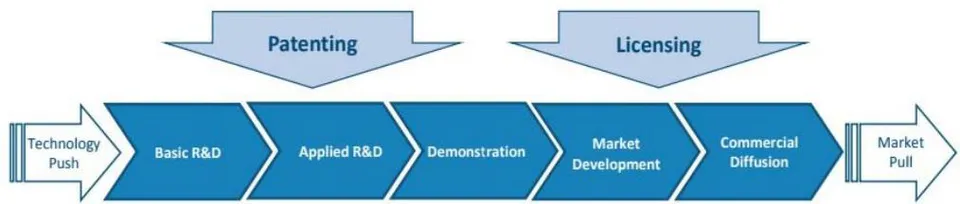
Illustration 1: Patents facilitate advances throughout the technology life cycle . Insert we see demand for technology leading to basic research and development, and the research and development leading to demonstrative activity for technology—this pushes technology into the market, and the market pull leads to commercial diffusion, bringing technology to the end-user, the consumer. All the while this activity is fuelled by pressure coming from patenting activity and licensing
Patent information is also very useful for tracking technology transfer which plays a key role in the diffusion of technology. A study in 2010 found evidence of significant climate change mitigation technology equipment and knowledge-flows across countries in the field of solar PV, wind power, biofuels and CO2 capture15. Hascic, et al., used the count of patent applications filed with different patent offices, namely duplicate applications, as a proxy measurement for technology transfers. Given the significant expense in procuring patents, applicants are now able to use the patent information to file only in markets where there is significant competitive activity, or where they plan to manufacture or sell their product. This certainly helps in investment decisions. Therefore, developing a system of patent assessment for RETs in IP Offices of a country is a crucial way that the government can utilise its IP sector to create an enabling environment for investment in RET.
On a broader scale, patents are used as an indicator for monitoring the innovation of technologies, the technology competitiveness of a country and the economic performance of a company or country16. Also patents can provide useful information for policy makers and investors on state-of- the-art technology information and identify R&D trends, allowing them to forecast innovation.
IRENA's 2013 Working Paper cites the example of Suntech Power and how it brought about the development of RET specifically for PV Solar cells in China. First off it must be mentioned that the US, Japan, and Europe are the origins of innovation or dominate innovation in RET. However, a huge amount of patents sourced from those countries are filed in developing economies like Brazil, China, South Korea, and South
Africa. Dr. Zhenrong Shi, the holder of several patents, worked as a university researcher in Australia, where he obtained his PhD. He decided to return to China, where he set up Sun Tech Power. Sun Tech Power grew quickly through acquiring other businesses, including a Japanese PV company, MSK, which became one of the world's leading companies producing PV cells. Key patents, technological capacity that was gained through technology transfer (in this case by acquiring companies), and the growing global market for PV all enabled rapid innovations in PV technology for China17.
V. SIGNIFICANCE OF IPRS: WHAT A ROBUST PATENT POLICY WOULD MEAN FOR NIGERIA
IPRs play a significant role in foreign technology transfer through foreign direct investment (FDI). Authorities have recognised the dual role of IPRs to: promote access to energy-related technologies and to create barriers to such access by restricting their diffusion. Thus, the desire to reward the inventor or IPR holder, is the very instrument that could restrict access to technologies and affect their diffusion.
The above position would have varying implications for developed countries, developing and least developed countries (LDCs). For developed countries where technology is advanced and a knowledge-economy is established, tightening IP protection systems would be most beneficial. However, for least developing countries, who must necessarily catch-up with the developed countries, restricting access to technology through patents, may stunt technological advancement and development in such countries. These LDCs are usually in Africa. Much of the international instruments on renewable energy the world over affirm the importance of technology transfer in fostering development in developing countries18. Technology transfer is seen as the solution to wider diffusion and use of energy-related technologies, and in helping African countries to surmount technological knowledge asymmetries and develop their innovative capacity . IPRs, particularly patents could support or hamper innovation and technology transfer, thereby facilitating or hindering access to modern energy, including renewable energy solutions. Developing local innovation capacity is recognized as a way out and premised on the ability of countries to 'access and deploy the relevant technologies' . Since developed countries are in possession of and control the vast technological knowledge, ditto in the renewable energy solutions sector, it follows that developing countries have to learn from them-the surest way to do this is to have access to developed countries' IP through technology transfer. If the IP protection systems of the developed countries are too tight, or robust, developing countries would have no way of accessing technology, and hopes of learning from such technology, through imitation or reverse engineering would be slim for developing countries. For example, U.S. and China are two countries with developed IP protection systems. China had not developed a robust patent policy until the 90s, and has in fact been accused of 'industrial espionage', and alleged stealing of IP in taciturn ways. On August 18, 2018, the US Trademark Office initiated an investigation under section 301 of the US Trade Act of 1974 into China's practices related to technology transfer, intellectual property, and innovation, claiming 'unfair treatment' of US companies and innovators doing business in China . US alleged that China was breaking WTO rules by denying U.S patent holders' basic patent rights to stop a Chinese entity from using the technology after a licensing contract ends . It was alleged that China used discriminatory practices to transfer technologies, from US to Chinese companies, and that China seeks to reduce its dependence on others by fostering both 'indigenous innovation' and 're-invention' of foreign technologies through its Medium and Long-Term Science and Technology Development Plan Outline(2006-2020), and the Made in China 2025 Notice . It can be seen from the foregoing, that because the U.S. has a robust patent policy with strong IPR protection, it is able to estop China from using its technological knowledge even while doing business in China. It is highly probable that if the aforementioned scenario had occurred in an LDC like Nigeria, who stand as no competition to US science and technology, US reaction would have been different.
There appears to be a shift in ground from one country to the other, depending on the industrialization level of the country. These flexibilities are regulated under international law, as most of the international instruments, relating to IP specify that developed countries should encourage development of least developing countries through technology transfer19.
The WTO's trade-related aspects of intellectual property (TRIPS Agreement), endorses these flexibilities for IPR protection, noting that member countries are at varying development levels. The TRIPS had transition20 deadline for developing countries which has since expired, but were extended to 2021 for least developed countries (LDCs)21. These flexibilities would be discussed shortly. The point being established here is that IPRs are perceived to have dual potential: either to promote access to energy-related technologies, or to create barriers to such access by restricting their diffusion22. At every point in time, developed and developing countries alike, may utilise IPRs to achieve either of the latter two objectives. Developed countries, with techno-nationalist tendencies would utilise IPR to restrict access to reinforce their technological advantage on the world stage, and developing countries like Nigeria would be interested in promoting access to technologies because of a need to 'catch-up', improve their economies, and meet development and energy challenges and would be pro-technology transfer. What follows therefore is that the notion of a Robust Patent Policy would be a subjective one for each country involved. For a developed country, in addition to other criteria that would be highlighted, a robust patent policy would mean a strong IP protection system, which would encourage and reward innovation. Conversely, in a developing country like Nigeria, a robust patent policy could mean encouraging access to technologies, thus aiding diffusion, through a less-stringent IP protection system. A survey of patent systems of 44 African countries, reveals that majority of them were unfit to safeguard a key purpose of patent protection, which is the diffusion of knowledge23. Instead, due to a lack of patent examination and public access to patented knowledge, they had mainly served as 'dumping grounds', for unqualified patents24. The challenges of the patent systems of African countries were unanimous: a lack of local capacity (including a dearth of patent lawyers and especially examiners), absence of efficient and organized systems for patent filing and storage, and for dissemination of knowledge about filed patents to potential innovators and other stake-holders. These challenges make it necessary for developing countries to engender flexibilities in their IP protection and innovative systems because of the need to grow technologically. Therefore, in view of the aforementioned, what would a robust patent policy mean for Nigeria? What are some of the features of a robust IP Policy, and considering its environmental, technical and economic limitations, how may Nigeria utilise or manipulate some of these features to address its developmental needs under international law, to aid the development of Renewable energy through intellectual property? In view of the limitations to Nigeria's IP/ Innovation system, what are some of the alternative pathways that Nigeria may adopt to encourage innovation in RET?
VI. FEATURES OF A ROBUST PATENT POLICY
The first question therefore is 'what is a policy?'
A Policy is defined as a course of action that is adopted by a legal entity . The online Cambridge dictionary defines it as a set of ideas or a plan of what to do in particular situations that have been agreed to officially by a group of people, a business organisation, a government, or a political party . Omorogbe adds that policies are statements of intent and desired direction and provide guidance for a government: policies establish direction but the rules that the people and institutions are bound to follow are found in the law, which by definition is binding . A policy unaccompanied by legislation that gives effect to its contents remains as a statement of intent, not bound to be obeyed and unenforceable . Be that as it may, C. Sa et al have made a notable observation that: 'while a policy can exist without a law, a law cannot exist without a policy . Policy and law therefore go hand in hand, but a Policy must necessarily pre-exist before the law, otherwise such a law will be empty.
Nigeria's Patent Law, the Patent and Designs Act25, as we know it today, is not predicated on any policy. Our IP laws certainly did not spring from a policy direction, which is why it is unable as it were, to address or cater for the technological and scientific needs of today including emerging modern energy needs such as Renewable Energy. It can only be described as a colonial contraption, flowing into the body of Nigerian laws as a statute of general application. Patent law was first established in Nigeria in the early nineteenth century through the Patents Ordinance No. 17 of 1900 and the Patents Proclamation Ordinance No. 27 of 1900. The Statute initially only applied to the colony of Lagos and the Southern protectorate of Nigeria. It was later extended to the Northern protectorate through the enactment of the Patents proclamation Ordinance No. 12 of 1902. After the amalgamation of Northern and Southern Nigeria in 1914 it became necessary to have a single unified patent system. Both the Patent Ordinances and Patent Proclamations were repealed and a new patentsystem, the Patent Ordinance of 1916, was enacted and eventually renamed and re-established as the Registration of United Kingdom Patents Ordinance of 1925. One of the prominent features of the 1925 Ordinance was the extension of the validity of patents granted in the United Kingdom to Nigeria as long as the patent owner made an application to register the patent in Nigeria within three years of the grant of the patent in the United Kingdom. The 1925 Ordinance remained in force until 1970 when it was repealed and replaced by the Patents and Designs Decree No. 60 (and later renamed as the Patents and Designs Act). Such is the history of how Nigeria came by its patent law. However, since 1970, there has been no amendment to the Patent and Designs Act in no manner whatsoever, to reflect any technological, scientific and developmental goals of the country. This eschews the dearth of innovation and scientific activity in the country. This is certainly affecting the pace of economic growth and industrial activity in Nigeria, although, Ofili's findings indicate that IPRs protection has negative and insignificant relationship with the rate of innovation in developing countries notwithstanding whether the developing country is within the low or high GDP band26. However, an x-ray of the countries examined in this research such as China and Canada, which were once developing countries, will show that a strong IP Policypoutlining a desire or vision by the country to be self-sufficient through innovation, propelled scientific advancement and consequently development of these countries.
The following will be the features of a robust patent policy identified from our discussions above, viz:
a) Balance between a Strong IPR Protection and a Weak IPR Protection
Under the TRIPS agreement, member countries of the WTO are mandated to move their IP protection systems to a certain standard. Nigeria ratified the TRIPS in 1995, and a country like China only ratified it in 2001, yet China has developed a strong and robust IP culture way more than most countries of the world27. The 21st century is largely a knowledge driven era where the manipulation and effective application of information sets nations apart28. Developed nations are in control of cutting edge technologies in areas such as pharmaceuticals, biotechnology, telecommunications, information technology including the Internet, and space technology. Developed countries have strong IP systems, and are way advanced in technology which propels their economic growth. Developing nations on the other hand, have been described as playing catch up29, to these developed countries in today's global knowledge-based economy. Countries are therefore not at the same level of development, and the TRIPS Agreement recognises this, as most of the key provisions reflect flexibilities proposed by the TRIPS in achieving technology goals.
Article 1(1) of the TRIPS provides:
'Members shall give effect to the provisions of this Agreement. Members may, but shall not be obliged to, implement in their law more extensive protection than is required by this Agreement, provided that such protection does not contravene the provisions of this Agreement. Members shall be free to determine the appropriate method of implementing the provisions of this Agreement within their own legal system and practice.'
On the Standards Concerning the Availability, Scope and Use of , with regards to Patents, Article 27 of the TRIPS provides thus:
Subject to the provisions of paragraphs 2 and 3, patents shall be available for any inventions, whether products or processes, in all fields of technology, provided that they are new, involve an inventive step and are capable of industrial application. Subject to paragraph 4 of Article 65, paragraph 8 of Article 70 and paragraph 3 of this Article, patents shall be available and patent rights enjoyable without discrimination as to the place of invention, the field of technology and whether products are imported or locally produced'.
Articles 65, & 66 are worthy of examination with regards to recognized flexibilities. Article , provides for general expectations required of different countries. Article 66 specifically provides for least developed country (LDCs) members thus:
'Least-Developed Country Members
In view of the special needs and requirements of least-developed country Members, their economic, financial and administrative constraints, and their need for flexibility to create a viable technological base, such members shall not be required to apply the provisions of this Agreement...for a period of 10 years from the date of application as defined under paragraph 1 of Article .
- Developed country Members shall provide incentives to enterprises and institutions in their territories for the purpose of promoting and encouraging technology transfer to least-developed country Members in order to enable them to create a sound and viable technological base .
Article 67 sheds light on the support that is expected of Developed countries for LDCs. 'Technical Cooperation- "In order to facilitate the implementation of this Agreement, developed country Members shall provide, on request and on mutually agreed terms and conditions, technical and financial cooperation in favour of developing and least-developed country Members. Such cooperation shall include assistance
- 49 Article 65
- Transitional Arrangements
Subject to the provisions of paragraphs 2, 3 and 4, no Member shall be obliged to apply the provisions of this Agreement before the expiry of a general period of one year following the date of entry into force of the WTO Agreement.
A developing country Member is entitled to delay for a further period of four years the date of application, as defined in paragraph 1, of the provisions of this Agreement other than Articles 3, 4 and 5.
Any other Member which is in the process of transformation from a centrally-planned into a market, free- enterprise economy and which is undertaking structural reform of its intellectual property system and facing special problems in the preparation and implementation of intellectual property laws and regulations, may also benefit from a period of delay as foreseen in paragraph 2.
To the extent that a developing country Member is obliged by this Agreement to extend product patent protection to areas of technology not so protectable in its territory on the general date of application of this Agreement for that Member, as defined in paragraph 2, it may delay the application of the provisions on productpatents of Section 5 of Part II to such areas of technology for an additional period of five years.
A Member availing itself of a transitional period under paragraphs 1, 2, 3 or 4 shall ensure that any changes in its laws, regulations and practice made during that period do not result in a lesser degree of consistency with the provisions of this Agreement.
- 50 Nigeria is an LDC as far as technological capacity is concerned.
- [^51] Goes further to add that: 'The Council for TRIPS shall, upon duly motivated request by a least-developed country Member, accord extensions of this period'.
- 52Article 66, TRIPS.
in the preparation of laws and regulations on the protection and enforcement of intellectual property rights as well as on the prevention of their abuse, and shall include support regarding the establishment or reinforcement of domestic offices and agencies relevant to these matters, including the training of personnel'.
The above sections of the TRIPS lends credence to the fact that varying degrees of IP capacity are recognised internationally and explains why some countries like Nigeria are taking their time in coming up with serious programs for the development of their IP. Technological transfer is recognised as a way to boost the technological capacity of LDCs, as it offers them an opportunity for imitation and reverse engineering, where for instance, registration of Technology through Nigeria's Technology Transfer Office is legal30. While US could estop China from copying its technology, even in China, it will be against TRIPS principles for the US to do the same in Nigeria. If Nigeria operated a strong IPR protection system, and was at the same level with China, Nigeria would be accused of industrial espionage and copying. However, because of Nigeria's technological capacity level, a weak IPR protection is certainly most favourable to access foreign technology.
On the other hand, a strong IPR protection should be utilised with local companies, to encourage local innovation, but in relation to foreign technology, which Nigeria should be most interested in, particularly in relation to RET and emerging technology, it appears most beneficial to be liberal until we have perfected our knowledge and technology base.
Adewopo et al, have noted alternative pathways which Nigeria may leverage on, other than through an IP System, which as it currently stands in Nigeria today is grossly underdeveloped. While Nigeria is building its Patent Policy and IPRs Protection regime, Adewopo et al note that investigating alternative forms of knowledge transfer that focus on developing and sharing of local technological solutions is a also a valid pathway for IP development. They note that such forms of knowledge transfer are already practised in African rural communities as informal open access technology transfer31. They are seen as important for the development and diffusion of indigenous innovations in biofuel in a sustainable and pro-development manner32. For instance in Tanzania and Mozambique, informal open access technology transfer takes place between small-scale farmers in cold pressing methods.
There are however, arguments that are in favour of the notion that strong IPRs protection will bring about tangible economic growth in developing countries.
Saggi (2013) argues that developing countries and developed countries have varying technological needs. And that for the developed countries to keep investing and producing new technologies required by the developing countries, the developing countries must have reasonable protection of IPRs. Firms situated in developed countries in the absence of tight IPRs regime in the developing countries may decide to cut down their investment in research and development, make their products more difficult to imitate and at the end churn out less efficient technologies33. These actions will reduce the volume of technology transfer to developing countries, a move that will invariably affect effective technology utilization, adoption and diffusion. This will further have adverse effect on the economic wellbeing of developing countries. Some authors are of the view that aside from the pressure from developed countries, developing countries may want to strengthen their IPRs systems to boost local economic growth34. This argument is predicated on the assumption that some domestic innovation will only come about as a result of strong IPRs systems. They therefore, argue that it is imperative that a country establishes an IPRs system that balances the ability of a nation to imitate technologies from advanced countries and at the same time provide necessary incentives for local innovation (Chen & Puttitanun, 2005)35.
b) Substantive Examination
The WTO recognised the varying degrees and capacities of member countries, and recognized flexibilities for categories of countries-meaning that standards were lowered for less developing and least developed countries (LDCs). The WIPO Policy Guide on Alternatives in Patent Search and Examination, identifies some of these flexibilities. They mostly relate to the patent system involving application, search and examination, and have put the special circumstance of each category of developed, developing, and LDCs into consideration. In general, patent search and examination can be categorized into three frameworks, which reflect TRIPS flexibilities. The WIPO identifies them thus:
a. Formality examination only; b. Formality examination and prior art search, and c. Formality examination, prior art search and substantive examination.
Formality Examination Only59
A patent may be granted, or refused following formality examination which will require an examination of formality requirements such as the form and contents of a patent application, and submission of required statements and documentation. No technical or scientific background is generally required to conduct formality examination.
Since no prior 1art search and substantive examination are conducted by a patent office, granted patents may or may not meet the substantive patentability criteria. If a patent does not comply with all the patentability requirements, third parties, such as competitors, can file a request for the review of the decision made by the patent office. Such a request is usually filed with a court either by an interested third party for nullification of a patent or by the alleged infringer, as a defense, in an action for infringement. This type of registration system defers substantive examination on patentability until a patent is actually litigated. This framework leads to considerable social cost-saving in terms of the patent office's spending, allowing the country to allocate its resources to other areas of priority Nigeria is classified amongst the countries with this simplistic registration system, which is usually associated with the utility model.
Formality Examination and Prior Art Search60
Once a patent application is filed and the formality requirements are checked, an examiner establishes a search report following a prior art search. If the formality requirements are met, a patent may then be granted without substantive examination as to the patentability of the invention, and the search report is published together with the granted patent. Although the procedure is less complex than that of a full substantive examination, the patent office must have the resources necessary to maintain up-to-date prior art databases. In general, technical or scientific background is required to conduct prior art search and Examiners should have ageneral understanding of the patentability requirements and the skill to interpret patent claim.
Formality Examination, Prior Art Search and Substantive Examination[^61] By substantive examination, we mean that the patents are examined to the extent that they comply with legal requirements for patents under the patent law of the country in question. Once formality as to content and form have been established and prior art search conducted, the examiners must then check conformity to legal requirements. It is not deferred until later or possible litigation as to the validity of the patent. Since compliance with legal requirements is fully examined before grant of a patent, granted patents enjoy a higher likelihood of validity if challenged. This provides legal certainty for both patentees and third parties, and increases confidence in the patent system by society at
large. The main characteristic of this type of registration system is that it is cost-intensive as maintaining a search and examination system requires substantial human and financial resources, for example, to hire and continuously train qualified examiners in all fields of technology, while maintaining and upgrading the technical infrastructure (such as databases) for prior art searches. Hence, this registration system is usually obtainable in developed industrialised countries such as the U.S. which provide for substantive examination under its patent law. Upon litigation, it is found that it is very rare that such patents will not be valid, because the patent office checks that they have fulfilled all legal requirements.
Nigeria's Patent and Designs Act, provides for legal requirements before the grant of Patents . An examination of section 4 shows that the patent system obtainable in Nigeria is formal examination only. Substantive requirements are spelled out in section 3(3). Section 4(2) provides:
- Where the examination mentioned in subsection (1) of this subsection shows that a patent application satisfies the requirements of section 3(1) and (3) of this Act, the patent shall be granted as applied for, without further examination and, in particular, without examination of the questions as to- a. whether the subject of the application is patentable under section 1 of this Act; b. whether the description and claims satisfy the requirements of section 3(2) of this Act; and c. whether a prior application, or an application benefiting from a foreign priority, has been made in Nigeria in respect of the same invention, and whether a patent has been granted as a result of such anapplication.
Section 4(4) goes further to cement a system of non-substantive examination by stating categorically thus:
This means that so long as formal requirements are fulfilled as spelled out in section 3(1) and (3), patents would be granted. There would be no prior search , and the patents would be deemed valid, until proven otherwise by litigation .
Given the lack of funds for priority search equipment, lack of technical capacity of examiners in Nigeria at the time of promulgation of the Patents and Designs Act, the utility model with no substantive examination seemed the best option for Nigeria. Has this technical capacity grown since 1970? It is doubtful, and Nigeria still needs to learn. Therefore, a robust patent policy for Nigeria would be one which allows Nigeria to leverage on the grace period given to LDCs till 202136, to build its capacity, train examiners, and fund an innovation strategy.
The WIPO recognised the challenges member countries face with substantive examination, and recommended adjustments, where there are limited resources thus:
a. Carrying out substantive examination, fully or partly, in cooperation with technical experts outside a patent office. b. Limiting substantive examination to certain strategic fields of technology for the country concerned. c. Restrict substantive examination to checking the compliance with some, butnot all, of the criteria to be met for a patent to be granted e.g. patentable subject matter, unity of invention and the disclosure requirement. In order to examine those requirements, patent offices do not need to maintain prior art search tools, which can be costly67. However, examiners need comprehensive knowledge of the applicable patent law in order to make sound decisions on compliance with the patentability requirements, which are not necessarily easyto apply68; d. Limit substantive examination to compliance with novelty and industrial applicability, but not obviousness or inventive step.
Nigeria could introduce some form of prior art search and substantive examination in line with the above where financial resources and technical capacity are a challenge. For instance, being a member of a Regional Patent Office like the ARIPO, means that ARIPO has trained examiners so Nigeria's Intellectual Property Office (IPONigeria) can leverage on this.
c) Utility Models and Traditional Patent Models
Most robust patent systems have a combination of utility models and traditional patent model systems. For example China, China's Patent Act has been amended severally to reflect its aspirations. The Act was first amended in 1972 to introduce....the next amendment was in year 2000, after that 2008, and then subsequently in 2009.
Historically patent systems began in Germany, and it was there that the utility model first surfaced. Utility models are an inexpensive way to get patents because they do not go through substantive examination which means that only examination as to presence of required documents is available37. An examination of the provisions of Nigeria's patent system reveals that it is a form of utility model. This makes it quicker to start reaping the benefits of such a patent, and for speedy diffusion of technologies. This system in Nigeria has been described as a 'deposit system', where no rigorous examination is conducted on patent application and where patents are granted without guaranty of validity38. It however has some advantages.
The burden of establishing the patentability of the invention is shifted from the Registrar to the one who challenges the validity of the patent. Therefore all costs of search falls on the claimant.
What can be done is to have an Act that provides for traditional patents, and the utility models. So that applicants can have the choice to exercise this option. This will also encourage foreign entities operating in Nigeria, as they are assured that patents obtained in Nigeria will meet standard elsewhere in the world.
Built on strong Science and Technology Policy
A robust patent policy is always built on a strong science and technology policy. That strong science and technology vision is what will usually inspire a desire to formulate a policy and subsequently law that will propel innovative activities. Two countries come to mind in hatching the theory of the power of a vision for technological development of a country: China and Canada. We are using China and Canada because both in history were never considered as technology hubs, and because of this were classified in the category of developing economies, being far behind from their contemporaries—the U.S., and Japan. Today China, home to the world's largest wind farm, and most advanced technological economy after the US, and then Canada, whose workforce often emigrated to the US for better opportunities, are now leading hubs of innovation with strong infrastructure and vibrant economies. How did they get here, and what can Nigeria learn as it seeks to improve its innovative capacity and economy?
China's technological progress is mainly as a result of conscious and deliberate effort by its leadership to utilise the country's resources and build. It is no wonder that today it has a robust Patent Law regime. China passed its Renewable Energy Law in 2005, and as at 2012, renewable and nuclear power accounted for of its electricity generation. Renewable energy industry is viewed as a critical area of Chinese national strategic emerging industries39.
In 2006, Hu Jintao and Wen Jiabao unveiled the National Medium- and Long-Term Program (MLP) for Science and Technology Development (2006-2020) (MLP), to rapidly advance 'indigenous innovation' in China. It was deeply concerned with the gap between China's 'Science and Technology (S&T) development'72 and that of developed countries. As the MLP stated, 'China's overall S&T level still has a fairly big gap to close, compared with that of developed nations'. As the MLP had noted, 'the nation will be for a long period of time underenormous pressures from developed nations [that] possess economic and S & T superiority', and acknowledged that it was difficult to acquire valuable technologies from other countries, viz: '[F]acts have proved that, in areas critical to the national economy and security, core technologies cannot be purchased'73. The report concluded that the only way China could advance its S & T, was to enhance its indigenous innovation capability in order to 'take the initiative in the fierce international competition'74. So far between 1978 to 2013, China has had 373 IPR policies regulating its renewable energy industry, among which there were 18 laws, 52 regulations, 293 department rules, 1 judicial interpretation, 5 group stipulations of the Central Committee of the Communist Party of China, and 4 industry stipulations75. Each of these policies were spread across Gao& Zao's identification of IPR core systems and IPR supporting systems. The former means systems or policies where the term "IPR" is in the title of the policy, and clearly puts forward to promote the creation, application, protection and management of renewable energy technologies IPR. An example is the 'Suggestions on Strengthening IPR Work of Strategic Emerging Industries' of China76. The latter on the other hand, refers to a policy whose title does not directly carry the word 'IPR', but which purpose can promote technology creation, use, protection and management, including all kinds of policies of finance, taxation, science and technology, education and industry . An example of such policy is the 'Instructions to Promote the Internationalization of Strategic Emerging Industries' , a policy issued by ten departments including the Commerce Department and the SIPO in 2011, which explicitly put forward that the creation, application, protection and management of IPR should be promoted .
China's science and technology policies on IP over the years, include but are not limited to the 1991 PRC Ten-Year Plan of the National Economy and Social Development; and the Eighth Five-Year Program Outline before it appeared together with "Intellectual Property Rights" in the 1995 State Council's Decision on Accelerating Scientific and Technological Progress . Coupled with this, in 2001, China signed the WIPO-TRIPS agreement, and then followed with the strategic Medium and Long Term Program (2006-2025), where key sectors including biotechnology, nanotechnology, and renewable energy have been prioritised. It is evident that all of these policies spanning over 373 supra, have made for a robust Patent Regime in China, and propelled China as second most advanced hub of RE in the world.
Canada on the other hand, was lagging behind in terms of its technological development. Today it is a formidable hub of technology transfer activities and considered a developed economy. This had not always been the case. In 1969, the OECD had observed of Canada in its report: A Review of National Science Policy: Canada, that Canada had failed to co-ordinate research activities around clearly articulated priorities , at a time when it had published international comparisons of national science policies and declared that the comprehensive planning of science according to state-defined objectives was necessary for successful economic policy . In 1963, the Canadian government was criticised for concentrating its resources on basic research, which was seen as too far removed from the industrial sector . The Royal Commission on Government Organization (the Glassco Commission) also observed that Canada's science failed to sufficiently support industry needs .
Following these criticisms, (including the situation of Canadians emigrating to the US for greener opportunities, and the import of American academics into Canadian university systems ), Canada decided to strengthen its position in the international scheme of things by a series of policies that leveraged its advantage for rapid scientific growth and development. In 1968, the Canadian Science Council produced the document: 'Towards a National Science Policy', calling for the pursuit of multi-disciplinary mission-oriented R & D, involving not only government agencies and the universities but industry as well. The Lamontagne Commission or Special Senate Committee Report entitled: A Science Policy for Canada, also reiterated the positions of the Glassco Commission and the OECD. Following this, the FG of Canada appointed a Minister of State for Science and Technology in 1971. One of the first moves of the Minister of State was the push to contract government research needs to the Universities or industry rather than commissioning research to be undertaken in the national laboratories alone .
Canada adopted a techno-nationalist approach which saw concerted effort in strengthening its technological capacity and ability. As technological activities deepened, with success of international trade, Canada relaxed its techno-nationalist tendencies, and what followed was collaboration with the government, the university/research centres, and industry, culminating in massive diffusion of technology. The technique employed by Canada as it developed its technology policy over the years, was through the institutionalization of technology transfer in the University of Toronto, Canada's biggest university.
Thus for Nigeria, we see that our Patent Law has not flowed from a well-articulated science and technology policy, eschewing a vision of where we would like to be technologically and how we would utilise the development of science and technology for the growth of the economy. A Science and Technology Policy for Nigeria will certainly bring leverage internationally for Nigeria. Nigeria can learn from the tripartite collaboration as happened in Canada, where key players viz, the industry, the university, and government collaborate to boost scientific activity, and deepen its effects. If our universities are positioned as centers for research, then industry will be affiliated to the universities, and government can fund research activities. This would consolidate efforts rather than scattered efforts in Science and technology development, as well as increase opportunities for real internships and employment across the country .
d) Balance between Techno-Nationalism and Technology Transfer
The term 'techno-nationalism' first surfaced in the writings of Robert Reich in 1987, where with a focus on US technology policy, he wrote in an essay for The Atlantic, that techno-nationalism was an attempt to 'protect future American technological breakthroughs from exploitation at the hands of foreigners, especially the Japanese'.[^90]
The relationship of nationalism and orientations towards science and technology is captured through the construct of techno-nationalism[^91]. Richard Samuels defines techno-nationalism as: 'the belief that technology is a fundamental element in national security; that it must be indigenized, diffused, and nurtured in order to make a nation rich and strong'[^92]. Atsushi Yamada writes that the point of technonationalist policies is 'to strengthen the competitiveness of domestic industries against foreign rivals'40. Joan Johnson-Freese and Andrew Erickson defined it as 'the idea that technological strength is an effective determinant of national power in a harshly competitive world'41. The proponents of techno-nationalism posit that a nation enjoys competitive advantage when it has in its custody, highly advanced technology. It gives prior attention to technology built at home and is not interested in technology transfer, because to do so would water down its scientific secrets, and thus economic or global power. advanced, industrialised countries advocate some sort of techno-nationalism to maintain their position as a world power. For instance, the Korean Intellectual Property Office (KIPO) only issues green patents to Note that once there has been technology transfer, patents would be obtained in the receiving country, and this would make the technology in question duplicable, through reverse engineering amongst others. Thus the majority of developing countries would naturally be interested in technology transfer, while technology emanating from its indigenous companies, and for national interest this is a form of techno-nationalism on the part of the Korean government.
One of the effects of a robust IP/Patent Policy is that it creates a balance between principles of techno-nationalism and technology transfer. When a country decides to be completely technologically sufficient, it does so in view of national interests. However, it must be exercised with caution, as no country can survive without international trade, and in the case of the developed country without the diffusion of its technologies through technology transfer.
In advancing technology and breakthrough discovery, countries still have to accept that some of the knowledge, even though protected would spill-over to other countries, through technology transfer. A balance must therefore be created between both principles. Again it is pertinent to highlight the experiences of China and Canada.
China's thinking about technological development including its renewable energy has been described as reflecting a pragmatic strain of technonationalism42. China's MLP Strategy was seen as a threat by the US43 under Trump's administration. The USTR released the results of its inquiry in a report entitled Findings of the Investigation into China's Acts, Policies, and Practises related to Technology Transfer, Intellectual Property, and Innovation, noting that:
Among all major economies, the United States has the highest concentration of knowledge and technology intensive industries as a share of total economic activity. And in high-tech manufacturing, the United States leads the world with a global share of production of 29 percent, followed by China at 27 percent44.
The report further alleged that China used discriminatory practices to transfer technologies, from
US to Chinese companies and that China seeks to reduce its dependence on others by fostering both 'indigenous innovation' and 're-invention' of foreign technologies through its Medium and Long-Term Science and Technology Development Plan Outline (2006-2020), and the Made in China 2025 Notice. In view of the above, Zhang Qiang, deputy director of the Institute of International Technology and Economics at the State Council's Development Research Center, penned an essay for Global Times in October 2010, where he noted that: 'although China and the U.S. regard clean-energy technology as a focus of mutual exchange and cooperation, the U.S. government will not let China share in its key technologies'.
Zhang made a point therefore to recommend that China better 'make its own strategies for clean-energy technological development'.45.
It is believed that this fear and eclipse of American technological dominance is one of the real sources of Trump's trade war with China and that China may pursue its clean energy goals 'more aggressively' on the premise of techno-nationalism46. These fears however are not unfounded as they may be premised on China's past antecedents47 and socialist inclinations. In 2011, US indicted China's largest wind turbine manufacturer, Sinovel, for stealing proprietary software and trade secrets. In 2013, a federal grand jury in the US indicted Sinovel, which exported turbines with allegedly stolen software to the US.
In view of the above, China has therefore maintained a liberalist stance rather than anautarkic approach towards its efforts at building its competitive edge in technology on the world stage48. This would be seen in three instances, viz
Under its Wind Power Concession Project (WPCP) in 2003, China surprisingly cut back a requirement for local content for foreign wind- power firms of during the Obama administration.
For providing subsidies to domestic wind power firms, ranging from 22.5 million, under its Special Fund for Wind power Equipment Manufacturing, China faced criticism. The USTR lodged complaint with the WTO under WTO rules . China terminated the program.
It is clear that China's leaders are trying to balance their desire to nurture domestic technology companies with their desire to maintain links with the outside world49. How well has China balanced its techno-nationalist goals with its need for international co-operation and learning? Following China's ability to bend in the face of US criticism as discussed above, one would say that they have found a balance, and are doing well for themselves technologically boosting their economy. If China has no ulterior motive of advancing more than national interest then this should be worthy of emulation by developing countries like Nigeria.
Canada on the other hand, has one of the most robust patent regimes in the world today, with its Patent Act and Patent Rules, patent matters entirely under the purview of the Canadian Federal Court. Canada has recently ratified the Patent Cooperation Treaty and amended its Patent Rules to reflect obligations under the PCT50. For Canada, research and innovation activities were always carried out in the interest of the public, or for public good, always to protect national interest; a total techno-nationalist approach. However, as research deepened Canada realised that it needed the money and the expertise to survive and so there was a gradual relapse from total techno-nationalism to the institutionalization of technology transfer51. It all began with the work of John Fitzgerald, an Associate-Professor of Hygiene at the University of Toronto, producing a diphtheria antitoxin. The Board of Governors of the University were at first reluctant to lend him any support because of perceived commercial aspects of manufacturing and distributing pharmaceuticals. This reluctance stemmed from a concern that the university's status as a public institution would be compromised52.
Fitzgerald lobbied for FG support with his lab in the area of funds with the argument that: 'it would be a highly patriotic action for us to manufacture our own anti-tetanus toxins for the Canadian Expeditionary forces'110. The Canadian government supported Fitzgerald's lab as 'there was no other pharmaceutical company meeting this demand'111 at the time. Fitzgerald'slab emboldened, produced and distributed tetanus anti-toxin and vaccines for smallpox to Canadian troops at War, and for the general public. Eventually, the lab came to be seen as a way to generate funds for research at the University, and subsequently patenting of inventionswas considered. However, patenting of faculty inventions was still viewed as a way of 'safeguarding [them for] the public good'112. This was evident in 1921 when the university produced an extract composed of an 'antidiabetic hormone' which it trademarked as insulin. The Board of Governors of the University claimed to hold the patents for the purpose of preventing [the] commercial exploitation and uncontrolled manufacturing of the extract-this was the logic guiding the appropriation of intellectual property as at then113.
After the war, there was serious debate as to whether the insulin should be produced on a massive scale and sold to the public. The Scientists and researchers were circumspect about this because it was never the intention of the government to commercialize scientific breakthrough. Therefore in Canada, what followed was a gradual relapse or relaxation of this techno-nationalist policy to collaboration with the government, the university/research centres, and industry, culminating in massive diffusion of technology53. The technique employed by Canada as it developed its technology policy over the years, was through the institutionalization of technology transfer in its biggest university, the University of Toronto. Nigeria can employ the same method as it establishes a patent policy, to explore ways through which there will be collaboration between industry, university and government. The NOTAP Industry Technology Transfer Fellowship has been designed to do this flowing from the office of the NOTAP, but there is no information as to the on-going success of the program or curriculum so as to assess the quality and relevance of the program to technology management in Nigeria.
e) Fast-Tracking
Most robust patent regimes have introduced a practice in patent examination process known as 'fast-tracking'. Fast tracking is usually connected with green patents. Green patents are those patents related to the sustainability of the environment, and to some extent to combat climate change , and are in connection to Climate Change Mitigation Technologies . The incorporation of green innovation into business models as well as the increase in the number of green patent applications has been a top trend since the past 5 years . The Johannesburg Plan of Implementation (JPOI) points to the enhancement of international and regional co-operation 'to improve access to reliable, affordable, economically viable, socially acceptable and environmentally sound energy services, as an integral part of poverty reduction programmes' . The UNFCCC also enjoined developed nations to assist developing nations through technology transfer, as part of a means to provide support for the JPOI adopted at the World Summit on Sustainable Development . This brought about an international agreement to 'support existing mechanisms, and where appropriate, establish new mechanisms for the development, transfer, and diffusion of environmentally sound technologies to developing countries and economies in transition . The aforementioned international instruments have largely influenced actions and policies by signatory countries to increase efforts to reduce their emissions of GHGs. This has led to what the researcher describes as 'green activism', from stakeholders and policy makers the world over, particularly in countries where 'innovation' is considered as the core or driving factor for 'growth', or 'economic growth'.
'Green activism' therefore spurred key patent or leading countries in innovation to come up with programmes in their various IPOs and Trademark Registries to 'fast track' or accelerate the 'delivery' of patents to the industry experts, innovators and those in R&D, all in a bid to aid diffusion of the technology sector, and contribute in aggregate to their emissions reductions commitments under international agreements.
Green patent fast-track schemes have been implemented in nine (9) countries the world over. They include the UK, the US, Canada, Australia, Israel, then China, Japan, Brazil, and South Korea. Patents coming from or registered in Japan, UK, and US, have been described as 'triadic' patents, because they are usually sought in the three countries first before anywhere else . Of course the IPOs of these countries are the strongest in the world today. Most of these fast-track programmes were established in 200954. The UK IPO was the first green patent fast track program as a follow up to the UNFCCC Conference at Copenhagen which led to the Kyoto Protocol. The patent application is considered and granted within 9 months, as opposed to normal examination procedure of 3-5 years. Australia's IPO followed next, in September 2009-patents here are examined within 4-8weeks. KIPO introduced its 'super-accelerated examination system for green technology' in October 2009, where 'first-office action' is usually within one-month of the request for accelerated examination. However the KIPO fast track system is only open to technologies funded or accredited by the Korean government, in relation to technology mentioned in relevant government environmental law, what can be described as 'techno-nationalism' which has already been addressed.
Japan (JPO) launched its fast track program in November of 2009. First- action is given within an impressive two (2) months, and it is to address 'green technology related applications', and the subject matter must have 'energy saving effects and contribute to CO2 reduction, like the other IPOs basically. Next established in history is the USPTO (United States Patent and Trademark Office), which launched its 'Green Technology Pilot Programme' in November 2009. This programme was initially designed for application under its USPC (US Patent Classification Codes) for 'green technologies', covering alternative energy, energy production, energy conservation, environmentally friendly purification and renewables, amongst others but energy and GHG emissions reduction. In early 2012, it later expanded to cover applications pertaining to environmental quality, energy conservation, renewable after its application, the USPTO closed its Green Technology Pilot Programme, and now runs other fast track programs like the Prioritized Examination Program (Track 1); the Patent Prosecution Highway; the Accelerated Examination Program, and a petition-based on the applicant's age or health. Next in line is Israel. Israel launched its fast track program in December 2009, at first only applicable to cases of infringement. Canada IPO (CIPO) launched its program in March 2011, first office action given within 2 months, compared to normal 2-3 years. Brazil's INPI (National Institute of Industrial Property) launched its fast track Pilot in 2012 to accelerate green patent applications to less than 2 years as opposed to its standard 5years and 4 months. The SIPO (China's State Intellectual Property Office) was the last to launch a fast track programme in August 2012, where approvals are usually gotten within one year.
From the above it can be seen that the practise of fast-tracking has been around for quite some time. The question most nagging is if it actually helps or improves the diffusion of green technology, thereby contributing to its development and availability.
Dechezleprétre, in conducting his research55, highlights several advantages to a reduced examination process or fast-tracking. It allows patent applicants to start licensing their technologies sooner, thereby reducing the time to reach the market. Also, possessing a granted patent may help start-up companies to raise private capital or to license their technology and start making revenue. This will certainly be a welcome development for the investor looking to recoup gains as expected. However Dechezleprétre observed that despite these advantages of fast-tracking, the demand did not necessarily increase in some countries56. Apart from a possible lack of awareness in those countries, it is very likely that companies or individuals who did not opt for fast-tracking have done so for the following reasons:
a. Innovators deem it to their advantage to enjoy a longer examination period in order to protect their monopoly of knowledge and increase their dominance in the market. When patents are granted, the particulars and processes of such inventions are published (revealing important R&D information to competitors), making it accessible to others in the industry, who quickly come up with improvements. This increases the risk of competitors being able to quickly design competing technology57.
b. When a patent application is filed in an IPO, it can be amended anytime from when it was filed to when it is granted. In a situation where they are fast-tracked, inventors are unable to amend or introduce developments, in particular the list of claims – during the examination process. Indeed, if granted too early, the design of the patent may not perfectly match the final version of the invention, thus facilitating circumvention58. This puts them at risk of losing 'prior status' under the Patent and Trademark law of the country in question.
c. Fast-track procedures may be costly.
The above are some of the reasons why some companies or entities may not opt for a fast-track procedure.
However it has proven useful and necessary in cases of suspicion of infringement , capital- raising activity, and most importantly, in securing commercial partnerships. Antoine Dechezlepretre has noted that the value of 'fast-track' patents are higher than 'normal-track' patents, because they contain more claims than their normal counterparts. He noted that the value of a patent is determined by three (3) different factors or measures, viz: the number of countries in which each patent has been filed (also called the family size of patents); the likelihood of becoming a "triadic" patent; and thirdly, the number of claims made in the patent . Triadic patents are patents which have been filed in the three major patent offices in the world i.e. USPTO, JPO, and the EPO. If innovators see that the technology/technology solution they seek to patent is widely in demand the world over, they are better off requesting accelerated examination procedure as existing demand means that the technology will be commercially viable .
Also data shows that fast-growing start-up companies in the "green tech" industry, who can use a granted patent to raise capital or to license their technology and start making revenue, benefit most from fast-tracking. Given the increased demand for alternative sources of energy, particularly in developing countries, this is significant for new and budding companies who want to invest in availability of RE technology including solar, wind, and bio-energy sources.
The above are some of the features of a robust patent policy. It behaves on Nigeria's policy makers to imbibe or institutionalize if not all, but at least a majority of the above five (5) salient features. A burning issue is fast-tracking, which Nigeria can immediately begin to implement as it requires minimal funding.
VII. NIGERIA'S PATENT LAW AND POLICY: WILL FAST-TRACKING ENCOURAGE INVESTMENT IN RETIN NIGERIA?
The big question is 'will fast-tracking procedure encourage investments in RET, and thereby accelerate the diffusion of RE technology in Nigeria? Should provision then be made for fast- tracking by the Intellectual Property Office of Nigeria (IPONigeria) or the NOTAP?
The issue is this- the life-span of patents in Nigeria is 20 years . This life-span is calculated not from the date of grant but from the date of filing of the application . This means that the exploitation period of the granted patent is already limited from the grant of the application, offering a reduced amount of time for investors to enjoy their 'monopoly' on the invention as it were. With no standard period for examination in the country (patent applications come out when they come out), investors, may be wary of investing or partnering with RE solution providers, and this could 'kill' innovative activity for RE, and indeed technological innovation in general, in the country. Recognising these markets, and creating these markets are the major way through which RE will be available for Nigerians. Therefore, there is need for the legislators to revisit the Patent Act 1970 to introduce methods and means for the process to be fast-tracked. Fast-tracking may not be favourable in all circumstances as highlighted above, but industry professionals should not be denied the option. Nigeria should key into global IP practise for acceleration of development of its renewable energy.
VIII. TECHNO-NATIONALISM AND TECHNOLOGY TRANSFER: THE CASE OF NIGERIA
Has Nigeria being involved in any form of techno-nationalism?
The answer is positive but more work needs to be done to reach an equilibrium like developed and industrialised countries. Fair enough Nigeria has the National Office of Technology Acquisition and Promotion Act which provides the technology transfer requirement in section . Also the Nigeria Oil and Gas Industry Content Development Act 2010 also makes it mandatory for foreign multinationals to have a certain percentage of its workforce as Nigerians59-the main crux of this is to clearly prepare Nigerians to learn from the foreigners and develop the skills and know-how to carry out much of technological and industrial activity on their own through technology transfer60. The principle of expropriation which occurred in the 70s and ; and the position of Nigeria as highest shareholder in the NNPC Shell Agip Joint Venture61 are all attempts at techno-nationalism.
In the early 2000s, Nigeria's attempt to launch its first satellite, Nigeria SAT was a form of technonationalism, giving Nigeria a position on space technology in Africa, and a boost to the growth of science and technology in the country62. However, energy is the most crucial of any nation's attempts at providing for its needs and ensuring energy security in a sustainable manner. It is so central to the realisation of development plans of any country. Therefore, attention must be paid to the development of technology that makes access to clean energy top priority in Nigeria. Encouraging multinationals to set up factories in Nigeria would speed up RE technology development, growth and diffusion. Nigeria's technological capacity is very basic and weak, and it needs to be strengthened with robust science and technology policy, that will position the country for developing the capacity to innovate, manufacture and cater to much of its energy needs, like China. It is at this stage of production of technology, including RE technology that Nigeria can enjoy export earnings and a good position in International trade. This ultimately translates for better economies of scale and sustainable development.
IX. SUMMARY
The lesson for Nigeria is this: for renewable technology development and diffusion, there must be a policy, a patent policy, which must have flowed from a science and technology policy. A policy represents a nation's vision, goals, plans, and direction, a nation's thinking on a particular issue, from which law would emerge. As has been noted, while a policy can exist without law, laws cannot exist without policies[^140]. The Patent and Trademark Act we have in Nigeria today has not flowed from a patent policy and most crucially has not flowed from a science and technology policy. It has not been subject to any amendments since 1970, and it can no longer cater to the current developments in Nigeria's technological climate and needs to be amended to include fast tracking procedure as an option. Nigeria must also have avision for science and technology. Having a Renewable Energy and Energy Efficiency Policy is good, but we must also infuse it with a vision for our technology sector to meet our pressing energy needs through renewable energy sources. This must necessarily then involve a tripartite collaboration between government (as the financier); the universities (as thecenters for research), and then finally
The industry players (companies who are involved in commercialization) must furnish the institutional and cultural cooperation that will facilitate the research, production, and commercialization of renewable energy technology in Nigeria.
Footnotes
There shall be exclusive consideration to Nigerian Indigenous service companies which demonstrate ownership of equipment, Nigerian personnel and capacity to execute such work to bid on land and swamp operating areas of the Nigerian oil and gas industry for contracts and services contained in the schedule to this Act. (p.17) ↩
Compliance with the provisions of this Act and promotion of Nigerian content development shall be a major criterion for award of licenses, permits and any other interest in bidding for oil exploration, production, transportation and development or any other operations in Nigerian oil and gas industry. (p.17) ↩
(2013), p.445. sourced from https://www.jstor.org/stable/43548545 Accessed: 14-08-2019 18:09 UTC (p.11) ↩
[Sept./Oct. 2013], pp. 909-930, at 909. https://www.jstor.org/stable/10.1525/as.2013.53.5.909 accessed 29-08-2019. (p.13) ↩
Adebambo Adewopo, Tobias Schonwetter & Helen Chuma-Okoro, 'Intellectual Property Rights and Access to Energy Servicves in Africa', in Omorogbe, Y. & Ordor, A.O., supra, n.1, p. 134. World Trade Organisation Article 7, TRIPS. Matthew Rimmer, 'Beyond the Paris Agreement: Intellectual Property, Innovation Policy, and Climate Justice', MDPI Laws [2019]; stable url: doi:10.3390/laws8010007; www.mdpi.com/journal/laws. Adebambo Adewopo et al, supra n.312, p. 135. Ibid. (p.2) ↩
Section 4, Patents and Designs Act, CAP P2, Laws of the Federation of Nigeria, 2004. (p.9) ↩
63except where the patent enjoys foreign priority, which the applicant would state on the face of his application, and which would enjoy priority over similar application. This is made possible by virtue of the Patent Corporation Treaty to which Nigeria is signatory, which gives an applicant 6 months to file a patent simultaneously in several patent offices. The ARIPO equally has such benefits for members. (p.9) ↩
Section 4(4), Patent and Designs Act, CAP P2, LFN 2004. (p.9) ↩
Section 5, Article 28, Agreement on Trade Related Aspects of Intellectual Property (TRIPS), Annex 1C of the Uruguay Round Agreements 1994, which established the World Trade Organization (WTO) in 1995. (p.2) ↩
In Nigeria, the following are not patentable subject matter: Patents cannot be validly obtained in respect of- (p.3) ↩
Under the P DA 2004, the term used is 'the art' or 'state of the art', provided it does not exist only six months before the new patent is filed. See section 1(3). (p.3) ↩
Mirei Ishaka, IRENA Working Paper, supra, n.5. (p.3) ↩
18Ibid (p.3) ↩
Ibid, p.12 (p.3) ↩
Hascic et al, 'Climate Policy and Technological Innovation and Transfer: An Overview of Trends and Recent Empirical Results', OECD (Organisation for Economic Co-operation and Development) Working Papers, No. 30, OECD, available at www.oecd-library.org/environment/climate-policy-and-technological-innovation-and-transfer_5km33bnggcd0- en. (p.4) ↩
An example is The Patent Landscape Report prepared by WIPO in cooperation with IRENA on Desalination Technologies and the Use of Alternative Energies for Desalination (November 2011), which explored the use of patent information to assess trends in deployment of renewable energy for desalination. (p.4) ↩
25IRENA Working Paper, Ibid. (p.4) ↩
26Principle 9 of the Brundtland Report, 1982; Paragraph 9 of the SE4ALL Initiative. (p.4) ↩
32Article 67, TRIPS (p.5) ↩
33To stronger IP protection systems. (p.5) ↩
34Article 66, TRIPS. UNEP Report, 2013, in Adewopo et al, p. 155. Though the transition deadline for developing countries has since expired, many African countries are yet to implement the standards completely while others are still in the process of reforming their IP laws to upgrade to the TRIPS standards. (p.5) ↩
Ahmed Abdel Latif et al, 'Overcoming the Impasse on Intellectual Property and Climate Change in the UNFCC: A Call for a Reasonable and Balanced Approach', International Center for Trade and Sustainable Development Policy, Brief No: 11, 2011, in Adewopo et al, Ibid, p. 131. (p.5) ↩
Adewopo et al, Ibid, p.154. (p.5) ↩
Ibid.. (p.6) ↩
Cap 344, 1990; CAP P2, Laws of the Federation of Nigeria 2004. (p.6) ↩
O.U. Ofili, supra n. 310, p. 4. (p.6) ↩
In terms of technological advancement China is second after the US. (p.7) ↩
O.U. Ofili, supra, p.7. (p.7) ↩
Ibid. (p.7) ↩
See section 5 of Nigeria's NOTAP supra. (p.8) ↩
Adewopo et al, p.160. (p.8) ↩
Dos Santos & Pelembe, in Adewopo et al, Ibid. (p.8) ↩
Onyekachi U.Ofili, supra n.310. (p.8) ↩
57Chen & Puttinam, in O.U. Ofili, Ibid, p.17 (p.8) ↩
O.U. Ofili, Ibid. (p.8) ↩
UNEP Report 2013; TRIPS Article 66. See Adewopo et al, 'IPRs and Access to Energy Services', in Omorogbe Y, and Ordor A.O. (eds.), supra, p.155. (p.10) ↩
Section 4 (1) of the Patent Act CAP P2 LFN: The Registrar shall examine every patent application as to its conformity with section 3(1), (3) and (4) of this Act, and- (a) if section 3(1) of this Act has not been complied with, the Registrar shall reject the application. Onyekachi U. Ofili, 'Intellectual Property Rights Protection and Economic Development: The Case of Nigeria', European Scientific Institute Journal (ESJI), [2014], p. 42. See Section 4 (4) of the Patents and Designs Act, 1990: 'Patents are granted at the risk of the patentee and without guarantee of their validity'. (p.10) ↩
Xing Gao& Keyu Zhai, 'Performance Evaluation on Intellectual Property Rights Policy System of the Renewable Energy in China', MDPI Sustainability Journal [2018], 10, 2097; p. 1. stable url: doi:10.3390/su10062097; www.mdpi.com/journal/sustainability. Andrew B. Kennedy, infra, n. 400, at 914. Ibid. Ibid. Xing Gao & Keyu Zhai, supra, n.376. a document jointly issued in April 2012 by the State Intellectual Property Office, the National Development and Reform Commission, and other departments. See Gao & Zhai, Ibid, p.2 (p.11) ↩
77Ibid. (p.11) ↩
Atsushi Yamada, 'Neo-Techno-Nationalism: How and Why It Grows', Columbia International Affairs Online - (March 2000), http://www.ciaonet.org/isa/yaa01/, in C. Sa et al Ibid. (p.12) ↩
Joan Johnson Freese and Andrew Erikson, 'A Geotechnological Balancer: The Emerging - China-EU Space Partnership, Space Policy: An International Journal 22:1 (Spring 2006), p. 12; in C Sa et al, Ibid., p.912. (p.12) ↩
Andrew B. Kennedy, 'China's Search for Renewable Energy: Pragmatic Techno-nationalism', Asian Survey, [University of California Press], Vol. 53, No. (p.13) ↩
On August 18, 2018, the USTR Office initiated an investigation under section 301 of the US Trade Act of 1974 into China's practices related to technology transfer, intellectual property, and innovation, claiming 'unfair treatment' of US companies and innovators doing business in China. See Michael A. Peters, 'Trade Wars, Technology Transfer, and the future Chinese Techno-State', Educational Philosophy and Theory, [Routledge Taylor & Francis Group, 2019], Vol. 51, No.9, 867-890, sourced from https://doi.org/10.1080/00131857.2018.1546109, accessed 29-08-2019. (p.13) ↩
Micheal A. Peters, Ibid. (p.13) ↩
Ibid. (p.13) ↩
These fears however are not unfounded as they may be premised on China's past antecedents and socialist inclinations. (p.13) ↩
One of such is industrial espionage.. US intelligence in 2011 described Russia and China as the most 'aggressive collectors of US economic information and technology'. China has acquired a reputation as a 'pre- eminent practitioner of industrial espionage'. Bloomberg in 2011 reported that the networks of at least 760 foreign companies, research universities, internet service providers and government agencies had been hit over the previous decade by cyber spies based in China'. See Michael A. Peters, supra. (p.13) ↩
Andrew B. Kennedy, supra, n.400, at 916. (p.13) ↩
Ibid. (p.14) ↩
107Amendments in force October 30 2019. (p.14) ↩
Spurred by a number of reasons-In 1951, Canada's Royal Commission on National Development in the Arts, Letters and Sciences otherwise known as the Massey Commission, examined Canada's cultural institutions and concluded that Canadian autonomy was threatened by growing strength of American mass culture. Also, Canadian firms lacked the patent know-how and funds to float prototypes. This lack of technical know-how and funding challenge led to the sale of its foremost Laboratories (Connaught) in 1972 based on a growing need to involve the industry and the business community. See C. Sá et al., supra, n.387. (p.14) ↩
C Sa et al, Ibid at p. 448 (p.14) ↩
In 1968, the Canadian Science Council produced the document: 'Towards a National Science Policy', calling for the pursuit of multidisciplinary mission-oriented R&D, involving not only government agencies and the universities but industry as well. The Lamontagne Commission or Special Senate Committee Report entitled: A Science Policy for Canada, also reiterated the positions of the Glassco Commission and the OECD. Following this, the FG of Canada appointed a Minister of State for Science and Technology in 1971. One of the first moves of the Minister of State was the push to contract government research needs to the Universities or industry rather than commissioning research to be undertaken in the national laboratories alone. (p.14) ↩
See Dechezleprétre, Antoine, 'Fast-tracking Green Patent Applications: An Empirical Analysis' [2013], ICTSD Programme on Innovation, Technology and Intellectual Property; Issue Paper No. (p.15) ↩
37; International Centre for Trade and Sustainable Development, Geneva, Switzerland, sourced from www.ictsd.org (p.15) ↩
Only a small share of green patents request accelerated examination. However, there is an important discrepancy across patent offices: Dechezleprétre observed that the numbers range from less than of green patents in Australia to over in the UK. The participation rate was very low in Canada, Japan and Korea (less than of green patents) and significantly higher in the US and Israel . However, the high participation rate in the UK shows that there is a demand for this type of mechanism from patent applicants. See Dechezleprétre, supra, n.428, p.19. (p.16) ↩
126Dechezlepretre, /bid. (p.16) ↩
To avoid such discrepancies, applicants may need to delay the moment when the patent is granted with definitive claims. Patent offices worldwide offer some flexibility in this respect, through the use of divisional applications, continuations and reissued patents. (p.16) ↩
Section 3 states as follows: (p.17) ↩
The benefits to be enjoyed by Nigerian companies by way of technology transfer are contained in Sections 44 and 45 of the Act. Section 44 stipulates that operators are required to have a program of incentives to promote transfer of technology, while Section 45 encourages the formation of joint ventures and other forms of alliances. (p.17) ↩
See Ann Genova, 'Nigeria's Nationalization of British Petroleum', The International Journal of African Historical Studies, Vol. 43, No. (p.17) ↩
The satellite was part of a group of satellites known as Disaster Monitoring Constellation (DMC). The satellite was worth $13 million and launched in Pletssek Russia. Many critics dismissed it as a misplacement of priorities for Nigeria at the time it was launched in 2003, perhaps out of a lack of knowledge. These satellites could help with monitoring of forests, and spillages and generally the first sighting of any pending disaster. One wonders why the Satellite was not used during the Boko Haram attacks, and abduction of the Chibok girls. C. Sa et al., supra, n. 62. (p.18) ↩