
Introduction
Imagine the process used two decades ago to design a business strategy. The management of an organization sat in the board room, analyzed the data from the last quarter, looked at various industry standards, and tried to understand consumer trends in advance. At that point, it was just about making well-educated guesses based on historical data and personal experience. In case of failure during a marketing campaign, a company could only learn about it when all the money allocated had long gone. This approach is now considered outdated.
Nowadays, we live in an era where the amount of data produced is just unbelievable. With each click of a button, hovering over some picture, abandoning the items in a digital shopping cart, and passing by geofenced stores, users produce some data. The human mind is not able to analyze such huge amounts of information because it does not work like that. That is why Artificial Intelligence becomes an essential part of business operations because it connects the dots of having too much data and doing something with it.
In this paper, I will explore how AI serves as the ultimate strategic partner for modern businesses. To make this abstract concept concrete, I will focus specifically on marketing strategy. Marketing is the perfect example because it is the frontline of a company's interaction with the public. A balance is needed between the aspects of psychology, budgetary planning, and creativity. This can be done by analyzing the working of AI for predictive analytics, personalization, and real-time adaptation. The way the boardroom has evolved can then be analyzed through the process. After this, a review of the cases will be done to provide practical insights. Finally, issues involved in entrusting the control of strategy to an automated system will be discussed.
The Evolution of Business Strategy
To understand why AI is such a big deal, we need to look at how strategic planning has evolved. For a long time, business strategy was about mass appeal. The goal was to create a product, market it to as many people as possible through television or print, and capture a small percentage of that massive audience. The strategy was linear: design, produce, market, sell, and review.
However, when the internet came along, the strategic direction changed to be digital segmentation. Companies were able to address exact demographics such as "women between the ages of 18 to 25 who have an interest in fitness". While this is a significant improvement, it is still about putting people into groups. Strategy at this time was still largely reactive. Companies would use their targeted ads, review the metrics and make changes to the ads accordingly.
AI represents the third major development in marketing strategy and is known as being proactive as well as personalized. The reason being is that AI does not categorize people into various segments; rather, it recognizes each consumer individually as a segment of one. Moreover, AI strategy can also adapt its approach mid-campaign while taking into account real time engagements.
The Paradigm Shift: Traditional vs. AI-Driven Strategy
This can be illustrated by looking at it in terms of driving a car. Traditional business strategy can be likened to driving using rearview mirrors only, hence knowing where you’ve come from and making assumptions of what lies ahead based on where you’ve been. In AI-powered strategy, driving would be akin to driving using a modern GPS with live traffic updates which, besides informing you of the best course to take, reroutes you if there is an accident a mile down the road.
Traditional business marketing could involve a strategist saying, “Based on our data, sales tend to drop in November, hence we should introduce a 20% discount offer.” This is a generic and blunt strategy because, in its attempt to improve sales numbers, it ends up reducing margins for all the customers regardless of whether they could pay more.
The AI-powered marketing strategist takes a different path altogether here. The AI could come up with something like this: "Since User A is very price sensitive and purchases during weekends only, let us send her a discount coupon worth 20 percent on Saturdays. Since User B is a brand loyal customer who makes a purchase irrespective of pricing, let us not send him any discounts but rather an exclusive invite to a new product that we will launch on Tuesday." Here the AI has designed two separate strategies altogether for two distinct individuals in order to maximize profits.
Core Mechanics: How AI Formulates Marketing Strategies
However, referring to "AI makes the strategy" is quite a simplistic approach. The truth is that AI represents an umbrella term which involves many other technologies operating collectively. In order to see how AI helps companies, it is crucial to dive deeper into its mechanisms.
Predictive Analytics
Predictive analytics takes current data and uses it to forecast future outcomes with a high degree of mathematical probability. In marketing strategy, this is used to calculate Customer Lifetime Value (CLV) and churn rate. If the AI predicts that a high-value customer is 80% likely to leave for a competitor within the next month, the marketing strategy automatically triggers a retention protocol, perhaps a personalized phone call or a high-value loyalty reward to save the relationship.
But this brings the problem of scalability into play – is it possible to make a personal call when the churn prediction model marks off thousands of customers at risk all at once? Personalized communication works much better than automation because it establishes connection and is flexible, but it is expensive and does not scale for consumer markets with large amounts of customers. Automated actions, such as sending email, application notification, and algorithmically generated discount coupons, cost much less money and delivering message to all marked customers immediately but have lower conversion rate and may be impersonal for high-value customers. That is why most companies choose to tier up their actions – they use human communication only with top valuable or risky customers and put others into automated retention channels. The trick here is that companies should tier up their contacts correctly because their CLV model is not only going to forecast churn but also define tier level for every customer.
Key Applications of AI in Strategic Marketing
When these core mechanics are applied to the real world, they manifest in several powerful strategic applications that dictate how modern marketing departments operate.
Hyper-Personalization at Scale
Personalization is not just using your name in an email’s subject line anymore. Hyper-personalization involves being presented with a completely different website experience than what you see after logging in. It uses algorithms to customize the hero images, product recommendations, and even copywriting style depending on our psychological profiles. This results in making the customers feel that they are being understood, thus enhancing the conversion rate.
Dynamic Pricing Strategies
Setting prices is among the hardest decisions that any company will make. Pricing too low means leaving some profits on the table, while pricing too high means losing sales volumes. The solution to this conundrum by artificial intelligence lies in what is known as dynamic pricing. Using the price that competitors are charging, stock volumes available, the prevailing weather at the point of sale, and user demand, AI sets the price of a product dynamically. This approach has been employed in airlines and ridesharing companies such as Uber for many years.
Programmatic Advertising
The traditional way of purchasing advertising spaces was through negotiation between human beings and agreements. With modern advancements, however, the AI conducts programmatic ad buying. In that split second when the web page loads, an AI auction takes place where the AI determines if you are among those who should be targeted and bids for ads at the best price before you know what is happening.
Content Generation and A/B Testing
With the rise of Generative AI (like GPT-4 and Midjourney), AI isn't just crunching numbers; it's creating the actual marketing collateral. AI can generate hundreds of variations of an ad copy and image. It then runs automated A/B tests, showing variant A to one group and variant B to another. Within hours, it identifies the statistical winner and automatically shifts all funding to the most effective creative asset. This takes the ego and guesswork out of creative strategy.
Yet, there are some risks associated with using generative AI which marketers need to pay attention to. The generative AI systems trained on datasets which aren't proprietary to a company can be prone to creating imagery and copy inconsistent with the brand guidelines and the overall tone of the campaigns. Another open issue with intellectual property, since AI systems trained on copyrighted materials generate outputs similar to those protected by copyright, posing risks to a brand's reputation. Yet, the biggest threat is connected to generative AI hallucinations where these technologies create claims and even numbers which don't have any factual basis but are generated with full conviction. Such mistakes can harm not only the marketing campaigns but also the reputation of the brand in case false claims are released to the public. Therefore, human input in the form of fact checking and validation is still necessary when working with generative AI.
Deep-Dive Case Studies of AI in Action
To truly appreciate how deeply AI has infiltrated business strategy, we must look at how the world's most successful corporations are using it. These case studies show that AI is not just a tool; it is the foundation of their entire business model.
Starbucks and "Deep Brew"
Starbucks is not only about selling coffee but about selling convenience and routine. Therefore, to maximize its efficiency, Starbucks developed its own internal AI platform referred to as ‘Deep Brew.’ With respect to the marketing strategy, Deep Brew operates the strategy of the Starbucks mobile application. That means that based on the time of the day, weather conditions, and individual purchase history, Deep Brew sends notifications with highly personalized suggestions. For example, on a hot Tuesday afternoon, when the system realizes that you normally prefer to have your iced tea, it sends you a notification to come to the nearest store offering you an opportunity to get the drink at a discount.
However, Deep Brew's expansion strategy functions similarly, demonstrating how marketing strategy can be integrated within business strategy. Starbucks uses Atlas, a geographic intelligence platform, to analyze the viability of store locations before investing money. The program takes into consideration demographic factors including incomes, populations, pedestrian counts, and competition, along with how close each location is to an already established Starbucks location. The reason why the variable "how close to other stores" is included is because the system predicts how the new store will impact the sales in adjacent locations, enabling the company not to sabotage itself by expanding. With income and population density considered together with foot traffic and competition, Deep Brew makes it possible for Starbucks to go beyond conjectures and intuition, using numbers to estimate the viability of a location prior to opening a store there.
Amazon’s Predictive Anticipation Engine
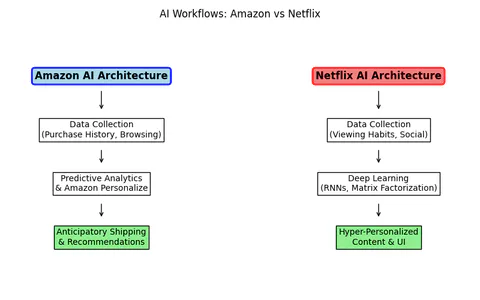
Amazon leverages predictive analytics and machine learning algorithms such as Amazon Personalize to streamline its supply chain and customer segmentation. Predictive analytics allows Amazon to predict consumer behavior and initiate anticipatory shipping as well as targeted advertising campaigns.
AI plays a key role in all the strategic activities of Amazon, and one might say that Amazon is the king of AI strategies in business. According to a very popular number attributed to a McKinsey & Company study, about 35 percent of Amazon's sales are due to its recommendation system rather than to customer searches. The above number has been stated by researchers of the University of Florida as well. However, the number should be taken with a grain of salt. A business professor from the University of Florida has called the above-mentioned numbers hard to believe, and his studies have shown that recommendations increase sales by only 11 percent, as it is quite hard for attribution studies to separate the contribution of recommendations from that of such other website features as search filters and browsing of categories because both factors determine what the customers buy.
The company also uses anticipatory shipping as a strategy. It leverages AI to such an extent that it starts shipping products to nearby local warehouses when it detects through predictive analytics that a customer is likely to order it. Based on hovering, search history, and demographic trends, the AI predicts the customer's intent and takes necessary steps in advance to ensure lightning delivery speed.
Sephora's Omni-Channel AI Experience
The cosmetics industry is incredibly personal, making it difficult to sell makeup online without the customer trying it on. Sephora solved this strategic hurdle using AI and Augmented Reality (AR). They launched the 'Virtual Artist' app, which scans a user's face and uses AI to map their facial features. The user can then virtually 'try on' different shades of lipstick or foundation.
From a strategic standpoint, this is brilliant. It not only ensures that the user gets a pleasurable experience but also ensures that Sephora has a goldmine of information about their users. The AI knows exactly what shades the user is interested in and quickly creates a tailor-made campaign for these shades. Sephora has managed to use AI effectively in connecting the physical store front to the online platform.
Netflix and the Strategy of Retention
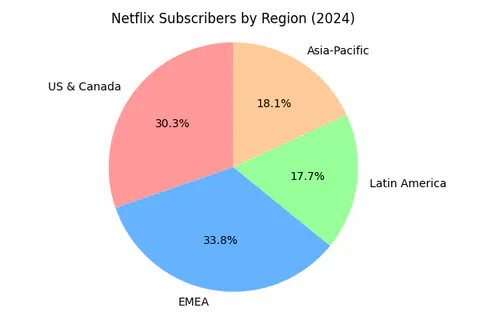
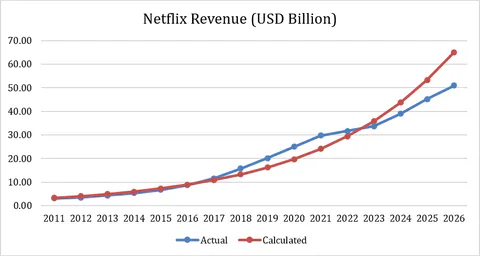
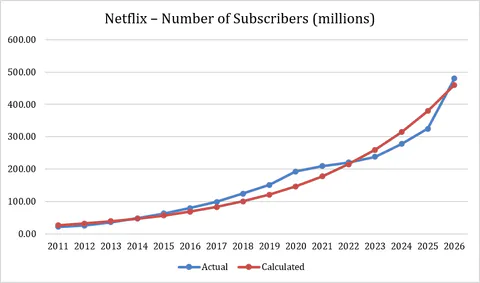
AI segmentation in Netflix includes multiple techniques such as Collaborative Filtering, Recurrent Neural Network, and real-time processing. They monitor how long their customers watch videos, collect interaction data from them, and even create thumbnails to the liking of their customers. In 2024, they managed to generate revenue worth $39 billion with more than 277 million subscribers worldwide.
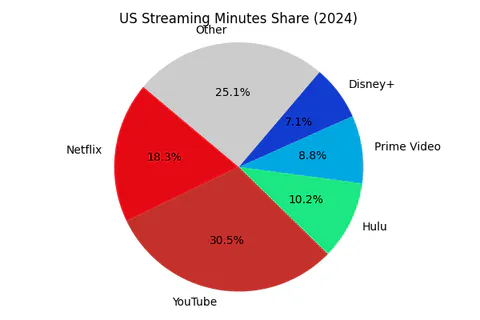
Marketing for subscription-based companies is not only aimed at gaining new customers but also retaining the current ones. Netflix employs AI technology as an efficient retention tool. Whenever you pause, rewind, or skip a particular movie or TV show, that piece of data is recorded in the database and used to form the famous recommendation algorithm that hooks up the viewer to Netflix.
More interestingly, Netflix has begun to employ AI to change the appearance of the artwork for its movies. If you regularly watch comedies, the thumbnail for your movie is going to display the face of the comedian featured in the movie. In case of another viewer who loves watching romance, AI will generate a thumbnail for the same movie, only this time showing the romantic scenes from the movie.
The Human Element: Augmented Intelligence in Strategy
With all these developments of automating marketing through super intelligent robots, the question that naturally comes up is whether or not there is still a need for humans in this process. As a business student studying these innovations, the answer is definitely yes! However, there are changes in the role of humans coming.
It is becoming more about the use of Augmented Intelligence, as opposed to Artificial Intelligence. While AI can easily calculate all possible correlations and do amazing things with data analysis, it does not have emotional intelligence. An AI algorithm might figure out that some advertisement generates tons of hits because it is controversial. The program will then suggest to continue investing in it. The human expert will need to step in and say: "Yes, it works like a charm, but we'll get a terrible reputation as people hate us for it".
Moreover, AI completely depends on historical data. This means it cannot produce any innovation as there is no historical precedent for something that never existed before. For example, there is no way the AI could have produced a touch screen phone with no physical keyboard -- this was impossible until the human visionary made it possible.
Calculations
a. Netflix Revenue (USD Billion)
In graph, x-axis as years from 2011 to 2026 and Y-axis will show Netflix Revenue (USD Billion). Let's consider 2011 as 1, 2012 as 2........2026 as 16.
After manually drawing graph and on excel, we concluded exponential equation covers maximum number of plots considering .
Formula:
Where "y" represents Netflix Revenue (USD Billion), and "x" represents 1, 2, 3…… (1 represents 2011, 2 represents 2012 and so on).
b. Netflix – Number of Subscribers (millions)
In graph, x-axis as years from 2011 to 2026 and Y-axis will show Netflix – Number of Subscribers (millions). Let's consider 2011 as 1, 2012 as 2........2026 as 16.
After manually drawing graph and on excel, we concluded exponential equation covers maximum number of plots considering .
Formula:
Where "y" represents Netflix – Number of Subscribers (millions) and "x" represents 1, 2, 3…… (1 represents 2011, 2 represents 2012 and so on).
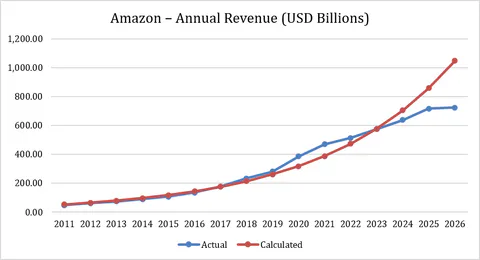
c. Amazon – Annual Revenue (USD Billions)
In graph, x-axis as years from 2011 to 2026 and Y-axis will show Amazon – Annual Revenue (USD Billions). Let's consider 2011 as 1, 2012 as 2........2026 as 16.
After manually drawing graph and on excel, we concluded exponential equation covers maximum number of plots considering .
Formula:
Where "y" represents Amazon – Annual Revenue (USD Billions) and "x" represents 1, 2, 3…… (1 represents 2011, 2 represents 2012 and so on).
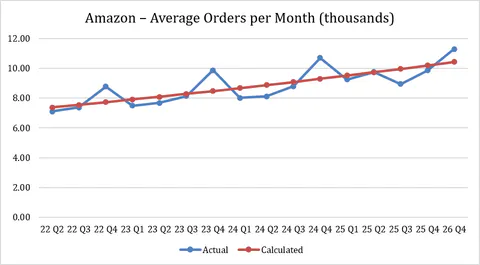
d. Amazon – Average Orders per Month (thousands)
In graph, x-axis as years from 2016 to 2026 and Y-axis will show Amazon – Average Orders per Month (thousands). Let's consider 2011 as 1, 2012 as 2........2026 as 16.
After manually drawing graph and on excel, we concluded exponential equation covers maximum number of plots considering .
Formula:
Where "y" represents Amazon – Average Orders per Month (thousands) and "x" represents 1, 2, 3…… (1 represents 2011, 2 represents 2012 and so on).
Challenges, Risks, and Ethical Considerations
Despite its incredible power, integrating AI into business and marketing strategy is not without significant challenges.
The Black Box Problem
One of the biggest issues with advanced machine learning is the 'black box' phenomenon. Sometimes, an AI will recommend a specific marketing strategy, but the math behind the recommendation is so complex that human engineers cannot understand why the AI made that choice. This is dangerous for corporate executives who have to explain their strategic decisions to a board of directors or shareholders. Blindly following an algorithm without understanding its logic is a massive corporate risk.
Algorithmic Bias
AI learns from human data, and humans are inherently biased. If a company uses historical data to train its AI on who its "best" customers are, the AI might inadvertently learn to exclude certain minority demographics or geographic regions from its marketing efforts. This not only results in highly unethical discriminatory marketing, but it can also trigger massive public relations disasters and legal lawsuits.
Data Privacy and Consumer Trust
To fuel these brilliant AI strategies, companies need data lots of it. However, we are currently experiencing a massive cultural and legal pushback regarding data privacy. Regulations like the GDPR in Europe and the CCPA in California strictly limit how much data companies can collect and how they can use it. Furthermore, consumers are becoming increasingly creeped out by hyper-personalization. If a marketing strategy feels too predictive, it crosses the line from helpful to invasive. Strategists must carefully balance the power of AI with respect for consumer privacy.
Hyper-personalization needs more technical solutions in addition to the legal ones. As a result of the need for data minimization, businesses are moving toward using federated learning, which helps in modeling behavior of users by learning from it directly from the user’s device without the data leaving the user’s device and going to any centralized database. The system of consent management is also changing with the introduction of layered consent where businesses allow people to choose between different types of consent. Some people might accept some purposes (personalization of content) but refuse others (ad targeting across multiple platforms). Companies are also moving towards using zero-party data where customers provide their own data voluntarily.
Future Outlook
Looking toward the end of the decade, the role of AI in business strategy will only deepen. We will likely see the rise of autonomous marketing departments, where an AI is given a quarterly budget and a target ROI, and is left completely alone to generate the creative assets, place the bids, run the campaigns, and adjust the pricing.
Additionally, the integration of Voice AI and smart assistants (like advanced versions of Alexa or Siri) means that businesses will have to develop 'conversational strategies.' Instead of optimizing for visual screen time, marketing strategies will have to optimize for how AI assistants speak to their owners when recommending products.
Conclusion
In conclusion, Artificial Intelligence has completely rewritten the playbook for business and marketing strategy. It has taken a discipline that was once defined by retroactive analysis, broad audience guessing, and slow campaign cycles, and transformed it into a precise, predictive, and hyper-personalized science.
By leveraging the core mechanics of machine learning, natural language processing, and predictive analytics, companies can now anticipate consumer needs before the consumer even registers them. Industry titans like Amazon, Starbucks, and Sephora have proven that integrating AI into the core of a strategic framework yields unparalleled financial success and customer loyalty.
However, this technological revolution requires careful navigation. Businesses must remain vigilant against the risks of algorithmic bias, the black box problem, and the erosion of consumer privacy. Ultimately, the most successful companies will be those that master 'augmented intelligence' combining the mathematical processing power of AI with the irreplaceable empathy, creativity, and ethical oversight of human strategists. AI is no longer a futuristic concept; it is the present engine of business strategy, and those who fail to adopt it will be left analyzing the past while their competitors predict the future.
The role of Artificial Intelligence has been a material, and increasingly quantifiable, accelerant to this growth trajectory for both companies. Netflix's AI-driven recommendation engine is estimated to save approximately $1 billion annually in customer retention by reducing churn through hyper-personalized content discovery, saving subscribers over 1,300 hours per day collectively in search time. AI further informs content commissioning decisions by identifying which genres, narratives, and talent combinations are statistically likely to resonate with specific audience cohorts, improving the hit-rate on original productions and rationalizing content spend. More recently, Netflix's ad-supported tier — which reached 94 million users by 2024 — deploys AI for personalized ad targeting and localization across 30+ languages, with advertising revenue projected to double in 2025; this represents an entirely new monetization layer that the data series does not yet fully reflect. For Amazon, AI's contribution is structurally deeper and dual-channel. Within e-commerce, AI-powered warehouse robotics — 1 million robots coordinated via Deep Fleet AI models — reduce fulfillment travel time by 10% and improve workplace safety by 30%, compressing operational costs and supporting the order volume growth visible in the quarterly orders dataset. More significantly, AWS — which contributes nearly 20% of Amazon's total revenue but a disproportionately higher share of operating profit — reported $108B in revenue in 2024 (+19% YoY), with its AI-specific revenue growing at triple-digit year-on-year rates and representing a multi-billion dollar annual run rate. Amazon's capital expenditure on AI infrastructure approximately doubled to ~$60B in 2024, with a further $100B+ planned for 2025 — the largest such commitment globally. In aggregate, AI has functioned not merely as an efficiency tool for these companies but as a structural demand creator: for Netflix, it deepens engagement and unlocks new revenue streams; for Amazon, it is simultaneously a cost optimizer in retail and the fastest-growing revenue segment within cloud — each reinforcing the ~21% compound growth rate observed across the 14-year dataset.
ACKNOWLEDGEMENTS
The author would like to express sincere gratitude to research mentor Dr. Mamta Jain, M.Sc (Mathematics), M.Phil (Computer Applications, University of Roorkee, now IIT Roorkee, India), Ph.D (Mathematics), Former Lead Auditor ISO 9001, ISO-22000 School Accreditation Examiner by QCI, Independent Researcher and Guiding Counsellor, Ludhiana, India, for her valuable guidance and mentorship throughout this research.