Good governance of charity foundations in Islam, specifically waqf, plays a significant role in achieving sustainable development. The substantial proportion of total waqf is still lying dormant across the world till now. The aim of the study is to obtain a better understanding of the problems related to waqf governance and its characteristics. An exploratory research design which uses depth interview is carried out on the authority which is responsible for the implementation of waqf governance in the region of south-east Asia particularly in Bangladesh. The findings showed that legislation and inefficient management are among the possible impeding factors for good governance of waqf. The paper, therefore concludes with the employment governance on waqf distribution that may be the effective model for achieving the Sustainable Development goals of Bangladesh through charity fund before 2030 easily; side by side Bangladesh can be the role model of entire world.
## I. BACKGROUND OF THE STUDY
The ward Waqf comes from the Arabic root verb waqafa which signifies—causing something to stop and standstill|. It also defines as holding or keeping. In shari'ah, waqf is defined as—holding a maal (property) and prevent the usage for the purpose of issuing benefits continuously to represent truth objective or the good of charity|(Aziz, Johari, & Yusof, 2013). Therefore, waqf is an Islamic institution which existed since the time of the Prophet Muhammad saw. It brings together both the spiritual and materials elements. Based on its nature, waqf actually acts as the catalyst for economic growth as well as the human development, provided that the institution is systematically and optimally implemented. Socially, waqf enables the birth of responsible and accountable citizens which will eventually promote sustainable development (Latif 2018). Waqf institutions could enhance socio-economic contributions of Muslims in many ways. The models of Islamic banking and finance have been linked with the institutional and welfarist concept of sustainability development (Ferdausur Rahman, Ahmad, & Islam, 2023).
There are a few hadiths that support the concept of waqf. One was mentioned by the Prophet (p.b.u.h): whence a child of Adam dies, his/her deed comes to an end except for three things; running and continuous sadaqah, knowledge that benefits (others) and a righteous child who pray for him or her. Second, when Umar bin Al-Khattab went to the Prophet (p.b.u.h) and said "Messenger of Allah! I got a land in Khaibar. I never got a property more precious to me than this. What do you advise me?" The Prophet (p.b.u.h) said, "If you want you can make habs on (bequeath) it, and give it as sadaqah (charity); provided that it should not be sold, bought, given as a gift or inherited". Then, Umar gave it as charity for the poor, relatives, slaves, wayfarers and guests. There is no harm for the person responsible for it to feed himself or a friend from it for free, without profiting. Third is when All the Prophet's (p.b.u.h) companions proclaimed their land as waqf. This evidenced through narrations and report by Thabit Bin Anas Jabir Bin Abdullah and Ibn Hazm (Ibrahim & Ibrahim, 2013). Allah (SWT) says in the Holy Quran: 'those who spend their wealth (in Allah's cause) by night and day, in secret and in public, they shall have their reward with their lord. On them, shall be no fear, nor shall they grieve' (Sura: Al-imran, verse: 274); 'By no means shall you attain Al Birr (piety, righteousness-here it means Allah's reward, i.e. paradise), unless you spend (in Allah's cause) of that which you love; and whatever of good you spend, Allah knows it well.' (Sura: Al-imran, Verse: 92); and 'Verify those who give sadaqat (i.e. zakat and alms), men and women, and lend a goodly loan, it shall be increased manifold (to their credit), and theirs shall be an honourable good reward (i.e. paradise)' (Sura: Al Hadid, Verse: 18). Based on its nature, waqf actually acts as the catalyst for economic growth as well as the human development, provided that the institution is systematically and optimally implemented. Socially, waqf enables the birth of responsible and accountable citizens which will eventually promote sustainable development. A waqf is under the context of charity "sadaqah". It is an inalienable religious endowment in Islamic law, typically donating a building or plot of land or even cash for Muslim religious or charitable purposes with no intention of reclaiming the assets. The donated assets may be held by a charitable trust. The grant is known as mushrut-ul-khidmat, while a person making such dedication is known as wakif, a donor (Ariff, 1991).
Waqf, since it was introduced by the Prophet Muhammad (SAW) in 622 Hijrah by giving away seven orchards that have been given by a man called Mukhairiq after his death to Rasullullah s.a.w for the purposed of Muslims society in Madinah (Khaf, 2003), the practices is still continuing and evolving with the times and across the Muslim country. Until today, the glorious of Waqf institution that have been achieved during the glory of the Ottoman Empire is still being spoken by the Muslims community all over the world. During that day, every society basic needs such as providing the health services, education, orphanage center, mosques, shelter and residences was provided by Waqf institutions. The practices of Waqf have been continued and followed by other Muslims country and one of it during the middle of the nineteenth century were a half size of land in Algeria has been donated as agricultural land while one-third in Tunisia in 1883 and one-eighth in Egypt in 1949 has been donated by the authority of the caliphate for the education and health purpose in order to fulfill needs of the society during that time (Cizakca, 1998). What have been written in history has showed that Waqf was not only seen as a mechanism in providing the basic needs to the needy but including in redressing. socio-economic inequities and as one of the social security system which will help individuals and public to ease the financial burden of a country thus enhancing the quality of life among the society in accordance with the requirement of Shariah (Abdullah, 2018). Following some countries are highlighted about waqf system:
First, waqf in Turkey. Waqf in Turkey are managed by Directorate General of Waqf and some are managed by mutawalli. Under the Turkish legislation, waqf must have a board of management and must be audited every two years. The Directorate-General received $5\%$ of net income of waqf as the cost of supervision and auditing. The Directorate-General is appointed by the Prime Minister and is under the office of Prime Minister. Waqf services cover the health care, education and social (Babacan, 2011).
Second, Waqf in Egypt. At the beginning, waqf in Egypt was in the form of waqf for families and khairi waqf (waqf for public interests). In the form of waqf for families, waqif may take back the properties which have been given for waqf purpose or may change its use, but waqif is not allowed to withdraw the properties for the benefit of himself or herself. In the khairi waqf, waqif cannot either withdraw the properties or change its use. Due to some problems arising in the implementation of Waqf for families, it was decided that this type of waqf was removed, including waqf muaqqat (limited time waqf) which was included in the waqf for families. Egyptian government manages waqf in detail and the waqf is always developed according to the circumstances. For instance, the Egyptian law of waqf allows the change of farmlands for good purposes, and the economic institutions are authorized to develop the outcome of agriculture for the people's economic improvement. The waqf law which is based on the Islamic sharia is regularly revised in accordance with the existing situations and an institutions specially handles waqf and its development was established in 1971 (Furqon, 2012).
Third, waqf in Kuwait. The government of Kuwait established a waqf foundation 'aamm Kuwait' or Kuwait Awqaf Public Foundation in 1993, managing waqf and its projects for people. This waqf foundation has distributed some helps, among others are scholarships for disadvantaged students, clothes for the poor, water supply and food during the holy month of Ramadan for the poor (Ramli & Sulaiman, 2006).
Fourth, waqf in Qatar. Law no. 8/1996 on Waqf, Chapter IV, Qatar government allows mobile and immobile goods for waqf, such as shares, securities and banknotes. Islamic law still the basis for the implementation of waqf. Even the money waqf can be invested at Islamic banks and the in stamen outcomes can be used for the needs or mauquf awhile (Çizakça & Murat, 1998). Studies on waqf problems and solutions have been conducted in previous study and stated the use of waqf lands is to provide a help for people's welfare as a worship to Allah SWT and the use of this waqf land should be conducted in the form of waqf pledge. Waqif have responsibility for the supervision and the use of the lands. Based on the studies, the waqf lands have yet to function properly for the public interest. The solution to this problems that must be authorized legally (Budiman, 2011).
It is a very important instrument in the economy of the Muslims since it is promised to be given the consent from Allah swt (al Haddad, 2008). Iman Abu Hanifa said that the legal meaning of waqf is the detention of a specific thing in the ownership of waqf and the devoting of its profit or products "in charity of poors or other good objects". While Iman Abu Yusuf says that waqf signifies the extinction of the waqif's ownership in the thing dedicated and detention of all the things in the implied ownership of God, in such a manner that its profits may revert to or be applied for the benefit of mankind. The above elaboration is reflected in the sayings of Allah saw which is mentioned in Surah al-lmran verse 92: Never will you attain the good [reward] until you spend [in the way of Allah] from that which you love. And whatever you spend - indeed, Allah is knowing of it. (in Quran 3:92) The governance of waqf properties in Malaysia is under the supervision of each state's jurisdiction, that is the State Islamic religious Council (SIRC). According to Zulkifli (2008), it is estimated that there are 35,727 hectares of waqf land in existence in Bangladesh, out of which 20,735.61 acres are registered. However, as at 2009, there are 9,937 hectares of waqf land, worth RM 1.9 billion has yet to be developed
The main objective of this paper is to study the alternative solutions to poverty alleviation other than the public policy by the government. The main focus is however to see how an instrument modeled using cash waqf as a source of fund can stand up against the other available alternative, namely microfinance institution. The study brings forward the potential that the model has in terms of how much poverty can be reduced and the amount of money can be saved by the government (Zuki & Md., 2012). By comparing cash waqf model and the microfinance institutions model side by side, it can't be helped but to notice how cash waqf model proves to be a viable alternative instrument in combating poverty. It manages to answer most (if not all) questions that have been raised against the microfinance institutions as a poverty alleviation solution. Thus this section will be concluded with the list of why cash waqf should be considered in sustainable development (Zuki & Md., 2012).
## II. LITERATURE REVIEW
Waqf is mostly known as donation to the community. The main characteristics of waqf are irrevocability, perpetuity and inalienability. Irrevocability means that the donor has no power in dismissing the donation at any time. Perpetuity means the donation given are last longer. The declaration is made between the donor and receiver and it is robotically legitimately binding. For inalienability, it means the donation should be not sold, given as gift or being inherited (Iman & Mohamad, 2014). In addition, waqf consists of two categories which are general and specific. General means a donor waqf something without a specific purposes or specific people while specific means a donor waqf something with a specific reason towards specific individuals. It is pleasant to note here that, on account of waqf, its reality does not come in light of financial issues, rather waqf has been there at the unique reference point of Islam since the season of Prophet Muhammad (peace be upon him) until the last Ottoman Empire (Çizakça & Murat, 1998). Meanwhile, "Right" infers that Islam dynamically indicate the commitment of the general public, especially the rich, to donate effectively in battling poverty in term of zakat and waqf (Ahmad, 2015). Then again, waqf as a intentional part founding is a systematized charity planning to convey wellbeing managements to poor people, it can be as properties, (for example, land, building, vehicle and so on) or, turning out to be more frequently now, which is cash waqf. Additionally, waqf is well-known as a fixed title of a possessed resource from disposition and portion of its advantages for a particular reason or purposes. Waqf is a happily charity considered in term of permanency. Consequently, the benefit cannot be rejected; nor its proprietorship exchanged. Just its benefits are to be utilized for the specific purpose(s), which is (are) basically charitable in nature. In this sense, waqf is a never-ending charity and this unendingness is its ultimate trademark. The charitable purposes of waqf customarily included instructive organizations, orphanage, streets, religious foundations like mosques, burial grounds among other public facility (Sadeq, 2002).
The Islamic waqf idea empowers the owner of property to settle his for the consumption of beneficiary's perpetuity. Waqf is recognized once the proprietor (waqif) makes a declaration that the pay of the property is to be saved forever for a specific reason. Waqf can be said to be a part of family law. The laws identifying with the waqf are an important piece of Islamic law (syariah). It has relations with different sectors of law and humanity, for example, legacy, wills, endowments and marriage, subsequently waqf are generally managed as a feature of family law. There are two types of dimensions in the institution of waqf which are making donation of waqf and management of waqf. Usually, a successful individual will make a donation of waqf as an act for charitable which has been belief by him/herself. For management of waqf, it actually depends towards the term of waqf itself. Occasionally, a voluntary giving is made by mutawalli or someone who is reliable in order to take a good care of the waqf property. Management who is dedicated also seldomly being ask to look at the waqf property (Ferdausur Rahman et al., 2023).
# a) The Waqf and its
Waqf is a charitable foundation. It improves by the effect of moral and religious motivation. The words charities have permanence and continuity, so that people can benefit from them for years, generations or even centuries. It should also be noted that the Islamic definition of Waqf makes its assets cumulative, in the application to the principle of perpetuity in Waqf. It means that a Waqf properties may not be sold or disposed of in may form, i.e. a Waqf properties remains in the Waqf domain perpetually and any new Waqf will be added to that domain, implying that the Waqf properties are only liable to increase. They are not permitted to decline since it is illegal to consume the properties of Waqf or to leave them idle by any action of neglect or transgression (Zain, Noor, Ramlan, & Samah, 2017).
 Figure 1: Waqf product in Bangladesh
Prophet Muhammad ordered Muslims to maintain their environment when he said in a prophetic hadis: "If any Muslim plants a tree or sows a field, and a human, bird or animal eats from it, it shall be reckoned as charity from him" (Imam Ahmad). In other hadits, he said, "If the day of resurrection comes upon any one of you while he has a seedling in hand, let him plant it" (Al-Bukhari). Many Muslims believe that waqf is solely for religious matters. Little do majority of the them know that waqf can benefit all level of society, As to rid away this misconstrued understanding of waqf, it is imperative to understand what waqf means in this new era of modern world (Ibrahim & Ibrahim, 2013). Waqf in general can be identified into three types which are All'qar (irremovable assets), Al-Manquil (removable assets) and Waqf Al-Irsod. The irremovable assets refer to any assets that cannot be moved, relocated or changed. In MAIS, the institution has dealt with irremovable wealth such as land for agriculture, school building, mosques and orphanage (Aziz et al., 2013).
Cash waqf is the main instrument in collecting waqf funds. Cash waqf is a product that allows people to donate cash without having to have fixed assets such as land. In Malaysia, some of the products introduced by the waqf institutions are gold waqf, takaful waqf and the Quran waqf. Cash waqf encourages people to do charity with no limitation on the amount of waqf and people can even join the cash waqf with the lowest amount of RM 10. One of the roles of cash waqf in the Islamic community is being used for da'wah1 infrastructure development, which is a social assistance for the Muslim community economic development (Azri Ahmad, 2008). Cash waqf investment will be able to generate multiple profits and can produce a lot of waqf properties in the form of a new permanent property (Hasan, 2015). The laws of the "waqf" offer the expansion of the wealth to become the "waqf"s objects, not only limited to non-moveable wealth but also moveable ones such as money, gold, vehicles, securities, intellectual possession, rental right, and the other moveable ones agree with the Islamic laws. Regarding non-moveable things which can be "waqf's objects not only limited to land possessions but in the article 16 of the laws of "waqf" stated that "the rights of the land agree with either the listed or non-listed applied laws". Therefore, the rights of land which become the "waqf" objects such as one's possession, the right of building use, the right of business use, the right of using, and the right of mansion possession (Medaline, 2018). It is expected that with a proper mechanism of waqf financing provided by Islamic financial institution, it is able to benefit many parties in getting financing facilities as well as for investment purposes that may attain the both objectives of this world and hereafter (Aziz et al., 2013). So far, we have already explained that it is very hard to get loan for development of Waqf land. So, it is the best solution to use cash waqf money in this sector (Chowdhury, Ghazali, & Ibrahim, 2011).
Ahmad (2015) focused on waqf- based microfinancing on the pattern of the Grameen Bank. He also suggested to protect against withdrawal risks, the MFI can use takaful and profit-equalization reserves to give depositors competitive returns. The traditional former lenders faced with borrowers whom they do not personally know the exposing them to very high risks due to the inherent screening problems faced by the newspaper or radio etc and encouraging people to come forward with a helping hand. It is the right of the waqf donor to instruct the Islamic Bank, where his/her money will be invested that is whether SME, or Microfinance or Land development etc. So if they want, they should be allowed to enjoy this right, in fact the bank will provide some good suggestions (Chowdhury et al., 2011). Basically, profit should be distributed according to the donor's will. However, if he assigns the responsibility to the bank, then it can be distributed in three ways:
1. To charities such as mosque, madrassa, poor, social activities, training of youth, marriage for poor girl, religious education etc.
2. To management includes maintenance, managerial expenses and future development and capital enhancement.
3. To marketing because when there is any natural disaster or illness etc then through publicity by television, radio or newspaper it is always easy to raise donated fund. So through proper marketing policy it is possible to encourage people to endowed more cash waqf (Chowdhury et al., 2011).
i. Small and Medium Enterprise (SME) loan
Waqf fund should be used to provide loan to small and medium enterprises due to the fact that SME is an emerging sector in underdeveloped and developing nations. If these sectors are neglected then it would be impossible for these nations to make economic development (Chowdhury et al., 2011). The paper has developed ICWME-I model as a source of financing for micro enterprises. This model is expected to provide financial services by using cash waqf fund and involved the participatory contract between nonprofit organization and micro enterprises. In addition, with the proposed model, there will be no collateral requirement, interest rate and other stringent requirements which usually imposed by existing conventional financial institutions (Thaker, Mohammed, Duasa, & Abdullah, 2016). The common parties involved for waqf to be valid are: founder (Waqif), beneficiary (Maukuf Alaihi) and donated property (Maukuf). First, the founder must be mature and has a sound mind. He must donate on his will and he owns the property he wants to donate. Second, the founder must specify in the waqf deed who shall benefits from his proclaimed waqf. The beneficiary can be specified as individual or general philanthropy to the society. Third, the donated property must be something that can be donated where its ownership rightfully belongs to the founder. Lastly, a lafaz is undertaken to validate the waqf agreement (Ibrahim & Ibrahim, 2013).
In present, it has proved around the globe that Micro Credit and Safety Net Program are not successful in reducing poverty and income inequality. In this context, Waqf can be one of the vital alternatives alongside Zakah because early history indicates free education, scholarship, orphanage, free treatment etc as provided by Waqf based institutions. But current scenario shows that, Waqf based institutions are not growing at a considerable level (Ahmad, 2015). Most of the 17 developmental goals of the SDGs comfortably match with the long-term objectives of shariah and there is good scope for the stakeholders of awqaf to develop waqf-based development plan in line with the framework of SDGs. Additionally, it finds that the global awqaf enjoy sufficient financial capacity to help muslim majority countries to realise some of the most relevant and urgent maqasid-oriented SDGs in a timely manner (Abdullah, 2018). An efficient waqf governance should help to preserve valuables either in the form of cash or non-cash fixed asset earned from voluntary but permanent distribution of wealth in an Islamic society (Latif, Din, & Mustapha, 2018).
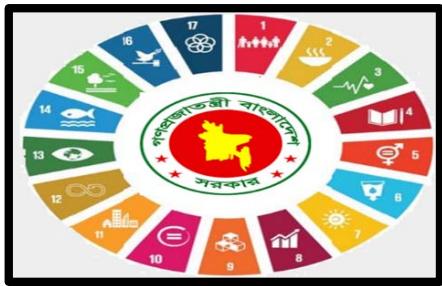 Figure 2: Waqf distribution area of Bangladesh
Waqf as a charitable institution in Islam is expected to play its significant role to carry out environmental protection and therefore to ensure a more sustainable development in the country. This paper tries to elaborate potential of waqf institution for environmental protection and to reveal advantages and benefits of making waqf a means for environmental protection (Aziz et al., 2013). In this religious approach, waqf as a charitable institution in Islam is expected to play its significant role to carry out environmental protection and therefore to ensure a more sustainable development in the country (Budiman, 2011). Most Muslims are familiar with the concept but do not really understand the definition and meaning of waqf along with its process, law, administration and management of it. Waqf is standardly known as benevolence instruments where the profit is used to improve the welfare of the unfortunate society (Ibrahim & Ibrahim, 2013). There are many papers written on the participation of Islamic financial institutions in providing fund to develop waqf properties. Here, it is evidenced that developing waqf properties are not small matters in hand. All parties should lend their hands to be realize what Rashid (2011) expressed as "only sky is the limit in the waqf development (Ibrahim & Ibrahim, 2013). From Islamic scholars, it can be concluded that sustainability from an Islamic perspective is a balance in the use of natural resources for the economic, social, and spiritual benefits of the past, present, and future. In short, sustainability is balanced, fair, and continuous in all aspects of human life, including spiritual and physical. There are seven principles of sustainability as proposed by Khan (2001) which is to avoid waste; establishing rules, and evaluating oneself through history; maintaining a balance in the thinking, actions, and the usage of resources; accountability in governance and administration; creating equity and justice in the economy and business; purification of the soul (tazkiyyah); and conversation and development of resources in the service for humans and other beings(Hassana, Baharib, Azizc, & Doktoralinad, 2020). In Islamic culture, Waqf is as one of the successful entrepreneurship patterns or permanent Islamic almshouses that require using simultaneously business skills and entrepreneurial innovation and using the profits for eliminating poverty and social welfare strata. In addition, by developing the Waqf and charity activities, benevolence, and prosperity in parallel with the private and, the expenses of the transitional government will be reduce. And major needs of the society in the field of education and training fields, higher education, health and treatment that are heavy burden for the government can be done by NGOs and people which will foster the movement cycle of development in parallel with development in public and private sector (Sulaiman & Zakari, 2015).
Waqf administration in Bangladesh is an Islamic discipline that is dynamic, socially beneficial and socially autonomous organization. This organization was formed according to the Bengal Walk for Act of 1934. According to Walk F Ordinance-1962 Wavkadfar. The main goal of this organization is to promote the development of walkthrough education, pollution control and proper management along with the implementation of the objectives. Consequent to the Walks Ordinance Constitution Act 2013 and the Walks (Transfer and Development of Assets) Act 2013. Innovative operations of Kazaldoir to make services delivery fast and efficient. In order to become a vital beneficiary country, Bangladesh will continue to pay its dues to the importance of global cooperation.
Table 1: Shows the distribution of waqf Revenue, taka in lakh, Main & Local working place
<table><tr><td>SL</td><td>Particulars</td><td>Target</td><td>Amended
Bazet 2022</td><td>6 month's income & expense</td><td>Bazet Allotmented 2021-2022</td><td>Actual income/expense 2021-2022</td></tr><tr><td>a</td><td colspan="6">Revenue</td></tr><tr><td>1</td><td>Collection</td><td>1,710.92</td><td>1,710.92</td><td>440.50</td><td>1,710.92</td><td>881.30</td></tr><tr><td>2</td><td>Allotment by Govt.</td><td>750</td><td>750</td><td>36</td><td>75</td><td>75</td></tr><tr><td>3</td><td>Collection by others</td><td>84</td><td>84</td><td>42</td><td>84</td><td>92</td></tr><tr><td>b</td><td colspan="6">Main & Local working place</td></tr><tr><td>1</td><td>Total Expenses</td><td>857.80</td><td>857.80</td><td>389.05</td><td>857.80</td><td>857.80</td></tr><tr><td>2</td><td>Balance</td><td>1012.12</td><td>1012.12</td><td>129.45</td><td>1012.12</td><td>190.50</td></tr><tr><td>C</td><td>Country Budget</td><td></td><td></td><td></td><td></td><td></td></tr><tr><td>1</td><td>Revenue Budget</td><td>1862.92</td><td>1862.92</td><td>518.50</td><td>1869.92</td><td>1048.30</td></tr><tr><td>2</td><td>Developed Budget</td><td>1862.92</td><td>1862.92</td><td>518.50</td><td>1869.92</td><td>1048.30</td></tr></table>
Table 2: Collection of wafq in taka (lakh)
<table><tr><td>Fiscal Year</td><td>Target of Collection</td><td>Actual Collection</td><td>Collection Rate</td></tr><tr><td>2021-2022</td><td>1,710.92</td><td>881.30</td><td>51.51%</td></tr></table>
Table 3: The Waqf of Funding, Expenditure and Advancement in Annual Scholarship Scheme in 2021-2022
<table><tr><td>Years</td><td>Amount of Allotment (TK)</td><td>Expenses (TK.)</td><td>Rate</td></tr><tr><td>2021-2022</td><td>75,00,000</td><td>75,00,000</td><td>100%</td></tr></table>
The waqf is not only the spiritual and religious aspect but also an important issue which has influence on the economic, political, community, educational and social development. As waqf institution covers a wide range of issues from economic to the social aspect of the human development, it can be attributed as one of the prime tools to uplift the pride, dignity and supremacy of Islam (Chowdhury et al., 2011). In Islamic culture, Waqf is as one of the successful entrepreneurship patterns or permanent Islamic alshouses that require using simultaneously business skills and entrepreneurial innovation and using the profits for eliminating poverty and social welfare strata. In addition, by developing the Waqf and charity activities, benevolence, and prosperity in parallel with the private and, the expenses of the transitional government will be reduce. And major needs of the society in the field of education and training fields, higher education, health and treatment that are heavy burden for the government can be done by NGOs and people which will foster the movement cycle of development in parallel with development in public and private sector. Many widows are facing financial constraint due to their low income and financial difficulties. Therefore, cash waqf can be used to transform many less privilege widows across Malaysia financially, socially, and religiously. The stated instruments and models can be applied to empower needy widows in Malaysia in order to reduce their financial challenges and constraints. The paper proposes strategies through which Cash Waqf can be used for the creation of resources and tools for empowerment of widowed women such as through educational funds, creation of employment opportunities, and provision of tools for entrepreneurial activities (Amuda, Razak, & Ahmed, 2016).
financing in Islamic history in developing a country by providing the social and public goods to the society have been a major factor for Waqf practices to be retrieved back today. In order to exterminate the poverty, depending in Zakat alone is not enough. Waqf can be an alternative in solving the socio-economic problem of the Ummah which covers the issues such as poverty, inequality and rising cost of living as well in promoting the social wellbeing in the society. (Atan & Johari, 2017). Waqf has played the role to facilitate kinds of either religious or social activities, such as places for worship, for travelers, for science, for schools, for scientific papers making, for water supply and for the needs. At the time of Bani Umayah and Bani Abasiah, waqf's role was not only to build places of worship or of education, but also it provided the operational cost for knowledge, for library, for education, for scholarship, for teachers' and lecturers' welfare and for other educational staff. This shows the significant role of waqf for people's needs in facilitating the religious, social and academic activities (Huda, Rini, Mardoni, Hudori, & Anggraini, 2017). By implementing all basic rules, the waqf implementation can be conducted by using the waqf lands for higher economic activities or by chanelling the money waqf to productive economic agencies that will be eventually invested for job vacancies (Çizakça & Murat, 1998).
Figure 1 explain about the Waqf possesses among to the social function. The Almighty Allah originates people with various characters and abilities. Hence, there are various conditions and environments among people can improve gradually his/her life style with the helping process.
 Figure 1: The Waqf possess among to the social function
Among those abilities, the rich should help the poor, the smart should help the stupid and the strong should help the weak. By doing this, people can make themselves closed to Allah and interactions among people can keep on moving that waqf agencies should be developed professionally and honestly. Furthermore, it can be used optimally for social needs; for instance, for the improvement of Islamic education and hospitals, for the empowerment of people's economic and the development of infrastructures of worships. A number of waqf goods, especially lands and buildings, are opportunities to improve people's economic in the future(Huda et al., 2017).
### b) Waqf and its Governance
According to Aisyah, Ismail, Sulaiman, Cahyo, and Sup (2022) the word 'governance' in Arabic means al-hakimiya that identifies a higher degree of moral social order to which all decision-making structures and 'authority' ought to submit. Normally, good governance practices will contribute in the making of efficient organizations (Mohammad Mohidul Islam, Bhuiyan, & Kassim, 2019). The Quran and Sunnah gave an outline of governance under different circumstances. Laws established by the Holy Quran, and sayings and practices of the Prophet Muhammad (PBUH) emphasize on habitual practices, customary procedures, actions, norms, and usage sanctioned by Islamic tradition. Islam emphasizes justice as fairness, non-discrimination and equity in order to ensure balance and harmony in every aspects of life. As stated in the verse (4:135) of the Holy
Quran, "O ye who believe! Stand out firmly for justice, as witnesses to Allah, even as against yourselves, or your parents, or your kin, and whether it is (against) rich or poor: for Allah can best protect both". The leadership is summoned to act in fairness, justice and bring good to the wellbeing of the ummah. Therefore, it is important for new policies to be imposed on Islamic organizations, on the basis of public interest (al-masalah al-mursalah), be it profit or non-profit organizations, as long as it is Shari'ah complaints and conforms to the public wellbeing (Aisyah et al., 2022).
In Bangladesh, risk prone crisis is high to development perspective(Md Mohidul Islam, Bhuiyan, Kassim, & Rasli, 2022), whereas waqf properties are under the governance of each state's jurisdictions, that is the State Islamic Religious Council (SIRC). Zulkifli, Ismail, Osman, and Ambali (2022) states that waqf affairs are the responsibility of each state. The courts recognize Shari'ah as the governing law of the property for Muslims including waqf. Section 25 of the Civil Law Act 1956 stated that the administration of Muslim's property shall be in accordance with the Islamic Law. There are 14 State Islamic Religious Councils, one for each of the 13 states in Malaysia and one for the Federal Territory. The government of Malaysia has formed the Department for Zakat, Waqf and Hajj on the 27th March 2004, with the aim of making the administration of zakat, waqf and Hajj systematic and effective. This department however does not have the authority to administer and manage waqf properties, but rather plays as a planning coordinator and observes the waqf matters (Rahman, Ahmad, & Islam, 2023; Zulkifli et al., 2022). Zulkifli et al. (2022) further added that has formed Yayasan Waqf for the sole purpose of identifying the underutilized assets of awaqf and planning for their development in coordination with the SIRC of each state. In actual fact, this is a good move the investment of waqf land could be supported by the federal or state government or statutory bodies or financial institutions. Of utmost importance is the ability of the waqf institution to choose the most supporting and suitable methods of financial schemes for any of its investment project. Islam demands its followers to practice altruism in the name of justice and brotherhood. One way of implementing this is through waqf practice among Muslims. Altruism is the willingness to do things that bring advantages to others. It is the practice of disinterest and selfless concern for the well-being of others. The main problems related to waqf administration in Malaysia are the inefficient management of waqf assets and the unsystematic waqf management systems within the states in Malaysia. They further elaborated on the growing concern of mismanagement in these institutions, such as frauds and inefficiency, may discourage the potential waqf donors to support such practice (Aisyah et al., 2022), and most of waqf properties are mosques, religious places, Islamic school and cemeteries and very few of waqf lands generate income to the Islamic Religious Councils. Example is the income derived from monthly rental of waqf properties managed by the authority of
territory only contributed a sum of TK. 15,745 utilized the benefits of the waqf concepts. Yassin et al. (2013) stated that the lack of effort of Muslim scholars and jurists during the last two centuries has caused the impediment of waqf properties. Otherwise, successful waqf governance will generate wealth to Muslim countries, which will indirectly contribute towards the economic growth and sustainability.
Waqf and its model of assets distribute in figure 1 describe the waqf is the one form of charity that is long-lasting because it has the characteristics of perpetuity. The donors make a donation which is in a form of a building where the benefit from the donation will be given to those needy ones who will benefit for a long time. Besides that, zakat is similar to waqf as its benefits is directed towards the beneficiary specifically. Philanthropy is aimed at those who are in needs physically and mentally, either poor or low income households. The poor in the mainstream economy is today widely perceived as a relative and multidimensional, dynamic phenomenon (Dema Moreno & Diaz Martinez, 2012; M., H., & W., 2008). Although poverty can be mitigated by policy interventions, Islamic institutions related to philanthropy and personal relationships may be a significant player. Personal relationships either family or nonfamily based would certainly compliment the role of formal and non-formal institutions (Bank, 2003). Amongst the identified issues in Waqf Unit are:
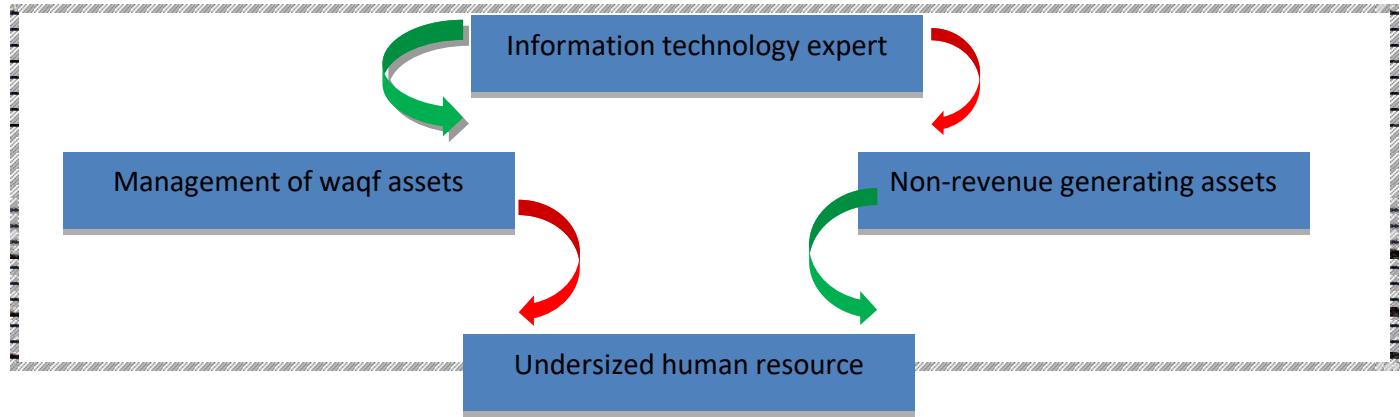 Figure 2: Management of waqf
A strong belief would spur an individual to perform religious obligations. It is inclusive of the commitment to carry out religious obligations such as performing daily prayers, fasting in the month of ramadan and performing hajj. In addition, being spiritually adequate is another important factor in this dimension because in many cases, the feeling of inadequacy is widely common among the poor despite receiving zakat aid from the authorities. Governance that is contribute to risk reduce as well sustainable (Md Mohidul Islam, Bhuiyan, Kassim, & Rasli, 2021)Waqf that is needed to maintain the governance.
Secondly, physical self needs are physical needs in daily life such as healthcare and nutrition, quality of dwelling or living place, amenities, utilities, clothing and transportation. The prophet SAW mentioned that the worldly life is tillage for the hereafter. Thus, it is imperative for a Muslim to preserve his/her life as it has big impact in the hereafter as mentioned the verse below. We have seen and have heard: Now then send us back: we will work righteousness: for we do indeed (now) believe|| (32:12).
Thirdly, knowledge or mind development is essential in developing the intellectual level and skills of individuals. Knowledge is an important aspect of human beings as it gives guidance for the correct way of thinking according to teachings of Islam. This is why Islam attaches great importance to knowledge and education. When the Quran began to be revealed, the first word of its first verse was 'Iqra' that is, read: "Read! In the Name of your Lord Who has created (all that exists). He has created man from a clot (a piece of thick coagulated blood). Read! And your Lord is the Most Generous. Who has taught (the writing) by the pen. He has taught man that which he knew not". (96: 1-5). Education is thus the starting point of every human activity. Allah created man and provided him with the tools for acquiring knowledge, namely hearing, sight and wisdom as mentioned below: "And Allah has brought you out from the wombs of your mothers while you know nothing. And He gave you hearing, sight, and hearts that you might give thanks (to Allah)" (16:78).
Fourthly, posterity or offspring are an important element of human needs. Besides having family, parenting skills and the ability to develop knowledge and skills in children today are essential in the current socioeconomic settings. Having children is a fundamental condition for the continuity of human life. The number of children in a family depends on a few factors such as the age of parents, genetic composition and climate (Tabash & Dhankar, 2014). In this matter, Islam has stressed the importance of safeguarding of the life of children regardless of their gender as mentioned by Quran: Finally, wealth accumulation such as possession of fixed assets and durable goods, the ability to generate income or revenue from economic activities and expenditure on food and non-durable goods. Excess wealth is usually interpreted as a sign of the favor of Allah, while poverty is viewed as a sign of His displeasure. In fact, both conditions are trials from
Allah as mentioned below. Now as for man when his lord trieth him, giving him honour and gifts, then said he, My Lord hath honoured me. But when he trieth him, restricting his subsistence for him, then saith he (indespair), My Lord has humiliated me.[89:15-16). In preserving the interest of muslim ummah who was ignored by his family and society, zakat shall be given to him in term of sponsoring Islamic education (faith), healthcare and nutrition (life) and also business capitalization (intellectual). Besides that, parenting skills and the ability in developing the knowledge in children (posterity) today is also important. This approach may increase their life quality as well as faith. As a return, they have to give back the benefits (wealth) they had received to the societies.
Waqf is to protect something such as building a affordable houses for the needy ones from being taken by a third person. Besides, waqf can be done in many ways in ensuring that it enhance wellbeing of muslim ummah which is by providing water for public consumption (life), providing Islamic institutions (faith) such as -pondok|| for those who want to learn more about Islam (intellect), help those handicapped and the poor, building bridges, provide wealth accumulation in term of financing orphanages and the marriage of young people in need wealth (Zuki & Md., 2012). The main question remains how zakat and waqf would be able to enhance wellbeing of muslim ummah based on basis of maqasid syariah. It would require proper planning and implementation to alleviate each element of wellbeing. Scholars and practitioners should work together to execute effective distribution methods that would be able to alleviate inner and outer fulfilment from the syariah perspective, driving towards a peaceful life, named as Hayat-e-Tayyaba (Sulaiman & Zakari, 2015).
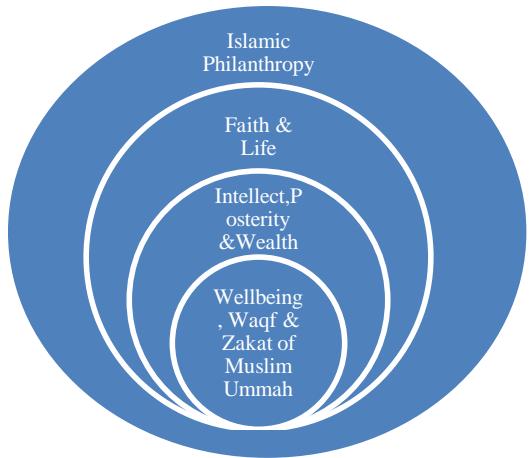
Islamic Philanthropy Figure 3: Element of Islamic Philanthropy in Enhancing Wellbeing
## III. METHODOLOGY
The methodology of this article is based on qualitative research on document study and opinion of all instruments correlated to waqf. To achieve the objectives, the study has been designed on the basis of reviewing some current literatures on the subject, gathering information relevant to the study from prior
publications, journals, reports, research papers, website of various organizations and all other secondary sources of data that are useful for this study. The desire of this approach is to search the conceptual instrument of waqf and their recurrence and practice to collect data among some of researcher's ideas. To achieve the aim of this study, which is to shed light for a better understanding of the problems related to the role of waqf governance in achieving sustainable development, a qualitative research design is adopted. This is a non-conclusive study and exploratory in nature. Initially, a literature study was done to determine the possible reasons of existing problems pertaining to waqf governance. Then, in order to obtain a clearer picture of the problem at hand, a qualitative primary data is collected by using depth interview as the tool and was executed during a case study on State Religion Board. Depth interview is a qualitative research technique that involves conducting intensive individual interviews to explore the respondents' perspectives on a particular idea or situation. It is a loosely structured interview. It allows freedom for both the interviewer and the interviewee to explore additional points and change direction, if necessary. A depth interview is preferred in this study since we are aiming for detailed information. Furthermore, this technique offers opportunity to capture rich, descriptive data. And it can be used as a standalone research method or as part of a multi method design. Nevertheless in this research it is used as part of the methods, to complement the initial literature study done. However, the limitation of this research technique is that depth interview could be prone to bias. Additionally, since this is a qualitative non-conclusive research, generalization of the result is not able to be made. The findings from depth interview in this study, is not generalizable to other state religious boards.
### a) Qualitative Method: Case Study
## i. Indomitable Genius-1
Table 2: History of Asma Khatun's Shabolombi Project
<table><tr><td>Year</td><td>Charity from moral parent</td><td>Self-fund</td><td>Total</td><td>Activities</td></tr><tr><td>2021</td><td>8,000</td><td>0</td><td>8,000</td><td>Purchased two goats. After 8 months one goat and 3 kids tk. 21,000 and she gives this amount to her father's business.</td></tr><tr><td>2022</td><td>5,000</td><td>0</td><td>5,000</td><td>Invested to her father's business. With the revenue of her family is running smoothly.</td></tr></table>
### a. Challenges
1) Scholarship amount is insufficient. One student cannot run his/her study by this little amount of scholarship.
2) Moral Parenting is donating only brilliant and poor student with handsome CGPA from previous public examination. But there are many university students they could not spend more time for the study and earn good CGPA because of poverty but they were brilliant students.
3) Every moral child has to prepare and send report to the moral parent and to the office as well but there are some moral children who have no smart phone and Wi-Fi facilities, in addition, their parents care takes independent projects at their village. In maximum cases parents are poor as well as illiterate
so it is tough to send the report with pictures after every two months.
4) There are many Zakat payers in our country have no clear concept about recipients and distribution system. So they give shari, lungi, cloths, blanket in the month of Ramadan and other sessions by which real Zakat receivers are not benefiting like poor students.
5) There are some rich people who are capable for paying Sadaqah (Zakat, Infaq, Qardhul Hasana, and Waqf Wasia). But they do not have clear idea regarding Sadaqah and its distribution system even the benefits of waqf. Otherwise, they are reluctant about waqf or charity.
### b. Suggestions
1) Moral Parenting Trust should increase the amount of scholarship so that one can give support any to one student/entrepreneur understanding everything e.i. one donor should support one student fully and bear all expenses so that a student can continue his/her study without any tension.
2) Moral parent can relax the reporting system like it may be quarterly or bi-annually. So that moral child can send the appropriate report with relax.
3) Moral parent should select the student not considering the previous result they can select the student based on their poverty and necessity so that actual poor and struggle students can enjoy the benefits from the moral trust.
4) The Rich and capable Muslim should learn about Sadaqah clearly and distribute properly.
## c. Aim in life
I want to do something for the poor people because everyone should do everything for the welfare of the people. Because the life is for other and for parents.
Rich men govt. servant and solvent people should do like this type of work, so that huge employment can be generated.
## ii. Indomitable Genius-2
Borhan Hossan, a student of Biotechnology, Islamic University, Kustia. His father is a farmer and mother is a house wife. His homeland is Rangpur with 4.5 decimals land and the amount of cultivable land is 8/10 decimals. She has one sister and total four family members. Basically, he is a child of a poor family. His father's monthly income is not remarkable. He stays at private hostel and his per month cost is tk. 5 to 6 thousand. Moral trust gives him per two-month tk. 2,700 i.e per month tk.1, 350 so he has to take extra money from his father which is not so easy. In the meantime, his moral parent donates three times under independent project (shabolomby project) which is described in following table:
Table 3: History of Borhan's Shabolombi Project
<table><tr><td>Year</td><td>Charity from moral parent</td><td>Self-fund</td><td>Total</td><td>Activities</td></tr><tr><td>2020</td><td>7,000</td><td>0</td><td>7,000</td><td>Pigeon Farming</td></tr><tr><td>2021</td><td>6,000</td><td>0</td><td>6,000</td><td>Pigeon Farming.</td></tr><tr><td>2022</td><td>5,000</td><td>0</td><td>5,000</td><td>Pigeon Farming. With the revenue of Pigeon Farming his family is running smoothly. Now in my firm the number of pigeons is huge, he cannot count. He is very happy with this scholarship and this independent (shabolomby project)</td></tr></table>
### a. Challenges
1) Scholarship amount is insufficient. One student cannot run his/her study by this little amount of scholarship.
2) In my university area tuitions are not available from where I can earn some money.
3) We are very poor so it is very tough to bring extra money from my family.
# b. Suggestions
- ✓ Moral Parenting trust should increase the amount of scholarship so that one can give support any to one student/entrepreneur understanding everything i. one donor should support one student fully and bear all expenses so that a student can continue his/her study without any tension.
- The Rich and capable Muslim should learn about Sadaqah clearly and distribute properly.
## c. Aim in life
I want to be a university teacher. So After completing graduation from Bangladesh I would like to go to any developed country for higher study. I want to do something for the poor people because everyone should do everything for the welfare of the people. Because following the $90\%$ theory from Dr. Mahbub the founder of Moral Parenting Trust. Under $90\%$ theory Dr. Mahbub said if you expend your total income for your family, it will not be enough or human demand has no limit. So, you should expend the $90\%$ income for your family and remaining $10\%$ for other poor and needy people.
## IV. FINDING AND ANALYSIS
In Bangladesh extreme poverty line that have represent to 24.3 percent, while marginal poor rates fell down by two-thirds of 12.9 percent, based on bottom line poverty that is measures of poverty using the international poverty line of $2.15 a day show comparable trends (Bank, 2003), so in the country there are a huge number of people who are still suffering from their basic needs. Whereas, Waqf can be a benchmark alternative to cope with poverty, Bangladesh is a country where majority percent is Muslim population. Hence the charity system is very popular with common that is recover of poverty and leads to SDG so waqf can also be effective in terms of gaining SDG goals. Waqf (mandatory Sadaqah) is the third pillar out of five pillars of Islam. So as a Muslim majority people of Bangladesh are more or less follow the procedure of waqf. There are some people who are underprivileged in the society are
waqf payer, according to the study we can call them the moral parent on the other hand the people who are poor students i.e. waqf receiver can be called the moral child. In addition, a group of persons who are responsible to care takes the moral child and their self-reliant project on behalf of Moral Parenting Trust is called advisors. After every two or three month moral child (entrepreneur) submit report to his moral parent to the advisor and Trust. It is mentioned here that $60\%$ charity donate their waqf and $40\%$ moral parent donate voluntary Infoq (charity) in this self-reliant project who are called moral parents (donor). Extreme poverty line are getting waqf from the privileged people are called entrepreneur. On the basis of demand and supply that are also some people or institutions which are considered as intermediary task for the waqf payer and receiver such as local mosque, community leader, etc.
## V. CONCLUSION
The aim of the paper is to examine the good Governance regarding Waqf in achieving sustainable development by enhancing wellbeing among households are through Islamic philanthropy. Waqf brings together both the spiritual and material elements. Based on its nature, waqf should be able to act as the catalyst for economic growth as well as the human development, if the institution is systematically and optimally governed. However, despite possessing the potential of improving the society, a substantial proportion of total waqf is still lying dormant across the world. New frameworks and models for waqf governance have been proposed by several scholars but as yet to be tested. Socially, waqf enables the birth of responsible and accountable citizens which will eventually promote the quality of life. A society that possesses quality of life will help to promote sustainable development. The waqf authority may consider various financial schemes and instruments appropriate to waqf real estate development. Strongly proposed the SIRC to set up its waqf corporate entity in the form of waqf holding or a waqf development corporation. He believes that the establishment of the waqf development corporation would enable the SIRC to arrange various finance schemes for the investment of waqf land. Then the councils will not be exposed to liabilities arising from a particular development. The hope is for the indoctorism of professionalism and to ensure effective management of waqf land. There are four main ideas which can be applied for the improvement of waqf institutions, namely internal financial control, transparency and reporting, management of funds and code of Good Governance. Besides, there is a need concerning legal reformation of waqf, whereby the government of Muslim countries should consider to re-evaluate waqf acts. Furthermore, educational institutions have a role pertaining to educate people to be aware of
Creating better people with a better quality of life. Then, the attention to waqf institutions can gradually be improved. Hopefully, the findings of this research could help in improving the performance of waqf institutions in the future and they will be able to promote sustainable development, especially among Muslim communities.
Generating HTML Viewer...
References
35 Cites in Article
Mohammad Abdullah (2018). Waqf, Sustainable Development Goals (SDGs) and maqasid al-shariah.
M Ahmad (2015). Role of waqf in sustainable economic development and poverty alleviation: Bangladesh perspective.
Siti Aisyah,Nurizal Ismail,Ibrahim Sulaiman,Eko Cahyo,Devid Sup (2022). Rethinking the Paradigm of Islamic Banking: Integrated of Commercial and Social Oriented.
Y Amuda,D Razak,A Ahmed (2016). Application of Cash Waqf in the Empowerment of Widows in Malaysia.
N Atan,F Johari (2017). A review on literature of Waqf for poverty alleviation between 2006-2016.
M Aziz,F Johari,M Yusof (2013). Cash Waqf models for financing in education.
W Bank (2003). World development report 2003/4: Making services work for poor people.
Agussabti Agussabti,Irfan Zikri,Rahmaddiansyah Rahmaddiansyah,Ahmad Hamid,Akhmad Baihaqi,Makoto Takahashi (2011). Exploring the social science of tropical peatland restoration: Towards more effective community empowerment initiatives for the Aceh peatland ecosystem.
M Chowdhury,M Ghazali,M Ibrahim (2011). Economics of Cash WAQF management in Malaysia: A proposed Cash WAQF model for practitioners and future researchers.
& Çizakça,Murat (1998). Awqaf In History And Its Implications For Modern Islamic Economies.
Dema Moreno,S Díaz Martinez,C (2012). Household Surveys examined: A Gender Perspective.
Ferdausur Rahman,T Ahmad,M Islam (2023). The Potential of Zakat and Sadaqah to Transform a Sustainable Development of Bangladesh: A Study on Moral Parenting Trust among Employment Opportunities.
Ahmad Furqon (2012). WAKAF SEBAGAI SOLUSI PERMASALAHAN-PERMASALAHAN DUNIA PENDIDIKAN DI INDONESIA.
M Hasan (2015). Role of Waqf in Sustainable Economic Development and Poverty Alleviation: Bangladesh Perspective.
S Hassana,Z Baharib,A Azizc,C Doktoralinad (2020). Sustainable development of endowment (waqf) properties.
Nurul Huda,Nova Rini,Yosi Mardoni,Desti Anggraini,Khamim Hudori (2017). MANAJEMEN PENGELOLAAN WAKAF DI INDONESIA TIMUR.
Ulfah Zainudin,Ahmad Othman (2013). Leasing and Factoring Companies Offering Shariah-Based Financing Products in Malaysia: Reference to the Financial Services Act 2013 (FSA) and the Islamic Financial Services Act 2013 (IFSA).
A Iman,M Mohamad (2014). Waqf property: Concept, management, development, and financing.
M Islam,A Bhuiyan,A Kassim (2019). Board Characteristics and Risk-Taking Decisions among Islamic Financial Institutions in Bangladesh.
M Islam,A Bhuiyan,A Kassim,S Rasli (2021). THE CORPORATE GOVERNANCE CHARACTERISTICS AND RISK-TAKING IN THE ISLAMIC FINANCIAL INSTITUTIONS: A THEORETICAL REVIEW.
M Islam,A Bhuiyan,A Kassim,S Rasli (2022). The Effect of Risk Management Committee Characteristics and Risk-Taking Among Islamic Financial Institutions in Bangladesh.
S Latif,N Din,Z Mustapha (2018). The role of good waqf governance in achieving sustainable development.
M,F,H,R,W,V (2008). Unintended consequences of Welfare Reform: The Case of Divorced Parents.
O Medaline (2018). The Development of "Waqf" on the "Ulayat" Lands in West Sumatera, Indonesia.
F Rahman,T Ahmad,M Islam (2023). The Potential of Zakat and Sadaqah to Transform a Sustainable Development of Bangladesh: A Study on Moral Parenting Trust among Employment Opportunities.
A Ramli,Sulaiman (2006). Pembangunan Harta Wakaf: Pengalaman Negara-Negara Islam.
S Rashid (2011). Certain legal and administrative measures for the revival and better management of awqaf.
A Sadeq (2002). Waqf, perpetual charity and poverty alleviation.
Maliah Sulaiman,Muntaka Alhaji Zakari (2015). Financial sustainability of state <i>waqf</i> institutions (SWIs) in Malaysia.
M Tabash,R Dhankar (2014). The impact of global financial crisis on the stability of Islamic banks: An empirical evidence.
M Thaker,M Mohammed,J Duasa,M Abdullah (2016). Developing cash waqf model as an alternative source of financing for micro enterprises in Malaysia.
S Yassin,D Dzuhailmi,A Haslinda,A Ismi,H Azimi,A Nobaya,S Banyan (2013). Challenges in the social environment landscape: readiness of youth in embracing diversity.
Z Zain,A Noor,A Ramlan,M Samah (2017). Enhancing Waqf Awareness Among Malaysian Muslim Youths: An Application of Utauton Digital Game.
Mazrul Zuki,M Md (2012). Waqf and its Role In Socio-Economic Development.
N Zulkifli,M Ismail,G Osman,A Ambali (2022). An Empirical Investigation on Integrated Waqf Governance in Malaysian Waqf Institutions.
No ethics committee approval was required for this article type.
Data Availability
Not applicable for this article.
How to Cite This Article
Dr. Md. Mohidul Islam. 2026. \u201cThe Role of Good Governance regarding Waqf in Achieving Sustainable Development: A Case of Bangladesh\u201d. Global Journal of Human-Social Science - F: Political Science GJHSS-F Volume 23 (GJHSS Volume 23 Issue F4): .
Explore published articles in an immersive Augmented Reality environment. Our platform converts research papers into interactive 3D books, allowing readers to view and interact with content using AR and VR compatible devices.
Your published article is automatically converted into a realistic 3D book. Flip through pages and read research papers in a more engaging and interactive format.
Good governance of charity foundations in Islam, specifically waqf, plays a significant role in achieving sustainable development. The substantial proportion of total waqf is still lying dormant across the world till now. The aim of the study is to obtain a better understanding of the problems related to waqf governance and its characteristics. An exploratory research design which uses depth interview is carried out on the authority which is responsible for the implementation of waqf governance in the region of south-east Asia particularly in Bangladesh. The findings showed that legislation and inefficient management are among the possible impeding factors for good governance of waqf. The paper, therefore concludes with the employment governance on waqf distribution that may be the effective model for achieving the Sustainable Development goals of Bangladesh through charity fund before 2030 easily; side by side Bangladesh can be the role model of entire world.
Our website is actively being updated, and changes may occur frequently. Please clear your browser cache if needed. For feedback or error reporting, please email [email protected]
Thank you for connecting with us. We will respond to you shortly.