The text deals with the challenge of managers in performing digital transformation in medium and large companies, born and successful in the context of the analog world. Digital Transformation (DIGITAL TRANSFORMATION) has started to take on strategic contours, no longer being solely linked to modernization and adaptation but becoming a matter of vital strategic positioning for various types and formats of organizations. This process is being driven thanks to the high availability of internet access, the capacity to process and store information, the connection of people in the online world, and the new ways of communicating and relating among people. At the center of this journey is the leader, more specifically the c-level and directors, who have the role of leading this movement in their organizations and with their followers, partners, shareholders, and society. To this end, we developed a model of categories and subcategories of competencies necessary for the implementation of DIGITAL TRANSFORMATION in traditional organizations of medium and large size in Brasilia, Brazil. The research used coding techniques extracted from the NVIVO 11 application as a data analysis strategy, with the objective of finding patterns in the collected data.
## I. INTRODUCTION
Digitalization reshapes the competitive landscape in several businesses (Downes and Nunes, 2013; Lansite and Lakhani, 2014; Facin, Barbosa, Matsumoto, Cruz & Salerno, 2022) and has become a critical aspect of executive management (Yokoi, Shan, Wade & Macaulay, 2019; Fernandes-Vidal, Perroti, Gonzalez & Gasco, 2021). According to Martins, Dias, Castilho & Leite. (2019), leading companies in digital maturity in Brazil have achieved an EBITDA growth rate up to 3 times higher than other companies.
There is a difference between starting businesses in the digitized framework, as occurs in startups, and performing transformations in traditional companies, established in organizational culture with analog DNA (Rogers, 2019; Waengertner, 2018; Alnuaimi, Singh, Ren, & Budhwar, 2022; Cortellazzo, Bruni, & Zampieri, 2019). While executives at traditional companies consider the urgency to reconfigure their business model digitally, the ability to respond to the transformation varies significantly given the profile and preparedness of the leadership and their strategic vision in this regard (Kane, Palmer, Phillips & Kiron, 2015; Correani, De Massis, Frattini, Petruzzielli & Natalicchio, 2020; Uchiira and Eimura, 2022).
Traditional companies are characterized in this study as those created in the last century, with continuous improvements in their process instead of stimulating more structural changes through innovation, a vertical hierarchy of subordination, and low learning capacity through experimentation (Ries, 2019). On the other hand, digital companies stand out for their ability to manage data and information, innovation practices, and value generation (Rogers, 2019), with the identification of the human factor as essential in the process of leveraging the business (Matt, Hess, & Benlain, 2015; Kamales, 2023).
Thus, we propose to analyze the role of leadership in the digital transition of traditional organizations in business transformation in Brazilian companies from a set of categories that guide the development of organizational and professional skills for digital transformation.
## II. LITERATURE REVIEW
### a) Digital Transformation
Digital transformation is understood as the change of mindset, attitude, and operations in business, focusing on emerging technological innovations (social media, mobile, analytics, or embedded devices), the role of internal employees in producing innovations, and user experience (Fitzgerald, Kruschwitz, Bonnet, & Welch, 2013; Goble, 2018; Tang, 2021; Sen, 2023), simplifying operations, or creating new business models.
Digital transformation is not just about incorporating new technologies. It achieves changes in strategy and management with combinations of information, communication, and connectivity technologies (Vial, 2019; Bonnet and Westerman, 2021).
Traditional companies follow three phases in a digital transformation process. First, technology is used to reduce costs and improve efficiency in the provision of services and other business operations; then, companies open their technology platforms to streamline the flow of information in the integration chains between company, supplier, and consumers; and, finally, they tend to transition to a platform model, opening their systems to third parties, often even competitors (lorio, 2019). This system is complex and requires a strong emphasis on the operation, the process, the organizational structure, and the management model, which entails difficulties that are often not overcome, either by the absence of resources or by restrictions or low maturity of the organizational culture for this purpose.
In some cases, analog strategies are a source of pride for their owners and customers. They are linked to handmade products, inspected in detail by humans, and built exclusively or in small batches. These companies are not interested in digitization, as analyzed here, as their purpose is tied to tradition and customization (Teki and Koroteev, 2019). However, these are one-off situations and aligned with specific strategies. Unlike most organizations that operate in a non-customized or massified way, in which digital transformation is an assumption of competitive advantage.
The concept of digital transformation can be operationalized according to five strategic domains that are evolving in the digital age, according to Rogers (2019):
- Customers: Using digital tools to understand how customers discover, evaluate, buy, and use products and how they share, interact, and stay connected with brands.
- Value: Understanding the additional benefit to be proposed to the client to build brand loyalty.
- Competition: Transformation of intermediation into a link for establishing partnerships and formulating integrated supply chains to gain greater competitiveness.
- Data: Identifying tools that create conditions for companies to make new predictions, discover unexpected patterns in business activities, and explore new forms of value.
- Innovation Process: Decision-making based on rapid testing and validation through a process that saves time, reduces the cost of failure, and enhances organizational learning.
These domains are the elements that make up the conceptual basis on which the information about the role of the leader in the implementation of digital transformation will be gathered, as well as to characterize the main leverage and restrictive factors in the process of transition from the analog to the digital business model.
### b) Leadership and Organizational Culture in the Context of Digital Transformation
Some traditional companies are not successful in transforming digital operations (Bharadwaj, El Sawy, Pavlou & Venkatraman, 2013; Schrage, Muttreja & Kwan, 2022). Some initiatives in this direction within the automotive, financial, and print media industry result from organization's inability to develop and introduce a digitally driven business model promptly, highlighting the failure of traditional organizations to make the digital transformation on their own (Siachou, Vrontis & Trichina, 2021)
It is a premise in this paper that leaders are like change agents whose actions affect other people more than other people influence their actions (Tanno and Banner, 2018; Oreg and Berson, 2019). In the digital transformation process, it is indispensable to change mental models, i. e., to be guided (Auricchio and Káganer, 2015). It is a radical transformation because it adopts as a premise the involvement and the ability to act more collaboratively.
Westerman, Soule, & Eswaran (2019) discuss digital practices embedded in leader activities, which have been adapted and synthesized in this study in the form of four leadership competencies that serve as pillars to underpin the digital transformation process (Table 01).
Table 1: Leadership Competencies for Digital Transformation
<table><tr><td>Competencies</td><td>Operational Definition</td></tr><tr><td>Agility in Experimentation</td><td>Experimenting with new solutions in a constant and systematized way, learning from the results and quickly applying new insights.</td></tr><tr><td>Process Organization</td><td>Structuring collaborative processes with fluidity across functional, geographical, hierarchical, and organizational boundaries to get things done.</td></tr><tr><td>Ability to make decisions from data</td><td>Mapping data collection to analyze information that supports decision making and the proposition of solutions to problems.</td></tr><tr><td>In-depth knowledge of the customer</td><td>Maintaining a continuous focus on meeting the stated and unstated needs of current and potential customers (shared competence with analog era managers).</td></tr></table>
These leadership competencies are inserted in a context in which organizational culture assumes a predominant role, either to leverage them or to restrict their effects. Agility in managing digital resources, understanding that organizations exist in changing reality, and awareness that business strategies need to be constantly reevaluated since they are conditioned to the emergence of new technologies and new experiences demanded by current or future customers (Tan, Pan, S., Lu & Huang, 2009; Keiningham et al., 2020; Saputra, Sasanti, Alamsjah & Sadeli, 2022), are challenges that stimulate the development of culture ready for agile, innovation, and adaptation and requires leadership that can manage the transition from analog to a digital model.
Understanding these characteristics that mark a traditional organization, as well as the importance of adapting the organizational culture to establish bridges and paths for the changes required by the digital evolution, are relevant points of intersection for promoting the necessary changes and the development of new competencies and leadership for the success of the digital transformation.
## III. METHODOLOGY
### a) Sample
The research subjects are the leaders (presidents or directors) of traditional private companies in Brasília, the capital of Brazil, who are responsible for conducting business strategies, including the promotion of adaptations required by the digital transformation, in addition to being the inducers of cultural changes necessary to adapt to the digital business model.
The target population of the research consists of regional companies of a private nature, founded in a period before the age of digitalization of business, with annual revenues of at least $10 million and at least 100 employees.
According to the two main theoretical models adopted in this paper for characterizing a traditional firm (Rogers, 2019; Ries, 2019), the selected organizations were evaluated if they:
- Operate in a mass market.
- Have a delimited sector of operation.
- Hold high barriers to entry.
- Adopt a vertical and not very matrixed hierarchy and
- Experimentation is not the primary strategy for change and innovation.
As a result of this procedure, it was possible to identify 45 eligible companies at the research locus and send invitations to 15 of them, a number considered sufficient to conduct in-depth interviews with at least one executive from each. However, throughout data collection, we observed exhaustion of responses as of the eighth interview, representing data saturation, a phenomenon understood as the number of times a piece of information is approached similarly by new interviewees.
### b) Survey Template
The categories and subcategories of the analysis presented in Table 01 correspond to the theoretical model extracted from Rogers (2019) and Westerman, Soule, & Eswaran (2016). The items refer to the presentation of the result of the association between Categories and Subcategories that forms the basis of support for the collection and presentation of the results of the field research.
The data collection occurred through in-depth interviews and subsequent content analysis due to the exploratory nature of this work. The semi-structured script for the interviews was based on categories and subcategories extracted from the theoretical assumptions developed by the authors listed in Table 2.
Table 2: Research Categories and Subcategories
<table><tr><td>Categories</td><td>Subcategories</td><td>Authors</td></tr><tr><td rowspan="3">1. Customer and Value Generation</td><td>Active
Value Generation</td><td>Rogers (2019)</td></tr><tr><td>Supply Chain Integration</td><td>Matt, Hess, & Benlain (2015)</td></tr><tr><td>Digital Technologies</td><td></td></tr><tr><td rowspan="4">2. Competition</td><td>Digital Actions</td><td rowspan="4">Rogers (2019)</td></tr><tr><td>Business Adaptation</td></tr><tr><td>Co-creation</td></tr><tr><td>Risk taker</td></tr><tr><td rowspan="3">3. Technological Tools</td><td>Strategic IT Assets</td><td rowspan="3">Matt, Hess, & Benlain (2015)</td></tr><tr><td>Investments (Digital Channels, Technologies and Training)</td></tr><tr><td>New Digital Platforms</td></tr><tr><td rowspan="3">4. Innovation: new products and services</td><td>Innovation (Culture, Idea Spreading, Rapid Experimentation and Agile Methodology)</td><td>Rogers (2019)</td></tr><tr><td>Processes (Innovative, Traditional, Hybrid)</td><td>Westerman, Soule, & Eswaran (2019).</td></tr><tr><td>Leader of the Future</td><td>Waengertner (2018)</td></tr><tr><td rowspan="4">5. Strategic Readiness</td><td>Agility in the Reception of New Ideas</td><td>Rogers (2019)</td></tr><tr><td>Digital Transformation Performance</td><td rowspan="3">Ries (2019)</td></tr><tr><td>Monitoring</td></tr><tr><td>Transformational Purpose</td></tr><tr><td rowspan="5">6. Data Usage</td><td>Evolving and Constantly Adapting the Proposal</td><td rowspan="5">Rogers (2019)</td></tr><tr><td>Customer Focus</td></tr><tr><td>Innovation by Rapid Experimentation</td></tr><tr><td>New Forms of Competition</td></tr><tr><td>Use of Data as an Asset and Value Generation</td></tr><tr><td rowspan="4">7. Leadership</td><td>Team Engagement Format</td><td rowspan="2">Westerman, Soule, & Eswaran (2019).</td></tr><tr><td>Role of Top Management</td></tr><tr><td>Leader Profile and Behavior (Attitude, Knowledge and Skills)</td><td rowspan="2">Dewek (2017)</td></tr><tr><td>Transformational Vision</td></tr></table>
The subcategories helped to delimit the scope of the concepts indicated in the categories.
The co-occurrence analysis procedures were used for the analysis stage of the categories and subcategories. According to Bardin (2002), the co-occurrence analysis seeks to extract from the text the relations between the elements of the message, focusing on the simultaneous presence (co-occurrence or association relation) of two or more features in the same unit of context that is, in a previously defined fragment of the message, obeying the following guidelines:
- Selection of the registration units (keywords, for example) and the categorization (themes), as outlined in the research objective.
- Selection of context units and cut the text into small parts.
- Coding: presence or absence of each registration unit (element) in each context unit (component).
- Calculation of co-occurrences (dendrogram and relationships among respondents).
- Representation and interpretation of results.
The interviews were recorded and transcribed. The transcript files were processed to be organized in NVivo qualitative analysis software, used in several empirical surveys (Bringer, Johnston, & Brackenridge, 2006; Booker, Bontis & Serenko, 2012; Basak, 2015; Bonello and Meehan, 2019; Sinkovics and Archie-Acheampong, 2020), which separates, organizes, categorizes and codes the interviewees' excerpts.
## IV. DATA ANALYSIS
The coding of selected excerpts by interviewees in the subcategories refers to the most cited and least cited elements and makes it possible to generate information about the needs for the development of competencies and actions for the implementation of digital transformation in the surveyed companies.
Table 3 presents the number of sources used research interview from the categories and (interviews) and the number of excerpts selected in each subcategories described in Table 3.
Table 3: Coding of Interviewees' Excerpts into Categories and Subcategories of Analysis
<table><tr><td>Category</td><td>Subcategories</td><td>Number of Sources</td><td>Number of Coded References</td></tr><tr><td rowspan="4">1. Client and Value Generation</td><td>Active</td><td>2</td><td>3</td></tr><tr><td>Generate value</td><td>7</td><td>19</td></tr><tr><td>Supply Chain Integration</td><td>2</td><td>4</td></tr><tr><td>Digital technologies</td><td>7</td><td>15</td></tr><tr><td rowspan="4">2. Competition</td><td>Digital Actions</td><td>1</td><td>2</td></tr><tr><td>Business Adaptation</td><td>6</td><td>16</td></tr><tr><td>Co-creation</td><td>5</td><td>5</td></tr><tr><td>Risk taker</td><td>2</td><td>5</td></tr><tr><td rowspan="5">3. Technological Tools</td><td>Strategic IT Assets</td><td>1</td><td>1</td></tr><tr><td>Investments: Digital Channels</td><td>3</td><td>7</td></tr><tr><td>Investments: Technologies</td><td>5</td><td>7</td></tr><tr><td>Investments: Training and capacity building</td><td>4</td><td>4</td></tr><tr><td>New platforms and technologies</td><td>7</td><td>20</td></tr><tr><td rowspan="8">4. Innovation: new products and services</td><td>Innovation: Culture</td><td>6</td><td>32</td></tr><tr><td>Innovation: Dissemination of ideas</td><td>3</td><td>3</td></tr><tr><td>Innovation: Rapid Experimentation</td><td>3</td><td>3</td></tr><tr><td>Innovation: Agile Methodology</td><td>4</td><td>5</td></tr><tr><td>Processes: Hybrid</td><td>7</td><td>18</td></tr><tr><td>Processes: Innovative</td><td>5</td><td>8</td></tr><tr><td>Processes: Traditional</td><td>5</td><td>9</td></tr><tr><td>Leader of the future</td><td>4</td><td>6</td></tr><tr><td rowspan="3">5. Strategic readiness</td><td>Agility to welcome new ideas</td><td>4</td><td>7</td></tr><tr><td>Digital Transformation performance monitoring</td><td>4</td><td>7</td></tr><tr><td>Transformational Purpose</td><td>6</td><td>12</td></tr><tr><td rowspan="5">6. Data Usage</td><td>Evolving and Constantly Adapting the Proposal</td><td>5</td><td>11</td></tr><tr><td>Customer Focus</td><td>2</td><td>2</td></tr><tr><td>Innovation by Rapid Experimentation</td><td>0</td><td>0</td></tr><tr><td>New Forms of Competition</td><td>1</td><td>1</td></tr><tr><td>Use of Data as an Asset and Value Generation</td><td>3</td><td>7</td></tr><tr><td rowspan="6">7. Leadership</td><td>Format Team engagement</td><td>6</td><td>18</td></tr><tr><td>Role of Top Management</td><td>5</td><td>14</td></tr><tr><td>Leader Profile: Attitude</td><td>6</td><td>24</td></tr><tr><td>Leader Profile: Knowledge</td><td>4</td><td>6</td></tr><tr><td>Leader Profile: Ability</td><td>3</td><td>4</td></tr><tr><td>Transformational Vision</td><td>7</td><td>33</td></tr></table>
The category that had the most subcategory excerpts coded was "Leadership", with 99 codings, corresponding to $29.3\%$ of the total. This finding demonstrates how the Leadership factor is key in digital transformation, as premised in the objective of this work. It also draws attention that the coded categories were "Strategic Readiness" and "Use of Data," with $7.7\%$ and $6.2\%$, respectively. Both categories are connected because while the strategic issue is the end that is designed for the organization in relation to its role in the market and the nature of the relationship that is intended with customers, the second refers to the technological means that are intended to be incorporated and developed to enable the objectives that should be
contained in the strategy. In these two categories lie the main skills shortages that would enable the transition from the analog to the digital mindset, processes, and operations.
Table 03 indicates the number of coded references and the number of subcategories associated with the excerpts of the interviews, highlighting E1, E5, E2 and E3, which present coded excerpts of their interviews in more than $66\%$ of the subcategories. This data indicates that in $50\%$ of the interviews, more than $60\%$ of the subcategories were associated and coded, demonstrating a pattern and proximity of responses among the traditional companies surveyed. Table 3 also
shows that a number greater than eight interviews tended toward repetition of responses.
Table 3: Codings by the Respondent and the Number of Associated Subcategories
<table><tr><td>Interviewees</td><td>Number of coded references</td><td>No. of subcategories</td></tr><tr><td>E1</td><td>92</td><td>25</td></tr><tr><td>E5</td><td>54</td><td>22</td></tr><tr><td>E2</td><td>51</td><td>25</td></tr><tr><td>E6</td><td>44</td><td>15</td></tr><tr><td>E3</td><td>38</td><td>23</td></tr><tr><td>E7</td><td>29</td><td>15</td></tr><tr><td>E4</td><td>24</td><td>15</td></tr><tr><td>E8</td><td>6</td><td>5</td></tr></table>
The next Table (04) refers to the crossing of the numbers of the excerpts chosen and coded for each of the subcategories of analysis in each of the eight interviewees. The red color highlights the inexistence of a statement associated with the interviewee. The yellow and green colors indicate an increasing volume of coding in subcategories. This Table contributes to the identification of the major thematic discussions and
units of analysis of the research, which represents a greater strength of data saturation in some directions. For example, the category "data use" as a DIGITAL TRANSFORMATION strategy is underdeveloped, whereas the category "NVivoleadership" has more examples and citations of actions and practices for DIGITAL TRANSFORMATION.
Table 4: Coding Matrix Between Interviewees, Subcategories and the Number of Coded Excerpts
<table><tr><td>Categories and Subcategories</td><td>E1</td><td>E2</td><td>E3</td><td>E4</td><td>E5</td><td>E6</td><td>E7</td><td>E8</td></tr><tr><td>1. Client and Value Generation</td><td></td><td></td><td></td><td></td><td></td><td></td><td></td><td></td></tr><tr><td>Active</td><td>0</td><td>2</td><td>0</td><td>1</td><td>0</td><td>0</td><td>0</td><td>0</td></tr><tr><td>Generate value</td><td>1</td><td>1</td><td>3</td><td>3</td><td>4</td><td>2</td><td>5</td><td>0</td></tr><tr><td>Supply Chain Integration</td><td>0</td><td>1</td><td>0</td><td>0</td><td>3</td><td>0</td><td>0</td><td>0</td></tr><tr><td>Digital technologies</td><td>1</td><td>1</td><td>1</td><td>4</td><td>3</td><td>0</td><td>3</td><td>2</td></tr><tr><td>2. Competition</td><td></td><td></td><td></td><td></td><td></td><td></td><td></td><td></td></tr><tr><td>Digital Actions</td><td>0</td><td>0</td><td>0</td><td>2</td><td>0</td><td>0</td><td>0</td><td>0</td></tr><tr><td>Business Adaptation</td><td>2</td><td>3</td><td>1</td><td>3</td><td>2</td><td>5</td><td>0</td><td>0</td></tr><tr><td>Co-creation</td><td>1</td><td>1</td><td>1</td><td>1</td><td>0</td><td>1</td><td>0</td><td>0</td></tr><tr><td>Risk taker</td><td>0</td><td>0</td><td>1</td><td>0</td><td>0</td><td>4</td><td>0</td><td>0</td></tr><tr><td>3. Technological tools</td><td></td><td></td><td></td><td></td><td></td><td></td><td></td><td></td></tr><tr><td>Strategic IT Assets</td><td>0</td><td>0</td><td>0</td><td>0</td><td>1</td><td>0</td><td>0</td><td>0</td></tr><tr><td>Investments: Digital Channels</td><td>0</td><td>0</td><td>1</td><td>0</td><td>4</td><td>0</td><td>2</td><td>0</td></tr><tr><td>Investments: Technologies</td><td>2</td><td>0</td><td>1</td><td>1</td><td>0</td><td>0</td><td>2</td><td>1</td></tr><tr><td>Investments: Training and capacity building</td><td>0</td><td>0</td><td>1</td><td>1</td><td>0</td><td>0</td><td>1</td><td>1</td></tr><tr><td>New platforms and technologies</td><td>4</td><td>1</td><td>5</td><td>1</td><td>7</td><td>0</td><td>1</td><td>1</td></tr><tr><td>4. Innovation: new products and services</td><td></td><td></td><td></td><td></td><td></td><td></td><td></td><td></td></tr><tr><td>Innovation: Culture</td><td>10</td><td>7</td><td>3</td><td>0</td><td>2</td><td>6</td><td>4</td><td>0</td></tr><tr><td>Innovation: Dissemination of ideas</td><td>0</td><td>1</td><td>0</td><td>0</td><td>1</td><td>1</td><td>0</td><td>0</td></tr><tr><td>Innovation: Quick Experimentation</td><td>1</td><td>1</td><td>1</td><td>0</td><td>0</td><td>0</td><td>0</td><td>0</td></tr><tr><td>Innovation: Agile Methodology</td><td>1</td><td>0</td><td>1</td><td>0</td><td>1</td><td>2</td><td>0</td><td>0</td></tr><tr><td>Processes: Hybrid</td><td>4</td><td>1</td><td>3</td><td>1</td><td>4</td><td>4</td><td>1</td><td>0</td></tr><tr><td>Processes: Innovative</td><td>4</td><td>1</td><td>1</td><td>1</td><td>1</td><td>0</td><td>0</td><td>0</td></tr><tr><td>Processes: Traditional</td><td>2</td><td>1</td><td>0</td><td>0</td><td>1</td><td>3</td><td>2</td><td>0</td></tr><tr><td>Leader of the future</td><td>3</td><td>1</td><td>0</td><td>0</td><td>1</td><td>1</td><td>0</td><td>0</td></tr><tr><td>5. Strategic Readiness</td><td></td><td></td><td></td><td></td><td></td><td></td><td></td><td></td></tr><tr><td>Agility to welcome new ideas</td><td>1</td><td>3</td><td>0</td><td>0</td><td>0</td><td>2</td><td>1</td><td>0</td></tr><tr><td>Digital Transformation performance monitoring</td><td>0</td><td>3</td><td>2</td><td>0</td><td>1</td><td>1</td><td>0</td><td>0</td></tr><tr><td>Transformational Purpose</td><td>4</td><td>2</td><td>3</td><td>0</td><td>1</td><td>0</td><td>1</td><td>1</td></tr><tr><td>6. Use of Data</td><td></td><td></td><td></td><td></td><td></td><td></td><td></td><td></td></tr><tr><td>Evolving and Constantly Adapting the Proposal</td><td>4</td><td>4</td><td>1</td><td>0</td><td>1</td><td>0</td><td>1</td><td>0</td></tr><tr><td>Customer Focus</td><td>1</td><td>0</td><td>1</td><td>0</td><td>0</td><td>0</td><td>0</td><td>0</td></tr><tr><td>Innovation by Rapid Experimentation</td><td>0</td><td>0</td><td>0</td><td>0</td><td>0</td><td>0</td><td>0</td><td>0</td></tr><tr><td>New Forms of Competition</td><td>1</td><td>0</td><td>0</td><td>0</td><td>0</td><td>0</td><td>0</td><td>0</td></tr><tr><td>Use of Data as an Asset and Value Generation</td><td>4</td><td>2</td><td>1</td><td>0</td><td>0</td><td>0</td><td>0</td><td>0</td></tr><tr><td>7. Leadership</td><td></td><td></td><td></td><td></td><td></td><td></td><td></td><td></td></tr><tr><td>Format Team engagement</td><td>2</td><td>1</td><td>1</td><td>0</td><td>6</td><td>7</td><td>1</td><td>0</td></tr><tr><td>Role of Top Management</td><td>7</td><td>2</td><td>1</td><td>0</td><td>2</td><td>2</td><td>0</td><td>0</td></tr><tr><td>Leader Profile: Attitude</td><td>13</td><td>3</td><td>2</td><td>2</td><td>2</td><td>0</td><td>2</td><td>0</td></tr><tr><td>Leader Profile: Knowledge</td><td>3</td><td>1</td><td>0</td><td>1</td><td>1</td><td>0</td><td>0</td><td>0</td></tr><tr><td>Leader Profile: Ability</td><td>2</td><td>1</td><td>0</td><td>1</td><td>0</td><td>0</td><td>0</td><td>0</td></tr><tr><td>Transformational Vision</td><td>14</td><td>6</td><td>2</td><td>1</td><td>5</td><td>3</td><td>2</td><td>0</td></tr></table>
The least cited subcategories refer to the need for competence development:
- Digital stocks, co-creation, and risk taker (Category: competition).
- Dissemination of ideas, rapid experimentation, and agile methodology (Category: Innovation- new products and services).
- Customer Focus and New Forms of Competition (Category: Data Usage).
- Knowledge and Skills (Category: Leadership) and
- Asset and Supply Chain Integration (Category: Customers).
The most cited subcategories reinforce the movement and prioritization pathadopted by the organizations:
- Generating Value and Digital Technologies (Category: Client).
- Business Adaptation (Category: Competition).
- New Platforms and Technologies (Category: Technological tools).
- Culture (Category: Innovation/Innovation New Products and Services).
- Hybrid Processes (Category: Processes/New Product and Service Innovation).
- Team engagement format, the role of top management, leader behavior profile- attitude and transformational vision (Category: Leadership) and
- Evolving and constant adaptation of the proposition and value delivery (Category: Data usage).
When looking at the participation in interviews, it can be highlighted that:
- The categories that had the most interviews coded (above $50\%$ ) were: Customer and Value Generation, Technology Tools, New Product and Service Innovation, Leadership, and Strategic Readiness.
- The categories that had the fewest interviews coded (below $50\%$) were: Competition and Data Use.
Still on the question of frequency, it is observed that the Digital Actions (Competition) and Customer Focus (Use of Data) Subcategories were not valued by the respondents.
As foreseen in the methodology in the use of Bardin's procedure, 2002, there are commented analyses and graphs with the intention of ascertaining the correlation of the answers between the interviewees.
Figure 01 refers to the dendrogram-type graph, in which observations are grouped by similarity of the textual content of the interview, i.e., by the similarity of words. The set of interviewees E1, E4, E2, E7, E5, and E6 represents greater relationship strength compared to the set of interviewees E3 and E8. The smaller bracket represents a greater relationship, and the similar colors also indicate a greater relationship. Another finding is that from left to right. The dash is closer to the top block of observations, which indicates greater relationship strength among the respondents. The dendrogram can help in identifying trends, complementarities, associations and confirmations.
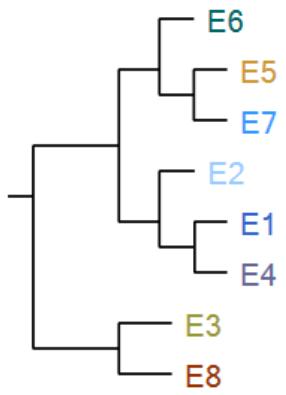 Source: Authors based on NVivo software Figure 1: Dendrogram Plot of Respondents by Word Similarity
The grouping of coded qualitative data based on content similarity is used in an exploratory way to tease out ideas rather than as explanatory evidence of an association (Jackson and Bazeley, 2019).
Table 05 presents the result of Pearson's correlation test by word similarity, where the pair of interviewees closest to 1 indicates a greater relationship, and the result close to -1 indicates less relationship strength. Interviewees 4 and 1, followed by interviewees 7 and 5, show the highest results: 0.94 and 0.93, respectively.
Table 5: Pearson Correlation by Word Similarity
<table><tr><td>Source A</td><td>Source B</td><td>Correlation*</td><td>Source A</td><td>Source B</td><td>Correlation*</td></tr><tr><td>E4</td><td>E1</td><td>0,944835</td><td>E6</td><td>E4</td><td>0,881417</td></tr><tr><td>E7</td><td>E5</td><td>0,937592</td><td>E8</td><td>E3</td><td>0,783014</td></tr><tr><td>E5</td><td>E1</td><td>0,934519</td><td>E3</td><td>E2</td><td>0,651582</td></tr><tr><td>E2</td><td>E1</td><td>0,934205</td><td>E4</td><td>E3</td><td>0,620171</td></tr><tr><td>E5</td><td>E2</td><td>0,931886</td><td>E3</td><td>E1</td><td>0,617741</td></tr><tr><td>E7</td><td>E6</td><td>0,931588</td><td>E6</td><td>E3</td><td>0,61107</td></tr><tr><td>E6</td><td>E5</td><td>0,928677</td><td>E7</td><td>E3</td><td>0,594058</td></tr><tr><td>E4</td><td>E2</td><td>0,922715</td><td>E8</td><td>E2</td><td>0,58843</td></tr><tr><td>E7</td><td>E1</td><td>0,918876</td><td>E8</td><td>E4</td><td>0,585165</td></tr><tr><td>E5</td><td>E4</td><td>0,911223</td><td>E5</td><td>E3</td><td>0,580212</td></tr><tr><td>E7</td><td>E4</td><td>0,905334</td><td>E8</td><td>E1</td><td>0,574269</td></tr><tr><td>E6</td><td>E2</td><td>0,902879</td><td>E8</td><td>E6</td><td>0,542879</td></tr><tr><td>E6</td><td>E1</td><td>0,899391</td><td>E8</td><td>E7</td><td>0,539397</td></tr><tr><td>E7</td><td>E2</td><td>0,898693</td><td>E8</td><td>E5</td><td>0,526236</td></tr></table>
Pearson's correlation can indicate content relationships for constructions of complementarity, trends, disagreements, and confirmations of arguments. The lowest relation between the interviewees with results below 0.52 indicates a weak relation, however still significant, but one must consider that there are more convergent than divergent points, in which it is observed that most correlations are above 0.6, which expresses that the excerpts selected from the interviews keep similarity in the answers, importance, and scope of the subcategories of analysis.
The correlation allows us to state that the two-by-two comparisons among all showed significant similarity, which indicates that the observations, selected/coded excerpts, and the frequency of similar words are concentrated toward a pattern, which reinforces the convergent nature of the responses.
## V. FINDINGS
The present research proposed to study the necessary adaptations and the development of competencies in the exercise of leadership for the successful implementation of digital transformation in traditional companies.
In the Customer and Value Generation Category, it was observed that respondents consider there is an association between "customer value generation" and the "use of new digital technologies," as indicated by Roger (2019), Westerman, Soule, & Eswaran (2016), and Magaldi and Salibi Neto (2018). However, supply chain integration and the view of the customer as an "asset" still lack further development and maturation in the surveyed organizations.
In the Competition Category, there are barriers that hinder the transformation of the data analysis item into an element that drives the practice and the digital mindset in traditional companies, especially from the guidelines of Roger (2019) and Westerman, Soule, & Eswaran (2016) regarding the integration of competitive chains in order to generate synergy and the adoption of co-creation and cooperation practices. The item "business adaptation" finds greater maturity, while others such as "risk taker," "co-creation," and "digital actions" are little mentioned by respondents, which may lead to a reflection of opportunity and development of new competencies and strategic initiatives.
In the Technology Tools Category, studies and reports of new practices, primarily supported by Matt, Hess, & Belain (2015) and complementarily by Morakanyane, Grace, & O'Reilly (2017), Rogers (2019), and Westerman, Soule, & Eswaran (2019), indicate that digital transformation must be supported by new, often disruptive technologies that make it possible to achieve new and higher levels of productivity and connectivity. The companies surveyed provided indications of deploying new platforms and technologies. However, the understanding, use, and adoption of digital channels are still evolving.
The Innovation Category proposes, in the context of digital transformation, the implementation of an organizational culture of innovation and the adoption of new methodologies of experimentation management (make mistakes and learn fast) (Waengertner, 2018; Westerman, Soule, & Eswaran, 2019). It can be observed from the research that some results drive relevant concern in building a culture of digital evolution and innovation. However, other important issues, such as the dissemination of ideas, rapid experimentation, and adoption of "agile" management methodologies, are still in the knowledge phase, and the adoption of these practices translates into a great opportunity for traditional organizations.
The analysis of the data collected indicated that the Strategic Readiness Category, in the context of digital transformation, creating a culture that is permeable to experimentation and open to developing new leadership and stakeholder relations capabilities, is an appropriate path to digital evolution. Establishing a process of "unlearning" to learn is a recommended strategy. Setting performance goals to reach new levels of performance is important to support a transformational purpose that guides everyone in the organization (Westerman, Soule & Eswaran, 2018; Iorio,
2019; Magaldi and Salibi Neto, 2018). It was identified that the creation of the transformational purpose is present in strategic planning and that recognition of the importance and prioritization of actions to implement and evolve digital transformation appear to be urgent. However, there is little development and agreement on targets for monitoring the performance of actions and the results of digital transformation initiatives.
It is emphasized in the Category Use of Data that data are considered assets as more valuable as tangible assets, and knowing how to manage and transform them into information for the decision-making process is a competitive differentiator (ROGERS, 2019; Westerman, Soule, & Eswaran, 2019). But this was not what was observed from the analysis of the responses. This topic presented the biggest "gap" among the others since actions and initiatives (whether operational or strategic) were not mentioned, as well as knowledge and mastery, which showed to be in the early stages. The use of data to improve the customer journey is still in the knowledge and learning phase, and few companies mentioned any type of action. Another relevant issue is the practice of rapid experimentation by the domain and use of data, which still lacks a better understanding of how to implement its use in day-to-day management. This is the category with the greatest lack of development of leadership competencies among the traditional companies in the sample.
The Leadership Category relates to team engagement practices, understanding, and action in mobilizing internal employees to implement the digital transformation and contributing to the desired development of the leading behavioral profile that prioritizes the evolution of organizational culture. The promotion of the digital mindset, working on multidisciplinary projects, and developing new skills is a strategic role in the exercise of leadership (ROGERS, 2016). Some items were scored with ongoing achievements: promotion, and encouragement of the behavioral aspect of the leader (attitude), implementation of a transformational vision directing development, targeting of training actions and preparation of teams and engagement of senior management in the role of stimulator of the digital transformation movement. However, although mentioned, there were few actions aimed at a greater engagement of the team and the implementation of short, medium, and long-term plans for training the organization's people (knowledge and skills). The initiatives are still in the traditional format of training and development, and there is no creation of favorable environments for experimentation and development such as the "squad", a practice provided for in the agile methodology, for example.
## VI. CONCLUSION
The present study aimed to analyze the role of leadership in the digital transition of traditional organizations in the process of business transformation in Brazilian companies. It was assumed that leadership alone is unable to accomplish the transformations in the business model. Other organizational dimensions are also relevant and influence the role of the leader in this process.
Several elements related to the thought of the leaders of the researched organizations were presented, with an indication of current practices associated with competencies and recognition of the non-existence of practices indicated as necessary for the implementation of digital transformation.
There are categories, especially "competition" and "data use," that point to difficulties in reorienting the perception of the role of competition and the relevance of full knowledge of the customer journey as crucial elements in adopting a digital mindset that goes beyond the technological view.
The other categories - "customer and value generation," "technology tools," "innovation," and "strategic readiness" - have important advances but still coexist with analog business model management practices still rooted in the mindset of the interviewed leaders.
It was observed that the new competencies associated with the "leadership" category are not dealt with clearly and objectively, and there are still no performance indicators to measure the effectiveness and success of the digital transformation, as well as goals and variable compensation policies for the implementation and development of the digital transformation.
It has become evident that organizations go through different degrees of digital transformation. Digital adaptation and evolution can be influenced by not only economic but also political and social issues. Therefore, this work does not have a prescriptive character of pointing a path, but it does indicate the need for competencies that directly and indirectly involve leadership in this process of transformation of traditional companies from the business analysis model to the digital one.
The research analyzed the factors described in the categories in Table 01 that contribute to the creation of an implementation and performance measurement roadmap for the adoption of digital transformation in traditional enterprises.
It can be observed that the importance and knowledge of this theme have taken top-level strategic contours in the top management of all the organizations surveyed. Even with different levels of digital maturity, all presented some kind of initiative or action for the pursuit of the digital evolution of their organizations.
The set of tools, theories, and the results of the survey with traditional companies enabled a more detailed analysis of the main points and the most urgent ones to be indicated as focal points within traditional organizations, as well as corroborated a set of factors that can serve for the diagnosis of the transformation stage through which traditional organizations interested in migrating to the digital management mentality are going through.
Among the main limitations of this study, we highlight the fact that the sample is restricted to companies in Brasília, Brazil, although of size and economic relevance, and that only one leader from each company was interviewed. Although the professionals indicated are the ones responsible for conducting or preparing the digital transformation policies, they do not necessarily translate the totality of the thought of the governing body of the companies surveyed.
There is a need for deepening the issues that involve the construction of a favorable environment for the implementation of a solid and consistent culture of innovation and digital evolution of the company.
Generating HTML Viewer...
References
47 Cites in Article
Bader Alnuaimi,Sanjay Kumar Singh,Shuang Ren,Pawan Budhwar,Dmitriy Vorobyev (2022). Mastering digital transformation: The nexus between leadership, agility, and digital strategy.
G Auricchio,E Kaganer (2015). How Digitalization Is Changing the Way Executives Learn.
L Bardin (2002). Análise de conteúdo.
S Basak (2015). Analysis of the Impact of NVivo and EndNote on Academic Research Productivity.
Anandhi Bharadwaj,Omar El Sawy,Paul Pavlou,N Venkatraman (2013). Digital Business Strategy: Toward a Next Generation of Insights.
M Bonello,B Meehan (2019). Transparency and Coherence in a Doctoral Study Case Analysis: Reflecting on the Use of NVivo within a 'Framework' Approach.
D Bonnet,G Westerman the New Elements of Digital Transformation.
Lorne Booker,Nick Bontis,Alexander Serenko (2012). Evidence‐Based Management and Academic Research Relevance.
Joy Bringer,Lynne Johnston,Celia Brackenridge (2006). Using Computer-Assisted Qualitative Data Analysis Software to Develop a Grounded Theory Project.
Alessia Correani,Alfredo De Massis,Federico Frattini,Antonio Petruzzelli,Angelo Natalicchio (2020). Implementing a Digital Strategy: Learning from the Experience of Three Digital Transformation Projects.
Laura Cortellazzo,Elena Bruni,Rita Zampieri (2019). The Role of Leadership in a Digitalized World: A Review.
L Downes,P Nunes (2013). Big-bang disruption.
Ana Facin,Ana Barbosa,Cristiane Matsumoto,Ana Cruz,Mario Salerno (2022). TEMAS DE DESTAQUE NA PESQUISA EM TRANSFORMAÇÃO DIGITAL: EVIDÊNCIAS DE ESTUDO BIBLIOMÉTRICO E ANÁLISE DE CONTEÚDO.
Jorge Fernandez-Vidal,Francesco Antonio Perotti,Reyes Gonzalez,Jose Gasco (2022). Managing digital transformation: The view from the top.
M Fitzgerald,N Kruschwitz,D Bonnet,M Welch (2013). Embracing digital technology: a new strategic imperative.
Maryanne Gobble (2018). Digital Strategy and Digital Transformation.
J Hair,W Black,B Babin,R Anderson (2014). Multivariate Data Analysis.
Andrea Iorio (2019). 6 (six) skills to surf the Digital Transformation.
K Jackson,P Bazeley (2019). Qualitative data analysis with NVivo.
G Kane,D Palmer,A Phillips,D Kiron (2015). Is Your Business Ready for a Digital Future?.
Timothy Keiningham,Lerzan Aksoy,Helen Bruce,Fabienne Cadet,Natasha Clennell,Ian Hodgkinson,Treasa Kearney (2020). Customer experience driven business model innovation.
Kamalis Landi (2023). The Human Side of Digital Business Transformation.
M Lansiti,K Lakhani (2014). Digital Ubiquity: How Connections, Sensors, and Data Are Revolutionizing Business.
H Martins,Y Dias,P Castilho,D Leite (2019). Digital Transformations in Brazil: Insights into the level of digital maturity of companies in the country.
Christian Matt,Thomas Hess,Alexander Benlian (2015). Digital Transformation Strategies.
Resego Morakanyane,Audrey Grace,Philip O'reilly (2017). Conceptualizing Digital Transformation in Business Organizations: A Systematic Review of Literature.
Shaul Oreg,Yair Berson (2019). Leaders’ Impact on Organizational Change: Bridging Theoretical and Methodological Chasms.
Eric Ries (2019). The startup style.
David Rogers (2019). Digital Transformation: rethinking your business for the digital age.
Nopriadi Saputra,Ningky Sasanti,Firdaus Alamsjah,Ferdinand Sadeli (2022). Strategic role of digital capability on business agility during COVID-19 era.
M Schrage,V Muttreja,A Kwan (2022). How the Wrong KPIs Doom Digital Transformation.
Ved Sen (2023). What Is Digital Literacy?.
Evangelia Siachou,Demetris Vrontis,Eleni Trichina (2021). Can traditional organizations be digitally transformed by themselves? The moderating role of absorptive capacity and strategic interdependence.
(2023). Global Journals capacity and strategic interdependence.
Noemi Sinkovics,Jason Archie-Acheampong (2020). The social value creation of MNEs – a literature review across multiple academic fields.
B Tan,S Pan,X Lu,L Huang (2009). Leveraging Digital Business Ecosystems for Enterprise Agility: The TriLogic Development Strategy of Alibaba.com.
David Tang (2021). WHAT IS DIGITAL TRANSFORMATION?.
Janice Tanno,David Banner (2018). Servant Leaders as Change Agents.
Zeljko Tekic,Dmitry Koroteev (2019). From disruptively digital to proudly analog: A holistic typology of digital transformation strategies.
N Uchihira,T Eimura (2022). The Nature of Digital Transformation Project Failures: Impeding Factors to Stakeholder Collaborations.
Peter Verhoef,Thijs Broekhuizen,Yakov Bart,Abhi Bhattacharya,John Qi Dong,Nicolai Fabian,Michael Haenlein (2021). Digital transformation: A multidisciplinary reflection and research agenda.
Gregory Vial (2019). Understanding digital transformation: A review and a research agenda.
Huosong Xia,Peiwen Ye,Sajjad Jasimuddin,Justin Zhang (2022). Evolution of digital transformation in traditional enterprises: evidence from China.
Pedro Waengertner (2018). The strategy of radical innovation: how any company can grow and profit by applying the principles of Silicon Valley's top organizations.
G Westerman,D Soule,A Eswaran (2019). Building Digital-Ready Culture in Traditional Organizations.
No ethics committee approval was required for this article type.
Data Availability
Not applicable for this article.
How to Cite This Article
Wendell Maurício de Lima Queiroz. 2026. \u201cThe Role of Leadership in Implementing Digital Transformation in Traditional Brazilian Companies\u201d. Global Journal of Management and Business Research - A: Administration & Management GJMBR-A Volume 23 (GJMBR Volume 23 Issue A3): .
Explore published articles in an immersive Augmented Reality environment. Our platform converts research papers into interactive 3D books, allowing readers to view and interact with content using AR and VR compatible devices.
Your published article is automatically converted into a realistic 3D book. Flip through pages and read research papers in a more engaging and interactive format.
The text deals with the challenge of managers in performing digital transformation in medium and large companies, born and successful in the context of the analog world. Digital Transformation (DIGITAL TRANSFORMATION) has started to take on strategic contours, no longer being solely linked to modernization and adaptation but becoming a matter of vital strategic positioning for various types and formats of organizations. This process is being driven thanks to the high availability of internet access, the capacity to process and store information, the connection of people in the online world, and the new ways of communicating and relating among people. At the center of this journey is the leader, more specifically the c-level and directors, who have the role of leading this movement in their organizations and with their followers, partners, shareholders, and society. To this end, we developed a model of categories and subcategories of competencies necessary for the implementation of DIGITAL TRANSFORMATION in traditional organizations of medium and large size in Brasilia, Brazil. The research used coding techniques extracted from the NVIVO 11 application as a data analysis strategy, with the objective of finding patterns in the collected data.
Our website is actively being updated, and changes may occur frequently. Please clear your browser cache if needed. For feedback or error reporting, please email [email protected]
Thank you for connecting with us. We will respond to you shortly.