The Role of Microfinance in Integrating Rural Women into Formal Banking System

α
Mohammed Idris Osman

σ
Idries Alsiddig
Idries Alsiddig

Send Message

To: Author

The Role of Microfinance in Integrating Rural Women into Formal Banking  System

Article Fingerprint

ReserarchID

R0T8B

The Role of Microfinance in Integrating Rural Women into Formal Banking  System Banner

AI TAKEAWAY

Connecting with the Eternal Ground
  • English
  • Afrikaans
  • Albanian
  • Amharic
  • Arabic
  • Armenian
  • Azerbaijani
  • Basque
  • Belarusian
  • Bengali
  • Bosnian
  • Bulgarian
  • Catalan
  • Cebuano
  • Chichewa
  • Chinese (Simplified)
  • Chinese (Traditional)
  • Corsican
  • Croatian
  • Czech
  • Danish
  • Dutch
  • Esperanto
  • Estonian
  • Filipino
  • Finnish
  • French
  • Frisian
  • Galician
  • Georgian
  • German
  • Greek
  • Gujarati
  • Haitian Creole
  • Hausa
  • Hawaiian
  • Hebrew
  • Hindi
  • Hmong
  • Hungarian
  • Icelandic
  • Igbo
  • Indonesian
  • Irish
  • Italian
  • Japanese
  • Javanese
  • Kannada
  • Kazakh
  • Khmer
  • Korean
  • Kurdish (Kurmanji)
  • Kyrgyz
  • Lao
  • Latin
  • Latvian
  • Lithuanian
  • Luxembourgish
  • Macedonian
  • Malagasy
  • Malay
  • Malayalam
  • Maltese
  • Maori
  • Marathi
  • Mongolian
  • Myanmar (Burmese)
  • Nepali
  • Norwegian
  • Pashto
  • Persian
  • Polish
  • Portuguese
  • Punjabi
  • Romanian
  • Russian
  • Samoan
  • Scots Gaelic
  • Serbian
  • Sesotho
  • Shona
  • Sindhi
  • Sinhala
  • Slovak
  • Slovenian
  • Somali
  • Spanish
  • Sundanese
  • Swahili
  • Swedish
  • Tajik
  • Tamil
  • Telugu
  • Thai
  • Turkish
  • Ukrainian
  • Urdu
  • Uzbek
  • Vietnamese
  • Welsh
  • Xhosa
  • Yiddish
  • Yoruba
  • Zulu

Abstract

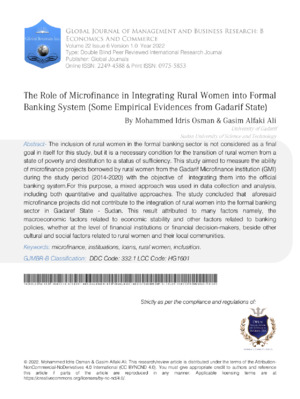
The inclusion of rural women in the formal banking sector is not considered as a final goal in itself for this study, but it is a necessary condition for the transition of rural women from a state of poverty and destitution to a status of sufficiency. This study aimed to measure the ability of microfinance projects borrowed by rural women from the Gadarif Microfinance institution (GMI) during the study period (2014-2020) with the objective of integrating them into the official banking system.For this purpose, a mixed approach was used in data collection and analysis, including both quantitative and qualitative approaches. The study concluded that aforesaid microfinance projects did not contribute to the integration of rural women into the formal banking sector in Gadaref State -Sudan. This result attributed to many factors namely, the macroeconomic factors related to economic stability and other factors related to banking policies, whether at the level of financial institutions or financial decision-makers, beside other cultural and social factors related to rural women and their local communities.

References

14 Cites in Article
  1. A Usama,Samia Massaad,Rabie Babiker,K Gamal,A Nadia,M Bashir,A Smah (2017). Female Genital Tract Malignancy, in Gadarif Advanced Medical Diagnostic Centre (GAMDC) Gadarif, Eastern Sudan, From 2017 to 2018.
  2. Mohd Arif (2014). International Journal in Multidisciplinary and Academic Research.
  3. Baza Ufoetl (2017). Financial Inclusion in Ethiopia.
  4. Jayati Ghosh (2013). Microfinance and the challenge of financial inclusion for development.
  5. K Isangula (2012). Improving Women and Family's Health through Integrated Microfinance, Health Education and Promotion in Rural Areas.
  6. Philip Mader,Solène Morvant-Roux (2016). Financial inclusion and microfinance.
  7. A Mishra,Etl (2017). The role of Microfinance in Financial inclusion in Bihar, A case Study.
  8. (2008). Sustainable Fisheries: Multi-Level Approaches to a Global Problem.
  9. (2021). Financial Inclusion: Lessons from World Bank Group Experience, Fiscal Years 2014–22.
  10. (2021). Focus Discussion Group with group of beneficiaries from Al-Shimieliab village, Central Rural Gadaif locality.
  11. (2021). Focus Group Discussion Ikatan Alumni Pesantren IMMIM, 16 September 2021.
  12. (2021). Focus Discussion Group with group of beneficiaries from Al-Rahad locality June 12 th.
  13. Dr Interview (1975). Closing Ceremony: Address by Dr. James A. Maraj Commonwealth Assistant Secretary-General.
  14. Mr Interview (2015). Interview with an expert: Mr Todd Snelgrove, Chief Value Officer, SKF.

Funding

No external funding was declared for this work.

Conflict of Interest

The authors declare no conflict of interest.

Ethical Approval

No ethics committee approval was required for this article type.

Data Availability

Not applicable for this article.

How to Cite This Article

Mohammed Idris Osman. 2026. \u201cThe Role of Microfinance in Integrating Rural Women into Formal Banking System\u201d. Global Journal of Management and Business Research - B: Economic & Commerce GJMBR-B Volume 22 (GJMBR Volume 22 Issue B6): .

Download Citation

Microfinance, women's empowerment, rural finance, financial literacy, gender equality, development.
Issue Cover
GJMBR Volume 22 Issue B6
Pg. 55- 62
Journal Specifications

Crossref Journal DOI 10.17406/GJMBR

Print ISSN 0975-5853

e-ISSN 2249-4588

Keywords
Classification
GJMBR-B Classification: DDC Code: 332.1 LCC Code: HG1601
Version of record

v1.2

Issue date

December 17, 2022

Language
en
Experiance in AR

Explore published articles in an immersive Augmented Reality environment. Our platform converts research papers into interactive 3D books, allowing readers to view and interact with content using AR and VR compatible devices.

Read in 3D

Your published article is automatically converted into a realistic 3D book. Flip through pages and read research papers in a more engaging and interactive format.

Article Matrices
Total Views: 1339
Total Downloads: 43
2026 Trends
Related Research

Published Article

The inclusion of rural women in the formal banking sector is not considered as a final goal in itself for this study, but it is a necessary condition for the transition of rural women from a state of poverty and destitution to a status of sufficiency. This study aimed to measure the ability of microfinance projects borrowed by rural women from the Gadarif Microfinance institution (GMI) during the study period (2014-2020) with the objective of integrating them into the official banking system.For this purpose, a mixed approach was used in data collection and analysis, including both quantitative and qualitative approaches. The study concluded that aforesaid microfinance projects did not contribute to the integration of rural women into the formal banking sector in Gadaref State -Sudan. This result attributed to many factors namely, the macroeconomic factors related to economic stability and other factors related to banking policies, whether at the level of financial institutions or financial decision-makers, beside other cultural and social factors related to rural women and their local communities.

Our website is actively being updated, and changes may occur frequently. Please clear your browser cache if needed. For feedback or error reporting, please email [email protected]

Request Access

Please fill out the form below to request access to this research paper. Your request will be reviewed by the editorial or author team.
X

Quote and Order Details

Contact Person

Invoice Address

Notes or Comments

This is the heading

Lorem ipsum dolor sit amet, consectetur adipiscing elit. Ut elit tellus, luctus nec ullamcorper mattis, pulvinar dapibus leo.

High-quality academic research articles on global topics and journals.

The Role of Microfinance in Integrating Rural Women into Formal Banking System

Mohammed Idris Osman
Idries Alsiddig
Idries Alsiddig

Research Journals