Japanese Zen Buddhism has led the way for Japanese aesthetics and has continued to bring this aesthetic to the public, most notably in the form of ukiyo-e. Zen Buddhism is a branch of Buddhism with the core principle of “no thought, no appearance, no dwelling,” and “Katsu” as its practice from Linji School. As Zen became integrated into Japanese life, meditation was likewise manifested in social life, most notably in the Edo period. As a declining, last feudal period in Japanese history, the Edo Shogunate was flawed in terms of notification. The samurai class, which was attached to the Shogunate, was fundamentally lacking in subject matter, and the Tokugawa family gave them the idea of Bushido but not its inner pillar. Japanese merchants, who had no status, spent their money recklessly but gained confusion and emptiness. Bijinga-e, who specializes in painting Japanese geisha in Ukiyo-e, shows all the meanings of “Kong” through the composition, white space, and the form of people in the painting. Most impressionists in the nineteenth century expressed their emotions and imitated East Asian style artworks, and only “had the form but not the spirit.” This paper thus concludes that the status of “Kong” in Japanese Zen aesthetics is like a butterfly in an invisible net, out of control and out of sight.
## I. INTRODUCTION
Nowadays, the world order is chaotic, the world pattern is fluid, and new possibilities can arise every day. The sense of crisis brought about by the new coronavirus puts people in fear of being threatened by death every day. The British exit from the European Union (Brexit) and the war between Russia and Ukraine make it impossible to return to the complete peace of the past in a short period. There are growing sea levels, melting glaciers, dwindling trees on the planet, and species going extinct with dramatically changing biodiversity. Each of those crises acts as a threat, which makes it impossible for us to rely solely on ourselves for survival. As a result, people are looking for spiritual support, some for their love of country, some for God, and others for a simple, "empty" state of existence.
Such an era stimulated the consciousness of question and the desire to continue my exploration of the aesthetics of Japanese Zen art based on the article An Analysis of the Status of Japanese Zen Art Aesthetics in Ukiyo-e: From Katsushika Hokusai, the famous painter in the formation of Ukiyo-e, to Van Gogh. In my previous paper, we opened the door to the desire to explore the aesthetics of Japanese Zen art. According to the previous article, we opened up with a hot topic, namely the specific relationship between Japanese Zen art aesthetics and ukiyo-e, to understand the dominant and driving position of Zen thought as deified philosophy in ukiyo-e by analyzing the normative style, painting form, painting content, and structural lines of Hokusai ukiyo-e paintings. This paper hopes to delve into the question of what ideas and ideologies in Zen Buddhism dominated the Japanese artistic aesthetic. How was this aesthetic art articulated through the Ukiyo-e that flourished in the Edo period? This paper holds that this subjectivity, in essence, can be understood as the Zen empty ideology. This idea of Kong drives human beings to express their abilities, roles, perceptions, and status through artistic expression in the practice process, demonstrating the form and spirit of this artistic aesthetic through autonomous, purposeful, and dynamic activities.
I have to clarify the use of the word "空 (written as "Kong") "before we begin talking about its position. In contemporary society, there are many expressions of Kong. When it is widely used in the aesthetic concept of fashion and residential furnishing style, it often has a similar meaning to "sunyata" and "sabi," expressing the normalization of white space, nothingness, and silence. Due to the fact that the Kyoto school incorporated the purely empirical understanding of the classical German philosophy of Kant, Heidegger, and French philosopher Sartre into their interpretation of Mahayana Buddhism, which led Kisaragi Nishida to propose the concept of "absolute nothingness" equal to sunyata, a continuous negation called catuskoti expresses the dualistic idea that one should not assert emptiness and one should not assert non-emptiness. But this is not the kind of "empty" I want to research. Since I think that Kong is not the negation of a negation, nor is it nothingness, nor is it the characteristic Japanese aesthetic of "dharma (open and quiet)1," nor is it simply the "Sugata (emptiness)" of the understanding of the text of the Heart Sutra. As it is said in the Treatise on the Many, "In sunyata, emptiness is fullness, and fullness is emptiness; formlessness is formed, and formlessness is formlessness..... True emptiness is a magical existence." (Abe, Zen, and Western Thought, pp. 126-27). The word "Kong" is used because it is specific to all civilizations and cultures, not simply the "emptiness" of the Japanese Kyoto School and the Zen thought of the Cao Dong School.
Mono no aware, wabi-sabi, and yuk were the key terms and focuses of Japanese Zen aesthetics for a long time. But this is not the entirety of the Japanese aesthetic, nor is it the entirety of the influence of Japanese Zen Buddhism on its artistic aesthetic. Undoubtedly speaking, art is a form of expressing emotions and spirits. By conveying such emotions and spirit through visual means, Japanese art aesthetic is always associated with Japanese Zen thought. Therefore, this paper wants to explore this concept of Kong by selecting one of the visible artistic expressions in Japan. This paper will analyze, interpret and visualize Kong through a type of woodblock print Ukiyo-e. Focusing on the Bijinga-e of the Edo period, it will reveal the veil of the Geisha (or so-called Geiko, Geigi, Oiran, and courtesans) rarely seen in civilian life from the gestures, character, body shape, appearance, background, and costumes of the figures in the paintings, to open the door to the Japanese merchants and samurai. It expresses the dimensions of Japanese thought and the general understanding of life in an aesthetically pleasing way, further revealing the concrete manifestation of "Kong".
## II. LITERATURE REVIEW AND METHOD
Contemporary analyses of Japanese Zen aesthetics are mostly limited to the researcher's field of study, such as On the Beauty Painting in the Ukiyo-e researcher Xu Qing (2004), who belongs to the category of practical art, so her focus is on the brushwork and painting styles of artists such as Kwaigetsudo Ando and Kita Kawagami. Cox (2013), a member of the Department of Anthropology and the European Centre for Japanese Studies at Oxford Brookes University, focuses his research on the popular and historical imaginings of the connections between Zen Buddhism and Japanese culture. He also gives what kinds of Japanese aesthetic pursuits show dynamic expression within anthropological descriptions and historical criticism. Then again, Jamieson (2018) is a musician who tried to fill in the blank of the research on the influence of Zen and the Kyoto School on the definition of contemporary music aesthetics through the cognition of Japanese music aesthetics. The subject the researchers belong to has limited their thoughts and understanding of Zen and ukiyo-e. This paper will not be confined to a single cognitive system and not just belong to one of the fields of aesthetics and religious philosophy, nor art or fine arts. This paper is an interdisciplinary article with multidisciplinary knowledge background.
The paper draws on Daisetz Suzuki's (2019) definition of Zen, Zen Buddhism, Bushido, swordplay, art, and haiku in Zen and Japanese culture, where he describes in simple, poetic terms what Zen is and highlights how its focus on primitive simplicity and self-effacement has helped shape an aesthetic that permeates Japanese culture. Also, from a more Western perspective, Bayou's (2011) Du Japon à l'Europe, changement de statut de l'estampe ukiyo-e, published in Arts Asiatiques (Paris) argues that such replicative Japanese prints shed their association with pure classical culture but considered a "fad." Thisfad articulated an aesthetic attitude of "pleasure" and portrayed a fleeting image of the world that influenced the European market in the second half of the 19th century. After all, nineteenth-century Western artists, comfortable with the academy, needed a new language to express contemporary ideas. The centuries-old fusion of East Asian philosophy and art was a decisive influence (Rodríguez Llera, R, 2022, pp. 368).
Accordingly, I will analyze the Zen Buddhist idea of Kong based on the intellectual background of Linji Lu and Huineng's Tanjing, the understanding of the personal experiences, creative styles, and paintings of ukiyo-e artists such as Utagawa Yoshitaki and Hokusai, and the influence of these ukiyo-e work on Western post-impressionism. The main research method I use for this study is to ask questions about the relationship between Zen Buddhism Kong and Japanese art aesthetics and Bijinga-e. The research methods used in this article are questioning, synthesis, discovery, judgment, analysis, comparison, and case study analysis using Ukiyo-e works as core examples.
## III. RESULTS AND DISCUSSION
### a) The ideology of " Kong " (its original form in Japan)
Zen Buddhism is a branch of Buddhism that was born as a rebellion against the caste system established in India after the Aryan conquest of the South Asian Subcontinent. This caste system divided Indians into different groups and classes, namely Brahmins who were born in the mouth of Brahma, Kshatriyas who mastered and manipulated politics, economy, military, and culture, Vaishyas who were in the lower position of Brahma named farmers and merchants, Shudras who were of low status, and pariah who were not included in the list. When the Brahmins weakened in the fourth century A.D., Prince Siddhartha broke the caste system, abandoned the superiority he possessed, advocated the equality of all beings, and promoted the universalization, popularization, and colloquialism of Buddhism. Thus, in the beginning, the Kong of "all is vanities" represented the dispossession and despair of the once privileged aristocratic and intellectual minority and the absence of class and lack of common knowledge. Moreover, this idea has existed since the beginning of Buddhism. Kong is considered in Mahayana Buddhism to be divided into two parts: the Kong of humans and the Kong of dharma, i.e., the absence of its own body and entity for human beings, and the absence of entity for the existence of all things that arise from causes. Each branch of Buddhism has different interpretations of this "Kong," ranging from "two empty" to "twenty empty," for example, from the four views of the Madhyamakakarika into human emptiness and dharma emptiness, and "three empty" from the Differentiation of the Middle Way from the Extremes. Among them, the "eighteen empty" are interpreted from the Maha Prajna Paramita Sutr, which considers that there are adhyatma-sunyata, bahirdha-sunyata, adhyatma-bahirdha-sunyata, sunyata-sunyata, mahasunyata, paramartha-sunyata, samskrta-sunyata, asamskrta-sunyata, atyanta-sunyata, anavakarasunyata, prakrti-sunyata, svalaksana-sunyata, savadharma-sunyata, abhava-sunyata, svabhava-sunyata, abhava-svabhava-sunyata, a total of eighteen kinds of sunyata. They are the foundation of the Nanzen thought of "无念为宗,无相为体,无住为本". After all, this nothingness is built on the great Kong of the ten worlds and ten directions.
Buddhism was introduced to China at the end of the reign of Emperor Ai of the Western Han Dynasty and went through a long and arduous process in the Eastern Han Dynasty, the Wei, Jin, Northern, and Southern Dynasties, and the Sui and Tang Dynasties. During this period, Zen Buddhism also passed through the six groups of Huineng, Nanyue Huairang, Mazu Daoyi, Baizhu Huaihai, Huangbo Xiyun, and Linji Yixuan, the core figure of the Linji school that eventually spread to Japan. Linji Yixuan, a native of Shandong Province in China today, lived in a period when the Great Tang Dynasty had just issued a decree on the destruction of Buddhism, demolishing more than 4,600 monasteries in the seventh year of the Huichang era, destroying more than 40,000 Caturdesa and Aranya, and returning more than 260,000 monks and nuns to the monastic world. However, the Linji school survived as one of the most prosperous of the five houses and seven schools that emerged during the Northern Song Dynasty[^3], and as the ancestor of Japanese Zen Buddhism, which holds the premier seat in Japanese Buddhism, the Linji school must have its uniqueness, which lies precisely in what it advocates "平常心之道<sup>4\</sup)." This normal mind of Linji school is based on material scarcity and intellectual barrenness, as it is said in the Baizhang Qinggui that "one day without work, one day without food," and that the teachings of Linji school are fundamentally based on an atmosphere of political and economic dependence and its "Kong" is also founded in the realm of the need for self-sufficiency to exist.
The Linji lu says that you enter the mortal world, you enter the holy world, you enter the contaminated dust, you enter the pure, you enter the land of various Buddhas, you enter the pavilion of Maitreya, you enter the world of Vairocana, and every place is the land of existence, in which there is existence, decay, extinction, and emptiness. The Buddha appeared in this world, turned the wheel of dharma, and later entered nirvana, but his past and future are invisible to you, so it is useless to seek his birth and death. This kind of invisibility is what Linji understands as the "empty appearance (空相)," a kind of illusion of all things, such as the saying that "入净入秽、入弥勒楼阁,又入三眼国土,处处游履,唯见空名"。"They are just empty names, and these names are also empty[^6]. These empty forms are related to and born with all dramas which do not have 'self-nature' (all the dharmas in this world and the next are without self-nature) and 'birth nature,' because the mind is empty. The dharma is empty, and the single thought is decisively cut off and transcended.
### b) The "practice" of "Kong" in Japanese social life and its appearance in Ukiyo-e
The representation of the "Kong" in Zen is the master's "raised whisk" and "Katsu (to yell or to shout, to browbeat, to scold, and hoarse)", as the fundamental Zen that leaves behind words. It is also the foundation of Linji School since there are inherent phrases called "德山棒,临济喝 (Deshan Bang, Linji He.)." This "Kong" has other manifestations in Japanese everyday life, such as the "Kong" of the declining rule and lack of authority of the Muromachi Shogunate, the ritualistic "Kong" of Bushido that ends with seppuku, and the vacuous, flatulent, degenerate "Kong" of the Japanese merchants' culture. The regime holders who cannot be autonomous and the policies that cannot land from on high are the sticks raised high in the air. And all those abstract glory, rituals, and punishments are the big stick hanging over the heart of the aristocratic warrior ruling class, the thought that hangs for a decision. In addition, the shout that does not represent public opinion and the parasite that cannot accomplish self-assertion are silent cries. The ultimate and pure expression of unanimity of thought by seppuku is also the outreach of the soul, the silent cry, and the loyalty to achieve the purpose decisively and actively. The merchants at the bottom of Japanese society, who could not get equality and respect, were looking for a place to enjoy themselves amid the turmoil. Their wandering around Hanamachi, Karyukai, and Kagai was their silent warning and cried to the society.
The Edo period was the last period of the feudal era of the warrior families in Japanese history, and the paramount ruler was the Tokugawa family. Since the Tokugawa family eliminated its greatest political enemy, the Tokugawa shogunate has wielded real power while the Mikado enjoys great prestige. The Edo Shogunate established Bushido as their fundamental spirit from the ideological point of view, making the samurai work for them with loyalty, righteousness, and courage as the benchmark of their living and hara-kiri as the code of honor of their death. Bushido greatly revived the status of Zen in Japan, as Peter Haskel says: "The Japanese Zen as we know it today is Tokugawa Zen, a teaching that looks back to its medieval roots but does it through the prism of its particular concerns." The Zen revived by the Tokugawa family is mainly through zazen, meditation, combat, and the spirit of "逢佛杀佛,逢祖杀祖 (Fengfo Shafo Fengzu Shazu) for those who are absent-mindedness and unconsciousness with a "Katsu" by the master. This method helped the military elite of the Shogunate to consolidate militarism. It was also fundamentally different from the foreign values brought by the Christian missionaries. Since the Shogunate during the Edo period forbade the Japanese from practicing Christianity, all Japanese were required to register at Buddhist temples to ensure no conversions occurred. Later, after the Tokugawa family took complete control of Japanese politics, reforms appeared frequently. They used the same method on those peasants with martial families and warriors as obligations which led to turmoil in society. This martial style of rule revealed the rulers' dictatorship and their bad habits in governance. The general citizens and peasants, so-called the "machi people" of the Edo period, who were constantly being crushed and governed, were powerless. However, they became aware of the commercial and handicraft industries emerging around cities, ports, and temples based on economic development and became practitioners. These merchants disrupted the Japanese dualistic class division between the samurai and non-samurai classes. The culture constructed by these people gave the urban population the conditions and leisure to support, for the first time, art and entertainment different from the aristocratic arts and culture and could satisfy the demands and participation of the masses. This entertainment briefly escaped the class status and identity of the "aristocracy," but was limited and constrained by its social environment and assets. Therefore, it was mainly expressed as personal, direct, erotic entertainment for the masses.
In the Edo period of Japanese history, "Kong" was evident from the political system, the vassals, and the masses. In terms of politics, the Shogunate system of the Edo period was based on the military, but it was in a situation of internal and external troubles. For example, in the seventh year of the Kanaga period, the Shogunate accepted the request to open a port under the coercion of the United States and later signed the Japan-U.S. Treaty of Goodwill in Kanagawa. Thus, political emptiness was the "Kong" of having no power in the face of the turbulent nineteenth century. The samurai class, the vassal of the Tokugawa Shogunate, and its antagonist, the Japanese merchants, practiced "empty forms" in two ways, respectively. The Japanese merchants sought life, and the samurai sought death, both of which were different in their demands, but both were making and fulfilling their needs. The former sought the "floating world" and used it as a false reality. The latter sought to honor and nobility as their synonyms and hara-kiri as their honor and ritual. Thus, each expresses "Kong" in different acts from the inside. This kind of "Kong" from the heart, in essence, shows their inner emptiness and confusion. That is to say, they do not know what they want, they do not know what they live for, and they do not know what they die for.
In the late 17th century, with the rise of the Japanese merchants' thinking and culture, the Kano and Tosa school of painting, which had served the court nobility, gradually lost its charm and was replaced by this type of Ukiyo-e. Ukiyo-e, with its gorgeous style and explicit materials, was the best able to express the Edo period. And the Bijinga-e was the most expressive of the "Kong" that existed from the hearts of the noblemen to the ordinary people. After all, the degradation of Japan in the Edo period was from the state to the people.
### c) Contrast the expression of "Kong" in Japanese Ukiyoe and post-Impressionist works influenced by East Asian civilization
Most of the Bijinga-e are expressed and painted the Geiko and Geido. Although Geiko is an art and even a national treasure in Japan, it is still a Japanese female performance tradition, a profession that serves to entertain wealthy clients. The job, which originated during the Edo period and trained women to dance, sing, talk, and host in the Japanese performance style, was a stage performance in Geisha[^10], fulfilling the role of emptiness as well as emptiness itself. Just as when some dancers dance, their primary principle is to empty their minds, the rhythm of their bodies and the steps of their feet are their expression and performance, and there is no exception to Geiko. After much practice in traditional Japanese art forms, Geiko's behavior is revealed through a combination of habit and instinct. For example, Kitagawa Utamaro's The Painting of a Women Playing in Shamisen uses vermilion, gofunn, ink, and other Yamato-e pigments to freeze-frame the picture of the Minarai-Jaya performing her mastered shamisen, this kind of static performance in Bijinga-e for the acting Geiko is also the expression of "Kong."
Chōbunsai Eishi was born into a family that managed the general finance of a Shogun family, and he was a member of the official hatamoto appreciated by the Tokugawa family. So, his series Six Immortal Poets is exquisite, with well-groomed women, from the dresses on the leading figures to the bonsai behind them, all exquisite. This full title of the Bijinga-e is about the Monk Henjo. Henjo (Yoshimine no Munesada) is the grandson of Emperor Kammu and was a waka poet who became a monk of a temple after the death of Emperor Ninmyo. The famous Yamato Monogatari writes about his love story with Ono no Komachi, a beautiful female immortal poet. Most of his waka was light, beautiful, rich in emotions, and humorous. Such as the poet "淡淡绿,丝绦满树,白露珠。春柳枝上,玉珠串串。(Pale green, the tree was covered with silk, with white dew pearls. On the willow branches in spring, jade pearls are strung.)" Henjo's waka is delicate, focusing on the most minor details of the landscape, and he likes to portray it vividly and charmingly. In the Bijinga-e, there are exquisite bonsai of plum blossoms, walls composed of bamboo leaf patterns, and a Karesansui made of fine sand and gravel outside the door, plus some well-stacked stone groups of the miniature garden landscape, which are the setoff of Henjo's waka. The three women in the picture also fill up the picture through their body language and body forms, completing the plot of the story. But, no matter how subtle the images are, the women in these images are treated with the same contempt as the waka, which is folk literature, and regarded as lingering interests by the nobility. The other works of Chōbunsai Eishi are also mostly large-scale, clean, and composed of well-dressed twelve-headed women. These works glorified
Kyoto, a city without the darkness that expresses the meaning of the floating world and leads a befuddled life as if drunk or in a dream since that ever-bright city would be an empty city without those Geikos in the painting.
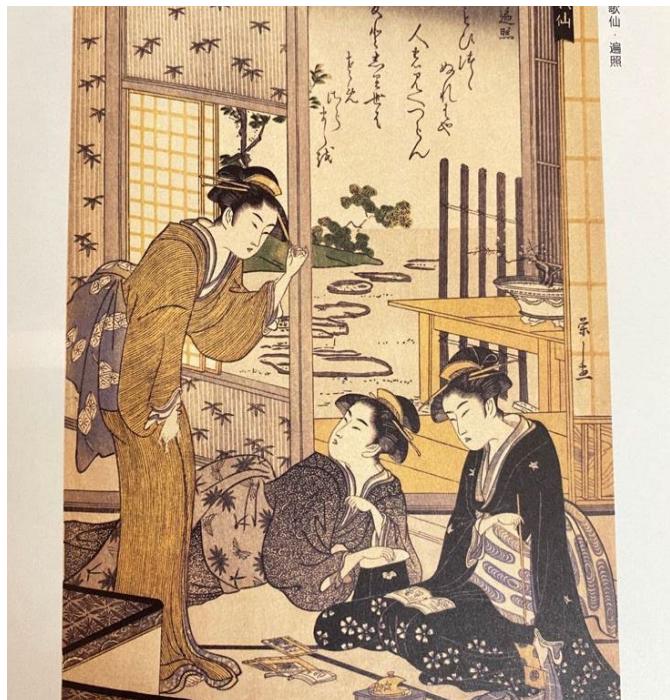 Figure 1: Six Immortal Poets·Henjo
Suzuki Harunobu invented the woodblock prints of multicolored Nishiki-e, and the painterly matters were mostly from classical waka to express the local custom. He often uses Nishiki-e and karazuri printing methods to depict his characters. He painted Bijinga-e, from young girls to Kabuki. The women in his works are between extensive (Bijinga-e aesthetic before him) and slender (Bijinga-e aesthetic after him). For example, in Lovers Beneath an Umbrella in the Snow, the dressed similar men and women mean that their love is eternal. Such background with solid and single color makes the picture mysterious, initially revealing the poetic tenderness of the quiet, yugen, and the subtlety of a possible fall with a faint sadness. Another example is Kaigetsudo Ando, whose paintings depicted Geiko in the gesture of standing or looking back, mostly shaped as a reversed Japanese character "く." That pin-up poses are a feature of his paintings, such as Standing Portrait of a Courtesan and Showing a Courtesan. He was a merchant first and last and often ran the Kaigetsudo painting workshop in the Suwa-cho district of Asakusa in Edo. He usually sold his Bijinga-e to the significant number of pilgrims and travelers who returned from Shin-Yoshiwara, Edo's pleasure district. In other words, from the picture to the way of buying and selling, Ando's works are empty in the fictitious transaction, and he is the best representative of Japanese merchants' profit-seeking thoughts.
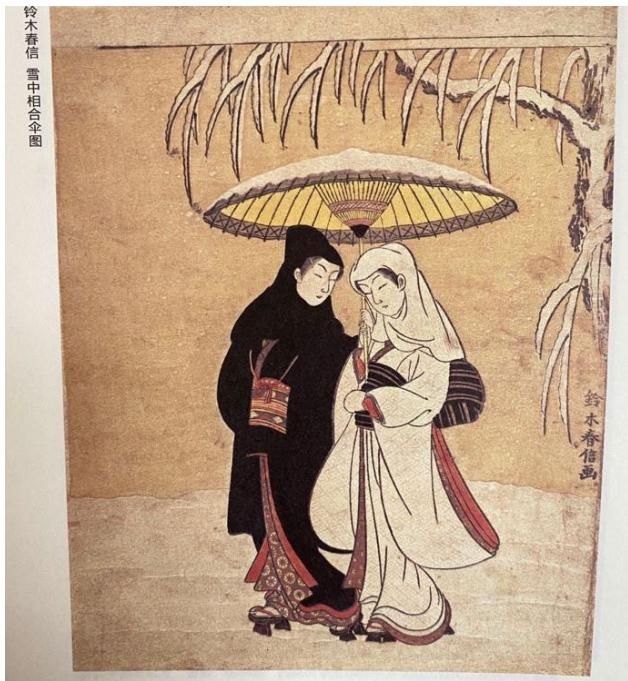 Figure 2: Lovers Beneath an Umbrella in the Snow
Kitagawa Utamaro's Okubi-e (large-headed pictures of beautiful women) is mostly of commoner women or married middle-aged women (a married middle-aged woman with a Shimada hair bun with her eyebrows cut off), expressing the beauty of women in the Edo period through depicting their hair. In the Okubie, such as The Courtesan Ichikawa of the Matsuba Establishment from the series Famous Beauties of Edo, Ase o fuku onna, Sugatami Shichinin Kesho, and Karagoto of the House of Chojiya in Edo-cho Nichome from the series A comparison of Courtesan Flowers, women postures are often expressed by looking into the distance or out of the painting. For example, the color used in The Hour of Xu (Figure 3) in the series The Twelve Hours in the Yoshiwara is mostly pale red, presenting an indescribable lightness with this light color, and a hazy light black color is added to express the color reflected from the distance as some haloes appear to be erratic. In addition, there are bright blues (sora-iro), reddish blues (benimidori) reflecting on peach blossoms, dark red (kurobeni) and dove feather grey (hatobanezumi) of smoldering flames, and bright and clean whitish green (byakuroku) and aloeswood brown (tonocha) This is the so-called asymmetry and dissonance (fausse) that expresses the Zen meaning. The famous Chinese contemporary writer Eileen Chang once described The Twelve Hours in the Yoshiwar in her Unforgettable Painting. She said, "The famous ukiyo-e The Twelve Hours in the Yoshiwar, which depicts the life of Geisha in twenty-four hours. The attitude of the painter is entirely different respect and solemnity, which is hard to be understood<sup>12\</sup)." She analyzed that Japanese
Kabuki is selected from a group of people as an institutionalized existence as if the Geisha is a mass lover trained by rules and regulations, and the weight of traditional habits is in the lightest small movements. In The Twelve Hours in the Yoshiwar, she only remembered the one in the day from 1 a.m. to 3 p.m. A woman changed into a dressing gown late at night, one hand catching the light flowered dress on her chest to prevent it from sliding down her shoulder, and the other hand holding an incense burner with a fine smoke floating from the incense head. A maid is squatting on the side to serve, painted much smaller than the Geisha. The Geisha stood there as if she were too tall, and her low hanging neck was too thin and too long, and her small white feet, which had not yet reached the wooden clogs, were too small to fit, yet she did know that she was loved, though she was alone at that time, the night seemed quieter and longer. Both the ukiyo-e and the understanding from Eileen idealize the prostitute. This idealization is derived from the system where the Japanese made the Geisha extraordinarily close to the standard of feminine beauty through rigorous training. What we see here is the day from 7 p.m. to 9 p.m., i.e., it should be a famous Geisha in Yoshiwara, and he realistically depicts the Geisha writing haiku and poems to the guests on one side, playing what she has been cultivated during Shikomi including culture, etiquette, language, decoration, poetry, song and dance, and music and music. The woman in the middle of the scene is assigned to a room where she is alone to show her talent to the guests and interact with them, and long scrolls filled with writing are scattered on the floor. Although it is not confident whether she is a Tayu, a Yujo, or something else, at least she is a Yujo, since she was dressed in a gorgeous costume and had a very high hairdo on her head. Although the women in these pictures are slaves (servants) of the yukaku operators, there is still a hierarchy of high and low rank among them. Some are Yujos, while others are maids. Isn't it idealistic and vague to ask each to live in their position and face all this with an ordinary mind? Utamaro is known as one of the three great masters of Japanese ukiyo-e. He expressed not only the organ aesthetics and social tendency and fashion of those kabuki actors but also the political ecology of the Edo period, as expressed in Ehon Taikoki and Hideyoshi and his Five Wives Viewing the Cherry Blossoms at Higashiyama, in which he offended the government and was imprisoned for 50 days. Have to admit that Kitagawa Utamaro opened the pinnacle of Bijinga-e followed by a decline.
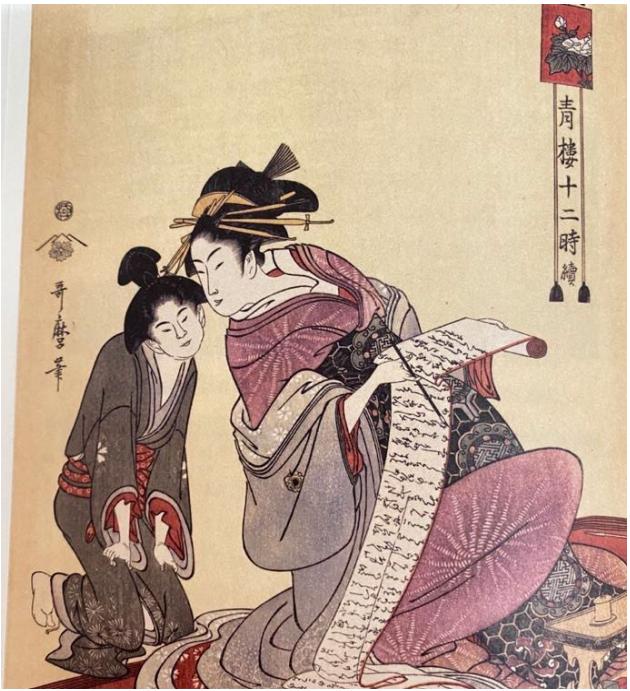 Figure 3: The Twelve Hours in the Yoshiwar. The Hour of Xu
At the end of the Shogunate, culture, economy, and politics were increasingly impoverished, and the political strength was slowing down, while the financial power of the Japanese merchants was growing and the Shogunate, to which the samurai were subordinate, lacked authority. Ukiyo-e, as a cultural product, was also affected. Painters tended to paint to satisfy the visual stimulation of their buyers. For instance, Utagawa Kunisada's Bijinga-e were close to the culture of Japanese merchants, such as Hoshi no shimo tosei fuzoku (Strarfrost contemporary manners) and the Harvest of Leisure and Catching Fireflies by the Sumida River (Sumida no hotarugari) all of which had a clear preference for a bent body with some male tension inside of it. The style is to paint those women with a pig's head and a cat's back (猪首猫背). This style has also been taken by Keisai Eisen, Kikukawa Eizan, and others. It embodies the chic, carefully calculated simplicity, and stylish Japanese aesthetic "粹 (lki)" of the Japanese Geisha and the idea of "人情嘶 (real-life story)" in Edo Rakugo. This perspective is derived from daily life and contains relationships and friendships connecting people. This kind of tension and lively atmosphere, with the hazy painting technique, brings out the decadent and depressed mood of Japanese society.
Bijinga-e with the "Kong" thought was widely imitated by European society in the $19^{\text{th}}$ century. After the Universal Exhibition held in London in 1862, the works of the Ukiyo-e were sent to France, where artists such as Stevens, Whistler, Tissot, Latour, Degas, Monet, and others collected the Ukiyo-e artworks. Among them, the Post-Impressionism artists were most interested in this Asian art. Van Gogh's Pere Tanguy, Van Gogh's La
Courtisane (after Keisai Eisen), Monet's La Japonaise: Camille Monet in Japanese Costume, James Abbott McNeill Whistler's The Princess from the Land of Porcelain, Gustave Leonard de Jonghe's The Japanese Fan, Edouard Manet's Portrait of Emile Zola, Mary Cassatt's Woman Bathing, and George Hendrik Breitner's Girl in a White Kimono are artworks that were produced after the Universal Exhibition when the artists were strongly influenced by the Oriental art school.
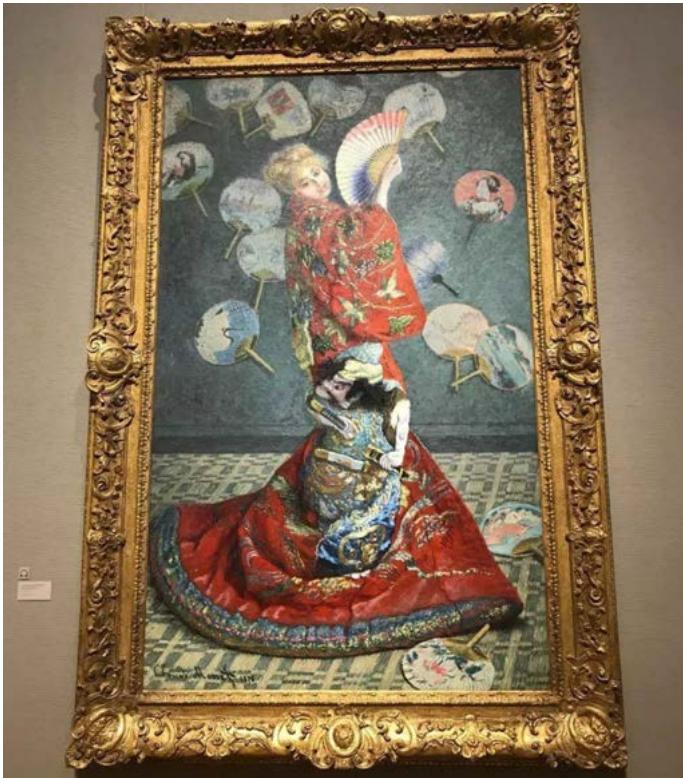 Figure 4: La Japonaise: Camille Monet in Japanese Costume
In La Japonaise: Camille Monet in Japanese Costume and The Princess from the Land of Porcelain, the artist painted his wife as the model in kimono. The composition of the image, the S-shaped pose, and the expression of the woman imitated and converged with Ukiyo-e and Japanese culture. Still, this convergence is limited to the East Asian elements rather than the connotation behind the paintings. In La Japonaise: Camille Monet in Japanese Costume, Monet depicts Camille wearing a padded ornate red kimono with the solemn expression of a samurai, standing on a Japanese tatami mat against a wall decorated with Japanese Noh masks and fans. Camille is facing the viewer, and her hair has been painted yellow from black to indicate her European identity, which is typical of European paintings, as well as her smile and dancing figure are different from the bitterness shown in the Ukiyo-e. Monet assembled many Japanese elements, but the complexity and his characteristic primary colorism are antagonistic to the central idea of emptiness embedded in the Bijinga-e. His paintings do not contain the humble, degenerate, silent, and hollow emotions that pervaded Japanese people and society; rather we can only perceive the feelings such as surprise and novelty. Besides, the figures in both paintings possess noble status; they are more essential figures like nobles and wives rather than the prostitutes in the Bijinga-e.
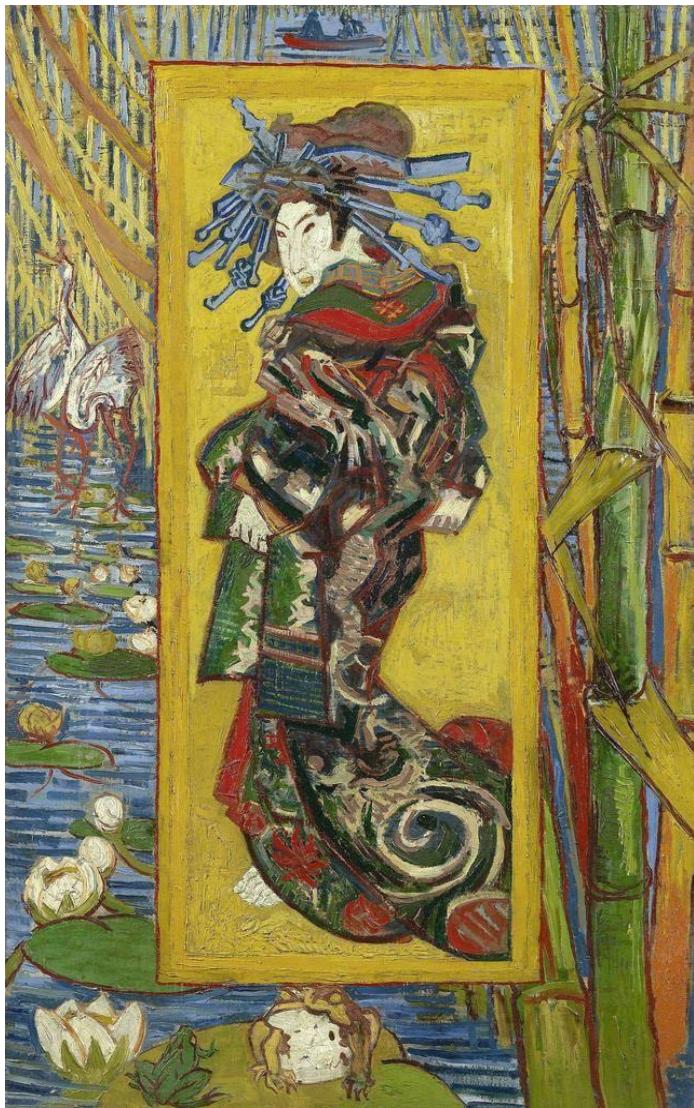 Figure 5: La Courtisane (after Keisai Eisen)
Some may argue that Van Gogh's La Courtisane (after Keisai Eisen) depicts an uncompromising Japanese Geisha. Indeed, Van Gogh's copying technique is even better, from the composition of the picture to the content of the painting, which is very similar to Ukiyo-e. Even the frogs and cranes drawn in the background of the image represent the "prostitute" in French slang. But the "Kong" here expressed in this copy from Eizumi Kisai's Geisha in 1887 is the one Van Gogh's understanding, as he wrote in his 1888 letter to Theo Van Gogh. He also felt the emptiness everywhere. He did indeed live in a great and true era of artistic revival, but the worn-out traditions still exist. We are powerless and lifeless, and new painters are isolated, impoverished, and treated like madmen. In the 1880s, Van Gogh was trying to break through the shackles, making his brushwork brutal, his forms and colors gradually leaning towards the Eastern style, and even trying to understand Zen Buddhism to understand Katsushika Hokusai. However, this is still unable to truly integrate his attitude and thoughts into the Japanese color reproduction of his paintings, or at least his expression makes it difficult for us to see his proper understanding of emptiness. These paintings are short of more profound thoughts and interests. Van Gogh never visited the last feudal Shogunate in Japan. He could not handle the idea of emptiness of confrontation, samurai spirit, and Machi civilization, with disunity, integration, poverty, and scarcity inside of it. He put it into his work. Van Gogh showed a new rendering of the soul and body of a returned object attached to the native Europe to which it belongs. It is a reproduction of the Kong aesthetic in the picture as if mirroring the people and civilization of a distant Eastern land. The image only expresses the visual beauty without showing the sentiment and story behind the content of the painting itself. As a result, the scenes have an impact on themselves, as Van Gogh combines his distress and confusion with the scenes in the paintings, forming his expression of "Kong." Or perhaps we should say that copy and imitate was originally Van Gogh's intention; after all, Van Gogh said to Theo when he copied Hiroshige Kogawa's painting: "I have found something wonderful that I must copy<sup>13\</sup)." It wasn't even just Van Gogh, but many others, such as Gauguin, who painted with Van Gogh for nine weeks in Arles. Gauguin's A Courtesan, from the series Night Cherry Blossoms in the Pleasure Quarter, after Utagawa Kunisadade, shows a woman with a stiff physique and a background of lamps, balustrades, and cherry blossoms. In the background of the picture, the lamp, the railing, and the cherry blossoms all look like objects placed on top of each other without any connection. The loneliness contained in "leaning on the railing", looking at the flowers, the moon, and the night, as well as the sadness and sorrow of the wind and the lamp, are not expressed by Gauguin. In other words, in Japanese painting, the matter is the place where color moves and emptiness is the attachment that is not separated from matter, just like the relationship between Courtesan and the railing in the picture. Kong is not emptiness, but the true nature of all dharmas, the true nature of color and mind. The European artists struggled, in replications, to find that mystery and vitality in Asian art that they could not comprehend, to explore the symbolic depth of imitation that had gradually tapered off in traditional European art forms. Perhaps this mimicry was effective, even laying a
vital foundation for the post-impressionists, leaving greater pictorial space and opportunity for their claim on the evasion of traditional art through the distinctive decorative subjects, elongated image format, asymmetrical composition, aerial perspective, and abstract color of the Ukiyo-e, but this expression lacked a critical understanding and inheritance of a key element in Japanese Zen aesthetics — "Kong."
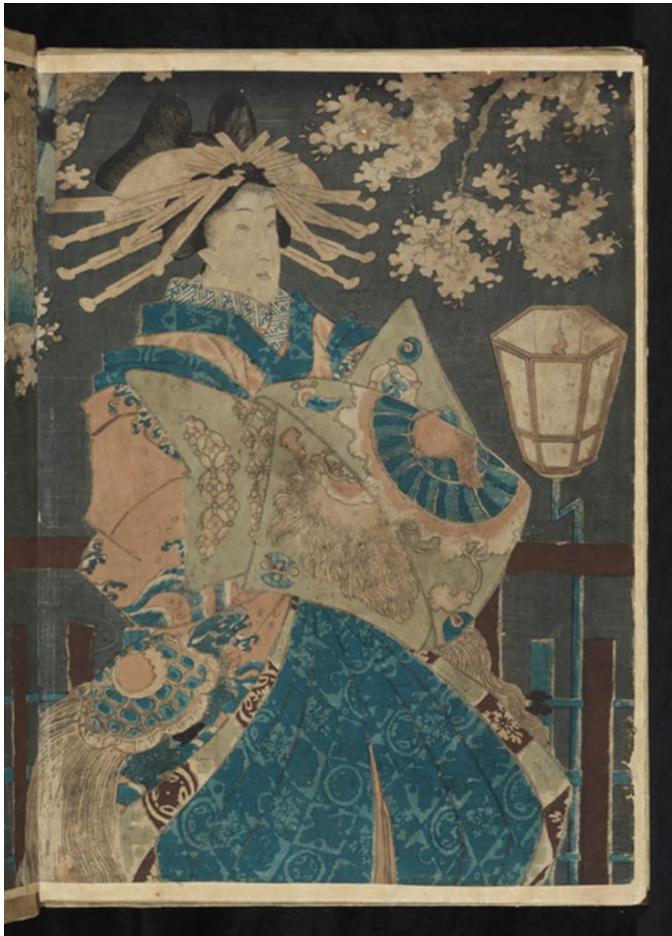 Figure 6: A Courtesan, from the series "Night Cherry Blossoms in the Pleasure Quarter"
## IV. CONCLUSION
In general, this paper argues that Kong in Zen and Japanese aesthetics has multiple meanings as it is not subordinate to any interpretations or scriptures alone. We begin by analyzing the initial ideology of the Kong in Japan. Buddhism emerged from Hinduism, passed through China, giving rise to Zen Buddhism, and then went through many generations, dynasties, and transformations before arriving in Japan. From the Vajra Sutra to the Baizhang Qinggui to the Linji Lu, the system and teachings were gradually developed and perfected so that "Kong" was also perfected ideologically and theoretically. Second, we examine the practice of Kong in Japanese daily life, often referred to as the Linji method of Zen practice (Katsu), among the samurai and the townspeople. In this paper, we choose the Edo period, when the Ukiyo-e was formed, as the timeline for our case study. In other words, we analyze "Katsu" in the last feudal era of Japan from three aspects: the ruling authority, the Bushido culture of being towards death, and the carpe diem of the Japanese merchants. Finally, we put this aesthetic into the context of paintings called Bijinga-e, the most famous art form in the Edo period, except for the Ukiyo-e. The gradual collapse of political power in Japan during that era brought a rich, evolving, an additional form of amusements and popular developed Yoshiwars. Bijinga-e is a delicate representation of that era, a true reflection of the emptiness, decadence, and dissipation of the samurai and the townspeople, a sign of the decline and degradation of martial power, and a construction of all the meanings of "Kong." With the spread of Ukiyo-e to the West, Bijinga-e was also copied by many famous Western painters of the Impressionist school. Whether it is the Geisha in the Ukiyo-e or the noblewoman in the Western oil painting, that one thing remains the same. The kind of reproduction after removing the modification of spirit and flesh is the loneliness and desolation that the artist strives to express, the individual human's complicated loneliness, and the unreachable breadth of thought and nature. What "Kong" can achieve is the lack of abundance, and what is mapped out is the same space. However, the Japanese Zen aesthetic ideology of "Kong" has not been inherited. The capture of Western reproductions in the context of Eastern painting is like a net that catches butterflies. The net waved and waved in the sky. The beauty of the "Kong" presentation of Japanese Zen aesthetics is like a flying butterfly, always flying, not in the net. Nobody knows where it goes.
[^3]: There is a saying: "临天下,洞一隅 Lintian Xia, Dongyi Yu." _(p.3)_
[^6]: $^{6}$ Yuho, K. T., & MumonYamada. (2017). The Record of Linji. University of Hawaii Press. pp.221 _(p.3)_
[^10]: Foreman, Kelly (2008). The Gei of Geisha. Music, Identity, and Meaning. _(p.5)_
[^2]: Translated as: For the subject of awareness, the absence of thoughts, to be in all stages but free from all stages, and no basis is fundamental. _(p.3)_
[^4]: Translated as: Ordinary mind is the way. _(p.3)_
[^7]: Linji considerably developed this tradition and Katsu technique as the so-called "Linji's Four Shouts." He distinguished four different categories of Katsu: _(p.3)_
[^9]: Followers of the Way, if you want insight into dharma as it is, just don't be taken in by the deluded views of others. Whatever you encounter, either within or without, slay it at once. On meeting a Buddha, slay the Buddha. On meeting a patriarch, slay the patriarch. On meeting an arhat, slay the arhat. On meeting your parents, kill your parents. On meeting your relatives, kill your relatives. Then, you attain emancipation. By not cleaving to things, you freely pass through. Retrieved from Linji Lu. pp.236. _(p.4)_
[^11]: $^{11}$ Jiang, Wenqing. (2021). Riben Zhonggu Hege 500 Shou: Pingan Shidai De Riben Hege. The People's Press of Yunnan. _(p.5)_
[^13]: Vincent van Gogh to Theo van Gogh Arles: c.25 July 1888. Web Exhibits: https://www.webexhibits.org/vangogh/letter/18/514.htm _(p.8)_
Generating HTML Viewer...
References
21 Cites in Article
Martin Bailey (2020). Gauguin and Van Gogh: their shared love of Japan revealed.
H Bayou (2011). Du Japon à l'Europe, changement de statut de l'estampe ukiyo-e.
George Breitner,Hendrik (1894). Girl in a White Kimino.
David Bromfield (2001). Lindsay, Sir (Ernest) Daryl, (31 Dec. 1889–25 Dec. 1976), Director, National Gallery of Victoria, Australia, 1941–56, retired; Member, National Capital Planning Commission, Canberra.
Rupert Cox (2013). The Zen Arts.
Heinrich Dumoulin (2005). India and China, World Wisdom Books.
P Haskel,永琢 (1990). Bankei and his world.
Huineng Tanjing (The Accessible Version (Collector's Edition)).
Daryl Jamieson (2018). Hollow Sounds: Toward a Zen-Derived Aesthetics of Contemporary Music.
Junaid Yasin,Nanda Thimmappa,Jussuf Kaifi,Diego Avella,Ryan Davis,Sanjit Tewari,Sachin Saboo,Ambarish Bhat (2020). CT-guided cryoablation for post-thoracotomy pain syndrome: a retrospective analysis.
Zeliang Liu (2006). Linji Lu and Huangbo Zongzhi. Xiamen Da Xue.
Michel Mohr (1994). Zen Buddhism during the Tokugawa Period: The Challenge to Go Beyond Sectaria Consciousness.
Barbara O'brien (2018). IV. Zen and the Samurai.
Ophascharas Nandawan (2016). Study the Art Forms of Installation Art by Female Artists in Thailand.
Ramón Rodríguez Llera,Rosa Cabañas Moreno Pilar Y Matilde,Arias Estévez,Zen,Tao Y Ukiyoe (2022). Cabañas Moreno Pilar y Matilde Rosa Arias Estévez. ZEN, TAO Y UKIYOE. Horizontes de inspiración artística contemporánea. Gijón: Satori Arte, pp. 368. ISBN: 978-84-17419-63-9.
Alastair Sooke (2018). Van Gogh and Japan: the prints that shaped the Artist.
Qing Xu (2004). On the Beauty Painting in the Ukiyo-e.
S Yamamoto (2007). The Late Meiji Period.
Yuxi Yi (2023). An Analysis of the Status of Japanese Zen Art Aesthetics in Ukiyo-e from Katsushika Hokusai to Van Gogh.
K Yuho,Mumonyamada (2017). Th e Record of Linji, translated by Ruth Fuller Sasaki.
Bowie Zhang Linji Lu (Treasures of Chinese Buddhist Classics.
No ethics committee approval was required for this article type.
Data Availability
Not applicable for this article.
How to Cite This Article
Yuxi YI. 2026. \u201cThe Role Played by Zen “Kong” in Japanese Aesthetics\u201d. Global Journal of Human-Social Science - H: Interdisciplinary GJHSS-H Volume 23 (GJHSS Volume 23 Issue H4): .
Explore published articles in an immersive Augmented Reality environment. Our platform converts research papers into interactive 3D books, allowing readers to view and interact with content using AR and VR compatible devices.
Your published article is automatically converted into a realistic 3D book. Flip through pages and read research papers in a more engaging and interactive format.
Japanese Zen Buddhism has led the way for Japanese aesthetics and has continued to bring this aesthetic to the public, most notably in the form of ukiyo-e. Zen Buddhism is a branch of Buddhism with the core principle of “no thought, no appearance, no dwelling,” and “Katsu” as its practice from Linji School. As Zen became integrated into Japanese life, meditation was likewise manifested in social life, most notably in the Edo period. As a declining, last feudal period in Japanese history, the Edo Shogunate was flawed in terms of notification. The samurai class, which was attached to the Shogunate, was fundamentally lacking in subject matter, and the Tokugawa family gave them the idea of Bushido but not its inner pillar. Japanese merchants, who had no status, spent their money recklessly but gained confusion and emptiness. Bijinga-e, who specializes in painting Japanese geisha in Ukiyo-e, shows all the meanings of “Kong” through the composition, white space, and the form of people in the painting. Most impressionists in the nineteenth century expressed their emotions and imitated East Asian style artworks, and only “had the form but not the spirit.” This paper thus concludes that the status of “Kong” in Japanese Zen aesthetics is like a butterfly in an invisible net, out of control and out of sight.
Our website is actively being updated, and changes may occur frequently. Please clear your browser cache if needed. For feedback or error reporting, please email [email protected]
Thank you for connecting with us. We will respond to you shortly.