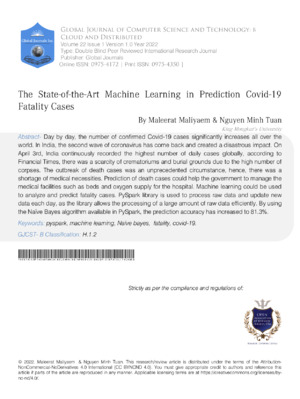
The State-of-the-art Machine Learning In Prediction Covid-19 Fatality Cases

α
Maleerat Maliyaem
Maleerat Maliyaem
σ
Nguyen Minh  Tuan
Nguyen Minh Tuan
α King Mongkut's University of Technology North Bangkok

Send Message

To: Author

The State-of-the-art Machine Learning In Prediction Covid-19 Fatality Cases

Article Fingerprint

ReserarchID

CSTBQ9OJY

The State-of-the-art Machine Learning In Prediction Covid-19 Fatality Cases Banner

AI TAKEAWAY

Connecting with the Eternal Ground
  • English
  • Afrikaans
  • Albanian
  • Amharic
  • Arabic
  • Armenian
  • Azerbaijani
  • Basque
  • Belarusian
  • Bengali
  • Bosnian
  • Bulgarian
  • Catalan
  • Cebuano
  • Chichewa
  • Chinese (Simplified)
  • Chinese (Traditional)
  • Corsican
  • Croatian
  • Czech
  • Danish
  • Dutch
  • Esperanto
  • Estonian
  • Filipino
  • Finnish
  • French
  • Frisian
  • Galician
  • Georgian
  • German
  • Greek
  • Gujarati
  • Haitian Creole
  • Hausa
  • Hawaiian
  • Hebrew
  • Hindi
  • Hmong
  • Hungarian
  • Icelandic
  • Igbo
  • Indonesian
  • Irish
  • Italian
  • Japanese
  • Javanese
  • Kannada
  • Kazakh
  • Khmer
  • Korean
  • Kurdish (Kurmanji)
  • Kyrgyz
  • Lao
  • Latin
  • Latvian
  • Lithuanian
  • Luxembourgish
  • Macedonian
  • Malagasy
  • Malay
  • Malayalam
  • Maltese
  • Maori
  • Marathi
  • Mongolian
  • Myanmar (Burmese)
  • Nepali
  • Norwegian
  • Pashto
  • Persian
  • Polish
  • Portuguese
  • Punjabi
  • Romanian
  • Russian
  • Samoan
  • Scots Gaelic
  • Serbian
  • Sesotho
  • Shona
  • Sindhi
  • Sinhala
  • Slovak
  • Slovenian
  • Somali
  • Spanish
  • Sundanese
  • Swahili
  • Swedish
  • Tajik
  • Tamil
  • Telugu
  • Thai
  • Turkish
  • Ukrainian
  • Urdu
  • Uzbek
  • Vietnamese
  • Welsh
  • Xhosa
  • Yiddish
  • Yoruba
  • Zulu

Abstract

Day by day, the number of confirmed Covid-19 cases significantly increases all over the world. In India, the second wave of coronavirus has come back and created a disastrous impact. On April 3rd, India continuously recorded the highest number of daily cases globally, according to Financial Times, there was a scarcity of crematoriums and burial grounds due to the high number of corpses. The outbreak of death cases was an unprecedented circumstance, hence, there was a shortage of medical necessities. Prediction of death cases could help the government to manage the medical facilities such as beds and oxygen supply for the hospital. Machine learning could be used to analyze and predict fatality cases. PySpark library is used to process raw data and update new data each day, as the library allows the processing of a large amount of raw data efficiently. By using the Naïve Bayes algorithm available in PySpark, the prediction accuracy has increased to 81.3%.


References

20 Cites in Article
  1. Manpinder Singh,Saiba Dalmia (2020). Prediction of number of fatalities due to Covid-19 using Machine Learning.
  2. Sirage Zeynu,Ahmed Analysis and forcasting the outbreak of Covid-19 in Ethiopia using machine learning.
  3. Tamer Sh,Roseline Mazen,Ogundokun Oluwaseun,Joseph Bamidele,Awotunde (2020). A novel machine learning based model for COVID-19 prediction.
  4. Sudhir Bhandari,Ajit Shaktawat,Amit Tak,Bhoopendra Patel,Jyotsna Shukla,Sanjay Singhal,Kapil Gupta,Jitendra Gupta,Shivankan Kakkar,Amitabh Dube (2020). Logistic regression analysis to predict mortality risk in COVID-19 patients from routine hematologic parameters.
  5. Arjun Yadaw,Yan-Chak Li,Sonali Bose,Ravi Iyengar,Supinda Bunyavanich,Gaurav Pandey (2020). Clinical features of COVID-19 mortality: development and validation of a clinical prediction model.
  6. Shreshth Tuli,Shikhar Tuli,Rakesh Tuli,Sukhpal Gill (2020). Predicting the Growth and Trend of COVID-19 Pandemic using Machine Learning and Cloud Computing.
  7. Mohammad Behdad Jamshidi,Ali Lalbakhsh,Jakub Talla,Zden_Ek Peroutka,Farimah Hadjilooei,Pedram Lalbakhsh,Morteza Jamshidi,Luigi Spada,Mirhamed Mirmozafari,Mojgan Dehghani,Asal Sabet,Saeed Roshani,Sobhan Roshani,Nima Bayat-Makou,Bahare Mohamadzade,Zahra Malek,Alireza Jamshidi,Sarah Kiani,Hamed Hashemi-Dezaki,Wahab Mohyuddin (2020). Artificial Intelligence and COVID-19: Deep Learning Approaches for Diagnosis and Treatment.
  8. Sina Ardabili,Amir Mosavi,Pedram Ghamisi,Filip Ferdinand,Annamaria Varkonyi-Koczy,Uwe Reuter,Timon Rabczuk,Peter Atkinson (2020). COVID-19 Outbreak Prediction with Machine Learning.
  9. Mohammadreza Nemati,Jamal Ansary,Nazafarin Nemati (2020). Machine-Learning Approaches in COVID-19 Survival Analysis and Discharge-Time Likelihood Prediction Using Clinical Data.
  10. Afm Batista,J Miraglia,Thr Donato,Chiavegatto Filho,Adp (2020). COVID-19 diagnosis prediction in emergency care patients: a machine learning approach.
  11. Hongwei Zhao,Naveed Merchant,Alyssa Mcnulty,Tiffany Radcliff,Murray Cote,Rebecca Fischer,Huiyan Sang,Marcia Ory (2021). COVID-19: Short term prediction model using daily incidence data.
  12. Rajan Gupta,Gaurav Pandey,Poonam Chaudhary,Saibal Pal (2020). Machine Learning Models for Government to Predict COVID-19 Outbreak.
  13. Anthony Kelly,Marc Johnson,Anthony (2021). Investigating the Statistical Assumptions of Naïve Bayes Classifiers.
  14. B S; Sharmila,Rohini Nagapadma (2019). Intrusion Detection System using Naive Bayes algorithm.
  15. B S Sharmila,Rohini Nagapadma (2019). Intrusion Detection System using Naive Bayes algorithm.
  16. Tuan Nguyen,M Meesad,P,Nguyen Ha,H (2021). English-Vietnamese Machine Translation Using Deep Learning, Recent Advances in Information and Communication Technology.
  17. Maleerat Maliyaem,Nguyen Minh Tuan,Demontray Lockhart,Supattra Muenthong (2022). A Study of Using Machine Learning in Predicting COVID-19 Cases.
  18. Tuan Nguyen,M,Phayung Meesad (2021). A Study of Predicting the Sincerity of a Question Asked Using Machine Learning.
  19. Tuan Nguyen,M (2022). Machine Learning Performance on Predicting Banking Term Deposit.
  20. Mohamad Siti Nurhidayahsharin,Khairilradzali,Shirwan Muhamad,Abdullah-Sani (2022). A network analysis and support vector regression approaches for visualizing and predicting the COVID-19 outbreak in Malaysia.

Funding

No external funding was declared for this work.

Conflict of Interest

The authors declare no conflict of interest.

Ethical Approval

No ethics committee approval was required for this article type.

Data Availability

Not applicable for this article.

How to Cite This Article

Maleerat Maliyaem. 2026. \u201cThe State-of-the-art Machine Learning In Prediction Covid-19 Fatality Cases\u201d. Global Journal of Computer Science and Technology - B: Cloud & Distributed GJCST-B Volume 22 (GJCST Volume 22 Issue B1): .

Download Citation

Precise machine learning model predicting COVID-19 fatalities.
Issue Cover
GJCST Volume 22 Issue B1
Pg. 57- 63
Journal Specifications

Crossref Journal DOI 10.17406/gjcst

Print ISSN 0975-4350

e-ISSN 0975-4172

Keywords
Classification
GJCST-B Classification: DDC Code: 006.312 LCC Code: QA76.9.D343
Version of record

v1.2

Issue date

November 21, 2022

Language
en
Experiance in AR

Explore published articles in an immersive Augmented Reality environment. Our platform converts research papers into interactive 3D books, allowing readers to view and interact with content using AR and VR compatible devices.

Read in 3D

Your published article is automatically converted into a realistic 3D book. Flip through pages and read research papers in a more engaging and interactive format.

Article Matrices
Total Views: 2604
Total Downloads: 46
2026 Trends
Related Research

Published Article

Day by day, the number of confirmed Covid-19 cases significantly increases all over the world. In India, the second wave of coronavirus has come back and created a disastrous impact. On April 3rd, India continuously recorded the highest number of daily cases globally, according to Financial Times, there was a scarcity of crematoriums and burial grounds due to the high number of corpses. The outbreak of death cases was an unprecedented circumstance, hence, there was a shortage of medical necessities. Prediction of death cases could help the government to manage the medical facilities such as beds and oxygen supply for the hospital. Machine learning could be used to analyze and predict fatality cases. PySpark library is used to process raw data and update new data each day, as the library allows the processing of a large amount of raw data efficiently. By using the Naïve Bayes algorithm available in PySpark, the prediction accuracy has increased to 81.3%.

Our website is actively being updated, and changes may occur frequently. Please clear your browser cache if needed. For feedback or error reporting, please email [email protected]

Request Access

Please fill out the form below to request access to this research paper. Your request will be reviewed by the editorial or author team.
X

Quote and Order Details

Contact Person

Invoice Address

Notes or Comments

This is the heading

Lorem ipsum dolor sit amet, consectetur adipiscing elit. Ut elit tellus, luctus nec ullamcorper mattis, pulvinar dapibus leo.

High-quality academic research articles on global topics and journals.

The State-of-the-art Machine Learning In Prediction Covid-19 Fatality Cases

Maleerat Maliyaem
Maleerat Maliyaem King Mongkut's University of Technology North Bangkok
Nguyen Minh  Tuan
Nguyen Minh Tuan

Research Journals