## I. INTRODUCTION
According to Wikipedia, management is "... the activities of setting the strategy of an organization and coordinating the efforts of its employees (or of volunteers) to accomplish its objectives through the application of available resources, such as financial, natural, technological, and human resources" ("Management"). It is obvious from this definition that any discussion of 'how to improve management' should start with the description of the system within which this activity is running. In other words, the first thing we need to do is to analyze the world around us as a system and only after that it'll be possible to discuss a style of management appropriate for this system, i.e. for the world. That is why, in order to define the best way of XXI century management, one needs, firstly, to answer another question: what are the main features of the world we are living in? This issue is discussed in the first section. Then a brief reminder of WED's principles of the SoPK is given. In the third section a discussion on the different principles of the so-called "good" management is presented together with the explanation why the author is sure that the SoPK does have some essential advantages compared to many other management models. The fourth part focuses on the necessary transformation of the traditional and outdated management to ensure human prosperity in the XXI century. In conclusion, the main idea on what should be done is stated.
### 1. What kind of world do we live in?
There are lots of answers to this question. One that gained popularity at the beginning of this century is known as VUCA ("VUCA"). VUCA stands for Volatility, Uncertainty, Complexity, and Ambiguity. It describes the permanent and unpredictable change that has become a norm in our lives and in many areas of the business world. Its core tenets are:
Volatility – "the nature and dynamics of change";
Uncertainty – "the lack of predictability";
Complexity - "the multiplex of forces, the confounding of issues, no cause-and-effect chain";
Ambiguity - "the haziness of reality, the potential for misreads".
In my view, this notion is insufficient to adequately describe the world's state-of-the-art. In fact, Volatility is a specific term from the financial analytics which means "the degree of variation of a trading price series over time (usually denoted by $\sigma$ )" ([^1]"Volatility"). There's a much more general and much more widely known (by scientists and engineers) term "Variability" which should be used instead of "Volatility". Next, two terms, "Uncertainty" and "Ambiguity", have highly overlapping meanings: both roughly mean the lack of predictability. So, it would be preferable to use the term "Unpredictability" instead of "Uncertainty" and "Ambiguity". Then, VUCA leaves no place for "human beings" (at least, explicitly), which makes it not adequate to the current situation. Humans are strange creatures because we can be rational and irrational simultaneously (Kahneman 2013). We often do not know why we made one or another decision. I'm sure it is impossible to describe and analyze our world as a system without including humanity as the important constituent. As a result, in a recent paper by Shper, Adler (2020) the authors came up with the model called
CHIVU: Complexity, Human Irrationality, Variability, and Unpredictability. In contrast to VUCA, the CHIVU model seems to be organized more logically: it starts with the complexity of our world; this complexity plus human irrationality and variability leads to general unpredictability of everything: process outputs, results of our decisions, etc. So, it is just CHIVU model will be used below.
There is another answer to the question formulated in the title of this section: The Forth Industrial Revolution. Describing the main differences of the $4^{\text{th}}$ revolution from previous ones, Klaus Schwab speaks about "velocity, scope, and systems impact" (Schwab 2016). Systems impact coincides with the complexity component of CHIVU, velocity and scope may be easily included into variability. That way the CHIVU model covers both types of answers. Additionally, it is worth noting that the 'variability' component covers two different types of variability: mediocristan and extremistan (Taleb 2007). Mediocristan variability is the variability of a system under normal conditions, and extremistan variability is the variability under the impact of 'black swan'-type event. Ultimately, one can say that we live in the world of complex interconnected and interrelated systems affected by multiple types of variability on multiple levels, where the decisions are being made by actors that can be rational and irrational simultaneously, and all those factors together lead to results both predictable and unpredictable.
So the problem arises: what kind of management is most appropriate for such a world? The answer will be given in the $3^{\text{rd}}$ section, but before that, let us look at the SoPK by WED.
#### 2. The main ideas of the SoPK
The necessity to change the style of traditional management has become obvious to WED long before the new century. "The basic cause of sickness in American industry and resulting unemployment is failure of top managers to manage... The causes usually cited for failure of a company are costs of start-up, overruns on costs, depreciation of excess inventory, competition – anything but the actual cause, pure and simple bad management" (Deming 2013, 16, italic by WED). This was written in 1987 – more than 35 years ago. At that moment, WED had already undertaken an attempt to change American style of management in his famous book "Out of Crisis" (Deming 1986). There he announced his well-known 14 principles of good management but most managers paid no attention to them. He understood that merely a set of principles was not enough – the World needs to have a theory of good management. As WED often spoke (in different words): "Theory leads to questions. Without questions, experience and examples teaches nothing. Without questions, one can only have an example. To copy an example of success, without understanding it with the aid of theory, may lead to disaster" (Deming 2013, 79). And WED created such a theory (Deming 1993, ch.4; 2013, 57)[^2]. He named it 'The System of Profound Knowledge' (SoPK). It consists of four interdependent parts:
- Appreciation for a system.
- Some knowledge about variation.
- Theory of knowledge - vital.
- Psychology.
Visually the SoPK can be presented as Venn diagram (fig.1).
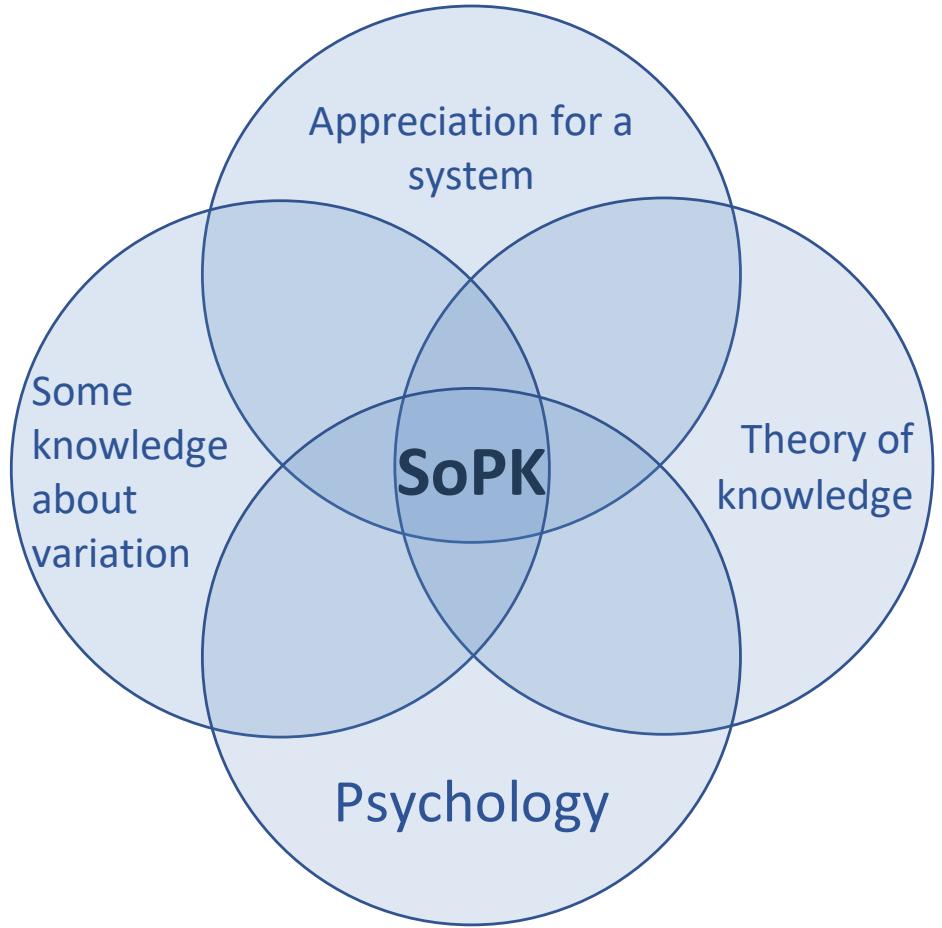 Fig. 1: The System of Profound Knowledge by W.E. Deming
The main purpose of this figure is to demonstrate how all parts of the SoPK are interrelated and cross-connected. The SoPK comes into being only in the heart of it, where all the circles intersect. Here are some WED's thoughts about the main features of each component (Deming 2013).
System (ibid, 58).
"... a system must have an aim. Without an aim there's no system... Management of a system requires knowledge of the interrelationships between all the components within the system. And of the people that work in it."
Variation (ibid, 77).
"Variation there will always be, between people, in output, in service, in product. What is the variation trying to tell us about a process, and about the people that work in it?"
Theory of knowledge (ibid, 79).
"... any plan is prediction. Any assumption is prediction... Management is prediction. And with the risk of being wrong... Theory leads to prediction. Without prediction experience and examples teach nothing."
Psychology (ibid, 80, 81).
"People are different from one another... Management of industry, education, and government operate today under the supposition that all people are alike... There is intrinsic motivation, extrinsic motivation, over-justification... We have been destroying our people, from toddlers on through the university, and on the job... The most important figures for management are unknowable."
I'll return to these points later.
Surely, the answer to this question is predicated upon a multitude of factors, but most crucial of those is one's vision of the main moving forces that impact our lives. In my view, the notion of CHIVU described in section 1 may serve as a reasonable starting point. The world needs management that is capable of generating optimal decisions in the environment of complexity – human irrationality – variability – and unpredictability. In the previous paper about WED (Adler & Shper 2015) management principles of different gurus applied to the realities of life in the XXI century were compared. The analysis was structured in accordance with the number of principles of 'good' management from 4 and up to 33, hence WED's 14 points fall somewhere in the middle. In the table below authors of those papers are listed in the left column (table 1). Later we added to this list the works of many other authors having divided them into two main groups: successful entrepreneurs (left column at the bottom) and gurus, professors, consultants, popular journalists, economists, etc. (right column). For those who are interested in details, the precise statements of good management principles from our list 4-33 may be found in the Appendix. As 7
years passed since that paper was published, many new works appeared that deserved being discussed from the point of current interest. Below I'll briefly consider the most interesting findings appeared recently and not discussed in (Adler & Shper 2015).
Table 1: List of papers containing suggestions about the principles of good management for the XXI century
<table><tr><td>Authors who proposed the number of principles of good management (numeral on the left)</td><td>Guru, CEOs, professors, consultants, popular journalists, economists, etc.</td></tr><tr><td>4 – (Carney & Getz 2009)</td><td>(Drucker 1999)</td></tr><tr><td>5 – (Myrick 2005)</td><td>(Johnson & Bröms 2000)</td></tr><tr><td>6 – (Berry & Seltman 2008)</td><td>(Collins 2001)</td></tr><tr><td>7 – (ISO 9000 2015)</td><td>(Bossidy & Charan 2002)</td></tr><tr><td>8 – (EFQM)</td><td>(Csikszentmihalyi 2003)</td></tr><tr><td>12 – (Korten 2009)</td><td>(Galbraith 2004)</td></tr><tr><td>14 – (Deming 1986)</td><td>(Seddon 2005)</td></tr><tr><td>14 – (Liker 2004)</td><td>(Sacks 2005)</td></tr><tr><td>25 – (Hopper, K. & W. 2007)</td><td>(Burlingham 2005)</td></tr><tr><td>25 – (Hamel et al. 2009)</td><td>(Pfeffer & Sutton 2006)</td></tr><tr><td>33 – (Matsushita 2004)</td><td>(Brafman and Beckstorm 2006)</td></tr><tr><td></td><td>(Shiba & Walden 2006)</td></tr><tr><td>Successful entrepreneurs:</td><td>(Osono, et al. 2008)</td></tr><tr><td>(Semler 2003)</td><td>(Jackson 2009)</td></tr><tr><td>(Hsieh 2010)</td><td>(Rother 2009)</td></tr><tr><td>(Mycoskie 2011)</td><td>(Bolchover 2010)</td></tr><tr><td></td><td>(Moyo 2012)</td></tr><tr><td></td><td>(Huffington 2014)</td></tr><tr><td></td><td>(Harnish 2015)</td></tr><tr><td colspan="2">Added for this paper:</td></tr><tr><td>(Mackey & Sisodia 2013)</td><td>(Pinker 2019)</td></tr><tr><td>(Sedlacek 2013)</td><td>(Mintzberg 2019)</td></tr><tr><td>(Rozenzweig 2014)</td><td>(Tschepin 2019)</td></tr><tr><td>(Laloux 2014)</td><td>(Razgulyaev 2020)</td></tr><tr><td>(Foer 2017)</td><td>(Ekind 2020)</td></tr><tr><td>(Madsbjerg 2017)</td><td>(Hamel & Zanini 2020)</td></tr><tr><td></td><td>(Dwyer & Micale 2022)</td></tr></table>
John Mackey and Raj Sisodia (Mackey & Sisodia 2013) write about a group of companies focused on the well-being of all stakeholders. Their ideology prioritizes goals like doing good for everybody, searching for the truth, creating beauty and heroism to do everything in one's power to make the world better. The companies studied in (Mackey & Sisodia 2013) can be collectively described as "Conscious Capitalism". They follow certain principles: openness, trust, equality, responsibility, honesty. All these principles are completely compatible with the SoPK values and WED's ideas.
The highly provocative book of Tomas Sedlacek (Sedlacek 2013) is a desperate attempt to persuade mankind that Economics (as the social science) has gone astray: its mainstream is carried with math and formulas and ignores Good and Evil – main moving forces of history. In the context of this paper, I guess that Sedlacek is trying to point out that economists have forgotten about Psychology – one of the pillars of the SoPK. The mere existence of social science without Psychology at its core is an example of astonishing myopia.
Phil Rosenzweig (Rozenzweig 2014) - the author of well-known "The halo effect... and the eight other business delusions that deceive managers" - continues to deepen our understanding of systemic and psychological problems which managers are facing again and again in the real world. His work outlines the importance of these two areas of the SoPK and their indissoluble connections.
F. Laloux (Laloux 2014) gives a wide colored perspective of organization development throughout human history and describes the level he named "teal". Teal organizations are based on the following principles (Laloux 2014, Appendix 4):
"Self-organizing teams with coaches when needed, no executive team meetings,
- no project managers - self-staff projects,
- minimum or no plans and budgets, organic prioritization,
- few staff remaining have only advisory role,
- recruitment by interviews by future colleagues,
- personal freedom and responsibility for training,
- no job titles and fixed job descriptions,
- high degree of flexibility in working hours, as long as commitments are upheld,
- focus on team performance plus peer-based individual appraisement,
- self-set salaries with peer calibration for base pay, no bonuses, equal profit sharing,
- no promotions but fluid rearrangements of roles based on peer agreement,
- dismissal is the last step in mediated conflict resolution mechanism,
- decision-making is fully decentralized and based on advice process,
- all information is available in real-time to all, including company financials and compensations, clear values translated into explicit ground rules of (un)acceptable behavior,
- organization seen as a living entity with its own evolutionary purpose (competition is irrelevant concept),
- strategy emerges organically from the collective intelligence of self-managing employees,
- innovation and development come from the purpose guided by intuition and beauty,
- suppliers are chosen by fit to the purpose,
- anybody can spend any amount of money provided advice process is respected,
- peer-based challenging of team's investment budget,
- marketing is our offer to the world, no sales targets,
- planning and budgeting are based on "sense and respond"
- with workable solutions, no targets, "change" no longer a relevant topic because organization constantly adapt from within,
- everyone is involved to let the best response to a crisis emerged"
- Careful comparison showed that the gist of these principles coincides closely with the ideas that WED outlines (in different words) in his books, papers, reports and notes (Deming 1986, 1993, 2013).
Foer F. (Foer 2017) discusses the deadly perils of the future humanity is facing due to efforts by GAFA (Google, Apple, Facebook, Amazon), and other high tech companies. These innovators intentionally or inadvertently (most probably both) are trying to construct a world where they decide what news we get, what books we read, what goods we buy, what destinations we choose, what friends we invite into our circle, etc. As usual, "The road to hell is paved with good intentions". The logic of constant growth required more and more followers – to achieve this goal, GAFA started to rely on people's biases and pander to the ubiquitous ignorance of the crowds. "Humans are comfortable with ignorance, but they hate feeling deprived of information" (Foer 2017, 139). Big Tech inundates us with big data and information, and most people mistake this abundance for knowledge; though many years ago Frank Zappa wrote that "Information is not knowledge, Knowledge is not wisdom, Wisdom is not truth..."[^3]. Thus, many decided that they were the only ones in possession of important knowledge... And they started to share it with the world... It created positive feedback and strengthened the power of GAFA. As a result, instead of the Utopia of Peace and Freedom the 'World of GAFA' emerges where "The value of knowledge has been deflated and depressed..." (Foer 2017, 170). Many other researchers are anxious about this problem – see for example the paper of N. Chomsky (Chomsky 2018). The possible reason for this phenomenon is the lack of system thinking. Knowledge itself is not enough; it needs to be combined with other components of the SoPK. Then knowledge can be transformed into wisdom. The remedy? In my view - proper education and knowledge of the SoPK principles.
Christian Madsbjerg (Madsbjerg 2017) raises a similar but more general issue: people bombarded by new gadgets and new technologies underestimate the role of genuine human relationships and humanitarian education. No artificial intelligence is able to experience emotions and empathize – this is a major difference between a Man and a Machine. The author proposed 5 principles of management for the XXI century, or, in his own words, 5 principles of sensemaking (Madsbjerg 2017, 7):
- Culture - not individuals
- Thick data - not just thin data
- The savannah - not the zoo
- Creativity - not manufacturing
- The North Star – not the GPS".
Careful scrutinizing of these principles reveals the close connection between them and the SoPK by WED.
Two books written in Russian (Tschepin 2019; Razgulyaev 2020) describe a number of Russian companies with management style very similar to one described in (Carney & Getz 2009; Myrick 2005; Berry & Seltman 2008; Semler 2003; Hsieh 2010; Mycoskie 2011; Johnson & Broms 2000; Mackey & Sisodia 2013; Laloux 2014). This management style relies on the trust between top management and employees, on empowering people to make decisions within their responsibility; style without punishments and searching for guilty workers, without strict rules for daily routines, etc. All these features follow WED's ideas and fully correspond with them.
Aleksandr Etkind in his recent book (Etkind 2020) discusses the approaching ecological/climate catastrophe and people's reactions to it. He explains that the coming disaster threatens the very existence of mankind, and asks if we are able to refrain from competing with one another, to stop wars and unite our efforts in order to survive. I see this book as a loud appeal for system thinking because the author outlines over and over again the very simple idea: everybody on this planet has common ground, common water and common sky - we all depend on and rely on one system. That's why we must cooperate instead of fighting each other. And this is exactly the WED's idea of win-win relations which was one of the central points he highlighted at his four-day seminars he ran since his rise to popularity in the USA in 1980 and to his death in 1993.
At last, Steven Pinker in his bestseller (Pinker 2018) asserts that all mankind history reveals the tendency to "converge toward humanism", so management has to develop along the same direction. Of course, this path in no way is simple and straightforward; and objective evidences given by Pinker cannot withstand any serious criticism - see, for example, Dwyer and Micale (2022). I think, nevertheless, the general direction of mankind's development is really going toward "Reason, Science, Humanism and Progress".
Such a conclusion coincides with the advices of Henry Mintzberg in his amusing book (Mintzberg 2019) and completely corresponds to the most recent book on the issue of this paper: Humanocracy by G. Hamel and M. Zanini (2022). The latter formulates the vision of good management as follows[^4]:
"You have the right to design your own job.
Your team is free to set its own goals and define its own methods.
You are encouraged to grow your skills and take on new challenges.
Your workmates feel more like family than colleagues.
You never feel encumbered by pointless rules and red tape.
You feel trusted in every situation to use your best judgement.
You are accountable to your colleagues rather than a boss.
You do not have to waste time sucking up or playing political games.
You have the chance to help shape the strategy and direction of your organization.
Your influence and compensation depend on your abilities and not your rank.
You are never given reason to feel inferior to the higher-ups.
The authors call such management style as human-centric.
At this point, an attentive reader may be asking himself: why the numerous works in the area of Total
Quality Management (TQM) are not discussed by the author, especially, since WED is considered by many professionals as one of the founders of TQM. There are two reasons for this. First, in my view, WED's SoPK is essentially a much broader concept than TQM. I agree with Black and Revere (2006) that "...TQM came from the work of W. Edwards Deming... and particularly his famous 14 points..." (p. 261). However, TQM is one of the many management models. The SoPK is not a management model – it is a system of guiding principles which should be used by CEOs for creating their own management models. Or, as Linderman, Schroeder, Zaheer, Liedtke, and Choo (2004) stated "Deming's system of profound knowledge is... a set of principles to guide action" (p. 592). I consider SoPK as an overarching theory of general management. Any label such as TQM or Six Sigma or Lean Production or something else narrows the significance of this approach. Second, the TQM appeared at the end of the last century as an answer to the underestimating importance of quality by business people all over the world. About twenty years later, quality became central to any product, service or organization and it needs no defense or special attention anymore. I am certainly not trying to diminish the significance of research in the quality management field – I am just interested in examining the same subject from another point of view.
Although in our earlier work (Adler, Shper 2015) we have not analyzed the principles of management from the viewpoint of CHIVU, the main conclusions of that paper remain unchanged. All new works, both mentioned here and even more not mentioned, added many nuances, but did not contradict the following conclusions.
The management of the XXI century should be
1. System-oriented;
2. Unpredictability-oriented;
3. People/Human-oriented.
The first point includes the SoPK's appreciation for a system and at the same time complexity from the CHIVU world. The second point includes knowledge about variation in the SoPK and 'variability plus unpredictability' components of CHIVU. The third point includes the theory of knowledge and psychology from the SoPK and human irrationality from CHIVU. In other words, the System-Unpredictability-People (SUP)-oriented management answers the main challenges of the current world situation and corresponds to the most comprehensive management theory of our time.
What makes me think that WED's SoPK is the most comprehensive management theory to date?
The answer is very simple: because of the variability component.
All the authors mentioned earlier and lots of others not mentioned due to publication volume restrictions discuss thoughtfully three components of the SoPK: system thinking, knowledge growth and psychology factors. These issues are quite clear and all the researchers include them in their analysis. And only a handful of authors (not more than 4 or 5) understand the role of variability in contemporary management[^6]. Why so? Because most authors are not familiar with the theory of variation. Why do we think so? Because understanding of variability cannot be boiled down to an acknowledgment of variations existence. The idea of statistical thinking ("Statistical thinking"):
- All work occurs in a system of interconnected processes.
- Variation exists in all processes.
- Understanding and reducing variation are keys to success.
is necessary but not sufficient condition for understanding the theory of variability. Why, and what else is necessary? As it was pointed out at the very beginning of this paper, management is an activity focused on achieving certain goals. To that end, one needs to be able to make reasonable decisions under conditions of ubiquitous variations presence. This task requires knowledge of such a tool as a control chart. Why? Because, this is the only way to differ variations which require management to make actions from another variations which do not require any actions. Or, this is the only way to answer if a process is predictable or not. And if not, there is no any management at all. Control chart was coined by a prominent teacher and friend of WED Dr. Walter Shewhart, who invented them and presented the theory of their applications in two books (Shewhart 1931/1980, 1939/1986). The experience of many experts in Russia and neighboring countries and great amount of papers and other publications in English tell us that most of the managers in the USA, Europe and other parts of the world do not understand and cannot interpret Shewhart Control Charts (ShCC). Why? Because, they have never been taught this skill. The theory of ShCCs has not been included into the student programs of many colleges and universities. What should managers know about variations? As variations are omnipresent and inevitable, all managers should know what the process variation is trying to tell them. It requires "... understanding of variation, including appreciation of a stable system, and some understanding of special causes and common causes of variation" (Deming 2013, 77). This is vital for the management of a system, especially for people in leadership positions. "The leadership of people (manager, leader, supervisor, teacher) is entirely different in the two states, stable and unstable. Confusion between the two states leads to calamity... There are two mistakes in attempts to improve a process, both costly:
Mistake 1: To treat as a special cause any outcome, any fault, complaint, mistake, breakdown, accident, shortage, when actually it came from common causes. (Tampering.)
Mistake 2: To attribute to common causes any outcome, any fault, complaint, mistake, breakdown, accident, shortage, when actually it came from a special cause." (Deming 2013, ibid). All managers should know how to minimize the losses from these two mistakes, and the only tool to do this is the ShCC. Though almost a century has passed since Shewhart coined this concept (the first ShCC appeared in 1924) there have been no further developments in methods of determining if a process is in a stable state or not. Of course, ShCC are being used in many companies, and there are industries where their application is mandatory (for example, according to IATF 16949:2016 standard, the suppliers for the Big Three are obliged to use control charts to prove the stability of their key characteristics). But management (especially top brass) often is not required to use this technique.
Meanwhile, in his foreword to Shewhart's book (Shewhart, 1939/1986) WED outlined the most important application of control charts: management of people. It is worth noting that any mistakes in this field can be highly costly and harmful. Similar thoughts were expressed in the recent paper in Quality Progress, which focuses on understanding variation (Nolan, Perla & Provost 2016): "Correctly assessing variation is fundamental to sound decisions". The authors of (Nolan, Perla & Provost 2016) provide interesting examples of the lack of understanding variation and of the right application of ShCC in such areas as GDP measurements (economics), accidents with nursing facility residents (medicine & social help), fatal occupational injuries rate in American states (safety assurance), and dropout rates by family income (education & well-being). In all these areas, ShCC turns out to be an irreplaceable tool for sound decision-making. Speaking of Russia, there is additional objective evidence of the lack of knowledge on ShCC (Shper & Beresh 2020). The author is conducting a survey of statistical process control knowledge among students, workers, operators, engineers, managers from 2005 to the present day (among all people whom I teach SPC course). One of the survey's questions is: "Are you able to construct a Shewhart control chart?" Over 15 years, 522 persons took part in the survey. The results are shown in fig.2. One can see a ShCC named $x - mR$ chart or chart for individual values and moving range. Each point in fig.2 represents a percentage of answers 'No' to the aforementioned question. This percentage refers to a group of people (usually 12 - 20). Answers were divided into subgroups by job activity: company employees (mostly engineers), quality department staff (usually quality managers, metrologists, auditors), and future managers (students of different universities and of MBA courses). Inside each subgroup there is a chronological order of points: from the left (2005) to the right (2020). Among 46 subgroups only 5 fell below the 0.5 value – that is only about $11\%$ of groups had more than $50\%$ of participants who were able to construct a ShCC. In fact, things were much worse because this survey was always conducted at the very beginning of a course or training, and very often the following lessons showed that participants who considered themselves familiar with ShCC turned out to be wrong. Nevertheless, the central line for the category of company employees is equal to 0.68, for quality department staff – 0.70, and for future managers – 0.95 (!). This means that in subgroups for future managers $95\%$ of people simply are unable to use such a fundamental tool as ShCC. It is worth noting that the process is stable (except for one point). How could they know? – usually said WED, pointing out that this knowledge could not come into the mind by itself. This skill must be taught.
It is important to take into account that the lack of even one component of the SoPK in any management model deprives it of being holistic (that was mentioned in part 2). That's why I am sure that the SoPK exceeds most of the other management theories.
Returning to the title of this section, I'd like to mention some recent works/events which add important colors to previous material.
First of all, a notable event has happened in August 2019. I mean, the Statement of 181 CEOs of the so-called "Business Round Table" ("Statement" 2019). For the first time, the CEOs of the biggest American corporations recognized that profit generation is not the main goal of their business. "This new statement better reflects the way corporations can and should operate today," said Alex Gorsky, Chairman of the Board and Chief Executive Officer of Johnson & Johnson and Chair of the Business Roundtable Corporate Governance Committee. "It affirms the essential role corporations can play in improving our society when CEOs are truly committed to meeting the needs of all stakeholders." ("Business" 2019). The same thought was claimed in a paper by Martin Wolf in "Financial Times" (Wolf 2019). Two famous persons: banker and entrepreneur - Jamie Dimon and Warren E. Buffett - (Dimon & Buffett 2018) called for public companies to reduce or eliminate the practice of estimating quarterly earnings - an approach that contradicts the long-term strategy necessary for prosperity.
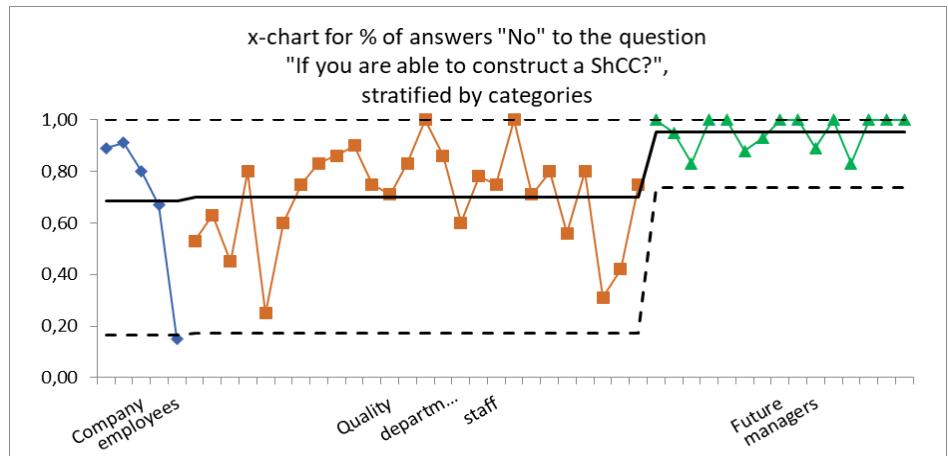
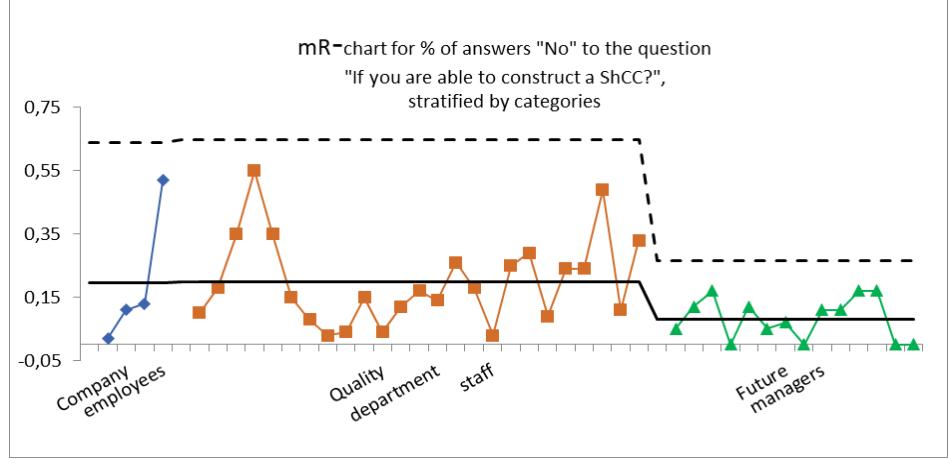 Fig. 2: x-mR chart for answers to the question "Are you able to construct a ShCC?"
What else seemed quite interesting in my view: the authors of (Tschepin 2019; Razgulyaev 2020) as well as (Mackey & Sisodia 2013) (to name a few) obviously are not familiar with the books of WED (it is clear from the references and mentions those authors provided). Nevertheless, main principles of their approach are in close alignment with WED's 14 points. More than that, they follow the SoPK at least in relation to its three constituents: understanding system, the theory of knowledge, and psychology. But again not the theory of variations - understandably so. The thing is: all these authors lack the statistical thinking background, so they simply do not know what they do not know.
An attentive reader may ask a question: were not there some papers critical of WED's SoPK published since 1993? In fact, we have found none. There was a publication in Quality Progress (Conclin 2014) where a group of quality experts tried to revise WED's 14 points. We thoroughly analyzed their arguments (Adler & Shper 2016) and found them completely unconvincing. Moreover, I totally agree with the title of another paper from Quality Progress (Moen & Norman 2016): "Always Applicable. Deming's system of profound knowledge remains relevant for management and quality professionals today". Another attempt to refute WED's ideas appeared in the book (Blommaert, Vandenbroek & Kolthof 2019). This time authors tried to persuade us that WED's famous cycle PDSA (Plan-Do-Study-Act) ("PDSA cycle") became obsolete and is not suitable for conditions of the $4^{\text{th}}$ Industrial Revolution. Again, I'm not convinced by their reasoning (although a detailed analysis of that work requires a separate paper).
## II. CONCLUSION
### What should be done?
No doubt that the modern world is drifting towards SUP-oriented management. This tendency corresponds with the increase in people's freedom and creativity, and it is pushed forward by scientific and technological development of global society. The draft of the new model of management equipped to deal with modern challenges exists since 1993. It was created by a prominent guru of quality W.E. Deming, who called it 'The SoPK'. However, as WED stated many times, the SoPK cannot suddenly materialize in people's minds from nowhere. As it has been already pointed out, the SoPK is not a management model. Moreover, I don't want it to become "crashed and burned" as it happened with TQM, according to Black and Revere (2006, 259). I don't want it will turn into "... a pale or highly distorted version of what Deming... laid out" (Hackman and Wageman 1995, 338). So far, there is only one possibility: the SoPK should become our way of everyday thinking. It should be taught and learned. Every person on Earth must possess the basics of the
SoPK because all CHIVU components will grow and over time will permeate every day of our lives. The earlier we start teaching our children the SoPK the better. That's why I suggest starting a discussion on how to teach the SoPK in primary school. Why primary, you ask, and not in universities? Because it'll be too late. Changing the minds of adults is almost impossible. Understanding of systems, variability, theory of knowledge and psychology must become an important part of common sense for every Earth inhabitant. Slightly rephrasing a well-known quote by H.G. Wells, one can say: understanding of the SoPK will one day be as necessary for efficient citizenship as the ability to read and to write. This is essential for the survival of mankind.
#### APPENDIX
The statements of principles for the $21^{\text{st}}$ century management from the list 4-33
John Galbraith (in fact he listed not principles of good management but principles of bad management – that's why he is absent in the left column of our table)
1. The so-called market system actually is a corporate system.
2. The power in corporations belongs to management.
3. Management is guided by the uncontrollable craving for power and self-enrichment
4. The using of GDP growth as a measure of society progress is not a harmless mistake.
B. M. Carney and I. Getz
1. Stop telling and start listening.
2. Start openly and actively sharing your vision of the company so people will "own" it.
3. Stop trying to motivate people
4. Stay alert.
Jack Myrick
1. Make them feel appreciated.
2. See their potential, not their flaws.
3. Lead with authority, not power.
4. Love them first.
5. Make them feel they are part of something special.
Steven Spear
1. One must formulate very specific goals and start moving to them by using the most advanced methods.
2. The control should be built into the process in order to find problems right away when and where they appear;
3. Problems should be solved so that root causes must be removed. To achieve this one should use PDSA cycle.
4. Problem solving should lead to the increase of process knowledge.
5. This knowledge should be spread all over the organization.
6. Leaders should help people and whole organization to move to self-perfection
# L. L., Seltman K
1. Continuous striving for ideal service quality and adherence to non-profit principles.
2. Constant and sincere wish to help each patient.
3. Constant commitment to professional development of each employee.
4. Aspiration to change in response to the change of society needs.
5. Constant commitment to achieve the top results in whatever one deals.
6. Utter honesty in all deeds.
#### ISO 9000
1. Customer focus
2. Leadership
3. Engagement of people
4. Process approach
5. Improvement
6. Evidence-based decision making
7. Relationship management
#### EFQM
1. Achieving Balanced Results
2. Adding Value for Customers
3. Leading with Vision, Inspiration & Integrity
4. Managing by Processes
5. Succeeding through People
6. Nurturing Creativity & Innovation
7. Building Partnerships
8. Taking Responsibility for a Sustainable Future
David Korten
1. Redirect the focus of economic policy from growing phantom wealth to growing real wealth.
2. Recover Wall Street's unleashed profits, and assess fees and fines to make Wall Street theft and gambling unprofitable.
3. Implement full-cost market pricing.
4. Reclaim the corporate charter.
5. Restore national economic sovereignty.
6. Rebuild communities with a goal of achieving local self-reliance in meeting basic needs.
7. Implement policies that create a strong bias in favor of human-scale businesses owned by local stakeholders.
8. Facilitate and fund stakeholder buyouts to democratize ownership.
9. Use tax and income policies to favor the equitable distribution of wealth and income.
10. Revise intellectual property rules to facilitate the free sharing of information and technology
11. Restructure financial services to serve Main Street.
12. Transfer to the federal government the responsibility for issuing money
Edwards Deming
1. Create constancy of purpose toward improvement of product and services, with the aim to become competitive and to stay in business, and to provide jobs.
2. Adopt the new philosophy.
3. Cease dependence on inspection to achieve quality
4. End the practice of awarding business on the basis of price tag.
5. Improve constantly and forever the system of production and service.
6. Institute training on the job.
7. Institute leadership.
8. Drive out fear.
9. Break down barriers between departments.
10. Eliminate slogans, exhortations, and targets for the work force asking for zero defects and new levels of productivity.
11. Eliminate work standards (quotas) on the factory floor. Substitute leadership.
12. Remove barriers that rob the hourly worker of his right to pride of workmanship.
13. Institute a vigorous program of education and self-improvement
14. Put everybody in the company to work to accomplish the transformation.
Jeffrey Liker
1. Base your management decisions on a long-term philosophy, even at the expense of short-term financial goals.
2. Create continuous process flow to bring problems to the surface.
3. Use "pull" systems to avoid overproduction.
4. Level out the workload (heijunka). (Work like the tortoise, not the hare).
5. Build a culture of stopping to fix problems, to get quality right the first time.
6. Standardized tasks are the foundation for continuous improvement and employee empowerment.
7. Use visual control so no problem is hidden.
8. Use only reliable, thoroughly tested technology that serves your people and processes.
9. Grow leaders who thoroughly understand the work, live the philosophy, and teach it to others.
10. Develop exceptional people and teams who follow your company's philosophy.
11. Respect your extended network of partners and suppliers by challenging them and helping them improve.
12. Go and see for yourself to thoroughly understand the situation
13. (genchi genbutsu).
14. Make decisions slowly by consensus, thoroughly considering all
15. options, implement decisions rapidly (nemawashi).
16. Become a learning organization through relentless reflection (hansej) and continuous improvement (kaizen).
#### Brothers Hopper
1. All successful organizations, however simple, consist of systems within a system (This is the Master Principle)
2. All systems are nurtured by routines, which must be regularly reviewed and refreshed.
3. The most important sub-system in any organization is the managerial hierarchy, which is likely to be based on some form of line-and-staff.
4. The best type of hierarchy is "bottom-up".
5. Leadership should as far as possible be collective or "collegiate".
6. The middle manager is the keystone of the managerial arch.
7. "One man, one boss" – which should be re-stated as "one person, one boss"
8. Meeting are "the medium of management work"
9. "Integrated decision-making" leads to right conclusions.
10. Planning should be for the short term (say, one to four years), the medium term (say, five to eight years) and the long term (say nine years up).
11. You should make a careful study of mistakes and successes of the pioneers in your field – and learn from them.
12. Excellent internal communications in all directions - but above all upwards - are necessary in any successful organization.
13. The manager must be a leader in both a practical and a moral sense.
14. You should use consultants sparingly – and "strategic" consultants never.
15. A manager should be aware of his responsibilities to society as a whole, including to his company's employees as human beings.
16. If it ain't broke, you should try to make it work better.
17. Avoid debt like the plague – or, if that is impossible, use it sparingly.
18. A manager should possess, or acquire what is known as "domain knowledge", i.e. a profound understanding of the technology and business of his company, which can normally be gained only through a long apprenticeship in that company or in the same industry.
19. The testing and training of managers should be pragmatic and continuous.
20. Managers who wish to reach the top should start at or near the bottom.
21. Job rotation (sometimes known as intra-company mobility) is desirable to create the "rounded" executive.
22. Employment should in general be for the long term – by which is meant, at least, eight and, if possible, ten years.
23. Complementarity is one of the keys to making appointments.
24. The remuneration system should promote and reward group effort.
25. Avoid ostentation like the plague.
#### Gary Hamel, et al.
1. Ensure that the work of management serves a higher purpose.
2. Fully embed the idea of community and citizenship in management systems.
3. Reconstruct management's philosophical foundations.
4. Eliminate the pathologies of formal hierarchy.
5. Reduce fear and increase trust.
6. Reinvent the means of control.
7. Redefine the work of leadership.
8. Expand and exploit diversity.
9. Reinvent strategy making as an emergent process.
10. De-structure and disaggregate the organizations.
11. Dramatically reduce the pull of the past.
12. Share the work of setting directions.
13. Develop holistic performance measures.
14. Stretch executives time frames and perspectives.
15. Create a democracy of information.
16. Empower the renegades and disarm the reactionaries.
17. Expand the scope of employee autonomy.
18. Create internal markets for ideas, talents and resources.
19. Depoliticize decision-making.
20. Better optimize trade-offs.
21. Further unleash human imagination.
22. Enable communities of passion.
23. Retool management for an open world.
24. Humanize the language and practice of business.
25. Retrain managerial minds.
#### Konosuke Matsushita
1. Business is something that human beings do for the happiness of other human beings.
2. Those who pursue business are artists at work on an endlessly unfolding canvas.
3. The healthy growth of a corporation depends on solid business principles.
4. A business is a public entity, it should never be thought of as a private possession.
5. If you do what naturally makes sense, like putting up an umbrella when it rains, your business will prosper
6. Recognize the fact that society knows best. If you strive to be accepted, you will prosper.
7. If you manage your business with correct ideas and proper methods, it is bound to succeed.
8. You cannot fail if you keep going until you do succeed.
9. Success in business is not due to good times and failure is not due to bad times.
10. Believing that the world is perpetually evolving is what makes vigorous business possible.
11. Making a profit is part of the social responsibility of a corporation. Not to realize a profit is a crime against society.
12. The outstanding entrepreneur strives to be a winner, but also to be a winner people will admire.
13. By practicing "dam management", you can keep your company stable and constantly growing.
14. The world is constantly moving forward. We should strive to make each day a little better than the day before.
15. Every failure contains the seeds of success and every success harbors the danger of failure.
16. Trust is something that takes time to build up, but that can be destroyed in an instant.
17. To fall behind one day today could put you behind a year or for the rest of your life.
18. The mission of a manufacturer is to offer good, affordable products and in abundant supply.
19. You must find a way to demonstrate your respect and appreciation to each and every employee.
20. Rely neither wholly on intuition nor completely on science.
21. In competitive sports and business alike, in the last moment of the game you could win, or you could lose.
22. If you do what you should do and don't do what you should not do, you will never lose
23. A person who is truly successful becomes more modest and more humble with each success
24. What kind of people you put together can determine whether their combined abilities are an asset or a liability.
25. No matter what the field of endeavor, there are different roles to play, but the worth of each job is the same.
26. First make the decisions dispassionately and then consider feelings, not the other way around.
27. Much is to be learned from keeping an open mind to the opinions of others.
28. When you delegate work, remember that almost more than ability enthusiasm will assure the job is done well.
29. When hiring, focus 70 percent on a person's strong points and 30 percent on his or her weak points.
30. The most effective approach to assigning work is to delegate responsibility without relinquishing involvement.
31. An effective formula for training employees is 10 percent strict, 90 percent gentle.
32. A report that says no problem exists could turn out to be the harbinger of a major problem.
33. No matter how able, a leader cannot win the support of others unless he or she knows how to mete out appropriate rewards and punishments
[^2]: Maybe it would be better to say that WED created a scheme/draft of the theory. However, this is not important for our subsequent discussion. _(p.2)_
[^3]: He in no way was the first who outlined this thought. A Nobel prize winner T. Eliot wrote about this in 1934, and there were many others who lived long before. _(p.5)_
[^4]: What transformation of management is necessary for mankind to thrive in the XXI century? _(p.6)_
[^1]: An earlier and abridged version of this work by name "Solving the XXI century challenges" was published in Quality Progress, 2022, Sept., 36-41. _(p.1)_
Generating HTML Viewer...
References
127 Cites in Article
Y Adler,V Shper (2015). Ideas of Dr. W.E. Deming and their Fate.
Y Adler,V Shper (2016). Who needs to teach the unlearned lessons? And what for? Standards and Quality.
L Berry,K Seltman (2008). Management Lessons From Mayo Clinic: Inside One of the World's Most Admired Service Organizations by Leonard L. Berry and Kent D. Seltman.
T Blommaert,S Vandenbroek,E Kolthof (2019). Management in Singularity: How to Manage Organizations When Ai.
D Bolchover (2010). Pay Check: Are Top Earners Really Worth It.
L Bossidy,R Charan (2002). Execution. The Discipline of Getting Things Done.
O Brafman,R Beckstorm (2006). The Starfish and the Spider. The Unstoppable Power of Leaderless Organizations.
B Burlingham (2005). Small giants: companies that choose to be great instead of big.
M Carney,I Getz (2009). Freedom, Inc. Free Your Employees and Let Them Lead Your Business to Higher Productivity, Profits, and Growth.
N Chomsky (2018). Las terribles 10 estrategias de manipulacion masiva.
J Collins (2001). Good to Great: Why Some Companies Make the Leap…And Others Don't.
J Conklin (2014). Whole new world. Seasoned quality professionals rethink Deming's 14 points for a new generation.
M Csikszentmihalyi (2003). Good Business. Leadership, Flow and the Making of Meaning.
J Dimon,W Buffett (2018). Short-Termism Is Harming the Economy.
W Deming (1986). Out of the Crisis.
W Deming (1993). The New Economics for Industry, Government, Education.
W Deming (2013). The essential Deming: leadership principles from the father of quality.
P Drucker (1999). Management Challenges for the 21 st Century.
Ph Dwyer,M Micale (2022). The darker angels of our nature: refuting the Pinker theory of history & violence/Edited by Ph.
Benedikt Sommerhoff (2023). Der EFQM-Excellence-Ansatz.
A Etkind (2020). Unknown Title.
F Foer (2017). World without mind: the existential threat of big tech.
J Galbraith (2004). The economics of innocent fraud: truth for our time.
G Hamel (1998). Moon shots for management (reinventing management to make it more relevant to a volatile business environment).
Hamel Zanini (2022). Unknown Title.
V Harnish (2015). SCALING UP: How a Few Companies Make It … and Why the Rest Don.
Kenneth Hopper,William Hopper (2007). The Puritan Gift.
T Hsieh (2010). Delivering Happiness. A Path to Profits, Passion and Purpose.
A Huffington (2014). Thrive.
Dennis Kehoe (2015). Quality systems and ISO 9000.
T Jackson (2009). Prosperity without Growth. Economics for a Finite Planet.
H Johnson,Th,A Bröms (2000). Profit beyond measure: extraordinary results through attention to work and people.
D Kahneman (2013). Thinking: Fast and Slow.
D Korten (2009). Agenda for a New Economy: From Phantom Wealth to Real Wealth. Why Wall Street Can't Be Fixed and How to Replace It.
F Laloux (2014). Reinventing Organizations. A Guide to Creating Organizations Inspired by the Next Stage of Human Consciousness.
J Liker (2004). The Toyota Way: 14 management principles from the World's Greatest Manufacturer.
J Mackey,R Sisodia (2013). Conscious Capitalism. Liberating the Heroic Spirit of Business.
Ch Madsbjerg (2017). Christian Madsbjerg’s Sensemaking: The Power of the Humanities in the Age of the Algorithm.
K Matsushita (2004). The Principles of Success.
H Mintzberg (2019). Bedtime stories for managers: Farewell for lofty Leadership…Welcome Engaging management.
R Moen,C Norman (2016). Always Applicable. Deming's system of profound knowledge remains relevant for management and quality professionals today.
Jacek Gutorow (2012). Review: Lydia Davis. 2019. Essays One. New York: Farrar, Straus and Giroux. Lydia Davis. 2021. Essays Two. New York: Farrar, Straus and Giroux. Lydia Davis. 2009. The Collected Stories. New York: Farrar, Straus and Giroux..
B Mycoskie (2011). Start Something That Matters.
J Myrick (2005). quill-driver, n..
T Nolan,R Perla,L Provost (2016). Understanding variation.
E Osono,N Shimizu,H Takeuchi (2008). Extreme Toyota: radical contradictions that drive success at the world's best manufacturer.
J Pfeffer,R Sutton (2006). Hard Facts, Dangerous Half-Truths, and Total Nonsense: Profiting From Evidence-Based Management.
S Pinker (2019). Enlightenment Now: The Case for Reason, Science, Humanism and Progress.
V Borisovich,N Kurbanov,V Zaernyuk,B Seifullaev (2020). Practical risk management at gold mining companies.
M Rother (2009). Levin, David Saul, (born 28 Jan. 1962), Chief Executive, McGraw-Hill Education, New York, since 2014.
P Rozenzweig (2014). Left brain, right stuff: how leaders make winning decisions.
Klaus Schwab (2016). The Fourth Industrial Revolution: what it means, how to respond1.
J Sacks (2005). The End of Poverty. Economic Possibilities for Our Time.
J Seddon (2005). The ‘break–fix’ archetype.
T Sedlacek (2013). Economics of Good and Evil: The Quest For Economic Meaning From Gilgamesh To Wall Street.
R Semler (2003). The Seven-Day Weekend.
W Shewhart (1931). Economic Control of Quality of Manufactured Product.
W Shewhart (1939). Statistical Methods from the Viewpoint of Quality Control.
S Shiba,D Walden (2006). Breakthrough Management. Principles, Skills and Patterns for Transformation Leadership.
V Shper,Y Adler (2020). The importance of time order with Shewhart control charts.
V Shper,A Beresh (2020). If we are ready to live in the VUCA world? Quality Management Methods.
N Taleb (2007). The Black Swan: The Impact of the Highly Improbable.
M Tribus (1992). The germ theory of management.
E Tschepin (2019). VkusVill. How to make a revolution doing everything in non-standard way.
(2023). Volatility (finance.
Volatility (2023). Uncertainty, Complexity and Ambiguity.
M Wolf (2019). How to reform today's rigged capitalism.
Nathan Myrick,Mark Porter (2021). Ethics and Christian Musicking.
Anita Pankake,Jesus Abrego (2017). Distributing Power and Authority.
Steven Spear 1 One must formulate very specific goals and start moving to them by using the most advanced methods.
L Berry,K Seltman (2008). New nationwide report reveals that 5 million people participate in self-help groups each year.
results in whatever one deals. 6. Utter honesty in all.
Collins Chansa,Mirja Sjoblom,Monique Vledder (2014). Achieving Better Health Outcomes Through Innovative Strategies and Results-focused Interventions.
Gregg Barak (2012). Theft of a Nation.
(2010). Corporate Charter Colonies.
Kyle Bagwell,Robert Staiger (1999). Domestic Policies, National Sovereignty and International Economic Institutions.
W Axline (2019). Epilogue: Basic Needs and Collective Self-Reliance.
R Colon,Jerry Keliman (1995). Clinical Notebook Appendix: The Bias Against Family Owned Businesses.
(2024). DEMOCRATIZE OWNERSHIP.
David Dodge (1975). IMPACT OF TAX, TRANSFER, AND EXPENDITURE POLICIES OF GOVERNMENT ON THE DISTRIBUTION OF PERSONAL INCOME IN CANADA.
(1996). Infobank Banking, EC Law, Employment, Financial Services, Information Technology, Insolvency, Intellectual Property, Local Government, Property.
Chris Butterworth (2019). Create Constancy of Purpose.
Frank Voehl (2020). Adopt the New Philosophy.
Improve constantly and forever the system of production and service.
Frank Voehl (2020). Break Down Barriers Between Departments and Organizations.
(1994). Eliminate slogans, exhortations and arbitrary targets for the workforce (Deming's point 10).
Eliminate work standards (quotas) on the factory floor.
Remove barriers that rob the hourly worker of his right to pride of workmanship.
Jeffrey Liker 1 (2014). Developing Short-Term and Long-Term Goals and Objectives.
Create continuous process flow to bring problems to the surface.
Isaac Zilinsky,Alon Liran,Eyal Winkler,Arie Orenstein,David Mendes (2007). How to Avoid Eyebrow Pull-up in Forehead Reconstruction.
Build a culture of stopping to fix problems.
R Maiden (1993). Continuous Improvement or Continuous Change?.
M Vidyasagar (null). The Realization Problem for Hidden Markov Models: The Complete Realization Problem.
Praz (2022). People Processes.
Shannon Spaulding (2018). How We Understand Others.
(1978). Even Though you've Helped your Company Develop New Programs... Maybe your Company still won't Develop you.
Andrea Temkin-Yu (2025). Caregiver Coping.
Make decisions slowly by consensus.
Akihiko Hasegawa (2017). Harmonious Improvement Through Kaizen Teian.
(null). Bottom-up Formation of Carbon-Based Structures with Multilevel Hierarchy from MOFGuest Polyhedra.
Leadership should as far as possible be collective or "collegiate.
(2008). Managerial Mentoring.
The manager must be a leader in both a practical and a moral sense.
(2005). The Creation of Society.
Venugopal Duddu (2018). Plagiarism: Avoid it like the plague.
Hartmut Holzmüller,Barbara Stöttinger (2001). International marketing managers' cultural sensitivity: relevance, training requirements and a pragmatic training concept.
Phoebe Lostroh (2016). Short Courses for Long-Term Learning.
(2020). It’s Not Just One and Done:.
Venugopal Duddu (2018). Plagiarism: Avoid it like the plague.
Gary Hamel (1993). The future for strategy: An interview with Gary Hamel.
Dominique Schnapper (2017). Transcendence by Citizenship.
(2015). Postmodernism.
Ciro Langella,Daniele Naviglio,Marina Marino,Armando Calogero,Monica Gallo (2018). New food approaches to reduce and/or eliminate increased gastric acidity related to gastroesophageal pathologies.
Reinvent the means of control. 7. Redefine the work of leadership. 8. Expand and exploit diversity.
No ethics committee approval was required for this article type.
Data Availability
Not applicable for this article.
How to Cite This Article
Shper Vladimir. 2026. \u201cThe System of Profound Knowledge – Answer to the Challenges of the XXI Century\u201d. Global Journal of Human-Social Science - E: Economics GJHSS-E Volume 23 (GJHSS Volume 23 Issue E1): .
Explore published articles in an immersive Augmented Reality environment. Our platform converts research papers into interactive 3D books, allowing readers to view and interact with content using AR and VR compatible devices.
Your published article is automatically converted into a realistic 3D book. Flip through pages and read research papers in a more engaging and interactive format.
Our website is actively being updated, and changes may occur frequently. Please clear your browser cache if needed. For feedback or error reporting, please email [email protected]
Thank you for connecting with us. We will respond to you shortly.