The Takeover of Family Business: An Exploratory Study in Light of Sensemaking Approach

Araban Oumaima
Araban Oumaima
Hourmat Allah Hind
Hourmat Allah Hind

Send Message

To: Author

The Takeover of Family Business: An Exploratory Study in Light of Sensemaking Approach

Article Fingerprint

ReserarchID

8CX63

The Takeover of Family Business: An Exploratory Study in Light of Sensemaking Approach Banner

AI TAKEAWAY

Connecting with the Eternal Ground
  • English
  • Afrikaans
  • Albanian
  • Amharic
  • Arabic
  • Armenian
  • Azerbaijani
  • Basque
  • Belarusian
  • Bengali
  • Bosnian
  • Bulgarian
  • Catalan
  • Cebuano
  • Chichewa
  • Chinese (Simplified)
  • Chinese (Traditional)
  • Corsican
  • Croatian
  • Czech
  • Danish
  • Dutch
  • Esperanto
  • Estonian
  • Filipino
  • Finnish
  • French
  • Frisian
  • Galician
  • Georgian
  • German
  • Greek
  • Gujarati
  • Haitian Creole
  • Hausa
  • Hawaiian
  • Hebrew
  • Hindi
  • Hmong
  • Hungarian
  • Icelandic
  • Igbo
  • Indonesian
  • Irish
  • Italian
  • Japanese
  • Javanese
  • Kannada
  • Kazakh
  • Khmer
  • Korean
  • Kurdish (Kurmanji)
  • Kyrgyz
  • Lao
  • Latin
  • Latvian
  • Lithuanian
  • Luxembourgish
  • Macedonian
  • Malagasy
  • Malay
  • Malayalam
  • Maltese
  • Maori
  • Marathi
  • Mongolian
  • Myanmar (Burmese)
  • Nepali
  • Norwegian
  • Pashto
  • Persian
  • Polish
  • Portuguese
  • Punjabi
  • Romanian
  • Russian
  • Samoan
  • Scots Gaelic
  • Serbian
  • Sesotho
  • Shona
  • Sindhi
  • Sinhala
  • Slovak
  • Slovenian
  • Somali
  • Spanish
  • Sundanese
  • Swahili
  • Swedish
  • Tajik
  • Tamil
  • Telugu
  • Thai
  • Turkish
  • Ukrainian
  • Urdu
  • Uzbek
  • Vietnamese
  • Welsh
  • Xhosa
  • Yiddish
  • Yoruba
  • Zulu
Font Type
Font Size
Font Size
Bedground

Abstract

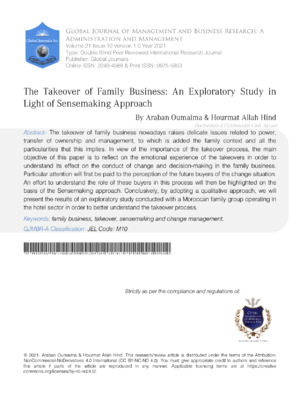
The takeover of family business nowadays raises delicate issues related to power, transfer of ownership and management, to which is added the family context and all the particularities that this implies. In view of the importance of the takeover process, the main objective of this paper is to reflect on the emotional experience of the takeovers in order to understand its effect on the conduct of change and decision-making in the family business. Particular attention will first be paid to the perception of the future buyers of the change situation. An effort to understand the role of these buyers in this process will then be highlighted on the basis of the Sensemaking approach. Conclusively, by adopting a qualitative approach, we will present the results of an exploratory study conducted with a Moroccan family group operating in the hotel sector in order to better understand the takeover process.

References

74 Cites in Article
  1. A Adler,M Obstfeld (2007). The role of affect in creative projects and exploratory search Industrial and Corporate Change.
  2. S Appelbaum,C Delage,N Labib,G Gault (1997). The Survivor Syndrome: Aftermath of Downsizing.
  3. Joseph Astrachan,Melissa Shanker (2003). Family Businesses’ Contribution to the U.S. Economy: A Closer Look.
  4. David Autissier,Kevin Johnson,Jean-Michel Moutot (2003). De la conduite du changement instrumentalisée au changement agile.
  5. J Bartunek,J Balogun,D Et Boram (2011). Considering planned change anew: stretching large group interventions strategically, emotionally and meaningfully.
  6. Jean Bartunek,Denise Rousseau,Jenny Rudolph,Judith Depalma (2006). On the Receiving End.
  7. S Basly (2002). La gestion des entreprises familiales, coordonné par.
  8. M Bayad,M Et Barbot (2002). Proposition d'un modèle de succession dans les PME familiales: étude de cas exploratoire de la relation père -fille.
  9. T Ben Shahar (2008). Kathrine Asla ØSTBY Les voyelles moyennes à double timbre dans le parler de la haute bourgeoisie parisienne : analyse acoustique et diachronique Présentation de la thèse de doctorat en sciences du langage, sous la direction de Chantal Lyche (Université d’Oslo) et de Bernard Laks (Université Paris Ouest Nanterre La Défense).
  10. V Bertella (2005). La pianificazione del ricambio generazionale nell'impresa familiare.
  11. M Bertolucci,J-D Et Pinzon (2015). De l'intuition dans la décision des managers de l'action publique; Le cas du pilotage des réseaux territorialisés d'organisations.
  12. H Bouchikhi (2008). The soul of the corporation: How to manage the identity of your company.
  13. Louise Cadieux,Brangre Deschamps (2011). Le duo cédant/repreneur.
  14. Louise Cadieux,Jean Lorrain,Pierre Hugron (2000). La succession dans les entreprises familiales dirigées par les femmes : une problématique en quête de chercheurs.
  15. Louise Cadieux,Jean Lorrain,Pierre Hugron (2002). La succession dans les entreprises familiales dirigées par les femmes : une problématique en quête de chercheurs.
  16. Louise Cadieux,Jean Lorrain,Pierre Hugron (2000). La succession dans les entreprises familiales dirigées par les femmes : une problématique en quête de chercheurs.
  17. F Caillette (2006). Transmission de PME: Un modèle non paramétrique de prévision des succès.
  18. J Chrisman,J Joshua,J Daspit,T Daniel (2015). Examining family firm succession from a social exchange perspective: A multiphase, multistake holder review.
  19. Jess Chua,James Chrisman,Pramodita Sharma (1999). Defining the Family Business by Behavior.
  20. A Cohen,P Sharma (2016). Entrepreneurs in Every Generation: How Successful Family Businesses Develop Their Next Leaders.
  21. Cosette (2004). COSSETTE, Pierre, L’organisation. Une perspective cognitiviste . Québec (Canada) : Les Presses de l’Université de Laval ( www.ulaval.ca/pul ) 2004. 223 p. ISBN:2-7637-8076-8. CAN$28.
  22. N Crutzen,Z Aouni,F Et Pirnay (2016). Les difficultés de la transmission intrafamiliale: Analyse statistique et étude qualitative en Belgique francophone.
  23. O Cullière (2001). Un modèle wébérien de la légitimité du repreneur d'entreprise, 2 ème journées Georges Doriot.
  24. J Daspit,J Chrisman,P Sharma,Long Et (2017). A strategic Management Perspective of the Family Firm: Past Trends, New Insights, and Future Directions.
  25. Alfredo De Massis,Jess Chua,James Chrisman (2008). Factors Preventing Intra-Family Succession.
  26. B Deschamps (2000). Le processus de reprise d'entreprise par les entrepreneurs-personne physique.
  27. D Detienne (2010). Entrepreneurial exit as a critical component of the entrepreneurial process: Theoretical development.
  28. Yuehan Dou,Xiubo Yu,Martha Bakker,Rudolf De Groot,Gerrit Carsjens,Houlang Duan,Chao Huang (2020). Analysis of the relationship between cross-cultural perceptions of landscapes and cultural ecosystem services in Genheyuan region, Northeast China.
  29. J Estève,H Et De Boislandelle (2015). Le marché de la cession/reprise/transmission.
  30. B Fallery,M Garcia,P James (2004). Les trois visions de la formation ouverte et leurs propositions de normes: standardiser les contenus, les activités ou les 33.
  31. Dennis Gioia,Kumar Chittipeddi (1991). Sensemaking and sensegiving in strategic change initiation.
  32. M Harvey,R Evans (1995). La vie après la succession dans l'entreprise familiale: Est-ce vraiment la fin des problèmes ?.
  33. Heather Haveman,Mukti Khaire (2004). Survival beyond succession? The contingent impact of founder succession on organizational failure.
  34. J Huff,S Anne,H Thomas (1992). Strategic renewal and the interaction of cumulative stress and inertia.
  35. Markku Ikävalko,Timo Pihkala,Sascha Kraus (2008). The Role of Owner-Managers' Psychological Ownership in SME Strategic Behaviour.
  36. R Jaziri (2018). La pérennité des entreprises familiales après la succession: le cas tunisien.
  37. Morten Jensen,Björn Johnson,Edward Lorenz,Bengt Lundvall (2007). Forms of knowledge and modes of innovation.
  38. Kiran Kandade,Georges Samara,Maria Parada,Alexandra Dawson (2020). From family successors to successful business leaders: A qualitative study of how high-quality relationships develop in family businesses.
  39. G Koenig (2006). Une subversion au long cours dans le fil de la tradition. Les défis du Sensemaking en entreprise.
  40. J Kotlar,J Et Chrisman (2018). Point: How family involvement influences organizational change.
  41. I Landsberg (1988). The Succession Conspiracy.
  42. H Laroche,J Et Nioche (2006). L'approche cognitive de la stratégie d'entreprise.
  43. Hervé Laroche,Véronique Steyer (2012). L’apport des théories du sensemaking à la compréhension des risques et des crises.
  44. Isabelle Le Breton-Miller,Danny Miller (2016). Entreprises familiales : comment bien préparer la relève.
  45. Le Breton-Miller,I Miller,D Steier,L (2004). Toward an integrative model of effective FOB succession.
  46. Le Breton-Miller,I Miller,D (2003). Lost in time: Intergeneration succession, change, and failure in family business.
  47. Isabelle Le Breton–miller,Danny Miller (2006). Why Do Some Family Businesses Out–Compete? Governance, Long–Term Orientations, and Sustainable Capability.
  48. Isabelle Le Breton‐miller,Danny Miller (2008). To grow or to harvest? Governance, strategy and performance in family and lone founder firms.
  49. J Longenecker,J Schoen (1978). Management succession in the family business.
  50. G Lumpkin,Keith Brigham,Todd Moss (2010). Long-term orientation: Implications for the entrepreneurial orientation and performance of family businesses.
  51. G Lumpkin,W Martin,M Vaughn (2008). Family orientation: Individual-level influences on family firm outcomes.
  52. Sally Maitlis,Scott Sonenshein (1988). Sensemaking in Crisis and Change: Inspiration and Insights From Weick (1988).
  53. Sally Maitlis,Timothy Vogus,Thomas Lawrence (2013). Sensemaking and emotion in organizations.
  54. S Maitlis,M Et Christianson (2014). Sensemaking in organizations: Taking stock and moving forward.
  55. Olimpia Meglio,David King (2019). Family Businesses: Building a Merger and Acquisition Research Agenda.
  56. (2014). Advances in Mergers and Acquisitions.
  57. Olivier Meier,Guillaume Schier (2008). Quelles théories et principes d'actions en matière de gouvernance des associations ?.
  58. A Ohman,A Flykt,F Et Esteves (2001). Emotion drives attention: Detecting the snake in the grass.
  59. C Paillot,A Et Csillik (2013). Reflective listening: A new use in psychotherapy, specificities of motivational interviewing.
  60. J Paterson,C Hartel (2002). An integrated affective and cognitive model to explain employess responses to downsizing.
  61. Veland Ramadani,Abdylmenaf Bexheti,Gadaf Rexhepi,Vanessa Ratten,Sadudin Ibraimi (2017). Succession Issues in Albanian Family Businesses: Exploratory Research.
  62. K Räsänen,H Päiviö,K Et Korpiaho (2007). Anglo-American forms of management education: A practice-theoretical perspective.
  63. Frederik Riar,Franz Kellermanns (2021). Family business.
  64. K Richomme-Huet,J De Freyman (2005). La triade Père Fils Fille dans la succession familiale : une approche par le récit de vie, Actes du colloque « L'entrepreneuriat : des enjeux, des stratégies et des hommes.
  65. S Robic,S Sonié,P Fonlupt,M-A Henaff,N Touil,G Coricelli,J Mattout,C Schmitz (2015). Decision-Making in a Changing World: A Study in Autism Spectrum Disorders.
  66. K Scherer (1984). Les émotions: fonctions et composantes [Emotions: Functions and components.
  67. William Tabor,James Chrisman,Kristen Madison,James Vardaman (2018). Nonfamily Members in Family Firms: A Review and Future Research Agenda.
  68. R Tiong,D Singh (2005). A Fuzzy Decision Framework for Contractor Selection.
  69. Gérard Vergnaud (2007). Représentation et activité : deux concepts étroitement associés.
  70. Amélie Villéger (2000). Les évolutions digitales dans l’entreprise familiale : obstacle ou pentacle de la coopération intergénérationnelle ?.
  71. D Warrick (2017). What leaders need to know about organizational culture.
  72. Karl Weick (2003). Theory and Practice in the Real World.
  73. Karl Weick,Kathleen Sutcliffe,David Obstfeld (2005). Organizing and the Process of Sensemaking.
  74. R Yin (2003). Designing case studies.

Funding

No external funding was declared for this work.

Conflict of Interest

The authors declare no conflict of interest.

Ethical Approval

No ethics committee approval was required for this article type.

Data Availability

Not applicable for this article.

How to Cite This Article

Araban Oumaima. 2021. \u201cThe Takeover of Family Business: An Exploratory Study in Light of Sensemaking Approach\u201d. Global Journal of Management and Business Research - A: Administration & Management GJMBR-A Volume 21 (GJMBR Volume 21 Issue A10).
Download Citation

Family Business Research.
Journal Specifications

Crossref Journal DOI 10.17406/GJMBR

Print ISSN 0975-5853

e-ISSN 2249-4588

Keywords
Classification
GJMBR-A Classification JEL Code: M10
Version of record

v1.2

Issue date
September 30, 2021

Language
fr
Experiance in AR

Explore published articles in an immersive Augmented Reality environment. Our platform converts research papers into interactive 3D books, allowing readers to view and interact with content using AR and VR compatible devices.

Read in 3D

Your published article is automatically converted into a realistic 3D book. Flip through pages and read research papers in a more engaging and interactive format.

Article Matrices
Total Views: 1954
Total Downloads: 963
2026 Trends
Related Research
Our website is actively being updated, and changes may occur frequently. Please clear your browser cache if needed. For feedback or error reporting, please email [email protected]

Request Access

Please fill out the form below to request access to this research paper. Your request will be reviewed by the editorial or author team.
X

Quote and Order Details

Contact Person

Invoice Address

Notes or Comments

This is the heading

Lorem ipsum dolor sit amet, consectetur adipiscing elit. Ut elit tellus, luctus nec ullamcorper mattis, pulvinar dapibus leo.


High-quality academic research articles on global topics and journals.

The Takeover of Family Business: An Exploratory Study in Light of Sensemaking Approach

Araban Oumaima
Araban Oumaima
Hourmat Allah Hind
Hourmat Allah Hind

Research Journals