I. INTRODUCTION
Cities have a significant impact on global environmental and socioeconomic aspects. In many cultural contexts, an increasing number of people are looking for the advantages of urbanization over traditional rural lifestyles and are drawn to the city infrastructure. By 2050, 6.5 billion people will live in cities, According to the Unities are experiencing several difficulties as a result of the ever-increasing strain placed on their infrastructure and resources.
Utilizing Information and Communication Technology (ICT) within an accessible integrated infrastructure is an emerging trend for managing and minimizing these challenges. Smart cities are the name given to this idea.
Academics and practitioners alike are paying significant attention to this topic, which is proving to be a robust area of research. Utilizing ICT to enhance various aspects of city operation and management is where a lot of cities are focusing their efforts to become "smarter," as evidenced by the following: environment, quality of life for citizens, local economy, transportation, traffic management, and electronic delivery of public services[1].
Throughout the last ten years, numerous urban communities all over the planet have pronounced the expectation to become smart urban areas. A somewhat shapeless term, overall there are three broad understandings of what is an intelligent city.
For some's purposes, a smart city is one in which metropolitan framework and administrations are overseen computationally, with organized computerized instrumentation implanted into the metropolitan texture, delivering nonstop surges of information that progressively feed into the executive's stems and control rooms, making new types of overseeing mindset. For other people, a savvy city is one in which the essential utilization of data and correspondence innovation (ICT) creates more brilliant residents, laborers, strategy, and projects; cultivates advancement, monetary turn of events, and business; and has metropolitan flexibility and supportability[2].
II. WHY DO WE NEED SMART CITIES?
One of the reasons why there is a need for a smart city is rapid urbanization. The general concept of the growth of a nation rises its per capita output. This usually happens when a nation's economy moves from an agrarian to an industrial one. As people migrate to urban areas, cities are not able to sustain the growing population density. The smart city brings efficiency in the areas of infrastructure, water, transport, energy, and waste management systems by enabling the cities to use technological advancement to help its citizen [3].
a) The Future Internet and Smart Cities
The social, financial, and mechanical points of view of new Web advances and their likely effect on urban communities and spatial biological systems were portrayed in two prescience reports ready by the Organization for What's in store [4].
i. IoT Technologies in Smart Cities of the Future
The Internet of Things (IoT) and relevant advancements in 5G networks and Mobile Edge Computing (MEC) are constantly being adopted by smart cities. Under this point of view, brilliant urban communities representing things to come can be considered as a microcosm of interconnected "objects" where exceptional and human-driven administrations can be given to residents as digital actual frameworks [5].
IoT application development is primarily driven by smart cities. Depending on one's point of view, there are several ways to define a smart city. An urban center equipped with technologies that make use of digital data to provide better public services and make better use of resources is another definition of a smart city. Six main components make up a smart city: smart governance, smart economy, smart citizens, smart mobility, and smart living [6].
III. ARTIFICIAL INTELLIGENCE AND
SMART CITIES
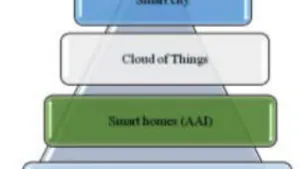
AI can be utilized for various purposes, including security, financial exchange, salvage of the board, and transportation. Complex issues like monetary rebuilding, natural security, government, and versatility emerge comparable to the improvement of an intelligent city. Our examination centers around the meaning of simulated intelligence for the development of brilliant urban communities in the accompanying section. By adding customized highlights such as setting mindfulness, artificial intelligence can likewise be utilized in savvy homes, permitting it to outperform automation. The ICT-based framework for future savvy urban communities was encased in a four-layer pyramid by these creators [7](Figure 1).
![Figure 1: ICT-based infrastructure [7]](https://doc.globaljournals.org/xfkc52_55624/ocr/images/derivatives/32/326b6753537031033052beae7937901fb6cd9ffdd9326f1668d3d0b0995e585a.webp)
A smart city changes its social, business, and standard necessities, further fostering the assets it has open. Smart metropolitan regions depend on data and correspondence innovation (ICT) to give arrangements that work on a city's reasonability and work on its populace, economy, and the biological system as a whole. Its object is to assess a city because of the upgrades in private happiness and monetary prosperity accomplished by using ICT developments to configure, layout, produce, and work the city establishment [5].
IV. CONCLUSION
After we reviewed the most important technologies used in smart cities and talked about the future of these technologies and the possibilities they offer to transform into a smart city environment, it is now possible to delve deeper into developing these technologies and move forward to improve the work of our environment and our lives.