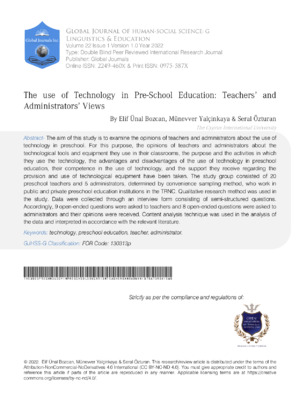
The use of Technology in Pre-School Education: Teachers’ and Administrators Views

α
Elif Unal Bozcan
Elif Unal Bozcan
σ
Munevver Yalcinkaya
Munevver Yalcinkaya
ρ
Seral Ozturan
Seral Ozturan

Send Message

To: Author

The use of Technology in Pre-School Education: Teachers’ and Administrators Views

Article Fingerprint

ReserarchID

437QB

The use of Technology in Pre-School Education: Teachers’ and Administrators Views Banner

AI TAKEAWAY

Connecting with the Eternal Ground
  • English
  • Afrikaans
  • Albanian
  • Amharic
  • Arabic
  • Armenian
  • Azerbaijani
  • Basque
  • Belarusian
  • Bengali
  • Bosnian
  • Bulgarian
  • Catalan
  • Cebuano
  • Chichewa
  • Chinese (Simplified)
  • Chinese (Traditional)
  • Corsican
  • Croatian
  • Czech
  • Danish
  • Dutch
  • Esperanto
  • Estonian
  • Filipino
  • Finnish
  • French
  • Frisian
  • Galician
  • Georgian
  • German
  • Greek
  • Gujarati
  • Haitian Creole
  • Hausa
  • Hawaiian
  • Hebrew
  • Hindi
  • Hmong
  • Hungarian
  • Icelandic
  • Igbo
  • Indonesian
  • Irish
  • Italian
  • Japanese
  • Javanese
  • Kannada
  • Kazakh
  • Khmer
  • Korean
  • Kurdish (Kurmanji)
  • Kyrgyz
  • Lao
  • Latin
  • Latvian
  • Lithuanian
  • Luxembourgish
  • Macedonian
  • Malagasy
  • Malay
  • Malayalam
  • Maltese
  • Maori
  • Marathi
  • Mongolian
  • Myanmar (Burmese)
  • Nepali
  • Norwegian
  • Pashto
  • Persian
  • Polish
  • Portuguese
  • Punjabi
  • Romanian
  • Russian
  • Samoan
  • Scots Gaelic
  • Serbian
  • Sesotho
  • Shona
  • Sindhi
  • Sinhala
  • Slovak
  • Slovenian
  • Somali
  • Spanish
  • Sundanese
  • Swahili
  • Swedish
  • Tajik
  • Tamil
  • Telugu
  • Thai
  • Turkish
  • Ukrainian
  • Urdu
  • Uzbek
  • Vietnamese
  • Welsh
  • Xhosa
  • Yiddish
  • Yoruba
  • Zulu

References

68 Cites in Article
  1. Aap (2011). Policy statement: Media use by children younger than 2 years.
  2. Bayram Akarsu,Cenk Akbıyık (2012). Relationships among perceived computer literacy skills, computer attitudes, and computer self-efficacy levels.
  3. Sadegül Akbaba-Altun (2002). Okul yoneticilerinin teknolojiye karşı tutumlarının incelenmesi" (Investigation of school administrators' attitudes towards technology).
  4. Yavuz Akpınar (2005). Bilgisayar destekli eğitimde uygulamalar.
  5. Hasan Aksoy (2006). Eğitim Kurumlarında Teknoloji Kullanımı ve Etkilerine İlişkin Bir Çözümleme.
  6. Sibel Altun (2007). İlköğretim Okullarında Çalışan Öğretmenlerin Bilgisayar Kullanma Becerileri Ve Bilgisayar Destekli Öğretime İlişkin Tutumları Üzerine Bir Araştırma (Bartın İli Örneği).
  7. Ronald Anderson,Sara Dexter (2005). School Technology Leadership: An Empirical Investigation of Prevalence and Effect.
  8. Neriman Aral,Kandır Adalet,M Can,Yaşar (2002). Okul öncesi eğitim programı" (Preschool education and preschool education program).
  9. Meziyet Arı,Pınar Bayhan (2003). Okul öncesi dönemde bilgisayar destekli eğitim.
  10. Judi Boyd,Steven Barnett,William Bodrova,Elenora Deborah,J Leong,Deanna Gomby (2005). Promoting children's social and emotional development through preschool education.
  11. Şener Büyüköztürk,Ebru Kılıç Çakmak,Özcan Erkan Akgün,Şirin Karadeniz,Funda Demirel (2009). Bilimsel araştırma yöntemleri.
  12. Colleen Cordes,Edward Miller (2000). Fool's gold: A critical look at computers in childhood.
  13. W Creswell,John (2014). Research design qualitative, quantitative and mixed methods approaches.
  14. Bülent Çavaş,Tarık Kışla,Peter Twınıng (2004). Egitimde Bilgi ve Iletisim Teknolojilerinin Kullanimina Yönelik Bir Arastirma dICTatEd Yaklasimi.
  15. Nadir Çeliköz,Kol,Suat (2016). Bilgisayar Destekli Öğretimin (BDÖ) Altı yaş çocuklarına zaman ve mekân kavramlarını kazandırmaya etkisi" (The Effect of Computer Assisted Instruction (BDÖ) on Teaching six-year-old children to time and space).
  16. Nihal Demir (2007). Okul öncesi öğrencilerine renk kavramının kazandırılmasında bilgisayar destekli ve geleneksel öğretim yöntemlerinin karşılaştırılması.
  17. Okay Demir (2015). OKUL ÖNCESİ ÖĞRETMENLERİN BİLİŞİM TEKNOLOJİLERİNİ KULLANMA DURUMLARI VE BUNUN ÖĞRETİME ETKİSİ (NİTEL BİR ÇALIŞMA).
  18. Serap Demiriz,Karadag,Asiye,Ulutas,İlkay (2003). Okul öncesi eğitim kurumlarında eğitim ortamı ve donanım" (Educational environment and equipment in preschool education institutions).
  19. Durlak Joseph,Weissberg Roger,Taylor Dymnicki Allison,Schellinger Rebecca,Kriston The impact of enhancing students' social and emotional learning: a meta-analysis of school-based universal interventions.
  20. Durualp Ender,Aral Neriman (2011). Oyun temelli sosyal beceri eğitimi" (Game-based social skills training).
  21. Epsteın Ann,S (2013). Using technology appropriately in the preschool classroom.
  22. Ertmer Peggy,A,Bai Hua,Dong Chaoyan,Park Khalil Mohammed,Hee Sung,Wang Ling (2002). Teacher Supervision and Professional Development.
  23. Espınosa Linda,M,Laffey James,M Whittaker,Tiffany Sheng Yanyan (2006). Technology in the home and the achievement of young children: findings from the early childhood longitudinal study.
  24. M Fish Angela,Li Xiaoming,Katy Mccarrick,Butler Sheretta,Stanton Bonita,Gail Brumitt,Navaz Peshotan Bhavnagri,Teresa Holtrop,Ty Partridge (2008). Early childhood computer experience and cognitive development among urban lowincome preschoolers.
  25. Gok Aylin,Turan Selahattin,Oyman Nidan (2016). Okul öncesi öğretmenlerinin bilişim teknolojilerini kullanma durumlarına ilişkin görüşleri" (Preschool teachers' views on the use of information technologies).

  26. Negin Nabavi (2018). THE BIRTH OF NEWSPAPER CULTURE IN NINETEENTH-CENTURY IRAN.
  27. Halmatow Medera,Akcay Nilüfer Okur,Ekin Samet (2017). Teknolojik araçların sınıfta kullanımına ilişkin okul öncesi öğretmenlerinin görüşleri" (Opinions of preschool teachers about the use of technological tools in the classroom).
  28. Suzan Haugland,June Wright (1997). Young children and technology: a world of discovery.
  29. Mary Hemmeter,Michaelene Ostrosky,Lise Fox (2006). Social and Emotional Foundations for Early Learning: A Conceptual Model for Intervention.
  30. (2013). Skill level of Web 2.0 technology applications of certified educators and the link to ISTE/NETS Standards.
  31. Ahmet Kacar,Ömer (2006). Okul Öncesi Eğitimde Bilgisayar Destekli Eğitimin Rolü.
  32. Emin Karip (2016). Toplumda ve Örgün Eğitimde bilişim Teknolojileri.
  33. Kartal Günizi,Güven Devrim (2006). Okulöncesi Eğitimde Bilgisayarın Yeri ve Rolü" (Role and role of computer in preschool education).
  34. Jared Keengwe,Grace Onchwari (2009). Technology and early childhood education: a technology ıntegration professional development model for practicing teachers.
  35. Cyprus Newspaper (2018). Bonsal, Stephen, (29 March 1865–8 June 1951), author and newspaper correspondent.
  36. Seray Kilinc (2015). Yayımlanmamış yüksek lisans tezi) (Investigation of parental views about the use of technology for preschool children).

  37. Suat Kol (2012). Okul öncesi eğitimde teknolojik araçgereç kullanımına yönelik tutum ölçeği geliştirilmesi" (Developing an attitude scale towards the use of technological equipment in preschool education).
  38. Fahrettin Korkmaz,Serkan Unsal (2016). Okul öncesi öğretmenlerin ''teknoloji'' kavramına ilişkin metaforik algılarının incelemesi" (Examining the metaphoric perceptions of preschool teachers about the concept of 'technology).
  39. Köroğlu Alper,Yusuf (2014). Examination of pre-school teachers 'and prospective teachers' selfefficacy perceptions of information technologies, attitudes of using technological tools and individual innovation levels).
  40. Burcu Küçükoğlu (2013). Unknown Title.
  41. Xiaoming Li,Melissa Atkins (2004). Early Childhood Computer Experience and Cognitive and Motor Development.
  42. Sharan Merriam (2009). Qualitative research: a guide to design and implementation.
  43. Melike Çetinkaya,Çiğdem Özgören,Şenol Orakcı,M Özdemir (2001). Metaphorical Perceptions of Middle School Students towards Math.
  44. Meb) (2003). Instruction on the use of information and communication technology tools and environments in educational activities.
  45. (2006). Basic education support project "teacher training component genel general competencies of teaching profession.
  46. Süleyman Ulupinar,Serhat Özbay,Cebrail Gençoglu,, Bora Özkara (2013). Attitudes Towards Nutritional Sport Supplement of National and International Kickboxers.
  47. B Miles,A Matthew & Huberman,Michael (2018). Qualitative data analysis: An expanded source book.
  48. National Association For The Education Of,Young Children (1996). Position Statement.
  49. Tuğba Akar,Mustafa Özgenel (1998). Okul Öncesi Dönemde Satranç Eğitiminin Çocukların Dikkat Gelişimine Etkisi: Deneysel Bir Çalışma.
  50. Elif Ozturk Yilmaztekin,Refika Olgan (2013). Eğilimler ve konular: okul öncesi dönemde teknoloji kullanımı ile ilgili yapılan çalışmaların gözden geçirilmesi" (Trends and issues: review of studies on the use of technology in preschool).
  51. Seymour Papert (1993). Mindstorms: Children, computers, and powerful ideas.
  52. Payton John,P Weissberg,Roger,A Durlak,Joseph,B Dymnick,Allison,D Taylor,Rebecca,B Schellinger,Pachan Kriston,Molly (2008). The positive ımpact of social and emotional learning for kindergartento eighth-grade students.
  53. Zeynep Kalkanlı (2013). ADHD from Chıldhood to Adulthood.
  54. Sayan Hamiyet (2016). Okul öncesi eğitimde teknoloji kullanımı. 21. Yüzyılda eğitim ve Toplum" (Use of technology in preschool education).
  55. Sert Gülşen,Kurtoglu Meltem,Ahmet Akinci,S Seferoglu,Sadi (2012). Öğretmenlrin teknoloji kullanma durumlarını inceleyen araştırmalara bir bakış: Bir içerik analiz çalışması.
  56. Mehmet Sincar (2009). İlköğretim okulu yöneticilerinin teknoloji liderliği rollerine ilişkin bir inceleme.
  57. Sönmez,Veysel,Füsun Alacapınar (2014). Örneklendirilmiş bilimsel araştırma yöntemleri.
  58. Müge Şen (2013). Okul öncesine giriş.
  59. Nurettin Şimşek (2005). Perceptions and opinions of educational technologists related to educational technology.
  60. Abbas Türnüklü (2000). Qualitative research technique that can be used effectively in educational science research: interview.
  61. (2003). World Education Indicators 2002.
  62. Ünver Gülseren,Başbay Bümen Nilay,Makbule (2010). The point of view of the instructor to the non-thesis master courses in secondary education: Ege University Case.
  63. P Weikart (1995). Purposeful movement: have we overlooked the base?.
  64. Ozge Bildiren,Buse Cevatemre,Ebru Ay,Gunes Ozen,Ceylan Hepokur,Merve Erkisa,Ozlem Kucukhuseyin,Engin Ulukaya,Serap Kuruca,Ilhan Yaylim (1995). An Investigation of Anticancer Effects of Doxorubicin and Calcitriol Combination on MCF-7 Cells.
  65. Yıldırım Ali,Simsek Hasan (2005). Sosyal bilimlerde nitel araştırma yöntemleri.
  66. Yıldırım Ali,Simsek Hasan (2011). Sosyal bilimlerde nitel araştırma yöntemleri.
  67. Yılmaztekin Öztürk,Elif,Olgan Refika (2013). Trends and Isues: Early childhood education.
  68. Yök (2018). Kodlama eğitimi ile binlerce gence yeni istihdam müjdesi" (Good news for thousands of young people with coding training.

Funding

No external funding was declared for this work.

Conflict of Interest

The authors declare no conflict of interest.

Ethical Approval

No ethics committee approval was required for this article type.

Data Availability

Not applicable for this article.

How to Cite This Article

Elif Unal Bozcan. 2026. \u201cThe use of Technology in Pre-School Education: Teachers’ and Administrators Views\u201d. Global Journal of Human-Social Science - G: Linguistics & Education GJHSS-G Volume 22 (GJHSS Volume 22 Issue G1): .

Download Citation

Pre-School Education technology, teachers, administrators, early childhood learning.
Issue Cover
GJHSS Volume 22 Issue G1
Pg. 41- 52
Journal Specifications

Crossref Journal DOI 10.17406/GJHSS

Print ISSN 0975-587X

e-ISSN 2249-460X

Keywords
Classification
GJHSS-G Classification: FOR Code: 130313p
Version of record

v1.2

Issue date

February 11, 2022

Language
en
Experiance in AR

Explore published articles in an immersive Augmented Reality environment. Our platform converts research papers into interactive 3D books, allowing readers to view and interact with content using AR and VR compatible devices.

Read in 3D

Your published article is automatically converted into a realistic 3D book. Flip through pages and read research papers in a more engaging and interactive format.

Article Matrices
Total Views: 1697
Total Downloads: 46
2026 Trends
Related Research

Published Article

Abstract not found

Our website is actively being updated, and changes may occur frequently. Please clear your browser cache if needed. For feedback or error reporting, please email [email protected]

Request Access

Please fill out the form below to request access to this research paper. Your request will be reviewed by the editorial or author team.
X

Quote and Order Details

Contact Person

Invoice Address

Notes or Comments

This is the heading

Lorem ipsum dolor sit amet, consectetur adipiscing elit. Ut elit tellus, luctus nec ullamcorper mattis, pulvinar dapibus leo.

High-quality academic research articles on global topics and journals.

The use of Technology in Pre-School Education: Teachers’ and Administrators Views

Elif Unal Bozcan
Elif Unal Bozcan
Munevver Yalcinkaya
Munevver Yalcinkaya
Seral Ozturan
Seral Ozturan

Research Journals