This personal account of my encounters with reading and writing in my professional development as mathematics teacher invites the reader to think about the possibilities of connecting with different forms of language manifestation. This article reviews concepts of free writing and the expressive and transactional functions of writing. It reflects on alternatives and instruments that can enhance different means of report, including communication in computer environments. The deep-reading construct introduces the importance of hyperconnected registers. This hyperconnection involves creative production via networked digital technologies and does not consider writing as the form of most outstanding cognitive value or centrality.
## I. INTRODUCTION
We live in a highly technological world. When we talk about mathematics or even mathematics teaching, we tend to feel uncomfortable talking about reading in general. But human beings are still the magnificent creatures we have always been, and writing about the interconnectedness of communicative experiences, given the new approaches to science, should be a usual affair. This is a personal account of my encounters with reading and writing throughout my life, especially about my professional development as a mathematics teacher<sup>1</sup>. Throughout this paper, I write in a personal way to highlight my reflections. I use the plural when ideas come up from the research team I lead or invite you, dear reader, to reflect with me. Due to this personal reflection, I also quote some of my publishing in this trajectory based on reading and writing processes<sup>2</sup>.
All through my elementary school, I was far from being a constant reader of any kind. I feel grateful and honored to the various schools I attended for the excellent of the teaching I received, but, in truth, I remember any suggestion or indication to read much in any of them. In Aperibé, the provincial town where I grew up, northwest of Rio de Janeiro state, books were not easy to buy. There probably wasn't a great choice
either. I vaguely remember the cover of a book called Juspion (probably Jaspion, the Brazilian version of some internationally known Justice Champion). That's it, just the cover! In secondary level, a school leader gave us a book as a present. It was called The Value of Small Things. That one remains well engraved in my memory, not the contents, but the message in the title, from a friendly, unforgettable biology teacher.
My interest in reading and books came as an undergraduate student of Mathematics (1987-1990). One book that caught my attention was Cuido, Escola! (Warning! School!), a book introduced by Paulo Freire (Harper et al. 1987). The books on mathematics contents (Calculus, Analysis, Analytic Geometry, etc.) were the usual thing at the time: theoretical exposition, demonstration and, or exercise resolution.
I would like to recall Paulo Freire's idea of literacy: reading means getting off the paper reading the world in all its complexity, local and global. Literacy is a critical process of taking possession and contextualizing, rather than mastering techniques that severe signs from their context; reading and writing are imbricated and creative processes.
## II. WRITING AND CREATION: BEYOND LITERACY
I had an early teaching experience as a literacy teacher, in 1989, I recall some brave but inexperienced teaching experiments. A meaningful experience related to text production (this term wasn't used then) was when I proposed a group write about a drawing: they had to write an "essay" and even find a title for their text.
The importance of creativity and image in textual production was remarkable. I corrected their writing signaling their spelling mistakes because the focus was on the elaboration and creation of a text as a whole; I was hoping to see a sequence of ideas, and it turned out to work that way for most students. I handed back their texts with notes and general comments. One girl's text was excellent, although there were various spelling inaccuracies. She came back the next day and told me that her mother had asked how come I considered her text perfect when there were so many corrections. I explained that my focus was not on spelling, and she understood. We can see here two different points of view: the pedagogical aim of the teacher and the family's follow-up of the learners'
progress. It is important to stress how important it is for schools to have good pedagogical coordination, which I only got to know in 1992 when I went to teach at a private school in Niteroi-RJ.
a) Writing, creative production, involvement, and interpretation in common
Research in mathematics education was blooming and was still very recent in Brazil, with the proposal of projects and didactic material. Another significant professional experience was the use of the book History of Signs³ in 7th-year classes. That experience was planned and articulated with the teacher of text production and with the support of coordinators. Besides preparing the book's reading and clearing out the meaning during the two-month term, the experience ended up with students producing and presenting short drama plays.
The students' writings were revised by me and the other teacher, and the performance was a surprise; the commitment and the creativity of the students always amazed us. Unfortunately, I didn't keep any kind of register of those plays to show here. Nowadays, as a researcher and teacher trainer, I would not allow myself to let any sort of production or performance done by students or subjects of my research go without registering. As a teacher without research experience, I wasn't aware of the relevance of archives.
The performance of those classes in their 7th-year of school in their first term was from good to excellent, and difficulties increased when teaching limited itself to operations with integers and numeric expressions. My readings during my studies leading to an MA degree showed the complexity and the importance of the historic development of the concept of a negative number and epistemological break, mainly with multiplying and dividing operations<sup>4</sup>. Contrary to what I thought, I realized that numeric expressions did not develop mathematical thinking; they dealt with memorizing procedures and didn't deserve the attention placed on them. Assembling a mathematical expression, with its parts in a puzzle or a game of dominoes could trigger more reasoning.
Besides being creative and fascinating, reading is situated temporally and contextually; the author produces it under certain social, cultural, and time conditions. How do writers move in their times or go over their ideas at different moments in their trajectories as inventive and affective beings? How do they communicate their feelings and learnings to others?
During my undergraduate years, I had just one remarkable experience with writing, was the subject of Research Methodology. In it, each class was reported in
The notes we take in our notebooks do not have the same function as the registers we make for other people to read; in our notebooks, we follow the teacher's words, whether on the blackboard or dictated. The reader's posture is to re-read the register, expecting a comprehension that they imagine is outside him or herself, obviously aiming at evaluating somehow. Through individual logs about understanding in class, it is possible to unfold and re-dimension the teacher's statement, with learners getting more involved, with records that reflect their ideas better.
Besides this differentiation of writing purposes, I also became aware that any tool used for evaluation needs to be experienced beforehand; when teachers are planning to start using diaries as an evaluation resource their students need to have some experience in log writing (Abrantes, 1995). The first students to use it should not be punished if they don't do well enough.
The daily focus is to capture what is left for the recipients of a lecture (or class, workshop, etc.) and how they reflect about something on the training activity in which they are taking par; this lack of personal reflection is what causes Blogs on the Internet to have a short life would be worth researching.
### b) Emerging ideas on writing and the continuity of teachers' planning
Entering an MA program in mathematics education (1992) allowed me great readings of academic texts, mainly books, articles, dissertations, and theses. These still had to be borrowed from the library and returned within a couple of weeks; some of them were heavy; they had a lot of pages, and the time to read them and write flashcards before returning them flew by too fast. So, when we had the money, we would xerox them.
During my MA years, I was acquainted with another way to introduce writing as a cognitive activity to reflect and develop mathematical thinking, from some seminars conducted by Arthur Powell (USA). I included writing in my own classes and master research proposal, as Figure 1 shows sample answers from learners.
Task: These exercises are from deforming machines; some of them stretch and some consolidate. Machines A and B reduce the given formation, which of them reduces more, why?
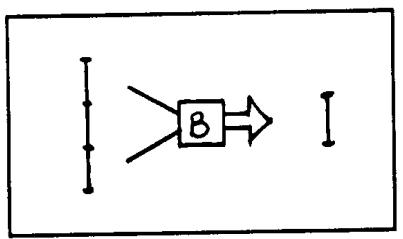
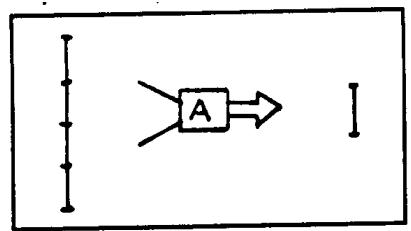
Source: Bairral (1998) Figure 1: Deforming machines
- "A. The first one entered with four and went out with one, and the second one entered with three and exited with one; therefore, the first one reduces more".
- The first one shrinks more because it started with a bigger piece.
- "A. Because the measuring stick has four pieces while the other one has three pieces; if both were reduced to one piece, A would reduce more."
Although they were registered for some specific activities, this type of answer allowed me to realize that the learners (12 to 13 years old) established numerical relations, as when they say 4 to 1 or from 3 to 1; having answered that machine A reduced more, I could not be sure they understood. The last answer doesn't make it clear whether the student thought $(4 - 1 = 3, 3 - 1 = 2)$ or $(1/4 < 1/3)$; or if they answered A because $3 > 2$. I realized that there was an opening for some interesting questions related to learning and develop concepts of proportionality and similitude (Bairral, 1998).
Through this type of register, I could check the richness of the emerging ideas; this diversity was not only important for my pupils; it could also re-dimension the planning and make my learning more valuable. Although my focus was on learning through writing - I was engrossed in readings about writing as a vehicle for learning (Powell & López, 1989) - and about the interactions with my students from their registers, I could also reflect on this type of task, about the concepts and emerging ideas and their differences. I could observe that tasks with different resources generate learnings of a different nature in concepts, procedures and, or attitudes.
In retrospect, I can see the use I made of writing at the time was not as an object of the expression and development of the mind; it was instead a way to capture information at a time when qualitative research lacked its methods for data production. I would say that my understanding was restricted to a very simplified use of writing. I was not aware yet of its potency; technology, one of my main focuses in the projects I coordinate, reduced itself to the computer and some physical resources; language was most likely associated with speaking and writing, and I did not perceive the imbrication of language and cognition (Castro & Castro, 2021).
c) From descriptive writing to expressive registers
Through my readings and conversations with my peers, I gained a growing perception of the importance of language, which I focused on in my research on mathematics education; I was increasingly aware of how we constitute ourselves from language and with it. I realized that language is much more than writing or speaking; I also had a grew aware of the intricate entwining of speech and thought.
Joining the UFRRJ and, happily, my work in Teaching Practice and Didactics for the program leading to a Prospective Mathematics Teachers degree allowed me to produce knowledge on my practice from different possibilities of the use of writing, articulated variously, even to evaluation (Bairral, 2001).
Through the systematic use of writing in various class dynamics, I built strategies to make it more reflective and less descriptive, which proved a challenging practice (Brandes; Boskic, 2008), and I kept warning my undergraduate students about the difference. On reflective dimension it is possible to involve the people in elucidating in detail the development of their professional knowledge; it follows that, because it involves an analytical process, contemplative writing must be potentiated among would-be teachers.
With Arthur Powell (2006), we highlighted the fact that, just as freewriting<sup>6</sup>, chronicles can be expressive; more than detailed prose, chronicles are notes about the contents and learning itself and they usually retain their expressive function. They contain comments on the subject as well as questions and descriptions of solutions, conjectures, and discoveries.
Due to characteristics of chronicle writing, chronicles provide, more than freewriting, factual information about what and how one learns and feels about it. In chronicles, subjects highlight their learning, feelings,
knowledge, discoveries, etc. Transcriptions in Chart 1 shows a transformation from freewriting reflection towards chronicle.
Chart 1: From freewriting to chronicle
<table><tr><td>Before (starting with freewriting)</td><td>After (Moving towards the chronicle)</td></tr><tr><td>Today we worked with the old problem of postal stamps. We pored over the previous information related to the problem and we found out new things. Some conjectures were suggested.</td><td>Today I watched the group work with exponents. When you move the value to the right, the value of the exponent goes up one unit. The opposite is valid if you pass to the left. I also noticed that the number of steps in multiplication is equal to the exponent number. When passing to the left, I take the reciprocal of the positive value found when I passed to the right. When you multiply powers with the same base, but different exponents, you add the exponents. For example, 5 x 5 = 5 = 625. When you divide powers with the same base, but different exponents, you subtract the first exponent from the second. For example, 53 : 51 = 53-1 = 5 = 25</td></tr></table>
Jose's reflection turned from generic narratives meeting with his peers (first column) into a register with the inclusion of reflections that sustain that he observes numerical patterns in potencies (second column); it is not a simple and linear way, and it is not the same for every subject. It is a process, a reflective and critical development, a change of discourse (Sfard, 2008), learning through a written register, with an explaining of how the subject understands the property of multiplication and division of powers of the same base.
Chronicles are also powerful vehicles for dialog among students and teachers, they become public documents to be read and commented on collective work, where the others, including the teacher, are viewed as interlocutors, not evaluators, helps the people involved and provides them with greater security to work in groups without worrying about what the others might say.
A transactional register is another writing function, different from descriptive or expressive essay, it looks for the product, and the written activities are used for cumulative assessment or simple diagnosis where learners complete sentences or write short answers, almost perfect, to the questions provided by the teacher; it is also usual to ask the subjects to register all the steps in mathematical procedures. As they are fundamentally destined for evaluation, written papers must be impersonal or transactional, not expressive; imagine a student watching a video on YouTube about a mathematical demonstration. Is it possible to use this video and potentiate another form of register, of involvement, of expressivity? I'll leave this as an invitation to you, dear reader!
In sum, expressive writing gives individuals with points of departure for their learning; in transactional writing, the use of which tends to be more evaluating, the issue of arrival, the product, is that which is expected, and, as we have mentioned, the subject
tends to complete sentences or write short answers, almost perfect, to the questions provided by the teacher. Both expressive and transactional functions of writing have the potential to generate knowledge; although expressive writing is like “thinking aloud on paper” in the author’s live flow of ideas and feelings, it can be used with transactional characteristics.
The transactional function is also enriched and perfected with various tools, mainly the ones that illustrate a more remarkable development in time, for example, imagine a portfolio as the culmination of a set of papers on a subject. One of those papers can be a conceptual map, another a task elaborated with some other resource; in each tool, there is some sort of register, and the transactional function would assume a comprehensive moment (map + task + etc., + portfolio) of those registers, generating a new one. This new production also needs to consider the specificities of each original resource; it would not limit itself to the production of the portfolio and it whether free, expressive, or transactional writing. It contemplates the cognitive-linguistic development of subjects the author. And for this, the interaction about what is registered assumes a crucial role.
Along my experience, I have realized that undergraduates' critical reading about their mates' productions proved a fruitful dynamic for the understanding of the importance of reflective registers, whether expressive or transactional, that is why I used to warn them about the difference between a report, usually used in the activities of Supervised Practicum, and a diary. The former contains a more descriptive text, and the latter tends to involve the subject in a more reflective production.
All the tools are essential in the development of writing, but it is crucial that the instructor or teacher must realize the nature of the text that can be produced in each one of these means. In the development and
perfecting of writing it is equally relevant to think that reading is essential in its different communication formats; writing well without reading enough is difficult, not to say almost impossible!
## III. WRITING IN ACADEMIA
One of the strategies that I use is asking my students to make outlines of every article or every chapter they read and summarize. The more a work comprises, the more difficult it can be to make a good overview, and the less it is possible to remain on the surface of things with it. In a book, for example, to avoid being superficial, I suggest they write summaries of each chapter; later they systematize a complete overview of the whole book. At other times, I ask them to write book reports; whether they make reports or summaries, continuing reading by going back to examine some parts and commenting on them with their tutor is quite beneficial; although the focus is on capturing central ideas, it is possible to take advantage of the exercise to go through the ABNT format, for example.
I view it as a tremendous Brazilian didactic mistake to propose that undergraduates write an article as a term paper for a subject; unfortunately, I have seen this is a task offered in courses in different disciplines and fields of knowledge. Besides the writer's experience, a report can cover different styles and it demands time to be written, it can be an essay, a theoretical study with or without its empiric counterpart, some literature review, etc. I do not consider a simple and powerful activity involving the subject as an actual author; it doesn't help to propose it to be handed in at a given deadline without it having systematically been followed up by the tutor. Why not give pre-graduate students the opportunity to reflect upon and communicate their experiences in other formats? Why not propose that academics make integrate synthesis (Bairral, 2021a) of published works by the same author or research group?
A summary can focus on the researcher's theoretical-conceptual developments, their re-dimensioning in the research, the innovating aspects of the teaching practice, etc.; why not suggest students contrast two experiments done at different times or in various institutions and then elaborate a critical analysis from that substantiation?, think, dear reader, about the alternative between a proposal that develops scientific and hyperconnected thinking or one that teaches a technique, although it does/ will not develop authorship, autonomy, and creativity?
Such strategies certainly will help their future academic production. With the various possibilities of presenting a paper, what has been innovated over the evaluation? Does it make sense to propose a book report when it is possible to write different opinions and
analyses available on the Internet or when we have access to a video by the author talking about their work? Any task proposed by the tutor needs to avoid being some mandatory homework due to get some marks and the student needs to involve him or herself in this process of learning to learn. Reflection on this type of evaluation instrument on education and its importance, limitations, particularities, and so on are recommended for teacher training.
During my Ph.D. program, I intensified my interest in information technologies, particularly using virtual environments in mathematics teachers' continuing training; I better understood the concept of technology in its symbolic dimension and its lack of neutrality; I realized that its aesthetic character, usually present in the design of an environment (or software), is essential, but not enough to sustain belonging in the context (online or offline) of learning.
## IV. WRITING IN SCIENTIFIC RESEARCH
With the researcher's diaries, writing allows for reflection to be continuously revisited, and itemized; will enable the discursive particularities of the context in which it was produced and understood, but how does the author move within that time, how does he or she revise their ideas at different points within the trajectory?
Chart 2: Three fragments from a researcher's diary
<table><tr><td>Date</td><td>Interlocutors /messages</td><td>Observation/reflection from FORMADOR</td></tr><tr><td colspan="3">F E B R U A R Y</td></tr><tr><td>Inscriptio n Period</td><td>From: Marcelo Bairral Sent: Friday, February 16, 2001 10:24 PM Subject: Information on Geometry Course on the Internet Dear Collegue, It is a great pleasure to inform you on the extension course for teachers called "Geometry for cycles \(3^{rd}\) and \(4^{</td><td>23</td><td>To: xxx Sent: Friday, March 23, 2001 12:52 AM Subject: Sentence 2 Below new sentence 2: "Is it possible that a teacher can limit her activities or exclude some content because she considers that the content demands or has some prerequisite? I don't think so". Teacher Ju Motivation for the opening page, with the teacher's words. The early tele-interactions with Ju, from one of her statements in the questionnaire, developed and went to the discussion list, besides going also to the school where she teaches. One of them was an inspiration and motivation, like one of the sentences: the second teacher sentence on the opening page. Fórum I² Ma (I² Ju) I³ Ju (I³ Ma) Questionário I³ Ma (I³ Ju) Diário 21/03 - 20:57:18 21/03 - 21:31:51 21/03 - 21:38:33 21/03 - 22:32:24 22/03 - 19:58:37 23/03 - 8:40:24</td></tr></table>

What was initially a job of copying and pasting became precious moments of reflecting on and understanding the object of the research. I was getting more and more involved every passing day as I developed my professional self; markings in bold (day 10) and the construction of schemata (day 23) were strategies I used to analyze the professional development of the participants involved; schemata were continuously improved from the new elements that emerged, they also worked as moments of confluence, of internal reflective movement and timing in the diary, it constituted some sort of meta-analysis.
## V. SYNCHRONICITY OF REGISTERS AND COLLECTIVE KNOWLEDGE CONSTRUCTION
With the insertion of the environment Virtual Math Team with the GeoGebra (VMTwG) in the research I have done or coordinated, I noticed the conjunctive nature of written inscriptions (Çakir; Zemel; Stahl, 2009) in both spaces - written chat and whiteboard - that we have used; the whiteboard has GeoGebra and, in the upper right corner, the written conversation.
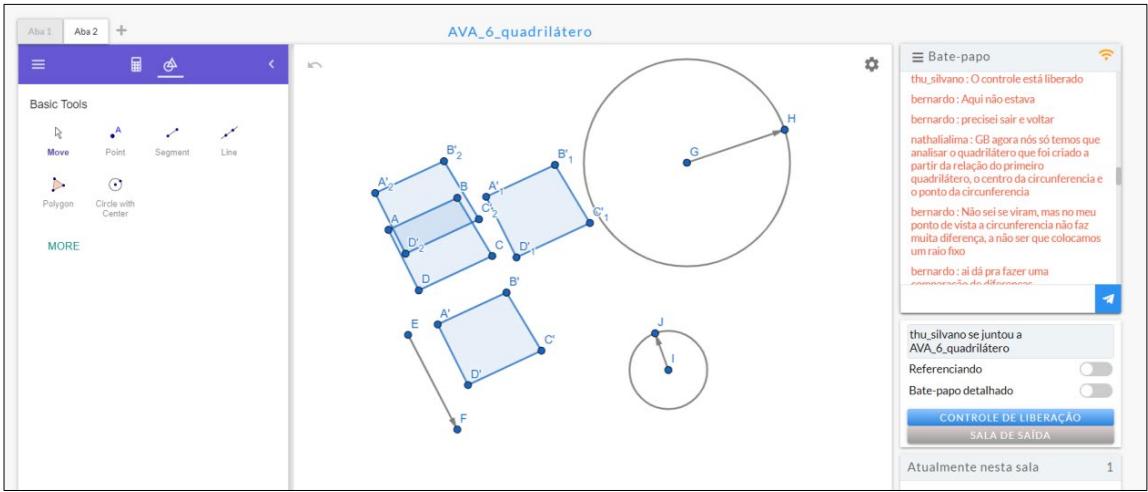
Source: Research Data Figure 2: Activity on VMTwG
Immersive and collaborative interaction on the VMTwG is a communicative process that aims at to share meanings; it is the meanings of the mathematical objects in a constant online socialization through synchronous exchanges by subjects working in small groups in different spaces in the environment; the negotiation of mathematic ideas is potentiated by the different representations - writings on the chat, constructions on the GeoGebra, and other registers - favored by the VMTwG (Bairral & Silvano, 2023).
The discoveries and learnings also influence the type of task that is proposed (Bairral & Marques, 2016), and the written registers cannot be seen in isolation (only chat or only screen construction); this conjunction can also be seen and potentiated in other communicative spaces, such as WhatsApp.
### a) Enter WhatsApp
Are we currently reading more or less? how does teaching innovate in the insertion of other ways of communication and registers that are already in the hands of many of our students and teachers? We again welcome Paulo Freire when he says that teaching
creates possibilities for the construction of knowledge; I know that if I move at all as a teacher, it is because, firstly, I move as a person; I don't believe it is possible to potentiate reading and writing instantiations if we don't see our interlocutor as a person who can also think and develop their mathematic reasoning in a way that can be different than mine.
I would like to highlight that interactive dynamics with digital technology on the web must favor the reflective movement from the individual to the collective and vice versa, for instance, WhatsApp can also be inserted into our educational practices. Before reading on, try to answer the situation below, and feel free to register, cross out, etc.
Imagine a triangular prism, locate the midpoint of its edges, join those points; how many faces will the polyhedron built by this union have?
After your consideration, please proceed with the reading from a conversation I had in a WhatsApp group with a 17-year-old student in his one before last year before leaving high school and taking the University Entrance Examination.
Chart 3: Fragment of WhatsApp interaction
<table><tr><td>With the Group</td><td>in Private</td></tr><tr><td>[11:14, 7/6/2018] Marcelo Bairral: one more question for the SAT candidates: How many faces does a polyhedron have when the vertices are the midpoints of the edges of a triangular prism?
[12:43] Inácio: 5 faces? OK?
[12:43] Inácio: Jeez! I'm lost in geometry, ha ha
[12:44] Marcelo: Nope
[12:45] Marcelo: How many faces does a triangular prism have?
[12:46] Inácio: 5</td><td>[16:47] Inácio: I had to get out at 1:20pm, 'cause I had a class and I just got home
[16:48] Inácio: but I tried to solve the question here and I tried with a drawing, and I found the value of 11 faces
[16:48] Inácio: If that's not the answer, then I don't know how to do it, ha ha
[16:49] Marcelo: how did you get to 11?
[16:50] Inácio: I made a drawing, Drew the prism and I put the vertices at the midpoints of the edges, then I</td></tr></table>
- [12:46] Inácio: I didn't get the thing about the vertices
- [12:47] Inácio: Because Euler's relation is $V + F = A + 2$
- [12:56] Marcelo: but don't use Euler's relation, just identify the polyhedron
- [12:56] Marcelo: great, 5 faces, a triangular prism.
- [12:57] Marcelo: it's 2 triangles and 3 rectangles, right?
- [12:57] Inácio: Right
- [12:57] Marcelo: now think of the midpoint on each face and then join them
- [13:01] Inácio: But it's the midpoint of the edges, right?
- [13:09] Inácio: there's going to be, what, 12 faces?
- [13:09] Inácio: I just made a wild guess
- [13:10] Inácio: 'cause making it with a cube, it's easy, ha ha, now doing that with a triangular prism, it's getting hard...
- [13:13] Marcelo: yes, but try with the prism
- [13:13] Marcelo: an example, a box that reminds a triangular prism?
- [14:31 - 16:31] other conversations among the group
- [16:33] Marcelo: Inácio, don't you forget about me...
- [16:34] Marcelo: need some more help?
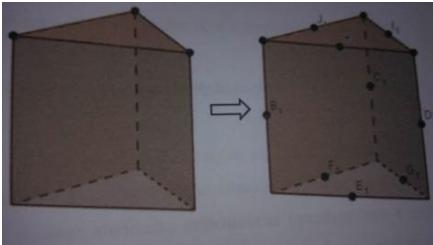
[16:44] Marcelo: Inácio I sent the prism and the midpoints signaled
- [16:47] Inácio: yeah, it's just that I just came home from school, I was doing it at my lunch time
- [16:47] Inácio: That's why I was off
- [16:49] Inácio: I know
- [16:49] Inácio: I had done up to there, but I just didn't get to join the faces right ha ha
went on joining the spaces, like, where the faces would be
- [16:51] Inácio: And then I found 11, but I don't know if it's right.
- [16:51] Marcelo: it is, but how did you count?
- [16:54] Marcelo: did you count up the faces or the edges?
- [16:59] Inacio: the faces
- [16:59] Inácio: I didn't even think of the edges
- [16:59] Marcelo: yes, it's easier
- [16:59] Inácio: I'll try to make a video to show my reasoning, ok?
- [16:59] Marcelo: ok
Share the../../../../../../.././..Movies/Inacio_17anos_prisma_Vid
eo 2018-06-07 at 17.08.02.mp4 video
- [17:08] Inácio: the result is 11?
- [17:18] Marcelo: wonderful, that's it: 2 (bases) + 3 + 3 + 3
- [17:18] Marcelo: congrats
- [17:19] Inácio: Thanks
- [17:19] Inacio:
- [17:19] Marcelo:
Source: Research material
In Chart 3, I copied the conversation and pasted it on a document, I chose to leave the registers the way they were posted because we are in a communicative space where the flow of ideas and the register's forms must be considered; It wouldn't make sense to pay much attention to the correct spelling and punctuation, those are aspects that must be done in other spaces and activities and, for instance, the teacher could ask the students to transcribe the conversation afterward, using a formal register.
Unfortunately, I have no way to integrate the WhatsApp video generated by the student $^{10}$ here, Figure 3 shows some of his drawings.
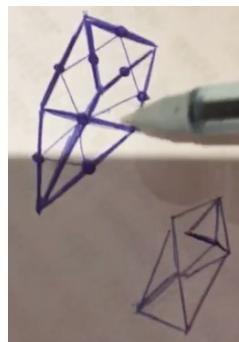
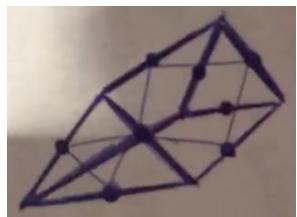
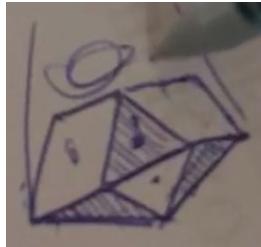
Source: Research material Figure 3: Capture of screen in the video made by the student.
In the two first figures, the learner constructed the triangular prism, located the midpoints of the edges, and joined them; the third picture shows one side of the resulting figure, which involves a greater degree of understanding from the student who demonstrates a count of the faces, marked with the points, from this picture. Although the illustrations here might not be self-explanatory, in the video they make sense with the student's verbal explanation, therefore, the conjunction set (writing + drawing + explanation + emoticons) acts, with equal relevance, in developing of his reasoning skills.
In the fragment shown in Chart 3, we see an interactive and explanatory text that took place, with interruptions and breaks, within about two hours; there are different registers there (writing, illustration, emojis, gif, video, etc.), which are pretty natural in communication in digital scenarios, potentiating hybrid forms of language (Santarella, 2019), through representations and interactions that take place synchronically and a-synchronously, without a hierarchy among them. As opposed to hierarchization, what we can consider in this learning is the time elapsed, besides the availability to reflect.
Devices with screens and their applications are an increasingly constant presence in our daily lives, we are warned about the impact on our memory, distraction, reading processes, and social interaction among others. I consider Wolf's study (2019) extremely relevant on this matter, Wolf discusses the analytical strategies of deep reading, namely: analogy and inference, empathy and creativity, and critical analysis. I articulate emotion, deep reading, and writing, I find here, simply as an illustration, analogy ([12:47] Inácio: Because Euler's relation is $V + F = A + 2$ ) and inference ([16:49] Inácio: I had done up to there, but I just didn't get to join the faces right haha) ([16:59] Inácio: I didn't even think of the edges), empathy ([17:18] Marcelo: wonderful), ([17:19] Inácio: ) and creativity ([16:59] Inácio: I'll try to make a video to show my reasoning, ok?) and critical analysis.
I'm leaving it up to you, my reader, of identifying the crucial analysis in this interactive fragment, would it
be placed in just one-time interval or the sum of all the times involved? Notice that the generated text here can be used in class or for evaluation, these registers generate others - in different formats and dynamics -, and they can be used with other students. It is worth mentioning that a significant group may not be as productive in their interaction, but you, the teacher, working in your reality will know how to build your dynamic.
I don't think WhatsApp must be introduced hastily into teaching practices, as it may just become a heavier workload on the teachers who already have little time to plan and reflect on their teaching and learning, nevertheless, it is possible to use it for some specific purposes. In any case, it should be the teachers' decision, taking into consideration their working conditions, overtime possibilities, including working on weekends, ethical issues like students 'ages, families' authorizations, use of images, institutional: authorizations, use of resources, extra class communication with the students, and so on.
## VI. WARNING, WRITING IS NOT EVERYTHING!
The gesture is the initial visual sign that contains the future writing of the child, as a seed contains a future oak, as it has been appropriately said, gestures are writing in the air, and written signs are often simple gestures that have been fixed. (Vygotski, 1991, p. 71)
Vygotski's quote is instigating, and ambiguous in a way, calling attention to the importance of gestures as a linguistic form in the first sentence but then subjecting it to writing. This ambiguity may not be Vygotski's, it is possible that I am being influenced by the whole compound of his work, where writing is always central, particularly words as a unit of analysis<sup>11</sup>. Whether ambiguous or not, this quote calls attention to gesture as a visual sign.
Through my professional development, I grew an awareness that our thought is expressed through some form of language $^{12}$, I also realized that orality and writing are symbolic technologies; the threesome orality-writing-information technologies, called "technologies of intelligence" by Levy (1993), bring up the expansive dimension of computational technology. Although writing, as it is not ephemeral, allows the author to share it or revise it at different times, the other forms of language manifestation must be valued, even in evaluation activities, it is by establishing relations that our learning potentiates itself in different ways. Our brain learns in the various associations with which we provoke it, in this sense, we must consider the semiotic package multimodal and multi representational (Arzarello & Robutti, 2010) in all our training activities.
Although writing has a more extended period of stability over time, allowing both the author and the reader to revisit it at different times and occasions, we cannot value only what is written during the schooling process (Bairral, 2020). With screen touching entering the scene, mobile devices, dynamic construction, and direct manipulations on screen came to compose my analytical spectrum. From there, I had a greater need to study and understand bodily cognition (Bolite Frant, 2014), the constant symbiosis between body and environment (Damásio, 1996), the potentiation of other forms of language manifestation, and mobile technology assuming physical extension – not repairing – of our bodies (Bairral, 2021b).
Reading and writing experiences should be interesting for all; writing practices can also be taught, but not as a mere technique or to produce transactional registers. I have become acquainted with some exciting experiences concerning textual production that didn't limit themselves to technical procedures.
We should not tolerate that our students be deprived of enriching their ways of reading and writing, of all types, through different means throughout their schooling from Elementary School to college learners cannot open their mathematics manuals only to locate exercises; it is crucial that they must use them also to read and understand the mathematics texts in their different representations (text, graph, tables, algebra, numeric, geometric, pictorial, etc.), therefore, joint reading, whether teacher-students or student-student, is also recommended. My experience in this practice has also been significant, suggesting that the students do some marking along their reading (with markers, for instance) of concepts or mathematics procedures; I would think that teachers know the available resources and they can create autonomous practices that potentialize readings and writings that they consider of interest, issuing from what scientific research inspires them to do.
a) For deep reading and hyperconnected registers
Regardless of the form of language manifestation<sup>13</sup> - in teaching or learning situations - the main thing is the interaction among the people involved and the dynamics (interactive and semiotic) that have guided the experience, the connections are the logic paths - of teacher or researcher - that must be followed to avoid underestimating or ignoring any type of mathematics language manifestation or production.
Hyperconnection involves non-linear production potentiated by hypertext technologies, with a predominance of text and hypermedia, using of mixed media; written is not the central technology, and it belongs to a dynamic and hybrid net of other forms of language manifestation (pictorial, gestures, screen touches, constructions on screen, explanatory audios or videos, conceptual maps, etc.).
A hyperconnected register can arise from an audio, an image, a piece of music, a GeoGebra icon, etc. In all of them, writing can be seen as a form of stability – temporary – of thought, but it should not be considered as the one with the most cognitive value; I am making a call to move away from the idea that “only what is written is valid” and to embrace instead the belief that “what is articulated and explained, in many different ways, is what counts” (Bairral, 2020). Hyperconnected registers complement and imbricate each other; hyper-connection – in either teaching or research – can be seen as moments of converging ideas, the culmination of an experience, and meta-analysis (theoretical or analytical).
The hyperconnection I defend is in tune with what Wolf (2019) highlights concerning the continuous strengthening of ties among our analogic, inferential, empathic, and knowledge-building processes, so
when we learn to connect more and more those processes in our reading, it becomes easier to apply them to our lives, untangling our motivations, intentions, and understanding with greater insight, maybe wisely, why other people think the way they do (Wolf, 2019, p. 75).
According to this author, this not only gives support to the compassionate side of empathy, but also contributes to strategic thinking, therefore, hyperconnection should advocate a creative and authoring process for subjects who are more and more critically submerged in the digital world; we should not naively naturalize this submersion but admit we already live in and produce culture digitally.
Hyperconnection should also encourage the readers to establish relations and build their cognitive-linguistic nets, always through interactive processes;
interacting is sharing, reflecting, and producing meanings collectively, with or without digital technologies. Interaction is a bridge to bind and move people, I hope you belong or see yourself in this movement, in this binding!
Generating HTML Viewer...
References
50 Cites in Article
Inácio Inácio: Because Euler's relation is V+F=A+2.
Marcelo but don't use Euler's relation, just identify the polyhedron.
No ethics committee approval was required for this article type.
Data Availability
Not applicable for this article.
How to Cite This Article
Marcelo Bairral. 2026. \u201cThe Value of Little Things, Math Learnings and Hyperconnected Looks\u201d. Global Journal of Human-Social Science - G: Linguistics & Education GJHSS-G Volume 23 (GJHSS Volume 23 Issue G6): .
Explore published articles in an immersive Augmented Reality environment. Our platform converts research papers into interactive 3D books, allowing readers to view and interact with content using AR and VR compatible devices.
Your published article is automatically converted into a realistic 3D book. Flip through pages and read research papers in a more engaging and interactive format.
This personal account of my encounters with reading and writing in my professional development as mathematics teacher invites the reader to think about the possibilities of connecting with different forms of language manifestation. This article reviews concepts of free writing and the expressive and transactional functions of writing. It reflects on alternatives and instruments that can enhance different means of report, including communication in computer environments. The deep-reading construct introduces the importance of hyperconnected registers. This hyperconnection involves creative production via networked digital technologies and does not consider writing as the form of most outstanding cognitive value or centrality.
Our website is actively being updated, and changes may occur frequently. Please clear your browser cache if needed. For feedback or error reporting, please email [email protected]
Thank you for connecting with us. We will respond to you shortly.