The third-order shear deformation theory (TSDT) effects on functionally graded material (FGM) thick circular cylindrical shells with entirely homogeneous equation under thermal vibration were investigated by using the generalized differential quadrature (GDQ) method. The nonlinear coefficient term of displacement field of TSDT was used in the equations of motion for thermal vibration of FGM thick circular cylindrical shells. Parametric effects of environment temperature and FGM power law index on the thermal stress and centre deflection of FGM thick circular cylindrical shells were investigated.
## I. INTRODUCTION
Some studies of shear deformation effects in functionally graded material (FGM) shells were presented. In 2018, Cong et al. [1] used Reddy's third-order shear deformation theory (TSDT) for the nonlinear displacements to study the time response of displacements of double curves shallow shells. The effecting numerical solutions for honeycomb materials in geometrical parameters, material properties and damping loads were presented. In 2017, Sobhaniaragh et al. [2] used the TSDT for the displacements to study the buckling loads of FGM carbon nano-tube (CNT)-reinforced shells in an environment (room temperature 300K) without thermal strains, parametric effects on material properties and critical buckling loads were presented by using the generalized differential quadrature (GDQ) method. In 2017, Dung and Vuong [3] used an analytical method with TSDT to study the buckling of FGM shells in elastic foundation under thermal environment and external pressure. In 2016, Dai et al. [4] presented a 2000-2015 review focused on coupled mechanics, e.g. thermo-mechanical responses with the first-order shear deformation theory (FSDT) models, HSDT models in widely used TSDT to study the bending, buckling, free and forced vibrations of FGM cylindrical shells by using various theoretical, analytical and numerical methods. In 2016, Fantuzzi et al. [5] used the numerical GDQ methods to study the free vibration of FGM spherical and cylindrical shells, frequency solutions in FGM exponent number and thickness ratio were included. There were some numerical studies in the thick shells. In 2016, Kar and Panda [6] used the code of finite element method (FEM) and the TSDT displacements to get the numerical static bending results of deflections and stresses for the heated FGM spherical shells under thermal load and thermal environment. In 2015, Kurtaran [7] used the methods of GDQ and FSDT to get the numerical transient results of moderately thick laminated composite spherical and cylindrical shells. In 2012, Viola et al. [8] presented static analyses of FGM cylindrical shells under mechanical loading by using the GDQ method and a 2D unconstrained third-order shear deformation theory (UTSDT). The numerical solutions for stresses without thermal effect are obtained. In 2010, Sepiani et al. [9] used the FSDT formulation to get the numerical free vibration and buckling results for the FGM cylindrical shells without considering the thermal effect.
Many GDQ computational experiences in the composited FGM shells and plates were presented by including and considering the effects of thermal temperature of environment and heating loads. In 2017, Hong [10] presented the numerical thermal vibration results of FGM thick plates by considering the FSDT model and the varied shear correction factor effects. In 2017, Hong [11] presented the numerical thermal vibration and flutter results of a supersonic air flowed over FGM thick circular cylindrical shells by considering the FSDT model and the varied shear correction factor effects. In 2017, Hong [12] presented the numerical displacement and stresses results of FGM thin laminated magnetostrictive shells by considering with velocity feedback and suitable control gain values under thermal vibration. In 2016, Hong [13] presented the thermal vibration of Terfenol-D FGM circular cylindrical shells by considering the FSDT model and the constant modified shear correction factor effects. The computational GDQ solutions for the parametric effects of thickness of mounted Terfenol-D layer, control gain values, temperature of environment and power law index were investigated. In 2016, Hong [14] presented the transient response of Terfenol-D FGM circular cylindrical shells without considering the shear deformation effects. The computational GDQ solutions for the normal direction displacement and thermal stress were obtained. In 2016, Hong [15] presented the investigation of rapid heating-induced vibration of Terfenol-D FGM circular cylindrical shells. The computational GDQ solutions for both the amplitudes of displacement and stress are increasing with rapid heating value. In 2015, Hong [16] presented the rapid heating-induced vibration of Terfenol-D FGM cylindrical shells with FSDT transverse shear effects. The computational GDQ solutions for thermal stresses and centre deflections in the parametric effects of magnetostrictive layer thickness, control gain values, temperature of environment, power law index of FGM shells and applied heat flux were obtained. In 2014, Hong [17] presented the thermal vibration and transient response of Terfenol-D FGM plates by considering the FSDT model and the varied modified shear correction factor effects. The computational GDQ solutions for the effect of different mechanical boundary conditions were investigated. In 2014, Hong [18] presented the rapid heating-induced vibration of Terfenol-D FGM circular cylindrical shells without considering the effects of shear deformation. The computational GDQ solutions for the displacement of Terfenol-D FGM shells versus the thickness of Terfenol-D is stable for all power law index values. It was interesting to investigate the thermal stresses and centre displacement of GDQ computation in this nonlinear TSDT vibration approach and the varied effects of shear correction coefficient of FGM circular cylindrical shells with four edges in simply supported boundary conditions. Two parametric effects of environment temperature and FGM power law index on the thermal stress and centre displacement of FGM circular cylindrical shells including the effect of varied shear correction coefficient were also investigated.
## II. FORMULATION PROCEDURE
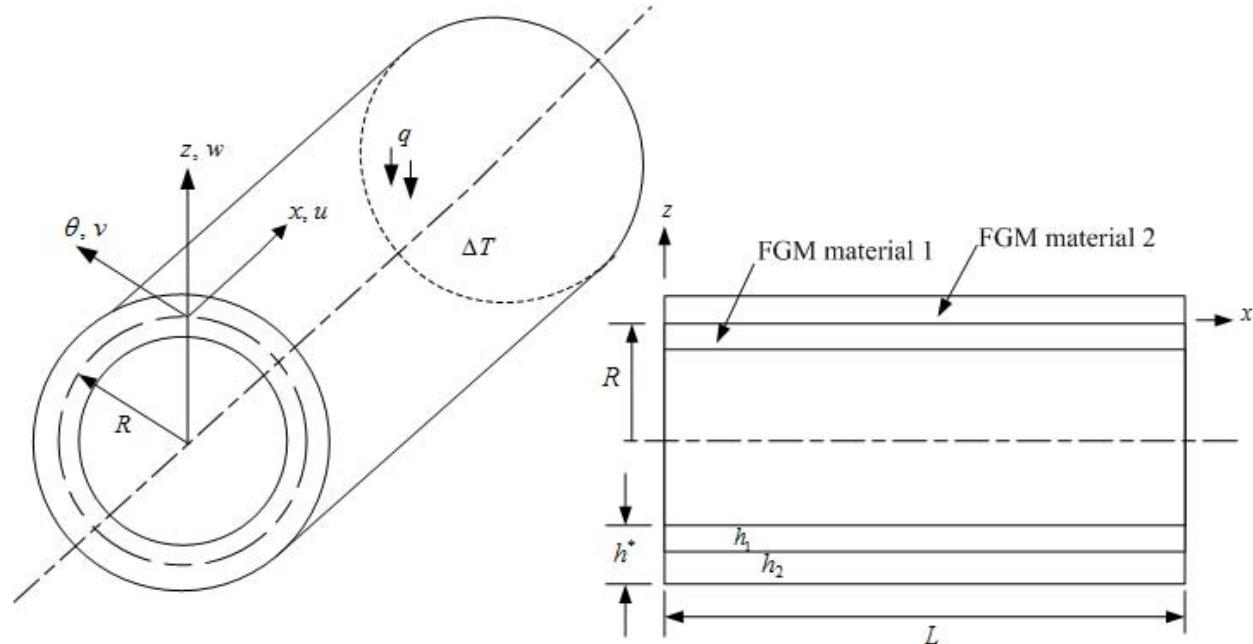
For a two-material FGM circular cylindrical shell is shown in Fig. 1 with thickness $h_1$ of inner layer FGM material 1 and thickness $h_2$ of outer layer FGM material 2, $L$ is the axial length of FGM shells, $h^*$ is the total thickness of FGM shells. The material properties of power-law function of FGM shells are considered with Young's modulus $E_{fgm}$ of FGM in standard variation form of power law index $R_n$. The others are assumed in the simple average form [19]. The properties of individual constituent material of FGMs are functions of environment temperature $T$. The time-dependent of nonlinear displacements $u$, $v$ and $w$ of thick FGM circular cylindrical shells are assumed in the nonlinear coefficient $c_1$ term of TSDT equations can be referred to the displacement equations [20], with the parameters $u_0$ and $v_0$ are tangential displacements in the insurface coordinates $x$ and $\theta$ axes direction, respectively, $w$ is transverse displacement in the out of surface coordinates $z$ axis direction of the middleplane of shells, $\phi_{x}$ and $\phi_{\theta}$ are the shear rotations, $R$ is the middle-surface radius of FGM shell, $t$ is time. Coefficient for $c_{1} = \frac{4}{3(h^{*})^{2}}$ is used in the TSDT expression. Thus $c_{1} = 0$ is used and became the FSDT mode.
For the normal direction stresses $(\sigma_{x}$ and $\sigma_{\theta}$ ) and the shear stresses $(\sigma_{x\theta},\sigma_{\theta z}$ and $\sigma_{xz})$ in the thick FGM circular cylindrical shells under temperature difference $\Delta T$ for the $k$ th layer can be referred to the constitutive equations in terms of stresses, stiffness and strains [21-22], with the parameters $\alpha_{x}$ and $\alpha_{\theta}$ are the coefficients of thermal expansion, $\alpha_{x\theta}$ is the coefficient of thermal shear, $\overline{Q}_{ij}$ is the stiffness of FGM shells. $\varepsilon_{x}$, $\varepsilon_{\theta}$ and $\varepsilon_{x\theta}$ are in-plane strains, not negligible $\varepsilon_{\theta z}$ and $\varepsilon_{xz}$ are shear strains.
A temperature difference $\Delta T$ between the FGM shell and curing area is given in functions of cylindrical coordinates $x$, $\theta$ and $t$. The heat conduction equation in simple form for the FGM shell in the cylindrical coordinates is used [13]. The dynamic equations of motion with TSDT for an FGM shell can be referred to the partial derivatives of external forces, thermal loads, mechanical loads and inertia terms [23], with the parameters $I_{i} = \sum_{k=1}^{N^{*}} \int_{k}^{k+1} \rho^{(k)} z^{i} dz$, $(i = 0,1,2, \ldots, 6)$, in which $N^{*}$ is total number of layers, $\rho^{(k)}$ is the density of $k$ th ply. $J_{i} = I_{i} - c_{1} I_{i+2}$, $(i = 1,4)$, $K_{2} = I_{2} - 2c_{1} I_{4} + c_{1}^{2} I_{6}$.
The Von Karman type of strain-displacement relations with $\frac{\partial v_0}{\partial z} = \frac{-v_0}{R}$, $\frac{\partial u_0}{\partial z} = \frac{-u_0}{R}$ and $\frac{\partial w}{\partial z} = \frac{\partial \phi_x}{\partial z} = \frac{\partial \phi_\theta}{\partial z} = 0$ are used to simplify the strain equations. Thus the dynamic equilibrium differential equations in the cylindrical coordinates with TSDT of FGM shells in terms of partial derivatives of displacements and shear rotations subjected to partial derivatives of thermal loads, mechanical loads $(p_1, p_2, q)$ and inertia terms can be derived in matrix forms. By assuming that mid-plane strain terms $\frac{1}{2} \left( \frac{\partial w}{\partial x} \right)^2$, $\frac{\partial w}{\partial x} \frac{\partial w}{R \partial \theta}$ and $\frac{1}{2} \left( \frac{\partial w}{R \partial \theta} \right)^2$ are in constant values, the relative parameters are listed as follows,
$$
\begin{array}{l} \left(A _ {i ^ {s} j ^ {s}}, B _ {i ^ {s} j ^ {s}}, D _ {i ^ {s} j ^ {s}}, E _ {i ^ {s} j ^ {s}}, F _ {i ^ {s} j ^ {s}}, H _ {i ^ {s} j ^ {s}}\right) = \int_ {\frac{- h ^ {*}}{2}} ^ {\frac{h ^ {*}}{2}} \bar{Q} _ {i ^ {s} j ^ {s}} \left(1, z, z ^ {2}, z ^ {3}, z ^ {4}, z ^ {6}\right) d z, \left(i ^ {s}, j ^ {s} = 1, 2, 6\right), \\\left(A _ {i ^ {*} j ^ {*}}, B _ {i ^ {*} j ^ {*}}, D _ {i ^ {*} j ^ {*}}, E _ {i ^ {*} j ^ {*}}, F _ {i ^ {*} j ^ {*}}, H _ {i ^ {*} j ^ {*}}\right) = \int_ {\frac{- h}{2}} ^ {\frac{h ^ {*}}{2}} k _ {\alpha} \bar{Q} _ {i ^ {*} j ^ {*}} \left(1, z, z ^ {2}, z ^ {3}, z ^ {4}, z ^ {5}\right) d z, \left(i ^ {*}, j ^ {*} = 4, 5\right), \\\end{array}
$$
in which $p_1$ and $p_2$ are external in-plane distributed forces in $x$ and $\theta$ direction respectively. $q$ is external pressure load, $k_{\alpha}$ is the shear correction coefficient, computed and varied values of $k_{\alpha}$ are usually functions of total thickness of shells, FGM power law index and environment temperature [24]. The $\overline{Q}_{i^s j^s}$ and $\overline{Q}_{i^* j^*}$ for FGM thick circular cylindrical shells with $z / R$ terms cannot be neglected are used in the simple forms in 2010 by Sepiani et al. [9] [24].
The time sinusoidal displacements and shear rotations are varied with $\sin (\omega_{mn}t)$ can be referred [13]. The time sinusoidal temperature difference $\Delta T$ of thermal vibration is assumed in the following simple equation varied with $\sin (\gamma t)$,
$$
\Delta T = \frac {z}{h ^ {*}} \bar {T} _ {1} \sin (\pi x / L) \sin (\pi \theta / R) \sin (\gamma t), \tag {2}
$$
where $\omega_{mn}$ is the natural frequency in mode shape subscript numbers $m$ and $n$ of the shells, $\gamma$ is the frequency of applied heat flux, $\bar{T}_1$ is the amplitude of applied temperature.
The GDQ numerical method is presented and referred [17][25-27]. The boundary conditions in dynamic GDQ discrete equations approach are to be considered for four sides simply supported, not symmetric, orthotropic of laminated FGM thick circular cylindrical shells and assumed that $A_{16} = A_{26} = 0$, $B_{16} = B_{26} = 0$, $D_{16} = D_{26} = 0$, $E_{16} = E_{26} = 0$, $F_{16} = F_{26} = 0$, $H_{16} = H_{26} = 0$, $A_{45} = D_{45} = F_{45} = 0$ under sinusoidal temperature loading. For a typical grid point $(i,j)$, the dynamic GDQ discrete equations can be rewritten into the matrix form as follows,
$$
[A]\{W^{*}\} = \{B\},
$$
where $[A]$ is a dimension of $N^{**}$ by $N^{**}$ coefficient matrix ( $N^{**} = (N - 2) \times (M - 2) \times 5$ ), $\{W^*\}$ is a $N^{**}$ th-order unknown column vector and $\{B\}$ is a $N^{**}$ th-order row external loads vector.
## III. NUMERICAL RESULTS
The FGM material 1 is SUS304, the FGM material 2 is $S i_{3}N_{4}$ used for the numerical computations under four sides simply supported. The frequency $\gamma$ of applied heat flux for the thermal loads is given in the heat conduction equation can be reduced and simplified [13]. It is needed to get the calculation values of $\omega_{mn}$ under $p_1 = p_2 = 0$ and $q = 0$ for the free vibration. It is reasonable to assume that $u_0, v_0, w, \phi_x$ and $\phi_\theta$ are expressed in the referred time sinusoidal form of free vibration and expressed in the referred entirely homogeneous matrix equation [29] with varied parameters $m\pi / L$ and $n\pi / R$. The determinant of the coefficient matrix in the entirely homogeneous equation vanishes for obtaining non-trivial solution of amplitudes, thus the $\omega_{mn}$ and $\gamma$ can be found.
The non-dimensional frequency $\Omega = (\omega_{11}L^2 /h^*)\sqrt{\rho_1 / E_1}$ and $f^{*} = 4\pi \omega_{11}R\sqrt{I_{2} / A_{11}}$ for SUS304/Si $_3$ N $_4$ thick circular cylindrical shells with entirely homogeneous equation and TSDT under free vibration are compared with published literature as shown in Table 1, in which $\omega_{11}$ is the fundamental first natural frequency $m = n = 1$, $\rho_{1}$ is the density of FGM material 1. The present value of $\Omega = 1.906986$ on $c_{1} = 0.925925 / \mathrm{mm}^2$, $L / h^{*} = 10$, $h^{*} = 1.2\mathrm{mm}$, $T = 700\mathrm{K}$, $R_{n} = 1$ is in close to the value of $\Omega = 1.65127$ with the material variation type A, three layers thickness ratio 1-8-1, the $L$ directional radius of curvature is $\infty$, $L / h^{*} = 10$, $R_{n} = 1$ for the FGM sandwich shell presented by Chen et al. [28]. The present value of $f^{*} = 5.041756$ at $L / h^{*} = 10$, $h^{*} = 2\mathrm{mm}$, $T = 300\mathrm{K}$, $R_{n} = 0.5$ is in close to the value of $f^{*} = 5.10$ on $n = 9$ with silicon nitride-nickel under classical shell theory (CST), no external pressure $(Ke = 0)$ by Sepiani et al. [9].
The following coordinates $x_{i}$ and $\theta_{j}$ for the grid points numbers $N$ and $M$ of FGM thick circular cylindrical shells are used to study the GDQ results,
$$
x _ {i} = 0. 5 \left[ 1 - \cos \left(\frac {i - 1}{N - 1} \pi\right) \right] L, i = 1, 2, \dots , N,
$$
$$
\theta_{j} = 0.5\left[1 - \cos\left(\frac{j-1}{M-1}\pi\right)\right]R,\,j=1,2,\dots,M.\tag{4}
$$
The convergence of centre deflection $w(L / 2,2\pi /2)$ (mm) in the thermal vibration under $c_{1} = 0.925925$ and $c_{1} = 0$ for FGM thick circular cylindrical shells $L / h^{*} = 10$ with applied heat flux $\gamma = 0.2618004 / s$ and $L / h^{*} = 5$ with $\gamma = 0.2618019 / s$, respectively at $t = 6s$, $L / R = 1$, $h^{*} = 1.2mm$, $h_{1} = h_{2} = 0.6mm$, $T = 100K$,
$\bar{T}_1 = 100\mathrm{K}$ are presented in Table 2. Considering the varied effects of $k_{\alpha}$ and $\omega_{11}$ for three values of $R_{n}$, in the nonlinear case of $c_{1} = 0.925925 / \mathrm{mm}^{2}$: (a) for value of $R_{n} = 0.5$, $k_{\alpha} = 0.111874$ and $\omega_{11} = 0.0001156 / \mathrm{s}$ are obtained. (b) for value of $R_{n} = 1$, $k_{\alpha} = 0.149001$ and $\omega_{11} = 0.0001151 / \mathrm{s}$ are obtained. (c) for value of $R_{n} = 2$, $k_{\alpha} = 0.231364$ and $\omega_{11} = 0.000114 / \mathrm{s}$ are obtained. In the linear case of $c_{1} = 0 / \mathrm{mm}^{2}$: (d) for value of $R_{n} = 0.5$, $k_{\alpha} = 0.111874$ and $\omega_{11} = 0.001000 / \mathrm{s}$ are obtained. (e) for value of $R_{n} = 1$, $k_{\alpha} = 0.149001$ and $\omega_{11} = 0.001000 / \mathrm{s}$ are obtained. (f) for value of $R_{n} = 2$, $k_{\alpha} = 0.231364$ and $\omega_{11} = 0.001000 / \mathrm{s}$ are obtained. The error accuracy is 0.000011 for the $w(L / 2,2\pi /2)$ in $R_{n} = 0.5$ and $L / h^{*} = 10$. The $N\times M = 13\times 13$ grid points can be used in the following GDQ computations of time responses for deflection and stress.
The $w(L / 2,2\pi /2)$ (mm) for the thermal vibration of FGM thick circular cylindrical shells are calculated with varied $\gamma$ and $\omega_{11}$. The $\gamma$ values are decreasing from $\gamma = 15.707960 / s$ at $t = 0.1s$ to $\gamma = 0.523601 / s$ at $t = 3.0s$ used for $L / h^{*} = 5$, from $\gamma = 15.707963 / s$ at $t = 0.1s$ to $\gamma = 0.523599 / s$ at $t = 3.0s$ used for $L / h^{*} = 10$. Fig. 2 shows the response values of $w(L / 2,2\pi /2)$ (mm) versus time $t$ under $c_{1} = 0.925925 / \mathrm{mm}^2$ and $c_{1} = 0$ for thick $L / h^{*} = 5$ and 10, respectively, $L / R = 1$, $R_{n} = 1$, $k_{\alpha} = 0.120708$, $T = 600K$, $\bar{T}_{1} = 100K$ during $t = 0.1s - 3.0s$. The maximum absolute value of $w(L / 2,2\pi /2)$ is 33.955818mm occurs at $t = 0.1s$ for thick $L / h^{*} = 5$ with $c_{1} = 0.925925 / \mathrm{mm}^2$ and $\gamma = 15.707963 / s$. The maximum absolute value of $w(L / 2,2\pi /2)$ is 267.064789mm occurs at $t = 0.1s$ for thick $L / h^{*} = 10$ with $c_{1} = 0 / \mathrm{mm}^2$ and $\gamma = 15.707963 / s$.
Usually the normal direction stress $\sigma_{x}$ and shear stress $\sigma_{x\theta}$ are three-dimensional components and in functions of $x$, $\theta$ and $z$ for the thermal vibration of nonlinear TSDT FGM circular cylindrical shells as shown in Fig. 3. Typically their values vary through the thickness direction of circular cylindrical shells. Fig. 3a shows the normal direction stress $\sigma_{x}(\mathrm{GPa})$ versus $z / h^{*}$ and Fig. 3b shows the shear stress $\sigma_{x\theta}(\mathrm{GPa})$ versus $z / h^{*}$ on centre position $x = L / 2$ and $\theta = 2\pi /2$ of FGM circular cylindrical shells, respectively at $t = 3.0s$ for thick $a / h^{*}$ $= 10$ with $c_{1} = 0.925925 / \mathrm{mm}^{2}$ and $R_{n} = 1$. The value 1.702E-03GPa of $\sigma_{x}$ on $z = -0.5h^{*}$ is found in the greater value than the value 1.955E-04GPa of $\sigma_{x\theta}$ on $z = 0.5h^{*}$, thus the $\sigma_{x}$ can be treated as the dominated stress. Figs. 3c-3d show the time responses of the $\sigma_{x}(\mathrm{GPa})$ on centre position of inner surface $z = -0.5h^{*}$ for $R_{n} = 1$, thick $L / h^{*} = 5$ and 10 with $c_{1} = 0.925925 / \mathrm{mm}^{2}$, respectively. The maximum value of $\sigma_{x}$
is 2.005E-03GPa occurs at $t = 0.1$ s in the periods $t = 0.1$ s-3s for thick $L / h^{*} = 5$.
In Fig. 4 shows the response values of $w(L / 2,2\pi /2)$ (mm) versus $T$ in 100K, 600K and 1000K with $R_{n}$ values from 0.1 to 10 for thick $L / h^{*} = 5$ and 10, respectively under $c_{1} = 0.925925 / \mathrm{mm}^{2}$, $\bar{T}_{1} = 100\mathrm{K}$, $\gamma$ and $k_{\alpha}$ at $t = 0.1\mathrm{s}$. Fig. 4a shows the curves of $w(L / 2,2\pi /2)$ vs. $T$ and $R_{n}$ for the $L / h^{*} = 5$ case, the maximum absolute value of $w(L / 2,2\pi /2)$ is 49.057815mm occurs in $T = 1000\mathrm{K}$ for $R_{n} = 2$. The $w(L / 2,2\pi /2)$ absolute values are all decreasing versus $T$ from $T = 600\mathrm{K}$ to $T = 1000\mathrm{K}$, for $R_{n} = 5$ only, it can withstand for higher $T = 1000\mathrm{K}$. Fig. 4b shows the curves of $w(L / 2,2\pi /2)$ vs. $T$ and $R_{n}$ for the $L / h^{*} = 10$ case, they are almost located in the same curves for all value of $R_{n}$. The maximum value of $w(L / 2,2\pi /2)$ is 7.039238mm occurs in $T = 1000\mathrm{K}$ for all value of $R_{n}$. The $w(L / 2,2\pi /2)$ values are all increasing versus $T$ for all value of $R_{n}$, the amplitude $w(L / 2,2\pi /2)$ of the $L / h^{*} = 10$ cannot withstand for higher $T = 1000\mathrm{K}$.
In Fig. 5 shows the $\sigma_{x}(\mathrm{GPa})$ on centre position of inner surface $z = -0.5h^{*}$ versus $T$ and all different values $R_{n}$ for the thermal vibration of thick $L / h^{*} = 5$ and 10 cases. Fig. 5a shows the curves of $\sigma_{x}$ vs. $T$ and $R_{n}$ for the $L / h^{*} = 5$ case, the values of $\sigma_{x}$ versus $T$ are all increasing from $T = 100\mathrm{K}$ to $T = 600\mathrm{K}$ and then all decreasing from $T = 600\mathrm{K}$ to $T = 1000\mathrm{K}$ for all value of $R_{n}$. The maximum value of $\sigma_{x}$ is 0.002018GPa occurs on $T = 600\mathrm{K}$ for $R_{n} = 2$. The stress $\sigma_{x}$ of the $L / h^{*} = 5$ can withstand for higher $T = 1000\mathrm{K}$. Fig. 5b shows the curves of $\sigma_{x}$ vs. $T$ and $R_{n}$ for the $L / h^{*} = 10$ case, they are all located in the same curves for all value of $R_{n}$, the values of $\sigma_{x}$ versus $T$ are all increasing from $T = 100\mathrm{K}$ to $T = 600\mathrm{K}$ and then all decreasing from $T = 600\mathrm{K}$ to $T = 1000\mathrm{K}$ for all value of $R_{n}$. The maximum value of $\sigma_{x}$ in 0.001745GPa occurs on $T = 600\mathrm{K}$. The stress $\sigma_{x}$ of the $L / h^{*} = 10$ can withstand for higher $T = 1000\mathrm{K}$.
## IV. CONCLUSIONS
The GDQ solutions could be calculated and investigated for the deflections and stresses in the thermal vibration of FGM thick circular cylindrical shells by considering the varied effects of shear correction coefficient and nonlinear coefficient $c_{1}$ term of TSDT. The novel contribution of the GDQ stress and deflection solutions work is to investigate the effects of over estimation and under estimation of nonlinear coefficient term of TSDT in the thermal vibration of FGM circular shells. The natural frequency and parameter results of frequency including the entirely element effect in the homogeneous equation are also investigated and used to calculate the corresponding results in dynamic convergence, vibration response of deflections and stresses.


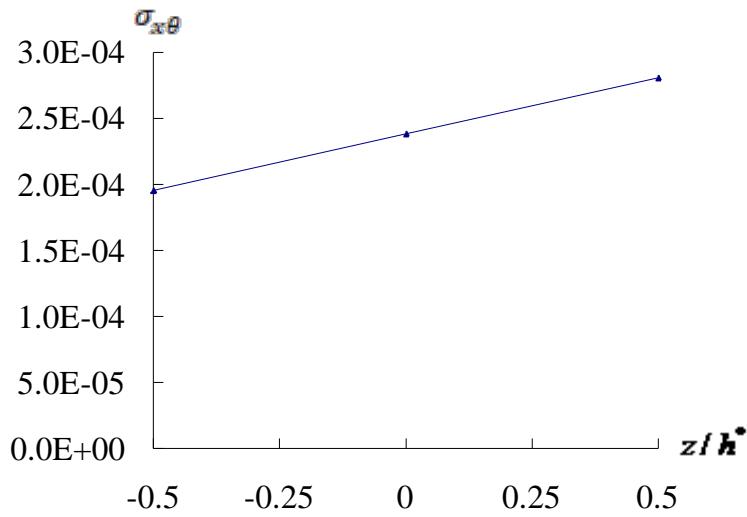 Fig. 3b: $\sigma_{x\theta}$ versus $z / h^{*}$ for $L / h^{*} = 10$
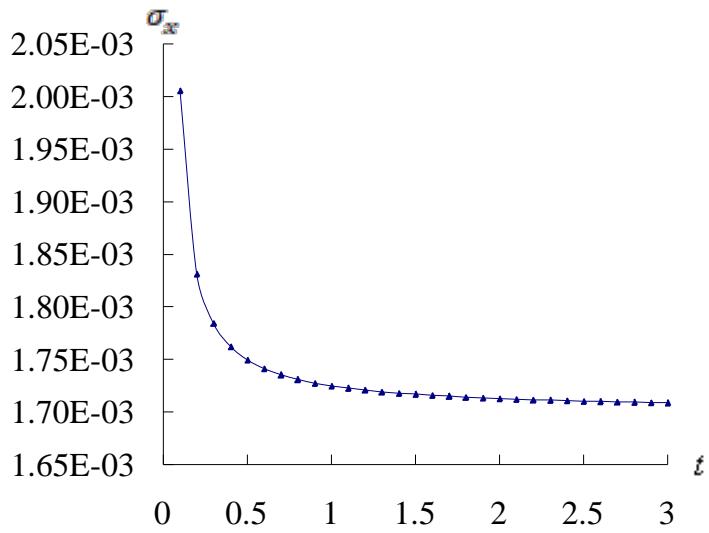 Fig. 3c: $\sigma_{x}$ versus $t$ for $L / h^{*} = 5$
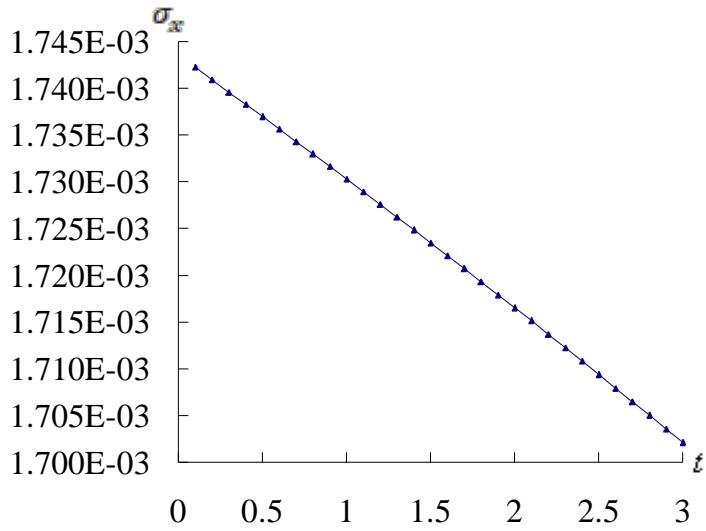 Fig. 3d: $\sigma_{x}$ versus $t$ for $L / h^{*} = 10$ Fig. 3: Stresses (GPa) versus $z / h^{*}$ and $t$ (s) for $L / h^{*} = 5$ and 10
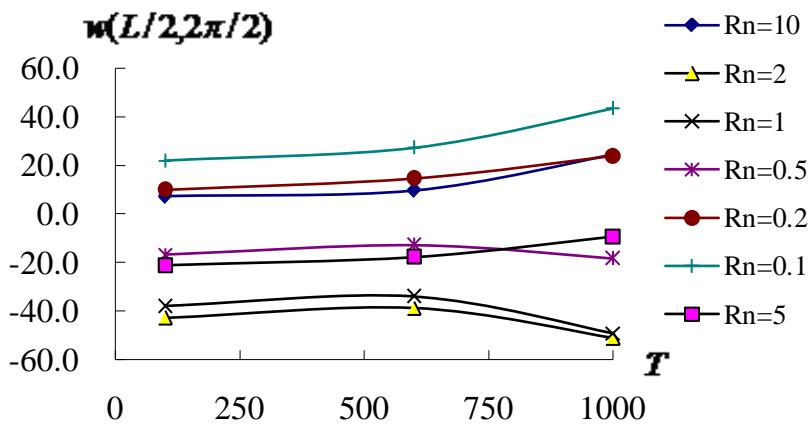 Fig. 4a: $w(L / 2,2\pi / 2)$ versus $T$ for $L / h^{*} = 5$ with $R_{n}$ from 0.1 to 10
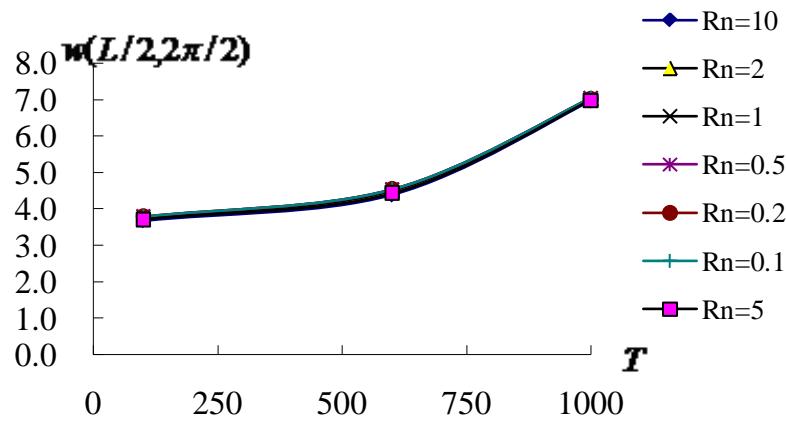 Fig. 4b: $w(L / 2,2\pi / 2)$ versus $T$ for $L / h^* = 10$ with $R_n$ from 0.1 to 10
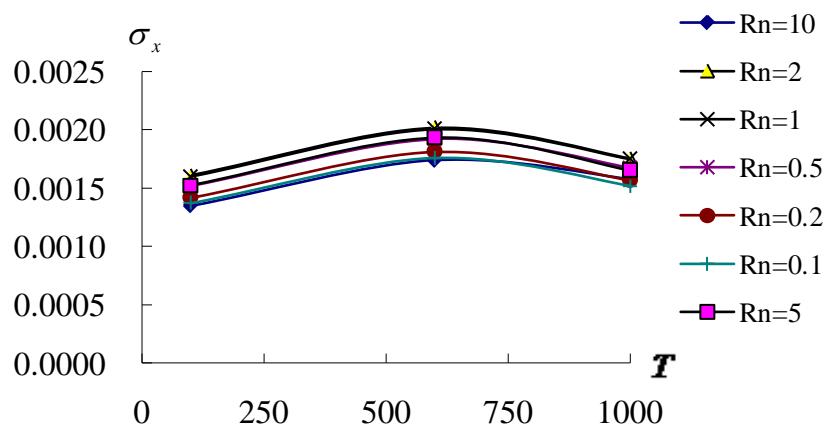 Fig. 4: $w(L / 2,2\pi / 2)$ (mm) versus $T(\mathrm{K})$ for $L / h^{*} = 5$ and 10 Fig. 5a: $\sigma_{x}$ versus $T$ for $L / h^{*} = 5$
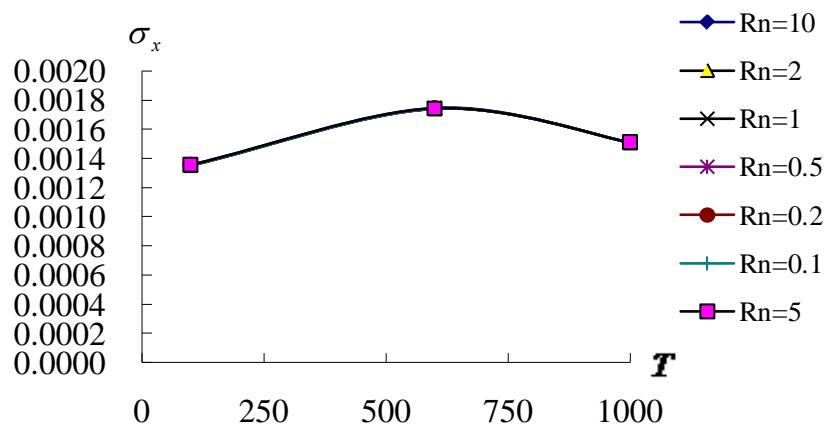 Fig. 5b: $\sigma_{x}$ versus $T$ for $L / h^{*} = 10$ Fig. 5: $\sigma_{x}(\mathrm{GPa})$ versus $T(\mathsf{K})$ for $L / h^{*} = 5$ and 10
Table 1: Compared values of $\Omega$ and ${f}^{ * }$ for SUS304/Si ${}_{3}{\mathrm{\;N}}_{4}$
<table><tr><td rowspan="2">c1(1/mm2)</td><td rowspan="2">h* (mm)</td><td colspan="2">Ω</td><td colspan="2">f*</td></tr><tr><td>Present method, T=700K Rn=1</td><td>Chen et al. 2017, type A, 1-8-1 Rn=1 [28]</td><td>Present method, T=300K, Rn=0.5</td><td>Sepiani et al. 2010, silicon nitride-nickel [9]</td></tr><tr><td>0.925925</td><td>1.2</td><td>1.906986</td><td>1.65127</td><td>0.517127</td><td>-</td></tr><tr><td>0.333333</td><td>2</td><td>11.14739</td><td>-</td><td>5.041756</td><td>5.10</td></tr><tr><td>0.000033</td><td>200</td><td>17704.31</td><td>-</td><td>800796.6</td><td>-</td></tr><tr><td>0.000014</td><td>300</td><td>3771.748</td><td>-</td><td>253980.0</td><td>-</td></tr></table>
Table 2: Dynamic convergence of the nonlinear TSDT FGM thick circular cylindrical shells
<table><tr><td rowspan="2">C1(1/mm2)</td><td rowspan="2">L/h*</td><td>GDQ grids</td><td colspan="3">w(L/2,2π/2) (mm) at t = 6s</td></tr><tr><td>N × M</td><td>Rn= 0.5</td><td>Rn= 1</td><td>Rn= 2</td></tr><tr><td rowspan="8">0.925925</td><td rowspan="3">10</td><td>7 × 7</td><td>5.093878</td><td>5.113268</td><td>5.162740</td></tr><tr><td>9 × 9</td><td>5.086901</td><td>5.107157</td><td>5.157094</td></tr><tr><td>11 × 11</td><td>5.086960</td><td>5.107170</td><td>5.157115</td></tr><tr><td rowspan="5">5</td><td>13 × 13</td><td>5.086899</td><td>5.107180</td><td>5.157098</td></tr><tr><td>7 × 7</td><td>0.591193</td><td>0.595686</td><td>0.615068</td></tr><tr><td>9 × 9</td><td>0.589491</td><td>0.594395</td><td>0.614112</td></tr><tr><td>11 × 11</td><td>0.589487</td><td>0.594404</td><td>0.614114</td></tr><tr><td>13 × 13</td><td>0.589495</td><td>0.594400</td><td>0.614107</td></tr><tr><td rowspan="8">0</td><td rowspan="3">10</td><td>7 × 7</td><td>23.807663</td><td>20.502832</td><td>21.591730</td></tr><tr><td>9 × 9</td><td>3.210114</td><td>3.212350</td><td>3.193146</td></tr><tr><td>11 × 11</td><td>3.216680</td><td>3.219491</td><td>3.210730</td></tr><tr><td rowspan="5">5</td><td>13 × 13</td><td>3.213940</td><td>3.215927</td><td>3.197326</td></tr><tr><td>7 × 7</td><td>0.524448</td><td>0.621863</td><td>0.832298</td></tr><tr><td>9 × 9</td><td>0.505710</td><td>0.599383</td><td>0.798741</td></tr><tr><td>11 × 11</td><td>0.505719</td><td>0.599400</td><td>0.798779</td></tr><tr><td>13 × 13</td><td>0.505719</td><td>0.599401</td><td>0.798781</td></tr></table>

Generating HTML Viewer...
References
26 Cites in Article
P Cong,N Khanh,N Khoa,N Duc (2018). New approach to investigate nonlinear dynamic response of sandwich auxetic double curves shallow shells using TSDT.
B Sobhaniaragh,M Nejati,W Mansur (2017). Buckling modelling of ring and stringer stiffened cylindrical shells aggregated by graded CNTs.
D Dung,Pham Vuong (2016). Analytical investigation on buckling and postbuckling of FGM toroidal shell segment surrounded by elastic foundation in thermal environment and under external pressure using TSDT.
Hong-Liang Dai,Yan-Ni Rao,Ting Dai (2016). A review of recent researches on FGM cylindrical structures under coupled physical interactions, 2000–2015.
N Fantuzzi,S Brischetto,F Tornabene,E Viola (2016). 2D and 3D shell models for the free vibration investigation of functionally graded cylindrical and spherical panels.
Vishesh Kar,Subrata Panda (2016). Nonlinear thermomechanical deformation behaviour of P-FGM shallow spherical shell panel.
H Kurtaran (2015). Geometrically nonlinear transient analysis of moderately thick laminated composite shallow shells with generalized differential quadrature method.
E Viola,L Rossetti,N Fantuzzi (2012). Numerical investigation of functionally graded cylindrical shells and panels using the generalized unconstrained third order theory coupled with the stress recovery.
H Sepiani,A Rastgoo,F Ebrahimi,A Ghorbanpour Arani (2010). Vibration and buckling analysis of two-layered functionally graded cylindrical shell, considering the effects of transverse shear and rotary inertia.
C Hong (2017). Varied effects of shear correction on thermal vibration of Functionally Graded Material plates.
Chih Hong (2017). Effects of Varied Shear Correction on the Thermal Vibration of Functionally-Graded Material Shells in an Unsteady Supersonic Flow.
C Hong (2017). Thermal Vibration of Magnetostrictive Material in Laminated Plates by the GDQ Method.
C Hong (2016). Thermal vibration of magnetostrictive functionally graded material shells by considering the varied effects of shear correction coefficient.
C Hong (2016). Transient response of functionally graded material circular cylindrical shells with magnetostrictive layer.
C Hong (2016). Rapid heating-induced vibration of composite magnetostrictive shells.
C Hong (2015). Rapid heating induced vibration of circular cylindrical shells with magnetostrictive functionally graded material.
C Hong (2014). Thermal vibration and transient response of magnetostrictive functionally graded material plates.
C Hong (2014). Rapid heating induced vibration of circular cylindrical shells with magnetostrictive functionally graded material.
Shyang-Ho Chi,Yen-Ling Chung (2006). Mechanical behavior of functionally graded material plates under transverse load—Part I: Analysis.
S Lee,J Reddy,F Rostam-Abadi (2004). Transient analysis of laminated composite plates with embedded smart-material layers.
S Lee,J Reddy (2005). Non-linear response of laminated composite plates under thermomechanical loading.
James Whitney (1987). General Laminated Plates.
J Reddy (2002). Related Variational and Energy Principles.
C Hong (2014). Thermal vibration of magnetostrictive functionally graded material shells by considering the varied effects of shear correction coefficient.
C Hong (2007). Thermal Vibration of Magnetostrictive Material in Laminated Plates by the GDQ Method.
Ch. Bert,S Jang,A Striz (1989). Nonlinear bending analysis of orthotropic rectangular plates by the method of differential quadrature.
No ethics committee approval was required for this article type.
Data Availability
Not applicable for this article.
How to Cite This Article
C.C. Hong. 2026. \u201cThermal Vibration of Thick FGM Circular Cylindrical Shells by Using Fully Homogeneous Equation and TSDT\u201d. Global Journal of Research in Engineering - A : Mechanical & Mechanics GJRE-A Volume 24 (GJRE Volume 24 Issue A2): .
Explore published articles in an immersive Augmented Reality environment. Our platform converts research papers into interactive 3D books, allowing readers to view and interact with content using AR and VR compatible devices.
Your published article is automatically converted into a realistic 3D book. Flip through pages and read research papers in a more engaging and interactive format.
The third-order shear deformation theory (TSDT) effects on functionally graded material (FGM) thick circular cylindrical shells with entirely homogeneous equation under thermal vibration were investigated by using the generalized differential quadrature (GDQ) method. The nonlinear coefficient term of displacement field of TSDT was used in the equations of motion for thermal vibration of FGM thick circular cylindrical shells. Parametric effects of environment temperature and FGM power law index on the thermal stress and centre deflection of FGM thick circular cylindrical shells were investigated.
Our website is actively being updated, and changes may occur frequently. Please clear your browser cache if needed. For feedback or error reporting, please email [email protected]
Thank you for connecting with us. We will respond to you shortly.