
I. INTRODUCTION
Currently a large amount of experimental data has been accumulated, indicating the efficiency of physical fields of various nature uses in the physical and chemical processes implementation in an aqueous medium. It is assumed that the effect of magnetic, electric and electromagnetic fields of different frequency ranges leads to a reorganization of the water structure and, as a consequence, to a change in the nature and strength of its interaction with molecules or ions of the solute . The optical, electrical, rheological and other properties of aqueous solutions, the rate of chemical reactions in it change as a result .
Water is very sensitive to the influence of an electromagnetic field (EMF) of ultra-high frequencies (30 – 300 MHz). An increase in its surface tension and heat of evaporation, a decrease in the rate of evaporation, and deterioration of the wetting ability have been determined as a result of the field action, which indicates an increase in intermolecular force in an aqueous medium [10–12]. The main factors determining the efficiency of field action are the EMF frequency and the time of its action [11]. It means that we can talk about the selectivity of the EMF effect on the water system, because the effects are revealed either only in its specific frequencies, or at certain frequencies expressed to the maximum extent. The frequencies corresponding to the maximum change in the property depend on the nature of the substance dissolved in the aqueous medium [13 – 16]. An increase in the action time leads to a gradual increase in the property up to a certain limit. Water and polymer solutions retain their changed properties throughout the observation period (more than six months), and electrolyte solutions gradually return to their initial state after the termination of the field action [10].
The modern theory of solutions of high molecular weight compounds considers the polymers swelling and dissolution as a mixing liquids process . Being dissolved, polymers molecules of a low molecular weight liquid penetrate into the polymer immersed in it. This is possible because chain high molecular mass compound molecules are flexible: their bonds, bending, create a poor packing of macromolecules. The liquid absorbed at the first stage of swelling has been used for salvation of the polymer polar groups.
The heat of swelling Q (the total amount of heat released during the swelling of 1 g of dry polymer) is the sum of the following values
where is the heat corresponding to the work of separation of macromolecules ( ); heat corresponding to the separation of solvent molecules ( ); is the heat released as a result of the interaction of the solvent and polymer molecules ( is solvation) [19].
An increase in intermolecular force in an aqueous medium due to the electromagnetic field influence should lead to an increase in and a decrease in , as a result of which a decrease in the total thermal effect of swelling can be observed. In addition, it is possible to slow down the diffusion of solvent molecules into the bulk of the polymer. This hypothesis can be confirmed by a change in the rate and degree of swelling, as well as the process heat effect.
The main task of this work was to determine the rate and degree of gelatin swelling at various values of the medium acidity, to determine the value of the isoelectric point (IEP), as well as the degree and heat of gelatin swelling in water exposed to EMF of various frequencies.
The object of research was gelatin – a protein material, a polydisperse mixture of proteins. Due to the presence of ionogenic groups, gelatin swells limitedly in cold water and unlimitedly –in hot water. Gelatin is used for preparation of hard and soft capsules, in the production of plasma substitute solutions, for preparation of hemostatic wound dressings in the pharmaceutical industry.
a) Experimental
Deionized water, purified by using membrane distillation DME-1/B (Russia) has been used for the experiments. The specific conductivity of the water was . The required pH values were obtained by adding HCl solution (chemically pure).
The source of the electromagnetic field was a high-frequency signal generator (Russia) with a frequency in the range of and an output power of 1 Watt. A capacitive cell was used to expose water with EM field. The voltage on the high-frequency electrodes was . The water irradiation lasted 3 hours. As shown by previous studies, water exposed to EMF retains its changed properties for a long time – up to a year or more. Therefore, the timing of subsequent experiments could not affect the results obtained.
We used powdered (particle size is less than or equivalent to 0.25 mm.) edible gelatin produced by JSC MOZhELIT (Belarus) with a moisture content of no more than 16%. Before the experiment, the gelatin powder was dried to constant mass.
A quantitative determination of swelling is the degree of swelling , equals to
where V and are the volumes of the swollen and initial polymer.
In the case of limited swelling, the degree of swelling reaches the limiting value [7].
Since the rate of swelling is determined by the rate of solvent molecules diffusion into the polymer, then the swelling process can be considered as a reaction of the first order in the simplest case, and the rate constant of the process is usually calculated using the equation
Swelling kinetics was studied by measuring the volume of swollen polymer every 5 minutes.
100 ml of activated or non-activated water was poured into a porcelain beaker and placed in a calorimeter, a test tube containing 4 g of powdered gelatin was placed there too to determine the heat of swelling. A Beckmann thermometer (temperature variation accuracy is ) and a stirrer were placed in the beaker with water. The temperature of the calorimetric system was measured for 15 min with continuous stirring. After reaching stable temperature, a sample weight of gelatin was poured from the test tube into a glass with water and the temperature change was recorded every minute for 15 – 20 minutes. The heat of swelling of the polymer per 1 g was calculated by the values of . The calorimeter constant was determined from the heat of KCl dissolution. All experiments were carried out 3 times.
II. RESULTS AND DISCUSSION
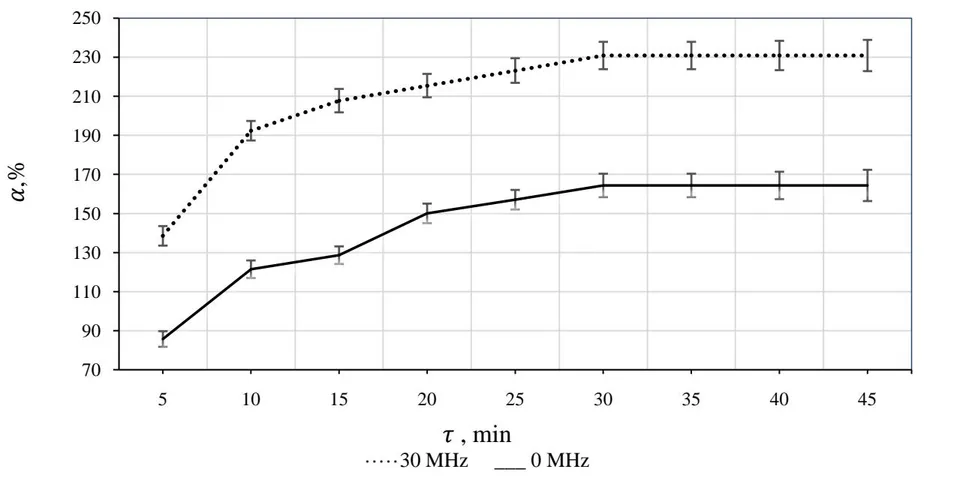
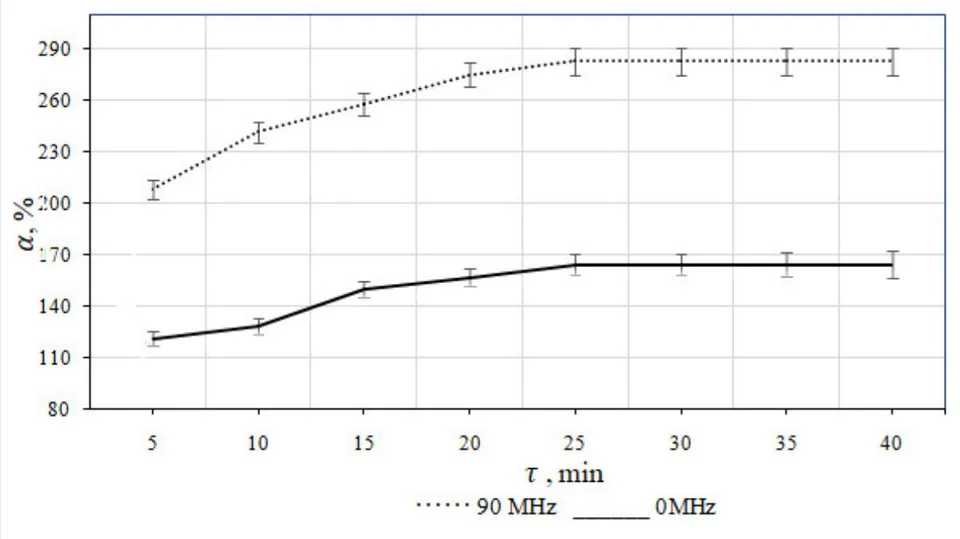
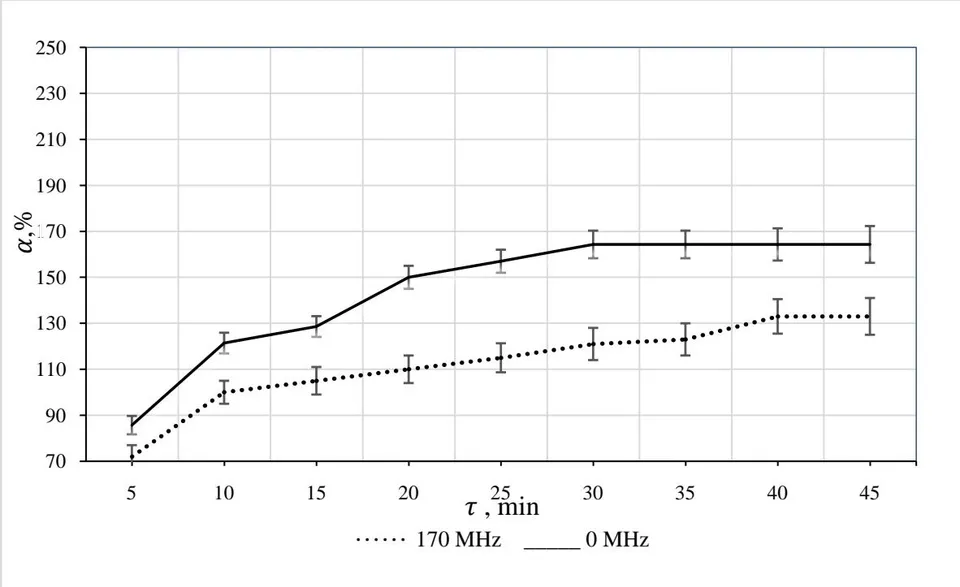
The change in the degree of swelling of gelatin ( ) in water exposed to the electromagnetic field of ultrahigh frequencies in the range of 30 – 190 MHz was established. Both its increase, most pronounced for water irradiated by a field of 30 and 90 MHz, and a decrease, for frequencies of 110, 150 and 170 MHz (pH = 6.3) are observed. The increase in the degree of swelling amounted to a maximum 67 – 119%, the decrease – 31 – 49% in absolute units. The rate of the process changes respectively, as evidenced by the calculated swelling rate constants (k) of gelatin (Table 1). The rate constants increase to varying degrees depending on the field frequency; however, there is no clear correlation between the degree and rate of swelling. Figure 1 shows the kinetic curves of the gelatin swelling in water exposed to EMF with frequencies of 30 and 90 and 170 MHz.
| f, MHz | ,% | ,% | k, min | t, min | |
| 0 | 164±6 | - | 1.00 | 0.14 | 30 |
| 30 | 231±6 | 67 | 1.40 | 0.19 | 30 |
| 50 | 193±5 | 29 | 1.20 | 0.15 | 30 |
| 70 | 193±8 | 29 | 1.20 | 0.15 | 35 |
| 90 | 283±6 | 119 | 1.70 | 0.16 | 30 |
| 110 | 146±4 | -20 | 0.89 | 0.18 | 30 |
| 130 | 177±5 | 13 | 1.10 | 0.16 | 30 |
| 150 | 115±2 | -49 | 0.70 | 0.22 | 20 |
| 170 | 133±3 | -31 | 0.81 | 0.19 | 25 |
| 190 | 140±6 | -24 | 1.10 | 0,18 | 30 |
Swelling is accompanied by the heat release, which is revealed in a temperature increase when dry gelatin is mixed with water. Calorimetric measurements showed that when gelatin swells in water exposed to EMF, the value of the thermal effect of this process decreases. The most significant decrease in the swelling heat is observed when using water exposed to EMF of 70 MHz frequency – by a maximum of 23%. When using water exposed to EMF of 190 MHz frequency, the swelling heat increases sharply – by 77.8% (table 2).
| f, MHz | 0 | 30 | 50 | 70 | 90 |
| 0.23±0.01 | 0.19±0.01 | 0.24±0.03 | 0.17±0.02 | 0.20±0.01 | |
| Q, J/g | 96±4 | 81±3 | 98±5 | 75±2 | 85±3 |
| ΔQ,% | - | -16 | 2,8 | -23 | -11 |
| f, MHz | 110 | 130 | 150 | 170 | 190 |
| Δt, °C | 0.20±0.02 | 0.21±0.03 | 0.19±0.02 | 0.22±0.02 | 0.40±0.06 |
| Q, J/g | 85±3 | 89±4 | 81±3 | 94±4 | 170±9 |
| ΔQ,% | -11.0 | -6.7 | -16.0 | -2.2 | 78.0 |
| – temperature change during swelling of 4 g of gelatin in 100 g of water | |||||
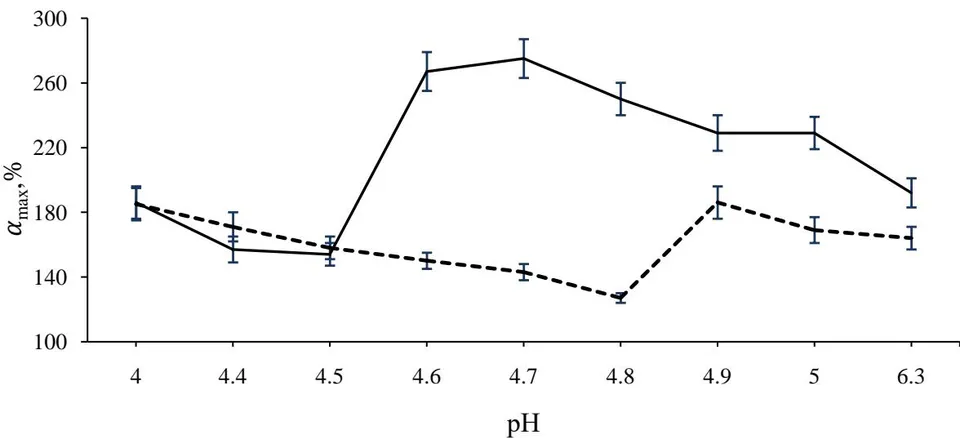
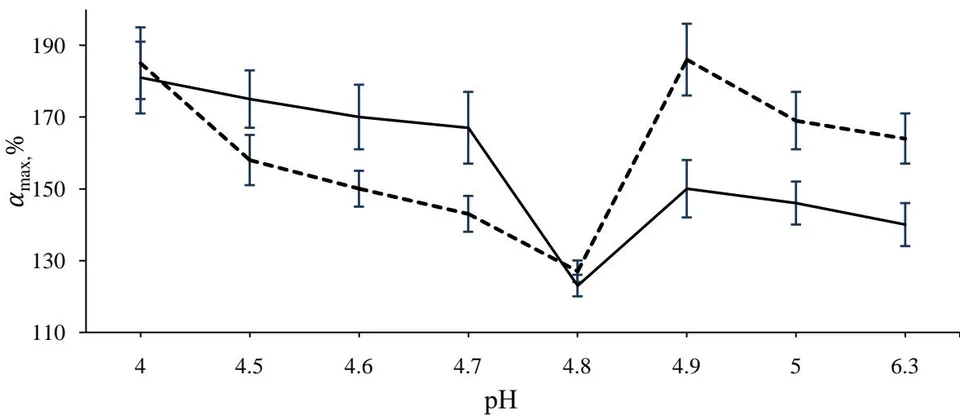
The swelling parameters for substances of protein nature depend on the pH of the medium, since the charge characteristics of macromolecules change when the pH changes. They are negatively charged in an alkaline medium, and they are positively charged in an acidic medium. The total charge of a protein molecule is zero in IEP. Having chosen two frequencies corresponding to the maximum decrease and maximum increase in the heat of gelatin swelling, we studied the parameters of polymer swelling depending on the pH of the medium. Table 3 shows the values of the maximum degree and rate constants of gelatin swelling at different pH values of non-activated and activated(70 and 190 MHz) water.
| pH | 4.0 | 4.4 | 4.5 | 4.6 | 4.7 | 4.8 | 4.9 | 5.0 | 6.3 |
| f = 0 MHz | |||||||||
| ,% | 185±10 | 171±9 | 158±7 | 150±5 | 143±5 | 127±3 | 186±10 | 169±8 | 164±7 |
| k, s-1 | 0.30 | 0.32 | 0.32 | 0.30 | 0.27 | 0.21 | 0.21 | 0.18 | 0.14 |
| f = 70 MHz | |||||||||
| ,% | 184±9 | 157±8 | 154±7 | 267±9 | 275±8 | 250±9 | 229±11 | 229±9 | 193±9 |
| k, s-1 | 0.28 | 0.28 | 0.20 | 0.21 | 0.24 | 0.26 | 0.26 | 0.26 | 0.21 |
| f = 190 MHz | |||||||||
| ,% | 181±10 | 178±7 | 175±8 | 170±9 | 167±10 | 123±3 | 150±8 | 146±6 | 140±6 |
| k, s-1 | 0.35 | 0.37 | 0.44 | 0.52 | 0.24 | 0.31 | 0.28 | 0.40 | 0.33 |
We observe a shift of IEP to the acidic region in water exposed by a field of 70 MHz, – a minimum of the degree of swelling is observed at pH = 4.5, while IEP corresponds to pH = 4.8in non-activated water. At the same time, the degree and rate of gelatin swelling is lower for pH <IEP values in comparison with non-activated water, and it is higher at pH> IEP. The maximum difference corresponds to pH = 4.7 and amounts to 132% in absolute units. IEP does not shift at a frequency of 190 MHz, the degree of swelling exceeds at pH <IEP, and lower values are observed at pH>
IEP. The results obtained indicate a change in the charge characteristics of macroions in activated water.
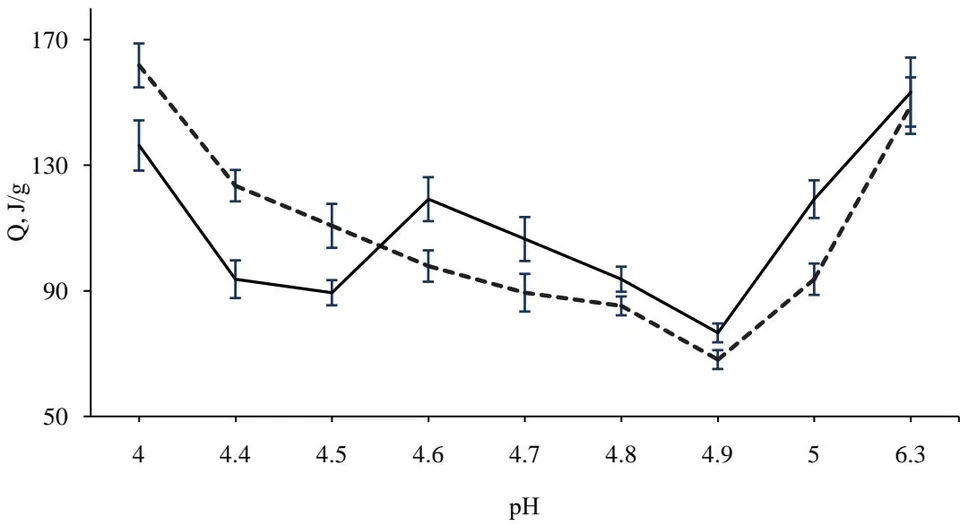
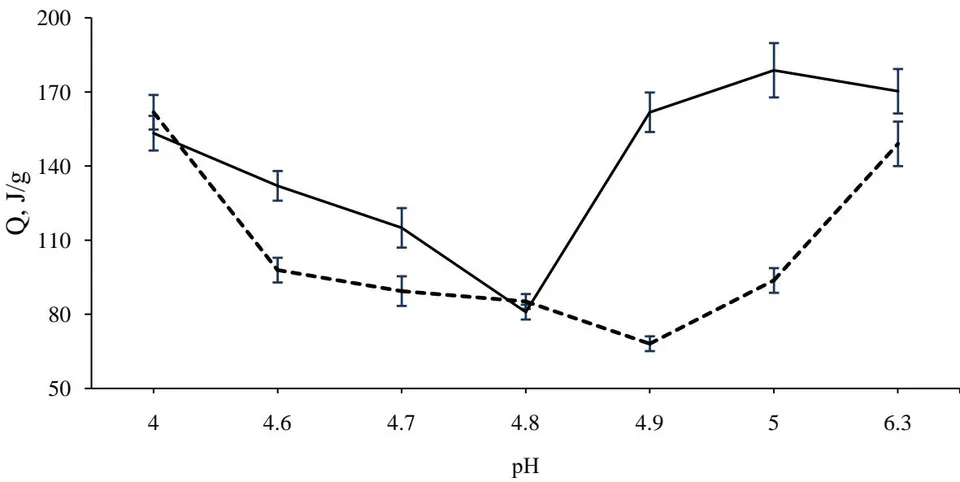
It was shown that the heat of gelatin swelling also significantly depends on pH. Figures 4 and 5 show the corresponding dependences. The minimum of specific swelling heat corresponds to pH = 4.9 for non-activated water. Two minima are observed on the curve – at pH 4.5 and 4.9 at a frequency of 70 MHz. In this case, the swelling heat of the polymer is lower in comparison with non-activated water (the degree of swelling in this range is also lower) in the range of pH = 4.0 – 4.5, and it is higher at pH > 4.5. The minimum value of Q is observed at pH = 4.8 at a frequency of 190 MHz, i.e. as well as for the degree of swelling. The heat of gelatin swelling is higher (except for pH = 4.8) in almost the total pH range in activated water (190 MHz). The maximum differences in Q values are achieved at pH = 4.9 and 5.0, reaching 93 and 84%, respectively.
Based on the hypothesis of the strengthening of the supra molecular structure of water as a result of electromagnetic effect, it can be concluded that intermolecular forces strengthen in an aqueous medium (the value of increases) in exposed water (with the exception of the 190 MHz frequency), and the solvation of proteins macroions composing gelatin (the value decreases) weakens. As a result, the specific heat of gelatin swelling decreases. It is obvious that the reverse processes occur at a frequency of 190 MHz. It was shown earlier [20] that during the general decrease in the heat of wetting of powdered with water irradiated by a field of different frequencies, its increase is observed for frequencies of 150 and 190 MHz, which also indicates the destruction of the structure of the aqueous medium.
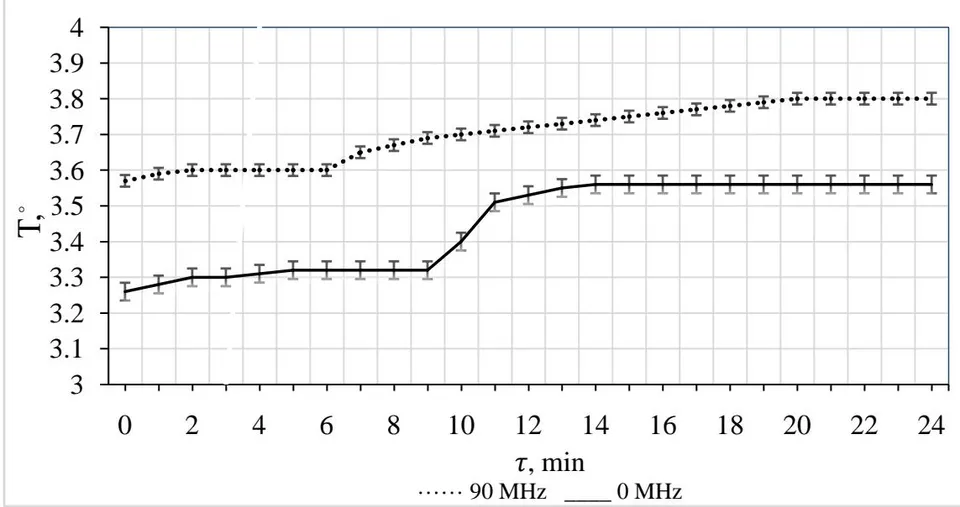
An increase in the degree and rate constant of the gelatin swelling in activated water would seem to contradict the hypothesis of a decrease in the mobility of water molecules due to an increase in intermolecular forces and a decrease in its ability to solvation. However, it is known that the solvation of the polar proteins groups composing gelatin leads to an increase in the rigidity of the chain molecules, which decreases the mobility of the polymer chain regions, hinders the penetration of the solvent among them, and slows down the swelling. Therefore, the gelatin swelling in activated water, due to the lower rigidity of the polymer chains, proceeds faster and is accompanied by higher values of the limiting degree of swelling. At the same time, it should be noted that the process of polymer swelling consists of two stages . The first stage is the diffusion of the solvent into the polymer and the solvation of the polymer molecules. In this case, the swelling heat is released. The second stage is characterized by an almost complete cessation of heat release, but entropy increases, since the loosening of the spatial polymer network and the associated partial release of macromolecules increases the number of configurations. Thus, the second stage of swelling is due to the entropy effect. It is at this stage that the main increase in the volume and mass of the polymer occurs. Based on this, we can talk about the effect of water irradiation with an electromagnetic field on both stages of the swelling process – there is a decrease in the solvation of macromolecules by activated water (decrease in Q) at the first stage, an increase in the degree of gelatin swelling due to an increase in the mobility of less solvated molecules at the second stage. When determining the rate constant, the total swelling effect is recorded. At the same time, it can be argued that the first stage of the process in activated water proceeds much slower, as evidenced by the curves of the dependence of the temperature change during the gelatin swelling on time during calorimetric measurements (Figure 6). The first section of the curve corresponds to the change in the temperature of the calorimetric system over time, the second - to the change in temperature when gelatin swells. Heat is released within 5 minutes in non-activated water, and 15 minutes in activated water. The same occurs at other frequencies, including 190 MHz.
A shift of IEP in activated water and a significant change in the thermal effect depending on pH indicate a change in the degree of ionization of protein molecules ionogenic groups, which affects the forces of their mutual repulsion or attraction and, as a consequence, the swelling degree. Moreover, gelatin is not an individual polymer, but a mixture of proteins. The electromagnetic field can affect the charge magnitude of individual protein macromolecules to a different extent, which complicates the correlation of data by the degree, rate, and heat of swelling. Nevertheless, it can be stated that the electromagnetic treatment of water significantly affects both the kinetic and thermodynamic parameters of swelling – i.e., using water exposed to an electromagnetic field at ultrahigh frequencies as a solvent; it is possible to control the polymers swelling, which is a process task in many industries.