
1. Introduction
A company can outsource forecasting and replenishment calculations while keeping the right to approve plans, release purchase orders and own inventory. Another company can use the same provider and software but allow the provider to make routine decisions and own the stock. Calling both arrangements “outsourced planning” hides differences in control, cost and responsibility.
The paper contributes a common description of planning arrangements, an explanation of four coordination gaps and five conditional propositions. Together, these show how specific choices about authority, ownership and information can explain differences hidden by broad outsourcing labels.
The research question is: How can third-party demand, inventory and supply planning arrangements be classified and explained when planning work, decision rights, inventory ownership, information and execution are assigned separately? The paper answers this question by distinguishing these choices and explaining the mechanisms that connect them.
2. Conceptual approach and scope
2.1. Research design
The paper combines conceptual synthesis with the development of a typology. Synthesis brings together ideas about collaboration, ownership and governance; the typology distinguishes the arrangements created by combining those ideas. Jaakkola (2020) argues that conceptual research needs an explicit design, a justified choice of concepts and a clear line of reasoning. This paper follows that approach by showing how each literature stream informs a design choice and how comparisons between choices drive the propositions.
2.2. How the framework is developed
The analysis uses four steps. First, it separates activities that are often grouped together: preparing a recommendation, approving it, making a commitment and carrying out the resulting transaction. Second, it maps concepts from the selected research to distinct choices about work, authority, ownership, information and execution. Third, it combines those choices into reference arrangements while keeping supplier ownership, customer ownership and independent provider ownership distinguishable. Fourth, it compares arrangements that differ in one choice to identify a mechanism and a condition under which that mechanism matters.
For example, comparing customer-owned stock with provider-owned stock does not isolate the effect of ownership if approval rights, fees and buyback obligations also change. The framework therefore treats these as separate features. The same reasoning is used to distinguish quicker data exchange from quicker approval. These are logical comparisons of possible arrangements, not observed company cases or numerical experiments.
2.3. Unit of analysis and boundaries
The unit of analysis is a planning arrangement for a defined group of materials and locations over an agreed planning horizon. The customer is the organization receiving the service. The provider may be a supplier, distributor, planning specialist, logistics firm, joint venture or lead firm coordinating others. A single company may have several arrangements at once.
The focus is purchased materials and goods for which demand, stock and supply decisions can be assigned across organizations. Detailed accounting treatment, tax rules, contract enforceability and sector-specific restrictions are outside the model. The framework describes possible roles; it does not imply that every combination is feasible in every business.
3. Literature foundation and the conceptual problem
3.1. Replenishment responsibility and inventory ownership
Vendor-managed inventory (VMI) research concerns the allocation of replenishment responsibility and the information needed to support it. Reviews by Govindan (2013) and Marquès et al. (2010) provide a basis for distinguishing the process from its label. Consignment concerns retained supplier ownership until an agreed transfer event. Gümüş et al. (2008) analyze consignment and VMI together, supporting their treatment as separable choices. The implication here is to clearly identify the planner, the inventory owner, and the party responsible for the loss.
3.2. Collaboration and information exchange
Collaborative planning, forecasting and replenishment (CPFR) brings joint planning, forecasting and replenishment into the discussion (Panahifar et al., 2015). Sari (2008) compares CPFR and VMI through simulation, illustrating that collaboration mechanisms can be compared under stated assumptions. Neither label alone specifies every approval or ownership right. Jung et al. (2008) address decentralized planning with limited information sharing, while Kaipia et al. (2017) examine information sharing in the context of sales and operations planning. Together, these streams motivate attention to what information a decision needs and how the parties coordinate its use.
3.3. Systems and governance
Prajogo and Olhager (2012) examine relationships among information technology, information sharing and logistics integration. Liu et al. (2016) address the fit between integration and IT capability. These studies motivate treating a technical connection and an organizational planning arrangement as related but distinct. A connected system provides a route for data; authority and incentives determine how that data can be used.
Huo et al. (2018) bring a transaction cost perspective to third-party logistics (3PL) relationships. Their findings distinguish demand, supply and technology uncertainty and also distinguish user-specific from provider-specific assets. This cautions against assuming that all uncertainty or relationship investment has the same governance effect. Fulconis and Paché (2018) discuss lead providers and fourth-party logistics (4PL) orchestration, adding the question of how responsibility is distributed across several providers.
Table 1. The role of the selected literature streams
| Research stream | Use in this framework |
|---|---|
| VMI and consignment | Separate replenishment authority from inventory ownership. |
| CPFR and decentralized planning | Identify shared decisions and coordination across organizational boundaries. |
| Information sharing and integration | Separate data access, update delay and decision authority. |
| Outsourcing governance and orchestration | Explain incentives, dependence and responsibility across providers. |
The proposed contribution is a synthesis at the level of the individual planning decision. It does not claim that earlier studies ignored ownership or governance. It asks how their distinctions can be combined to explain why two arrangements with the same outsourcing label can behave differently.
4. Research Contributions
The contribution here is to bring established ideas into a framework that describes and explains third-party planning at the level of a specific decision. The framework adds value through the way its elements are combined and connected. It makes three contributions.
4.1. A common description of alternative arrangements
We combine planning scope, decision rights, inventory ownership, financial exposure, systems, information and execution in one description. Existing concepts such as VMI, consignment and CPFR provide important starting points, as discussed in Section 3. The framework in this paper uses their distinctions to compare arrangements across demand, inventory and supply planning, including partial outsourcing and combinations that do not fit a single provider label.
Separating the preparation of a recommendation from approval, commitment and execution makes that comparison more precise. Two firms can outsource the same planning calculations while assigning different approval rights. The framework records that difference explicitly. Tables 2 to 6 provide the dimensions and reference arrangements needed for this comparison; they do not claim to list every possible contract.
4.2. An explanation of gaps between assigned roles
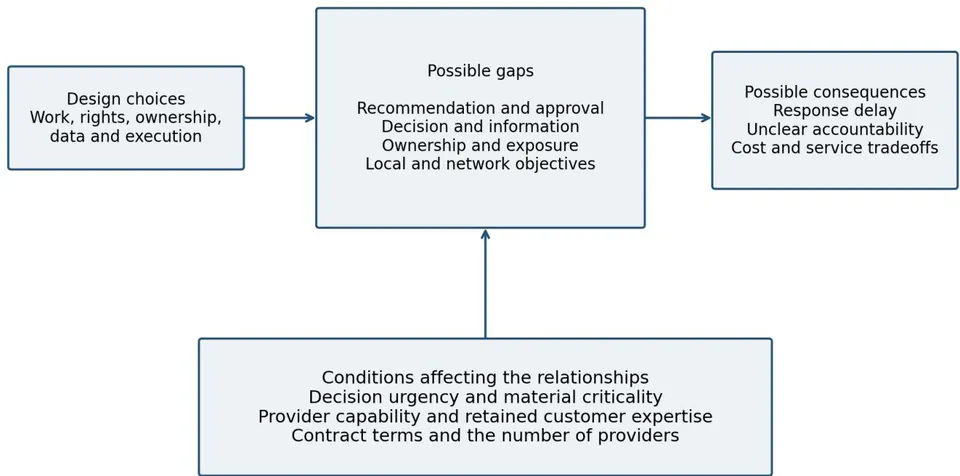
We connect the design choices to four possible gaps: recommendations without timely approval, decision authority without sufficient information, ownership without corresponding financial exposure, and local targets without a way to resolve network conflicts. Figure 1 brings these relationships together. This moves the analysis beyond describing who performs each task to explaining why an arrangement may encounter delay or unclear accountability.
For example, frequent system updates may leave response time unchanged if orders still wait for approval. Provider ownership may also leave some inventory risk with the customer when purchase guarantees apply. These examples illustrate the proposed mechanisms; they are not evidence of measured effects.
4.3. Conditional propositions for comparing models
We derive five propositions that state when approval authority, information exchange, financial exposure, coordination and retained expertise are expected to matter. Each proposition identifies a mechanism and limits its claim to stated conditions. This gives later research specific relationships to examine and helps readers avoid treating greater outsourcing or integration as automatically preferable.
Together, these contributions offer a basis for comparing arrangements that differ in one design choice while holding others constant in the analysis. The claim in this paper is an explanatory synthesis of the selected literature. Establishing whether the framework is unique across the wider literature, or whether its propositions hold in practice, requires further work.
5. Defining the planning arrangement
An arrangement is described by the nine choices in Table 2. Planning scope defines what work is included. Decision rights define who can act. Inventory ownership and financial exposure distinguish legal title from the consequences of errors or unused stock. The remaining choices describe where information and execution sit.
Table 2. The choices used to describe an operating model
| Choice | Main options |
|---|---|
| Planning work | Demand planning, inventory planning, supply planning or any combination. |
| Decision rights | Customer decides; provider advises; both agree; provider decides within limits; or provider has broader authority. |
| Inventory ownership | Customer, supplier or another provider owns the stock. Ownership can differ by stock group or change at an agreed event. |
| Cost and risk | Agree who funds stock and pays for excess, obsolete stock, shortages or price changes. |
| Planning system | Customer system, provider system, shared system or several specialist systems. |
| Data sharing | Manual updates, portal access, automated files, API or EDI connections, shared access or a mix. |
| Available information | Orders only, or also stock, usage, forecasts, exceptions, supply limits and wider network data. Update frequency can vary. |
| Physical and buying work | Customer, planning provider or other firms buy, receive, store, move and deliver goods. |
| Provider setup | One provider, suppliers by product group, a joint venture or a lead firm coordinating specialists. |
5.1. Decision rights within each planning function
Four rights need separate attention: recommend, approve, commit and execute.
Recommending creates a proposed plan. Approval accepts the plan or an exception.
Commitment releases a purchase order or another binding supply instruction. Execution carries out the order, receipt, storage or delivery. A provider may hold any subset of these rights. Joint approval also needs a rule for resolving disagreement; otherwise, responsibility can be shared without a clear way to reach a decision.
5.2. Ownership and exposure
Title means legal ownership. Custody means physically holding the goods. Exposure means bearing a particular cost or loss, such as funding inventory, writing off obsolete stock or paying for shortages. These roles can differ. Provider ownership with a customer buyback commitment can leave the customer exposed to unused stock. Customer ownership with provider liability for specified errors can shift some exposure in the other direction.
6. Scope of outsourced planning
Demand planning estimates future need. Inventory planning sets stock targets, locations and reorder policies. Supply planning works out how to meet requirements given suppliers, lead times, capacity and order constraints. These functions affect each other: a supply shortage can change priorities, while a higher service target can change stock needs.
At the scope level, each function can remain in-house or include an outside role. Table 3 lists all eight combinations of those binary choices. Within each outside role, authority can still be advisory, joint or delegated. The table is exhaustive only for this defined scope distinction, not for every possible operating model.
Table 3. All combinations of outside involvement across the three planning functions
| Planning option | Outside planning role | Main benefit and drawback |
|---|---|---|
| All in-house | None | Keeps knowledge and control inside the company, but needs an internal planning team. |
| Demand only | Demand planning | Adds forecasting skills, but the provider needs business context and must pass plans to internal teams. |
| Inventory only | Inventory planning | Adds stock planning skills, but demand estimates and supply limits are set elsewhere. |
| Supply only | Supply planning | Adds supplier or capacity planning skills, but depends on demand plans and stock policies from others. |
| Demand and inventory | Demand and inventory planning | Links forecasts to stock targets, but buying and capacity plans still need coordination with others. |
| Demand and supply | Demand and supply planning | Links expected need to available supply, but a separate inventory policy may limit the plan. |
| Inventory and supply | Inventory and supply planning | Links stock targets to replenishment while the customer can keep demand planning. |
| All three | Demand, inventory and supply planning | Allows one view of the plans, but increases reliance on the provider and the need for customer oversight. |
Splitting work creates a boundary across which assumptions must move. Outsourcing demand and supply while keeping inventory planning internal, for example, can leave the provider working within stock rules it does not control. This can be useful when the customer wishes to retain service policy. It can also lead to repeated plan revisions when the stock rules and supply constraints do not fit. The relevant issue is the handling of the boundary, not whether the split is inherently good or bad.
7. Inventory ownership and system arrangements
The four core combinations are connected systems with customer-owned stock, connected systems with provider-owned stock, a provider system without an automated connection and customer-owned stock, and the same system arrangement with provider-owned stock. Table 4 extends this comparison to other system options. Approval rights remain a separate choice in every cell.
Table 4. System and inventory ownership combinations
| System option | Customer owns the stock | Provider owns the stock |
|---|---|---|
| Separate connected systems | Provider plans using shared data. Customer keeps inventory ownership and related risk. | Provider plans and holds stock. Customer systems receive agreed stock, order and service data. |
| Provider system with no automated connection | Customer uses reports, a portal or manual updates while keeping ownership. | Provider manages its stock in its system. Customer shares needs and receives service information. |
| Provider uses customer system | Outside planners work in the customer system with agreed access rights. | Provider uses customer tools, with separate records for its stock and business transactions. |
| Shared planning system | Both parties use the same planning information. Customer owns the stock. | Both parties use the same planning information. Provider owns the stock. |
| Manual or partly connected tools | Customer owns the stock. The parties use spreadsheets, email, portals or a mix of manual and automatic updates. | Provider owns the stock. The same range of manual and partly connected tools can be used. |
7.1. Connection type and information quality
Automated files, application programming interfaces (APIs) and electronic data interchange (EDI) are different ways for systems to share data. They can be combined. A shared application can avoid a separate transfer, but still needs access rights and a common meaning for the data. Update frequency, correctness and completeness must therefore be distinguished before starting the connection.
7.2. Provider platforms without integration
Using a provider system without an automated interface still requires information exchange through a portal, documents or manual entry. This may reduce interface development work while adding reconciliation work. It can be adequate for decisions that tolerate delayed updates and less adequate for decisions that quickly become outdated. This is a conceptual fit argument, not a claim that manual or integrated models have a fixed performance ranking.
8. Models with retained customer ownership
The following reference models combine planning roles in recognizable ways. They illustrate families of arrangements rather than exclusive categories. Their possible benefits and drawbacks follow from the division of work and authority, and can change with capability, demand and contract terms.
Table 5. Customer-owned inventory with alternative planning roles
| Model | Possible benefits | Possible drawbacks |
|---|---|---|
| In-house planning with outside logistics | Customer keeps planning knowledge and decisions. Specialists store and move goods. | Customer needs its own planning team and reliable updates from logistics providers. |
| Planning advice | Specialists prepare advice while the customer keeps approval. | Both sides may review the same work. Advice may arrive late or lack authority to resolve problems. |
| Partial planning outsourcing | Outside help focuses on selected functions from Table 3. | Separate teams may use different demand assumptions, stock policies or supply plans. |
| Joint planning | Combines the customer’s business knowledge with the provider’s operating knowledge. | Disagreements can delay decisions. Responsibility may be unclear if no one has the final say. |
| Provider decides within limits | Provider can act within agreed service, stock and spending limits. | Needs clear exception rules. Poor data or conflicting goals can still lead to poor decisions. |
| All planning outsourced | One provider coordinates demand, inventory and supply plans. | Customer may lose skills and become more dependent on the provider while still carrying inventory risk. |
8.1. Approval can be selective
Customer control can sit at policy level rather than at every transaction. The customer may set service objectives, spending limits and inventory rules while allowing the provider to make routine decisions. Alternatively, it can approve every order while delegating forecast preparation. Both arrangements outsource work, but the second creates a recurring approval boundary between planning and action.
8.2. Retained risk with outsourced judgment
When the customer owns stock but the provider makes replenishment decisions, the customer will bear the cost of judgments it did not make. Clear objectives, review rights and specified provider liabilities can reduce that gap, but do not eliminate it. Conversely, retaining every decision can protect financial control while limiting the responsiveness expected from outsourcing. The tradeoff depends on whether customer review adds useful judgment or mainly adds delay.
9. Supplier ownership and coordinated planning
Table 6. Additional planning and supply arrangements. Several may be combined
| Model | Possible benefits | Possible drawbacks |
|---|---|---|
| VMI without consignment | Supplier manages agreed replenishment using customer stock and usage data. | Customer can still carry inventory risk. Supplier may focus on its own products or sales. |
| Consignment without VMI | Supplier owns stock until an agreed event. Customer can still decide when to replenish. | Owner and planner may have different goals. Excess stock and return costs need clear treatment. |
| VMI with consignment | Supplier both manages replenishment and keeps ownership until the agreed event. | Prices may include stock funding costs. Customer may still face purchase commitments or obsolete stock costs. |
| Another provider owns inventory | Provider can source from several suppliers and hold stock for different needs. | Adds funding costs and profit margins. Several customers may compete for the provider’s stock. |
| CPFR joint planning | Shared plans and forecasts can connect business needs with replenishment. | Needs ongoing time and agreement from both sides. Ownership and final approval still need to be defined. |
| Lead provider coordinates others | One firm coordinates planning specialists, suppliers and logistics providers. | Adds a management layer and fees. Responsibility may be split across several firms. |
9.1. VMI and consignment
VMI can operate with customer-owned inventory. Consignment can operate with customer-led replenishment. Combining them gives the supplier both a replenishment role and retained ownership until an agreed event. The arrangement may align some incentives, but minimum purchase obligations, return rules and the pricing of inventory finance can leave important costs with the customer (Gümüş et al., 2008; Marquès et al., 2010).
9.2. CPFR and multiple providers
CPFR is a collaboration mechanism that can operate across several ownership and system arrangements (Panahifar et al., 2015). A lead provider can coordinate multiple planning or logistics specialists, but its title does not establish authority over their decisions. Supplier, distributor, 3PL, 4PL and joint venture describe different kinds of relationship; the allocation of actual rights remains necessary to understand the operating model (Fulconis and Paché, 2018).
10. How the design choices affect planning
The framework links operating choices to four possible gaps. A gap is a mismatch between what an arrangement asks a party to achieve and the information, authority or exposure assigned to it. The argument does not require all roles to sit with one party. It requires the boundaries between roles to be workable.
10.1. The recommendation and approval gap
A provider may be expected to respond quickly but lack the right to approve or release an order. When plans change faster than the customer can review them, useful recommendations can become outdated. Customer approval can still add value by detecting errors or incorporating priorities unavailable to the provider. The issue is the balance between the time consumed and the judgment added.
10.2. The decision and information gap
Authority is of limited use when the decision maker cannot see the relevant demand, stock or supply constraint. More frequent updates can reduce one part of this problem, but do not create missing commercial context or resolve inconsistent definitions. Research on decentralized planning and information sharing provides the starting point for this reasoning (Jung et al., 2008; Kaipia et al., 2017).
11. Conceptual propositions
The propositions below are assumptions from the framework. Each states a mechanism and the conditions under which it is expected to matter.
11.1. Approval delay and responsiveness
If routine replenishment already follows agreed policy, an additional approval step may contribute little new information and consumes time. Allowing the provider to decide within limits when it has the information can remove that delay. This will not be true when customer review prevents costly errors, changes priorities or is completed quickly before the decision becomes time-sensitive.
Proposition 1. For routine, policy-compliant decisions, provider authority within agreed limits is expected to improve responsiveness relative to approval of every transaction when customer approval adds substantial delay and little additional decision value.
The mechanism is the removal of an approval bottleneck, not the provider’s external status. The same improvement could follow from faster customer approval. This distinction prevents the proposition from being read as a general case for full outsourcing.
11.2. Information and authority must work together
Integration research motivates the distinction between technical connection and coordinated action (Prajogo and Olhager, 2012; Liu et al., 2016). An updated stock balance can arrive immediately while an order waits for approval. Equally, a provider can have authority but be unable to act well because stock data are wrong. Faster information has value only where information delay is an important limit on the decision.
Proposition 2. The responsiveness benefit of more frequent data exchange is expected to be smaller when approval or commitment delays remain the main constraint, even if the systems exchange accurate data.
This proposition does not imply that integration has no other benefits. It can improve traceability or reduce manual work even when it has little effect on the time from a recommendation to the time of an action taken.
11.3. Ownership and economic incentives
Inventory ownership can make a provider more attentive to financing and unsold stock. Yet this mechanism depends on the costs it actually bears. If the customer guarantees purchase or takes back obsolete stock, the provider may recover much of that cost. If the provider bears a loss but cannot change replenishment or allocation, its incentive cannot easily change the relevant decision.
Proposition 3. Provider inventory ownership is expected to strengthen incentives to limit excess stock only to the extent that the provider incurs the marginal cost of excess and has authority over the decisions that create it.
The ownership distinction follows the VMI and consignment literature; the conditional incentive argument is the present paper’s deduction (Gümüş et al., 2008). It does not equate a lower customer inventory balance with a lower total supply chain cost.
12. Coordination across decisions and organizations
12.1. Local targets and network priorities
A supplier may aim to keep its products available, while the customer aims to balance stock across many suppliers. A planning specialist may optimize inventory while a transport provider favors shipment consolidation. All may meet their own targets while the combined plan creates shortages or unnecessary stock elsewhere. Coordination requires a way to settle conflicts between these targets, not only a way to display them.
The discussion of lead providers and 4PL orchestration highlights the importance of coordination roles (Fulconis and Paché, 2018). The present framework adds that a coordinator needs either authority to settle conflicts or a reliable route to the party that has that authority. Requiring agreement from every participant can preserve representation but also create delay.
Proposition 4. As interdependence among providers increases, shared information alone is expected to be insufficient for coordinated planning unless conflicting local targets can be resolved through agreed decision authority or escalation.
This mechanism matters most where one provider’s action restricts another’s options, such as when inventory and transport decisions share the same capacity constraint. It matters less when providers serve independent material groups and their plans do not compete for resources.
12.2. Delegation and retained expertise
A customer can keep formal approval rights yet lack the expertise to challenge a provider’s assumptions. In that situation, review can become a formality. At the other extreme, repeating the provider’s calculations in full can remove much of the reason for outsourcing. Retained expertise therefore has value when it helps the customer identify unusual assumptions and important exceptions.
Outsourcing governance research directs attention to dependence and relationship-specific investments. Huo et al. (2018) show that the effects of such investments and uncertainty are not uniform. Building on that caution, the present argument treats retained expertise as a way to make oversight useful, rather than assuming that greater internal involvement is always preferable.
Proposition 5. When materials are critical and assumptions are difficult to observe, the value of customer oversight under delegated planning is expected to increase with the customer’s ability to challenge material exceptions, provided that oversight remains timely.
The proposition concerns the quality of review rather than its frequency. A focused review by informed staff can be more useful than approval of every routine order. For stable, transparent and low-consequence decisions, the additional value of close customer review may be smaller.
12.3. Different settings and limits
The propositions allow different arrangements to be suitable in different settings. Manual updates can be sufficient for decisions that tolerate delay. Customer approval can be valuable when it supplies knowledge the provider lacks. Provider ownership can align stock incentives where losses genuinely stay with the provider. A shared platform can simplify work where definitions and authority are already clear. These counterexamples explain why the framework avoids a universal outsourcing or technology maturity ladder.
13. Discussion and implications
13.1. Implications for managers
Managers can use the framework to describe what the contract actually transfers. A statement that the provider “owns planning” is incomplete unless it identifies approval, commitment and exception rights. A promise to remove inventory from the customer’s ownership is also incomplete without explaining purchase obligations, obsolete stock and the cost of financing.
For a company working with an external planner and warehouse operator, customer-owned inventory and customer-released purchase orders remain compatible with broad outside planning support. The key questions concern the approval boundary and the information available on both sides. This is a hypothetical arrangement illustrating the framework, not a report of an organization’s implementation.
Different material groups can justify different combinations. Strategic demand assumptions may remain internal while routine replenishment is delegated. A supplier may own stock for one group while the customer owns another. These differences should be represented explicitly rather than compressed into a single score for the whole business.
13.2. Limits and research implications
The framework is based on selective literature and logical reasoning. It does not establish how common the models are, the size of any performance effect or the best arrangement for a particular company. Some sources were accessible only through abstracts, limiting detailed comparison of their assumptions. The proposed synthesis may also overlap with arrangements described using terminology outside the selected literature.
The dimensions can vary over time and across decision levels. A firm may delegate routine orders while retaining annual sourcing decisions. Formal rights can also differ from actual influence. Later research can examine these differences and test the conditions set out in the propositions; the present framework provides a clear conceptual foundation to guide future empirical research and inform planning practice.
14. Conclusion
Third-party planning involves several transfers that need not happen together. Planning work can move outside while approval and inventory risk remain with the customer. Inventory ownership can move to a provider while purchase commitments keep some economic exposure with the customer. Systems can exchange data quickly while the organization still makes decisions slowly.
The framework explains these possibilities by combining planning scope, decision rights, ownership, exposure, systems, information and execution. Its five propositions describe conditional relationships involving approval delay, information, incentives, coordination and retained expertise. The central conclusion is that workable planning depends on the fit between assigned responsibility and the means to exercise it. More outsourcing, more integration or provider inventory ownership alone cannot establish that fit. The contribution is the combined description of arrangements, the explanation of four coordination gaps and the five propositions that link design choices to their possible consequences.
Use of Artificial Intelligence
ChatGPT assisted with literature discovery and language revision.