I. INTRODUCTION
Since the release of Competitive Advantage: Creating and Sustaining Superior Performance in 1985, Porter's strategic management framework, the value chain, has become a worldwide recognised management tool. Essentially, the framework aims to work as a guidance to identify and understand an organisation's ability to create value and competitiveness (Aktouf, et al., 2005). Furthermore, as the framework is a natural part of universities' curricula in various undergraduate and postgraduate programmes (Johnson, et al., 2013), it follows that an encounter with Porter's (1985) value chain is a given for a student also in the current 21st century. However, beneath the surface of academic acceptance, scholars have started to publish papers with the purpose of reassessing as to whether historical management frameworks, such as the value chain, still can be applied in the business environment of today (Abdelhadi, 2017).
An example of such a paper is Abdelhadi (2017). Abdelhadi (2017) initiated an academic discussion about procurement's function in the value chain, where it was discussed if procurement could be regarded as a primary activity. The incentive to commence the research was the changing business practices in modern time, which, according to Abdelhadi (2017, p. 30), could be explained by: "... the shifts in the commercial and economic practices around the world, particularly the phenomenon of globalisation and its relative impact". Abdelhadi (2017) concludes that the activity of procurement cannot be regarded as a primary activity in the value chain. Building on Abdelhadi's (2017) conclusions, this paper still aims to continue his work to understand if the conclusion is still valid when one takes the last years' disruptive events into consideration. Reflectively, the author believes that Abdelhadi's original thought of challenging Porter's (1985) value chain is relevant and pertinent to bridge the gap between contemporary business practices and academia; especially, with regard to the recent market disturbances, such as last years' global occurrences of supply chain disruption, COVID-19, and the Suez Canal blockage. The author aims to shed light on the procurement function's importance and its practices to understand if it can be reconsidered as a primary activity in the value creation of a product. This is investigated with a starting point in the following research question:
In regard to the last years' occurrences of supply chain disruption, is it possible to reconsider the procurement function as a primary activity in Porter's (1985) value chain?
With reference to the rising attention to managing competitive supply chains and value chains, it is important to stress that the two terms will be considered interrelated rather than interchangeable. Thus, in order to avoid an ambiguous conceptualisation of one another, the value chain of a company will be understood as a chain of value-added activities within an organisation, where value is continuously added to the product (Porter, 1985). However, holistically, a value chain of a company also plays a significant role in a larger stream of activities of multiple value chains, which is known as the value system. Essentially, by providing the inputs necessary to produce and deliver the product to the final customer, the value system consists of the value chains of the suppliers as well as the customers (Bozarth & Handfield, 2015). For this reason, the value chain becomes interrelated to the supply chain, as a supply chain is characterised as a network of organisations that are involved to realise a product, which in this paper will be recognised as interchangeable with a value system (Mentzer, et al., 2001).
II. UNFORESEEN EVENTS: MITIGATION OF SUPPLY CHAIN DISRUPTION
Throughout the last three years, value chains have been immensely affected worldwide by the occurrences of, for example, COVID-19 and the Suez Canal blockage. The events have entailed broken supply chains in various industries, which have further led to a realisation of one's vulnerability when it comes to responding to buyer demand in uncertain times (Thalbauer, 2020; Elenjickal, 2021). Therefore, this section will explore what organisations have learnt from these unforeseen events, and further investigate how the occurrences have left a footprint in the organisations' ways of mitigating risk in global supply chains moving forward.
a) COVID-19
Across the last years, the pandemic, known as COVID-19, has instigated a chaotic presence for organisations worldwide, as the phenomenon has caused an awareness of how exposed global corporations' supply chains have been to uncertainty (Ivanov & Dolgui, 2020). According to Thalbauer (2020), the result of the chaotic presence is that: "[supply chains] are broken and [organisations] need to evolve to a new normal". Essentially, the offering of logistics services for one's products, such as same-day-delivery, has become more challenging because of the lack of visibility, collaboration, and coordination with one's supply chain partners. As stated by Swanson and Yoshinori (2020), the supply chain has been impacted tremendously by the pandemic, logistically influencing corporations' transportations capacity, supply channels, inventories, and responsiveness. Overall, COVID-19 has had a vast impact on nearly every industry. As a result, the prediction is that it will affect the supply capabilities and value generation of a product for years to come (Lawrence, 2020; Shih, 2020). Henceforward, it can be argued that succeeding supply chains will be the ones that acknowledge and enable uncertainty to appear in the organisational journey as a part of the 'new normal'.
Moreover, as the pandemic is expected to affect supply chains moving forward, global organisations should interpret this current period of time as a call for action. This implies ensuring that the supply chain's value generation is robust to mitigate its exposure to unforeseen risk (Shih, 2020). Such risk could entail a threat to stakeholders' value interest in the individual organisation and further negatively impact the corporations' outwardly reliability, thus, harming one's competitive standing (Mentzer, et al., 2007). Therefore, there is a rising competitive need to enhance one's resilience to cope with supply chain volatility (Elenjickal, 2021). It has been found that one approach to initially enhance an organisation's level of resilience could be through a more transparent elegance of communication, both in internal and external processes (Lee, et al., 1997; Schvaneveldt & Neve, 2021).
b) Suez Canal Blockage
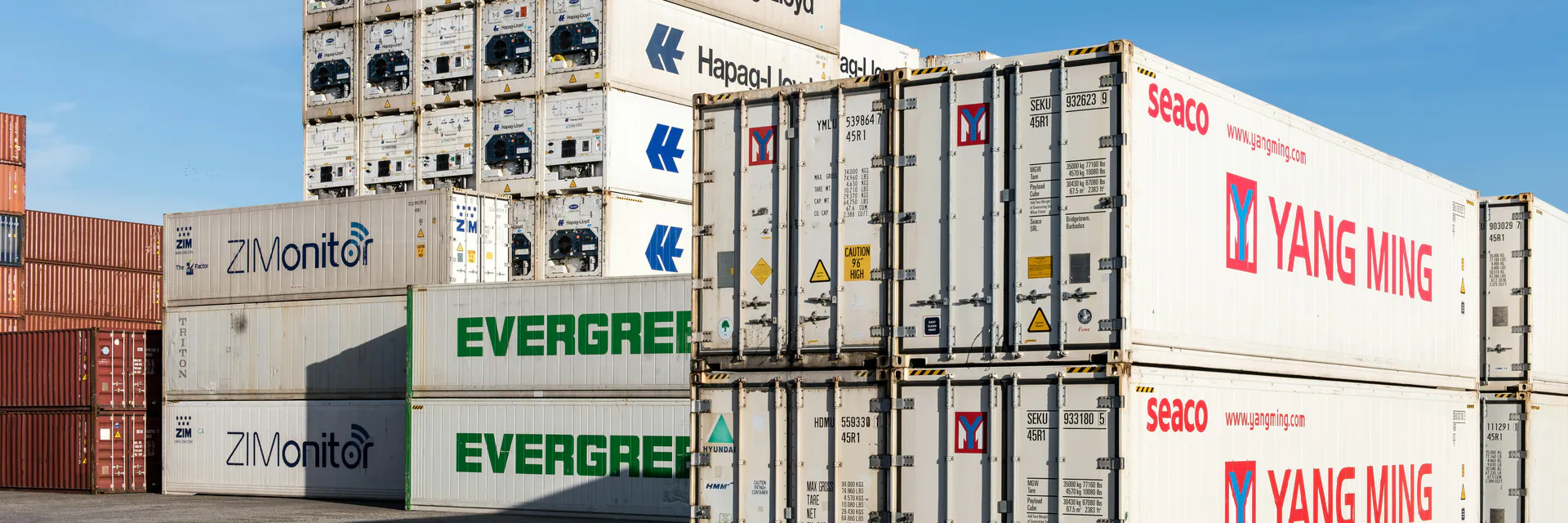
In the midst of COVID-19, another unprecedented event blocked and disrupted the world's supply chains, when a large Ever Green containership was stuck for six days in the Suez Canal during March 2021 (Elenjickal, 2021). The blockage resonated with ripple effects, which entailed a delay in manufacturing processes across industries (Brooks, et al., 2021). Similarly with the pandemic, the Suez Canal blockage has been regarded as a call for action, which is why organisations ought to scrutinise how they could optimise supply chain flows in order to mitigate exposure to supply instability (Xie & Chiu, 2021). As argued by Chopra and Sodhi (2004), since supply chain risks have a linkage to unpredicted events that disrupt the chain by delaying the information flow, corporations are urged to implement an extent of preparedness and agility with a resilience strategy. Consequently, one could therefore also say that organisations' current state of unpreparedness is a consequence of the last decades' desire of becoming lean through elimination of non-value adding processes, which potentially have mitigated room for resilience plans if unprecedented circumstances would occur (Modig & Åhlström, 2018).
Ultimately, the unforeseen events have left a noticeable footprint upon how organisations and their collaborating supply chain partners ought to cope with uncertainty moving forward. At the same time, the two described disturbances have entailed a long list of lessons learned for corporations to become more resilient. According to Elenjickal (2021): "uncertainties happen. And they seem to be happening with greater frequency". In other words, one of the greatest learning outcomes has unarguably been that, from now on, supply chain volatility will be an essential practice to manage, as one cannot prevent disruptions from occurring.
Nonetheless, in order to understand how value activities can support organisations mitigating their exposure to such uncertainties, it is assessed pivotal to initially comprehend the elements of Porter's (1985) value chain. By utilising the value chain as a starting point, the aim is to unravel the central concepts of value chain management by Porter with the intention of exploring whether its elements, herein procurement, have adapted to a changing business environment.
III. RESEARCH DESIGN
As explained in the introduction, the purpose of this paper is to assess as whether it is feasible to reconsider the procurement function as a primary activity in Porter's (1985) value chain, with a view to the last year's occurrences of supply chain disruption. The next section describes the research design to this purpose.
The author's methodological research design can be defined as a secondary qualitative data analysis (Bryman & Bell, 2015), where knowledge about the present consequences of disruptive supply chains and the evolutionary view upon procurement have been gathered through secondary data. On this basis, the author has assembled information through usage of previously published and analysed data. In sum, the insights from academia are assessed as a fundamental pillar of this paper, to the purpose of evaluating the importance of procurement in the current 21st century. On one hand, it has been argued that the disadvantage of such data is that they are intended for other purposes. However, one the other hand, it can also be argued that such data are a useful resource because they provide the researcher with additional time to reflect on the data's suitability to the research question (Saunders, et al., 2019).
In the commencing process of data collection, the author utilised EBSCOhost's research database, the Royal Danish Library, and additional online sources to access journals, where the following keywords were used: value chain, competitive advantage, procurement, COVID-19, and Suez Canal blockage. A central output of the search was Abdelhadi's (2017) research paper, which, on a par with the problem statement of this paper, questions procurement's function in the value chain. However, it becomes apparent how the paper of Abdelhadi (2017) does not take the notion of supply chain disruption or responsiveness into consideration. Additionally, it is assessed a more thorough explanation is needed to understand Abdelhadi's (2017) conclusion of not considering the procurement function as a primary activity. Subsequently, the insightful research results gave incentives to add additional relevant keywords to the author's process of gathering data. These keywords were: inbound logistics, buyer value, procurement logistics, and agility. Based on the nine
IV. LITERATURE REVIEW
The purpose of this section is to unravel the central concepts of value chain management by Porter, and further understand whether the view on the procurement function is still rightful placed as a secondary activity. Furthermore, the intention is to scrutinise as to whether the expectation of value and the notion of procurement have adapted to the current reality of a changing business environment.
a) The Value Chain
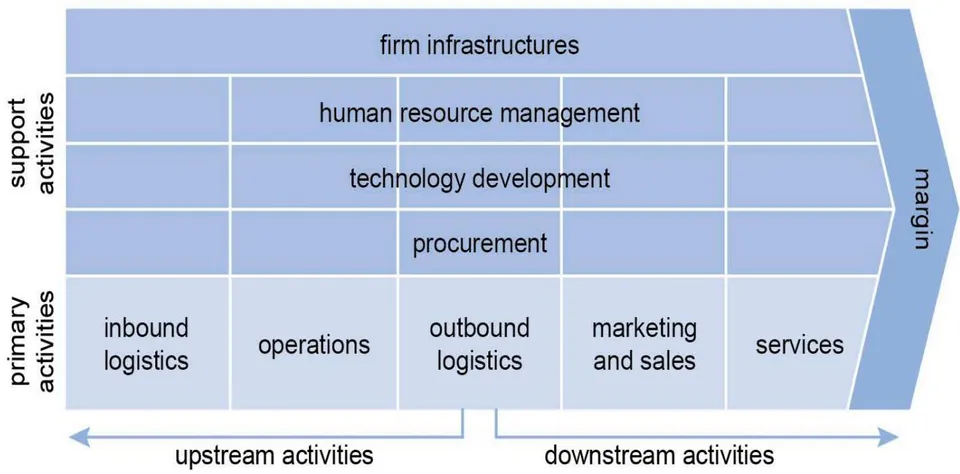
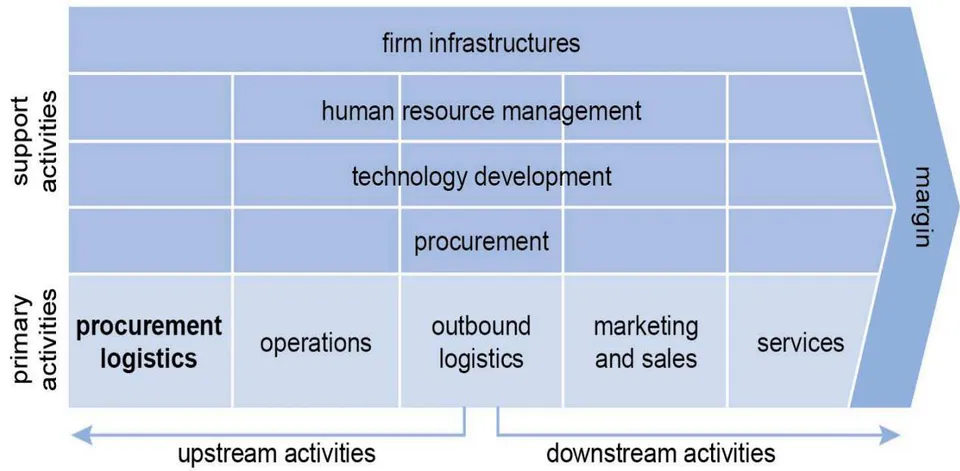
According to Porter (1985), an organisation's competitiveness cannot be understood by assessing it as a whole. Instead, one's assessment should be conducted more systematically across the organisation's activities in order to comprehend its performance and behaviour in terms of costs and differentiation. Fast forwarding to today, these value activities are still assessed as the fundamental pillars of the theoretical success of Porter's (1985) value chain, which equals to the corporate chain that stretches from the upstream engagement with the supplier to the downstream relationship with the customer (Abdelhadi, 2017). In order to facilitate the analysis of a company's competitiveness, Porter's (1985) value chain splits activities into two overall categories: primary activities and support activities. While a primary activity constitutes to a direct contribution to the addition of value to the production of a product, a support activity has an indirect effect on the value of a product. This implies that the secondary activities provide the input and structure, which allow the primary activities to competitively excel (Kumar & Rajeev, 2016; Holsapple & Singh, 2001). As shown in Figure 1, the primary activities consist of inbound logistics, operations, outbound logistics, marketing and sales, and service. The activities that support these, support activities, are firm infrastructure, human resource management, technology development, and procurement (Abdelhadi, 2017). Overall, as stated by Brandenburger (2002), the success of Porter's (1985) management framework can be explained twofold: firstly, it provides a distinctive picture of the essential activities within an organisation. Secondly, through the choice of limited competitive strategies, it gives the decision-maker a simplified view of his/her options to act.
Porter's incentive principle of introducing the value chain in 1985 was to give a response to the criticism of his findings presented in Competitive Strategy: Techniques for Analyzing Industries and Competitors (1980). The majority of the criticism was particularly levelled against that the findings could not be deployed in the industries of the time, as the presented findings were too macroeconomic (Aktouf, et al., 2005). In other words, it was argued that the one-dimensional nature of his work made it difficult for businesses to apply in practice. In the opinion of Aktouf et al. (2005, p. 185), page 185: "Porter felt obliged to turn to the microeconomic aspects of his doctrine". According to Porter (1985) himself, the academic development of the generic strategies and the value chain in Competitive Advantage (1985) was his act of taking accountability by filling out the gaps to the received criticism (Porter 1985; Aktouf, et al., 2005; Argyres & McGahan, 2002b). As a result, the act of taking accountability turned into a success, as the response to his findings was considered awe-inspiring, and still is due to the mainstream usage of his work worldwide. However, as pointed out by Aktouf et al. (2005), one could also claim the mainstream usage has entailed that the definition of competitive advantage, buyer value, and value creation have become too one-sided.
Moreover, Klein (2000) explains that Porter's (1985) initial conceptualisation of competitive advantage is vague, as it creates confusion as to how to comprehend the term from both a theoretical and practical standpoint. Originally, Porter (1985, p. xxii) stated that "competitive advantage grows fundamentally out of the value a firm is able to create for its buyers".
He further expressed that it is to be found "... at the heart of a firm's performance in competitive markets" (Porter, 1985, p. xxj). However, based on Porter's (1985) view, Klein (2000) argues that this presentation of competitive advantage does not define the notion in a contemporary way unless one groups the conceptualisation of competitive advantage together with one's interpretation of value. In this vein, Aktouf et al., (2005, page 186) consider it is a clear example of how: "... the question of value has divided theorists for decades, competitive advantage loses its relevance as a central notion in strategic thinking". Reflectively, as business practices and the organisational way of strategising have historically been far from static, one should be cautious in the comprehension of a terminology with a span of more than one decade. Essentially, this indicates that a change in time could lead to an alteration in a notion's conceptualisation, as it might adapt to new surrounding settings.
Another example of a terminological change is the emergent importance of relationships from the late 20th century into the current 21st century. As highlighted by Aktouf et al. (2005), relationships are another missing link in Porter's (1985) value chain. In their research, it is highlighted that, while the value chain originally intends to divide a business into value activities, it neglects how internal and external relationships tie these activities together (Aktouf, et al., 2005). Consequently, it could be interpreted that Porter's (1985) value chain disregarded in which way relational bonds were embedded in the stream of activities because the value chain was characterised as less complex in comparison with today's global supply chain (Min, et al., 2019). This could explain why the relational parameter did not receive the same level of recognition in 1985 as it has received in modern times.
b) Buyer Value
An organisation has to be capable of generating value in order to be competitive and retain its customers (Piboonrungroj, et al., 2017). In order to generate competitive value, Porter (1985) believes an organisation's focus should be on comprehending the buyer's demands and desires. In other words, a company should invest in its capabilities of comprehending the buyer's expectation to value.
According to Prahalad and Ramaswamy (2004), the conceptualisation of value is to be understood as the buyer's willingness to pay, which is influenced by a company's performance, facility, and attribute of its goods and services. Taylor and Fearne (2009) continue with a similar view by expressing that buyers seek attributes or benefits from the product beyond the price alone. An example of such benefits could be one's execution of stability across the supply chain, herein referring to the organisation's capability of stabilising lead time in volatile events. However, to acquire the attention of the buyers, Kothandaraman and Wilson (2001) state that an organisation must prove its value generation through its fulfilment of high, consistent performances. Essentially, such consistency will require that each activity in the value chain is carried out on a holistic basis. If not, the company will jeopardise its abilities to meet the buyer's demand and, thus, diminish its competitive standing (Piboonrungroj, et al., 2017, Kumar & Rajeev, 2016). Ultimately, as a means to succeed within this aspect, Vargo and Lusch (2004) stress that it will imply interactional cooperation in the overall value system.
Consistent with Piboonrungroj, et al.'s research (2017), the holistic capability of thinking beyond one's own corporate boundaries is referred to as value chain thinking. Within value chain thinking, the organisation does not behave from a singular perspective, but, instead, creates, captures, and distributes useful information towards its multiple stakeholders (Piboonrungroj, et al., 2017). Along with Slywotsky et al. (2002), the holistic value thinking phenomenon has paved the way for a customer-centric approach, which has been argued to generate a more competitive value chain approach, in line with the current era of globalisation. Hereby, when an unforeseen event occurs in the value system, the individual actor ought to explore it from the versatile view of value chain thinking and, thus, make allowance for information-sharing with stakeholders to strengthen the value system's coherence and stability (Piboonrungroj, et al., 2017). By incorporating a holistic value thinking approach into one's practices, it is anticipated to result in a threefold outcome: Firstly, it will result in creating a synergised value for the buyer. Secondly, it will create the ability to successfully respond to changes in customer needs.
Thirdly, it will mitigate one's exposure to supply chain risks (Lee, et al., 1997; Goldsby, et al., 2006; Wieland & Wallenburg, 2013).
c) Procurement
As it has been exhibited in the prior section (the value chain), procurement is placed in Porter's (1985) value chain as a secondary activity, where the function has an indirect influence on the value creation of the product (Holsapple & Singh, 2001). However, over the last decades, the function itself has received significant attention due to organisations' competitive aspiration of becoming more responsive to uncertainty in their respective global supply chain. Here, procurement operates as a critical role in knowledge sharing across the whole chain (Georgino, et al., 2021). According to Abdelhadi (2017), the desire of utilising procurement more strategically can be explained as a globalised shift in economic practices, which is influencing and redefining the traditional corporate thinking of business practices within procurement. Moving forward, the procurement function is anticipated to become more strategically involved in the organisational movement towards a vision, where it will work as a means to ensure transparency and resilience, thus, improving the collaborative synergy between an organisation and its suppliers (Rejeb, et al., 2018).
Originally, the procurement function was viewed as being responsible of ensuring a controlled and punctual process of all movements of internal and external goods, receipts, and management of transportation (Spöttl, 2017). However, procurement is further argued to involve more than just controlled processes, but also the concepts of supplier relationship management, stakeholder management, contract management, negotiation, and purchasing (Georgino, et al., 2021). As simplified by Fleischmann (2018), it is the procurement function's obligation to provide, maintain, and deliver efficiencies to achieve the organisation's long-term goals, herein to enhance the information flow across value activities, both internally and externally (Fleischmann, 2018; Cugno & Castagnoli, 2020). Consequently, information and communication are viewed as the backbone of the overall procurement process (Osmonbekov & Johnston, 2018). Therefore, the function ought to be recognised as a pivotal means for mitigating information distortion. Hence, it should be perceived as a competitive resource to rapidly respond to unforeseen events that could negatively affect the organisational movement (Georgino, et al., 2021).
According to The Chartered Institute of Procurement and Supply (2022), "procurement and supply management involves buying the goods and services that enable an organisation to operate in a profitable and ethical manner". The institute further states that "responsibilities vary from sourcing raw materials and services to manging contracts and relationships with suppliers" (CIPS, 2022). However, Porter (1985) would instead define the notion of procurement as the function of purchasing inputs utilised within a company's value chain, herein raw materials, supplies, and other consumable items. Through a comparison of the two characterisations of procurement, the two perspectives are alike. However, Porter (1985) does not directly mention anything about the management of supplier relationships. Essentially, procurement is not only about coordination of the organisation's material needs for manufacturing (Rejeb, et al., 2018). Rejeb et al., (2018) continue by stressing that contemporary procurement is equally about the emphasis upon granting access and sharing information with supply chain partners. In essence, procurement is about visibility.
In continuation of the conceptualisation of procurement, Mônica et al., (2021) make it clear that there has been a vast debate of the role of procurement over the last years. The debate has concerned the role of procurement in the value chain, but also the concrete definition of which practical actions are required in a procurement function (Ellram & Birou, 1995; Georgino, et al., 2021). Already back then, Porter (1985) seemed aware of this potential debate, as he in Competitive Advantage commented on the closeness between the secondary activity procurement and the primary activity inbound logistics. He further stressed that inbound logistics ought to be viewed as, "activities associated with receiving, storing, and disseminating inputs to the product, such as material handling, warehousing, inventory control, vehicle scheduling, and returns to suppliers" (Porter, 1985, pp. 39-40). Reflectively, it becomes apparent that the two activities, inbound logistics and procurement, do have certain similarities. Similar to inbound logistics, procurement refers to the function of purchasing input, but the function of procurement also emphasises enhancement of the relational information flow between the focal company and its suppliers (Büchi, et al., 2020). Nonetheless, the closeness between the activities is acknowledged by Porter (1985, p. 41) himself, as he concludes that: "... purchasing inputs are commonly associated with primary activity". Ultimately, one could be curious as to which practical actions are required in these two activities and whether they are more alike than one would think.
According to Porter (1985), the difference between procurement and inbound logistics are still notable, as procurement refers to the spend across an organisation in various activities, whereas inbound logistics refers only to direct inputs to the product. It means that procurement does not necessarily relate to raw components to produce the physical produce, as it could likewise be procurement of machines for the plant, temporary help, supplies for the office, or consultancy services to support strategic decisions.
Overall, as stated by Porter (1985, p. 41), "the dispersion of the procurement function of obscures the magnitude of total purchases". In essence, the statement clearly exhibits how procurement is associated with various activities across the value chain and not only the direct raw components for the operations.
i. Procurement Logistics
Beyond the conceptualisations of procurement and inbound logistics, a new notion has begun to receive great attention throughout academia in the last decade. The phenomenon is known as procurement logistics, which "... comprises the connection between the supplier's distribution logistics and manufacturer's production logistics system" (Zander, et al., 2020). According to Tracy and Sands (2011), there is a need to strengthen supply chains by bridging the gap between logistics and procurement. Essentially, in a time where transparency and holistic recognition are argued to be the means to succeed in the 'new normal', the notion of procurement logistics has received its attention due to a need of bringing further flexibility and efficiency to the supply chain (Thalbauer, 2020; Bogaschewsky, 2019), thus, enhancing the emphasis on the practice of holistic exchange of information (Büchi, et al., 2020).
By comparing the original, known notion of inbound logistics to procurement logistics, Rejeb et al., (2018) explain that the new phenomenon has a deeper emphasis as it also includes the relational action of exchanging data and information with one's supply chain partners. Hence, procurement logistics intends to extend the upstream activities' responsibility by going beyond the action of purchasing goods and the receiving of goods at the warehouse (Zander, et al., 2020). It can therefore be interpreted that its aim is to directly enhance the state of stability in the physical creation of the product. Holistically, the new, discovered term is essentially still about procuring the required materials to produce the physical product. However, it paves the way for a new perception on the importance of communication within upstream logistics and sets the stage for an additional range of actions required to sustain one's competitiveness (Globaltranz, 2016).
d) Agility
In relation to the rising pursuit of developing one's capabilities within value chain thinking, agility, responsiveness, and resilience have become recurrent conceptualisations in modern procurement, which have been proved costly to neglect corporately in the recent decades (Barratt & Oke, 2007; Christopher & Lee, 2004). Specifically, agility has received a lot of attention within academia, as various industries have been exposed to increased volatility and unpredictability in correlation with occurrences of broken supply chains (Georgino, et al., 2021; Zander et al., 2021; Elenjickal, 2021; Thalbauer, 2021). According to Swafford et al.,
(2006), agility concerns an organisation's ability to master a turbulent market as well as its correspondingly volatile effect on customer demand. Additionally, Eckstein et al. (2015) support the latter view on agility by stating that it is about the company's capability to sense short-term, temporary changes in the business environment in order to rapidly cater for such disturbances. In essence, agility has been introduced by papers as a tool to meet buyer value through quick response, which has been represented as a compulsory requirement for organisations, operating in a global supply chain (Yusuf, et al., 1999; Feizabadi, et al., 2019).
In recent time, it has been identified that agile organisations can strategically leverage time more competitively due to their capability of responding to unique customer needs (Gligor, et al., 2013; Tang, et al., 2015). However, such agile competitiveness is only accessible once a network of transparency and win-win relationships are established, in which the pursuit is collaborative effectiveness (Nicoletti, 2018). If one takes a step back from the horizontal view towards agility, everything comes down to one's ability of being resilient (Wieland & Wallenburg, 2013). By investing in either agility or robustness, Wieland and Wallenburg (2013) argue that enhanced resilience will positively affect a supply chain's output of customer value. Additionally, an organisation is recognised as resilient if it is able to stabilise the original situation or create a new stable situation. As stated by Chakravarthy (1982), an organisation needs to either utilise a reactive or proactive strategy in order to develop its resilience. While a reactive strategy caters for environmental changes with a corporate action, a proactive strategy prevents changes through forecasting and prediction (Lengnick-Hall & Beck, 2005). As such, the reactive strategy is also known as being 'agile' through visibility and speed, whereas the proactive strategy is known as 'robustness' through anticipation and preparedness (Wieland & Wallenburg, 2013). Overall, these two branches form the conceptualisation of resilience (Shukla et al., 2011; Braunscheidel & Suresh, 2009).
Moreover, irrespective of the dimension of resilience that an organisation pursues, the importance of communication and cooperation in the value system cannot be neglected, as both have an encouraging impact on one's ability to act resiliently and meet buyer value (Wieland & Wallenburg, 2013). Therefore, it is vital that global organisations prioritise building and investing relationally in their linkages with supply chain partnerships to become more competitive and resilient to changing customer values and volatile markets (Min, et al., 2019). Essentially, through holistic communication and value-chain thinking, the aim is to coordinate processes and information harmoniously across the supply chain in order to cope with unforeseen events, thus, cooperating for mutual gain (Flynn, et al., 2010). Consequently, it becomes evident how one's capacity of resilience should be viewed as a contributory value factor in modern supply-chain execution.
V. DISCUSSION
Across the last years, the procurement function, and its linkage to work as a means to resiliently respond to uncertainties, has received a vast majority of attention due to companies' minor ability to master volatile market conditions (Abdelhadi, 2017; Georgino, et al., 2021). Unforeseen events have disrupted supply chains in various industries, which have shed light on how vulnerable contemporary global supply chains have been to such occurrences (Thalbauer, 2020; Elenjickal, 2021).
Initially, it is stated that this paper seeks to continue the work of Abdelhadi (2017) by scrutinising whether the procurement function can be reconsidered as a primary activity in Porter's (1985) value chain. However, the last years' occurrences of supply chain disruption have also been taken into account. Abdelhadi (2017) concluded that procurement could not be regarded as a primary value adding activity. Based on the literature review, this author would initially agree with Abdelhadi (2017) if one's overall decision is built upon the conceptualisation of procurement alone. It has been identified that procurement does not only concern sourcing of raw components to produce a product, it is also responsible for the activity of sourcing other elements, such as procuring machines for the plant, offices supplies, and consultancy services (Porter, 1985; Rejeb, et al., 2018). Therefore, it becomes clear how the whole procurement function cannot be placed as a primary activity, as all of the function's responsibilities do not solely contribute with adding value to the production of the product. Nevertheless, it has been identified that there are similarities between the primarily activity, inbound logistics, and the secondary activity, procurement (Porter, 1985; Ellram & Birou, 1995; Büchi, et al., 2020; Georgino, et al., 2021). For this reason, it has been brought to attention that if fragments of the two activities are suitably unified, it cannot be neglected that this might entail a more contemporary, upstream primary activity to cater for changing buyer value and uncertainties (Wieland & Wallenburg, 2013; Gligor, et al., 2020).
According to Abdelhadi (2017), the rising attention towards procurement has resulted in companies having to commence utilising procurement more strategically as a competitive source. In addition, companies have been urged to evolve and prepare themselves for a 'new normal' by developing resilience strategies into the value system, since uncertainties are anticipated to happen with greater frequency (Chakravarthy, 1982; Lengnick-Hall & Beck, 2005; Wieland & Wallenburg, 2013; Thalbauer, 2020). Hence, organisations ought to redefine their traditional corporate way of operating within procurement to ensure a consistent, competitive standing in a volatile reality (Abdelhadi, 2017). Ultimately, it brings us back to this paper's contribution to academia through the discovery of the notion of procurement logistics, which has received attention due to a need of flexibility and transparency in the value system (Bogaschewsky, 2019). As previously discovered, as resilience is identified as a pivotal feature to meet contemporary buyer value, procurement logistics is viewed as the function to accommodate to such criteria by promoting the importance of information sharing. In other words, it operates as an enhancement of one's resilient standpoint.
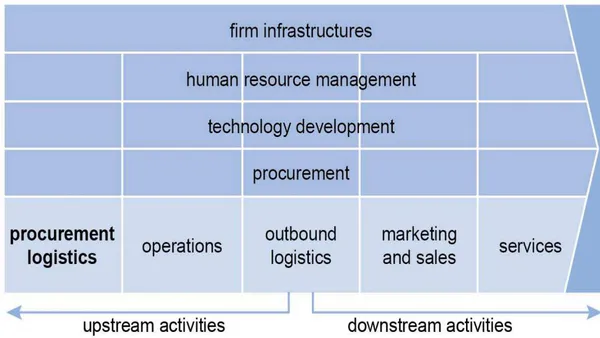
In comparison with the traditional primary activity, inbound logistics, procurement logistics implies a deeper emphasis on the relational cooperation with the suppliers, which will enhance the communication and flexibility in association with receiving, storing, and distributing inputs to the product (Zander, et al., 2020; Tracy & Sands, 2021). Finally, as shown in Figure 2 below, replacing the original notion of inbound logistics with procurement logistics, creates a stronger foundation to cope with uncertainty, which will provide a more coherent bridge between primary and secondary activities from an upstream perspective. Through the greater emphasis on information-sharing to attain visibility, procurement logistics' aim is to competitively enhance the state of stability in the physical value creation of a product (Xie & Chiu, 2021). Overall, through an incorporation of procurement logistics into Porter's (1985) value chain, the remodification is envisioned to enhance one's upstream ability in the value system to cater for changing customer demand and mitigating exposure to supply chain volatility.
VI. CONCLUSION
Since its release, Porter's (1985) value chain has become a worldwide recognised management tool, which is still recommended to be used in order to understand an organisation's value creating activities. However, the reality is that modern papers have started to be published with the purpose of reassessing whether historical management frameworks still can work as a remedy into business practices of today. The discussion has boomed in the last three years, since global value chains have been vastly affected by COVID-19 and the Suez Canal blockage. This has led to an increased awareness of how vulnerable supply chains are to uncertainty. In relation to modern supply chain execution, it is evident how pivotal an organisation's capacity of resilience is in the physical value creation. In essence, it is imperative that models of value creation take this fact into account.
Particularly the procurement function has received considerable attention, as it has been viewed as a valuable means to develop resilience onwards by enhancing the flow of transparent communication across the value system. With that being said, in regard to the recent years' supply chain disturbance, it has made the author question whether the procurement function can be reconsidered as a primary activity in Porter's (1985) value chain. Even though there are resemblances to the primary activity inbound logistics and the secondary activity procurement, it has been identified that the procurement function cannot be regarded as a primary activity due to its comprehensive emphasis upon sourcing material for the whole company, thus, not solely the production. However, it is found that if fragments of these two activities are suitably unified, it could lead to a new primary activity to cater for changing buyer value and exposure to uncertainty. It has led to the discovery of procurement logistics, which in the view of the author would fit well into a contemporary value model.
As a consequence of the recent supply volatilities, companies have been urged to evolve and prepare themselves for a 'new normal', since uncertainties are anticipated to occur more frequently. Therefore, to improve the state of stability in the value chain, the author claims that organisational benefits are to be reaped by altering the traditional primary activity inbound logistics into procurement logistics. This would pave the way for a stronger foundation to accommodate to uncertainty, as the notion has a deeper emphasis on promoting information sharing and developing a resilient strategy. Furthermore, the remodified value chain is holistically envisioned to create a ripple effect with the aim of aligning expectation to an enhanced flow of transparency throughout the value system.
VII. FUTURE RESEARCH
The author encourages papers to continue research that challenges the value chain. As this study is solely using secondary data, it would be fruitful to test the integration of procurement logistics, as a primary activity, with the usage of primary data, in order to understanding its implications in real-life practice. Ultimately, future researchers should note that the perspective of this paper has predominately been directed towards the upstream activities in the value chain, more specifically procurement. In the process of writing this paper, the author realised that procurement is not the only activity, which has received a lot of attention over the last decades. Another activity is unarguably the secondary activity technology development technology, the evolution of which has influenced business practices in various ways. For this reason, future papers are also recommended to scrutinise as to whether technology development, as well as the other activities in Porter's (1985) value chain, ought to be utilised differently in the present business environment in comparison to how it originally was introduced by Porter in 1985.