This meta-analysis aimed to investigate the competencies and skills acquired by teachers through correlation between the duration of maker training and effective implementation of its outcomes in educational settings. The methods applied were based on PRISMA recommendation, utilizing the PICOC method, with meta-analysis conducted using the MAJOR Meta-analysis 4.1 package in the JAMOVI statistical software. The results of this study indicated that the time required for the effects of teacher maker training to manifest should exceed 5 months, with a confidence interval between 2.7 months and 8.4 months. It is concluded that training in the maker culture remains a new and growing condition that requires greater attention in the implementation of makerspaces regarding the development of appropriate methodologies, due to the challenges that arise throughout their implementation in schools.
## I. IntroduCtion
inserção da Cultura Maker nas escolas de educação básica no Brasil é uma realidade crescente e apresenta estratégias diversificadas com objetivos de realizar ações que desenvolvam as competências digitais e, consequentemente, possibilitem avanços no desenvolvimento dos processos de ensino e aprendizagem (Carvalho & Bley, 2018). O avanço das tecnologias e a mudança no paradigma educacional demandam que os professores da educação básica estejam preparados para incorporar metodologias ativas e práticas inovadoras em suas salas de aula.
Nesse contexto, as atividades makers têm se destacado como uma ferramenta pedagógica eficaz para promover o aprendizado prático, criativo e colaborativo entre os alunos. Partindo do artesanato, passando pela programação e robótica até chegar na fabricação digital, a cultura Maker apresenta uma grande variedade de atividades que desenvolvem projetos e que podem ser realizadas em quaisquer ambientes escolares, mas, principalmente, em ambientes específicos denominados Makerspaces ou FabLabs. São nestes espaços, compartilhados, de prototipação, modelagem e fabricação, que se constitui a marca mais divulgada desta modalidade de arranjo de equipamentos à disposição de comunidades (Silva & Merkle, 2016). O potencial educativo da cultura Maker e suas ferramentas têm sido amplamente discutido em ambientes fora da escola (Litts et al., 2016), onde muitos pesquisadores concordam sobre a urgente transferência destas ferramentas e tecnologias para dentro do ambiente escolar, visto que abordam diversas áreas da educação. Há uma contínua pressão para reformar as escolas nos moldes da "aprendizagem do século XXI" com inovação e pensamento empreendedor (Sefton-green, 2013).
Além disso, a fabricação digital (como impressoras 3D e máquinas de corte a laser), é vista como tendo relação direta com segmentos da indústria (Eisenberg, 2013), presumindo que cada vez mais, com o uso das ferramentas makers em sala de aula, haja um fortalecimento de habilidades e competências dos alunos, principalmente das disciplinas da STEAM (Science, Technology, Engineering, Arts, Mathematics), apropriadas para a indústria contemporânea, ensino superior, empreendedorismo e inovação (Taylor, 2016).
No entanto, para que os professores possam implementar essas práticas de maneira efetiva, é fundamental que possuam competências e habilidades específicas. É aqui que surge a necessidade da formação do professor, pois, para que haja uso adequado de um FabLab com todas as suas tecnologias, faz-se urgente necessidade de momentos formativos, tanto de utilização do maquinário como no desenvolvimento de competências digitais adequadas para a fabricação digital de experimentos ou produtos educacionais (Gavassa & Munhoz, 2016; Schelhowe, 2016).
No livro de Perrenoud et al. (2002), sobre as competências para ensinar no século XXI, há destaque para pontos cruciais na formação de professores, enfatizando a necessidade de desenvolver competências além do domínio de conteúdo, com foco na adaptação às necessidades dos alunos e na utilização de estratégias pedagógicas diversas. Os autores preconizam a importância da reflexão sobre a prática docente como elemento fundamental para o desenvolvimento profissional, e propõe uma abordagem centrada no aluno, onde os professores devem adaptar suas estratégias de ensino para promover a aprendizagem significativa. O conceito de transposição didática é introduzido, destacando a habilidade dos professores em traduzir conhecimento especializado de maneira acessível aos alunos. Há o reconhecimento da complexidade da prática docente e propõe uma formação que leve em conta a multidimensionalidade dessa profissão, preparando os educadores para lidar com questões relacionadas ao conteúdo, gestão de sala de aula, relações interpessoais e desenvolvimento socioemocional dos alunos.
Quanto as competências e habilidades makers, elas referem-se ao conjunto de conhecimentos, capacidades práticas e atitudes que capacitam indivíduos a participar ativamente na cultura maker. As competências maker englobam conhecimentos específicos, como o domínio de ferramentas, técnicas de fabricação digital, programação e eletrônica, bem como a compreensão de princípios de design e prototipagem. Por outro lado, as habilidades makers incluem a aplicação prática desses conhecimentos, destacando a capacidade de criar, inovar e resolver problemas de maneira criativa e tangível. Isso envolve a proficiência na concepção e construção de objetos físicos, a habilidade de experimentar e iterar em projetos, bem como o pensamento crítico, a colaboração e a disposição para enfrentar desafios de maneira prática (Valente & Blikstein, 2019). Em conjunto, competências e habilidades makers são fundamentais para fomentar a criatividade, a autonomia e a inovação em diversas áreas, desde a educação até a indústria.
A pesquisa se justifica pela necessidade premente de compreender o processo de formação de professores para a integração de atividades makers no contexto educacional. Essas atividades, que envolvem o uso de ferramentas, tecnologias e processos de criação, promovem a aprendizagem multidisciplinar e o desenvolvimento de habilidades essenciais, como resolução de problemas, pensamento crítico, colaboração e criatividade.
É essencial investigar o tempo de formação necessário para que os professores adquiram competências sólidas e se sintam preparados para aplicar atividades makers, visando aprimorar os programas de capacitação docente. Além disso, compreender os métodos de formação mais eficazes possibilitará a direção mais eficiente dos recursos educacionais, contribuindo para a criação de um ambiente de aprendizado mais enriquecedor para os alunos.
Diante da crescente relevância das atividades makers na educação, surge a questão central desta pesquisa: Qual é o tempo de formação adequado para que um professor da educação básica adquira as competências e habilidades mínimas necessárias para executar atividades makers de forma eficaz em sala de aula?
Desta forma, o objetivo desta pesquisa foi investigar as competências e habilidades makers adquiridas pelos professores por meio da correlação entre a duração da formação maker e da implementação efetiva de seus resultados em ambientes de ensino.
## II. METODOLOGIA
Os métodos aplicados neste estudo foram baseados na recomendação PRISMA (Preferred Reporting Items for Systematic Reviews and Meta-Analyses) (Galvão, Pansani, & Harrad, 2015), que consiste em um checklist e um fluxograma de quatro etapas para auxiliar no relato de revisões sistemáticas e meta-análises.
O método PICOC (Petticrew & Roberts, 2006) foi empregado devido à sua eficácia na orientação de uma revisão sistemática, proporcionando clareza nos aspectos centrais do estudo e direcionando a extração dos dados relevantes para esta pesquisa. Os pontos pertinentes a uma Revisão Sistemática da Literatura (RSL) são delineados a seguir: a população-alvo compreende professores da educação básica; a intervenção analisada refere-se à utilização de ferramentas da Cultura Maker; a comparação envolve as diversas metodologias adotadas ao longo da formação de professores; os resultados abrangem quaisquer relatos dos professores que participaram dos momentos formativos; o contexto abarca o local de aplicação da pesquisa e o período de formação.
### a) Estratégias de Busca
Foram consultadas as bases de dados ACM Digital Library, El Compedex, IEEE Digital Library, ISI Web of Science, Science@Direct, Scopus, Springer Link e Periódicos Capes, por terem relevância mundial em publicações de artigos científicos. A última busca foi realizada em outubro de 2023 e foram feitas nas opções avançadas de cada base sem que houvesse marco temporal de publicação e sem restrições quanto ao idioma para evitar qualquer tipo de viés. Nas bases ACM Digital Library, ISI Web of Science, Science@Direct, Scopus e Springer Link os artigos deveriam conter a combinação dos descritores ("maker culture") AND ("teacher training")) no título ou no resumo. Nas bases El Compendex e IEEE Digital Library foi utilizada a combinação de descritores ("maker") AND ("teacher training")) e no Periódico Capes utilizouse ("cultura maker") E ("formação de professores")). As mudanças dos descritores ocorreram quando não surgiam resultados e através deste refinamento, foram selecionados os documentos no formato de artigo.
### b)Depuração e Aplicação dos Critérios de Inclusão
Os artigos identificados durante a pesquisa foram exportados para a plataforma Parsifal, uma ferramenta online especialmente projetada para auxiliar pesquisadores na condução de revisões sistemáticas da literatura (Kitchenham & Charters, 2007). Para estabelecer os critérios de inclusão, os artigos selecionados deveriam abordar qualquer tipo de estudo relacionado à formação de professores na perspectiva STEAM, específica da educação básica no contexto da cultura maker. Os critérios de exclusão foram aplicados de forma rigorosa, incluindo artigos fora do escopo da cultura maker, aqueles que não apresentavam estudos aplicados à educação básica e qualquer artigo de revisão. A primeira triagem foi realizada através da leitura dos títulos e resumos dos artigos, sendo que apenas os que atenderam aos critérios iniciais foram submetidos à leitura completa. Este procedimento visou aplicar os critérios de inclusão e exclusão de forma rigorosa, garantindo a seleção cuidadosa dos artigos a serem considerados na revisão sistemática.
### c) Análise do Risco de Viés dos Estudos
Os riscos de viés dos estudos selecionados foram avaliados por meio da ferramenta ROBIS1 (Risk of Bias in Systematic Reviews), desenvolvida para a análise do viés em revisões sistemáticas. A ROBIS, conforme descrita pelo Brasil (2017), apresenta questões orientadoras que facilitam a avaliação crítica. Com base na classificação resultante dessas questões, os avaliadores têm a capacidade de julgar o risco geral de viés na revisão. O site disponibiliza a análise de risco através de diversos pacotes, como o RoB 2.0. Nesse pacote, são examinados os seguintes pontos: D1 - viés decorrente do processo de randomização; D2 - viés devido a desvios da interação pretendida; D3 - viés devido à falta de dados de resultados; D4 - viés na medição do resultado; D5 - viés na seleção do resultado relatado.
Ao final é possível baixar o processo de análise de cada estudo e o resultado do risco de viés de todos os estudos juntos. Nesta pesquisa, a maioria dos estudos analisados possuíram baixo risco de viés e um deles apresentou alto risco de viés.
### d) Metanálise
Para consolidar as evidências dos artigos em dados adequados para a metanálise, foram elaboradas tabelas descritivas que incorporam informações cruciais, incluindo: 1. autoria do estudo;
2. duração da formação na cultura maker;
3. relatos positivos acerca da formação;
4. relatos negativos relacionados à formação. Cada relato foi atribuído um valor de 1 para cada frase citada nos artigos, proporcionando uma quantificação numérica dos relatos, assim, esse procedimento permitiu uma mensuração objetiva, viabilizando uma análise estatística posterior.
O software estatístico empregado para gerar as estatísticas descritivas e os modelos de metanálise foi o Jamovi 2.4 (Jamovi, 2023). Especificamente para gerar os modelos metanálise, utilizou-se o pacote MAJOR Meta-analysis 4.1 (R Core Team, 2022) onde optou-se por utilizar a ferramenta Effect Size and Smapling Variances or Standard Errors (Viechtbauer, 2010), que permite analisar como o tempo de formação maker está relacionado com as afirmativas pós-formação.
Adicionalmente também se analisou a plotagem de assimetria de resíduos (Sterne et al., 2011) onde foi abarcado o Fail-Safe N pelo critério de Rosenthal, com o intuito de verificar a quantidade amostral necessária para impactar os efeitos identificados (Orwin, 1983).
## III. RESUlTadOS
A partir da busca nas bases de dados supracitadas, um total de 63 artigos foi identificado, dos quais 3 eram duplicados, restando 60 artigos. Após aplicação dos critérios de inclusão e exclusão iniciais, analisando o título e resumo dos artigos, foram excluídos 48 artigos. Os 12 artigos restantes foram analisados na íntegra, dos quais foram selecionados 8 artigos que cumpriram todos os critérios estabelecidos para esta revisão sistemática com dados necessários para realizar uma metanálise. A Figura 1 mostra o diagrama de fluxo para a seleção dos artigos para a revisão sistemática.

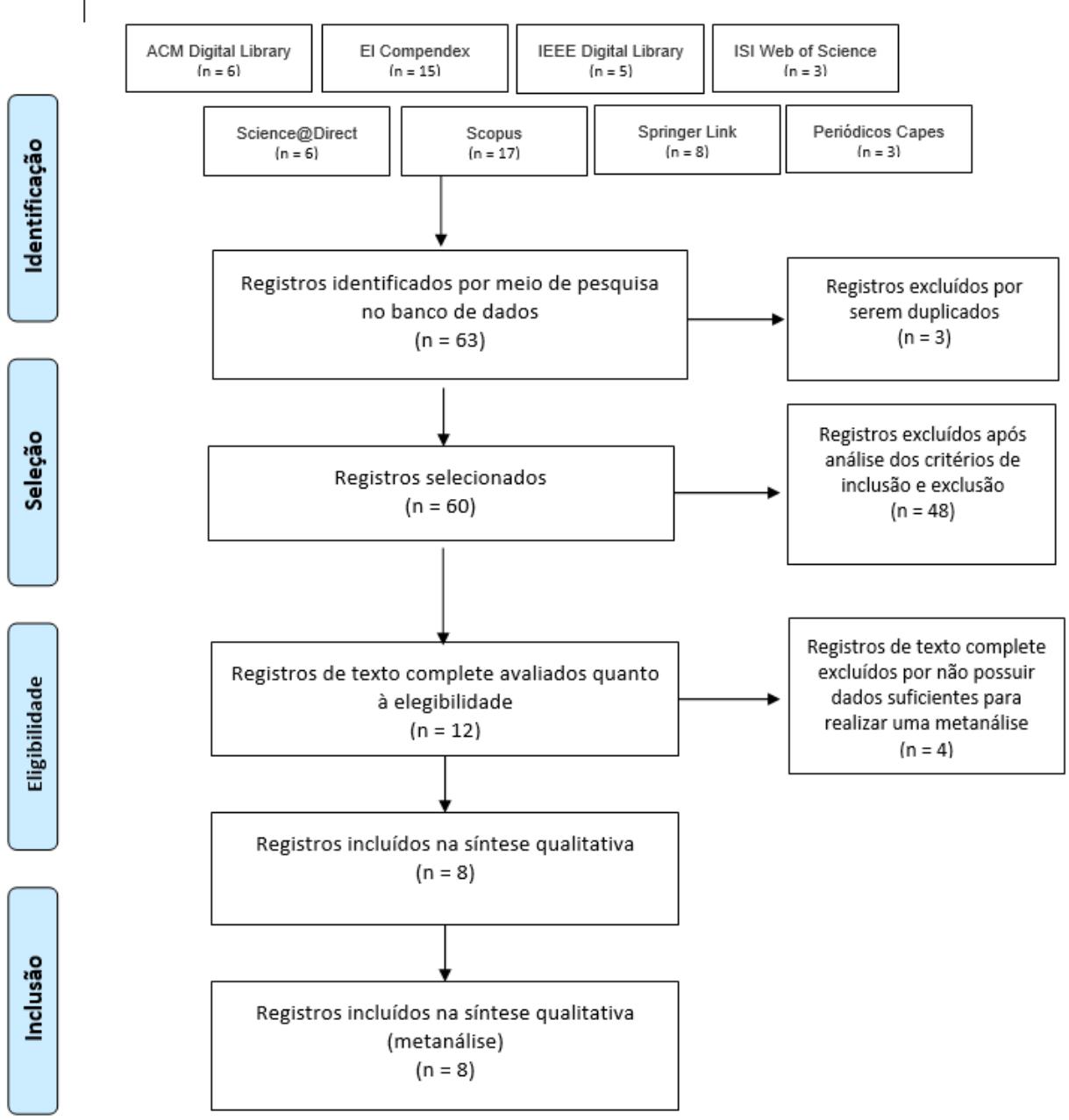
PRISMA Flow Diagrama Fig. 1: Fluxograma do processo de seleção. Elaborado pelos autores (2024).
O idioma predominante nas publicações dos artigos foi o inglês. Dos 8 artigos selecionados para a revisão sistemática, 7 $( 87,5\% )$ foram escritos em inglês e apenas 1 $( 12,5\% )$ foi escrito em espanhol. No quadro
1 seguinte, foram sintetizadas as informações extraídas dos artigos utilizando o método PiCOC e servindo de base para análise do risco de viés como também para realização da metanálise.
Quadro 1: Informações dos estudos com base no método PICOC
<table><tr><td>TÍculo</td><td>Autores e Ano</td><td>Áreas do conheimento e Nível Educationals (Population)</td><td>Ferramentas do maker (Intervention)</td><td>Metodologias realizadas (Comparison)</td><td>Efeitos da formação (Outcome)</td><td>Local e período de formação (Context)</td></tr><tr><td>A Mathematics Teacher's Training to Create a Maker Space in Mathematics Lessons by Means of GeoGebra</td><td>Shyshenko et al., 2022.</td><td>- Professores de matemática - Ensino Médio</td><td>- Simuladores Virtuais</td><td>- STEM - STEAM - Método de projetos - Modelagem Matemática</td><td>- 3 affirmativas positivas - 1 affirmativa negativa - 4 affirmativas no total</td><td>- Ucrânia - 2 meses</td></tr><tr><td>Empowering educators by developing professional practice in digital fabrication and design thinking</td><td>Andersen & Pitkänen, 2019.</td><td>- Professores de Ciências, Tecnologia, Artes e Matemática - Ensinos Fundamental 1, 2 e Ensino Médio</td><td>- Programação e Robótica - Laboratórios de Fabricação</td><td>- Design Thinking - Aprendizagem Baseada em Projetos - Construtivismos - Construcçãoismo</td><td>- 9 affirmativas positivas - 7 affirmativas negativa - 16 affirmativas no total</td><td>- Dinamarca - 12 meses</td></tr><tr><td>Interdisciplinary craft designing and invention pedagogy in teacher education: student teachers creating smart textiles</td><td>Karppinen et al., 2019.</td><td>- Professores de Ciências, Tecnologia e Artes - Educação Infantil</td><td>- Artes e Ofícos - Kits de Eletrônia</td><td>- Educação em design - Pedagógia de invenção</td><td>- 11 affirmativas positivas - 1 affirmativa negativa - 12 affirmativas no total</td><td>- Finência - 3 meses</td></tr><tr><td>Making a Makerspace for children: A mixed-methods study in Chinese kindergartens</td><td>Xiang et al., 2023.</td><td>- Professores de Ciências e Matemática - Educação Infantil</td><td>- Artes e Ofícos - Materiais de construição e reciclagem - Kits de Eletrônia - Programação e Robótica - Laboratórios de Fabricação</td><td>- STEM - Processo de Design de Engenharia</td><td>- 11 affirmativas positivas - 6 affirmativas negativa - 17 affirmativas no total</td><td>- China - 3 meses</td></tr><tr><td>Mediação Tecnológica apoyada en la cultura Maker enedinheción secundaria</td><td>Dominguez-González et al., 2021.</td><td>- Professores de Ciências, Tecnologia e Matemática - Ensino Fundamental 1 e 2</td><td>- Kits de Eletrônia - Programação e Robótica</td><td>- Modelo tecno-pedagogico - Andragogia - Construcçãoismo - Design Thinking - Aprendizagem colaborativa</td><td>- 8 affirmativas positivas - 4 affirmativas negativa - 12 affirmativas no total</td><td>- México - 7 meses</td></tr><tr><td>Of Women Tech Pioneers and Tiny Experts of Ingenuity</td><td>Kjartansdóttir et al., 2020.</td><td>- Professores de Tecnologia - Educação Infantil e Ensino Fundamental 1 e 2.</td><td>- Jogos - Kits de Eletrônia - Programação e Robótica - Laboratórios de Fabricação</td><td>- STEM - STEAM - Aprendizagem Baseada em Projetos</td><td>- 9 affirmativas positivas - 5 affirmativas negativa - 14 affirmativas no total</td><td>- Islândia - 8 meses</td></tr><tr><td>STEAM in Oulu: Scaffolding the development of a Community of Practice for local educators around STEAM and digital fabrication</td><td>Milara et al., 2020.</td><td>- Professores de Ciências, Tecnologia, Artes e Matemática - Ensino Fundamental 1 e 2.</td><td>- Kits de Eletrônia - Programação e Robótica - Laboratórios de Fabricação</td><td>- STEAM - Construcçãoismo - Pensamento Computational - Aprendizagem Baseada em Projeto - Educação Integrativa</td><td>- 10 affirmativas positivas - 5 affirmativas negativa - 15 affirmativas no total</td><td>- Finência - 10 meses</td></tr><tr><td>Transferring makerspace activities to the classroom: a tension between two learning cultures</td><td>Walan & Gericke, 2023.</td><td>- Professores de Ciências, Tecnologia e Matemática - Ensino Fundamental 1 e 2</td><td>- Kits de Eletrônia - Programação e Robótica - Laboratórios de Fabricação</td><td>- STEM</td><td>- 11 affirmativas positivas - 11 affirmativas negativa - 22 affirmativas no total</td><td>- Suécia - 1 mês</td></tr></table>
Para análise do risco de viés de cada estudo onde a primeira coluna contém os títulos dos estudos, a utilizou-se da ferramenta ROBIOS no pacote RoB2.0 segunda coluna e as subsequentes contêm os julgamentos em cada domínio da ferramenta de avaliação e a última coluna (denominada "Geral") contendo os julgamentos gerais de risco de viés para cada estudo. O quadro 2 representa as análises individuais dos riscos de viés com base nos cinco itens proposto no RoB 2.0. O quadro 3 traz os resultados dos
ricos de viés em cada estudo, onde é possível perceber que o estudo 1 de Shyshenko et al. (2022) possui um alerta de algumas preocupações e o estudo 3 de Karppinen et al. (2019) tem alto risco de viés. No geral, os estudos mostram baixo risco de vieses.
Quadro 2: Análise do risco de viés com uso da ferramenta ROBIS
<table><tr><td>Studies</td><td colspan="6">Risk of bias domains</td></tr><tr><td></td><td>D1</td><td>D2</td><td>D3</td><td>D4</td><td>D5</td><td>Overall</td></tr><tr><td>Shyshenko et al., 2022.</td><td>+</td><td>+</td><td>+</td><td>×</td><td>×</td><td>-</td></tr><tr><td>Andersen & Pitkänen, 2019.</td><td>+</td><td>+</td><td>+</td><td>+</td><td>+</td><td>+</td></tr><tr><td>Karppinen et al., 2019.</td><td>+</td><td>+</td><td>+</td><td>×</td><td>×</td><td>×</td></tr><tr><td>Xiang et al., 2023.</td><td>+</td><td>+</td><td>+</td><td>+</td><td>+</td><td>+</td></tr><tr><td>Domínguez-González et al., 2021.</td><td>+</td><td>+</td><td>+</td><td>+</td><td>+</td><td>+</td></tr><tr><td>Kjartansdóttir et al., 2020.</td><td>+</td><td>+</td><td>-</td><td>+</td><td>+</td><td>+</td></tr><tr><td>Milara et al., 2020.</td><td>+</td><td>+</td><td>+</td><td>+</td><td>+</td><td>+</td></tr><tr><td>Walan & Gericke, 2023.</td><td>+</td><td>+</td><td>+</td><td>+</td><td>+</td><td>+</td></tr><tr><td colspan="5">Domains
D1-Bias arising from the randomization process.
D2-Bias due to deviations from intendend intervention.
D3-Bias due to missing outcome data.
D4-Bias in measurement of the outcome.
D5-Bias in selection of the reported result</td><td colspan="2">× high
- some concerns
+ low</td></tr></table>
Quadro 3: Resultado do risco de viés em cada estudo
<table><tr><td>D1- Bias arising from the randomization process.</td><td colspan="4"></td></tr><tr><td>D2 - Bias due to deviations from intend intervention.</td><td colspan="4"></td></tr><tr><td>D3 - Bias due to missing outcome data.</td><td colspan="3"></td><td></td></tr><tr><td>D4 - Bias in measurement of the outcome.</td><td colspan="2"></td><td colspan="2"></td></tr><tr><td>D5 - Bias in selection of the reported result</td><td colspan="2"></td><td colspan="2"></td></tr><tr><td>Overall risk of bias</td><td colspan="2"></td><td></td><td></td></tr><tr><td>0%</td><td>25%</td><td>50%</td><td>75%</td><td>100%</td></tr></table>
A estimativa pontual é de 5.62, o que significa que, em média, há um efeito positivo ou influência positiva no tempo de formação na cultura maker. Possui um erro padrão baixo $( \mathsf { S E } ~ = ~ 1.45 )$ - que representa uma estimativa precisa. O z-score indica que os desvios padrões estão acima da média esperada e é
considerado estatisticamente significativo $( z = 3.87,$ ). O p-value é muito baixo $( \rho \ < \ 0.001$ indicando que os resultados são estatisticamente significativos e rejeitando uma hipótese nula. Os índices AIC e BIC foram, respectivamente 2.770 e 8.469 conforme disposto na tabela 1.
Tabela 1: Modelo de efeitos aleatórios $( \mathsf { K } = 8 )$
<table><tr><td></td><td>Estimate</td><td>se</td><td>Z</td><td>p</td><td>CI Lower Bound</td><td>CI Upper Bound</td></tr><tr><td>Intercept</td><td>5.62</td><td>1.45</td><td>3.87</td><td><.001</td><td>2.770</td><td>8.469</td></tr></table>
A variação entre os estudos foi substancial além da variação devido ao acaso $( \mathsf { T a u } ^ { 2 } = 8.3827,$ )com heterogeneidade moderada $\left. { | 2 = 51,21\% } \right.$, onde a razão da variação real em relação à variação total observada $( \mathsf { H } ^ { 2 } = 2.05 )$ mostra que há uma quantidade significativa de variação real entre os estudos. Estes resultados sugerem que, embora haja um efeito global significativamente positivo, essa média pode não ser
completamente considerada entre os estudos, como sugere a tabela 2.
Tabela 2: Estatística de Heterogeneidade $( \mathsf { K } = 8 )$ )
<table><tr><td>Tau</td><td>Tau2</td><td>I2</td><td>H2</td></tr><tr><td>2.895</td><td>8.3827 (SE = 8.909)</td><td>51.21%</td><td>2.050</td></tr></table>
O efeito do tempo de formação relacionado com as afirmativas positivas relatados pelos professores é apresentado no Forest Plot da figura 2, onde mostra que o tempo médio para uma formação maker surtir efeito positivo nos professores é igual a
5,62 meses. Os estudos cujos IC's tocam a linha vertical indicam falta de significância estatística enquanto os estudos que não tocam sugerem estimativa estatística significantes.
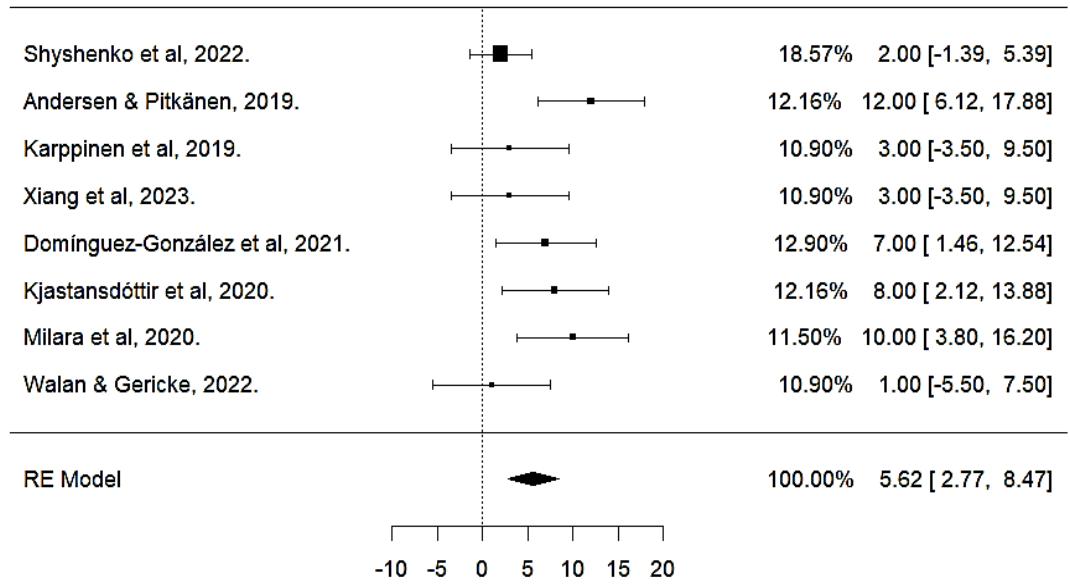 Fig. 2: Efeito do tempo e do intervalo de confiança quanto a formação Maker. Elaborado pelos autores (2024).
O teste Fail-Safe N evidenciou a necessidade de 82 estudos adicionais para alterar o efeito identificado $\begin{array} { r l r } { \mathrm { ( n ~ ) } } & { { } = } & { 82 } \end{array}$; $\mathrm { ~ \mathsf ~ { ~ p ~ } ~ } < \mathrm { ~ \mathsf ~ { ~ 0 ~ } ~ }, 001$, onde não há evidências significativas de viés de publicação relacionado ao tamanho do estudo (Kendall Tau = - 0.079; $\rho = 0.796$. No entanto há algumas assimetrias no funil de dispersão $( \mathsf { R E } = 0.643$; ${ \rho } = 0.520 )$ como disposto na tabela 3.
Tabela 3: Avaliação do viés de publicação.
<table><tr><td>Test Name</td><td>Value</td><td>P</td></tr><tr><td>Fail-Safe N</td><td>82.000</td><td><.001</td></tr><tr><td>Kendalls Tau</td><td>-0.079</td><td>0.796</td></tr><tr><td>Egger's Regression</td><td>0.643</td><td>0.520</td></tr></table>
Por fim, na figura 3 apresenta-se o efeito desempenhado pelo tempo de formação na cultura maker com os resultados positivos apresentados pelos estudos. Os pontos fora do funil podem sugerir a presença de viés de publicação ou fatores que afetam a seleção de estudos, os pontos mais a direita da linha vertical indicam uma tendência de relatos de estudos com efeitos positivos para formações superiores a 5 meses.
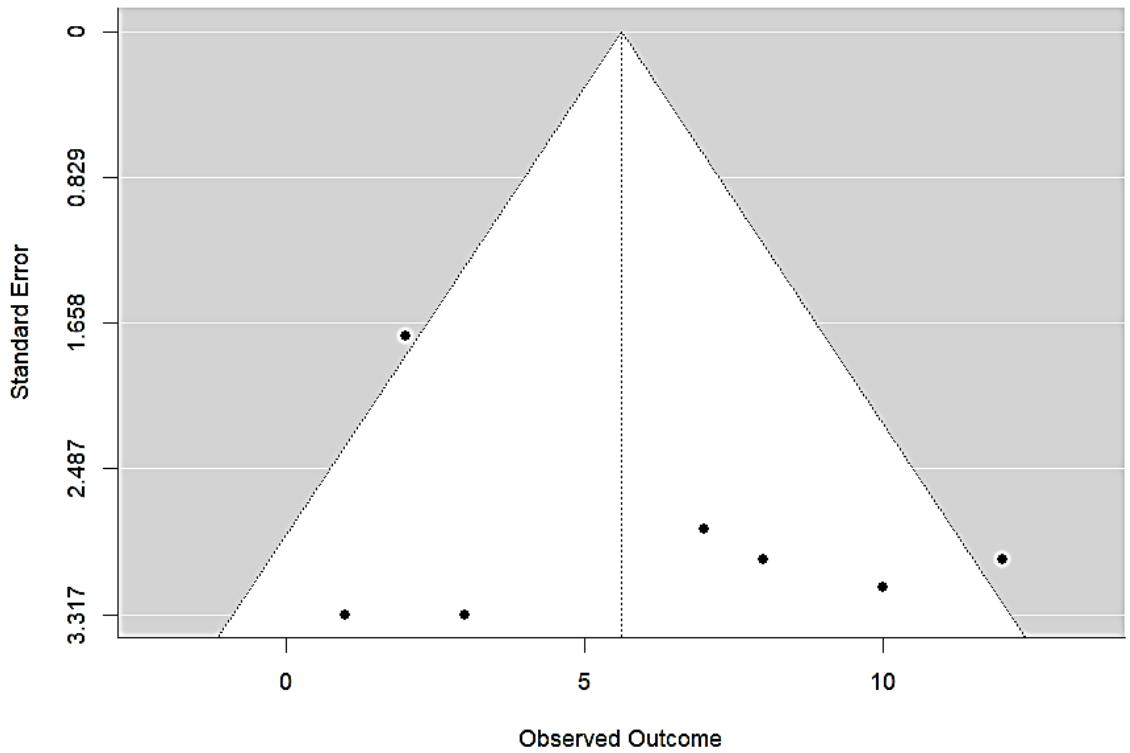 Fig. 3: Funil de dispersão dos estudos. Elaborado pelos autores (2024).
Após a análise completa dos estudos, destacaram-se os estudos de Domínguez-González et al. (2021), Kjartansdóttir et al. (2020) e Milara et al.
(2020), cujos efeitos do tempo de formação são estatisticamente significativos para discussão final desta pesquisa;
Tabela 4: Modelo de efeitos aleatórios $( \mathsf { K } = 8 )$ )
<table><tr><td></td><td>Estimate</td><td>se</td><td>Z</td><td>p</td><td>CI Lower Bound</td><td>CI Upper Bound</td></tr><tr><td>Intercept</td><td>5.58</td><td>1.37</td><td>4.09</td><td><.001</td><td>2.904</td><td>8.260</td></tr></table>
A estimativa pontual é de 5.58, o que significa que, em média, há um efeito negativo ou influência negativa no tempo de formação na cultura maker. Possui um erro padrão baixo $( \mathsf { S } \mathsf { E } ~ = ~ 1.37 )$ - que representa uma estimativa precisa. O z-score indica que os desvios padrões estão acima da média esperada e é considerado estatisticamente significativo $( z = 4.09 )$. O p-value é muito baixo $( \rho \ < \ 0.001$ )indicando que os resultados são estatisticamente significativos e rejeitando uma hipótese nula. Os índices AIC e BIC foram, respectivamente 2.904 e 8.260 conforme disposto na tabela 4. A variação entre os estudos foi substancial além da variação devido ao acaso $( \mathsf { T a u } ^ { 2 } =$ 10.5125) com heterogeneidade alta $( | ^ { 2 } = 77,77\% )$, onde a razão da variação real em relação à variação total observada ${ \bf \langle } \mathsf { H } ^ { 2 } = 4.498 { \bf \rangle }$ mostra que há uma quantidade significativa de variação real entre os estudos. Estes resultados sugerem que, embora haja um efeito global significativamente negativo, essa média pode não ser completamente considerada entre os estudos, como sugere a tabela 5.
Tabela 5: Estatística de Heterogeneidade $( \mathsf { K } = 8$ )
<table><tr><td>Tau</td><td>Tau2</td><td>I2</td><td>H2</td></tr><tr><td>3.242</td><td>10.5125 (SE = 7.8988)</td><td>77.77%</td><td>4.498</td></tr></table>
O efeito do tempo de formação relacionado com as afirmativas negativas relatadas pelos professores é apresentado no Forest Plot da figura 4, onde mostra que o tempo médio para uma formação maker surtir efeito negativo nos professores é igual a
5,58 meses. Os estudos cujos IC's tocam a linha vertical indicam falta de significância estatística enquanto os estudos que não tocam sugerem estimativa estatística significantes.
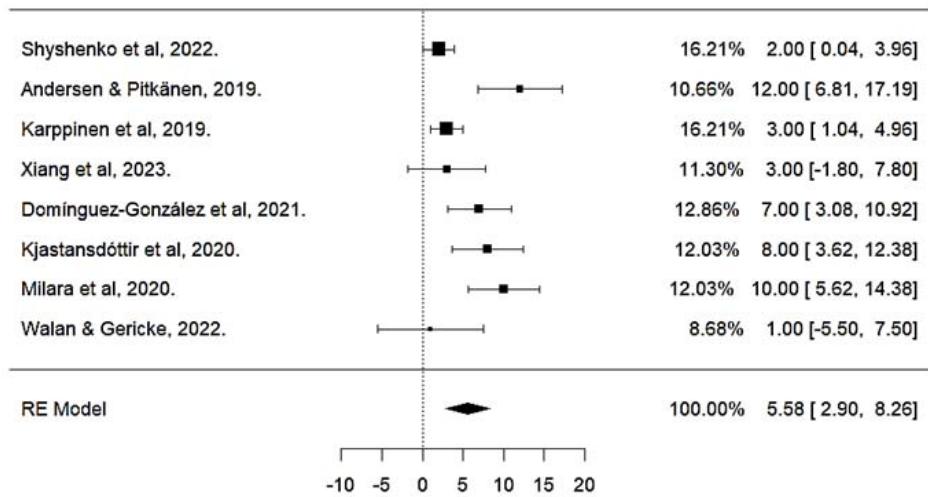
Fonte: Elaborada pelos autores (2024). Fig. 4: Efeitos do tempo e intervalo de confiança quanto a formação maker.
O teste Fail-Safe N evidenciou a necessidade de 181 estudos adicionais para alterar o efeito identificado $( \mathsf { n } ~ = ~ 181$; $\mathsf { ~ p ~ } < \mathsf { ~ 0 ~ }, 001$ ), onde pode haver evidências significativas de viés de publicação relacionado ao tamanho do estudo (Kendall Tau $=$ 0.371; $\mathrm { ~ ~ { ~ \mathsf ~ { ~ P ~ } ~ } ~ } = \mathrm { ~ ~ { ~ \mathsf ~ { ~ O. 209 } } ~ }$, no entanto há assimetrias consideráveis no funil de dispersão $( \mathsf { R E } = 1.093$; $\rho =$ 0.274) como disposto na tabela 6.
Tabela 6: Avaliação do viés de publicação.
<table><tr><td>Test Name</td><td>Value</td><td>P</td></tr><tr><td>Fail-Safe N</td><td>181.000</td><td><.001</td></tr><tr><td>Kendalls Tau</td><td>0.371</td><td>0.209</td></tr><tr><td>Egger's Regression</td><td>1.093</td><td>0.274</td></tr></table>
Por fim, na figura 5 apresenta-se o efeito desempenhado pelo tempo de formação na cultura maker com os resultados negativos apresentados pelos estudos. A presença de pontos fora do funil pode sugerir a presença de viés de publicação ou fatores que afetam a seleção de estudos, os pontos mais à direita da linha vertical indicam uma tendência de relatos de estudos com efeitos negativos para formações superiores a 5 meses, contabilizando um total de 2 estudos.
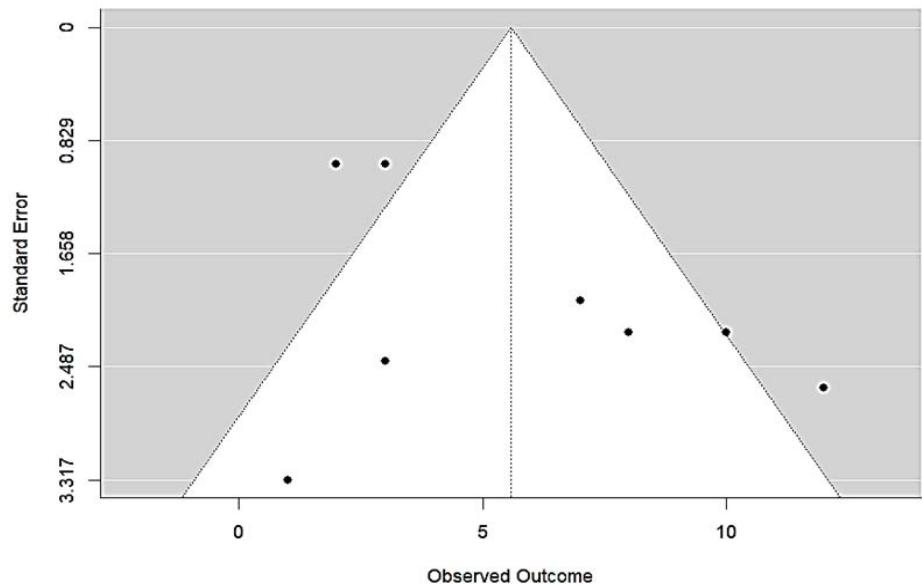
Fig. 5 Funil de dispersão dos estudos. Elaborado pelos autores (2024).
Após a análise completa dos estudos, destacaram-se os estudos de Domínguez-González et al. (2021) e Kjartansdóttir et al. (2020), cujos efeitos do tempo de for mação são estatisticamente significativos para a discussão final desta pesquisa. Acrescentaremos Milara et al. (2020) por estar no limite entre a parte interna e externa do funil.
## IV. DISCUSsÃO
O presente estudo teve como objetivo investigar as competências e habilidades makers adquiridas pelos professores por meio da correlação entre a duração da formação maker e da implementação efetiva de seus resultados em ambientes de ensino. Pelas evidências dos modelos de metanálise, nota-se com clareza que ao tempo mínimo necessário para gerar algum tipo de impacto, seja positivo ou negativo, na formação dos professores, deve ser superior a 5 meses, com intervalo de confiança entre 2,7 meses e 8,4 meses. É importante deixar claro que as formações não foram diárias e ininterruptas, mas sim semanalmente, periódicas e dentro do planejamento semanal escolar. Considera-se também que a magnitude dos efeitos especificados para tais variáveis demanda estudos mais amplos e com compatibilidade entre as medidas e variáveis empregadas para maximizar o nível de significância estatística e, consequentemente, otimizar as condições de generalização das evidências apresentadas. Dentre os oito estudos selecionados, apenas três apresentaram dados estatísticos significativamente relevantes
No estudo de Domínguez-González et al. (2021), realizado com professores de ciências, tecnologia e matemática do ensino fundamental 1 e 2 no México, a formação ocorreu num período de 7 meses, utilizando kits de eletrônica, programação e robótica cujas metodologias abordadas foram Modelo tecno-pedagógico, Andragogia, Construcionismo, Design Thinking e Aprendizagem colaborativa. Ao final do estudo houve 12 relatos, citadas no quadro 4 a seguir.
Quadro 4: Relatos de pós-formação do estudo de Domínguez-González et al (2021). RP - Relato positivo e RN Relato negativo.
<table><tr><td>Relatos</td><td>Frases Coletadas No Estudo (Traduição Dos Autores)</td></tr><tr><td>RP1</td><td>Os professores procuream,a,prender sobre a cultura maker porque consideram que a aplicariam no curto prazo na escola.</td></tr><tr><td>RP2</td><td>Atitudes collaborativas entre os professores e,a,prendizagem cooperativa.</td></tr><tr><td>RP3</td><td>Há processos reflexivos sobre a aplicabilitadade da cultura maker na educação.</td></tr><tr><td>RP4</td><td>Gerou-se a visão com a expectativa de se apoiar{nessa cultura para a solução de problemas, como estrategia didática para travaíhar com seu alunos.</td></tr><tr><td>RP5</td><td>A maior dos alunosasnocraram,satisfaçao emrealizar atividadeprácticasepeloque implicava para culminar atarefa.</td></tr><tr><td>RP6</td><td>O professor observou mudanças positivas nos alunos,algemde othersmudançasesalunosque não seesperava.</td></tr><tr><td>RP7</td><td>Alguns professoresdesenvolveramde formaindependenteatividades em sala de aula,apoiadaela cultura maker.</td></tr><tr><td>RP8</td><td>Um professor desenvolveuatividades inclusivaspara umalunaque nãopodia ouvir e nem falar.</td></tr><tr><td>RN1</td><td>Para algoqnalosfoi dificilamontagemde componenteseletrônicos.</td></tr><tr><td>RN2</td><td>Outros poucos alunosnão cumprimarcom o material solicitado,situaçaoquecausou atraso nasatividadesplanejadaspelos professores.</td></tr><tr><td>RN3</td><td>Alguns alunosmocraramapatiaeindifençaelaatividade.</td></tr><tr><td>RN4</td><td>Alguns professoresnão tiveramapoio da direçãoda escola pararealizaratividadesqueenvolvessemouso de componenteseletrônicosouferramentas,devidoà falta de recursos econômicospara aquisicao de materiais.</td></tr></table>
O estudo realizado por Kjartansdóttir et al. (2020), contou com a participação de professores de tecnologia da educação infantil e do ensino fundamental 1 e 2 na Islândia, cujo tempo de formação foi de 8 meses, utilizando jogos, kits de eletrônica, programação e robótica, além de laboratórios de fabricação digital. As metodologias abordadas forma a STEM, STEAM e Aprendizagem baseada em projetos, tendo ao final da formação 14 relatos que estão citados no quadro 5 a seguir.
Quadro 5: Relatos de pós-formação do estudo de Kjartansdóttir et al. (2020). RP - Relato positivo e RN Relato negativo.
<table><tr><td>Relatos</td><td>Frases Coletadas No Estudo (Traduição Dos Autores)</td></tr><tr><td>RP1</td><td>Um professor admite ter aprendido "muito, organize e ministrandoously com os outros", enquiry "metade do encanto foi,apherder com os professores presentes".</td></tr><tr><td>RP2</td><td>Muitoos membros da equipe mentionam a inclusão a esse respeito e relatam como os makerspaces offerecem opportunities para atender às differentes necessidades e interesses de aprendizagem de diversos alunos com uma escolha de projetos.</td></tr><tr><td>RP3</td><td>Outro professor vê que os makerspaces tem o potencial de afastar os alunos do tédioesimal, especially na série medias, quando as suas "mentes não são suficientemente desafiadas" e os livros assumem o papel de mediadores do conhecimiento.</td></tr><tr><td>RP4</td><td>Os membros da equipe também sublinham a natureza social da aprendizagem e salientam como os professores podem,apherder com os alunos, tal como os alunos uns com os outros.</td></tr><tr><td>RP5</td><td>Um professor deixava as crianças assumirem o controle, permitia que,apherdessem no seu "...rinheiro, aplicar apenas orientações minimas por meio de perguntas esclareceradas, informações sobre detalhes cruciais ou folhotos com orientações instruetionais.</td></tr><tr><td>RP6</td><td>Os membros conseguiram, atraves de,apherder com autodrigida, adquirir e construir o seu "...rinheiro, aplicar apenas orientações minimas por meio de perguntas esclareceradas, informações sobre detalhes cruciais ou folhotos com orientações instruetionais.</td></tr><tr><td>RP7</td><td>Os professores organizaram workshops e"Whys e aproveiçaram as mídias sociais e comunidades digitais para complementar das suas contribuições com professores em todo o País,proporcionando condições favoráveis para uma,apherder com a expansão da cultura do fazer e do maker.</td></tr><tr><td>RP8</td><td>Os professores deram especial atençao ao The Lab of Ingenuity,que capacitou estudiantes deixa natureidade a tornarem-se instrutores de novas technologias e literações digitais,permitindo ao..."laboratório trazer...'conhecimentos,competências e empreendedorismo para a sua comunidade escolar.</td></tr><tr><td>RP9</td><td>Os professores também revelam como os makerspaces podem servir como um local viavel para as pessoas expressarem as suas competências collaborativas e a sua assertividade coletiva.</td></tr><tr><td>RN1</td><td>O tempo también é um problema em termos de encontrar espaço para fazer dentro do curriculum.</td></tr><tr><td>RN2</td><td>Alguns membros da equipe consideram o agendaamento e a elaboração incompatíveis, sustentar que o cronograma deve ser a primeira coisa a ser feita para dar espaço à criatividade e que são necessários períodos mais longos para que os participantes mergulhem na elaboração dos projetos.</td></tr><tr><td>RN3</td><td>Os resultados confirmam outros desafiros, o reduto dos testes padronizados, da preparação de professores e da integração de Tecnologia.</td></tr><tr><td>RN4</td><td>As exigências curriculas das disciplinas e os calendários rígidos dificultaram a implementação de avançosos e deabalhos de projetos integrados sem dispositions especialis.</td></tr><tr><td>RN5</td><td>Houve relutância dos professores de disciplinas académicas em desenvolver sessões de,apherder com experimentais e colaborativas</td></tr></table>
O estudo de Milara et al. (2020) foi com professores de ciências, tecnologia, artes e matemática do ensino fundamental 1 e 2 na Finlândia. Eles utilizaram kits de eletrônica, programação e robótica, além de laboratório de fabricação digital, abordando as metodologias STEAM, Construcionismo, Pensamento computacional, Aprendizagem baseada em projetos e Educação integrativa. Ao final da pesquisa houve 15 relatos que estão citados no quadro 6 a seguir.
Quadro 6: Relatos de pós-formação do estudo de Milara et al. (2020).
RP Relato positivo e RN Relato negativo.
<table><tr><td>Relatos</td><td>Frases Coletadas No Estudo (Traduição Dos Autores)</td></tr><tr><td>RP1</td><td>Reconheceu que as experiências praticas augmentaram a consciência do processo de aprendizagem e dos desafios que os professores podem fazer durante a sua formação.</td></tr><tr><td>RP2</td><td>Descobriram que as máquinas não são a chave para,iniciar as atividades STEAM na escola,mas poder ser inciadas a partir de um[nível muito boa e até mesmo sem máquinas.</td></tr><tr><td>RP3</td><td>Eles perceberam que é mais importante partir da visão e dos values da escola,envolver uma ampla gama de pessoas e considerar quais são as necessidades dosisexuários em relação às máquinas.</td></tr><tr><td>RP4</td><td>Considerou que as atividadespresentadas são adequadas para alunos de uma ampla faixa etária.</td></tr><tr><td>RP5</td><td>Discutiram que tais atividadesproporcionam aos alunos novas possibilidades e participações e encontrararam formas novas e criativas de,aplerder e de se entusiasmarem com a aprendizagem.</td></tr><tr><td>RP6</td><td>Reconhecem a formação como umaatividade de successo,reconhecendo o valor da formação paradesenvolver umentendimento comum e definir um ponto de partida comum para cada escola travahabar para a comunitadê.</td></tr><tr><td>RP7</td><td>Expressaramexplicitamente naqueca que a formação teve impacto na sua visão de ensino.</td></tr><tr><td>RP8</td><td>O professor 2 achou Úteis as metodologias e o material disponibilizando no.</td></tr><tr><td>RP9</td><td>Descobriram que foram reforçadoselo processode design,perceberam aimportância da aprendizagemprática e dedeixar ascriçanas cometerem erros econsideraram os differentes papés de um professor como facilitador da aprendizagem.</td></tr><tr><td>RP10</td><td>Todos os professoresparticipantesno inquisito confirmaram quejáestavamaplanear comointegrar a fabricação digital nas suas aulas,ealgues delesjá forneceramalguns exemplos de projetos que tinkham emente.</td></tr><tr><td>RN1</td><td>Apercentaramcomumdesafio significativo o facto dealgunsprofessores não reconhecem a necessidade dedesenvolverasusas prácticaspara adapá-lasao mundo cada vez mais em mudança emque todos vivemos.</td></tr><tr><td>RN2</td><td>Consideraramasrestrçõesde tempo e osdesafiosestruturaiscomo osprincipaldesafios.</td></tr><tr><td>RN3</td><td>Os professorescomentaramanome Quantidade de conteudos comque tiveram delidar ao longo da formação.</td></tr><tr><td>RN4</td><td>Alguns delesalegaramqueotempo quelheshofoatrubiúdo parafrequrar a formaçãoope prepararasatividades(intervençao,escreverdocumentação,lerartigos...)nãoera suficiente,pelo que tiveramqueutilizar o seuproprio tempo livre paracontinuar a,auperrender.</td></tr><tr><td>RN5</td><td>Na vidaquotidianadescola,arigidez(horários,espacoes)e odesafio de grandesgrupos de alunos dificultamam Implementaçãode muitas ideias.</td></tr></table>
Nota-se que os relatos positivos estão voltados para a utilização da Cultura Maker atrelada à diversas metodologias ativas que possibilitam novas estratégias didáticas gerando satisfação nas atividades executadas pelos professores e alunos. Percebe-se também que há desenvolvimento de novas competências e habilidades para utilização de máquinas do FabLab, gerando a colaboração entre professores, formadores e alunos, além de possibilitar múltiplas formas de inclusão, além do acesso de meninas e mulheres às atividades makers.
Dentre os relatos negativos destacam-se a falta de tempo, tanto para elaborar as atividades makers como para a execução delas em salas de aula. Houve relatos de falta de recursos nas escolas para compras de materiais adequados, de dificuldades em incluir as atividades makers no currículo escolar e a recusa de alguns professores às novas metodologias e integração tecnológica que o Maker propõe.
Alguns estudos descrevem as mudanças pedagógicas exigidas dos professores para apoiar a fabricação digital nos makerspaces ou FabLabs dentro das escolas e para que tais mudanças aconteçam requer tempo e dedicação adequados. Os professores precisam conhecer sobre os materiais que podem ser utilizados, as ferramentas como a impressora 3D e a máquina de corte a laser e os processos de modelagem computacional com uso de softwares específicos para tais atividades, além do mais, precisam conhecer estratégias metodológicas para apoiar a construção de significados e a complexidade de ideias, compreensão dos conhecimentos e interesses prévios dos alunos (Brahms, 2014; Gutwill et al., 2015).
Porém, os estudos de Gohde et al. (2019) afirmam que as tentativas de integrar a Cultura Maker nas escolas numa base generalizada e sustentável, enfrentam diversos desafios consideráveis. Muitas escolas são incapazes ou não querem adotar práticas inovadoras como as tecnologias do maker (Selwyn et al., 2018) e existe um perigo real de que as ferramentas makers sigam a tendência de tecnologias anteriores e sejam apenas utilizadas de maneira superficial e inconsistentes dentro das escolas (Zhao, 2017).
No entanto, este estudo considera que há impactos relevantes na educação básica, quando a formação de professores para o desenvolvimento de atividades makers ocorre de maneira regular e contínua no tempo mínimo de 5 meses, havendo notório desenvolvimento de competências e habilidades para gerar autonomia no desenvolvimento atividades e fabricação de produtos para o ensino.
## V. ConsideraÇÕes Finais
Esta pesquisa buscou contribuir significativamente para o ensino, fornecendo informações valiosas sobre as competências e habilidades makers adquiridas pelos professores por meio da correlação entre a duração da formação maker e da implementação efetiva de seus resultados em ambientes de ensino. Os resultados obtidos poderão orientar políticas educacionais, programas de formação de professores e práticas pedagógicas, visando promover um ensino inovador e alinhado às demandas do século XXI.
Dentes as contribuições que esta pesquisa revela, tem-se o tempo necessário para surtir algum efeito na formação dos professores que deve ser superior a 5 meses (encontros periódicos semanais) com intervalo de confiança entre 2,7 meses e 8,4 meses. Além disto, os principais relatos positivos versam sobre os FabLabs, as metodologias e estratégias didáticas, além do desenvolvimento de competências digitais e as possibilidades de inclusão dos diversos alunos. Os relatos negativos tratam da falta de tempo no planejamento e na implementação das atividades makers, bem como a resistência de alguns professores no uso das ferramentas e metodologias e a falta de recursos financeiros para aquisição de materiais.
Como limitação do corrente estudo, considerase que a magnitude dos efeitos especificados para tais variáveis demanda estudos mais amplos e com compatibilidade entre as medidas e variáveis empregadas para maximizar o nível de significância estatística e, consequentemente, otimizar as condições de generalização das evidências apresentadas.
Além disto, pode haver características que não tenham sido identificadas ou que foram negligenciadas e que podem se revelar importantes, as quais podem ser exploradas futuramente, como exemplo, a análise de subgrupos, de ferramentas específicas do Maker ou comparativos de metodologias. Assim, recomenda-se que pesquisas futuras sejam realizadas com o intuito de analisar como estas formações acontecem, quais são os resultados para grupoespecíficos e, quem sabe, ampliar estas pesquisas para outras áreas do conhecimento além das Ciências, Tecnologias, Engenharias, Artes e Matemática (STEAM).
## VI. OUTrAS InFOrMAÇÕes
Esta RSL não careceu de registro nem de protocolo. A pesquisa foi financiada pelo Programa de Pós-Graduação em Tecnologias Educacionais (PPGTE) da Univerisade Federal do Ceará (UFC). Nenhum potencial conflito de interesse foi relatado pelos autores. Todos os dados coletados para esta revisão estão disponíveis no site: htps://parsif.al/luizpfl/uma-revisaosistematica-sobre-a-formacao-de-professores-e-a-cultur a-maker/ sob pedido de disponibilidade dos autores.
[^1]: https://parsif.al/ _(p.3)_
Generating HTML Viewer...
References
30 Cites in Article
Hanne Andersen,Kati Pitkänen (2019). Empowering educators by developing professional practice in digital fabrication and design thinking.
J Skelton,C Rodgers,L Ellis,A Lyles (2014). Rubrics and Evaluations.
Brasil (2017). ROBIS -Risk of Bias in Systematic Reviews: ferramenta para avaliar o risco de viés em revisões sistemáticas: orientações de uso.
A Carvalho,D Bley (2018). Cultura Maker e o uso das tecnologias digitais na educação: construindo pontes entre as teorias e práticas no Brasil e na Alemanha.
A Carvalho,D Bley (2018). Cultura Maker e o uso das tecnologias digitais na educação: construindo pontes entre as teorias e práticas no Brasil e na Alemanha.
M Eisenberg (2013). 3D printing for children: What to build next?.
T Galvão,T Pansani,D Harrad (2015). Principais itens para relatar Revisões sistemáticas e Meta-análises: A recomendação PRISMA.
Guilherme Peixoto Da Fonseca,Marcelo Rodrigues Dos Santos,Francis Ribeiro De Souza,Carlos Negrão,Maria-Janieire De Nazaré Nunes Alves (2016). TESTOSTERONA E DOENÇA CARDIOVASCULAR: DO TRATAMENTO AO USO ABUSIVO.
Anna-Lena Godhe,Patrik Lilja,Neil Selwyn (2019). Making sense of making: critical issues in the integration of maker education into schools.
D González,M Santiago,M Domínguez González (2021). Mediación tecnológica apoyada en la Cultura Maker para la enseñanza de Ciencia y Tecnología en educación secundaria.
Joshua Gutwill,Nina Hido,Lisa Sindorf (2015). Research to Practice: Observing Learning in Tinkering Activities.
S Karppinen,V Kallunki,K Komulainen (2019). Interdisciplinary craft designing and invention pedagogy in teacher education: student teachers creating smart textiles.
B Kitchenham,S Charters (1051). Guidelines for performing systematic literature reviews in software engineering version 2.3.
Skúlína Kjartansdóttir,Torfi Hjartarson,Svava Pétursdóttir (2020). Of Women Tech Pioneers and Tiny Experts of Ingenuity.
B Litts,Y Kafai,D Fields,E Malverso,K Peppler (2016). Connected making.
L Merkle (2016). Perspectivas educacionais FabLearn: conceitos e práticas maker no Brasil.
Iván Milara,Kati Pitkänen,Jari Laru,Megumi Iwata,Marta Orduña,Jukka Riekki (2020). STEAM in Oulu: Scaffolding the development of a Community of Practice for local educators around STEAM and digital fabrication.
R Orwin (1983). A fail-safe N for effect size in meta-analysis.
P Perrenoud,M Thurler (2009). As competências para ensinar no século XXI: a formação dos professores e o desafio da avaliação.
Team Core (2022). R: A Language and environment for statistical computing (Version 4.1).
J Sefton-Green (2013). Mapping digital makers: A review exploring everyday creativity, learning lives and the digital.
Neil Selwyn,Selena Nemorin,Scott Bulfin,Nicola Johnson (2017). Everyday Schooling in the Digital Age.
I Shyshenko,O Martynenko,Ya. Chkana,O Udovychenko,T Spas,O Semenikhina (2022). A Mathematics Teacher’s Training to Create a Maker Space in Mathematics Lessons by Means of GeoGebra.
J Sterne,A Sutton,J Ioannidis,N Terrin,D Jones,J Lau,. Higgins,J (2011). Recommendations for examining and interpreting funnel plot asymmetry in meta-analyses of randomised controlled trials.
B Taylor (2016). Evaluating the benefit of the maker movement in K-12 STEM education.
(2023). The jamovi project.
J Valente,P Blikstein (2019). Maker education: Where is the knowledge construction?.
Susanne Walan,Niklas Gericke (2023). Transferring makerspace activities to the classroom: a tension between two learning cultures.
S Xiang,W Yang,I Yeter (2023). Making a Makerspace for children: A mixed-methods study in Chinese kindergartens.
Y Zhao (2017). What works may hurt: Side effects in education.
No ethics committee approval was required for this article type.
Data Availability
Not applicable for this article.
How to Cite This Article
Luiz Paulo Fernandes Lima. 2026. \u201cTime of Basic Education Teachers Training in Maker Activities: A Meta-Analysis\u201d. Global Journal of Human-Social Science - G: Linguistics & Education GJHSS-G Volume 24 (GJHSS Volume 24 Issue G2): .
Explore published articles in an immersive Augmented Reality environment. Our platform converts research papers into interactive 3D books, allowing readers to view and interact with content using AR and VR compatible devices.
Your published article is automatically converted into a realistic 3D book. Flip through pages and read research papers in a more engaging and interactive format.
This meta-analysis aimed to investigate the competencies and skills acquired by teachers through correlation between the duration of maker training and effective implementation of its outcomes in educational settings. The methods applied were based on PRISMA recommendation, utilizing the PICOC method, with meta-analysis conducted using the MAJOR Meta-analysis 4.1 package in the JAMOVI statistical software. The results of this study indicated that the time required for the effects of teacher maker training to manifest should exceed 5 months, with a confidence interval between 2.7 months and 8.4 months. It is concluded that training in the maker culture remains a new and growing condition that requires greater attention in the implementation of makerspaces regarding the development of appropriate methodologies, due to the challenges that arise throughout their implementation in schools.
Our website is actively being updated, and changes may occur frequently. Please clear your browser cache if needed. For feedback or error reporting, please email [email protected]
Thank you for connecting with us. We will respond to you shortly.