To Bring an End to Global Warming – Make it Rain

α
William Van Brunt
William Van Brunt

Send Message

To: Author

To Bring an End to Global Warming – Make it Rain

Article Fingerprint

ReserarchID

2WC5F

To Bring an End to Global Warming – Make it Rain Banner

AI TAKEAWAY

Connecting with the Eternal Ground
  • English
  • Afrikaans
  • Albanian
  • Amharic
  • Arabic
  • Armenian
  • Azerbaijani
  • Basque
  • Belarusian
  • Bengali
  • Bosnian
  • Bulgarian
  • Catalan
  • Cebuano
  • Chichewa
  • Chinese (Simplified)
  • Chinese (Traditional)
  • Corsican
  • Croatian
  • Czech
  • Danish
  • Dutch
  • Esperanto
  • Estonian
  • Filipino
  • Finnish
  • French
  • Frisian
  • Galician
  • Georgian
  • German
  • Greek
  • Gujarati
  • Haitian Creole
  • Hausa
  • Hawaiian
  • Hebrew
  • Hindi
  • Hmong
  • Hungarian
  • Icelandic
  • Igbo
  • Indonesian
  • Irish
  • Italian
  • Japanese
  • Javanese
  • Kannada
  • Kazakh
  • Khmer
  • Korean
  • Kurdish (Kurmanji)
  • Kyrgyz
  • Lao
  • Latin
  • Latvian
  • Lithuanian
  • Luxembourgish
  • Macedonian
  • Malagasy
  • Malay
  • Malayalam
  • Maltese
  • Maori
  • Marathi
  • Mongolian
  • Myanmar (Burmese)
  • Nepali
  • Norwegian
  • Pashto
  • Persian
  • Polish
  • Portuguese
  • Punjabi
  • Romanian
  • Russian
  • Samoan
  • Scots Gaelic
  • Serbian
  • Sesotho
  • Shona
  • Sindhi
  • Sinhala
  • Slovak
  • Slovenian
  • Somali
  • Spanish
  • Sundanese
  • Swahili
  • Swedish
  • Tajik
  • Tamil
  • Telugu
  • Thai
  • Turkish
  • Ukrainian
  • Urdu
  • Uzbek
  • Vietnamese
  • Welsh
  • Xhosa
  • Yiddish
  • Yoruba
  • Zulu

Abstract

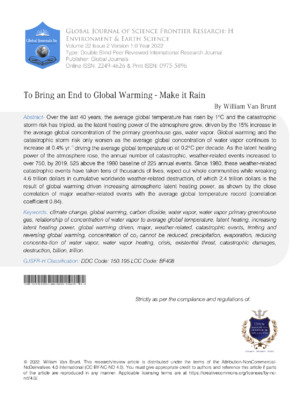
Over the last 40 years, the average global temperature has risen by 1°C and the catastrophic storm risk has tripled, as the latent heating power of the atmosphere grew, driven by the 15% increase in the average global concentration of the primary greenhouse gas, water vapor. Global warming and the catastrophic storm risk only worsen as the average global concentration of water vapor continues to increase at 0.4% yr. -1 driving the average global temperature up at 0.2°C per decade. As the latent heating power of the atmosphere rose, the annual number of catastrophic, weather-related events increased to over 750, by 2019, 525 above the 1980 baseline of 225 annual events. Since 1980, these weather-related catastrophic events have taken tens of thousands of lives, wiped out whole communities while wreaking 4.6 trillion dollars in cumulative worldwide weather-related destruction, of which 2.4 trillion dollars is the result of global warming driven increasing atmospheric latent heating power, as shown by the close correlation of major weather-related events with the average global temperature record (correlation coefficient 0.84).

References

16 Cites in Article
  1. John Houghton (2002). The Physics of Atmospheres.
  2. O Galashev,Rakhmanova (2013). Emissivity of the Main Greenhouse Gases ISSN 1990.
  3. (2020). Time Series Plot and the NOAA Global Climate at a Glance (1910–2015): Global Ocean Temperatures.
  4. J Hansen,,R Ruedy,,M Sato,,K Lo, (2019). NASA GISS Surface Temperature (GISTEMP) Analysis.
  5. W Van Brunt (2020). Autonomous Changes in the Concentration of Water Vapor Drive Climate Change.
  6. S Mieruch,S Noël,H Bovensmann,J Burrows (2008). Analysis of global water vapour trends from satellite measurements in the visible spectral range.


  7. Hye-Mi Kim,Michael Alexander (2015). ENSO’s Modulation of Water Vapor Transport over the Pacific–North American Region.
  8. William Brunt (2020). Autonomous Changes in the Concentration of Water Vapor Drive Climate Change.
  9. William Brunt (2020). Autonomous Changes in the Concentration of Water Vapor Drive Climate Change.
  10. (2013). National Oceanic and Atmospheric Administration (NOAA).
  11. K Mao,Y Ma,L Xia,Wendy Chen,X Shen,T He,T Xu (2014). Global aerosol change in the last decade: An analysis based on MODIS data.
  12. K Mccracken,J Beer (2007). Long‐term changes in the cosmic ray intensity at Earth, 1428–2005.
  13. El Niño (2005). ENSO) Related Rainfall Patterns Over the Tropical Pacific.
  14. E Rauch,A Allmann (2021). Figure 24. Income inequality has been trending upwards.
  15. A Kumar,M Hoerling (2003). The Nature and Causes for the Delayed Atmospheric Response to El Ninõ Journal of Climate.
  16. Stephan Lewandowsky,Kevin Cowtan,James Risbey,Michael Mann,Byron Steinman,Naomi Oreskes,Stefan Rahmstorf (2018). The ‘pause’ in global warming in historical context: (II). Comparing models to observations.

Funding

No external funding was declared for this work.

Conflict of Interest

The authors declare no conflict of interest.

Ethical Approval

No ethics committee approval was required for this article type.

Data Availability

Not applicable for this article.

How to Cite This Article

William Van Brunt. 2026. \u201cTo Bring an End to Global Warming – Make it Rain\u201d. Global Journal of Science Frontier Research - H: Environment & Environmental geology GJSFR-H Volume 22 (GJSFR Volume 22 Issue H2): .

Download Citation

Explores effects of climate change and global warming on environment and ecosystems, emphasizing the importance of sustainable practices.
Journal Specifications

Crossref Journal DOI 10.17406/GJSFR

Print ISSN 0975-5896

e-ISSN 2249-4626

Keywords
Classification
GJSFR-H Classification: DDC Code: 150.195 LCC Code: BF408
Version of record

v1.2

Issue date

April 16, 2022

Language
en
Experiance in AR

Explore published articles in an immersive Augmented Reality environment. Our platform converts research papers into interactive 3D books, allowing readers to view and interact with content using AR and VR compatible devices.

Read in 3D

Your published article is automatically converted into a realistic 3D book. Flip through pages and read research papers in a more engaging and interactive format.

Article Matrices
Total Views: 1664
Total Downloads: 48
2026 Trends
Related Research

Published Article

Over the last 40 years, the average global temperature has risen by 1°C and the catastrophic storm risk has tripled, as the latent heating power of the atmosphere grew, driven by the 15% increase in the average global concentration of the primary greenhouse gas, water vapor. Global warming and the catastrophic storm risk only worsen as the average global concentration of water vapor continues to increase at 0.4% yr. -1 driving the average global temperature up at 0.2°C per decade. As the latent heating power of the atmosphere rose, the annual number of catastrophic, weather-related events increased to over 750, by 2019, 525 above the 1980 baseline of 225 annual events. Since 1980, these weather-related catastrophic events have taken tens of thousands of lives, wiped out whole communities while wreaking 4.6 trillion dollars in cumulative worldwide weather-related destruction, of which 2.4 trillion dollars is the result of global warming driven increasing atmospheric latent heating power, as shown by the close correlation of major weather-related events with the average global temperature record (correlation coefficient 0.84).

Our website is actively being updated, and changes may occur frequently. Please clear your browser cache if needed. For feedback or error reporting, please email [email protected]

Request Access

Please fill out the form below to request access to this research paper. Your request will be reviewed by the editorial or author team.
X

Quote and Order Details

Contact Person

Invoice Address

Notes or Comments

This is the heading

Lorem ipsum dolor sit amet, consectetur adipiscing elit. Ut elit tellus, luctus nec ullamcorper mattis, pulvinar dapibus leo.

High-quality academic research articles on global topics and journals.

To Bring an End to Global Warming – Make it Rain

William Van Brunt
William Van Brunt

Research Journals