

To Evaluate the Role of HbA1C as a Predictor for the Development of Diabetic Nephropathy in Type 1 Diabetic Patients

Article ID

7W64A

A study on using HbA1c as a predictor for diabetic nephropathy development.

To Evaluate the Role of HbA1C as a Predictor for the Development of Diabetic Nephropathy in Type 1 Diabetic Patients

Dr. Sushant Duddala
Dr. Sushant Duddala
Arghadip Das
Arghadip Das
Shaibesh M Shrestha
Shaibesh M Shrestha
Dr. Snigdha Shanti Cheela
Dr. Himani J Suthar
Dr. Himani J Suthar
Dr. Vinodh Boopalraj
Irshan Ali Mohammed
Irshan Ali Mohammed
DOI

Abstract

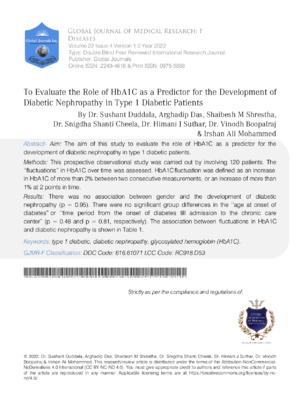
Aim: The aim of this study to evaluate the role of HbA1C as a predictor for the development of diabetic nephropathy in type 1 diabetic patients. Methods: This prospective observational study was carried out by involving 120patients. The ‘‘fluctuations” in HbA1C over time was assessed. HbA1C fluctuation was defined as an increase in HbA1C of more than 2% between two consecutive measurements, or an increase of more than 1% at 2 points in time. Results: There was no association between gender and the development of diabetic nephropathy (p = 0.95). There were no significant group differences in the ‘‘age at onset of diabetes” or ‘‘time period from the onset of diabetes till admission to the chronic care center” (p = 0.48 and p = 0.81, respectively). The association between fluctuations in HbA1C and diabetic nephropathy is shown in Table 1. Among those who developed nephropathy, 10 of 20(60%) had fluctuations in HbA1C; compared to those who do not develop nephropathy 54 of 100 (54%) had fluctuations in HbA1C (p = 0.05). The mean HbA1C per individual was 8.65 ± 1.3 in the whole sample. As shown in Table 1, mean HbA1C was 9.5 ± 1.7% among those who developed nephropathy compared to a mean of 8.6 ± 1.2% for those who did not develop nephropathy, and was statistically significant between the two groups (p = 0.004). Conclusion: we concluded that the T1D patients who have a similar mean HbA1C may progressively behave differently in terms of developing nephropathy, depending on the fluctuations in HbA1C.

To Evaluate the Role of HbA1C as a Predictor for the Development of Diabetic Nephropathy in Type 1 Diabetic Patients

Aim: The aim of this study to evaluate the role of HbA1C as a predictor for the development of diabetic nephropathy in type 1 diabetic patients. Methods: This prospective observational study was carried out by involving 120patients. The ‘‘fluctuations” in HbA1C over time was assessed. HbA1C fluctuation was defined as an increase in HbA1C of more than 2% between two consecutive measurements, or an increase of more than 1% at 2 points in time. Results: There was no association between gender and the development of diabetic nephropathy (p = 0.95). There were no significant group differences in the ‘‘age at onset of diabetes” or ‘‘time period from the onset of diabetes till admission to the chronic care center” (p = 0.48 and p = 0.81, respectively). The association between fluctuations in HbA1C and diabetic nephropathy is shown in Table 1. Among those who developed nephropathy, 10 of 20(60%) had fluctuations in HbA1C; compared to those who do not develop nephropathy 54 of 100 (54%) had fluctuations in HbA1C (p = 0.05). The mean HbA1C per individual was 8.65 ± 1.3 in the whole sample. As shown in Table 1, mean HbA1C was 9.5 ± 1.7% among those who developed nephropathy compared to a mean of 8.6 ± 1.2% for those who did not develop nephropathy, and was statistically significant between the two groups (p = 0.004). Conclusion: we concluded that the T1D patients who have a similar mean HbA1C may progressively behave differently in terms of developing nephropathy, depending on the fluctuations in HbA1C.

Dr. Sushant Duddala
Dr. Sushant Duddala
Arghadip Das
Arghadip Das
Shaibesh M Shrestha
Shaibesh M Shrestha
Dr. Snigdha Shanti Cheela
Dr. Himani J Suthar
Dr. Himani J Suthar
Dr. Vinodh Boopalraj
Irshan Ali Mohammed
Irshan Ali Mohammed

No Figures found in article.

Dr. Sushant Duddala. 2026. “. Global Journal of Medical Research – F: Diseases GJMR-F Volume 22 (GJMR Volume 22 Issue F4): .

Download Citation

Journal Specifications

Crossref Journal DOI 10.17406/gjmra

Print ISSN 0975-5888

e-ISSN 2249-4618

Classification
GJMR-F Classification: DDC Code: 616.61071 LCC Code: RC918.D53
Keywords
Article Matrices
Total Views: 1628
Total Downloads: 10
2026 Trends
Research Identity (RIN)
Related Research
Our website is actively being updated, and changes may occur frequently. Please clear your browser cache if needed. For feedback or error reporting, please email [email protected]

Request Access

Please fill out the form below to request access to this research paper. Your request will be reviewed by the editorial or author team.
X

Quote and Order Details

Contact Person

Invoice Address

Notes or Comments

This is the heading

Lorem ipsum dolor sit amet, consectetur adipiscing elit. Ut elit tellus, luctus nec ullamcorper mattis, pulvinar dapibus leo.


High-quality academic research articles on global topics and journals.

To Evaluate the Role of HbA1C as a Predictor for the Development of Diabetic Nephropathy in Type 1 Diabetic Patients

Dr. Sushant Duddala
Dr. Sushant Duddala
Arghadip Das
Arghadip Das
Shaibesh M Shrestha
Shaibesh M Shrestha
Dr. Snigdha Shanti Cheela
Dr. Himani J Suthar
Dr. Himani J Suthar
Dr. Vinodh Boopalraj
Irshan Ali Mohammed
Irshan Ali Mohammed

Research Journals






























































