I. INTRODUCTION
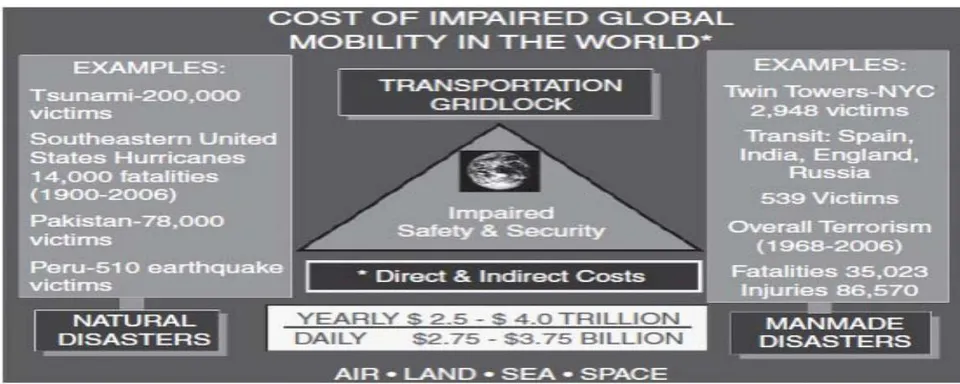
The 9/11 attack, in the USA, suggests that the terrorists are extending their operational mandates beyond the land-based threats. The container security initiatives come into light as an institutional response to terrorists' threat to improving the borders security and global trading system through pre-screening 100% US-bound shipping containers from all ports around the world. After the 9/11, the exposure of the risks and the severity of the security threat bring a new dimension to think and act right now. The threats and the perception of the security threats have changed the security matrix of the USA in large scale. The 9/11 was a significant trauma for the United States itself and the world community those who are directly or indirectly involved in maritime transportation as well as the civil society around the globe. From that point of view, the USA security top brass has redesigned their strategies to combat the threats stemming from the terrorists globally. (Source: Fact Sheet, 2007). The attempt has been made here to scan the initiatives taken by the USA in global scale regarding feasibility, achievability and its implications in the international trade and commerce.
a) The aim and objectives
This study aims to look at the matter in broader perspectives especially in the context of existing limitations and constraints of the international seaborne trade and commerce. The objectives are plural that is to examine the feasibility, achievability of the CSI, and its implications in a global context.
b) Methodology
This particular study has been developed through secondary research that includes consulting relevant books, journals, publications, and various
UNCTAD reports. However, a few numbers of professionals, academics, and logistic consultants in maritime industries have been interviewed.
II. THE CSI IN BRIEF
The container security initiatives (CSI) are based on the bilateral agreements signed between foreign customs, and the US Custom and Border Protection (CBP). The primary function of the CSI is to target and pre-screen the containers destined for or transiting through the USA from the rest of the world which may pose a potential security risk to the United States. The CSI is a reciprocal programme; under CSI, the US customs will have the access and will station in the ports of the CSI participating countries to ensure the security compliance and criteria under these regimes while the participant countries will enjoy the same opportunity if they wish to. The CSI designates three core elements:
Identify high-risk containers
Pre-Screen and evaluate the containers before placed on vessels.
Use technology in order to pre-screen the high-risk containers without slowing down the movement of the legitimate trade.
It is believed that some factors influence the authority concerned to introduce the CSI. Firstly, lax of port security, inadequate ocean surveillance after cold war, overwhelming dependences on maritime trades and transportation, the trend of littoral states concentrates their resources on land-based structures to protect, Secondly, maritime attack has given the opportunity to the extremist lobby to cause the massive economic destabilisation through shutting down the critical Sea lanes of Communication(SLOC), Thirdly, maritime based terrorism has given the opportunity of the terrorists as viable means of inflicting coercive punishment on enemy audiences. Fourthly, the global containerisation complex provides the extremists with a logistical channel facilitating a covert movement of weapons and personnel. (Chalk, P. 2008).
III. INTERNATIONAL SEABORNE TRADE,
The containerised shipping has been a critical component in the global trade due to containerization nowadays. It carries great significance in international trade as the 108 million cargo containers are transported each year around the world with various means of sea transportation. Regarding manufactured goods, 90 percents of world manufactured goods are being transported through containerised mode. In 2006, 11.6 million containers arrived in the USA that is 32000 containers per day.
The vast volume of international seaborne trade and the globally integrated supply chain that deal with demand and supply equation, emphasis on the needs for of security of the supply chain players and respective trading countries. Particularly in the USA, six million containers enter into the States every year and projected figure by 2010 will be doubled. The US imports in 2000 were 23% of Global Imports according to IMF Direction of Trade Year Book 2001 and 50% of these imports stem from developing countries (Developing Asia, America, and Africa). The imports from Developing Asia, America and Africa, are 25%, 17% and 2% respectively to the USA while this much import is equivalent to 23%, 54% and 19% exports of this three country groupage respectively. This scenario depicts an overall picture of world trade and the US trade where the CSI seems to have a significant influence over the US and international trade.
The container security initiatives incorporate 24 hours advance vessel manifest rule that allows the officer of the US Customs stationed in a foreign port to analyse information of the containers and identify any potential threats before loading on board and target high-risk cargo destined for and transiting through the US. The 24-hour rule obligates the respective players to submit 14 data electronically to the CBP as shown in figure 01 below:
Fig. 2: 14 Data Requirements
| 1 | Foreign port of departure |
| 2 | Standard carrier alpha code (SCAC) |
| 3 | Voyage number |
| 4 | Date of scheduled arrival in the first US port |
| 5 | Number and quantity of packages (based on bill of lading descriptions) |
| 6 | First port of receipt by the carrier |
| 7 | Detailed cargo description: shipper's description or the 6-digit harmonised tariff schedule number |
| 8 | Shipper's name and address. Alternatively ID numbers as assigned by US customs |
| 9 | Consignee's name and address. Alternatively ID numbers as assigned by US customs |
| 10 | Vessel flag, name and number |
| 11 | Names of foreign ports visited beyond the port named in point 6 |
| 12 | International hazardous goods code if applicable to cargo |
| 13 | Container number |
| 14 | Numbers on all seals affixed to the container |
All data outlined above need to be supplied mandatorily to the CBP through electronically for their approval and further verification. This measure repeals the vague cargo descriptions such as Freight-all-Kind totally, Said to contain, foodstuff or general merchandise etc.
C-TPAT, another approach, is a joint of government and business initiative to strengthen the cooperative relationship regarding overall supply chain security and border security through exchanging reliable and verifiable security information about their suppliers.
The participants in C-TPAT enjoy the first lane preferential treatment during the customs inspection and expedited procedures under the auspices of C-TPAT.
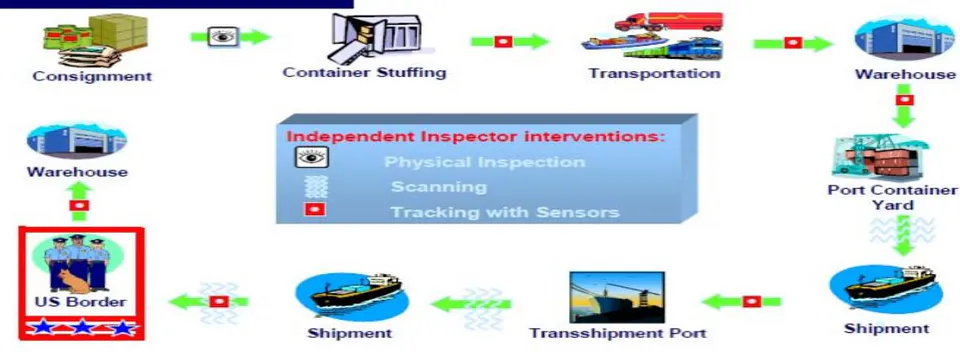
Now the question is whether the CSI arrangement either feasible or achievable? Regarding feasibility, it can be argued that this measure is not out of the elaborate security management information system. The proposed CSI embraces the independent inspector intervention includes physical examination, Non-Intrusive examination (Scanning with Gamma Rays), and tracking with sensors at different processes of container loadings. The vessel requires 14 specific data about the container. The availability of massive data, transmission and verification of these data with the CBP, and its clearance may delay the loading operations could require the cargo to be loaded in the next vessel. This warns that the possible disruption of vessel scheduling, increasing demand for shore-based storage infrastructure, and commercial loss due to the cargo being time sensitive, are expected. The CSI uses intelligence and automated information to identify the suspected containers have some drawbacks as the
Source: Bichou, K (2009) intelligence report does not always provide the crosscheck of statistical reasoning that leads to high level of noise in background data. (Bichou,2009), (Nagle, K.N.2009-10).
The coordination of the all reliable information is a precondition to ensure the objectives of the regime proposed. It is the requirement to collect information, analyse, and assimilate the threat information and need to pass information to the right people to deal with in time, to ensure the purpose of the regime. However, the question arises-what would be the scenario when the intelligence reports and the scanning reports on particular container contradict each other? In this case, the delay is imminent. In the crisis time, if the management of the information system fails to coordinate and obtain exact data from the exact people on time, then the total system of systems may fail to work. (Natale, P.J 2009).
The CSI has been undertaken to thwart the security threats to the US. From that point of view, it can argue that this is a biased security approach, like a USCG deepwater project rather than inspection biased approach.
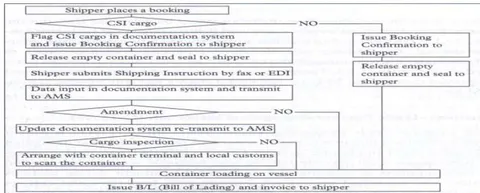
This approach stresses the prevention rather than inspection. However, these measures have some positive aspects such as the compliance of all transportation regimes can be ensured and complied with, and will increase the supply chain visibility. In the assessment of feasibility, the following dimension needs to inspect and analyse such as marketing, administration (documentation and ICT) and operations are regarded as three functional departments in container transportation as shown in figure 05 below-(Bichou, K.2009)
Fig. 5: Potential Errors of 24 rules
| Functional department | Potential errors |
| Marketing | Flagging the CSI cargo in business information systemBooking data qualityBooking Confirmation to shipperCSI cut-off time |
| Administration(documentation and ICT) | Manifest data qualityTransmission of manifest data to AMS timelyHandling amendmentBill of Lading issuance to shipperRating the shipmentBilling the CSI fee and amendment fee |
| Operations | Ship/port planningRelease of empty containerCoordination with terminals and customers for cargo inspection |
Any local or international legislation needs to conform to the maximum utilisation of resources available, stakeholder interests, and pace of the industry
Source: Bichou, K (2009) concerned. As the shipping is now derived demand in the world's current context, then the economies of scale come to the corner to consider.
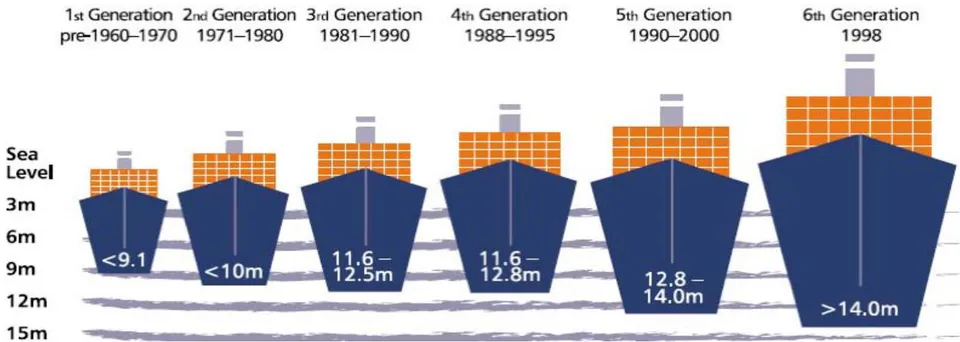
The evolution of container day by day is taking place to keep the economies of scale in the right figure. As the carrier becomes bigger, under 24-hour rule, the inventory lists will be more significant. This inventory seems to be critical in case of group age cosmetics consignments where the carriage of goods ranging from aromatic oils to soaps to lipsticks to nail varnish. Some of them are dangerous goods due to flammable nature. In that case, the computer system of CBP may tend to be laden or require extra time to assess and analyse satisfying their standards set. The likelihood of delays is
Source: Victorian ports strategic framework expected. It seems to be a cumbersome task for the respective custom officer or the CBP due to the sheer volume of container information even that is true in case of random inspection as well. (Bichou, K.2009).
The security literature and economic or financial literature does not exist in the same axis in all time. With the CSI, The US has made great strides in transportation security is beyond doubt. The US-led CSI needs to analyse from the viewpoint of- whether the US authority has taken into account the nature, limitation of regulatory context in which the maritime industry works or operates in the home or international level. The maritime security literature implies to do so before any development, application, management, and risk assessment of any proposed law or regulations. In this case, such initiatives either have been taken or not, have not reported yet. Any international regulatory instruments provide prescriptive guidelines for compliance, implementation while the developments, management of risks are entrusted down to the government agencies, or authorised organisation.
The US-led CSI, it is so far clear that both the regulatory body (CBP), and body of management and implementation of proposed security regime, is the same department which raises the significant question of reliability and impartiality of information they will be gathering in verification and decision-making process. In the same time, the CBP may not allow anybody or third party to access their data or information gathered in any particular case for crosscheck assuming that it is sensitive to be shared. The shippers or carriers may tend to hide information as required by the CBP (14 data) in fear of the fate of transportation of goods, commercial reputation standing in the community, and international arena. This point needs to look at before implementation of the US-led CSI regime on a global scale. If the transparency and accountability of the CBP are not set in a comprehensive framework of an independent body, then the international business community may lose the confidence over the system, or there will be a scope to make or to be victimised commercially. (Bichou, K.2009).
However, it is still unclear –whether the CBP is looking at to the point. In the current trend of international business, the bill of lading is the critical item for international documentary credits, and its behaviour varies with the context especially in shipping as far as concerned. In this case, full and accurate information regarding the final owner of the cargo or cargo movement throughout the supply chain may not be available instantly to the CBP or designated customs officer stationed at the foreign port due to frequent trade made en route that lacks both the feasibility and achievability of the CSI. (Wilson, J.F.2008).
In those particular cases, the situation will lead to congestion at the loading ports because of mandatory 14 data requirements under 24 Hour Rule. The host country will endure the all possible impacts. The maritime security literature both suggests and stresses on international harmonisation and reciprocity rather than a single concept to set common standards and requirements through international bodies and instruments such as the IMO and its legislation. This harmonisation concept facilitates to improve security, increase trade and commerce, better relations and save money. The US-led CSI seems to lack such opportunities. However, regarding reciprocity, the CBP assures the willing participant to join in the CSI, but that is also not out of the US imposed requirements and domination. Regarding security question, it has been seen that either the measures are "The US imposed and other countries conform" attitudes. This unilateral approach and attitude raise the fundamental question of the effectiveness of the measures taken in the global context as the threats of terrorists are not limited to the jurisdiction of the USA authority and CSI participant countries only but have the international dimension. (Natale, P.J.2009).
The conventional risk targeting is based on the assumptions of un-intentional (not deliberately) human or system behaviour to cause harm(safety-risk approach) but in case of the formulation of the CSI has not got the same perspective as the threats stem from terrorists or malicious acts that have the global dimension. The feasibility assessment implies to examine - whether the US-led CSI impede the flow of cargo and commerce. The CBP has undertaken a program, under the CSI, to improve the quality of information provided by the carrier to evaluate the potential risks, put the ocean carrier under the burden. On the other hand, the Importer Security Filing or '10+2' obligates the importers to provide ten specific data to CBP before loading. The ocean carrier is under obligation to place 2 data files before CBP within 48 hours before departure. The 10+2 initiatives will add the annual costs in between 690 million to the supply chain costs due to filing fees.
Dr Stephen E Flynn, Fellow of the Counterterrorism and National Security Studies, estimates that the 100% container inspection will result in a half day delay per container and radioactive x-ray system will cost 20 per container. This Estimation indicates that the global supply chain tends to be slower and costly. Nobody is against the principle of security of cargo, vessel and so on but the question of feasibility comes to the corner when security is ensured at the expense of benefits from the globalised economy. (Leone, A.M. 2009-10). It can be argued that the information technology is there for a radical technical solution which raises the concerns- whether that is economical especially for developing CSI countries.
Moreover, the current facility design of the ports and the security dimension sought under CSI are not compatible with the existing global ports. This is the critical point of conflict which gives rise the supply chain cost and raises the question of feasibility from the infrastructural point of view. The argument is that the integration of port facility design and security aspects can minimise the costs and expedite the flow of commerce and cargo throughout the supply chain. (Abbott, S.P. 2009-10). The feasibility examination needs to look at the financial capability point of view. The combating terrorism suggests that three elements are instrumental such as Crisis Management, Consequence Management, and Protective Measures. Crisis management requires plans and methods, and Consequence Management requires strategies and resources. Finally, Protective measure implies to make sure proper planning and resources (Technology, Skilled and trained Manpower, infrastructure), to protect resources. (Christopher, K. (2009).
However, according to the customs of the Netherlands and the United Kingdom, one scanner can scan 30,000 containers per year although the long time is needed to analyse and interpret the image taken. According to British Customs, the mobile scanner costs from 3.3 million while the fixed scanner is costing about $20 million. FEMA (The Federal Emergency Management Agency) under the Port Security Grant Program, the US government, shares the port security costs regarding security equipment maintenance contracts, warranties, repair, or replacement costs and upgrades. It indicates that the USA can share the expenses mentioned above assuming that it is a shared responsibility. In a similar vein, could the CSI governments' effort the same expenses through cost sharing like the USA? What would be the stake holder's perceptions in CSI countries regarding costs sharing? If not, what would be the alternative? The alternative could be the granting soft loans for the CSI country, but it will also put the CSI members under financial burden. Significantly, it raises the question of the financial and technological capabilities of the allied countries to adopt this measure.
IV. IMPLICATIONS ON INTERNATIONAL SEABORNE TRADE
The literature of Cost-benefit analysis implies to find out the answer of the question- whether security is a cost or enabler of trade and commerce, whether it is regarded as expense or trade facilitator in the current globalised economy? The current reality is- the emerging security issue seems to be inconsistent with the principle of facilitation of international trade due to additional costs. The additional costs lead to the financial burden to the respective port players that imply to have a right balance between trade facilitation and security measures. The balance between costs and security measures is essential because the additional costs may reduce the consumer's demand for the lower value of goods transported in a container and finally products can be uncompetitive. This issue might impact the economy and the trade of developing countries. (UNCTAD). The maritime operators of the CSI country need to invest vast amounts on security equipment, procedures, and recruitment of additional security personnel in compliance with CSI. The stakeholders seem to endure the CSI compliance, procedural and operational costs. (Bichou, K.2009).The efficient operations of any transport modes are dependent on the modern but simplified procedures and reduced barriers, simplified legal regime, adequate resources, management efficiency and capability etc. in order to facilitate both the integrated logistics operations and consumer's comfort. Dr Stephen E Flynn attempts to investigate- whether security initiatives interrupt the flow of commerce and cargo, does the supply chain seem to be expensive with the CSI? The estimation of Dr Stephen E Flynn indicates that the global supply chain tends to be slower and costly as mentioned earlier (Leone, A.M.2009-10).
The security needs to be ensured to measure the performance of the supply chain in order to have uninterrupted service up to the consumption unit. However, the other side of the security has - the compliance costs, procedural and operational costs. These additional costs seem to be exerted negative pressure on the CSI participant economies. On the other hand, the competitiveness of internationally traded products is influenced by some specific factors such as the Costs including direct costs, indirect costs, additional costs(insurance) etc., Time, Safety, Risks, and finally Security. It seems that the CSI security initiative may increase the direct and indirect costs (due to delay under conventional arrangement such as CSI) but can save the significant costs as the goods flow will not be interrupted by other constraints such as terrorist threats. The insurance premium will be low due to the immediate effect of security. The OCED (2002) estimates that the costs of delays and procedures range from 5 to 13% of the value of the goods traded. (Source: OCED.2002). These estimates suggest to having secured supply chain and if the security question is ignored may become the source of delays. The above recommend that the trading opportunity can be benefitted through organised and harmonised security approach.
All possible circumstances point the finger to the possible delays that are the central concern of all players involved with maritime transportation sectors. The delays have the series of consequences as the delays lead to congestion in ports leads to vessel schedule cancellation and disruption leads to shore-based storage infrastructure demands lead to increased costs of shipper leads to commodity price high and ultimate effects on consumers being deprived of the globalised economy due to the high supply chain. The maritime transport stakeholders involved with trading with the USA may see their economies of scale regarding operating costs in US trade routes(Transatlantic and Transpacific); the CSI may influence their strategies and in setting alternative options.
(UNCTAD Transport Newsletter (2003) FEMA (The Federal Emergency Management Agency) under Port Security Grant Program, the US government, shares the port security costs regarding security equipment maintenance contracts, warranties, repair, or replacement costs and upgrades but the reciprocal program seems to be absent in CSI country which may lead financial burden for stakeholders. AAPA, Port & Politics (2009-2010). In the globalised economy, the literature of integrated logistics system suggests that the goods be produced, consumed, and distributed from the origin (producer) to destination (customer) at right quantity, at the right quality, at the right time and finally at the competitive and right price. As the philosophy is-No transport, No trade and commerce. The integrated transport/logistics ensures the uninterrupted and smooth flow of commerce and cargo and gives the guarantee of transfer at reduced costs to consumers and customers. That means, the optimisation can be achieved through. It can be argued that, with the introduction of CSI, the USA and its CSI allies seek to optimize their own logistical system independently apart from the mainstream global supply chain in the name of security that may result in loss of both the grand integrity of global supply chain and efficient management of product flow across the global chain or pipeline will be sub-optimal and unbalanced due to US-led unilateral approach.
V. CONCLUSION
There is no scope to initiate any measures independently in supply chain management if so, it only will contribute the costs to supply chain. (Banomyong, R. 2005). This may lead to a reduction of efficiency and reliability of the supply chain in particular in the maritime transportation industry. However, the efficient transport and the secured transport are not opposite each other. It can be argued that the world, faces this measure as the first time, has not had any experience and infrastructure to deal with current context, the initial costs will seem to be disappointing to put the new system in place. It indicates that the short-term effects may not be welcoming, but the medium and long-term effects can be a facilitator or driver in trade and overall supply chain enhancements.