## I. INTRODUCTION
Psychologists view the individual as the primary unit of interest; thus, psychological arguments tend towards a latent individualism in various disciplines. Incorporating psychological analysis into IR is difficult due to the complexity and range of variables that IR normally evaluates. Political psychology-based decision-making theories, however, have lately seen a rebirth in IR research. Associated research agendas, particularly those linked to the micro dynamics of behaviour in Foreign Policy Analysis (FPA) have also elicited growing attention (Hall and Ross 2015). Although the predicament of relating decision-making models at the level of individuals to societal or organizational levels of analysis is ever-present, the challenge of identifying the nuances of change remains a pressing concern for IR. This paper addresses the prevailing psychological-constructivist dichotomy and advances a novel, individual-centric approach to IR. Starting with constructivist thinking, it opens a critical path to the analysis of the micro dynamics of behaviour, specifically by understanding the personality traits of a specific leader in its case study.
### a) A Constructivist analysis
Constructivism emerged in IR in the late 1980s. Critiquing prevailing theories, constructivism refers to a social model that assesses sets of meaningful practices /behaviours to determine the structure wherein the interactions of actors are developed. In constructivism, the interplay between structure and agency becomes a mutually reproducible structure comprising actors' relationships and the social context at large (Adler 1997; Hopf 1998). Derived from social constructionism in sociology, constructivism specifically aimed to surmount of mainstream realism shortcomings (Chernysh 2010; Wendt 1992). Constructivism accordingly builds on existing IR theories with an emphasis on qualitative forms of interpretation: particularly, Daddow (2013) examines the constructivist essence denoting a theoretical marriage between the intersubjective nature of reality, seeing human activities and understandings of those activities as constructions constantly engaged in identities and norms' negotiations. Slaughter (2011) points out that constructivism is significant about the meanings derived from past social practices and beliefs. Finnemore and Sikkink (2001) go a step forward in defining constructivism, referring to a climax of social life and societal change, while simultaneously providing a methodological advance of mainstream IR theories.
Constructivists opine that 'invisible' structures such as national politics and transnational interactions alter rules and norms constitutive of political practices across the international system (Koslowski and Kratochwil, 1995). Nonetheless, constructivists posit a logic of relations between identities and norms and societal expectations, thus setting limits for legitimate conduct (Goldgeier and Tetlock 2001, March and Olsen 1998, Wendt 1999). Ideas and identities matter in shaping behaviours and outcomes; those are not defined by structures of the global power balance or by an 'objective national interest' as different realist positions had asserted.
While some constructivists see the role played by the state as central and the latter as a key unit of analysis, others do not. Some constructivists entails the concept that our observation in the global realm comes from social interactions still dominated by the state. Wendt, a prominent constructivist thinker, suggests "the constitutions of identities and interests [are] more of a say in the explanation for State behaviour and the outcomes that result from the interaction between States in the international arena" (Daddow 2013, p.164-165) and that "anarchy is what states make of it". Wendt criticises realism and then re-reifies the state as central to IR knowledge. Essential for this paper's later discussion, the contrary view suggests that actors, who may be states or other actors, change norms constitutive of political practises underpinning the overarching international system in which states dwell (Koslowski and Kratochwil 1995). Metaphorically speaking, states are also subject to pressures and conflicts which arise from within and without which cannot be reduced to 'national interest'; they are not essentially pawns on a structural game board where states merely create and then comply with tried-and-tested conventions (Koslowski and Kratochwil 1995). Thus, states' interactions further construct norms traceable into international bodies devising new patterns of social processes (Finnemore and Sikkink 1998).
Constructivism therefore is this paper's preferred theory because it advances a view that different units of analysis beyond state-centrism can be key factors in revealing human identities and behaviour, "say[ing] more about us, our collective constructions of international life and our desires than it does about what is happening in the world" (Doty 2000, p.139). By embracing those core principles which aim to examine and dismantle the status quo of state centricism, the paper stresses the importance of identity, norms, and ideas. Therefore, I first argue state-centrism is the inner problem - as any other micro-state actor is approximated to be the state, hiding seemingly insignificant shades and details. The paper advances the alternative constructivist approach, concerning the "internalisation of norms" designed by Martha Finnemore and Kathryn Sikkink (1998), Doty and others.
However, Tan (2006) advances conceptual points coalescing with my previous theoretical explanations concerning the principle shared by IR main theories. He suggests that constructivism is less distinct from other IR models than it likes to claim as it shares the same epistemological foundations, because it is still traceable to post 1648 Westphalian. This was because the first positivist theory, Realism, was built around state-centric assumptions. In so far as some constructivist's unit of analysis is taken from rationalist empiricism and state-centricism, it is inadequate: Wendt (1987), a constructivist founder, claims the identity of the state is unquestionable since its identity remains the basis of any analysis in IR. Adler and Barnett (1998) support this argument, emphasising the ontology of states' identities being traditionally units of analysis. This "taken for granted measurement" would explain Wendt's (1987) claims that state order is the dictating structure explaining the global arena's changes.
Contrarily, Doty (2000) claims the discussions on what constitutes the theory's best analytical unit is predicated on a rationalist research agenda. Constructivism emerged after positivist theories but its initial pioneers did not challenge the centrality of the state as the main analytical analysis. "In reifying [...] the State [...] ideas/norms, constructivism can no longer claim to privilege practice in its analysis of international. Constructivism, [...] tends to fall back upon the idealized notion of a 'pre-interactional order" (Tan 2006, p.254). In inexplicably, state centrisism has not gone unchallenged by IR scholars' subdivisions, but their influence in the field was insufficient to advance alternative solutions. As Palan (2000) contends, the state-unit has gained widespread acceptance in the IR system. However, within constructivism, key thinkers share the same linear viewpoint which sees state centrisism as the foundations for the following constructivist analysis. Therefore, the state became a universal accepted construction.
Scholars approach the aforementioned claims differently: Tan (2006) credits constructivist subjectivity, addressing concepts and ideas as elements that construct the world; yet, Tan offers no explanation as to how it would be possible to analyse norms and ideas unrelated to structure. He holds the challenge of constructivism lies in determining how institutions influence state behaviour; this paper argues from Tan and others that one needs to go beneath (or 'beyond') state level analysis, taking account of institutions and individuals, but focusing especially on individuals.
Palan (2000) also reminds the state matters but builds on Doty in insisting that it is not the state alone that matters to the exclusion of other social actors in the conversations and practices which construct foreign policies. Equally, Onuf (1989) affirms the international system engages in a social identity construction form. However, even this concept lacks an analytical structure. It is evident that scholars like Onuf (1989) recognise the inadequacy state-centric perspectives such as Wendt (1987) and Carlsnaes (1992). They suggest a focus on practices, language and identity construction are the core of the resolution of the agent-structure problem.
The agency-structure problem has solicited divergent perspectives. Onuf (1989): "States cannot serve as units of analysis from a constructivist perspective, since they themselves are nothing but social organizations [...] they are the problem that needs explaining, not a source for explanation. The problem of anarchy, therefore, needs to be investigated within the context of theory and not confused with the daily interaction of states" (p.584). One can build on this critique through Onuf's (1989) claims by arguing that anarchy is what human beings (pace Wendt, not states) make of it. Wendt's predilection is to privilege ideas bereft of human experience, "a mockery of human agency, in short" (Tan 2006, p.252) because identity and norms come from given individuals before being applied by states. Therefore, my submission is that different constructivists argue different views but only scholars such as Tan, Onuf and Doty, and also Finnemore and Sikkink, manage the problem of state centricity coherently: maintaining the analytical focus on state centrisism does not foster a deeper understanding.
Giddens claims the structure of state relations is essentially a methodological device that is unequivocally supported by human agency, the only engine that steers historical and IR events (Giddens 1987; Dessler 1989). Equally, Campbell (1998) claims "the material substrate of agency that remains, [are] the individuals once the constitutive properties of the self are stripped away" (p.220)". Therefore, "agency resides in individual human beings" (Campbell 1998, p.372). Campbell (1998) adds "the mere existence of an alternative mode of being -the identification and the analysis of the State as main unit of analysis to analyse every other microlevel phenomena in the IR system- [...] denaturalises the claim of a particular identity to be the true identity" (p.350). Thus, it is imperative to analyse human agents as the drivers of institutionalised structures (Doty 1997).
Doty also argues "the agent-structure problem, far from being resolved, has rather been elaborated on [...] but definitely not resolved" (Doty 1997, p.373), because no approach to evaluating individual motivations for actions has been perceived as a potential full analysis. Perhaps, within the purview of constructivism, the solution to the agency-structure problem is to reshape the ontological nature of agents, to collectively synthesise agents and structure. This paper will not try to resolve the agent structure problem; it draws on the debate to identify the centrality of individuals to constructivist explanation, and therefore the value of returning to individual psychology as a field of research. But this analysis leads to an argument that exploring individuals' actions and motive and personalities might be fruitful within a constructivist approach.
### b) Differences within constructivist approaches
In this section, the differences within constructivism are discussed beyond those concerned with state centricism, including their divergent definitions of norms and identities. Some constructivists discuss norms as languages of institutional behaviours (e.g. Onuf). Others focus on how norms dictate aggregate behaviour for groups: for Finnemore and Sikkink (1998) the shared norms' international structure explains the construction of nongovernmental organizations (NGOs) and transnational networks. These institutional structures shape the content of norms and the relationships between identities and values. A common feature upheld by this constructivist subdivision concerns institutions as shaping forces in actors' behaviours. All constructivists are interested in understanding the origins of norms and their role in driving forces for political change. Constructivists explore "rationality, [which] cannot be separated from any politically significant episode of normative influence or normative change, just as the normative context conditions any episode of rational choice. Norms and rationality are thus intimately connected, [although] scholars disagree about the precise nature of their relationship" (Finnemore and Sikkink 1998, p.888-889). This leads to a view that the reasons decision-makers perceive and use to justify actions derive from a process of institutional norm internalisation at state and sub-state levels (Hollis and Smith, 1990). This research embraces Finnemore and Sikkink's (1998) norm internalisation process using a heuristic method to investigate the individual level within a constructivist structure and enable its findings to impart meaning to personal traits. However, the study does not deny the importance of other factors, but focuses specifically on the individual/ psychology level. The "starting point is the contention that experience is not neutral, un-interpreted fact and cannot serve as an independentUMPire of what theories it is rational to accept" (Hollis and Smith 1990, p.88). Further research would open new avenues for investigation within the constructivist tradition and a long-overdue conversation with psychology.
### c) A constructivist-psychological dialogue
This poses the question of the relations between constructivism and psychological approaches, of possible dialogue between the two. While constructivism and psychology have generally been separate fields, constructivist and psychologist scholars share mutual curiosity about identity and human subjectivity. But scholars rarely have conversations on this (Shannon, 2012). Importantly, this will be my analysis: to explain the drivers behind specific leaders' actions that changed the status quo drawing on the psychology of personality. On one hand, "political psychology can provide a micro-foundational basis for understanding" human inclinations; on the other, constructivism provides the "dimension of sociological and cultural forces on such dynamics" (McDermott 2004, p.13), thus paving the way for a nuanced analysis distinct from a state-centric approach. Psychology and constructivism overlap when exploring structures and progress each other when understanding the position of the individual within social structures and vice versa, the paper argues. Having said that, this paper "[is not] the dissident of a self-confident and singular figure claiming to know the error of all previous ways and offering salvation from all theoretical sin" (Campbell 1998, p.351). Although original in focus, the paper is modest in scope: to explore through a single case study using a single theory how a dialogue between constructivism and individual psychology might develop IR research.
McDermott and Lopez (2012) assert linking individual psychology to constructivist theory is a laudable endeavour which can facilitate a deeper understanding of the relationships between human beings as agents and structures: "constructivists may have a hard time admitting that psychological processes form the foundation of individual identity; however, it is hard to imagine how individuals come to learn from and assimilate their environment absent an evolved psychology that allows them to process information from the environment from the outset" (p. 201). But no actual work has been done that this author can identify which achieves this in detail. One way to do this is to focus on the personality and character's traits of individual decision makers, discussed below.
Long before the emergence of constructivism, Hermann's (1980) research on foreign policy was impactful. She investigated leaders' traits in relation to their foreign policies actions, focusing on foreign policy orientations. This is valuable as an exposition of foreign policy; it assesses articles, interviews, and newspaper to evince leaders' characteristics and analyse the findings. My research also benefits from Hudson's (2005) assessment of individuals' decision- making processes in foreign policy. Her arguments inspired the thinking here on the "point of intersection [not being] the state, [but] human decision makers. [Indeed,] If our IR theories contain no human beings, they will erroneously paint for us a world of no change, no creativity, no persuasion, no accountability" (Hudson 2005, p.3). However, Hudson's research is entirely focused on individuals' decision-making attitudes in FPA instead of advancing an analysis over the multidimensional personality of individuals. Overall, arguments by FPA researchers such as Hermann, et al., (2001) shape this paper's development.
The paper tests the argument that it is the attributes of leaders that dictate how they will respond to challenges. That represents a particular way of 'doing' FPA which helps contextualise FPA findings, whilst introducing a different methodological approach to analyse policy change. Other approaches from a more behavioural position (McDermott 2004; McDermott and Lopez 2012) might highlight individual brain processes, but do not touch on the social and interactive nature of foreign policy making. Prospect theory elucidates ambivalent choices that involve balancing rationalist forecasts, observing human propensities or aversions to risks (McDermott and Lopez 2012); while attribution theory studies decision-making relationships in political settings by examining human behaviour vis-à-vis dispositional or situational grounds (McDermott and Lopez 2012). Shannon and Keller's (2007) research gets closest to explaining the decision making and norm violation in IR involved in policy change, probing decisions made under the Bush administration during the 2003 Iraq war. However, they focus on hypothesis/ suggestions of specific words and actions extracted from interviews and speeches. They attempt to justify the personal traits of certain leaders by "counting specific words, [...] that indicate work on a task or instrumental activity" (Shannon and Keller 2007, p.100).
Such models only entail cognitive devices like methodological-schema experimentations limited to specific research papers, without creating a replicable model which coalesces both disciplines.
Contrarily, this paper endeavours to associate psychology and constructivism by engaging with WTT (Jayawickreme, Zachry and Fleeson, 2019) - a psychological model investigating the personal individuals' traits - which appears compatible with constructivist IR theory. WTT might not be optimal to analyse a leader's personal trait, but my study is innovative, exploratory and wholly original.
## II. METHODOLOGY
Building on the literature critique, I endeavour to examine how individuals understand how they construct rules, values, and movements, thus creating the consequent (often unforeseen) results affecting the status quo (Putnam and Banghart, 2017). The research design "refers to how best explain... how the world really is" by performing a constructivist-psychological analysis to undertake an innovative measurement of a particular case (Hollis and Smith 1990, p.203).
There was no ethical issue raised in this work, given that the data collection procedure did not engage with any researcher-respondent relationship, and only involved an analysis of sources for unravelling a dialogic truth. This study was devoid of any risk of harm, and did not need to obtain informed consent, safeguarding of rights to withdraw as well as participant privacy, since there were no 'participants' (Gross, Alhusen and Jennings 2012).
The engagement with the paper required an interpretative process of key sources (Farrands, 2010). The hermeneutic filter employed throughout the research was imperative for this analysis to "[reveal] the world as a totality of meanings, references and relations [...] illuminated" in a "'world' as a web of involvements with other beings and relations with others" (Odysseos 2009, p.31). Hermeneutics helped to make sense of actors' perspectives rendered meaningful via actors' personal traits and reactions to events, by remaining coherent at all stages. I approached the sources with a rigorous dialogic process, as the aforementioned iterations "reach[ed] [what] other analytic methods cannot touch" (Farrands 2010, p.41), thus providing rigor to the findings. This "implicit dialogue – between the interpretation of [the constructivist and psychological exchange] and the interpretation of the elements of a text... [became] an integral participant in [the nature of knowledge exploration" (Farrands 2010, p.39). To do this, a specific case, Gorbachev's management of change in Soviet foreign policy, and a specific psychological model, have been chosen. For the analysis, a wide range of primary and secondary sources have been used (Lebow, 2017; Riaz, 2019).
The case study is of Mikhail Gorbachev: Soviet Union official, General Secretary of the Communist Party (CPSU), and USSR Prime Minister (1990-1991) (Britannica, T. Editors of Encyclopaedia 2021). With a view to attaining optimal results, I employed a process tracing method wherein I broke down complex phenomena to divulge the strategic engagements between agent-structure dynamics for individual analysis. This process tracing enabled an analysis of personal traits and how they might be related to foreign policy decisions and orientations.
As mentioned, WTT (Jayawickreme, Zachry and Fleeson 2019) constituted this research's theoretical model of agency. WTT "distinguishes between the descriptive and explanatory aspects of traits as separate aspects of the whole trait. [Thus,] WTT unites two basic approaches to personality into a single model" (Jayawickreme, Zachry, Fleeson 2019, p.2). This assumes significance as the complex phenomena of social psychology can be reached through a complex classification of human beings' personality traits.
WTT comprises two investigative parts. Firstly, the theory's descriptive parts comprise the identification of a collection of traits, thus building upon the Big-5 Personality Theory which was designed by Goldberg (1990) and constituting the foundations of a frequently utilised personality theory (Zillig, Hemenover and Dienstbier 2002). It includes openness to experience, consciousness, extraversion, agreeableness, and neuroticism (Cattell and Schuerger 2003). Each trait incorporates other related personality 'fits' as characteristics' cluster. For instance, the 'agreeableness' traits translate not only into generosity and warmth, but also temper and aggressiveness (Ashton et al. 2004). I assessed these five traits by interpreting relevant sources gathering evidence via observation of Gorbachev's Presidency. This appears justified because WTT does not explicitly state stages in life where the evidence must be collected. WTT also does not clarify the genesis of these Big-5 traits, and is primarily concerned with the means for which these factors decree behaviours. A qualitative approach collected these five traits using both recorded actions and Gorbachev's verbal statements during his Presidency. The method which addressed the paper's contextual time framework was the "Ten Item Personality Inventory" (TIPI) postulated by Gosling, Rentfrow, and Swann (2003), which comprises a record of the reverse-scored items. The TIPI was computed onto Dr DeNeui's excel spreadsheet, which plotted scores alongside the traits after automatically updating them (2009). The TIPI excel database required writing a number based on the amount that specific adjective pertaining to the individual. This approach has been used in business and management research (Isaacson, 2012; Long, 2015), but not in IR. The detailed working of this analysis is tabulated below. These ten adjectives already provided on the worksheet include:
1. Extraverted, enthusiastic.
2. Critical, quarrelsome.
3. Dependable, self-disciplined.
4. Anxious, easily upset.
5. Open to new experiences, complex.
6. Reserved, quiet.
7. Sympathetic, warm.
8. Disorganized, careless.
9. Calm, emotionally stable.
10. Conventional, uncreative.
Heuristically, I assigned a number for all adjective categories examining Gorbachev's personality, although one trait could be applicable more frequently than others. The scale to rate each adjective's category is:
- 1=Disagree Strongly
- 2=Disagree Moderately
- 3=Disagree a little
- 4=Neither agree nor disagree
- 5=Agree a little
- 6=Agree moderately
- 7=Agree Strongly
After computing the data of these personal attributes, they were synthesized by a report on DeNeui's excel spreadsheet in statistical form (2009). The scores on the TIPI appeared in columnal form were highlighted in green finalize explanatory part of the trait, which was the WTT's first part. The Big-5 analysis were integrated by a trait-behaviour elaboration to filter the analysis within WTT perspective. An interpretative method was used for characterizing the cognitive processes shaping a behaviour; specifically, analysing how Gorbachev's actions were related to Big-5 findings, so assessing how the descriptive analysis of traits concretised into a tangible behavioural explication. By examining the psychological findings through a constructivist structure, psychology no longer lacked a theory of structure, while constructivism was endowed with an explanatory agency.
## III. GORBACHEV'S FOREIGN POLICY: A CONSTRUCTIVIST-PSYCHOLOGICAL ANALYSIS
Gorbachev understanding of the contexts of his role commenced on his 1978 arrival in Moscow tasked with overseeing the Soviet agricultural department, becoming the Central Committee Secretary at the age of 47 years (Gallagher, 1991). In 1980, his leadership skills helped him gain membership of the Politburo, becoming the youngest Senior Secretary (Brown, 1996). Despite his lack of previous influence in the Party (CPSU), his performances in leading sessions of the Politburo got him noticed for probable promotion (Brown, 1996). However, this role went first to Chernenko, who, by Gorbachev's own admission, was better equipped to rule the country (Brown, 1996). An "accident of fate [...] saw Andropov's health go into steep decline, just over a year before the same ill fortune caught up with Chernenko, [which] was decisive in ensuring Gorbachev ['s ascendency to power]" (Brown, 1996, p.67). Before Gorbachev's Secretaryship, nobody suspected his desires for radical reforms, given the Politburo was managed by his effective meeting performances in the CPSU. His meeting with former British Prime Minister Margaret Thatcher was pivotal for his election to the Presidency (Brown, 1996).
Gorbachev's election victory in 1985 (Medvedev, 1994) did not find favour with the military because of his view of the Afghanistandebace (Brown, 1996). Gorbachev's relations with the military remained conflict-prone. Gorbachev's Presidency favoured more political party control and reduced military power via "unilateral troop cuts, budget reductions and a shift in resource allocation away from the military to the civilian sector [which] have caused consternation [...] Implementation of these policies, before achieving arms control agreements with the West, [was] viewed [by the army] as undermining Soviet national security" (Peterson, 1990, p.54). His relationship with the CPSU was equally complex. While this relationship helped him become Soviet leader in 1985, Gorbachev's relationship with the Communist Party was ambiguous. Initially the Party's preferred leader, Gorbachev progressively ruled it. Yet, he would have consistently required the CPSU's approval to attain political reforms. He managed to circumvent conventional Communist practises without directly confronting them. Soon after his ascendancy to power, Gorbachev started to reduce the Party size and its institutions, from twenty to nine, also reducing the number of Politburo meetings from once a week to once every three weeks (Miller, 1993). Through a process of reforms intended to liquidate totalitarianism, he generated a climate wherein it became evident "the system had created, nursed and formed Gorbachev, and yet long-ago Gorbachev had internally rebelled against the native system" (Brown, 1996, p.88).
### a) TIPI analytical framework
#### Extraverted, enthusiastic (item 1)
There is credible evidence to suggest Gorbachev was an extroverted leader. During his ruling time at the Communist Party -11 March 1985 to 25 December 1991 (Robertson, 1982) -it was his enthusiasm, talkativeness, and energetic personality which led him to that openness (Brown, 1996). He invited "economists with various views, patiently listening to them discourse at great length" to consider their suggestions and implemented their advice (Taubman, 2017, p.451). Unlike many of his counterparts, "Gorbachev found it [...] gratifying to deal with Western European leaders" (Taubman, 2017, p.475).
His enthusiasm was chronicled Anatoly Chernyaev's diary (2006), who was Gorbachev's closest aide from 1986 onwards, covering myriad roles -from Foreign Policy Adviser to Head of Central Committee in the international department, to member of the Central Committee (Taubman, 2017). Chernyaev spoke of the Soviet leader with an "enormous energy, an insatiable appetite for work, and a great capacity for learning" (Brown, 1996, p.114). The British Ambassador to Moscow, Rodric Braithwaite, described Gorbachev as a "vivid, powerful, lively" leader (Taubman, 2017). Therefore, Gorbachev is ranked 7 in the TIPI scoring system, thus 'strongly agreeing' that he could find "A way to feel elated rather than discouraged [...] [regardless of] the seeming adversity" (Taubman, 2017, p.465).
It is easy to find evidence for Gorbachev's extroversion and enthusiasm; it is harder to find evidence for the second adjective. The sources of his personality lack 'critical, quarrelsome', and no associated situation can be attributed to these qualities. Contrarily, official speeches and records emphasise his vivid talkativeness and listening skills to people with divergent viewpoints, accepting contrary positions and missing bad-tempered attitudes that could depict him as a quarrelsome individual. Thus, the score concerning the second adjectives of Gorbachev's personality has no reasons not to be '1-disagree strongly'.
The third adjectives' category is 'dependable' and 'self-disciplined'. Gorbachev's self-discipline could be ascribed to his working habits, given that he worked 14-16 hours a day (Brown, 1996). Among Gorbachev's characteristics was self-discipline. Taubman (2017) portrays him as a "decent man" with self-discipline. Acts of unpretentiousness are chronicled as the leader's explanation to establish a self-disciplined reputation. This did not extend effectively to economic policies, for the Russian people were increasingly short of necessities, ostensibly due to inept economic policies that jeopardised supplies (Taubman, 2017). If his self-discipline was impactful, his dependability was not without significance. Overall, he received considerable amounts of support throughout his Presidency, although that declined towards the end, specifically in relation to Politburo. The Party initially trusted Gorbachev's reforms, since his reformist proclivities got him the top position at CPSU. Gooding (1990) points out that during the final Presidency years, Gorbachev had to "employ ambiguity, concealment and deception" during the Politburo meetings, with a view to having his reforms approved (p.197). In peripheral areas, people were disillusioned by the Soviet style of earlier leaders and briefly saw him as change beacon (Brown, 1996). Gorbachev's attempts to reform Russia found favour with people even when not much was achieved. This was demonstrated by the many who listened to the President's speeches and attended his visits among rural areas even after power loss (Gooding, 1990). The Soviets continued to depend on Gorbachev even after his credibility was domestically fragile after the coup. In front of the Russian White House, people expressed their support to the President "cheer[ing] and chant[ing]" President, President" (Neef, 2011, p.1). Gorbachev's conflicted dependability and self-discipline are prominent personality traits. His self-discipline is significant, but his dependability so strong. As there are other elements that suggest Gorbachev was overall trusted, the dependable characteristic grade is adversely affected by inconsistency caused by lack of Party support. Accordingly, my general rate to this third adjectives section is 6: 'moderately agree.'
Item 4 related to 'easily upset' and 'anxious' views Gorbachev as averse to public disclosure for his emotions and self-confident appearances to Party members and population (Eaton, 1987). In Medvedev's - senior adviser of Gorbachev - book (1994) he reminiscences an episode concerning President's anxiety, which was intensely caused by the French press warning in February 1989 about the Soviet President's possible resignation attributed to Politburo's relentless criticism. Medvedev documents Gorbachev's irrepressible stress in trying to proffer a solution not to make his reforms fade with his position. Chernyaev discusses similar episodes. He talks about Gorbachev's "anxiety and sadness [...] the fear of losing the levers of power" that he was trying to develop a parliamentary culture in a country that was alien to democracy (2006, p.792). Taubman (2017) opines Gorbachev did deal with a lot of dissatisfaction, but added he was able to control his distress by convincing himself it was better to think calmly and rationally. This evidence causes a decline in his score. Accordingly, the heuristic method suggests that the anxious and upsetting feelings best correspond to '5-agree a little' as he could prevail over his apprehensions and maintain the ability to rule the country.
Meanwhile, 'open to new experiences', 'complex', the fifth item, is a pivotal point of Gorbachev's personality. Gorbachev defines himself as complex, always seeking novel ideas, and novel leadership styles to distinguish himself (Taubman, 2017). Yakovlev (1991), the Soviet ambassador to Canada, recalls a conversation with Gorbachev where the latter expressed an urgent need to construct new USSR principles. These proposals were implemented through poorly-crafted reforms that stymied Gorbachev's efforts to build a pluralistic society. His complex personality is evidenced in his first speech in London in 1984, where he outlined the Perestroika - "restructuring" in Russian, indicating political and economic transformations to revive the country's struggling financial condition (Allen, 2001) - and Glasnost -which translates into "openness", alluding to the introduction of new policies for the USSR's modernisation in political, economic, and ideological connotations (Brown, 1996). Although these reforms were destined to fail, Gorbachev's tenure was imbued with keenness to bring about reforms. An article dated February 6, 1990 published in Pravda, described his trait as "revolutionary in its essence but evolutionary in its tempo" (p.1). Brown (1996) recognises Gorbachev "was a complex politician operating in a complicated political environment" (p.229). However, this "new kind of Soviet leader" referred to by Roberts (1988) signifies a reformist leader who attempted to transform Russia via political pluralist processes was not without opposition. Although the end-results of these reforms was disastrous, the reform approach was not intended to disintegrate the USSR. Therefore, the fifth adjectives category will be '7-Agree Strongly'.
Next, Gorbachev's reserved and quiet traits are harder to identify as he was identified by his biographies and his colleagues' memoirs as a talkative person, who could convince people via his speeches. A few instances of his mandate could indicate Gorbachev's personality was sporadically reserved. When conversing with George H.W. Bush in 1989, Gorbachev felt offended by some comments made by his American counterpart, but he showed no signs of distress. He kept a mild attitude towards Bush's remarks (Taubman, 2017). Taubman (2017) describes Gorbachev's reticent approach in terms of complementing his colleagues' achievements. Due to this limited evidence, I categorize Gorbachev's quietness as '5-Agree a little'.
The 'sympathetic' and 'warm' traits were widely reported during his leadership. His cordial temperament made him sensible and amenable to compromise (Taubman, 2017). He often "plac[ed] a high premium on 'personal chemistry'" (Taubman, 2017, p.445) to marry politics with integrity. Averted to violence, Gorbachev aimed to prevent using military force and violence. Examples included efforts to withdraw Soviet troops in Afghanistan, attempts to settle "by political means and through dialogue" the Nagorno-Karabakh dispute (albeit unsuccessfully) (Brown, 1996, p.265), and enabling the Balkan countries to select their own government form. Also, Gorbachev was on cordial terms with his foreign counterparts, particularly Ronald Reagan, George Bush, Margaret Thatcher, Helmut Kohl, and Felipe Gonzalez (Brown, 1996). During his visit to Moscow (1988), Reagan claimed he was "impressed by the [...] friendliness of the Soviet [leader], he even disavowed his characterization of the Soviet Union as an "evil empire": "I was talking about another time, another era" (Farnham, 2001, p.239). In wake of this evidence, I believe that the sympathetic and warm adjective category for Gorbachev's personality corresponds to '7-Agree Strongly'.
The next category of adjectives is 'disorganized', 'careless'. Despite being described as a soft-spoken man, there was some indication concerning his lack of disorganized manners. According to Granim, Gorbachev's apprehension of failing in his efforts to reform USSR made him disregard real circumstances. Granim reiterated Gorbachev would oftentimes underestimate the unbalance of power in the CPSU he was creating trying to make changes in the Soviet system (Taubman, 2017). In his diary dated October 29, 1989, Chernyaev (2006) depicts Gorbachev as unmoved in terms of expressing gratitude to his collaborators. The Soviet Foreign Minister Andrei Gromyko, initially Gorbachev's ally, who later turned into a formidable opponent because of his replacement as Foreign Minister by Eduard Shevardnadze (Kavanagh and Riches, 2013), noted Gorbachev lacked attention to detail, and became increasingly disorganised due to the sheer number of goals he wanted to accomplish (Taubman, 2017). Accordingly, the most appropriate number for ranking Gorbachev's careless/disorganised attitudes corresponds to '5-agree a little'.
The ninth adjective category is 'calm', 'emotionally stable'. In official conversations with Politburo members and during visits abroad, Gorbachev behaved in a controlled manner (Winter et al., 1991). He is not known to have a tendency to rush things up. As noted by Chernyaev (2000) one of his main virtues was to "remai[n] calm, if not entirely confident" even when the USSR and the leader were "put through hell" (p.226-7). Gorbachev rarely counterattacked critics, and maintained his composure. In contrast to Chernyaev's testimonies, Gorbachev's anxiousness sometimes did increase during Politburo meetings. Chernyaev (2000) observed "an increasing loss of orientation and control, giving in to emotions" and "overreacting to the press" (p.228-9). As Taubman (2017) claims, Gorbachev's position prevented him from publicly expressing his real emotions and expected him to maintain total emotional control. Although Gorbachev did often succeed in maintaining his composure, there were times when he gave in to anger. Chernyaev (2006) recorded a conversation between Gorbachev and Genscher - Foreign Minister and Vice Chancellor of Germany where he was "so agitated and bitter, [...] unprecedented in its heat [...] [beyond] any generally accepted limits for exchange between statesman of such ranks" (p.308). Since, his overall internal battle oftentimes eclipsed his efforts, the conclusion must be that Gorbachev's lack of emotional control must be balanced with '4-Neither agree nor disagree' due to the parallel fluctuations he experienced throughout his tenure.
'Conventional', 'uncreative' are the last adjectives assessed. Overall, Gorbachev went against the norm to build a novel social democratic order, albeit with inept reforms (Taubman, 2017). As Yakovlev opined, Gorbachev was "transforming the country almost single-handedly" (1991, p.157), since his allies were primarily concerned with the Party's survival. Gorbachev's reformist personality moved him away from the rigid elements of Marxism-Leninism towards a new political pluralism of power without jettisoning all communist principles (Brown, 1996). His attempt to pursue fragile reforms considerably weakened the old communist system without creating the new pluralistic power balance based on principles of communism he sought (Brown, 1996). Although his unorthodox approach liquidated totalitarianism, turning the conventional command economy into a market economy, and challenging the status quo by rejecting violence and force (Taubman, 2017), his visions failed to merge the intended pluralistic parliamentary democracy with the CPSU's monocratic rule, resulting in economic and political instability. Overall, the following definition sums up his leadership: a "visionary who changed his country and the world", although he was unable to accomplish his political, economic, and societal goals (Taubman 2017, p.688). Consequently, the last item of the TIPI score corresponds to '1-disagree strongly'.
### b) Big Five: a description-to-behaviour analysis within Constructivism
The Big-5 statistical results will be now coded and summarised via an analytical heuristic trait behaviour using an Excel Worksheet. Thereafter, the personality results of the case study have been computed, with the below chart showing the findings:
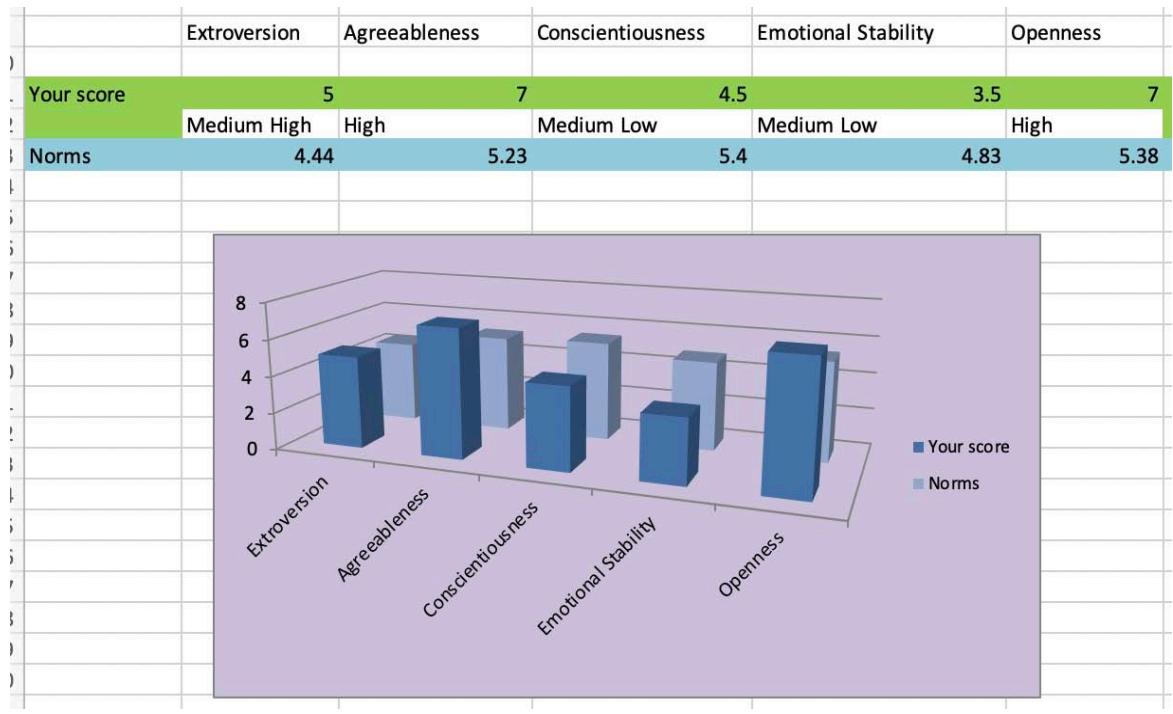
The category of extroversion exemplifies the examined person's ability to be talkative, enthusiastic, and outspoken without having to require a specific stimulus to remain socially independent. According to the Big-5, extroversion demonstrated the ability to be active, energetic, outgoing (Long, 2015). The results for extroversion for Gorbachev were 5 against an average of 4.4. To evaluate and apply the elaborative part of WTT-explaining-Gorbachev's extroversion is analysed based on specific situations he was confronted with, wherein he expressed his 'medium-high' level of extroversion.
Gorbachev's deeds demonstrated high extroversion levels in myriad situations. To demonstrate this one can explore Gorbachev's extroversion through the global attention and resultant fruitful ties forged with Western leaders, taking positive measures to dismantle the Cold War. The week he spent in the UK in 1984 was the first such prominent visit reflecting his extroversion. As Gorbachev met with Margaret Thatcher, the press portrayed him as the antagonistic future Soviet Bloc leader (Brown, 1996). Despite the possibilities of escalated tensions, Gorbachev's extroversion helped him develop a positive rapport with Thatcher. His charm and achievement-oriented approach with Thatcher facilitated the establishment of trust and a focused-oriented attitude for cooperation (Brown, 1996) which helped build a "good personal relationship" in British-Soviet affairs. Their meeting went some way to change American-Soviet relations. Gorbachev's medium-high extroversion trait did help him establish positive emotional contacts with Thatcher, who also revealed aspects of her open-minded leadership. Their meeting played a pivotal role in establishing a crack in East-West conflict. At a later stage, the Soviet leader confronted the
Cold War boldly and publicly invited Ronald Reagan to Russia for a peaceful meeting. Reagan accepted the invitation based on the positive feedback obtained from Thatcher (Brown, 1996) – who made it seem as if she took the initiative in the Western bloc in relations with him.
Meanwhile, the biggest sign of Gorbachev's extroversion in terms of behaviour was his interaction with President Bush culminating in the Malta Summit (1990). At this point, Gorbachev's extroversion had already elicited international attention. The Soviet leader was successful in forming a positive relationship with both Reagan and George Bush, the American Vice-President later to be President. Gorbachev's informal conversation with Bush in 1987 came to be called the "conversation in the car". Bush accompanied Gorbachev to the airport, which was not a part of the protocol-, and in the car, they had a dialogue which "went far beyond the usual exchange of pleasantries. We [Gorbachev and Bush] agreed that relations between our countries were reaching a new level and that new opportunities were opening up, which must be used to the maximum extent possible" (Gorbachev, 2018, p.1). Both leaders met again during the Malta 1990 summit when Bush became America's President. When Bush became suspicious about Gorbachev's assertive/ talkative personality, Gorbachev's extraversion captured Bush's attention in the summit. Thus, his previously sceptical attitude made way for a warmer personal relationship (Taubman, 2017). Bush agreed on a joint press conference with Gorbachev, showcasing his willingness to work with him. "They were outgoing, passionate, confident in their [...] effort" demonstrating the essence of the Big-5 extraversion trait (Long, 2015, p.32).
The Malta summit also emerged as a turning-point in agreement on the Intermediate-Range Nuclear Forces Treaty – a deal which approved the removal of some nuclear missiles along with other categories of weapons (United States of America, 1987). Gorbachev's extroversion continued to impact the connection established with Bush even after their mandates ended, referring to "George and I" having conversations (Gorbachev, 2018, p.4). The extroverted nature identified in my statistical analysis has been translated from descriptive to behavioural terms, demonstrating his ability to influence perceptions by remaining committed to conflict-resolution, and open leadership (Lencioni, 1998).
In the subsequent section, I will evaluate the second characteristic of the Big-5, namely, Gorbachev's agreeableness. In this regard, the psychological domain alludes to humans' altruism, genuine commitment to help others to improve their lives and ethical concerns for the human level (Goldberg, 1990). Gorbachev scored 7 in the agreeableness category in the TIPI analysis, considerably higher than the average 5.23. The agreeableness trait in my case study refers to his consideration for the Soviet population to enjoy a better standard of living, turning down the use of brute force, and giving Germany and the Eastern European populations the freedom to choose their form of government. Gorbachev's concern for human rights was evidenced in the fact that he "had quickly put his own people in [a] key spot" (Shultz, 1993, p.704), and his wish to achieve social harmony in Russia (Pervin and John, 1999). In a 2001 interview he stated the resources spent by previous legislations to create a strong defence system were useless, given that people lacked necessities: "there's no toothpaste, no soap powder, not the necessities for life. It was incredible and humiliating to work in such a government." One of the reasons why the population lacked basic supplies was also due to his ineffective economic reforms. Gorbachev's agreeableness trait along with the Afghanistan withdrawal resulted in his winning the Nobel Peace Prize in 1990 (Tubman, 2017).
Secondly, his agreeableness led him to call for the Reykjavik summit with the American President with a view to eliminating many kinds of weapons, finally achieved via the INF Treaty of 1987 banning the use of intermediate and shorter-range missiles (Brown, 1996). Gorbachev's signed agreements signify a commitment only to partial disarmament: he did not interfere with the military mobilisations in countries where Soviet influence was projected on more than one occasion, and he accepted German reunification, but only when it was no longer possible to stop it (Chernyaev, 2000). Soviet management of eastern Europe had primarily been by military force (Brown, 1996). Gorbachev's refusal to use violence as Russian control of East and Central Europe collapsed caused conflict in the CPSU (Taubman,
2017). This led to the collapse of the USSR, the emergence of new successor states, and evoked extreme reactions from the Politburo (Brown, 1996). He "broke with the traditional view of Eastern Europe as a region to be held at any cost [...] [on the contrary, he] opened up the road for [...] transition from imposed communism to independence and political choice" (Brown, 1996, p.250). Finally, his trait of 'high agreeableness' is mainly emphasized by his efforts to shift the USSR's expenditure resources on defence to use them to provide more living essentials to the Soviets, while seeking personal rapport with foreign leaders with a view to achieving a more harmonious power balance.
Conscientiousness is the third trait of the Big-5, and Gorbachev's analysis of this trait equalled 4.5, being 'medium low' in relation to the average 5.4. In conscientiousness, psychology signifies an individual's ability to be organised and ambitious, self-disciplined in approaching problems and effective in executing tasks (Rothmann and Coetzer, 2003). Gorbachev's 'medium low' conscientiousness relates to his attempts to revive the Soviet economy, because his approach turned out to be unmanageable. According to Brown (1996), Gorbachev dealt with "two contradictory items - improving the system and constructing the system on different principles"; his ambition to have the economy rebuild led "the economic system [to go] from bad to worse under the weight of this contradiction" (p.130), Gorbachev's difficulty lay in the fact that he needed the CPSU to support his reforms to shift to a market economy, which was very unlikely, given that it would have been in violation of the fundamental principles of communism (Taubman, 2017). However, his conscientiousness remained a part of his ambitious reformist mentality the CPSU reluctantly accepted. His ambitions impelled him to pursue an unrealistic market-oriented transformation, given the USSR was unprepared to sustain Gorbachev's liberal views (Isaacson, 2012). Particularly, this can be seen in the strategic practical roadmap absence for economic reform with meticulous worked-out organisation stages. What the country got was miscalculated, trial-and-error processes intended to accomplish economic reforms which failed to achieve a structural overhaul of the underlying framework of the country (Brown, 1996).
Nonetheless, Gorbachev's conscientiousness reflected incoherence: he was, on the one hand, ambitious, in that he did commit himself to take transformative efforts via Glasnost and Perestroika, and there is no reason to think he did not mean this; on the other, he was unable to follow these plans through. His failures facilitated the rise of the oligarchs in 1989 and affected his Presidency, which explains a conscientiousness 'medium low' score of his personal trait.
Gorbachev's 'neuroticism' trait can also be ranked as 'medium low'. Neuroticism refers to people who tend to be nervous, tense, and fearful, whereas low neuroticism scorers reflected a more emotionally stable personality trait (Pervin and John, 1999). Gorbachev's big-5 findings for neuroticism scored 3.5 against an average of 4.83. His emotional stability, despite a degree of neuroticism, is exemplified in the coup of 1991 when was vacationing in Crimea (Taubman, 2017). The coup began on 18 August 1991. He and his family were held by "hard-line Communist elements of the Soviet government and military. However, this coup failed three days after it began" (History.com Editors 1991, p.1). Even as conspirators were conniving plotting, he did not exhibit signs of anxiety: a key personality trait was self-confidence (Shakhnazarov, 1993, p.147). His low neuroticism levels gave him the confidence to give his family reassurance that the situation would soon normalise, although this did create 'moderate stress levels' for Gorbachev (Long, 2015). Gorbachev's low neuroticism levels revealed ability to maintain a calm exterior even amidst a crisis, since he was used to exhibiting "all his tactical manoeuvring to keep hard-liners on the leash" (Taubman, 2017, p.618). Gorbachev's "emotional stability and lack of greediness caused him to act in a rational manner" showing a well-balanced neuroticism trait (Long, 2015).
'Openness to experience' is the last trait of the big-5 explored. Gorbachev's score was 'high' at 7 against an average of 5.38. This trait gives insights into his reformist mind-set, tendency to solve complex problems, and openness to the vision of a Russia founded on principles of social democracy opposed to ossified ideals of communism (Long, 2015). Gorbachev's reorganisation of the country moved towards Perestroika and Glasnost, but failed to fully achieve "freedom of speech, freedom of the press, freedom of association, religious freedom, and freedom of movement" (Brown, 1996, p.318). Gorbachev wanted to bring reforms in the USSR through pluralist politics involving a diluting of CPSU power. As alluded to in 'openness to experience' trait, Gorbachev's willingness to question long-held theories made him pursue unconventional moves (Long, 2015) including the establishment of a "new legislature more like a [...] parliament and [...] different from the unreformed Supreme Soviet" (Brown, 1996, p. 312).
This trait is also reflected in the "500 days programme", which, despite its apparent weakness, "rejected [...] the traditional Communist economic order, its avoidance even of a single mention of 'socialism', and its commitment to speedy marketisation" (Brown, 1996, p.313). His 'openness to experience' trait could be attributed to his faith in cultural variety (Long, 2015), also tracked in his foreign policy. He respected Eastern European countries' ethnic diversity and spoke openly about his acceptance of multi-ethnic civilisations (Brown, 1996).
### c) Results and discussion
Ultimately, this analysis demonstrates how an individual's Big-5 can change the status quo shaped by their attributes. The psychological analysis does not pinpoint areas shaping an individual's traits -for example, childhood or past experiences. Yet, since there is paucity of information on Gorbachev's personality beyond his Presidency, the latter gives the examined evidence that demonstrated the how policies and executive decisions can cause historical changes owing to personal attributes. The findings demonstrate it is the leaders' personality, as well as their visceral predilections, which influence what eventually happens and eventual response to challenges, and not the other way around. This research has aimed at developing an explanation enabling a sharper account of foreign policy change via a specific worked through analytic method which has the value of dissolving the psychological-constructivist dichotomy.
## IV. CONCLUSIONS
This paper has explored one way of doing research looking at individual decision makers' personal traits. The aim is to find a more adequate explanation of foreign policy change than those offered by previous studies of individual psychology. Attempting to advance a new method of grasping foreign policy change, I envisioned an approach shifting attention from state-centricity to individuals, building on its critique of constructivist variations.
Some constructivists understand political and social life as constant changing norms and identities' dynamics negotiated continually. While some constructivists are aligned with other IR theories in upholding the primacy of the state, others demur. It is those scholars this research follows. By arguing the states' construction derives from human interactions, it is possible to move beyond the formulation of the agency-structure problem achieving the need to focus on individuals and to find a psychological approach enabling research grounded in a solid methodology, which, WTT enables.
By examining the psychology of personality, the aim was to clarify the drivers of leaders' actions when they challenge and change the status quo in foreign policy. Given a fully developed constructivist-psychological dialogue is yet to emerge, my focus was on personality studies, with an emphasis on FPA, which analyses leaders' traits pertaining to their foreign policies movements.
Accordingly, primary and secondary materials have been examined in English, Italian few Russian sources. Consistent with the approach, post-positivist approaches resulted in the embrace of qualitative methodology (empirical not empiricist) involving a case study analysis. The research focused on the personal traits of Mikhail Gorbachev adopting a process tracing approach aimed to illuminate the relations of structural processes with an individual analysis-level. A heuristic method was employed through dialogic and reflective approaches which helped the textual references interpretation of Gorbachev's traits by dialoguing with them while maintaining a rigorous methodology.
WTT provided the theoretical model of agency to elucidate personality characteristics. WTT involves a descriptive and an explanatory approach to these traits, combining behaviours within descriptive trait characteristics into a unique model. Even as the descriptive trait theoretical part is built upon the Big-5 Theory, I collected the five traits of Gorbachev by observing his comportment from the reading, with a view to evaluating the traits' organisations. Thus, the five traits of Gorbachev's personality were recorded and translated into actions organised in a constructivist framework. To undertake the measurement of these Big-5, TIPI was used, which entailed a trace of the reverse-scored adjective-categories, before calculating Dr. DeNeui's excel spreadsheet (2009), which automatically processed scores alongside the Big-5. The TIPI record required a specific number (computed through an interpretative analysis) to correspond to the leader's trait for each adjective listed on the TIPI. These are: extroverted, enthusiastic (item 1); critical, quarrelsome (item 2); dependable and self-disciplined (item 3); easily upset and anxious (item 4); open to new experiences, complex (item 5); reserved and quiet (item 6); sympathetic and warm (item 7); disorganized, careless (item 8); calm, emotionally stable (item 9); and finally, conventional, uncreative. After numbering them depending on Gorbachev's personality, the following scores were achieved: '7- strongly agree' (item 1); '1-disagree strongly' (item 2); '6-moderately agree' (item 3); '5-agree a little' (item 4); '7-Agree Strongly' (item 5); '5-Agree a little' (item 6); '7-Agree Strongly' (item 7); '5-agree a little' (item 8); '4-Neither agree nor disagree' (item 9); and eventually '1-disagree strongly' (item 10). After the scores were registered on the TIPI worksheet, the Big-5 five traits were assessed, thereby completing the first segment of the WTT: the explanatory part of the trait.
To combine the Big-5 analysis with the trait-behaviour part of the WWT, I interpreted Gorbachev's actions with a view to assessing how the descriptive study of traits concretise into behavioural patterns. The results derived from the WTT's employment were examined within a constructivist framework drawing from Finnemore and Sikkink's (1998) model of norm internalisation. By maintaining a heuristic approach, I elaborated upon the process of norm internalisation to explore the how individual personality seeks to initiate possible policy change. I reflexively dialogued with the reading to employ a valid constructivist-psychological method to understand how internalised humans' norms lead to new political processes. Through incisive research into Gorbachev's Presidency, his personal traits were identified in how they constructed significant change in Soviet foreign policy in their domestic and international dynamics. The Gorbachev case study avoided state-centrism, positing the individual as one of a range of shaping factors. Overall, the paper offers a distinctive opening to combine constructivist and individual psychological approaches with a specific methodology using WTT which illustrates how some of the problems of a conventional (Wendtian) constructivism can be overcome. No doubt there is further scope for the criticism of this approach, as well as for testing it in other and more diverse cases, but within the scope of this research paper it is sufficient.
Generating HTML Viewer...
References
87 Cites in Article
Emanuel Adler (1997). Seizing the Middle Ground:.
E Adler,M Barnett (1998). Security Communities.
Robert Allen (2001). The rise and decline of the Soviet economy.
Michael Ashton,Kibeom Lee,Marco Perugini,Piotr Szarota,Reinout De Vries,Lisa Di Blas,Kathleen Boies,Boele De Raad (2004). A Six-Factor Structure of Personality-Descriptive Adjectives: Solutions From Psycholexical Studies in Seven Languages..
M Beschloss,S Talbott (1994). At the highest levels: The inside story of the end of the Cold War.
Paul Brewer,Marco Steenbergen (2002). All Against All: How Beliefs about Human Nature Shape Foreign Policy Opinions.
T Britannica (2021). Editors of Encyclopaedia.
A Brown (1996). The Gorbachev Factor.
D Campbell (1998). Writing Security: United States Foreign Policy and the Politics of Identity.
W Carlsnaes (1992). The agency-structure problem in foreign policy analysis.
H Cattell,J Schuerger (2003). Essentials of 16PF assessment.
Jeffrey Checkel (1998). The Constructive Turn in International Relations Theory.
A Chernyaev (2000). My Six Years with Gorbachev.
A Chernyaev (2006). The diary of Anatoly Chernyaev.
K Chernysh (2010). Russian Foreign Policy Discourse During and After War: Representations of NATO.
C Cox Miles (1937). III. The Role of Individual Psychological Differences in Social Psychology.
O Daddow (2013). International relations theory: the essentials 2 nd edition.
D Deneui (2009). Excelscore TIPI.
David Dessler (1989). What's at stake in the agent-structure debate?.
(2021). ABC News Union of Soviet Socialist Republics (USSR) Coup Poll, August 1991.
Roxanne Doty (1997). Aporia:.
Roxanne Doty (2000). Desire all the way down.
W Eaton (1987). Summit to Focus on a Second Pact: Gorbachev's Mood: Elation and Anxiety.
B Farnham (2001). Reagan and the Gorbachev Revolution: Perceiving the End of Threat [online.
C Farrands (2010). International Relations Theory and Philosophy.
Martha Finnemore,Kathryn Sikkink (1998). International Norm Dynamics and Political Change.
Martha Finnemore,Kathryn Sikkink (2001). T<scp>AKING</scp>S<scp>TOCK</scp>: The Constructivist Research Program in International Relations and Comparative Politics.
J Gallagher (1991). My son's story.
A Giddens (1979). Central Problems in Social Theory.
Lewis Goldberg (1990). An alternative "description of personality": The Big-Five factor structure..
J Goldgeier,P Tetlock (2001). Psychology and International Relations Theory.
John Gooding (1990). Gorbachev and democracy.
M Gorbachev,H Mikhail Gorbachev: George,Bush (2018). Document No. 9: Memorandum from Baker for the President, “Your December Meeting with Gorbachev”.
M Gorbachev (1990). O proekte platformy CK KPSS k XXVIII c´´ezdu partii.
Samuel Gosling,Peter Rentfrow,William Swann (2003). A very brief measure of the Big-Five personality domains.
Deborah Gross,Jeanne Alhusen,Bonnie Jennings (2012). Authorship ethics with the dissertation manuscript option.
T Hall,A Ross (2015). Affective politics after 9/11.
Margaret Hermann,Thomas Preston,Baghat Korany,Timothy Shaw (2001). Who Leads Matters: The Effects of Powerful Individuals.
Margaret Hermann (1980). Explaining Foreign Policy Behavior Using the Personal Characteristics of Political Leaders.
(1991). Was Gorbachev Part of the August Coup?.
M Hollis,S Smith (1990). Explaining and Understanding International Relations.
Ted Hopf (1998). The Promise of Constructivism in International Relations Theory.
David Houghton (2007). Reinvigorating the Study of Foreign Policy Decision Making: Toward a Constructivist Approach.
Valerie Hudson (2005). Foreign Policy Analysis: Actor-Specific Theory and the Ground of International Relations.
W Isaacson (2012). Steve Jobs CEO and Cofounder of Apple Inc..
Eranda Jayawickreme,Corinne Zachry,William Fleeson (2019). Whole Trait Theory: An integrative approach to examining personality structure and process.
R Jepperson,A Wendt,P Katzenstein (1996). Norms, Identity, and the Culture of National Security.
D Kavanagh,C Riches (2013). A Dictionary of Political Biography.
M Koenig-Archibugi (2010). Understanding the global dimensions of policy.
R Koslowski,F Kratochwil (1995). Understanding Change in International Politics: The Soviet Empire's Demise and the International System.
P Lencioni (1998). The five dysfunctions of a team.
Sean Wu,Julia Farquhar,Scott Compton (2015). Why do Team-Based Learning educators use TBL?.
J March,J Olsen (1998). The Institutional Dynamics of International Political Orders.
R Mcdermott (2004). Political Psychology in International Relations.
R Mcdermott,A Lopez (2012). Psychology and Constructivism: Uneasy Bedfellows?.
Chris Brown (2013). Psychology and Constructivism in International Relations: An Ideational Alliance. Edited by Vaughn P. Shannon and Paul A. Kowert. Ann Arbor, MI: University of Michigan Press, 2012. 298p. $80.00 cloth..
E Kosilova (1994). Self-consciousness in autism.
J Miller (1993). Mikhail Gorbachev and the End of Soviet Power.
C Neef (2011). The Solzhenitsyn files: secret Soviet documents reveal one man's fight against the monolith.
L Odysseos (2009). Deconstructing the modern subject: method and possibility in Martin Heidegger's hermeneutics of facticity.
N Onuf (1989). World of Our Making: Rules and Rule in Social Theory and International Relations.
R Palan (2000). A world of their making: An evaluation of the constructivist critique in International Relations.
L Pervin,O John (1999). Handbook of personality: Theory and research.
W Peterson (1990). 6. Abandoning Pretenses: Gorbachev and the Military, 1987-1988.
Linda Putnam,Scott Banghart (2017). Interpretive Approaches.
D Remnick (1994). Lenin's tomb: The last days of the Soviet empire.
M Riaz (2019). Research Methodology.
S Roberts (1988). AJC New York Praises Arrest in Brutal Anti- Semitic Attack.
J Robertson (1982). The Soviet Union in the Third World: Successes and Failures (Book Review).
S Rothmann,E Coetzer (2003). The Big Five Personality Dimensions and Job Performance.
J Ruggie (1998). What Makes the World Hang Together? Neo-utilitarianism and the Social Constructivist Challenge.
G Shakhnazarov (1993). The Price of Freedom: Gorbachev's Reformist Undertaking through the Eyes of his Aide.
Vaughn Shannon,Jonathan Keller (2007). Leadership Style and International Norm Violation: The Case of the Iraq War.
V Shannon (2012). Introduction: Ideational Allies-Psychology, Constructivism, and International Relations.
V Shannon,P Kowert (2012). Psychology and Constructivism in International Relations: An Ideational Alliance.
G Shultz (1993). Turmoil and triumph: My years as secretary of state.
A Slaughter (2011). International Relations, Principal Theories.
J Steele (2011). Mikhail Gorbachev: I should have abandoned the Communist party earlier.
See Tan (2006). Rescuing constructivism from the constructivists: a critical reading of constructivist interventions in Southeast Asian security.
W Taubman (2017). Gorbachev: His Life and Times.
(1987). Treaty between the United States of America and the union of soviet socialist republics on the elimination of their intermediate-range and shorter-range missiles.
Alexander Wendt (1987). The agent-structure problem in international relations theory.
Alexander Wendt (1992). Anarchy is what states make of it: the social construction of power politics.
A Wendt (1999). Social Theory of International Politics.
David Winter,Margaret Hermann,Walter Weintraub,Stephen Walker (1991). The Personalities of Bush and Gorbachev Measured at a Distance: Procedures, Portraits, and Policy.
A Yakovlev (1991). USSR: The Decisive Years.
Lisa Zillig,Scott Hemenover,Richard Dienstbier (2002). What Do We Assess when We Assess a Big 5 Trait? A Content Analysis of the Affective, Behavioral, and Cognitive Processes Represented in Big 5 Personality Inventories.
No ethics committee approval was required for this article type.
Data Availability
Not applicable for this article.
How to Cite This Article
Chiara Rambaldi. 2026. \u201cTo What Extent are International Relations Constructed from an Individual Psychological Approach?\u201d. Global Journal of Human-Social Science - F: Political Science GJHSS-F Volume 23 (GJHSS Volume 23 Issue F4): .
Explore published articles in an immersive Augmented Reality environment. Our platform converts research papers into interactive 3D books, allowing readers to view and interact with content using AR and VR compatible devices.
Your published article is automatically converted into a realistic 3D book. Flip through pages and read research papers in a more engaging and interactive format.
Our website is actively being updated, and changes may occur frequently. Please clear your browser cache if needed. For feedback or error reporting, please email [email protected]
Thank you for connecting with us. We will respond to you shortly.