1. Introduction
Tourism serves as a significant driver of economic growth, particularly in regions with rich cultural and natural resources (Rani Subramanian et al., 2015) [16]. North Eastern India, comprising eight states, is renowned for its stunning landscapes, diverse ecosystems, and vibrant tribal cultures, making it a promising destination for eco-tourism and adventure tourism. Tourist hotspots such as Arunachal Pradesh, Assam, and Sikkim offer unique experiences, from breathtaking mountain views to cultural festivals that highlight the indigenous heritage (Rizal & Asokan, n.d.) [17]. In contrast, Tamil Nadu, located in Southern India, boasts a well-established tourism industry characterized by its historical significance, architectural marvels, and cultural heritage. The state attracts millions of visitors annually, drawn to its famous temples, beaches, hill stations, and UNESCO World Heritage Sites such as Mahabalipuram and the Brihadeeswarar Temple in Thanjavur. Tamil Nadu has a tourism economy supported by a robust infrastructure network and a diverse range of attractions, including spiritual, historical, and eco-tourism options (Mahamad S et al., 2014) [6]. Nevertheless, the state grapples with challenges related to over-tourism, environmental degradation, and the need for sustainable tourism practices. The North Eastern region, often regarded as the ’gateway’ to the East, is endowed with unparalleled biodiversity, unique cultural practices, and a burgeoning potential for eco-tourism, adventure tourism, and cultural tourism (Nishant et al., 2023) [15]. However, despite its vast potential, the region faces numerous challenges, including infrastructural inadequacies, accessibility issues, and the need for sustainable development to preserve its fragile ecosystems (Jamalludin et al., 2022) [4]. Government initiatives, such as the ’Look East Policy’ and other regional tourism schemes, aim to address these concerns, but there remains a significant gap in realizing the full potential of tourism in the North East states and Tamil Nadu state (Subramaniam & Kannan, 2012) [19]. Renowned for its heritage sites, religious tourism, diverse landscapes, and robust infrastructure, the region attracts millions of domestic and international tourists annually (Muralidhar & Karthikeyan, 2016) [14]. The Tamil Nadu tourism economy benefits from better connectivity, government support, and well-developed hospitality sectors (Mahamad S et al., 2014) [6]. However, as the demand for tourism grows, concerns about environmental degradation and the sustainability of tourism practices have emerged, necessitating strategic interventions (Maheshkumar S & Soundarapandian M, 2024b) [11]. Also, India has experienced significant economic growth over the past few decades, with a focus on liberalization and reforms that have opened up various sectors to private and foreign investment (Maheshkumar, 2026) [8]. This has led to a robust GDP growth rate, making India one of the top emerging markets globally (Mongia & Singh, 2023) [13].
2. Objectives
To analyze the inflow of domestic and foreign tourists in North Eastern India and Tamil Nadu from 2016 to 2023.
3. Methodology
This study aims to conduct a comparative analysis of the tourism economies in North Eastern India and Tamil Nadu, focusing on the economic impact of tourism, the challenges faced by both regions, and sustainable growth strategies that can be employed to enhance their tourism sectors. By utilizing secondary data sourced from the Ministry of Tourism, Government of India, and various tourism statistics reports, this study seeks to provide valuable insights for policymakers, stakeholders, and researchers interested in the dynamics of tourism development in these distinct yet equally rich regions of India. The study period spans from 2010 to 2023, examining both foreign and domestic tourist arrivals. Data from 2016 to 2023 interpretation includes a comparative approach between North Eastern India and Tamil Nadu to assess trends and growth rates. The analysis incorporates tables for clarity and comprehensive understanding.
4. Data Analysis
Table 1. Foreign Tourist Inflow and Domestic Tourist Inflow in India (2010-2023)
| Year | Foreign Tourist Arrival (in millions) | Domestic Tourist Arrival (in millions) |
|---|---|---|
| 2010 | 17.91 | 747.70 |
| 2011 | 19.50 | 864.53 |
| 2012 | 18.26 | 1045.05 |
| 2013 | 19.95 | 1142.53 |
| 2014 | 22.33 | 1282.80 |
| 2015 | 23.33 | 1431.97 |
| 2016 | 24.71 | 1613.55 |
| 2017 | 26.11 | 1835.20 |
| 2018 | 27.60 | 2087.29 |
| 2019 | 29.17 | 2374.02 |
| 2020 | 30.82 | 2700.12 |
| 2021 | 32.58 | 3071.03 |
| 2022 | 34.43 | 3492.89 |
| 2023 | 36.38 | 3972.69 |
Source: Ministry of Tourism, Govt. of India
In Table 1, the trend of both foreign and domestic tourist arrivals in India from 2010 to 2023 demonstrates significant growth, with a steady rise in numbers across both segments. Foreign tourist arrivals have gradually increased, reflecting India’s improving position in global tourism. Domestic tourism, which constitutes the majority of the sector, witnessed sharper growth, highlighting the importance of local travel. However, the impact of the COVID-19 pandemic in 2020 caused a noticeable decline, followed by a recovery in subsequent years. The findings suggest a robust recovery trajectory, driven primarily by domestic tourism. The increase in tourist inflow leads to a rise in employability in certain areas (Maheshkumar S & Soundarapandian M, 2024c) [12]. To sustain this momentum, recommendations include improving tourism infrastructure, enhancing global promotion strategies, and focusing on emerging areas like eco-tourism and digitalization to attract a more diverse set of travelers.
Table 2. Top 10 countries tourist arrivals for 2023
| Rank | Country | International Tourist Arrivals (2023, in millions) | Share of Global Market (%) |
|---|---|---|---|
| 1 | France | 83 | 10.70% |
| 2 | United States | 70 | 9.10% |
| 3 | Spain | 72 | 9.30% |
| 4 | China | 61 | 7.90% |
| 5 | Italy | 58 | 7.50% |
| 6 | Turkey | 51 | 6.60% |
| 7 | Mexico | 50 | 6.50% |
| 8 | Thailand | 40 | 5.20% |
| 9 | United Kingdom | 38 | 4.90% |
| 10 | India | 20 | 2.60% |
Source: India Tourism Statistics, 2023 and UNWTO - World Tourism Organization Reports.
Table 2 reveals, the top 10 countries in international tourist arrivals for 2023 show that France, Spain, and the United States lead the global tourism industry, with each capturing a significant share of the international tourism market. India, while ranking tenth, has steadily increased its arrivals, reflecting a growing presence in the global market. The distribution of tourist arrivals highlights the dominance of European countries in global tourism, along with key players like China and Turkey. In India, a relatively smaller share, at 2.6%, suggests room for improvement in global competitiveness. To increase its global ranking, India should focus on enhancing tourism infrastructure, improving visa policies, and promoting diverse travel experiences.
Table 3. Major Tourism Spots in North Eastern States
| States | Major tourist Places |
|---|---|
| Arunachal Pradesh | Tawang, Dirang, Bomdila, Miao, Namdapha, Parashuram Kund, Khnosa, Roing, Malinithan, Pasighat |
| Assam | Kamakhya temple, Umananda, Basisth Ashram, State zoo, State museum, Sukreshwar Temple etc in Guwahati, KNP, Manas, Orang, Sibasagar, Tezpur, Hajo, Bogibeel, Dhala-Sadiya bridge |
| Manipur | Imphal, Bishnupur, Loktak lake, sirori Hills, Keibul, Lamjao National Park |
| Meghalaya | Shillong, Cherapunji, Dawki etc. |
| Mizoram | Aizwal, Champai, Tamdil, Thenzawl etc. |
| Nagaland | Dzukou Valley, Dzilekie, Japfu peak, Tseminyu, Longkhum, UngmaVeda Peak, Shilloi LakeMount tostu etc. |
| Sikkim | Gangtok, Bakhim, Yamthang, Dubdi, Dzongri, Varsey, Tashiding etc. |
| Tripura | Agartala, old Agartala, Tripua Sundari Temple etc. |
Source: NER data bank
In Table 3, the major tourism spots in the North Eastern (NE) states of India showcase the region’s rich cultural and natural diversity (Saurish Bhattacharjee, 2019) [18]. Arunachal Pradesh is home to key attractions such as Tawang, Bomdila, and Namdapha, known for their scenic beauty and historical significance. Assam draws visitors to Kamakhya Temple, Kaziranga National Park, and Manas, offering a blend of spiritual and wildlife experiences. Manipur’s Loktak Lake and Keibul Lamjao National Park stand out for their ecological uniqueness. Meghalaya is famed for Shillong, Cherapunji, and the breathtaking Dawki River. In Mizoram, Aizawl and Champai attract tourists with their cultural heritage. Nagaland offers natural beauty with sites like Dzukou Valley and Japfu Peak. Sikkim’s Gangtok, Yamthang, and Tashiding Monastery are top tourist destinations for nature lovers and spiritual seekers (Konwar, n.d.) [5]. Tripura’s major tourist spots include Agartala and the Tripura Sundari Temple, offering a mix of history and religious tourism. These destinations highlight the cultural richness and natural beauty of the NE region, making it a growing hub for both domestic and international tourists (Dutta Scholar & Sen Professor, n.d.) [2]. Tourism centered on the Indigenous Knowledge Systems (IKS) of Northeast India highlights the unique heritage and traditions of its indigenous peoples (Maheshkumar S & Soundarapandian M, 2023) [9].
Table 4. Major Tourism Spots in Tamilnadu State
| State | Major Tourist Places |
|---|---|
| Chennai (Marina Beach, Fort St. George, Kapaleeshwarar Temple), | |
| Madurai (Meenakshi Temple), Ooty (Nilgiri Hills), | |
| Kanyakumari (Vivekananda Rock Memorial), | |
| Tamil Nadu | Mahabalipuram (UNESCO World Heritage Sites), |
| Coimbatore (Marudamalai Temple), | |
| Rameswaram (Ramanathaswamy Temple), | |
| Thanjavur (Brihadeeswarar Temple), Trichy (Rock Fort), | |
| Pondicherry (Auroville, beaches) |
Source: Ministry of Tourism, Tamilnadu @2024 Report
In Table 4, Tamil Nadu is one of the most prominent tourism destinations in India, boasts a diverse array of attractions that highlight its rich cultural heritage, religious significance, and natural beauty (Muralidhar & Karthikeyan, 2016) [14]. Chennai, the capital city, is known for Marina Beach, Fort St. George, and the Kapaleeshwarar Temple. Madurai’s iconic Meenakshi Temple is a prime spiritual destination, while Ooty in the Nilgiri Hills offers picturesque landscapes and a cool climate. Kanyakumari, located at the southern tip of India, is famous for the Vivekananda Rock Memorial. Mahabalipuram is renowned for its UNESCO World Heritage Sites, showcasing ancient temples and rock-cut sculptures. Coimbatore’s Marudamalai Temple, Rameswaram’s Ramanathaswamy Temple, Thanjavur’s Brihadeeswarar Temple, and Trichy’s Rock Fort highlight Tamil Nadu’s spiritual legacy (Subramaniam & Kannan, 2012) [19]. Pondicherry, with its serene beaches and Auroville, adds a mix of spirituality and relaxation to the state’s tourism offerings. These attractions make Tamil Nadu a favored destination for both domestic and international travelers.
Table 5. No. of Domestic and Foreign Arrivals in NE states and TN state from 2016 to 2023
| Year | Domestic Tourist Arrivals in NE states (in lakhs) | Domestic Tourist Arrivals in Tamil Nadu (in lakhs) | Foreign Tourist Arrivals in NE states (in lakhs) | Foreign Tourist Arrivals in Tamil Nadu (in lakhs) |
|---|---|---|---|---|
| 2016 | 118.45 | 150.60 | 0.3119 | 66.50 |
| 2017 | 125.73 | 173.10 | 0.4496 | 71.30 |
| 2018 | 130.88 | 192.50 | 0.5478 | 78.70 |
| 2019 | 135.21 | 212.30 | 0.8257 | 123.00 |
| 2020 | 80.09 (due to COVID-19) | 115.30 (Pandemic Impact) | 0.0842 | 5.00 |
| 2021 | 85.58 | 122.20 | 0.1074 | 12.30 |
| 2022 | 118.45 | 218.60 | 0.1040 | 40.70 |
| 2023 | 130.71 | 122.10 (till May) | Data not yet available | 117.50 |
Source: Ministry of Tourism, India.
In Table 5, data indicates a steady increase in domestic and foreign tourist arrivals in both the North Eastern states and Tamil Nadu from 2016 to 2019, with a significant drop in 2020 due to the COVID-19 pandemic. Tamil Nadu consistently attracted more domestic and foreign tourists compared to the North Eastern states. Post-pandemic recovery is evident as the numbers gradually rise in 2021 and 2022, though foreign tourist arrivals remain lower than pre-pandemic levels. To boost tourism, the North Eastern states could focus on improving infrastructure and promoting unique cultural experiences. Tamil Nadu could enhance its appeal by diversifying attractions and improving safety measures. Collaborative marketing campaigns and digital tourism platforms could further help draw domestic and international tourists, ensuring sustained growth.
5. Trend Analysis
Trend analysis is a statistical technique used to identify patterns or trends in data over a specified period (Birnbaum et al., 1997) [1]. In this study, it is essential to perform trend analysis on domestic and foreign tourist arrivals, as illustrated in Table 5, to understand the fluctuations in tourism over the years, particularly in response to significant events like the COVID-19 pandemic, allowing us to understand growth rates, particularly through the Annual Growth Rate (AGR) calculated using Jamovi Version 2.5.6.0. This analysis reveals fluctuations in tourism trends, especially during the COVID-19 pandemic, and helps identify recovery trajectories.
5.1. Growth Rate Calculation
The formula for Annual Growth Rate (AGR) (Verma & Shukla, 2019) [20]:
Table 6. Domestic Tourist Arrivals in North Eastern States and Tamil Nadu State
| Year | Arrivals (in lakhs) | AGR (%) | Arrivals (in lakhs) | AGR (%) |
|---|---|---|---|---|
| 2016 | 118.45 | - | 150.60 | - |
| 2017 | 125.73 | 1.08 | 173.10 | 14.96 |
| 2018 | 130.88 | 0.92 | 192.50 | 11.39 |
| 2019 | 135.21 | 3.17 | 212.30 | 10.28 |
| 2020 | 80.09 | -40.85 | 115.30 | -45.69 |
| 2021 | 85.58 | 9.23 | 122.20 | 6.08 |
| 2022 | 118.45 | 38.44 | 218.60 | 78.93 |
| 2023 | 130.71 | 10.00 | 122.10 | -44.06 |
Source: Table 5 and compiled by using Jamovi Version 2.5.6.0
In Table 6, the domestic tourist arrivals in the North Eastern states experienced a fluctuating trend from 2016 to 2023, with an overall growth rate (AGR) of 38.44% in 2022 after a significant drop of 40.85% in 2020 due to the COVID-19 pandemic. In Tamil Nadu, the domestic arrivals showed a remarkable recovery in 2022, achieving an AGR of 78.93%, despite a sharp decline in 2020. To sustain this growth, both regions should enhance tourism infrastructure and marketing strategies to attract more domestic tourists, particularly in the post-pandemic recovery phase.
Table 7. Foreign Tourist Arrivals in North Eastern States and Tamil Nadu State
| Year | Arrivals (in lakhs) | AGR (%) | Arrivals (in lakhs) | AGR (%) |
|---|---|---|---|---|
| 2016 | 0.3119 | - | 66.50 | - |
| 2017 | 0.4496 | 44.14 | 71.30 | 11.43 |
| 2018 | 0.5478 | 21.83 | 78.70 | 10.00 |
| 2019 | 0.8257 | 50.61 | 123.00 | 56.72 |
| 2020 | 0.0842 | -89.83 | 5.00 | -95.92 |
| 2021 | 0.1074 | 27.00 | 12.30 | 146.00 |
| 2022 | 0.1040 | -2.90 | 40.70 | 230.89 |
| 2023 | Data not yet available | - | 117.50 | 189.44 |
Source: Table 5 and compiled by using Jamovi Version 2.5.6.0
In Table 7, foreign tourist arrivals in the North Eastern states saw a dramatic rise from 2016 to 2019, with a peak growth rate of 50.61% in 2019, before plummeting by 89.83% in 2020 due to the pandemic. Conversely, Tamil Nadu’s foreign arrivals demonstrated resilience, achieving an impressive AGR of 230.89% in 2022 after the pandemic’s initial impact, reflecting strong recovery strategies. Moving forward, both regions should invest in international marketing campaigns and partnerships to boost foreign tourist arrivals and capitalize on the increasing global interest in travel.
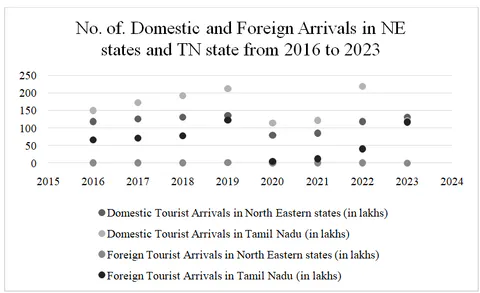
To perform a trend analysis with visualization for the given data on tourist arrivals, using Microsoft Excel 2021 to create line charts that show the trends in domestic and foreign tourist arrivals in the North Eastern states and Tamil Nadu from 2016 to 2023.
Source: Table 5 and compiled by using Microsoft Excel 2021
In Figure 1, analyzing the tourism trends from 2016 to 2023 reveals distinct patterns in domestic and foreign tourist arrivals in the North Eastern states and Tamil Nadu. Both regions experienced a steady rise in domestic tourist arrivals until 2019, with the North Eastern states increasing from 118.45 lakhs to 135.21 lakhs and Tamil Nadu from 150.6 lakhs to 212.3 lakhs. The COVID-19 pandemic caused a sharp decline in 2020, dropping arrivals to 80.09 lakhs and 115.3 lakhs, respectively. Post-pandemic recovery is evident, with the North Eastern states rebounding to 130.71 lakhs in 2023 and Tamil Nadu to 218.6 lakhs in 2022, though 2023 data till May indicates 122.1 lakhs. In terms of foreign tourists, Tamil Nadu consistently outperformed the North Eastern states, with arrivals rising from 66.5 lakhs in 2016 to 123 lakhs in 2019, while the North Eastern states saw a modest increase from 0.3119 lakhs to 0.8257 lakhs. The pandemic caused a drastic reduction in foreign arrivals to 5 lakhs in Tamil Nadu and 0.0842 lakhs in the North Eastern states in 2020. Recovery has been slower, with Tamil Nadu reaching 40.7 lakhs by 2022 and 117.5 lakhs till May 2023, while the North Eastern states showed minimal improvement to 0.104 lakhs by 2022. To boost tourism, the North Eastern states should enhance infrastructure and promote their unique cultural experiences, while Tamil Nadu could benefit from diversifying attractions and improving safety measures. Collaborative marketing and digital tourism platforms could further attract both domestic and international tourists, ensuring sustained growth.
6. Suggestions
Promotion of Unique Cultural Experiences: North Eastern states should focus on marketing their rich tribal cultures, festivals, and eco-tourism activities to attract more domestic and international tourists. This could include immersive experiences such as homestays, local craft workshops, and guided tours of indigenous practices.
Enhanced Digital Marketing Strategies: Both regions should leverage digital platforms to promote their tourism offerings more effectively. This could involve targeted social media campaigns, engaging content marketing, and partnerships with travel influencers to reach a broader audience.
Sustainability Initiatives: Developing and implemented sustainable tourism practices is essential for both regions. This includes promoting eco-friendly accommodations, waste management initiatives, and conservation programs to protect the natural environment while enhancing the visitor experience.
Strengthening Tourism Education and Training: Investing in training programs for local stakeholders, such as tour guides, hospitality staff, and artisans, can enhance the overall quality of tourism services (Maheshkumar, 2025) [7]. This will not only improve the visitor experience but also create job opportunities within the local community.
Strategic Use of Technology: The integration of technology, such as virtual reality (VR) experiences or augmented reality (AR) applications, can enrich tourists’ experiences. Utilizing apps for seamless travel planning, navigation, and information about local attractions can also enhance visitor satisfaction.
7. Conclusion
Tourism in both North Eastern India and Tamil Nadu has shown remarkable potential, with each region offering distinct experiences to tourists. While the North East offers vast opportunities for eco-tourism and adventure tourism, it faces significant challenges in infrastructure and accessibility. Tamil Nadu, with its well-established infrastructure and popular destinations, faces sustainability issues due to over-tourism and environmental degradation. The development of the tourism industry is crucial for the economic growth of India. By harnessing their unique cultural and natural assets, these regions can attract a more diverse tourist base, contributing to local employment and sustainable economic development of Northeastern states. Tamil Nadu has established a tourism sector that serves as a model for growth, emphasizing the importance of strategic marketing, diverse attractions, and sustainable practices. Traveling and touring significantly reduce stress levels and enhance stress management (Maheshkumar S & Soundarapandian M, 2024a) [10]. Management should focus on the relationships between these dimensions and the services (Efrah Ali, 2024) [3]. By addressing the existing challenges and capitalizing on the opportunities presented by the evolving tourism landscape, India can significantly boost its position in the global tourism market.