
I. INTRODUCTION
The importance of gender equality and women empowerment in policy and developmental goals cannot be over-emphasised. Women continues to be vulnerable as a consequence gender inequality perpetuated by economic conditions, under-development and imbalanced socio-economic conditions in society. Infrastructure investment globally plays a central for medium to long-term sustainable economic development. However, the degree of gender-inclusivity in the design, financing and implement of infrastructure project in many countries remains under question. As demonstrated in their paper, Mosenogi and Daw (2021) disaggregating South African economy into 34 industries shows the difference on gender-based income inequality from infrastructure investment thus painting a clear picture of the unequal gender-pay gap where males still earn more than females.
This indicates that Aguilar and Hart (2018) when arguing for the importance of gender in energy infrastructure points out that, the differentiated impacts of these developments on women and men are seldom explored, discussed or documented. This indicates that the impacts differentiation because of the direct effect on women and men, for example, through job opportunities, as well as through indirect impacts, as with respect to access to land and resources. As argued by OECD (2019), it is often assumed that females will automatically gain from new infrastructure projects in the same way as men do, without acknowledging possible distinct impacts on women and men according to their needs and social roles. The importance of gender-sensitive impact assessment cannot be over-emphasised. Prior to the commencement of every infrastructure project, the impact on both men and women at economic and social level must be under-taken so that all necessary measures can be designed to mitigated risks or challenges that both genders might be exposed to. This paper aims at making a significant contribution in the body of knowledge and practice within the space of gender equality, women's empowerment and infrastructure investment. South Africa is in the process of infrastructure development and is evident various infrastructure project conceptualised and implemented throughout the country. The paper therefore seeks to propose a framework that can easily applied on scientific basis to ensure gender mainstreaming in infrastructure investment.
II. LITERATURE REVIEW
Good access to quality and sustainable infrastructure is an essential determinant of people's wellbeing and a basic requirement for businesses to prosper. High-quality infrastructure from digital, transport, energy and water to public parks and museums underpins inclusive growth and supports sustainable development, in line with the 2030 Agenda (Mosenogi, 2019). As argued by Pouw (2009), a relational scheme can be derived at different phases of consolidation within the economy depending on how much detail is desired for exploration. From a gender-perspective it is important to differentiate between individual members of households. Likewise, differentiation can be between individuals within firms, communities and governments if that would meet the objective of questions to be explored. There is thus always the possibility to zoom in a specific relationship within the relational scheme and construct a new scheme at a lower level of aggregation (e.g. intra-household level).
As presented in the pioneering work of Pouw (2009), understanding the theoretical relationship of gender, the economy and labour produced the schematic framework which remains helpful in academia and practice to perform different analysis. Pouw (2009) further argues that units of analysis in the relational scheme are mutually exclusive. He further states that each of them forms a separate entry into the scheme. The cells in the scheme specify the nature and form of the relationship between the row entries on the left and the column entries at the top of the scheme. For example, 'households' relate to 'labour' in two ways: i) by sustaining and regenerating the labour force through providing unpaid household work and care and real labour supply; and, ii) by demanding labour themselves.
Fundamentally, the optimisation problems that need to be solved in the economy are the optimisation of allocating goods and services, labour, time and natural resources by economic agents over economic agents. Individuals, households, firms and communities make economic choice at the micro sphere of the economy. Additionally, the government is an important economic agent that operates at the macroeconomic level. The government has a special part in facilitating and guiding the (re) distribution of scarce resources in the economy, for example by legislature and formalising market operations and procedures. Although, government policies and regulation are implicitly reflected in the economic decisions of households, firms and communities, the government is given a separate entry as the 'closure' of the scheme (Pouw, 2009). As argued by The World Bank, (2010), infrastructure should not only be developed for women but also by women thus allowing the optimal distributive economic choice. According to Aguilar and Hart (2018), a gender-responsive approach to project design and implementation enables the identification of potential barriers to enable energy access to vulnerable households and provides a clearer comprehension of the needs and interests of the whole population of target communities. The study by Mosenogi (2019), brings forth scientific evidence on the gender disparities in the
South African labour market within the space of electricity infrastructure investment using the case of Kusile and Medupi and the two cannot be an exception based on literature. It is against this backdrop that the re-look at infrastructure investment is of paramount importance and framework proposed below should be a guiding and reference tool in changing the landscape.
III. ANALYSIS AND FRAMEWORK
a) Analysis
The existence of frameworks to enhance gender inclusive development in the space of, especially mega infrastructure projects remain limited globally and close to non-existent in South Africa. "Gender mainstreaming", "gendered budgeting", and "women's empowerment" features dominantly in social and economic policies at different scales in various international bodies such as the United Nations, the World Bank, and the European Union as well as in national, regional, and local institutions (Perrons, 2005). Gender mainstreaming is largely impeded by different institutional hurdles and the believe that public policy cannot assist societal gender transformation (Mosenogi, 2019; Perrons, 2005; Standing, 2004; Subramanian, 2004). This is further supported by Mukhopadhyay (2004) who argues that gender mainstreaming has become normalised as a "technical project" and has been disassociated with its foundation of feminism which opposes inequality in gender and power relations.
From the analytical point of view, South Africa remains under-developed with poverty, unemployment and inequality being extremely high with its population being a slight increase. According to Statistics South Africa (2021) population mid-year estimates for 2021 shows that South Africa has reached 60,14 million despite COVID-19 challenges with female's population share remaining higher to males at . Table 1 below illustrates the population number in South Africa.
| Population group | Male | Female | Total | |||
| Number | % distribution of males | Number | % distribution of females | Number | % distribution of total | |
| Black African | 23 761 051 | 80,9 | 24 879 278 | 80,9 | 48 640 329 | 80,9 |
| Coloured | 2 578 930 | 8,8 | 2 716 038 | 8,8 | 5 294 968 | 8,8 |
| Indian/Asian | 790 412 | 2,7 | 754 810 | 2,5 | 1 545 222 | 2,6 |
| White | 2 257 654 | 7,7 | 2 404 805 | 7,8 | 4 662 459 | 7,8 |
| Total | 29 388 047 | 100,0 | 30 754 931 | 100,0 | 60 142 978 | 100,0 |
Contrary to the high population numbers of females, table two below shows that unemployment for females remains high in South Africa compared to males.
| Jan-Mar 2020 | Apr-Jun 2020 | Jul-Sep 2020 | Oct-Dec 2020 | Jan-Mar 2021 | Qtr-to-qtr Change | Year-on-Year Change | |
| Both Sexes labour Force, Population 15-64 years | |||||||
| Unemployment Rate | 30,1 | 23,3 | 30,0 | 32,5 | 32,6 | 0,1 | 2,5 |
| Employed/Population Ration (Absorption) | 42,1 | 36,3 | 37,5 | 38,2 | 38,0 | -0,2 | -4,1 |
| Labour Force Participation Rate | 60,0 | 47,3 | 54,2 | 56,6 | 56,4 | -0,2 | -3,9 |
| Females | |||||||
| Unemployment Rate | 32,4 | 24,8 | 32,3 | 34,3 | 34,0 | -0,3 | 1,6 |
| Employed/Population Ration (Absorption) | 36,9 | 31,3 | 32,4 | 33,2 | 33,1 | -0,1 | -3,8 |
| Labour Force Participation Rate | 54,5 | 41,7 | 47,9 | 50,6 | 50,2 | -0,4 | -4,3 |
| Males | |||||||
| Unemployment Rate | 28,3 | 22,1 | 29,6 | 31,0 | 31,4 | 0,4 | 3,1 |
| Employed/Population Ration (Absorption) | 47,5 | 41,3 | 42,7 | 43,3 | 43,0 | -0,3 | -4,5 |
| Labour Force Participation Rate | 66,3 | 53,0 | 60,6 | 62,8 | 62,6 | -0,2 | -3,7 |
As shown in table two above, total unemployment rate in South Africa was as at first quarter of 2021. Unemployment for females was higher at and those of males slightly lower than that of the opposite sex at . The patten shows to be the same from quarter 1 of 2020 thus reflecting gender disparities in the South African Labour market. Both labour absorption and participation rate of females shows to be lower than that of males.
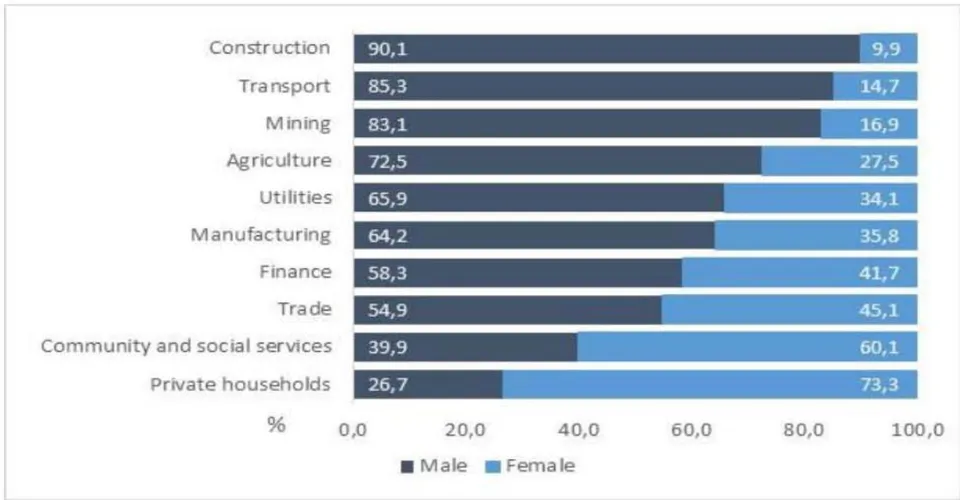
COVID-19 has had its share in the labour market dynamics globally and South Africa is not exception challenges posed by this pandemic. Furthermore, COVID-19 related labour data shows a clear pattern of gender inequality in the labour market in South Africa. Figure 1 below shows percentage distribution of those who worked during lockdown by industry and sex, Q1: 2021. As argued by Statistics South Africa (2021b) of the 15,0 million persons who were employed in Q1: 2021, almost four out of every five persons were expected to work during the national lockdown by the companies/organisations they work for. Reflecting the gender dynamics of the South African labour market, about 9 in 10 people employed within the Construction industry who worked during the lockdown were men. Construction activities takes place because of infrastructure investment. However, looking at figure 1 below construction sector shows to be an industry were fewer women engaged in work activities across all industries during lock-down. Worth noting, is the higher number of women in the community and social services and private household thus pointing the continuous gender role definition by society and the labour market in general.
Source: Statistics South Africa (2021b)
b) Economic and Gender Dimension of Labour Framework
To achieve the desired developmental outcomes and impact, a conscious decision to mainstream gender in development projects must be made. As argued by Fofack (2011), empirical evidence is increasingly showing that projects which integrate gender considerations have higher chances of meeting their underlying development objectives. The African Development Bank Group (2009) advances the following gender infrastructure indicators for infrastructure project cycle to ensure intentional equitable benefit for women in infrastructure development projects. Notwithstanding the plethora of laws and policies in South Africa, females have not yet progressed as expected in terms of socio-economic empowerment and gender equality (Mosenogi, 2019).
It is evident that a blanket approach towards attainment of gender equality cannot yield desired results of equal society at both social and economic level. Challenges facing South Africa in attaining gender equality are heavily founded in many years of historical system of economic planning and social setting and thus require a well-though, evidence-based and robust yet inclusive approach to deal with. These challenges still remain visible and prominent in the South African labour market.
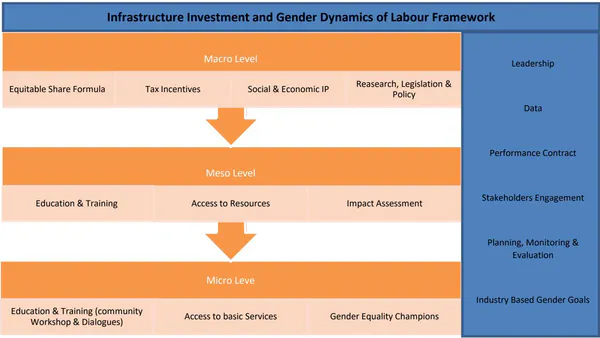
As argued by Von Fintel and Moses (2017), internal migration in South Africa has a strong gender dimension. Historically, the apartheid-era migrant labour system meant that predominantly black African men moved to urban areas without their families. After the abolition of influx controls in 1986, many women relocated, presumably to join their male partners. The period of migration feminization was also coupled with labour market feminization. However, existing research shows that increased female labour supply was poorly matched by labour market absorption, leading to rising unemployment among black African women (Von Fintel and Moses, 2017). It is against this background and the research findings that this study developed the Infrastructure Investment and Gender Dynamics of Labour Frame work which is outlined below.
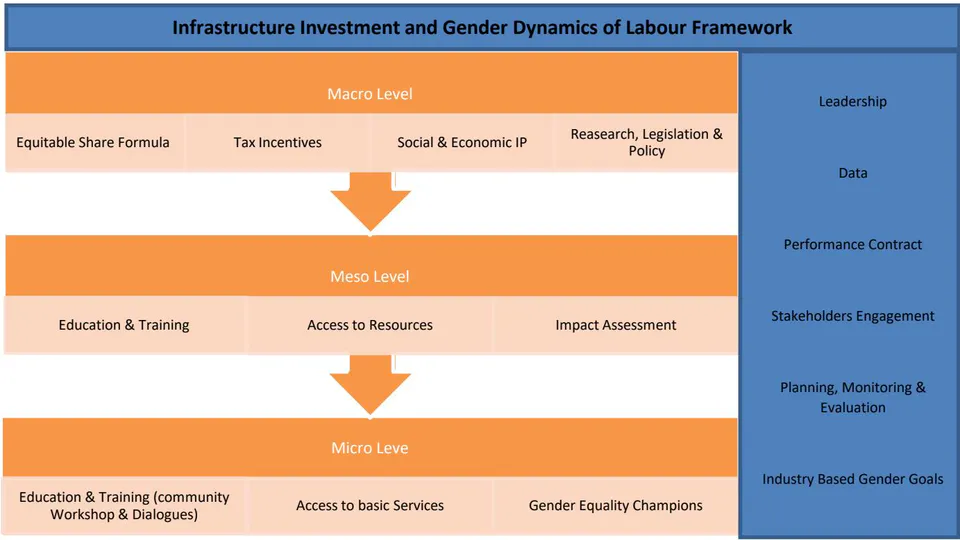
Macro Level
Macroeconomic policy, both fiscal and monetary policy, is often thought of as gender-neutral. But economic policy choices affect women and men differently because of their different positions in the economy, both market (paid) and non-market (unpaid). For instance, budget cuts that reduce social spending may increase the demands on women's unpaid household labour, while trade liberalization may negatively affect women's employment in contexts where they are over-represented in import-competing sectors, such as agricultural food crops, (UN Women, 2016). Yet, macroeconomic policies to date have paid scant attention to these issues and have therefore not been conducive to the achievement of gender equality. Focusing on goals, measurement and policy instruments, this brief lays out the key problems with current macroeconomic policies and provides building
Example:
| SA Equitable Share-Population component = 1% | Males Population (% share) | Females Population (% Share) | Budget Share Males | Budget Share Females |
| National | 48% | 52% | 48% of 1% Component | 52% of 1% Component |
| Province A | 47% | 53% | 47% of 1% Component | 52% of 1% Component |
| Province B | 50% | 50% | 50% of 1% Component | 50% of 1% Component |
| Municipal A | 46% | 56% | 46% of 1% Component | 56% of 1% Component |
| Municipal B | 49% | 51% | 49% of 1% Component | 51% of 1% Component |
The above table illustrate a possible approach towards gender-sensitive equitable share formula. Noting that South Africa has more females compared to blocks for an alternative macroeconomic agenda that is rights-based and gender-responsive, (UN Women, 2016).
Based on the findings of this study, it is argued that to achieve sustainable economic and inclusive labour market at a macro level the following aspects as outlined in the diagram above be considered and these are:
Equitable Share Formula
Many Authors have argued for gender budgeting, however, achieving this have always been a challenge for various reasons. Gender equality can surely not be achieved without resources. The framework thus argues that the population components of the equitable share must be divided by gender-based population statistics and be allocated as such at National, provincial and local level.
males, and women bears the brunt of poverty while at the same time being under-represented in the labour market, it only makes sense that the fiscal policy be re- focused to be gender sensitive and amongst other the equitable share formula can play a pivotal role. This principle must therefore be applied across all spheres of government. A proposed framework requires effective oversight to ensure that the budget is spent in accordance with females and males needs in the society.
Tax Incentive
Tax system is another key fiscal policy tool that can be used for various reasons such as attracting investment, encouraging/discouraging consumption and other economic and social behavioural patterns, raising revenue for government, etc. tax incentive is therefore another critical tool that can be used by South Africa to encourage employment of women in South African. Companied must therefore be incentivised for employing women across all ages, more especially young women due to the high unemployment of youth in South Africa.
- Investment (Social and Economic Infrastructure Projects (IP))
The South African government has 18 Strategic Infrastructure Projects (SIPs). To achieve women's economic empowerment and gender equality in the labour market, gender mainstreaming must be prioritised in these projects. Such mainstreaming must be informed by industry gender-specific labour statistics; gender-based unemployment in the province or municipality where the project is located; gender disaggregated population data at provincial and municipal level. This principle must be applicable and enforced across all spheres of government and over-and-above the 18 SIPs. This could be an opportunity to fast-track transformation in the labour market.
Research, Legislation and Policy
There is a need for continuous investment in various sectors of the economy and such must be funded. The South African Employment Tax Incentive Act, (2013) be extended to include women. The Commission for Gender Equality Act 39 of 1996 be amended to give powers to the commission to enforce implementation of its findings or recommendations. Policy on gender equality and women's empowerment be continuously reviewed to be sector specific and aligned to industries of the future. Investment in research and development has the potential to enhance innovation in areas of gender equality, women empowerment and gender inclusive economic growth.
Meso Level
South African Government structure is divided into three spheres of government which are National, Provincial and Local government. Amongst others, the provincial government (Meso Level) is responsible for implementation of education, distribute resources and conduct impact analysis of resources distributed on the socio-economic conditions of its population. The framework thus argues that such approach must be gender-sensitive to achieve gender equality and as a consequence reduce poverty, unemployment and inequality. The following must be done to realise this:
- Education and Training
Gender mainstreaming in the curriculum is of critical importance. This will break and reshape gender stereotypes in the society. Furthermore, as indicated in the research finding, across all skills level women remains underrepresented in the labour market. Gender budgeting in education and training must therefore be legislated to accelerate women capacity in economic sectors which are male dominated such construction and electricity. These must consider capacity building for future industries to empower women in being more competitive in the fourth industrial revolution.
- Access to Resources
In the phase of rapid economic development and changes, access to resource has never been important as today to human development. Equitable access to resource has the potential to reduce poverty, unemployment and inequality significantly in South Africa and afford women a competitive edge to equally compete for opportunities in the labour market. Resource such as business funding for women currently must be compulsory for women. Access to ICT infrastructure for females must be a priority for both private and public in the current age of Industrial Revolution. Funding for education must take a gender-based population shape.
Impact Assessment On a continuous basis, both private and public sector and the Constitutional body such as Commission for Gender Equality must assess the impact of resources on economic empowerment and transformation in the labour market. This will create a scientific-evidence-based accountability mechanism. Outcomes of such impact assessment must inform future discourse to accelerate gender equality and change he unequal patterns of the labour market.
Micro Level
Households as suppliers of labour to the market are based at micro level of the economy and local government sphere in the South African context. This is where communities develop and practices its culture and tradition that shapes the ultimate labour supplied to the entire economy. It is at local level were gender roles and stereotypes are shaped and defined. Hence the framework emphasis the need for education and training (workshops and dialogues); Access to basic service and gender equality champions.
- Education and Training (Workshops & Dialogues)
Reframing of mind set, behavioural patterns and attitudes can only be achieved through education and training over time. Local government and key stakeholders must play an active role in facilitating community workshops and dialogues, which can ultimately shape a clearly understanding of gender equality at a grass roots level.
- Access to basic Service
Many women across African countries spend most of their time on unpaid labour such as collecting wood for energy and fetching water for cooking and laundry. These are also responsibilities of young girl children in most areas which compromised the time and energy that could be used in their schoolwork and shaping their future. Provision of basic service such as water, energy, access to data, sanitation and health service can go a long way in encouraging and enabling women to participative fully in the economy.
Gender Equality Champions (GEC)
To effectively advocate for and implement education and training and provision of basic service at a local level, there is a need to establish gender equality champions. In partnership with other stakeholders, GEC will have the responsibility to design, implementation and sustainability of gender and development programmes and projects in local communities.
IV. CONCLUSION
One of the root causes of poverty and gender-based violence is gender inequality and un-empowered female population. It evident from many studies that distribution of resources in South Africa is largely not gender biased based on the state equality or inequality. Population as a component of equitable share in South Africa is gender-blind and to that effect does not consider gender dynamics in the county. More women are unemployed and lives in poverty compared to men. Infrastructure developments present an opportunity to South Africa as a country advance gender equality, eradicate gender-based poverty and achieve women empowerment not only as beneficiaries but as leaders of development.