
I. INTRODUCTION: SUPERGRIDS ARE TODAY'S SUCCESSFUL REALITY
a) "Electricity Highways" unite Canada on a New Level Year by year, Canada aims to create a more cohesive, prosperous, and equitable society, supporting its provinces' efforts, addressing internal challenges in economic development and contributing to international collaboration globally.
Uniting Canada's efforts to safeguard and strengthen "One Canadian Economy" vision 1 and "build Canada into an economic superpower" [2] requires the country to review and upgrade its strategic economic pathways to remove any barriers to internal trade and grow competitive industrial innovations.
One of these strategic pathways is focused on competitive wholesale markets and related to clean electricity, one of the key high-quality products Canada's economy has been built on. Competitive electricity wholesale is well proven globally with many successful examples in North America, the European Union and Australia, demonstrating high efficiency and reliability of regional markets and power transmission system operations. Many Canadian provincial transmission operators are closely involved in advancing their own wholesale markets or are a part of regional transmission organizations administering these markets [3].
To make a new uniting step into a "coast-to-coast" competitive wholesale electricity market making it truly pan-Canadian, critical power transmission advancements have to be deployed, upgrading transmission grids through "electricity highways" innovations - supergrids.
b) Indeed, Supergrids Today are a Power Transmission Reality Worldwide With the necessity for a robust transmission grid to reach remote renewable power generation, make interconnections between jurisdictions for energy trading, and accommodate the expected growth of power consumption, supergrids already became a preferred regional and inter-regional multi-value solution. Being technologically advanced, supergrids embed High Voltage Direct Current (HVDC) technology (e.g., [4,5],) presenting Alternate Current (AC) and Direct Current (DC) merge in action [6].
c) HVDC Technology in Supergrids for Power Transmission is Transformational
Large-scale advancements in HVDC deployment and operations shaped the industry for the next decade [7].
This included "unprecedented levels of investments and contract awards, creating a firm project pipeline and enabling the industry to make the required investments in the supply chain to increase much-needed production capacity".
The recently announced multi-purpose supergrid infrastructure projects, embedding multi-terminal HVDC technology, combine offshore wind export and interconnection functionality. Long term strategic grid plans including key roles for multi-terminal HVDC overlaying existing HVAC grids as the bulk electrical energy carrier of choice were also published by several European transmission grid operators.
The volume of HVDC-based supergrid tenders and frameworks announced only in 2023 worldwide, demonstrating at least 46 new HVDC projects based on Voltage Source Converter technology to be installed over the next decade, and equating to a 94.3 GW addition of HVDC transmission capacity, with over USD 140 billion publicly announced [7], confirms an immediate need for Canada to consider a national-scale supergrid investment to upgrade its power transmission coast-to-coast and strengthen its export/import infrastructure.
d) Canada is Geo-Economically Unique, and so are the Needs of its Power System
An excerpt from a report prepared for Electricity Canada [8] defines Canadian Electricity System today as follows:
"The Canadian electricity sector is unique in generation mix, geography, and regulatory structure when compared with other North American jurisdictions. Regulation of the sector takes place at the provincial level with limited regulation of transmission lines that cross provincial boundaries.
(...) Most Canadian provinces operate nearly as islands, with limited connectivity amongst Western Provinces (BC, Alberta, Saskatchewan, and Manitoba) and similarly limited connectivity between the Eastern Provinces (Ontario, Quebec, and Atlantic Canada).
The uniqueness of Canada's power transmission system needs calls for addressing an immediate supergrid opportunity in Canada: the country must deploy a coast-to-coast Transcontinental Supergrid that would address all transmission needs of provincial transmission operators, ensure strong provincial interties between the transmission grids and with remote offshore wind generation in the Atlantic, and international interconnections with wholesale electricity markets in the U.S. It would also address remote industrial consumption needs.
e) Canada's Transcontinental Supergrid is Requested to be Promptly Considered as a "Nation-Building" Infrastructure Project
To review Canada's Transcontinental Supergrid opportunity, let us look at a glance at the current realities of the provincial transmission grids, consider upgrading the interties between them, and better understand how the ten provincial transmission grids may be transformed into Canada's Transcontinental Supergrid.
We will think about a transcontinental transmission target as well as the export/import targets with wholesale markets in the U.S.
Finally, we will make an initial assessment of potential investments in Canada's Transcontinental Supergrid.
II. MATERIALS AND METHODS
a) Interconnecting by Supergrid
i. Transforming Power Transmission in Canada: Requirements for Success
a. "One Canadian Economy" Needs Pan-Canadian Wholesale Electricity Market
Canada is already on its way to strengthening "One Canadian Economy" vision through achieving its low carbon practice. As a part of this geo-economic vision, Canadian provinces would trade electricity freely across the country; their provincial competitive electricity markets would have been grown, upgraded and enhanced [3].
The next immediate, critical and inevitable step in advancing Canada's geo-economic efforts is seen in transforming these provincial markets into a pan-Canadian wholesale electricity market (here referred to as Canadian National Electricity Market, further - CNEM).
CNEM is seen as a crucial part of Canada's energy sector, facilitating the wholesale trading of electricity across all the provinces and territories in the country.
CNEM would administer and facilitate the trading of electricity across the Transcontinental Supergrid, integrating, managing and coordinating dispatchable and non-dispatchable clean electricity generation sources and uses, and ensuring a stable and competitive market environment.
The key parts of the CNEM multi-value include the following:
Interconnected Transmission Grid: CNEM would operate on the Transcontinental Supergrid with provincial interties and international interconnections
Wholesale Electricity Market: CNEM would operate as a competitive wholesale market where generators (including Distributed Energy Resources aggregators) sell electricity, and distributors and retailers buy it to resell to consumers.
Demand Response: Demand Response aggregators representing consumers would bid demand response into the wholesale market as a substitute for generation.
Regional Pricing: Canadian NEM would operate in the five regions: Atlantic, Mid-Eastern, Central, Mid-Western and Pacific. Separate prices are determined for each of these Canadian NEM regions.
Renewable Energy Integration: CNEM would play a key role in the integration of renewable energy sources, including wind, solar and geothermal.
CNEM would be governed by federal market rules and regulations, ensuring a fair and efficient trading environment across the country.
b. Transcontinental Supergrid is the Infrastructure for Pan-Canadian Market
The only way to trade electricity coast-to-coast is to promptly and efficiently develop and deploy Canada's Transcontinental Supergrid. This will align the provincial transmission systems operations with the needs identified in [9] to ensure reliability, resilience and energy security of these systems. This will also allow for meeting the future CNEM requirements to the provincial electricity systems.
Deploying Canada's Transcontinental Supergrid can be done by deeply engaging all the provincial power transmission grids to strengthen major "electricity highways" with embedded high voltage direct current (HVDC) multi-terminal, multi-vendor, multi-purpose solutions.
This will transform currently not well connected provincial transmission grids in Canada into a robust transcontinental transmission grid enabled with provincial interties and international interconnections. This will also enable integrating intra- and extra-provincial renewable power generation, making renewable generation fleets dispatchable [10], and accommodating the expected power consumption growth through the proposed CNEM's competitive wholesale electricity market operations.
To better understand emerging opportunities related to the future of Canadian National Electricity Market and the Transcontinental Supergrid as its infrastructure, let us review existing inter-regional transmission practices and achievements, and technological advances in the European Union, United States of America, and Australia.
ii. Learning from the EU: Practices and Achievements
a. Inter-Regional Wholesale Market: Using European Experience To better define the realities and opportunities related to transmission in the electricity value chain in Canada, it may be important to learn from countries and their continental unions - regional organizations such as the European Union that "facilitate pan-continental integration, ranging from collaborative intergovernmental organizations to supranational politico-economic union" [11], and their common frameworks.
Specifically, a common framework related to the European Energy Market within the EU's Projects of Common Interest (PCI) [12,13], referred by the Canada Electricity Advisory Council [9], maybe adapted to the context of a pan-Canadian Wholesale Electricity Market and Canada's Transcontinental Supergrid as its infrastructure. "Analogous to Canada in some ways, the EU is a federation of member states, each with jurisdiction over their own electricity systems. The PCI model is designed to facilitate cooperation on interregional energy projects between member nations by providing a centralized and agreed-upon methodology for identifying, allocating, and arbitrating costs and benefits, and by providing a mechanism to bridge cost asymmetries".
The today's EU's Projects of Common Interest model is backed by a European energy policy vision presented in the "Green Paper: A European strategy for sustainable, competitive and secure energy" of 2006 [14]. In this Green Paper the European Commission "asks the Member States to do everything in their power to implement a European energy policy built on three core objectives:
- Sustainability - To actively combat climate change by promoting renewable energy sources and energy efficiency;
- Competitiveness - To improve the efficiency of the European energy grid by creating a truly competitive internal energy market;
- Security of supply - To better coordinate the EU's supply of and demand for energy within an international context".
The Green Paper [14] clarified that "The first challenge facing Europe is the need to complete the internal gas and electricity markets." By "internal market" for electricity this document clearly understands a market covering the whole European Union.
Opening up the Member States markets to the internal EU market "will create fair competition between companies at European level and improve the security and competitiveness of the energy supply in Europe. As of July 2007, consumers will have the legal right to purchase gas and electricity from any supplier in the EU. In order to make an internal energy market a reality, the following core areas need particular attention:
- A European grid with common rules and standards for cross-border trade is needed to give suppliers harmonised access to national grids. These common rules will be drawn up in cooperation with grid operators and, if necessary, with a European energy regulator;
- A priority interconnection plan to stimulate investment in infrastructure linking the various national grids, most of which are still not adequately interconnected;
- Investment in generation capacity to meet peaks in demand can be encouraged by opening up markets which are truly competitive;
- A more clear-cut unbundling of activities to distinguish clearly between those which generate and those which transmit and distribute gas and electricity. The confusion which is being created in
certain countries is a form of protectionism for which further measures at Community level could be considered;
- Boosting the competitiveness of European industry by securing the availability of energy at affordable prices."
According to "Fact Sheets on the European Union. Internal energy market" [15] updated in April 2024, "The European energy market is competitive, customer-centred, flexible and non-discriminatory. Its measures address issues of market access, transparency and regulation, consumer protection, interconnections and security of supply. They strengthen the rights of individual customers, energy communities and vulnerable consumers, clarify the roles and responsibilities of market participants and regulators, and promote the development of trans-European energy networks."
Completing the EU's internal market objectives "requires several steps: removing numerous obstacles and trade barriers, aligning tax and pricing policies with norms and standards, and implementing environmental and safety regulations. The objective is to ensure a functioning market with fair access, high consumer protection and sufficient levels of interconnection and generation capacity."
The EU's internal market completion achievements are defined by the following historical steps in the liberalisation of gas and electricity markets:
"During the 1990s, the European Union and its Member States began a gradual process of opening up their monopolistic national electricity and gas markets to competition. This initiative unfolded through several legislative packages:
- The First Energy Package, adopted between 1996 and 1998, introduced a first liberalisation of national energy markets;
- The Second Energy Package, adopted in 2003, allowed industrial and domestic consumers to choose their own energy suppliers from a wider range of competitors;
- The Third Energy Package, adopted in 2009, introduced rules on the separation of energy supply and generation from transmission networks (unbundling), new requirements for independent regulators, a European agency for the cooperation of national energy regulators (ACER), European networks for transmission system operators for electricity (ENTSO-E) and gas (ENTSOG) and enhanced consumers' rights in retail markets;
- The Fourth Energy Package, known as 'Clean Energy for all Europeans' and adopted in 2019, introduced new rules for renewable energy, consumer incentives and limits on subsidies to power plants, such as capacity mechanisms. It required the preparation of risk-mitigation plans for
electricity crises and increased ACER's competences for cross-border cooperation;
- The Fifth Energy Package, known as 'Fit For 55' and adopted in 2024, aligns the Union's energy targets with its new net-zero climate ambitions and extends the gas package to hydrogen. After the Russian invasion of Ukraine in 2022, the REPowerEU plan amended it to phase out Russian fossil energy imports, diversify energy sources, introduce energy-saving measures, and accelerate the shift to renewables. The reform of the electricity market design introduced new rules for long-term contracts and increased protection of vulnerable consumers".
b. Connecting Synchronous Areas in the European Union
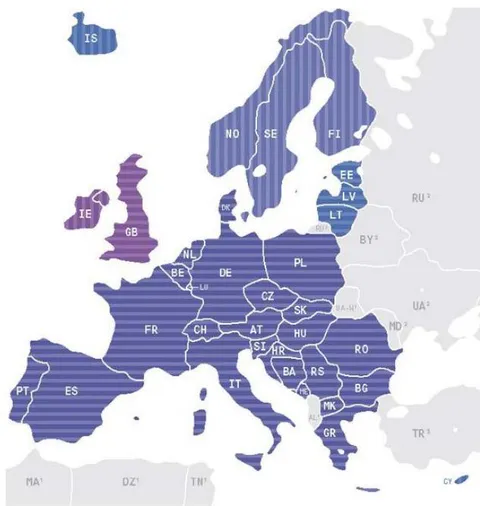
ENTSO-E, the European Network of Transmission System Operators for Electricity, is the association for the cooperation of the European transmission system operators (TSOs) [16] operating within six synchronous areas in the European Union (see Fig. 1.2.1):
Continental Europe Synchronous Area (CESA),
Baltic Synchronous Area (BSA),
Nordic (Scandinavian) Synchronous Area (NSA),
British Synchronous Area, also called Great Britain Synchronous Area (GBSA) and United Kingdom Synchronous Area,
Irish Synchronous Area (ISA), and
Isolated Systems Area, also called Isolated systems of Cyprus and Iceland.
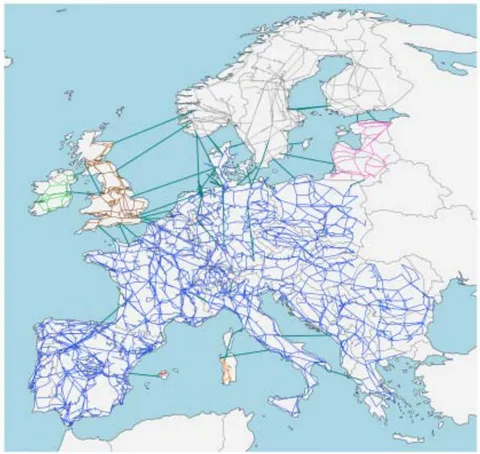
Interconnections of the synchronous areas in the EU are done by HVDC power lines (see Fig. 1.2.2):
Continental Europe Synchronous Area [18]
The Continental Europe Synchronous Area (CESA) is one of the largest synchronous electrical grids in the world, primarily operating in Europe. It is interconnected as a single phase-locked frequency electricity grid that supplies over 400 million customers in 32 countries, including most of the European Union. The transmission system operators operating this grid formed the Union for the Coordination of Transmission of Electricity (UCTE), now part of the European Network of Transmission System Operators for Electricity (ENTSO-E).
Baltic Synchronous Area [19]
The three Baltic states (Lithuania, Latvia, and Estonia) undertook the synchronization of their electric power transmission infrastructure with the Continental Europe Synchronous Area (CESA), a project known as Baltic Synchro. Managed by ENTSO-E, this initiative aimed to disconnect from the IPS/UPS system, previously governed by the 2001 BRELL Agreement with Belarus and Russia. The project was successfully completed on February 9, 2025.
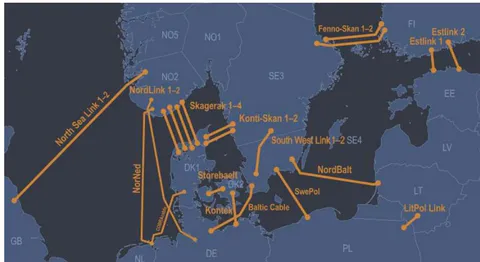
On December 9, 2015, Poland and Lithuania commissioned LitPol Link, which was the first direct connection between the Baltic states and the European grid. In 2018, another proposed link with Poland via the Baltic Sea was announced, called Harmony Link. The total investment planned for the Harmony Link project is around €680 million, of which €493 million will come from the Connecting Europe Facility. The Baltic States also have connections with the Nordic electricity grid via NordBalt and Estlink, although Estlink was operating at one-third capacity at the time of the grid switchover.
Nordic (Scandinavian) Synchronous Area [20]
The Nordic regional group (formerly NORDEL) of ENTSO-E is a synchronous electrical grid composed of the electricity grids of Norway, Sweden, Finland and the eastern part of electricity sector in Denmark (Zealand with islands and Bornholm). The grid is not synchronized with the Continental Europe Synchronous Area but has a number of non-synchronous DC connections with that as well as other synchronous grids. Gotland is not synchronized with the Swedish mainland either, as it is connected by HVDC. The grid also has HVDC submarine power cable links with the Baltic States – see Fig. 1.2.3:
Irish Synchronous Area [21,22]
EirGrid and the System Operator Northern Ireland (hereafter referred to as "SONI") operate in the Synchronous Area IE/NI. The transmission systems of Ireland and NI are electrically connected and synchronised. EirGrid and SONI work closely as required by the respective TSO licences to ensure that security standards are maintained on the Synchronous Area IE/NI.
Isolated Systems Area
Within the ENTSO-E network, the "isolated systems area" refers to regions like Cyprus and Iceland, which are not directly connected to the main European synchronous grid and operate as separate power systems, meaning they are not synchronized with the rest of the continental European grid; essentially, they are considered "islands" within the larger European electricity network [23].
c. Supergrid for Enhancing the Market
According to "A European Supergrid" Memorandum [26] submitted by "Friends of the Supergrid" in 2012, Supergrid was seen as "an electricity transmission system, mainly based on direct current, designed to facilitate large-scale sustainable power generation in remote areas for transmission to centres of consumption, one of whose fundamental attributes will be the enhancement of the market in electricity."


A "Roadmap to the Supergrid Technologies" [27] following this Memorandum and published in 2014 stated that the decarbonisation of Europe's energy sector requires a strong, integrated Supergrid, and the development of such a grid can start today alongside the installation of new renewable power plants. The Roadmap presented the following vision: "A Transcontinental Supergrid will allow Europe to confront the threats posed by climate change, secure an independent energy future for the continent and provide ongoing access to affordable and stable supplies of energy that meet all our needs (...).
Replacing the constrained, hierarchical one-to-many model of the past, such a grid would become a many-to-many intelligent network that is largely automated and able to operate, monitor and, to some extent, heal itself. As well as providing a safer and cleaner supply of electricity, such a grid will also deliver considerable savings in terms of transmission costs and reductions in lost supply; in short, it will be more flexible, more reliable and better able to meet our needs."
The Roadmap presented Supergrid "as the term for the future electricity system that will enable Europe to undertake a one-off transition to sustainability. This transmission network will make possible the delivery of decarbonised electricity across the continent, enhancing the existing AC networks. It will become the backbone of Europe's future power system. Europe's challenging renewable energy targets will necessitate the development of renewable generation remote from existing population centres, with much of it based offshore... Supergrid will allow future generation to be built where resources are optimal and transported to existing grids for delivery to existing and future load centres."
The Roadmap [27] defined applications for Supergrid including the following "key findings:
- The Supergrid will allow future generation to be built where the required natural resources are optimal rather than where they are convenient for transmission
- The Supergrid will allow the transmission of decarbonised electricity across countries, enhancing existing AC networks
- The Supergrid will incorporate "Smart Grid" technologies that offer considerable savings in maintenance cost and loss of supply during transmission
- The Supergrid will prove integral to meeting carbon reduction targets for 2020 and 2050 including those necessitated by moving an increasing share of transport and heating to the electricity grid
- The Supergrid will expand transmission capacity while, at the same time maintaining (at least) today's security of supply".
The Roadmap [27] reviewed Network Technologies for Supergrid "with a look to the future through emerging technologies that hold out the prospect of revolutionising the transmission of electrical energy". The document showed that using existing technology "it is possible to construct a grid that takes advantage of variable conditions across the continent to ensure reliability of supply".
The Roadmap [27] demonstrated that "no insurmountable hurdles to the creation of a pan-European transmission network have been identified" and that "remaining difficulties relate principally to interoperability between regulatory regimes and manufacturers' equipment." It was shown that so-called "network supernodes" complementing HVDC and HVAC technology can contribute to achieving the required security of supply in larger HVDC networks.
d. Trans-European Networks for Energy
Trans-European Networks for Energy (TEN-E) is a policy focused on linking the energy infrastructures of EU countries (see a fact sheet on Trans-European Networks) [28]. As part of the policy, 11 priority corridors have been identified: three for electricity, five for offshore grids and three for hydrogen. Additionally, there are three priority thematic areas: smart electricity grid deployment, smart gas grids and a cross-border carbon dioxide network.
The TEN-E Regulation (EU) 2022/869 lays down guidelines for trans-European energy networks, identifying projects of common interest (PCIs) among EU countries, projects of mutual interest (PMIs) between the EU and non-EU countries, and priority projects involving trans-European energy networks. This regulation ended support for new natural gas and oil projects and required mandatory sustainability criteria for all projects.
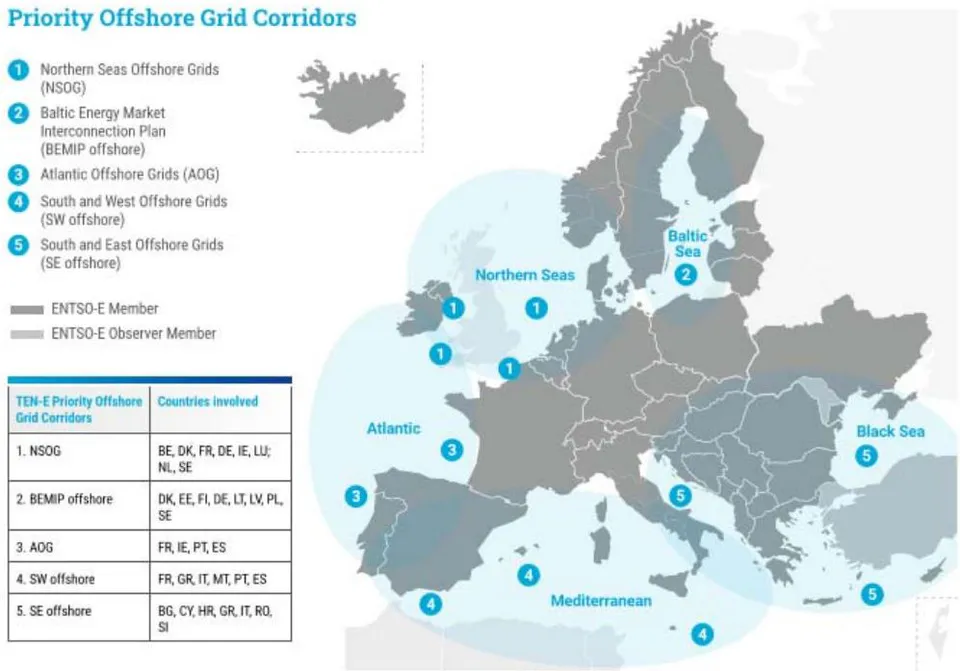
New PCs for energy and cross-border renewable energy projects are funded by the Connecting Europe Facility 2021-2027 for Energy (CEF-E), a funding instrument with a seven-year budget of EUR 5.84 billion allocated in the form of grants managed by the Climate, Infrastructure and Environment Executive Agency. The Commission draws up the list of PCs via a delegated act, which enters into force only if Parliament or the Council express no objection within two months following notification.
e. Multi-Terminal Multi-Vendor HVDC
One of the current steps of upgrading HVDC deployment and AC/DC transmission merge is defined by multi-terminal DC grids (MTDC), HVDC transmission systems that connect more than two terminals, allowing for multiple power sources and load points to be integrated into a single DC grid, enhancing reliability, flexibility, and energy trading [30,31,32].
MTDC systems are an evolution of traditional two-terminal HVDC links, enabling the integration of multiple converter stations into a single DC grid. The current level of Multi-Terminal Multi-Vendor deployment globally is demonstrated by the following projects in the EU.
READY4DC: "Getting ready for multi-vendor and multi-terminal DC technology" Project, supported by Horizon Europe, started on 1 April 2022 and was completed on 30 November 2023 [33]. The project "has created and engaged a community of experts that gave recommendations on the major technical and legal aspects of designing and building an interoperable multi-vendor HVDC grid" [34](see Fig. 1.2.5):
A set of key project deliverables [36] included Legal and Regulatory Aspects of a Multi-Vendor Multi-Terminal HVDC Grid [37], Multi-Vendor Interoperability Process and Demonstration Definition [38], Long-Term View for HVDC Technology [39], and Framing the European Energy System [40].
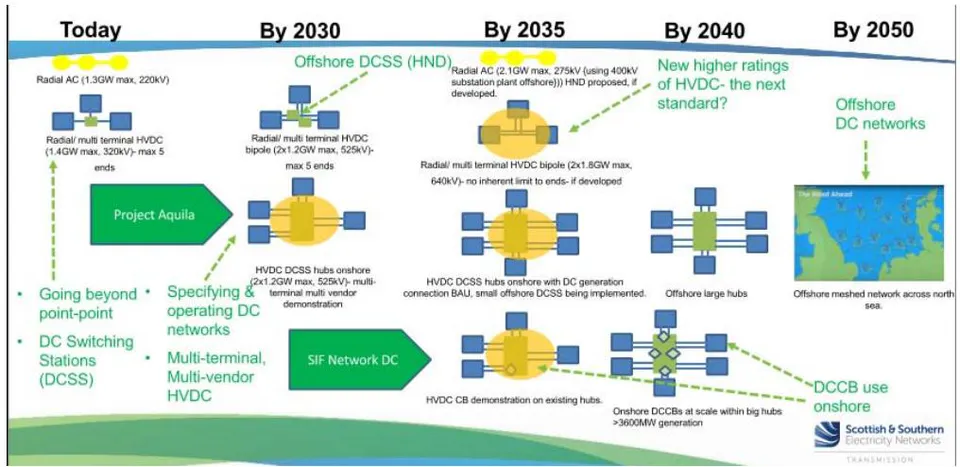
Project Aquila is a world-leading project developing a Multi-Terminal, Multi-Vendor DC-hub in Peterhead, Scotland to establish the foundations for DC-Grids in Great Britain [41]. As part of the project, in
2023-2024 the Great Britain's National HVDC Centre undertook the workstream of "Aquila Interoperability". According to the projections [42], advances in MTDC deployment in Great Britain will bring the development level from radial/multi terminal HVDC (1.4GW max, 320kV) with limited number of terminals today to large offshore HVDC hubs (>3600MW generation) with onshore DC circuit breakers (DCCBs) at scale by 2040 (see Project Aquila, Fig. 1.2.6):
InterOPERA: "Enabling interoperability of multi-vendor HVDC grids" Project is a Horizon Europe-funded initiative aiming to make future High Voltage Direct Current (HVDC) systems mutually compatible and interoperable by design, paving the way for multi-terminal, multi-vendor, and multi-purpose HVDC grids in Europe. The project was officially launched in Lyon, France in
January 2023 [43, 44] as "a joint initiative involving eight TSOs, three offshore wind developers, four HVDC equipment manufacturers, two wind turbine manufacturers, two sector associations, two universities under the coordination of a research and innovation institute" (Fig. 1.2.7):
Functional requirements for multivendor multi-terminal HVDC grids (InterOPER A deliverable D2.1) were presented at CIGRE 2024 in Paris on August 29, 2024 [46]. Grid-forming functional requirements for HVDC converter stations and DC connected power park modules in multi-terminal multi-vendor HVDC systems (InterOPER A deliverable D2.2) were also published in January 2024 [47, 48].
HVDC-WISE: "Reliable and resilient AC & DC grid design to accelerate the integration of renewables across Europe" project[49]investigates concepts and proposes solutions to encourage the development of large-scale HVDC-based transmission grid infrastructures capable of bringing benefits to the existing power networks in terms of resilience and reliability, as well as integrating the upcoming large amount of renewable energy sources. This project proposes, designs, and validates HVDC-based grid architecture concepts to make the widespread deployment of reliable and resilient AC/DC transmission networks possible, thus enabling the realization of the European energy transition"[51]. The HVDC-WISE project started in October 2022 and is expected to be completed in March 2026; it is a multidisciplinary initiative with 14 collaborators from 11 countries representing the academic (5), transmission system operators (4), and industry (5) sectors [50]:
The European Commission has defined plans for the development of renewable energies to reach climate neutrality by 2050. This change in production of electricity from fossil fuels to wind and solar power generation will lead to dramatic changes in power flows across AC transmission networks. HVDC is increasingly being recognized as the most effective technology to handle the transport of this energy (see Fig. 1.2.9).
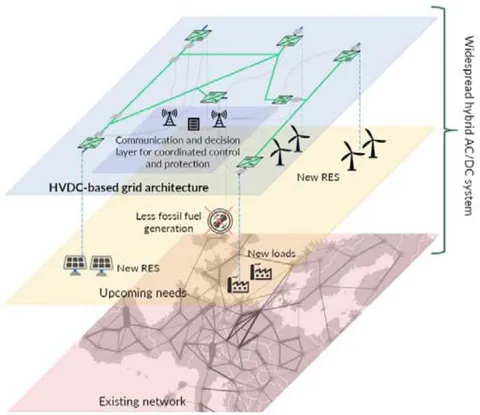
Milestones/Objectives of the HVDC-WISE Project are as follows [52]:
Develop a complete reliability-&-resilience-oriented planning toolset with appropriate representation of different HVDC-based grid architecture concepts in hybrid AC/DC grids
Identify, propose and compare different HVDC-based grid architecture concepts aiming to address TSOs' reliability and resilience needs for widespread AC/DC systems
Identify and assess emerging technologies for HVDC-based grid architecture concepts needed for the deployment of widespread AC/DC transmission grids
Validate the toolset and grid architecture in an industrially relevant environment
Prepare for the adoption and deployment of these proposed solutions by the industry.
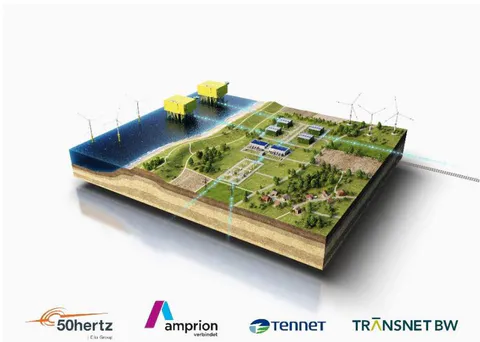
As a follow-up of the HVDC-WISE project, In July 2024 an important joint project for the energy transition: "Energy future "made in Europe": Multiterminal hubs as an important building block for realising the climate-neutral grid" was launched by Germany for MultiTerminal, Multi-Vendor (MTMV) HVDC Systems deployment [53]. The four German transmission system operators, 50Hertz, Amprion, TenneT and TransnetBW,
collaborated with industrial partners Siemens Energy, GE Vernova and Hitachi Energy aiming to develop multi-terminal hubs with direct current circuit breakers for the first time in order to link the new extra-high voltage direct current connections (Fig. 1.2.10).
f. European Transmission Planning
Transmission planning of grid development projects in the European Union, including all HVDC-related projects, in presented in the Ten-Year Network Development Plan (TYNDP) [54]. The TYNDP is the pan-European electricity infrastructure development plan, that provides a European-wide vision of the future power system and investigates how power links can be used to make the energy transition happen in a cost-effective and secure way.
The TYNDP transmission planning process consists of four main processes: the building of scenarios, the project collection, the identification of system needs, and the project cost-benefit analysis. This complies with the TEN-E Regulation, which requires projects to be assessed under different planning scenarios, each of which represents a possible future development of the energy system.
The most recent 4th Guideline for cost-benefit analysis of grid development projects was issued in March 2024 [55]. This Guideline was prepared by the European Network of Transmission System Operators for Electricity (ENTSO-E) in compliance with the requirements of the EU Regulation (EU) 2022/869 on guidelines for trans-European energy infrastructure (referred to as 'the TEN-E Regulation').
The Guideline addresses the projects contained in TYNDR, including the Projects of Common Interest (PCI) and Projects of Mutual Interest (PMI). It is also focused on the cross-border cost allocation process as required by the TEN-E Regulation (Fig. 1.2.11).
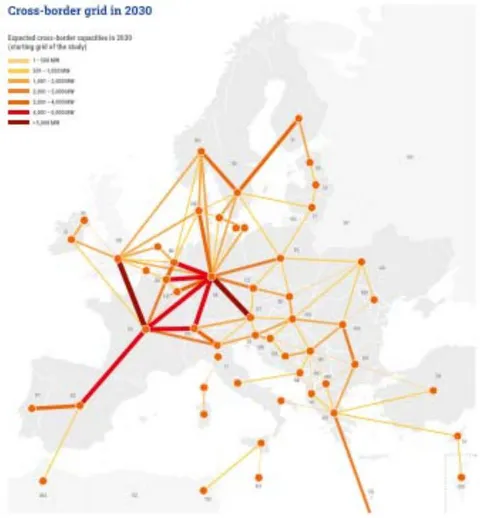
The Guideline provides general guidance on how to assess projects from a cost-benefit analysis (CBA) perspective. It describes the ENTSO-E's criteria for performing CBA in addition to the common principles and methodologies used in the necessary network studies, market analyses and interlinked modelling methodologies.
iii. North American Inter-Regional HVDC Advances
a. Cross-Seam Transfer Upgrade
From an inter-regional power transfer upgrade angle, it may be important to highlight that power transmission in the contiguous U.S. is presented by three non-synchronised power grids: the Eastern Interconnection (EI), Western Interconnection (WI) and Texas interconnection (TI), with a power seam between the Eastern and Western interconnections, and a power seam between the Eastern and Texas interconnections.
Inter-regional cross-seam transmission means connecting non-synchronised grids through the use of high-voltage direct current HVDC technology and facilities; e.g., electricity flow between the Eastern and Western Interconnections is enabled by seven back-to-back (B2B) high-voltage direct-current (HVDC) facilities (1,320 megawatts (MW) in total).
Increasing cross-seam transmission capacity represents a timely and impactful opportunity to modernize and strengthen the U.S. transmission grid.
Clear understanding of this opportunity was presented in 2020 by the Interconnections Seam Study [57, 58, 59] uniquely capturing "capacity expansion and production cost at an unprecedented geographic scale and detail, all performed with consistent data inputs".
The Interconnections Seam Study "examined the potential economic value of increasing electricity transfer between the Eastern and Western Interconnections using high-voltage direct current (HVDC) transmission and cost-optimizing both generation and transmission resources across the United States". With the U.S. resource portfolio in transition, the ability to share additional resources across the seam was seen economically attractive under a variety of possible futures.
Increasing cross-seam transfer expected to "create a more integrated power system that could drive economic growth and increase efficient development and utilization of the nation's abundant energy resources, including solar, wind, and natural gas".
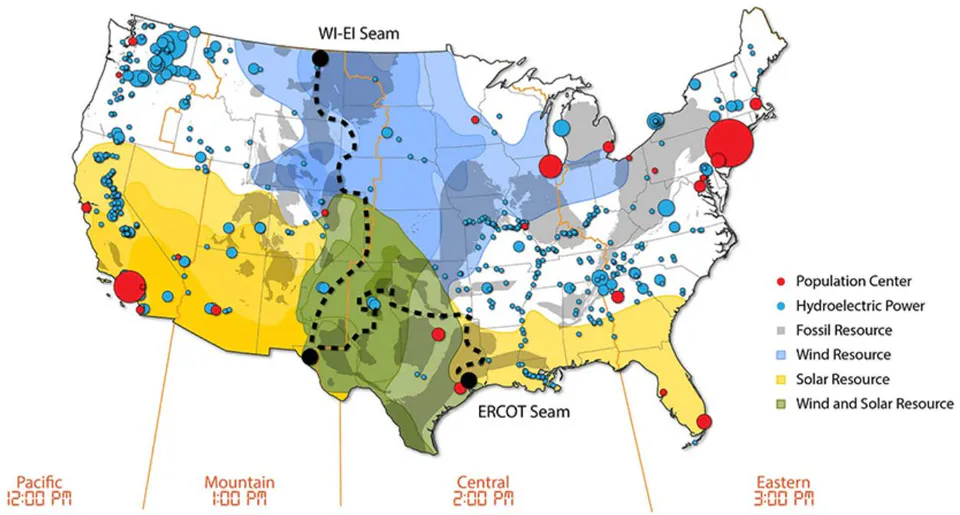
The Study's approach to designing a national transmission network under these futures uniquely captured "capacity expansion and production cost at an unprecedented geographic scale and detail, all performed with consistent data inputs".
The Study "co-optimized capacity expansion and systems operations to quantify the potential value of increasing the transmission capacity between the EI and WI using HVDC technology to facilitate more economically efficient exchange of power and adequacy throughout the United States".
Several cross-seam HVDC designs were studied with one of these designs (called "the macrogrid") presenting features similar to those of previously developed transmission overlays. In each cross-seam transmission design, HVDC capacity was co-optimized not only with generation investments but also with AC transmission investments to ensure that AC transmission investment needs were satisfied.
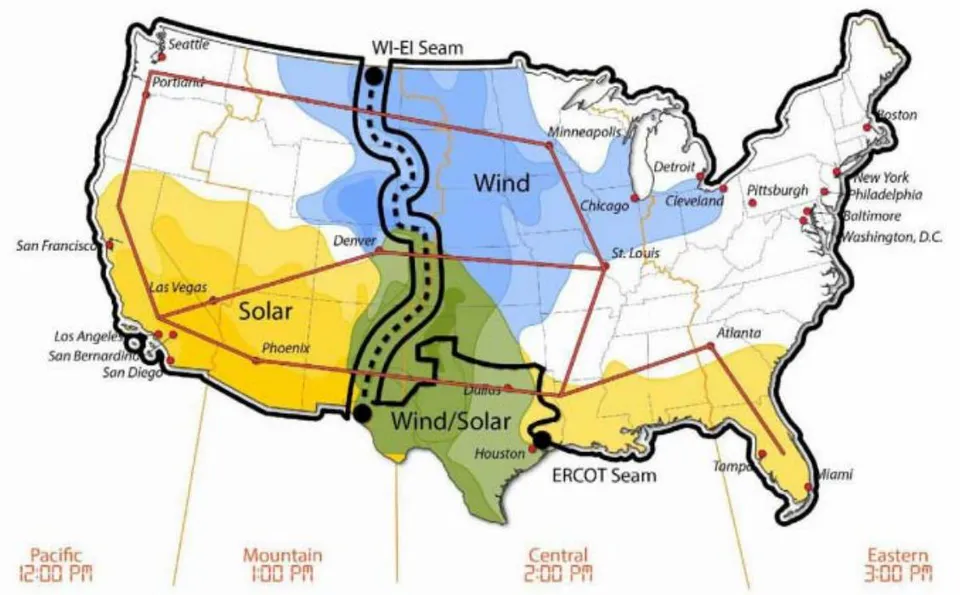
The four conceptual transmission designs (D1, D2a, D2b and D3 – see Table 1.3.1) were studied under eight different grid planning scenarios: Base Case, Low Gas Price, High Gas Price, High AC Transmission Cost
(1.5x), High AC Transmission Cost (2x), No Retirements, Low-Cost Renewables, and High Variable Generation (VG).
Table 1.3.1: Future Transmission Designs
| Design | Future Transmission Description |
| Design 1 (D1) | Existing B2B facilities are replaced at their current (2017) capacity level and new AC transmission and generation are co-optimized to minimize system-wide costs. |
| Design 2a (D2a) | Existing B2B facilities are replaced at a capacity rating that is co-optimized along with other investments in AC transmission and generation. |
| Design 2b (D2b) | Three HVDC transmission segments are built between the Eastern Interconnection and Western Interconnection and existing B2B facilities are co-optimized with other investments in AC transmission and generation. |
| Design 3 (D3) | Macrogrid (a nationwide HVDC transmission network) is built and additional AC transmission and generation are co-optimized to minimize system costs. |
| Design→ | D1 | D2a | D2b | D3 |
| HVDC-B2B (GW) | 0 | 6.7 | 6.3 | 0 |
| HVDC-Line (GW-miles) | 0 | 0 | 14,487 | 29,062 |
| AC Line (GW-miles) | 18,409 | 19,357 | 17,778 | 16,076 |
| Design→ | D1 | D2a | D2b | D3 |
| HVDC-B2B (GW) | 0 | 25.7 | 7.5 | 0 |
| HVDC-Line (GW-miles) | 0 | 0 | 31,335 | 63,156 |
| AC Line (GW-miles) | 52,737 | 60,141 | 50,964 | 43,190 |
Fig. 1.3.3: Transmission Investment Summary [61]
b. Macrogrid Leading Transmission Futures
While the needs for interregional transmission planning have been well recognized, the next step in the U.S. vision promoting continental macrogrids in the U.S transmission mainstream was promoted by people deeply understanding the necessity of interconnecting clean/renewable power generation and transmitting it across the country [60-66]. The Macro Grid Initiative as a joint effort of the American Council on Renewable Energy (ACORE) and Americans for a Clean Energy Grid (ACEG) promoted prompt investment in a century transmission infrastructure to enhance reliability, improve efficiency and deliver more low-cost clean energy. The "Macro Grids in the Mainstream" report of 2020 [61] addressed interregional transmission and Macro Grids to illuminate their value in the U.S. Terms were defined for interregional transmission ("transmission between two or more distinct geographical regions that are otherwise planned and operated separately, or between two or more distinct geographical regions that are separated by significant distance") and macrogrid ("a network of interregional transmission lines, generally expansive in geographical scope"), the term very close to the "supergrid" term used globally. It was highlighted that "macrogrids and high-voltage interregional transmission connections are either already in place, under development or being considered almost everywhere in the world"; e.g., China had recently completed five times more high-voltage interregional transmission than Europe, and over 80 times more than the U.S. Seeing macrogrid development as a natural and unsurprising next stage of electric industry evolution in the U.S. "because of its geographical centrality and size, its high electricity consumption, the benefits likely to accrue from interregional transmission development, and the fact that it has both north-south and east-west opportunities that appear attractive", the report contributed to the U.S. government review of its policies to address current challenges to interregional transmission and macrogrid development.
Defined benefits in [61] associated with interregional transmission and macrogrids include cost reduction via sharing; economic development; improved reliability; enhanced resilience and adaptability; increased renewable levels; and lowered cost of reducing emissions.
The main costs associated with developing interregional transmission and Macro Grids are transmission line costs (including public outreach, regulatory approval, and permitting) and substation costs (including the cost of converter stations for HVDC).
While historically in the U.S. the amount of time required to plan and build interregional transmission ranged 7.5 years to 13 years creating disincentives for organizations to initiate interregional transmission projects, it was proposed to reduce the risk by simplifying and shortening these processes. To address this based on the experts approach [61-66], "an interregional transmission design should take advantage of the strengths of both AC and DC technologies, combining AC in doing what AC does best with DC in doing what DC does best", using HVDC capabilities to make macrogrids "economically attractive to move energy, ancillary services, and capacity from a region where it is low-priced to other regions where they are high-priced".
Stepping into the second quarter of the century, the experts presented "an HVDC macrogrid spanning the continental US from the Atlantic seaboard to the Pacific coast, and from Florida, the Gulf coast, and Southern California northwards to Canadian border, with the easternmost north-south link in the Atlantic serving the region's offshore wind" with much of the benefit "driven by annual load diversity which allows shared capacity and significantly reduces what individual regions would have to build otherwise."
As the seven RTOs in the U.S. "provide a regional force having no profit motivation, trusted for their knowledge and experience, providing a familiar and collaborative environment within which entities may engage and negotiate", in the hypothetical scenario presented by the Macrogrid Initiative the macrogrid "was designed by a multiregional collaborative stakeholder group comprised mainly of experts from the RTOs with vendors and consultants hired where appropriate; a sister organization consisted of representatives from each state's regulatory body. Development and construction of this system was funded by merchants, utilities, state governments, and the Federal government".
According to the scenario in [61], "The HVDC national grid operator controls the HVDC network. RTOs retain regional control of the AC network. Power generally flows west-to-east and south-to-north during daytime hours and reverses these directions during nighttime hours. The system is self-contingent, i.e., its operational rules provide flow limits in each link which enable operating within all limits while safely withstanding loss of any one link."
c. On the Path to a National Macrogrid
Addressing possible reasons why some regions have opposed the development of macrogrids, a Reliable Continental Design concept was further proposed (see Fig. 1.3.4) extending the macrogrid to the east coast to include the offshore wind resources [63]. This design provided a third north-south link in the Atlantic Ocean, increasing macrogrid economies of sharing to include those between the U.S. Northeast and Southeast and satisfying the "rule of three" that establishes high-capacity interregional transmission with three or more parallel lines as most economically attractive [63].
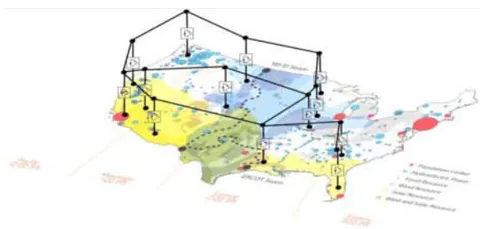
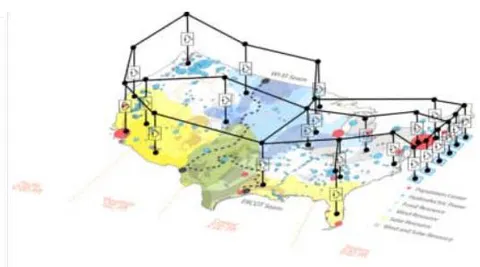
A unique opportunity for a detailed exploration of an alternative to the conventional transmission expansion process to address identified challenges for the U.S. electric power system is presented in [67].
The advanced hybrid grid was seen part of the key for the massive transmission expansion required to support very high levels of clean electricity for the United States.
The macrogrid concept proposed was seen as more than massive build-out of conventional high-voltage DC (HVDC) lines and converter stations. The macrogrid vision presented "a backbone of long-distance lines composed of networked, multi-terminal HVDC based on voltage source converter (VSC) technology."
The tasks proposed specific steps including:
- Technical studies on reliability, resilience, economics, and operations
- Coordination and oversight of the physical infrastructure.
- Cost comparisons
- Use of rights-of-way.
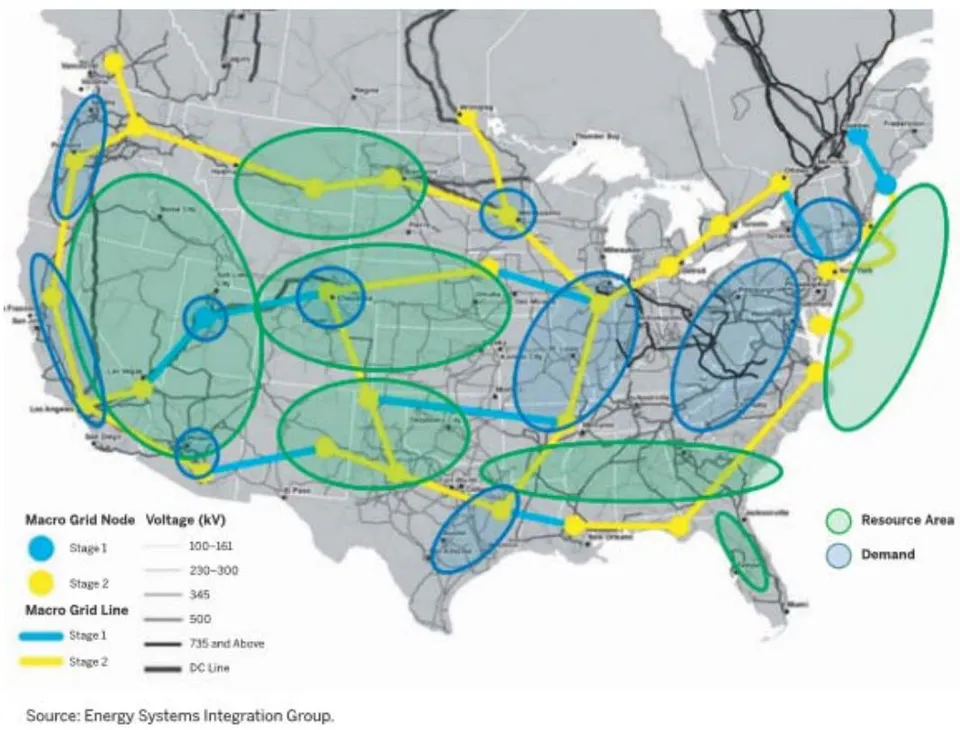
Successfully developing a macrogrid requires "consensus, an available funding approach, and public support. China has all three and, as a result, has built or is building nearly three times more interregional transmission capacity than the rest of the world combined."
To address this issue, the National Infrastructure Bank Act of 2023, introduced in the U.S. House of Representatives as HR 4052, provided $80 billion toward "a new grid overlay to transport renewable energy" [69].
A clear motivation for expediting the Macrogrid deployment was presented in "The MacroGrid: Motivation, Implementation, and Orchestration" [70]: "The ability to move the most economically attractive
renewable energy to load centers is primary. However, the macrogrid also produces substantial economic benefits from diurnal load diversity and the ability to share energy and ancillary services across time zones; and from annual peaking diversity and the ability to enhance reliability and save money by sharing capacity across geographical regions. Additional reliability benefits are obtained through the control capability of voltage source converters. The macrogrid also enhances resilience through the ability to move energy during extreme events. Finally, it "buys" not only long-distance transmission but local transmission as well, by offloading the underlying AC grid. Doing so reduces the number of transmission projects necessary to reach certain renewable objectives, providing a path to transmission expansion that may not exist otherwise."
According to [70], while most of the Macrogrid components are being proposed by merchant developers, other involved parties include local utility companies, regional transmission organizations (RTOs), load-serving entities, state governments, federal agencies, and equipment manufacturers. "Balancing the interests of these diverse entities is daunting; yet, the
industry has been here before, in terms of developing transmission on a geographically expansive scale to serve a complex group of organizations having only partially aligned and even competing interests."
d. National Transmission Planning Study
To understand the transformation needed to ensure the U.S. electric transmission system meets a greenhouse gas emissions reduction by 2035 and by 2050, the U.S. Department of Energy (DOE) Grid Deployment Office (GDO) partnered with the National Renewable Energy Laboratory (NREL) and the Pacific Northwest National Laboratory (PNNL) on the multiyear National Transmission Planning Study (NTP Study) [71-76].
Selected statements from the Executive Summary of the NTP Study [72] below are as follows.
The net benefits from large-scale transmission expansion compared to historic rates of transmission deployment found by the Study include:
- Accelerated transmission expansion leads to national electricity system cost savings of $270–490 billion through 2050.
- Incremental investments in transmission are more than compensated for by reduced electricity system costs for fuel, generation and storage capacity, and other costs. Approximately 1.80 is saved for every dollar spent on transmission.
- The benefits of transmission expansion to system costs scale with the level of electricity demand and rate of decarbonization.
A substantial 2.4 to 3.5 times expansion of the size of the transmission system throughout the entire contiguous United States compared to 2020is expected by 2050. The use of high-voltage direct current (HVDC) transmission technologies, including advanced multiterminal converters, results in the greatest benefits to consumers across the transmission options studied.
Regardless of future policy, market, and technology conditions grid planning at the national or multiregional scale requires enhanced institutional coordination, accessible data, and new grid modeling approaches, which have advanced under the NTP Study in partnership with technical and planning experts.
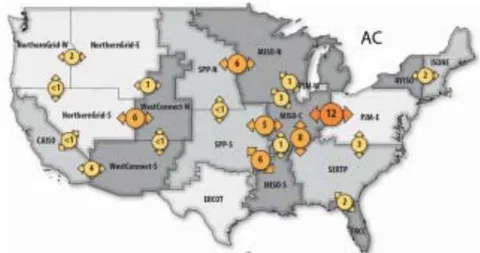
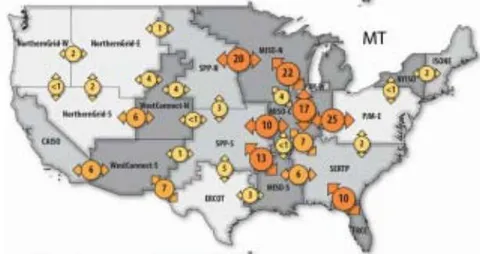
An expanded transmission system will help meet national energy objectives—supporting domestic manufacturing, enabling increasingly energy-intensive computing, and electrifying large parts of the economy—and continue to serve the evolving energy needs of the next century.
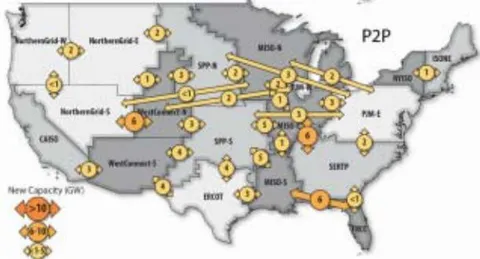
High Opportunity Transmission (HOT) interfaces represent transmission capacity expansion results between regions across many scenarios. Transmission projects that align with these HOT interfaces could be strong candidates for further study and serve as a starting point for accelerated transmission expansion – see Fig. 1.3.6.
Because the role and impact of transmission can vary based on many factors, the study team examined a wide range of demand growth and emissions reduction scenarios across the four transmission frameworks: Referenced Transmission Framework (Limited, or Lim) and three Accelerated
Transmission Frameworks - Alternate Current (AC), Point-to-Point (P2P-HVDC) and Multitermal Direct Current (MT-HVDC) - see Fig. 1.3.7 below:
Reference Transmission Framework
Limited (Lim)
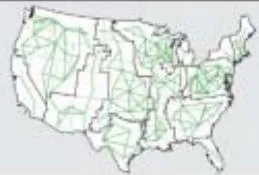
- No new interregional transmission expansion
- Total annual transmission expansion limited to recent observed maximum
Accelerated Transmission Framework
Alternating Current (AC)
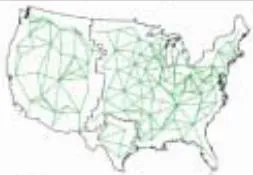
- Interregional expansion allowed within interconnections
- No new DC connections
Point-to- Point (P2P)
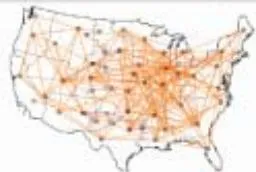
- Interregional expansion allowed across the country
- Includes long-distance point-to-point HVDC options
Multiterminal (MT)
- Interregional expansion allowed across the country
- Includes multiterminal HVDC options between neighboring zones
Transmission portfolios that deliver broad-scale benefits to consumers were developed using laboratory and industry tools. These transmission portfolios demonstrate new interregional transmission combined with intraregional transmission upgrades can help meet the flexibility requirements of high renewable energy power systems.
The implementation of the AC scenario results in significant expansions of 345- and 500-kilovolt (kV) lines that help collect low-cost renewable energy in concentrated areas and deliver power over long distances. The MT-HVDC scenario uses MT HVDC for long-distance power transfers but still relies heavily on the expansion of the AC network to move power within and between regions. The MT-HVDC scenario also enables connections between the three interconnections, increasing the existing (as of 2023) amount of transfer capacity between the interconnections by greater than 20 times.
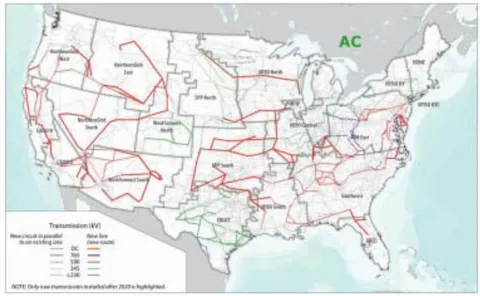
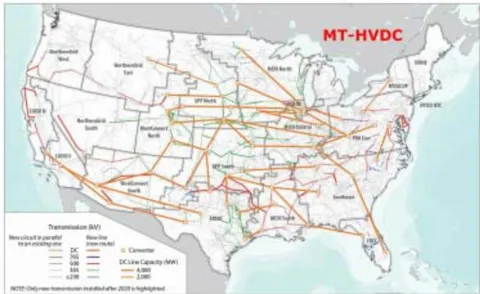
Only new transmission (developed between 2020 and 2035) is shown with the colored lines on the map. The gray lines in the background represent the existing network.
The AC and MT-HVDC transmission portfolios from [72, Figure ES-12] are only two specific illustrative implementations of the zonal HOT results. They provide a possible starting point for national or multiregional transmission planning that could deliver the cost, reliability, and emissions benefits found in the study.
e. HVDC CORE Development
In 2023 the U.S. Department of Energy presented its HVDC COst REDuction (CORE) initiative supporting the research and development to reduce HVDC technology and long-distance transmission costs by by 2035 [77, 78]. The major objective of the CORE initiative is "to develop and domestically manufacture HVDC transmission technologies to meet all U.S. market demands in a cost competitive manner".
The HVDC system performance targets highlighted by the CORE initiative include the following areas [79]:
- Standardizing the technology to reduce project-specific design tailoring
- Promoting interoperability of multi-vendor systems
- Increasing power density of converters & cables
- Developing modular and standard circuit breakers
This also includes multi-terminal/meshed HVDC and its scalability (offshore/onshore), better ways to handle protection with overhead lines, and intelligent operation of substations, cables, lines, and components within the station.
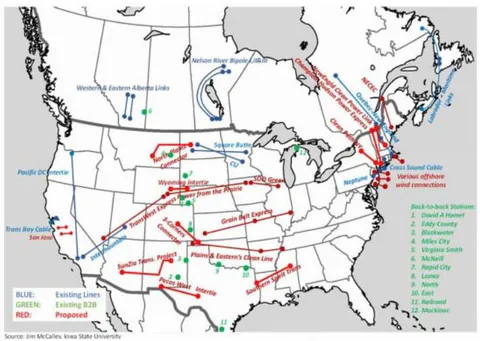
Industrial advancements in the U.S. may be presented by MISO's current efforts to incorporate HVDC in Energy and Ancillary Services Market Operations, as well as Transmission Planning in MISO [80].
A background for both existing and proposed HVDC, with proposed projects at various development stages, is shown on Fig. 1.3.9 below:
f. Offshore Wind HVDC Planning
In the Atlantic offshore HVDC applications area, standard and modular HVDC designs "supporting the Future Vision of an Open Access HVDC Grid" was presented in May 2023 [83] – see Fig. 1.3.10.
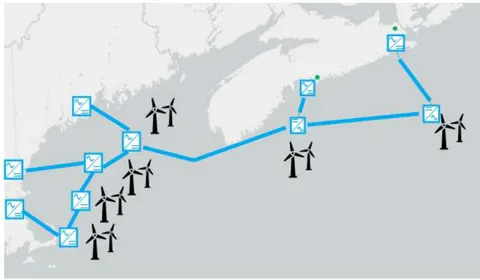
According to "The New England Maritimes Offshore Energy Corridor" [84], the proposed designs are consistent with the New England States' vision for an offshore grid, and best suited for future expansion and enabling interconnections with Gulf of Maine offshore wind. "A robust offshore HVDC grid creates opportunities for connecting Nova Scotia wind resources to emerging Gulf of Maine sites to take advantage of resource diversity between the New England and Maritimes wind energy zones... The distances to be covered by an offshore transmission system connecting Nova Scotia wind energy areas to New England make the use of HVDC transmission technology the best choice for those connections."
Another example of efforts in offshore HVDC transmission is presented by Southern New England OceanGrid Proposal [85](see Fig. 1.3.11).
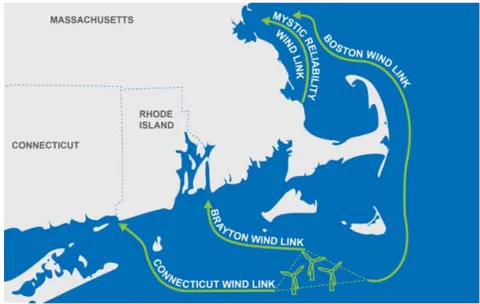
The Southern New England OceanGrid project proposed "developing a southern New England OceanGrid that includes a vision to:
- Connect offshore wind directly to load centers and robust grid connections
- Meet needs identified by ISO-NE for new paths for offshore wind to integrate with existing system
- Avoid more than $1 billion in onshore transmission upgrades".
The above reviews suggest that advancements and achievements in the European Union and the U.S. in planning and deploying "electricity highways" with embedded multi-terminal, multi-vendor, multi-purpose HVDC core allow Canada for making an immediate next step in transforming power transmission in Canada coast-to-coast.
iv. National Electricity Market Experiences in Australia
a. National Electricity Market (NEM)
The National Electricity Market (NEM) of Australia is a cross-state wholesale electricity market. The NEM spans Australia's eastern and south-eastern
coasts and comprises five interconnected states that also act as price regions: Queensland, New South Wales (including the Australian Capital Territory), South Australia, Victoria, and Tasmania. Western Australia and the Northern Territory are not connected to the NEM, primarily due to the distance between networks, and have their own electricity systems [86].
The NEM involves wholesale generation that is transported via high voltage transmission lines from generators to wholesale consumers - large industrial energy users and to local electricity distributors in each region. The transport of electricity from generators to wholesale consumers is facilitated through a 'pool', or spot market, where the output from all generators to meet demand is aggregated and scheduled at five-minute intervals [87].
The quarterly volume weighted average spot electricity prices in each region of the NEM for the past five years are shown in Fig. 1.4.1 below. The average is weighted against demand for electricity [88].
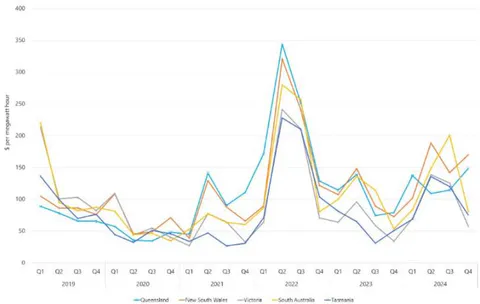
The Australian National Electricity Rules for NEM have been developed and maintained by the Australian Energy Market Commission [89] and enforced by the Australian Energy Regulator [90]. The administration and management of NEM is performed by the Australian Energy Market Operator (AEMO) [90].
The National Electricity Market (NEM) consists of both a wholesale market, which allows participants to buy and sell electricity, and a retail market, which allows consumers to choose the retailer from which they purchase their electricity. AEMO is responsible for operating the wholesale and retail markets [91].
AEMO conducts the market through a centrally-coordinated dispatch process that pools generation from producers and delivers required quantities of electricity from the pool to wholesale consumers [92].
To manage forward price risk in physical electricity spot trading markets, financial trading markets operating in coordination with the NEM offer contractual instruments such as financial hedging contracts for electricity prices. In Australia, two distinct electricity financial markets support the wholesale electricity market: over-the-counter (OTC) markets, comprising direct transactions between counterparties, and the exchange traded futures market (e.g., the Sydney Futures Exchange) [93].
Overall, "the NEM, the grid, and the financial market work together" well in Australia [94]. A detailed overview of the Australian physical and financial electricity market, is provided by the Australian Energy Regulator's annual "State of the Energy Market Report" [95].
b. Transmission Network for NEM Operations
Transmission Infrastructure
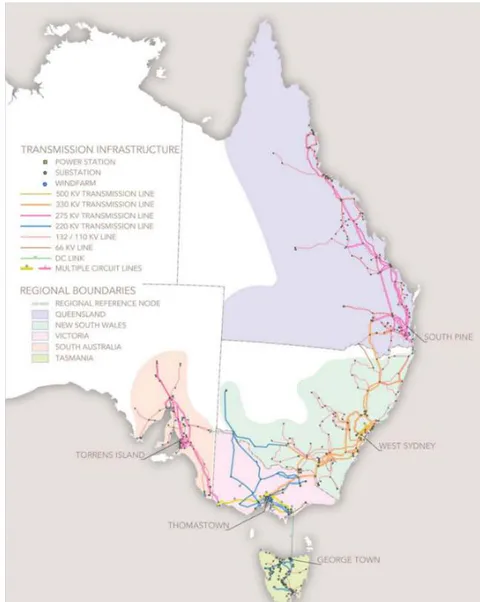
The National Electricity Market (NEM) operates on one of the world's longest interconnected power systems, stretching from Port Douglas in Queensland to Port Lincoln in South Australia and across the Bass Strait to Tasmania - a distance of around 5,000 kilometres [96].
Transmission Network Service Providers
There are five state-based transmission network service providers (TNSPs) servicing each of the regions in the NEM, with cross-border interconnectors linking the state grids at state borders. Four of the networks form a synchronous grid, and interconnect with Tasmania via an HVDC transmission (see table 1.4.1).
Table 1.4.1: Transmission Network Service Providers
| Region | TNSP |
| Queensland | Powerlink Queensland |
| NSW (and ACT) | TransGrid |
| Victoria | AusNet Services |
| South Australia | ElectraNet |
| Tasmania | TasNetworks |
Transmission Network Planning
Transmission network planning in the NEM is led by AESO in coordination with the jurisdictional transmission planning bodies in each of the five regions [98]:
- NSW and ACT - TransGrid
- Queensland - Powerlink
- South Australia - ElectraNet
- Tasmania - Transend
- Victoria - AEMO (in its role as Victorian transmission network service provider).}
As the NEM system planner, AEMO forecasts the overall transmission system requirements over the next 20 years in its Integrated System Plan [99].
In addition to the Integrated System Plan, AEMO publishes the following reports:
Electricity Statement of Opportunities - an assessment of supply adequacy in the NEM over the next 10 years, highlighting opportunities for generation and demand-side investment [100], and NEM constraint reports with details on interconnector capacity and constraints in the transmission network [101].
c. Transmission Network Interconnectors
> Operating Interconnectors
There are currently six interconnectors in the NEM operating in two formats:
- By HVDC transmission - Basslink (TAS to VIC), Murraylink (VIC to SA) and Terranora (NSW to QLD),
- By HVAC transmission - Heywood (VIC to SA), VNI (VIC to NSW) and QNI (NSW to QLD).
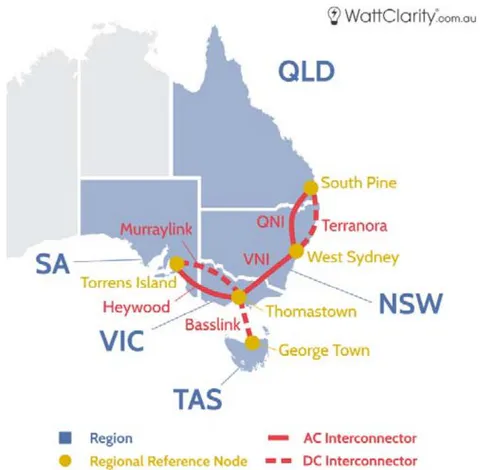
Terranora Interconnector (N-Q-MNSP1): The Terranora interconnector (also known as Direct link interconnector) is a 59km, 180 MW HVDC transmission link between Mullumbimby and Terranora in NSW, connecting the NSW and Queensland electricity transmission systems [103].
Queensland to New South Wales Interconnector (QNI) is defined as the flows across the two 330 kV lines between Dumaresq in New South Wales and Bulli Creek in Queensland [104]. In 2022 Transgrid and Powerlink commissioned an upgrade, called QNI minor, increasing QNI maximum transfer capacity from 1300 to 1450 MW (QLD to NSW) and from 850 to 950 MW (NSW to QLD).
Victoria to New South Wales (VIC1-NSW1) is defined as the flow across a set of and HVAC lines; an interconnector upgrade, known as VNI Minor, was commissioned in March 2023 [105].
Basslink (T-V-MNSP1), commissioned in early 2006 after Tasmania joined the NEM, is defined as the flow across the DC cable between George Town in Tasmania and Loy Yang in Victoria [106]. The commissioning included the undersea DC cable, converter stations and several control schemes in Tasmania.
Heywood Interconnector (V-SA), also called "The Victoria to South Australia" interconnector, is defined as the flow across the 275 kV lines between Heywood substation in Victoria and SouthEast substation in South Australia [107].
Murraylink (V-S-MNSP1), commissioned in 2002, is a HVDC 220 MW transmission link across the HVDC cable between Red Cliffs in Victoria and Monash in South Australia [108, 109].
> Current Interconnector Capabilities
Information on nominal interconnector capabilities is available from the Interconnector Capabilities report [101] - see Table 1.4.2:
Table 1.4.2: Interconnector Capacity in Australia
| Interconnector | From | To | Nominal Capacity, MW |
| Terranora (N-Q-MNSP1) | NSW | Queensland | 107 |
| Queensland | NSW | 210 | |
| Queensland to New South Wales (QNI) | NSW | Queensland | 850 |
| Queensland | NSW | 1300 | |
| Victoria to New South Wales (VIC1-NSW1) | Victoria | NSW | 400 to 1700 |
| NSW | Victoria | 400 to 1450 | |
| Basslink (T-V-MNSP1) | Victoria | Tasmania | 594 |
| Tasmania | Victoria | 478 | |
| Heywood (V-SA) | Victoria | South Australia | 600 |
| South Australia | Victoria | 550 | |
| Murraylink (V-S-MNSP1) | Victoria | South Australia | 220 |
| South Australia | Victoria | 200 |
Planned Interconnectors
Major interconnectors currently planned under AEMO supervision include EnergyConnect, Marinus Link, Keronglink and Humelink projects (see Fig. 1.4.10 below).
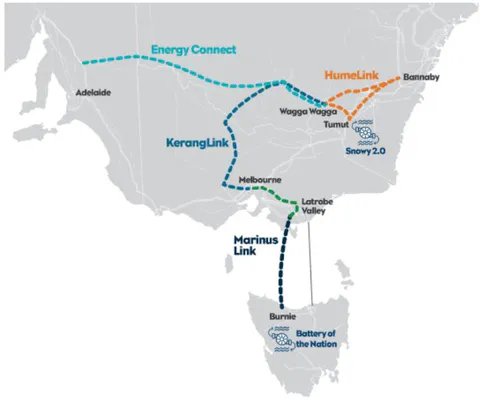
Energy Connect [111, 112] is a new 900km interconnector currently under construction connecting the energy grids of New South Wales, Victoria and South Australia. The project is being built in two stages: Stage 1 has a 150 MW capacity, and Stage 2 will have an 800 MW capacity, with Stage 2 nearing completion in 2026.
Marinus Link Marinus Link [113] is a proposed 1500 MW capacity undersea and underground electricity connection to further link Tasmania and Victoria as part of Australia's future electricity grid. The Marinus Link interconnector is planned to be built in two stages: Stage 1 – a 750 MW HVDC link with a planned commissioning date of 2028, and Stage 2 – a second 750 MW HVDC link with a notional commissioning date of 2032.
KerangLink (VNI West), (also named "Victoria to NSW Interconnector West" [114, 115, 116], is a proposed new high capacity double-circuit overhead transmission line, which will deliver vital new transmission infrastructure for delivering clean, low-cost renewable power from renewable energy zones in New South Wales and Victoria.
HumeLink [117,118] is a planned transmission line project in Australia, specifically in the state of New South Wales (NSW). It's designed to connect the Snowy 2.0 hydro project with the wider grid, with a primary goal of increasing the delivery of renewable energy. The project is expected to add 2,200 MW of on-demand energy to the grid.
Based on the practices and achievements of the HVDC-enabled transcontinental transmission infrastructure for advancing inter-regional competitive wholesale electricity markets in Europe, the United States and Australia, let us now review selected approaches for Canada to choose its own "coast-to-coast" electricity route.
b) Canada Taking its Unique Route
i. Calling for Canada's Transcontinental Supergrid Framework
Enhancing electricity transmission interconnections between Canadian jurisdictions presents a today's must for the country [9]. Using interprovincial, inter-regional and international interconnections to support energy transition in each of Canadian provinces can "help deliver long-term economic and system-wide benefits", "unlocking beneficial synergies between systems - particularly by enabling the large-scale build-out of variable resources", and connecting them with dispatchable renewable energy sources such as hydroelectric generation stations, linking "regions with complementary demand profiles, leveraging diverse weather patterns and noncoincident peak electricity demand", and enhancing electricity system reliability. "Interconnections further help as a hedge against extreme weather events or periods of under-production from renewable sources, including hydroelectricity, that may impact one jurisdiction but not others."
"The (Canada Electricity Advisory) Council's recommendations fit into 4 critical themes:
- Align on goals to ensure that the path forward is clear and decision-makers can commit
- Enable the build so that critical projects can move forward expeditiously and with Indigenous participation
- Support the transition with additional funding of targeted needs to ensure all Canadians benefit
- Save energy to lighten the load and thereby minimize investment needs and improve the likelihood of achieving Canada's goals reliably and affordably."
According to the Canada Electricity Advisory) Council [9], as "inter-regional transmission build-out has been slow and uneven despite increased federal efforts", "supporting inter-regional transmission development calls for a common framework" in Canada where "...the federal government could play a pivotal role in developing and implementing such a framework for Canada's inter-regional transmission planning".
To power Canadian homes, vehicles, and industries while achieving net-zero emissions by 2050, Canada must become a clean electricity superpower [119]; this means Canada must operate an efficient, stable, secure and competitive, made-in-Canada Supergrid as a net-zero electricity grid by 2035 [120]. This Transcontinental Supergrid will necessitate larger generation capacity and enhanced transmission networks to ensure the reliability of Canada's electricity system. "We will expand Canada's electricity grid, connect it from coast-to-coast-to-coast, and ensure that Canadians and Canadian businesses have access to cleaner and cheaper energy into the next century" [119].
The experienced and expected growth of clean electricity sources and uses in Canada requires a major change in the electricity system in the country, moving it through the merge of AC and DC transmission to Canada's Transcontinental Supergrid as the national Wholesale Electricity Market infrastructure. The immediate next step in this change is developing a common framework focused on Canada's Transcontinental Supergrid.
ii. Transcontinental Supergrid in Canada - What Would it Be?
A definition of Supergrid generally used in inter-regional/international transmission planning is as follows [121, 122, etc.]:
"A supergrid is a large, wide-area transmission network, often trans-continental or multinational, designed to facilitate the trade of high volumes of electricity across great distances, typically using high-voltage direct current (HVDC) technology."
The definition of "supergrid" is also close to the term "macrogrid", often referred to in integrating existing regional grids and using HVDC to improve power
transfer between them, particularly for integrating renewable energy sources; both terms were used interchangeably in section 1 of this publication.
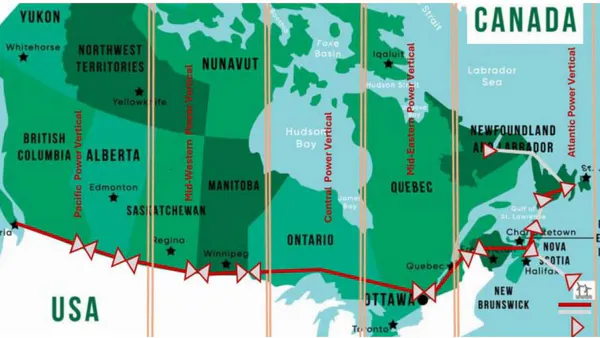
Because of the geo-economic nature of Canada with most of the country's population living and major electricity uses located along the Canada-U.S. border, the proposed Transcontinental Supergrid in Canada would have its "horizontal" East-West core established within a transmission belt along the U.S. border with key substations connected to "vertical" transmission lines leading to clean generation stations and remote industrial facilities in the North and international wholesale electricity markets in the South.
Canada's Transcontinental Supergrid is defined by:
- Purpose: It aims to connect regions with abundant clean energy resources to regions with high demand, enabling the efficient transfer of electricity over long distances and/or connecting asynchronous electricity systems/areas.
- Technology: It relies on HVDC transmission solutions including power converter stations and DC lines.
- Architecture: It sees HVDC solutions as multi-terminal, multi-vendor, and multi-purpose.
- Benefits: By transferring electricity from areas with excess supply to areas with demand, Canada's Transcontinental Supergrid can balance variable renewable energy sources (like solar and wind) and dispatchable clean power sources thus maintaining and improving grid reliability, resilience and energy security.
- Referenced Examples: The concept of a European Supergrid envisions interconnecting various European countries and regions, including remote renewable power generation hubs, by using HVDC power grids.
iii. Transcontinental Supergrid Concept
a. Vision
Canada's Transcontinental Supergrid today is seen in this publication as:
- Canadian Wholesale Electricity Market Infrastructure
- Clean Electricity Dispatch enabler
- National Energy Security defender
- Complete electrification enabler
- Low carbon economy facilitator
HVDC
technology
as
Canada's
Transcontinental Supergrid core enables physical and economical linking of provincial wholesale electricity markets into a single, synchronized "megamarket" (following current development and deployment of the internal market in the EU [109]).
Based on the above Canada's Transcontinental Supergrid vision, its proposed description is as follows:
A. Canada's Supergrid presents a merge of high voltage (HV) alternate current (AC) and direct
current (DC) transmission grids to achieve Transcontinental electricity transmission in Canada
B. Canada's Supergrid must be capable of transmitting electricity:
- From clean power generation sources in the East (e.g., Atlantic Coast) to power uses in the West (e.g., Pacific coast) or vice versa: from clean power generation sources in the West to power uses in the East;
- From remote clean power generation sources in the North to power uses and export/import transmission hubs in the South;
- From transmission hubs in the South to remote industrial power uses in the North.
C. Neighbouring provincial AC transmission grids should be connected with each other and with clean power generation hubs by multi-terminal multi-vendor (MTMV) DC transmission grids. D. HVDC transmission grids may be inter-provincial, intra-provincial, extra-provincial and international:
- Inter-provincial DC transmission grids ("interties") connect AC transmission grids located in the neighbouring provinces (e.g., between Alberta and Saskatchewan).
- Intra-provincial DC transmission grids connect renewable power generation hubs (e.g., solar PV power hubs) located in a province with related provincial AC transmission grid (e.g., in Ontario or Alberta).
- Extra-provincial DC transmission grids connect renewable power generation hubs (e.g., offshore wind power hubs) with one or more provincial AC transmission grids (e.g., in Nova Scotia) and/or with AC transmission grids in the U.S. (e.g., in New England).
- International DC transmission grids ("interconnections") for export/import operations connect provincial AC transmission grids with AC transmission grids in the U.S. states (e.g., interconnections between Alberta and Montana).
b. Principles
The proposed high level Canada's Transcontinental Supergrid vision, addressing and ensuring reliability, resilience and energy security of each of the provincial transmission grids and the Transcontinental Supergrid as a whole, is built on the following principles:
- Each and every Canadian provincial power transmission grid shall represent a key component of Canada's Transcontinental Supergrid.
- Each and every provincial power transmission grid shall include one or more High Voltage Alternate Current (HVAC) power loops and/or trunks that connect transmission hubs linked to clean power
generation sources and/or markets, and/or to power uses.
- The major transmission hubs shall interface:
- Intra-provincial connections with clean power generation sources,
- Extra-provincial connections with clean power generation sources,
- Intra-provincial connections with power uses,
- Provincial interties via power transfer paths to neighbouring transmission grids,
- International interconnections via power transfer paths to import/export markets in the U.S.
- The transmission interfaces shall represent the following structure merging AC and DC transmissions:
- Provincial interties between the neighbouring provincial grids shall present a transmission set including one or more HVDC solutions (e.g., HVDC lines and power converters, and/or back-to-back converter stations).
- International interconnections connecting the provincial grids with one or more export/import markets shall present a transmission set including one or more HVDC solutions (e.g., HVDC lines and power converters, and/or back-to-back converter stations).
- Intra-provincial connections connecting the provincial grids with one or more clean energy generation sources (including remote sources) shall present a transmission set including one or more HVDC solutions (e.g., HVDC lines and power converters, or converters only).
- Extra-provincial connections connecting the provincial grids with one or more clean energy generation sources (including remote sources) shall present a transmission set including one or more HVDC solutions (e.g., HVDC lines and power converters).
- Provincial power transmission grids as Transcontinental Supergrid components shall represent the following capacity (in MW):
- Capacity of power loops/trunks in provincial transmission grids and provincial interties between these grids shall meet or exceed a target level for power flow in both east-to-west and west-to-east directions.
- Capacity of international interconnections in the provincial transmission grids shall meet the import/export targets of these grids.
- HVDC solutions within each Supergrid interface shall optimize their connections with the provincial AC transmission grids and with each other to maximize their technological and economic values.
- Coordination between power flows in the provincial interties and international interconnections shall
ensure reliability, resilience and energy security requirements of Canada's Transcontinental Supergrid.
c. Interconnection Capacity
Interconnection capacity within Canada's Transcontinental Supergrid is seen as follows:
- Transmission capacity of any provincial intertie should be equal or higher than transmission loop capacity in any province (e.g., BC Hydro, Alberta Electric System Operator (AESO) or Hydro-Québec TransÉnergie loops capacity)
- Transmission capacity of any international interconnection should be equal or higher than expected export/import capability of this interconnection
- Transmission capacity of any intra-provincial DC transmission from a clean power generation hub should be equal or higher than the power generation hub capacity expected
- Transmission capacity of any extra-provincial DC transmission from a clean power generation hub should be equal or higher than the power generation hub capacity expected
d. Transmission Verticals and Horizontals
To better define the paths to clean power generation sources and uses in Canada and their efficient connections via the Transcontinental Supergrid, the Supergrid's concept may be seen through its horizontal and vertical transmission axes.
The horizontal (or H-) Supergrid axis defines power transmission coast-to-coast connecting the loops/trunks of the ten provincial transmission grids in the country.
This horizontal axis is positioned relatively closely to the south border of Canada. Following the H-axis, the Supergrid power interties connect major AC transmission substations on the ten provincial transmission loops/trunks relatively close to the south border.
The H-axis also allows for connecting with extra-provincial power generation (e.g., offshore wind power stations) on the Scotian Shelf, a submerged continental shelf located in the Atlantic Ocean, off the coast of Nova Scotia and New Brunswick [132].
The vertical (or V-) Supergrid axes define power transmission regions enabling remote clean power generation in the North to be transferred to major power use hubs in the South, and power from transmission hubs in the South – to remote industrial power uses in the North. The V-axes also define transmission regions for power export to/import from the wholesale power markets in the U.S.
Canada's Transcontinental Supergrid proposes five vertical transmission regions (further - "verticals"): Atlantic, MidEastern, Central, MidWestern and Pacific, and involves international interconnections (via
international transmission lines). The Atlantic, MidEastern and MidWestern verticals show access to large hydro resources; the Atlantic vertical also includes access to a nuclear power resource in New Brunswick. The Central vertical shows access to nuclear power resources in Ontario. The Pacific vertical shows access to seasonal hydro and to geothermal resources. The electricity export/importinterconnections are described in section 5 "Transmission Grids in Canada at a Glance".
Specifically, the Atlantic vertical includes access to large-scale hydropower generation in Newfoundland & Labrador (e.g., Muskrat Falls), nuclear power generation in New Brunswick (e.g., the Point Lepreau Nuclear Generating Station) and offshore wind power opportunities in Nova Scotia (e.g., the Sable project).
The Muskrat Falls Generating Station [133] is located on the lower Churchill River about 25 kilometres west of Happy Valley-Goose Bay, Labrador. The Muskrat Falls station has a capacity of over 824 MW and provides 4.5 TWh of electricity per year. Power transmission is provided via Labrador-Island and Maritime links to Nova Scotia and further to the New Brunswick and New England intertie and interconnections.
The Point Lepreau Nuclear Generating Station (PLNGS) is located on the northern shore of the Bay of Fundy 2 km northeast of Point Lepreau, New Brunswick. Installed gross capacity of and design net capacity of [134, 135]. Electricity supplied in 2023: 4.76 TWh.
The Sable offshore wind generation opportunity refers to the potential for developing offshore wind farms in the waters around Sable Island, specifically the Sable Island Bank, a shallow area with high wind speeds, making it a prime location for renewable energy generation at 15 GW capacity [136].
The MidEastern vertical includes access to large-scale hydropower generation in Quebec and Labrador. Today's hydro generating fleet in Quebec comprises 61 hydroelectric generating stations with a total installed capacity of 36.7 GW, and Churchill Falls generating station in Labrador with its capacity of 5.43 GW. Its hydropower facilities in Quebec also include 28 large reservoirs with a combined storage capacity of over 176 TWh [137, 138].
The Central vertical includes access to three major nuclear power stations in the province of Ontario: Bruce Nuclear Generating Station, located in the municipality of Kincardine on the eastern shore of Lake Huron, Ontario with installed capacity of 6,232 MW, operated by Bruce Power [139], and two nuclear generating stations in Pickering and Clarington (Darlington) on the north shore of Lake Ontario with 4,698 MW in-service generating capacity (as of Dec. 31, 2024), operated by Ontario Power Generation [140];
The MidWestern vertical includes access to large-scale hydropower generation in Manitoba: 15 hydropower generating stations with 5.25 GW capacity. The most important hydroelectric development in Manitoba is Nelson River Hydroelectric Project with 4.78 GW capacity and 29.25 TWh of average annual generation. Planned hydroelectric stations are also considered by doubling the Midwestern axis in Manitoba by additional 5.28 GW capacity [141, 142].
The Pacific vertical includes seasonal access to large-scale hydropower generation in British Columbia, and major geothermal opportunities in the Canadian part of the Pacific Ring of Fire (British Columbia, Yukon, Alberta and Northwest Territories) [143, 144].
e. Transcontinental Supergrid Ownership
As provincial and territorial governments have jurisdiction over the management of electricity systems in the country, they are expected to take a leadership role in establishing the ownership of transformed Canadian electricity systems in such way that each component of the Supergrid within each province or territory is owned by this province/territory.
As indicated by the Federal Government, "...Canada has the potential to become a clean electricity superpower with a cross-Canada electricity grid that is more sustainable, more secure, and more affordable..." [119], and pan-Canadian Supergrid with inter-provincial (from coast to coast) and intra-provincial transmissions is seen as a major national federal-provincial undertaking.
Negotiated agreements between provincial/territorial and federal governments will address electricity systems transformation in a coordinated fashion [124]. These negotiated agreements are seen as an accelerator offering a practical path forward in the Canadian federation; they ensure systemic change, while respecting provincial authority over electricity.
f. Investment in Transcontinental Supergrid
Achieving the Supergrid development and deployment within 2025-2035 time frame requires prompt and efficient investment decisions at federal and provincial levels.
The federal government can complement its policy efforts related to pan-Canadian Supergrid — including support for integration in the electricity sector [123] —with financial supports for the Supergrid deployment that incentivize provincial and territorial governments to exercise their policy tools. In return for coordinated provincial and territorial policy action focused on investments in the Supergrid, the federal government could offer more stable long-term funding for provincial and territorial electricity transformations [124].
As indicated in Canada's 2023 Budget, "...Given the long lead times and high upfront costs for electricity generation and transmission projects—and
with our allies and partners set to invest heavily in preparing their own electrical grids for the future—Canada needs to move quickly to avoid the consequences of underinvestment" [119].
The 2023 Budget's made-in-Canada plan followed the federal tiered structure to incent the development of Canada's electricity sector and provide additional support for projects that need it. This plan includes:
- A clear and predictable investment tax credit as the anchor that offers foundational support for investments in clean electricity;
- Beyond this investment tax credit, as needed, low-cost and abundant financing through a targeted focus on clean electricity from the Canada Infrastructure Bank; and,
- Targeted electricity programs, where needed, to ensure critical projects get built.
To support and accelerate clean electricity investment in Canada, Budget 2023 proposed to introduce a 15 per cent refundable tax credit for eligible investments, including Equipment for the transmission of electricity between provinces and territories.
With respect to intra-provincial transmission, the government will consult on the best means, whether through the tax system or in other ways, of supporting and accelerating investments in projects that could be considered critical to meeting the 2035 net zero objective.
The Canada Infrastructure Bank is an active partner in supporting these efforts by making investments in renewable energy, energy storage, and transmission projects. These investments will position the Canada Infrastructure Bank as the government's primary financing tool for supporting clean electricity generation, transmission, and storage projects, including for major projects in pan-Canadian Supergrid.
Overall, based on the electric federalism [125] rooted in negotiated agreements of the federal government with provinces, as well as historical and current experiences of the provinces in merging HVDC and HVAC transmissions, provincial intertities and international interconnections, pan-Canada's Transcontinental Supergrid provides a unique solution for the country to achieve its net zero goals and commitments "in a way that makes sense in the Canadian federation" [124].
The Transcontinental Supergrid Concept built on the provincial AC power transmission grids as its key components, and provincial interties and international interconnections connecting these grids based on HVDC solutions allows for looking into the Transcontinental Supergrid's architecture in more detail.
c) Transcontinental Supergrid Architecture Facets
A high-level architecture of Canada's Transcontinental Supergrid interconnecting the transmission grids of the country is discussed in the section. The architecture facets include selected definitions, description of components, and inter- and extra-provincial transmission path naming.
i. Selected Definitions
Power Transmission Grid
"Transmission Grid", sometimes also referred to as "Transmission System", means a network for transmitting electricity from power generation stations via transmission substations to distribution substations or to neighbouring grids, and includes any structures, equipment or other facilities used for that purpose.
Power Transmission Types
- Interprovincial Transmission: Connects AC transmission grids located in the neighbouring provinces.
- Intra-Provincial Transmission: Connects renewable power generation sources (e.g., solar PV or onshore wind power stations) located in a province with related provincial AC transmission grids.
- Extra-provincial Transmission: Connects renewable power generation sources (e.g., offshore wind power stations) with one or more provincial AC transmission grids.
- International Transmission: Connects provincial AC transmission grids with AC transmission grids in the U.S. states.
Transmission Nodes and Hubs
- Transmission node means a power substation of any transmission voltage (generally ranging from and above) collecting generated power, and/or transferring it to distribution/consumption and/or market areas.
- Transmission hub means a power substation of (usually higher) transmission voltage connected with a higher number of transmission nodes, with a total power exceeding the node average when collecting it and/or transferring it to distribution/consumption and/or market areas.
> HVAC Transmission Loops and Trunks
- "HVAC power transmission loop" definition refers to a transmission grid where multiple power lines of the same voltage connect major power transmission substations, enabling power flow between them within a closed loop.
- "HVAC power transmission trunk" definition refers to a transmission grid where multiple power lines of the same voltage connect major power transmission substations, enabling power flow between them within in a "tree-like" trunk with major "branches".
Interface, Interconnection and Intertie
- "Interface" means a general term defining a boundary, or point of interaction, or a group of connecting power lines between power grids or zones/regions/parts of a power grid.
- "Interconnection", sometimes also referred to as "Intertie", means a connection between individual Transmission Systems, or Grids that involves a transmission line or set of lines.
The terms "Interface", "Interconnection" and "Intertie" are used interchangeably in this publication when reviewing provincial transmission grids in Canada.
Transmission Path
Transmission Path, also referred to as "transfer path", is defined by interfaces between neighbouring power control areas and represents a significant flow of power between these areas.
Clean Power Generation Sources
- Clean power generation sources are intra-provincial) power generation stations (like hydro, onshore, solar or geothermal) or extra-provincial power generation stations (like offshore wind). Most of clean power generation sources are located remotely; however, there may be generation sources (e.g., onshore wind or solar PV power generation) located close to urban areas.
Power Uses
- Power uses are substations connected to industrial, commercial or urban residential users and characterised by power consumption/demand.
> HVDC Solutions
HVDC solutions include:
- HVDC transmission systems involving a long-distance DC transmission line and converter stations at both sides of the line. DC-line based HVDC solutions connect AC transmission grids located far apart, or connect AC transmission grids with remotely located power sources (such as offshore wind power),
- HVDC back-to-back converter stations. "Back-to-back" HVDC solutions involve two converters in the same converter station to connect two AC transmission grids, either asynchronous or at different frequencies, without a DC transmission line.
HVDC Grid Topology
HVDC grid topology refers to the way in which the AC and DC grids are interconnected [112].
HVAC grids may have the following topologies:
Two-terminal (point-to-point) HVDC transmission: point-to-point HVDC transmission involves two converter stations on a power grid connected by a DC transmission line.
Multi-terminal (linear, radial or meshed) HVDC transmission involving multiple converter stations and multiple DC transmission lines connecting these stations including:
Radial HVDC grids where power converters are connected by a DC line to a central DC switching station ("central node") which does not have any converters connected at its point;
Linear HVDC grids where power converters at "rectifier" side (e.g., offshore wind power converters located close to each other) have their DC nodes connected which allows them to transmit power not only via their own DC line, but also to the DC line of a neighboring converter station;
Meshed HVDC grids where power converters at "rectifier" and "inverter" sides have their DC nodes connected, and converters at "rectifier" side have DC lines to more than one converter on inverter side.
ii. Description of Components
Canada's Transcontinental Supergrid consists of the following key components:
Provincial AC power transmission grids with embedded core loops and/or trunks;
Connections of the provincial transmission grids with intra-provincial and extra-provincial clean power generation sources (including remotely located power generation);
Connections of the provincial transmission grids with power uses (including remotely located industrial power consumption);
Interties of the provincial transmission grids with neighbouring provincial transmission grids;
Interconnections of the provincial transmission grids with international export/import power markets.
Based on the Canada's Transcontinental Supergrid concept in section 2.3 above, the structure of provincial transmission grid as a typical component of the Canada's Transcontinental Supergrid can be shown on Fig. 3.1 below.
Each HVDC solution used in a Supergrid component:
- Can connect one or more HVDC systems
- Can be connected to one or more HVAC transmission grids
- Can be of long-distance (such as very long HVDC lines) or "zero"-distance (such as HVDC "back-to-back" converter stations) nature
- Can be two-terminal or multi-terminal
- Can be modular multi-level
- Can connect clean power generation sources located intra-provincially (within a province) or extra-provincially (e.g., an offshore wind power hub in the Atlantic Ocean or a geothermal power hub in the Northwest territories).
The Supergrid Component structure approach presented in Fig. 3.1 can be applied to each of the ten provincial transmission grids in Canada.
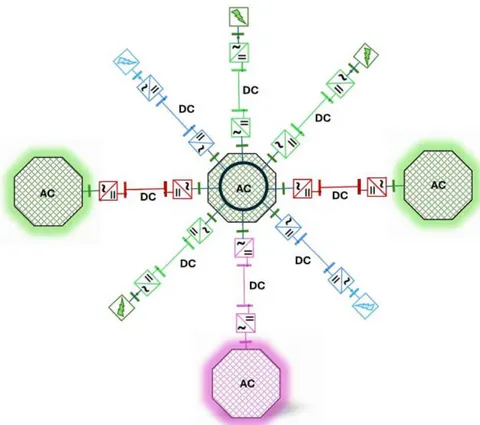
where:
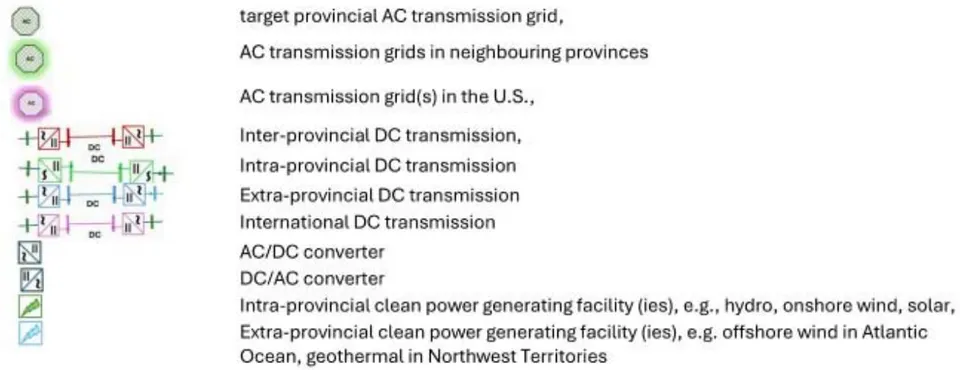
iii. Inter- and Extra-Provincial Transmission Path Naming
Canada's Transcontinental Supergrid concept relies on the methodologies and practices for inter- and extra-provincial transmission paths and their transfer limits well defined by the Western Electricity Coordinating Council (WECC), the Midwest Reliability Organization (MRO), and the Northeast Power Coordinating Council (NPCC) ensuring the stability of transmission grids in the Western and Eastern interconnections in North America.
The Western Electricity Coordinating Council (WECC) coordinates a number of high voltage power links, known as WECC Intertie Paths, in western North America. These Paths present interties between various areas [127].
The NERC Glossary of Terms [128] defines an Available Transfer Capability (ATC) Path as "any combination of Point of Receipt (POR) and Point of Delivery (POD) for which ATC is calculated; and any Posted Path". In WECC, a Path, as defined in the context of the Path Rating Process, is a facility (or several facilities) between systems or internal to a system, for which schedules and/or actual flows can be monitored for reliability purposes.
In the WECC 2023 Path Rating Catalog [129], Transfer Limit of any Path is defined by the rating of the path. This can be a single maximum rating or a range of operations, dependent on system conditions. If the path is rated "bidirectional," information for each direction is given.
As an example, British Columbia's high voltage transmission paths have been linked to Alberta and the United States for over thirty years [130]. Inter-provincial Path 1: Alberta-British Columbia in WECC 2023 Path Rating Catalogue [129] includes a set of AC lines (Bennett-Cranbrook , Pocaterra-Fording Coal
Tap 138 kV and Russell-Natal 138 kV) with the total Transfer Limit of 1,000 MW East to West, and 1,200 MW West to East.
The Northeast Power Coordinating Council defines transfer path requirements in the NPCC Methodology and Guidelines for Forecasting Available Transfer Capability (ATC) and Total Transfer Capability (TTC) as follows [131]: "All Control Areas within NPCC that are offering Open Access Transmission Services, must define the TRANSMISSION PATHS for which they allow energy transfers INTO, OUT OF and THROUGH their systems. A transmission Path is defined by its Point Of Delivery (POD) where the energy is delivered to an adjacent system and its Point Of Reception (POR) where the energy is received from an adjacent system. All electrical paths, interfaces and interconnections for which open access is offered and where congestion could occur should be identified and associated to a given PATH determined by its POR and POD. The POR and POD can be physically existing points of the network or they can represent a virtual area of the network. The TTC of a PATH is the Total Transfer Capability from the POR to the POD of that PATH. For a PATH consisting in the aggregation of segments connected in series resulting TTC will be the minimum of the series segments. And similarly, resulting ATC will be the minimum of the series segments ATCs. Connectivity of the Paths through the overall network should be established by using identical POR/POD naming when applied to the same physical interconnection or interface."
To align the naming of transmission paths and their transfer capabilities within the Transcontinental Supergrid, the intertie and interconnection paths for all Canadian provinces in the Supergrid are proposed to be named in a "XY" format, where X means number, and Y - geographic direction (see Table 3.1):
Table 3.1: Transmission Path Naming
| Province POD/POR, transmission system | Province/State POD, transmission system | Geographic Direction | Supergrid Path Name |
| British Columbia | Washington, Bonneville Power Administration | South | 1S1 |
| British Columbia | Alberta, AESO | East | 1E2 |
| Alberta, AESO | Montana | South | 2S3 |
| Alberta, AESO | Saskatchewan | East | 2E4 |
| Saskatchewan | North Dakota | South | 3S |
| Saskatchewan | Manitoba | East | 3E |
| Manitoba | North Dakota | South | 4SW |
| Manitoba | Minnesota | South | 4SE |
| Manitoba | Ontario, IESO | East | 4E |
| Ontario, IESO | New York, NYISO | South | 5S |
| Ontario, IESO | Minnesota, MISO | Southwest | 5SWW |
| Ontario, IESO | Michigan, MISO | Southwest | 5SWE |
| Ontario, IESO | Quebec, TransÉnergie | East | 5E |
| Quebec, TransÉnergie | New York, NYISO | South | 6SW |
| Quebec, TransÉnergie | Vermont and Massachusetts, ISO NE | Southeast | 6SE |
| Quebec, TransÉnergie | New Brunswick, NBSO | East | 6E |
| New Brunswick, NBSO | Maine, ISO NE | Southeast | 7SE |
| New Brunswick, NBSO | Northern Maine, NMISA | Southwest | 7SW |
| New Brunswick, NBSO | Prince Edward Island, Maritime Electric | Northeast | 7NE |
| New Brunswick, NBSO | Nova Scotia. NSPI | East | 7E |
| Nova Scotia, NSPI | Newfoundland and Labrador, NL Hydro | NorthEast | 8NE |
| Labrador, CF(L)Co | Quebec, TransÉnergie | Southwest | 9SW |
d) Planning for HVDC in Transcontinental Supergrid
i. Supergrid Means AC-DC Merge
HVDC transmission technology deployment has evolved dramatically over the last 15 years making it ready for large-scale AC-DC merge. HVDC offers higher-capacity, longer-distance, lower-loss transmission on a smaller footprint than AC. The development of voltage-sourced converter technology demonstrated dramatic improvements in HVDC capabilities, and these capabilities are increasingly needed to enhance the existing AC grid upgrade [145]. This allows for promptly making the next steps in Canada's Transcontinental Supergrid based on multi-value transmission planning through recognizing the increasingly broad set of HVDC use cases and
capabilities, and preparing for the Transcontinental AC-DC merge in action.
ii. Key Technological Components
The key HVDC technologies highly relevant for the Transcontinental Supergrid planning and deployment [146] include the following:
- AC/DC voltage source converters
- DC circuit breakers
- Cables and overhead lines
Also, new technological opportunities are considered for further development:
- DC/DC converters
- DC fault current limiting devices
- Energy dissipation systems
- Energy storage

- Power flow controllers (meshed HVDC grid current flow controllers)
The key technological HVDC components mentioned are briefly reviewed in the section below.
a. AC/DC Voltage Source Converters
AC/DC converters are the interfaces between the AC and DC grids (see Fig. 4.1):
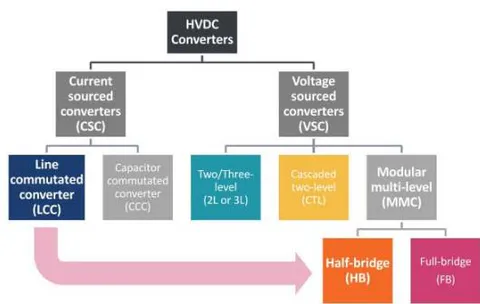
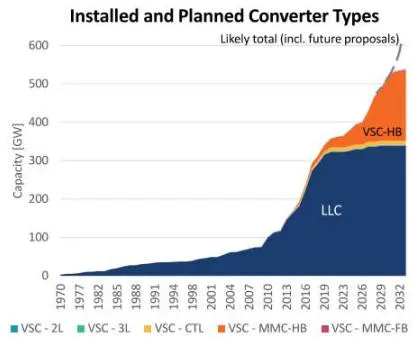
While line commutated converters (LCCs) have been operational since mid-20th century, their drawbacks do not make these converters a promising technological solution. Today all power converters for HVDC solutions planned globally are voltage source converter (VSC) technology based.
Further advancements in VSC technology moved it from two-level converters with series connected Insulated Gate Bipolar Transistors (IGBTs) to modular multi-level converters combining a large number of smaller converters connected in series known as cells or submodules (see Fig.4.2):
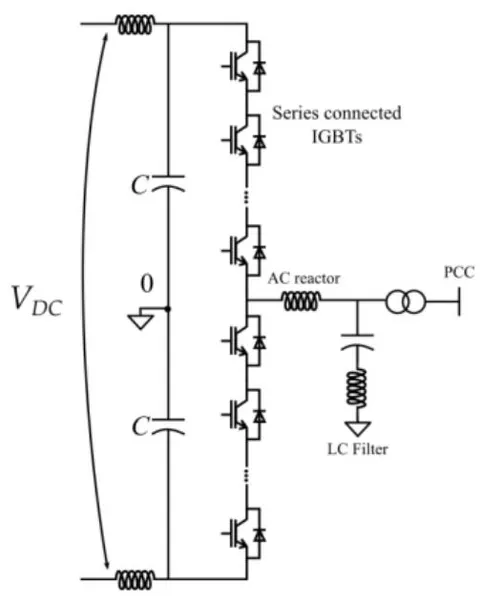
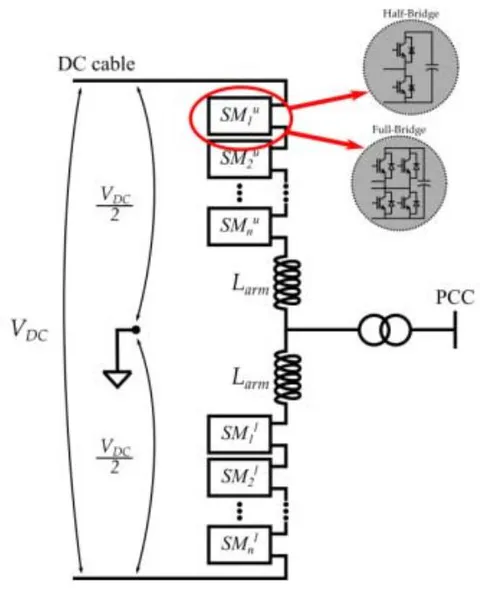
The advantages of multi-level converters are as follows [148, 149, 150]:
Effective handling of high voltage and power levels, making them well-suited for applications demanding substantial power conversion, such as HVDC transmission systems.
Producing nearly sinusoidal output waveforms, which significantly reduces harmonic content and ensures the delivery of high-quality power.
Fault tolerance and redundancy: Because of their modular design, MMC can continue operating even if a sub-module experiences a failure, ensuring system reliability.
High scalability and adaptability to varying voltage and power requirements via adding or removing sub-modules as needed.
High efficiency due to their reduced switching losses and improved waveform quality.
Because the MMC design ensures reduced stress on the converter's components and allows independent control of its active and reactive power,
multi-level converters are able to provide auxiliary services to the HVAC grid like a static synchronous compensator.
With technology growth driven and led by modular multi-level converters, power converter-based HVDC capabilities are seen today as follows [145,151] (see Fig. 4.3):
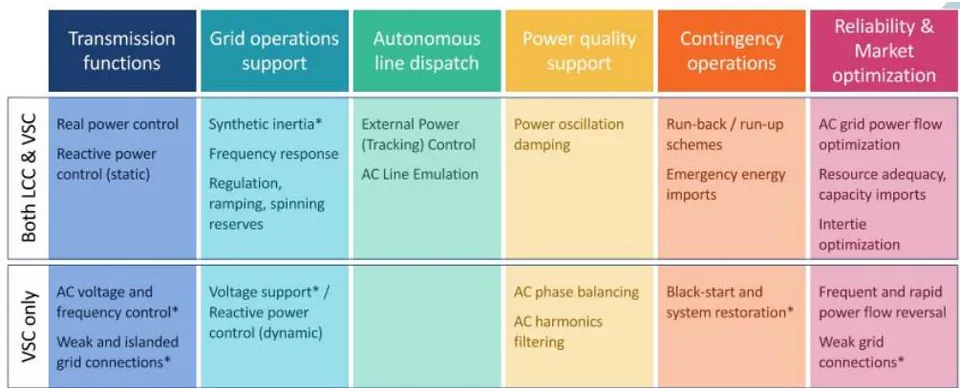
b. Direct Current Circuit Breakers
Recent advancements in HVDC technology brought to industrial deployment a major HVDC component Direct Current Circuit Breaker (DCCB).
As a fault separation device (FSD), Direct Current Circuit Breaker presents a key equipment for HVDC transmission operations. An FSD is defined as a device able to separate a faulty protection zone and a healthy protection zone, allowing the healthy protection zone not to be de-energized [146].
DCCB provides the fast interruption of a fault DC current which is more challenging compared to AC circuit breaker operations.
The most important requirements for DC circuit breakers in HVDC grids include [152]:
- Creating a current zero crossing
- Very fast breaking action
- Minimal conduction losses
- Repetition of switching operation
- Prevention of excessive overvoltage
- Minimal arcing after contact separation
- Long lifetime.
Current DCCB solutions using different techniques, can be classified as mechanical, solid state and hybrid circuit breakers (see a review in [146, 153]).
A mechanical circuit breaker consists of only mechanical parts, an AC breaker, an auxiliary circuit to create a current zero crossing and an energy absorption branch.
A solid-state circuit breaker (pure semiconductor circuit breaker) consists of several solid-state
switches, which have the ability to turn off current even though it does not have current zero crossings. In order to achieve the breaking capability that is required, a number of semiconductor switches are connected in parallel and in series.
Hybrid circuit breakers combine the advantages of mechanical and solid-state breakers. They make use of a smaller number of power electronic devices and a mechanical switch in the main conduction branch.
Industrial deployment of DCCBs have been increasing in the recent years. As an example, a hybrid HVDC circuit breaker of Hitachi Energy has been performed successfully in the Zhangbei high-voltage direct current (HVDC) power transmission project in China. Commissioned in 2020, it was the world's first HVDC power transmission system to utilise multi-level voltage sourced converter (VSC) technology at a rated voltage of [154].
c. DC Cables and Overhead Lines
DC cables are the basic block that allows the power transmission in DC systems. They are made of a conductor (copper or aluminum) that transmits the power at a certain voltage level. The conductor is insulated from the ambient by means of an insulating material and additional layers depending on the application.
Two main general applications can be identified: underground and undersea power transmission. The type of cable is slightly different depending on the aforementioned applications and
different technologies are commercially available, which are covered in detail in the following subsections.
Underground HVDC power transmission: The cables enable the power transmission with a reduced footprint (narrow trench) compared to transmitting power by means of overhead lines.
Undersea/submarine HVDC power transmission: The cables serve two main functions: Connecting remote offshore platforms to mainland transmission grids and interconnecting countries or islands separated by sea. If the installation is done in shallow water (up to 500m depth), burial in the seabed or coverage by rocks or protective layers is mandatory to protect the cable against the risk of damage from fishing gear or anchors. On the contrary, for deep waters (from 500 m onwards), cables are simply laid on the seabed.
There are three technologies of HVDC cables (with the mass-impregnated and the extruded cross-linked polyethylene (XLPE) the main technologies used today): HVDC low pressure oil filled cables, HVDC paper-insulated cables, and HVDC Extruded XLPE cables. Mass-impregnated (MI) and cross-linked polyethylene (XLPE) cables are both used for HVDC transmission, but MI cables are a more established technology, particularly for subsea applications, while XLPE cables offer advantages like higher operating temperatures and polarity reversal capabilities.
DC overhead lines (OHLs) are the basic building block along with DC cables in a DC grid. They
are composed of conductors that transmit the power, which are installed in metallic towers using insulators.
The corridor through which an OHL passes is called right-of-way (ROW), and nowadays, the acquisition of this ROW is one of the main difficulties to build new OHLs. Safety clearances to earth and surrounding objects are prescribed by international standards, so it is normal to see trees and grass cut down to avoid any flashovers from conductors to the elements nearby.
In DC OHLs, the same bare conductors without insulation as in AC OHLs are used. The most used conductor in power transmission is the aluminum conductor steel reinforced (ACSR). Conventional conductors such as ACRS are operated at a temperature lower than . New technologies, such as high temperature low sag (HTLS) conductors allow to increase the current capability of the lines with minor modifications in the existing assets and using the same ROW (tower do not need to be replaced, sometimes reinforced). They operate at a higher temperature, typically more than see [146].
d. HVDC Technology Readiness Levels
Technology Readiness Levels for modular multi-level voltage sourced converters (MMV-VSC), DC circuit breakers (DCCB), and HVDC overhead lines and cables are presented in Fig. 4.4 below:
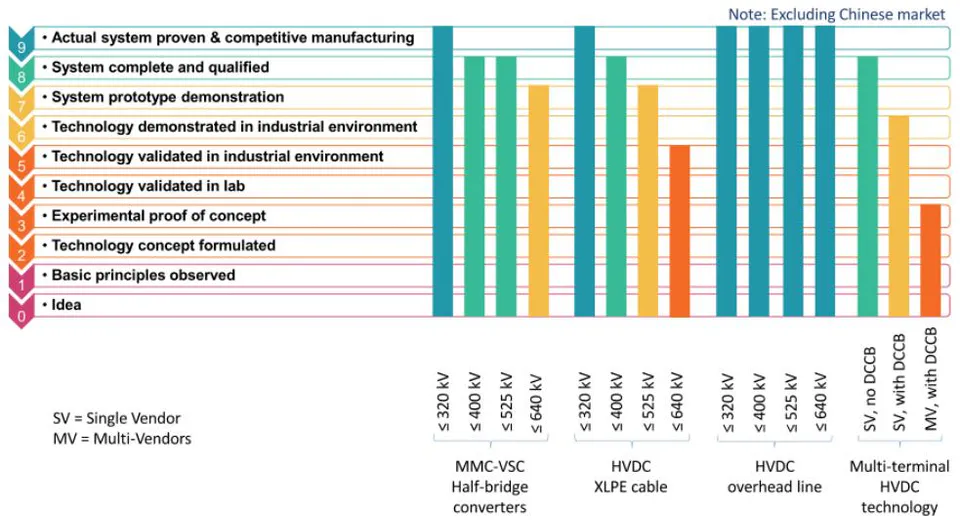
iii. Operational Impacts on Reliability and Resilience
a. HVDC Control Impacts
Grid services and associated control that HVDC grids can provide to HVAC grids may include [126]:
- AC frequency control (active power):
HVDC systems connected to energy sources outside an AC grid can provide frequency regulation services to the AC grid.
- AC voltage support (reactive power):
HVDC system at the point of AC grids connection allows for the adjustment of the reactive power setpoint of the converter to respond to AC voltage disturbances.
Black start:
HVDC links can re-energize AC networks after a partial or system-wide blackout.
Power oscillation damping:
HVDC systems can be designed to damp undesirable power oscillation in connected AC grids through the modulation of active or/and reactive power signals.
AC line emulation:
HVDC systems can be designed to emulate the response of AC circuits or gridsto provide real-time adaptation to power disturbances in the AC grids without manual intervention from system operators.
Grid-forming capabilities:
Grid-forming converters are capable of providing both an inertial and primary response to the AC grid they are connected, being driven by an energy resource, such as a battery or the reserves of another AC grid connected by HVDC. As such, Grid-forming converter controllers can set the frequency of their power injections to the target AC grid. Other grid-forming converter capabilities include contributing to fault levels, acting as a sink to counter harmonics, interharmonics, and imbalances in system voltage, and aiding in preventing adverse control interactions.
b. Protection Impacts
Protection devices and strategies are key to ensuring the secure operation of HVDC systems/grids
and AC grids they are connected to. The ability to contain faults and cascading events in these grids is necessary to ensure the protection of AC and DC grid assets, so that large-scale AC/DC electricity systems like Canada Transcontinental Supergrid can be operated in a reliable and resilient fashion.
Protective functions for connecting/merging AC and DC grids have two major areas: (1) protection for DC systems/grids and (2) protection for AC grids they are connected to.
DC grid protection functions include AC Circuit Breakers, DC Circuit Breakers, Fault-blocking converters, energy dissipation/dynamic breaking systems, and DC/DC converters.
AC grid protection functions include VSC HVDC grids use for "firewall" protection of AC grids. Specifically, the controllability performances of HVDC systems, addressing the rapidity of active power variation, can use firewall actions to prevent disturbance propagation in AC grids. Related HVDC control capabilities can modulate the active and reactive powers to alleviate system stresses.
iv. Multi-Value Transmission Planning
HVDC solutions multi-value transmission planning for Transcontinental Supergrid can offer additional benefits (and avoided AC facilities cost) that lower their net cost [145]. The major HVDC benefits in transmission planning may be defined as follows:
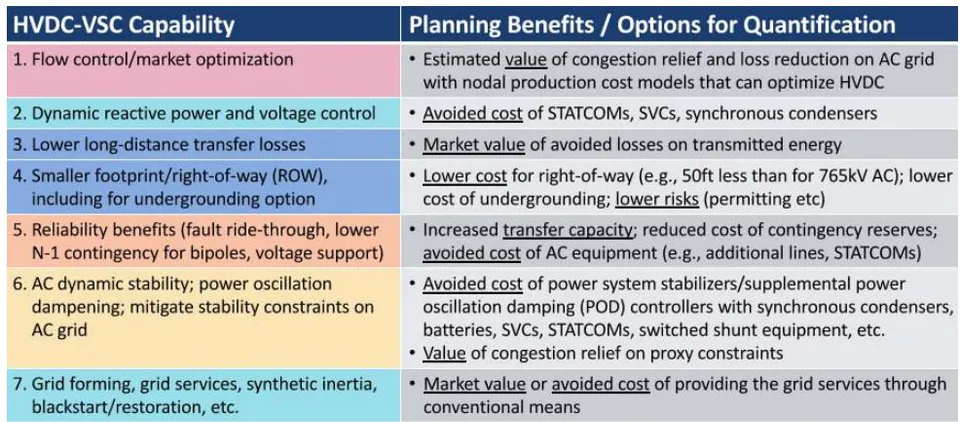
As an example, strengthening transmission capacity of provincial interties in the Transcontinental Supergrid may require increasing the capacity of existing transmission corridors. When the existing right-of-way (ROW) is restricted, conversion from HVAC to HVDC may be assessed as the least-cost strategy to increase the capacity of the corridor. In some cases, HVDC conversion may be an option for distances of or for increases of capacity, and the lower-cost option at and capacity increases [155].
To leverage HVDC capabilities in the Transcontinental Supergrid, multi-value HVDC planning is seen as critical [145]. HVDC systems/projects should be analysed "sequentially adding more detail, scope, system performance, model fidelity, and temporal granularity as analyses move from planning to design and integration".
Advanced AC grid capabilities brought by HVDC in the EU and recently in Canada present existing significant experience for the Supergrid planning:
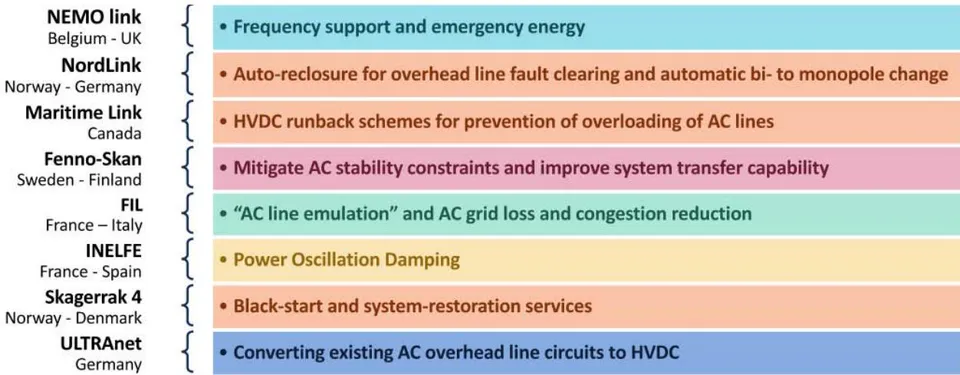
v. HVDC Use Cases
Important use cases documenting the reasons for the HVDC-enabled Transcontinental Supergrid are summarised in the following areas [145]:
Long-distance bulk transport,
Asynchronous connection,
Optimal use of right-of-way,
Controllability.
Existing use cases for HVDC Transmission, their descriptions and features are presented in a summary table below [156] (see Table 4.5.1):
Table 4.5.1: HVDC Use Cases and Descriptions [156]
| Use Case | Description/Features |
| 1. Integration of remote renewables and offshore wind | More cost effective and stable for long-distance access to remote renewables Offers relatively high availability and capacity, low maintenance, and low losses for long distance transmission of renewables Superior controllability for integrating volatile renewable generation and stabilizing AC networks Allows for large export capacity from weak (but renewable rich) portions of the AC grid |
| 2. Long-distance bulk-transmission | Overhead HVDC lines: Offers lower-cost, high-capacity transmission over longer distances, with lower losses, and less right of way than AC transmission lines Underground and submarine HVDC cables: offers lower-cost, high-capacity transmission over long distances; using underground HVDC minimizes environmental impact and reduces outage risks |
| 3. Corridor transfer capability increase | Conversions of AC transmission to HVDC (and upgrades of aging HVDC lines) allow for substantial increases in the transfer capacity of existing transmission lines and corridors without the need for additional right of way and new greenfield transmission lines |
| 4. Interconnections between asynchronous grids | Allows power transmission between AC grids that are not synchronized Asynchronous HVDC interconnection also allows for precise control of power transfer (for both reliability and trading) and the blocking of cascading failures without an increase of the grids' short-circuit current Two asynchronous systems can use HVDC to provide each other frequency support, balancing power, and operating reserve when needed |
| 5a. Interconnections between BAs within a synchronous region | An HVDC link connecting neighboring balancing areas within a single synchronous AC network allows the BAs to exchange energy (for reliability and trading), provide balancing power, and share operating reserves (similar to HVAC transmission links) HVDC can additionally provide AC grid support services, such as power flow control (avoiding the need for phase shifters), dynamic voltage control (avoiding the need for STATCOMs), and system stability and dynamic support |
| 5b. Transmission Embedded within a single Balancing Authority | HVDC transmission connected to different points of the AC grid within a single balancing area provides large transfer capability without imposing stability issues or loop flows on the AC grid It also provides power flow control functions within the AC network (such as for congestion management and loss reduction), dynamic voltage control (at each interconnection point), system stability improvement (including mitigation of stability-based AC transmission constraints), and the mitigation of AC-grid contingency impacts and system cascading failure risks |
| 6. Infeed to load centers/urban areas | Allows for more cost-effective, high-capacity transmission feeds into urban areas and other large load centers where overhead lines are not an option or rights-of-way are very limited |
| VSC-based underground DC transmission can be added to existing transmission rights-of-way to reliably deliver more power to load centers without increasing short-circuit levelsProvides additional reliability services, such as dynamic voltage support within the load center | |
| 7. Providing power to remote locations (including small islanded grids and offshore platforms) | VSC HVDC transmission can support weak or even passive islanded or remote grids, stabilize the islanded AC networks, and improve grid performance in the event of power disturbances |
Summarizing required planning for HVDC in Transcontinental Supergrid section based on transmission planning experts recommendations [145]:
- Canada's Supergrid would enable transcontinental AC-DC transmission merge.
- High capacity, long-distance, controllable, multi-terminal HVDC technology is particularly valuable for transcontinental transmission across multiple balancing areas.
- Voltage Source Converters (VSC) as the dominant HVDC technology offer substantial advantages in addressing many of today's transmission needs and grid reliability challenges at lower cost.
- Gaining hands-on experience with VSC technology by learning from existing and current deployments in the European Union is critical for the Transcontinental Supergrid deployment and integration.
- Multi-value planning is necessary to the Supergrid deployment leveraging multiple benefits (and avoided AC grid upgrade costs) offered by modular multi-level VSC-based HVDC transmission interties and interconnections.
e) Transmission Grids in Canada at a Glance
Keeping the concept of Canada's Transcontinental Supergrid in mind, the features of the country's ten provincial transmission grids were reviewed. These features include:
- Provincial transmission systems - High voltage power grids transporting electricity over large distances from power generation plants to electric stations/substations in consumption areas, and enabling electricity wholesale operations with other provinces/territories and internationally with the U.S.
- Transmission paths - The routes of power connecting provincial transmission systems. These paths are defined by transmission interfaces - interprovincial interties and international cross-border interconnections representing physical boundaries within the grid, often defined by specific transmission lines and substations. These interfaces have defined transfer limits to the maximum amount of power that can be moved from one side of the interface to the other. Transfer limits can be constrained by various factors, including capacity of the lines, stability of the system, or other technical
limitations. While transmission interfaces define the boundaries between the provincial grids, the largest transmission grids such as in the provinces of Ontario and Quebec also indicate zonal transmission interfaces within the grids which are also well defined.
- Existing and planned HVDC solutions - Hvdc lines and back-to-back converter stations currently operating in the provincial transmission grids and/or being considered in transmission planning.
- Electricity Interchange - Interprovincial power transmission-based in-flows and out-flows, and/or international export and import; this may be applied to the province in total and/or to each of the provincial Transmission Paths in operation.
i. Electricity Transmission Systems
British Columbia (BC): The BC Hydro electricity transmission system presents a 500 kV Circular (Loop) Core architecture with key electricity transmission hubs (see “Proposed Definitions” in section 3.1) and West/East and North/South transmission paths.
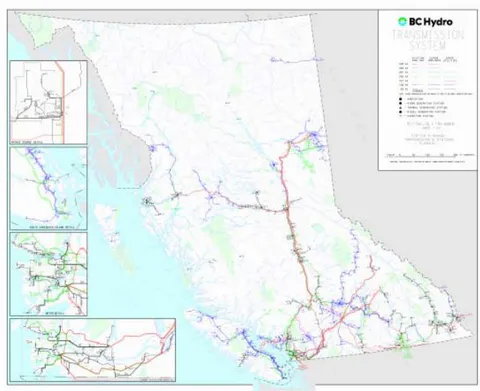
Alberta (AB): The AESO electricity transmission system presents a 500 kV/240 kV "Vertical Trunk" architecture with three Transmission Paths.
The transmission includes two intra-provincial HVDC transmission lines: Western Alberta Transmission Line (WATL) and Eastern Alberta Transmission Line (EATL), and an Alberta-BC HVAC Intertie.

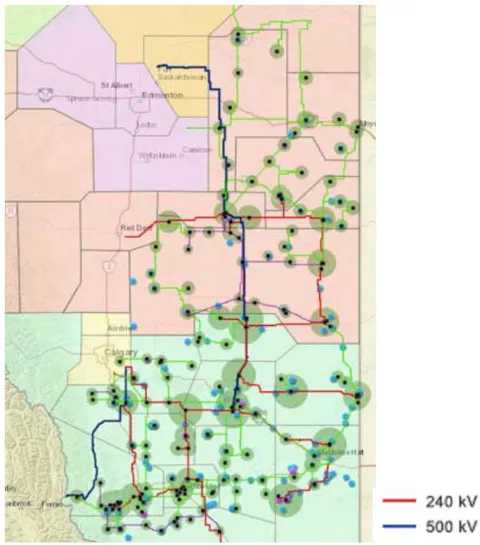
Saskatchewan (SK): The Saskatchewan Electricity System presents a "Vertical Trunk" architecture with lines shaping the "trunk" and transmission lines making transmission loops as well as radial lines [159]:
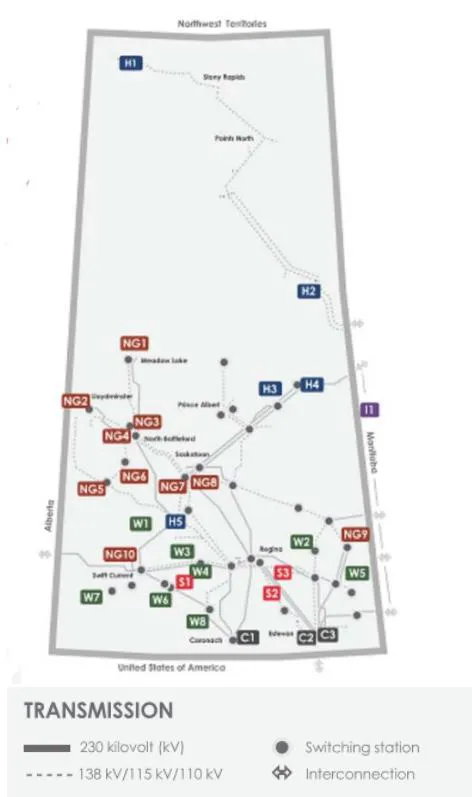
Manitoba (MB): Manitoba Hydro (MH)'s transmission system presents a "Vertical Trunk" architecture with three transmission paths to Alberta, Saskatchewan and
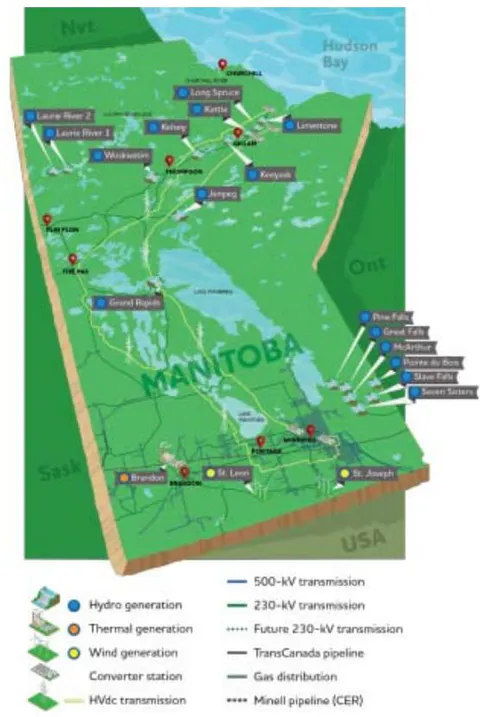
Minnesota. The “Vertical Trunk” transmission is based on a combination of long-distance HVDC and HVAC lines shaping the “trunk” and
kV transmission making transmission loops as well as radial lines ("the branches").
Ontario (ON):
The Ontario's transmission system has three major connected components (see Fig. 5.1.5):
A 500 kV Loop transmission in the area surrounded by the lakes Ontario, Erie and Huron, and covered by five electrical zones: West, Southwest, Niagara, Bruce, and Toronto;
A 500 kW "Trunk" transmission with several 230 kV and 115 kV transmission loops and radial lines covering the East and Ottawa electrical zones;
A "Trunk" transmission with several and transmission loops and radial lines covering the Essa, Northeast and Northwest electrical zones.
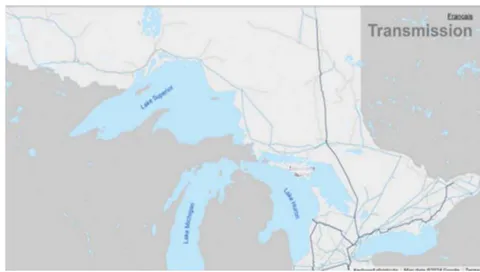
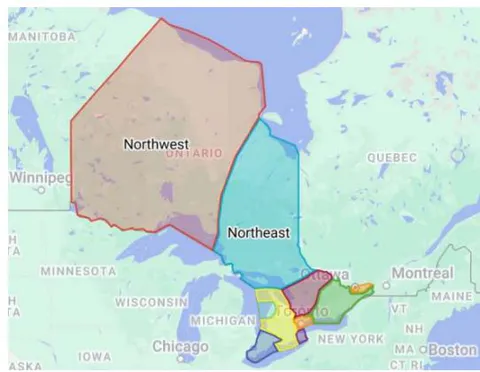
Ontario's IESO transmission system is divided into ten electrical zones: West, Southwest, Niagara, Bruce, Toronto, East, Essa, Ottawa, Northeast and Northwest. It is administered/directed by the Independent Electricity System Operator (IESO), the Crown corporation responsible for operating the electricity market in the province [162].
Quebec (QC)
The Quebec's electricity transmission system (also known as the Quebec interconnection) is a pioneer
in high-voltage power transmission strongly built on the 735 kV HVAC core. The South Shore region of Montreal and the Saint Lawrence River between Montreal and Quebec City contain 735 kV power line loops in the system architecture.
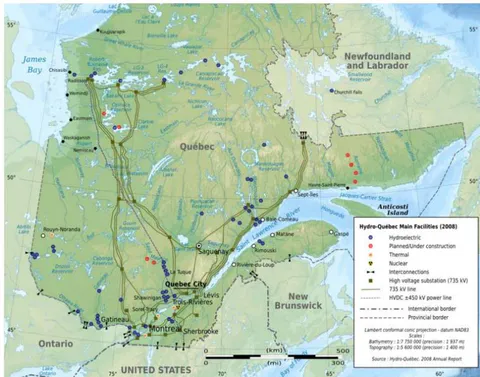
Hydro-Québec is also a global leader in High Voltage Direct Current (HVDC) transmission and has many HVDC interconnections with neighboring systems. The Hydro-Québec's electricity transmission system is managed by Hydro-Québec TransÉnergie (HQT), a division of the crown corporation Hydro-Québec.
New Brunswick (NB)
New Brunswick Power's transmission system is built on 138 kV and 345 kV transmission loops with 230 kV links between them (see Fig. 5.1.7):
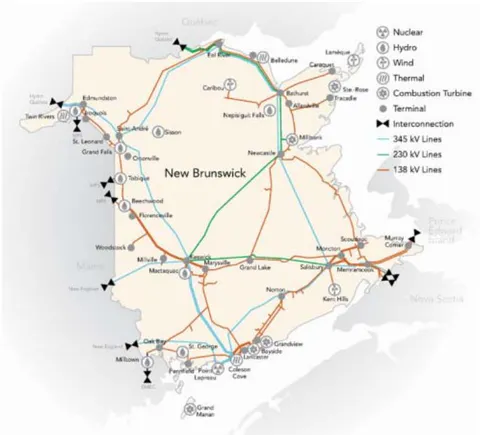
Nova Scotia (NS)
Nova Scotia Power INC. (NSPI)'s transmission system presents a "Horizontal Trunk" architecture with two transmission paths to New Brunswick and Newfoundland and Labrador. The "Horizontal Trunk" architecture includes 345 kV transmission core with 230 kV/138 kV/69 kV radial lines.
The NSPI system is interconnected to New Brunswick Power via one 345kV and two 138kV transmission lines.
Nova Scotia is also interconnected with Newfoundland via a 500MW, DC Maritime Link intertie that was placed into service on January 15, 2018 to receive power capacity and energy from the Muskrat Falls Hydro project and the Labrador Island Link DC tie between Labrador and Newfoundland [166].
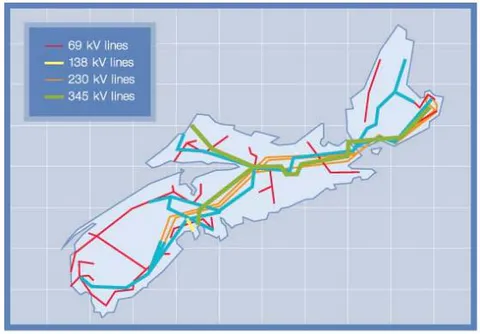
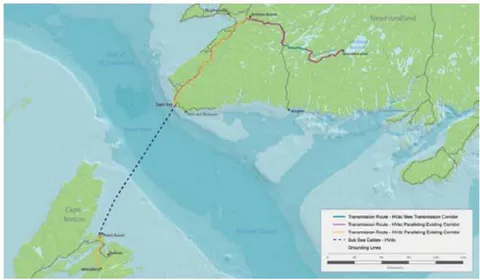
Prince Edward Island
Prince Edward Island's high voltage transmission system consists of 69 kV and 138 kV transmission lines as well as the interconnections between Prince Edward Island and New Brunswick. Prince Edward Island is connected to the NB Power system through its HVAC 560 MW, 138 kV submarine cable interconnection.
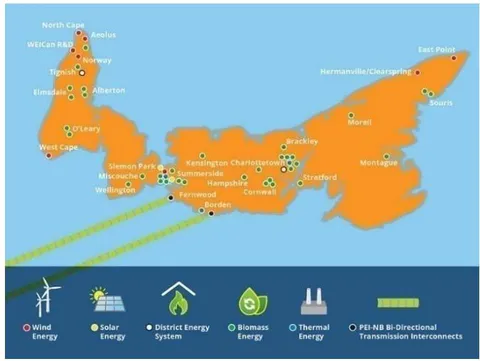
Newfoundland and Labrador
There are two primary zones of electrical infrastructure in the Newfoundland and Labrador Interconnected System—the Island Interconnected System and the Labrador Interconnected System. A system map of the provincial transmission system is shown in Fig. 5.1.10.
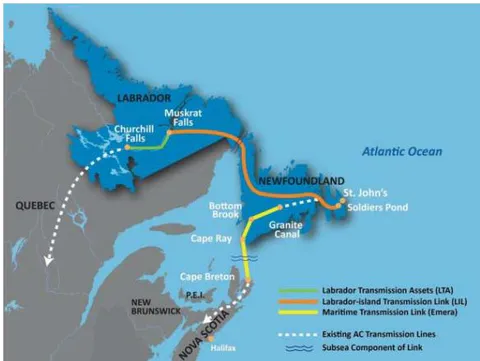
The Island Interconnected System is the interconnected portion of the Island electrical system. In 2018, the system became connected to The Eastern Interconnection in North America for the first time via the Labrador-Island Link, which connects it to the Labrador Interconnected System, and the Maritime Link, which connects it to Nova Scotia) [169].
The Labrador Interconnected System is the interconnected portion of the Labrador electrical system. Central to the system is large, hydroelectric generation capability from Churchill Falls and transmission to the two major customer centres in Labrador East and Labrador West. It is connected to the Island Interconnected System via the Labrador-Island Link (LIL). The system is also connected to the Eastern Interconnection via the HVAC 735 kV transmission lines from Churchill Falls to Quebec.
ii. Transmission Paths
British Columbia
British Columbia's high voltage transmission system has been linked to Alberta and the United States for over thirty years [157].
Specifically, Path 1E: Alberta-British Columbia (Path 1 in the Western Electricity Coordinating Council (WECC) 2023 Path Rating Catalogue [129]) includes a set of AC lines with the total Transfer Limit of 1,000 MW East To West, and 1,200 MW West to East.
Path 1E: Bonneville Power Administration (BPA)-British Columbia (Path 3: Northwest in WECC [129]) includes a set of AC lines with the total Transfer Limit of 3,150 MW North to South, and 3,000 MW South to North [170].
Alberta
The Alberta's Electricity System managed by AESO is connected to British Columbia via Path 1E (Path 1 in WECC [129]); to Saskatchewan via Path 2E (Path 2in WECC [129]); and to Montana via Path 2S (Path 83 in WECC [129]).
Path 2E to Saskatchewan presents McNeill HVDC Back-to-Back Intertie with the total Transfer Limit of 150 MW East To West and 150 MW West to East.
Path 2S to Montana presents Montana-Alberta Tie Line (MATL) at an AC voltage of with the total Transfer Limit of 325 MW North to South and 300 MW South to North.
Saskatchewan
The Saskatchewan's Electricity System managed by SaskPower is connected to Alberta via Path 2E (Path 2in WECC [129]); to Manitoba via Path 3E (Manitoba Hydro); to North Dakota via Path 3S (Southwest Power Pool (SPP), a Regional Transmission Organization).
Saskatchewan-Manitoba Path 3E Total Transfer Limit is 290 MW [171].
Saskatchewan-North Dakota Path's Total Transfer Limit is currently 150 MW to be expanded to 650 MW by 2027 [172].
Manitoba
Manitoba Hydro manages four Paths: Path 4E to the east with Ontario (IESO), Path 3E to the west with Saskatchewan (SaskPower), and two to the south: Path

4SE to Minnesota and Path 4SW to North Dakota (MISO) [173].
Table 5.2.1: Manitoba Paths [174]
| Path | Out-Flow/Export (MW) | In-Flow/Import (MW) |
| Manitoba - North Dakota Path 4SW and Manitoba - Minnesota Path 4SE (MISO): | 3058 | 1475 |
| Manitoba -Ontario (IESO) Path 4E: | 125 | 25 |
| Manitoba -Saskatchewan Path 3E: | 400, including: | 145, including: |
| South Interface: Path 3ES | 365 | 75 |
| North Interface: Path 3EN | 35 | 70 |
Ontario
The Ontario's Electricity System managed by IESO is connected to the wholesale transmission systems administered by Manitoba Hydro (Manitoba),
MISO (via Minnesota and Michigan), NYISO (New York), and Hydro-Québec TransÉnergie (Quebec) - see Fig. 5.2.1 below:
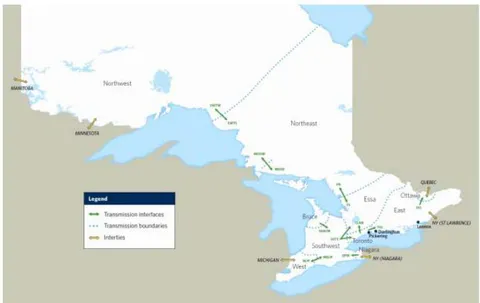
Table 5.2.2: IESO Transmission Intertie/Interconnection Capabilities (all Transmission Elements In-service) [176]
| Path/Interlink | Direction | Total Transfer Capability (MW) |
| ON-MB Path 4E | West | 250 |
| MB-ON Path 4E | East | 260 |
| ON-MN Path 5SWW | South | 150 |
| MN-ON Path 5SWW | North | 145 |
| ON-MI Path 5SWE | South | 1,500 |
| MI-ON Path 5SWE | North | 1,650 |
| ON-NY @ Niagara Path 5SW | South | 2,005 |
| NY-ON @ Niagara Path 5SW | North | 1,810 |
| ON-NY @ St. Lawrence Path 5SE | South | 295 |
| NY- ON @ St. Lawrence Path 5SE | North | 295 |
| ON-QC Path 5E | East | 2,135 |
| QC-ON Path 5E | West | 2,730 |
Quebec
Hydro-Québec operates interties/interconnections with the power systems of Ontario, the Maritime provinces, New York State and New England [177]; it is
also interconnected with Labrador, NL. In the HQT Master Plan 2020 interconnections with the neighbouring system were planned as follows:
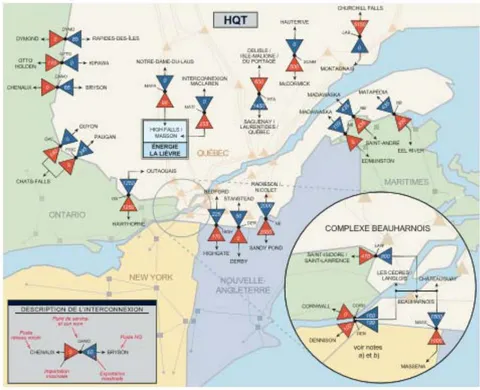
Table 5.2.3: Interconnections with Neighbouring Transmission Systems
| Neighbouring Transmission System | Number of Interconnections | TTC Import | TTC Export |
| New York Path 6SW | 2 | 1,100 | 1,999 |
| Ontario Path 5E | 8 | 1,970 | 2,705 |
| New England Path 6SE | 3 | 2,170 | 2,275 |
| New Brunswick Path 6E | 3 | 785 | 1,029 |
| Total | 15a | 6,025 | 7,974b |
New Brunswick
NB Power is one of the most interconnected utilities in North America. The main interconnections are with the following jurisdictions:
- New Brunswick - Quebec
- New Brunswick - New England
- New Brunswick – Northern Maine
- New Brunswick - Nova Scotia
- New Brunswick - Prince Edward Island
As of December 6, 2022, Total Transfer Capability of the NBSO interconnections is as follows (see Table 5.2.4):
Table 5.2.4: Total transfer capability (TTC) as of 2022 [179]
| Interface | Interface Name | Direction | TTC (MW) |
|---|---|---|---|
| Path 6E (HQT-NBSO): | |||
| Path 6ES | Madawaska – Edmundston*/Saint Andre | In-flow | 594 |
| Out-flow | 435 | ||
| Path 6EN | Matapedia – Eel River* | In-flow | 435 |
| Out-flow | 350 | ||
| Path 7SE (NE-NBSO): | |||
| New England - New Brunswick | Import | 550 | |
| Export | 1,000 | ||
| Path 7SW (NMISA-NBSO) | |||
| Path 7SWW (MPD-NB) | Maine Public District – New Brunswick | Import | 129 |
| Export | 110 | ||
| Path 7SWE (EMEC-NB) | Eastern Maine Electric Cooperative – New Brunswick | Import | 32 |
| Export | 32 | ||
| Path 7E (NBSO-NSSO) | |||
| New Brunswick – Nova Scotia | In-flow | 350 | |
| Out-flow | 150 | ||
| Path 7NE (NBSO-PEIEC) | New Brunswick – Prince Edward Island | In-flow | 300 |
| Out-flow | 300 |
Nova Scotia
NB-NS Interface: From the perspective of the NS side of the NS-NB Intertie, the export Total Transfer Capability (TTC) is up to 500 MW. Import Total Transfer Capability is up to 300 MW or of gross load in Nova Scotia, whichever is less.
NS-NL Interface (via Maritime Link):
Maritime Link is an HVDC interconnection between Nova Scotia and Newfoundland and Labrador with a nominal bi-directional rating of 500 MW [180].
As of 2023, Total Transfer Capability of the NSSO interconnections is as follows (see Table 5.2.5):
Table 5.2.5: Total transfer capability (TTC) as of 2023 [180]
| Interface | Interface Name | Direction | TTC (MW) |
| Path 7E (NBSO-NSSO): | |||
| (NSX) | Nova Scotia Import/Export | Import | 300 |
| Export | 500 | ||
| Path 8NE (NSSO-NLH): | |||
| (MLI) | Maritime Link | Import | 475 |
| Export | 325 |
Prince Edward Island: see Table 5.2.5 above.
Newfoundland and Labrador: see Table 5.2.6 below.
Table 5.2.6: Total transfer capability (TTC) as of 2023
| Interface | Interface Name | Direction | TTC (MW) |
| Path 8NE (NSSO-NLH): | |||
| (MLI) | Maritime Link | Import | 325 |
| Export | 475 | ||
| Path 9SW (QHT-CF(L)Co): | |||
| (LAB) | Churchill Falls Labrador | Import | 0 |
| Export | 1000 |
iii. Existing and Planned HVDC Solutions
British Columbia: None
Alberta:
Intra-provincial: The C1.8 billion Eastern Alberta HVDC Transmission Line, owned by ATCO Ltd., are both 500-kV, 1,000-MW systems. Eastern Alberta Transmission Line is a 485 km long, 500 kV, bipolar overhead transmission line. Western Alberta Transmission Line is a 350-kilometer, 500 kV, bipolar overhead transmission line. Each of the HVDC transmission lines has its capacity of 1,000 MW and can be expandable to a minimum capacity of 2,000 MW [181].
Inter-provincial: The McNeill back-to-back converter station enables a 150 MW transfer at a DC voltage of 42 kV interconnecting the asynchronous Alberta and Saskatchewan systems. Built and commissioned in 1989 by GEC-Alstom, owned and operated by ATCO, the facility is an the only intertie between the Eastern and Western Interconnections in North America [156,157], providing standby voltage support capacity in both AC systems as well as energy exchange using thyristor-based converters [182,183].
Saskatchewan
The McNeill is a 150 MW back-to-back converter station at a DC voltage of 42 kV interconnecting the asynchronous Alberta and Saskatchewan transmission systems (see section 5.2 Alberta).
Manitoba:
Intra-provincial:
Manitoba Hydro's transmission facilities have been developed and are operated as an integrated system, with the backbone being the three Nelson River HVDC transmission lines called Bipole I, Bipole II, and Bipole III [184].
The Bipole I ( , 1620 MW) and Bipole II ( , 1800 MW) transmission lines [177] run alongside each other for much of their 895-km route, starting at the northern Radisson and Henday converter
stations near Gillam. Both lines end in the south at the Dorsey converter station just northwest of Winnipeg.
The Bipole III HVDC transmission line is built on a different route through western Manitoba and two new converter stations. It begins at the Keewatinohk converter station approximately 80 km northwest of Gillam, and ends at the Riel converter station just east of Winnipeg. Bipole III (± 500 kV, 2,000 MW) is an independent and physically separate HVDC system.
Ontario: None
Quebec:
Hydro Quebec Transenergie (HQT) is a global HVDC leader using HVDC technology for all of its asynchronous electricity systems within the Eastern Interconnection. This includes HVDC back-to-back converter stations on the borders with the provinces of Ontario and New Brunswick:
- Quebec's electricity system is connected to the Ontario system through the Outaouais 1,250 MW HVDC back-to-back converter station, located near Ottawa/Gatineau on the Quebec side of the border between the Canadian provinces of Ontario and Quebec. The Outaouais 1,250 MW back-to-back station consists of two independent 625 MW blocks. The station is fully owned by the provincial utility, Hydro-Québec (HQ).
- Quebec's electricity system is connected to the New Brunswick system through the Madawaska 350 MW HVDC back-to-back converter station is located in Quebec near the village of Degelis with a connection into New Brunswick near the city of Edmundston [185]. It connects the Quebec transmission system with the system in New Brunswick.
This also includes long-distance HVDC transmission lines such as Quebec - New England Phase I/II HVDC transmission project (representing also the first large-scale multi-terminal HVDC transmission in the world [186, 187], relatively short HVDC interconnection lines, e.g. Hertel-New York interconnection line [188] and back-to-back HVDC stations, e.g., Châteauguy - one of the largest back-to-back HVDC converter stations in North America
enabling power exchanges between Hydro-Québec and New York Power Authority (NYPA) [189].
New HVDC interconnection developments in progress [190] include:
- Appalachaches–Maine (NECEC), 1243 MW commissioning in 2025,
- Hertel-New-York (CHPE), 1283 MW commissioning in 2026,
- Monténergie-Vermont (New England Clean Power Link - NECPL), 1000 MW commissioning after 2030,
- Quebec-New Brunswick, 2179 MW commissioning after 2030 (use of existing interconnections up to 1029 MW, new 1150-MW interconnection).
New Brunswick
The Eel River HVDC back-to-back converter station is located in Eel River Crossing, New Brunswick [191]; it is the first operative HVDC station in the world equipped with thyristors. The Eel River Converter Station, commissioned in 1972 and upgraded in 2014, consists of two separate bidirectional solid-state nonsynchronous back-to back converter units (each nominally rated 160 MW) connecting 230-kV transmission systems of Hydro-Québec and NB Power. The converter station has a nominal throughput rating of 320 MW and an overload capability of up to 350 MW.
Nova Scotia
The Maritime Link Project [192] is a 500 MW, HVDC connection that enables to transmit to/ via Nova Scotia clean, renewable electricity generated in Newfoundland and Labrador. The stabilizing features of Hitachi Energy's HVDC Light® solution also allow Nova Scotia to integrate additional renewables and contribute to Canada's emission-reduction efforts. The HVDC Light® Maritime Link is the first of its kind in the world with a full Voltage Source Converter (VSC) bipolar configuration, to enhance system availability.
Also, currently several HVDC opportunities are being reviewed that include anew HVDC transmission intertie was reviewed in 2023 to connect offshore wind in the Gulf of Maine (New England) and in Nova Scotia with load centers in the two regions to achieve their decarbonization goals [193, 194].
Prince Edward Island: None
Newfoundland and Labrador:
Maritime Link: see Nova Scotia sub-section above.
Labrador-Island Link (LIL):
The Labrador-Island Link HVDC system is configured as a 900 MW, kV Line Commutated Converter HVDC bipolar transmission system with two sections of overhead transmission line, the Strait of Belle Isle marine crossing, shoreline pond return electrodes, and converter stations at Muskrat Falls and Soldiers Pond. The HVDC bipolar scheme includes two 450 MW converters and switchyard at both Muskrat Falls and Soldiers Pond for total transfer capacity of 900 MW. The overland transmission line is a bipole line with a single conductor per pole, duel electrode conductors for a portion of the line, and an optical ground wire communication cable. The lines are supported by galvanized steel lattice towers. Construction of the 1,100 km LIL HVDC system was completed in late 2017; power commenced flowing in 2018 and the asset was commissioned on April 14, 2023 [195].
iv. Electricity Interchange
According to Canada Energy Regulator (CER)'s data, provincial electricity interchange recorded in 2021 and projected for 2025, 2030 and 2035 is presented in tables 5.4.1-5.4.10 below. The projections selected from CER's "Canada's Energy Future 2023: Supply and Demand Projections to 2050" [196] include "Current Measures" and "Canada Net-zero" scenarios.
Table 5.4.1: BC Hydro Electricity Interchange
| British Columbia Interchange, GWh: | Recorded | Current Measures Scenario | Canada Net Zero Scenario | ||||
| 2021 | 2025 | 2030 | 2035 | 2025 | 2030 | 2035 | |
| Interprovincial In-Flows | 1,409.30 | 5,433.98 | 7,407.52 | 7,809.40 | 5,577.14 | 7,103.88 | 11,388.99 |
| Interprovincial Out-Flows | 4,659.64 | 911.14 | 51.14 | 17.51 | 871.68 | 165.19 | 3,293.76 |
| Net Interprovincial Out-Flows | 3,250.34 | -4,522.84 | -7,356.37 | -7,791.88 | -4,705.45 | -6,938.69 | -8,095.24 |
| Imports | 7,527.55 | 4,841.88 | 4,841.88 | 4,244.01 | 4,841.88 | 4,841.88 | 4,244.01 |
| Exports | 11,430.41 | 8,440.35 | 6,317.29 | 5,625.01 | 3,598.47 | 1,475.41 | 1,381.00 |
| Net Exports | 3,902.86 | 3,598.47 | 1,475.41 | 1,381.00 | 8,440.35 | 6,317.29 | 5,625.01 |
| Alberta Interchange, GWh: | Recorded | Current Measures Scenario | Canada Net Zero Scenario | ||||
| 2021 | 2025 | 2030 | 2035 | 2025 | 2030 | 2035 | |
| Interprovincial In-Flows | 4,867.46 | 1,586.33 | 87.03 | 169.08 | 1,659.40 | 853.58 | 7,758.42 |
| Interprovincial Out-Flows | 1,495.53 | 5,862.92 | 8,576.99 | 8,859.36 | 5,974.56 | 7,550.57 | 13,579.42 |
| Net Interprovincial Out-Flows | -3,371.93 | 4,276.59 | 8,489.96 | 8,690.28 | 4,315.16 | 6,696.98 | 5,821.00 |
| Imports | 1,583.93 | 0.00 | 0.00 | 0.00 | 0.00 | 0.00 | 0.00 |
| Exports | 121.49 | 410.00 | 410.00 | 410.00 | 410.00 | 410.00 | 410.00 |
| Net Exports | -1,462.44 | 410.00 | 410.00 | 410.00 | 410.00 | 410.00 | 410.00 |
Table 5.4.3: SaskPower Electricity Interchange
| Saskatchewan Interchange, GWh: | Recorded | Current Measures Scenario | Canada Net Zero Scenario | ||||
| 2021 | 2025 | 2030 | 2035 | 2025 | 2030 | 2035 | |
| Interprovincial In-Flows | 655.72 | 3,050.77 | 3,540.57 | 3,500.31 | 3,015.49 | 3,061.31 | 10,928.27 |
| Interprovincial Out-Flows | 274.67 | 676.78 | 74.89 | 185.15 | 789.23 | 693.54 | 5,400.64 |
| Net Interprovincial Out-Flows | -381.05 | -2,374.00 | -3,465.68 | -3,315.16 | -2,226.26 | -2,367.77 | -5,527.63 |
| Imports | 17.03 | 0.00 | 0.00 | 0.00 | 0.00 | 0.00 | 0.00 |
| Exports | 187.20 | 130.00 | 130.00 | 130.00 | 130.00 | 130.00 | 130.00 |
| Net Exports | 170.17 | 130.00 | 130.00 | 130.00 | 130.00 | 130.00 | 130.00 |
Table 5.4.4: Manitoba Hydro Electricity Interchange
| Manitoba Interchange, GWh: | Recorded | Current Measures Scenario | Canada Net Zero Scenario | ||||
| 2021 | 2025 | 2030 | 2035 | 2025 | 2030 | 2035 | |
| Interprovincial In-Flows | 8.26 | 623.28 | 513.78 | 499.91 | 634.67 | 150.65 | 4,298.14 |
| Interprovincial Out-Flows | 1,326.70 | 3,090.01 | 2,967.38 | 3,078.30 | 3,081.87 | 3,679.73 | 11,614.65 |
| Net Interprovincial Out-Flows | 1,318.44 | 2,466.73 | 2,453.60 | 2,578.40 | 2,447.20 | 3,529.08 | 7,316.51 |
| Imports | 3,072.80 | 1,000.00 | 1,000.00 | 1,000.00 | 1,000.00 | 1,000.00 | 1,000.00 |
| Exports | 5,442.08 | 8,815.72 | 15,084.37 | 14,340.83 | 8,815.72 | 15,084.37 | 14,340.83 |
| Net Exports | 2,369.28 | 7,815.72 | 14,084.37 | 13,340.83 | 7,815.72 | 14,084.37 | 13,340.83 |
Table 5.4.5: IESO Electricity Interchange
| Ontario Interchange, GWh: | Recorded | Current Measures Scenario | Canada Net Zero Scenario | ||||
| 2021 | 2025 | 2030 | 2035 | 2025 | 2030 | 2035 | |
| Interprovincial In-Flows | 9,120.35 | 7,144.31 | 12,569.64 | 15,048.25 | 8,229.88 | 16,283.12 | 26,373.77 |
| Interprovincial Out-Flows | 2,922.56 | 6,971.09 | 3,577.21 | 2,123.80 | 6,116.48 | 3,006.93 | 9,907.73 |
| Net Interprovincial Out-Flows | -6,197.79 | -173.22 | -8,992.43 | -12,924.46 | -2,113.40 | -13,276.19 | -16,466.05 |
| Imports | 521.73 | 6,846.89 | 6,846.89 | 6,846.89 | 6,846.89 | 6,846.89 | 6,846.89 |
| Exports | 15,628.25 | 6,565.33 | 10,988.71 | 10,584.53 | 6,565.33 | 10,988.71 | 10,584.53 |
| Net Exports | 15,106.52 | -281.56 | 4,141.82 | 3,737.64 | -281.56 | 4,141.82 | 3,737.64 |
Table 5.4.6: Hydro-Québec TransÉnergie Electricity Interchange
| Quebec Interchange, GWh: | Recorded | Current Measures Scenario | Canada Net Zero Scenario | ||||
| 2021 | 2025 | 2030 | 2035 | 2025 | 2030 | 2035 | |
| Interprovincial In-Flows | 33,845.61 | 33,355.55 | 29,835.99 | 28,409.07 | 32,191.85 | 29,304.48 | 36,622.04 |
| Interprovincial Out-Flows | 13,275.06 | 12,427.55 | 20,171.17 | 18,273.91 | 13,705.21 | 20,976.97 | 25,581.96 |
| Net Interprovincial Out-Flows | -20,570.55 | -20,928.00 | -9,664.82 | -10,135.16 | -18,486.63 | -8,327.51 | -11,040.08 |
| Imports | 6.49 | 600.00 | 600.00 | 600.00 | 600.00 | 600.00 | 600.00 |
| Exports | 24,283.56 | 25,152.69 | 26,779.29 | 26,592.14 | 25,152.69 | 26,779.29 | 26,592.14 |
| Net Exports | 24,277.07 | 24,552.69 | 26,179.29 | 25,992.14 | 24,552.69 | 26,179.29 | 25,992.14 |
Table 5.4.7: NB PowerElectricity Interchange
| New Brunswick Interchange, GWh: | Recorded | Current Measures Scenario | Canada Net Zero Scenario | ||||
| 2021 | 2025 | 2030 | 2035 | 2025 | 2030 | 2035 | |
| Interprovincial In-Flows | 5,102.33 | 6,384.60 | 10,017.02 | 5,771.93 | 6,530.20 | 9,471.74 | 6,531.83 |
| Interprovincial Out-Flows | 2,062.86 | 1,669.23 | 2,204.63 | 2,533.25 | 1,710.48 | 815.41 | 679.77 |
| Net Interprovincial Out-Flows | -3,039.47 | -4,715.38 | -7,812.39 | 3,238.68 | -4,819.73 | -8,656.32 | -5,852.06 |
| Imports | 131.24 | 414.74 | 414.74 | 414.74 | 414.74 | 414.74 | 414.74 |
| Exports | 2,154.52 | 807.52 | 1,083.17 | 672.72 | 807.52 | 1,083.17 | 672.72 |
| Net Exports | 2,023.28 | 392.78 | 668.43 | 257.98 | 392.78 | 668.43 | 257.98 |
Table 5.4.8: NS PowerElectricity Interchange
| Nova Scotia Interchange, GWh: | Recorded | Current Measures Scenario | Canada Net Zero Scenario | ||||
| 2021 | 2025 | 2030 | 2035 | 2025 | 2030 | 2035 | |
| Interprovincial In-Flows | 1,006.64 | 5,196.88 | 5,794.65 | 5,916.74 | 5,301.31 | 4,099.09 | 1,865.60 |
| Interprovincial Out-Flows | 0.08 | 519.65 | 1,595.75 | 1,286.86 | 438.25 | 3,531.98 | 6,030.41 |
| Net Interprovincial Out-Flows | -1,006.57 | -4,677.23 | -4,198.90 | -4,629.87 | -4,863.06 | -567.11 | 4,164.81 |
| Imports | 138.24 | 110.00 | 110.00 | 110.00 | 110.00 | 110.00 | 110.00 |
| Exports | 2.64 | 0.00 | 0.00 | 0.00 | 0.00 | 0.00 | 0.00 |
| Net Exports | -135.60 | -110.00 | -110.00 | -110.00 | -110.00 | -110.00 | -110.00 |
Table 5.4.9: Maritime Electric Electricity Interchange
| Prince Edward Island Interchange, GWh: | Recorded | Current Measures Scenario | Canada Net Zero Scenario | ||||
| 2021 | 2025 | 2030 | 2035 | 2025 | 2030 | 2035 | |
| Interprovincial In-Flows | 848.18 | 848.08 | 751.11 | 860.87 | 785.11 | 813.92 | 675.82 |
| Interprovincial Out-Flows | 0 | 114.1 | 223.72 | 645.3 | 153.21 | 184.81 | 227.31 |
| Net Interprovincial Out-Flows | -848.18 | -733.98 | -527.39 | -215.57 | -631.9 | -629.11 | -448.51 |
| Imports | 0 | 0 | 0 | 0 | 0 | 0 | 0 |
| Exports | 0 | 0 | 0 | 0 | 0 | 0 | 0 |
| Net Exports | 0 | 0 | 0 | 0 | 0 | 0 | 0 |
| Newfoundland and Labrador Interchange, GWh: | Recorded | Current Measures Scenario | Canada Net Zero Scenario | ||||
| 2021 | 2025 | 2030 | 2035 | 2025 | 2030 | 2035 | |
| Interprovincial In-Flows | 36.26 | 0.57 | 0.26 | 13.84 | 0.40 | 4.01 | 1,810.90 |
| Interprovincial Out-Flows | 31,146.16 | 31,381.89 | 31,074.69 | 30,995.95 | 31,084.47 | 30,540.65 | 31,938.13 |
| Net Interprovincial Out-Flows | 31,109.90 | 31,381.33 | 31,074.42 | 30,982.11 | 31,084.07 | 30,536.63 | 30,127.23 |
| Imports | 14.70 | 0.00 | 0.00 | 0.00 | 0.00 | 0.00 | 0.00 |
| Exports | 1,152.64 | 1,200.00 | 1,200.00 | 1,200.00 | 1,200.00 | 1,200.00 | 1,200.00 |
| Net Exports | 1,137.94 | 1,200.00 | 1,200.00 | 1,200.00 | 1,200.00 | 1,200.00 | 1,200.00 |
III. EXPECTED RESULTS AND OUTCOMES
a) Estimation Framework and Planning Implications for Transcontinental Supergrid
Possible next steps in the Transcontinental Supergrid planning proposed in this section include the following:
- Review and potential upgrade of total transfer capability limits for interprovincial and international transmission paths, and existing and currently planned HVDC solutions
- Selection of an interprovincial coast-to-coast transfer capability target
- Review of international coast-to-coast transfer practices
- Review of through-province transmission capabilities
- Review of HVDC back-to-back stations planning for Supergrid development
i. Upgrading Total Transfer Limits
a. Interregional Transfer Capability Studies
Canadian systems represent a crucial part in the interconnected North American bulk power system (BPS). Interregional energy transfers play an increasingly pivotal role across provincial transmission grids in Canada addressing the changing resource mix and extreme weather. A strong, flexible, and resilient transmission system in Canada is essential today to support energy adequacy to reliably meet customer demand.
To better define opportunities with upgrading Total Transfer Capabilities coast to coast, a comprehensive analysis of current opportunities was completed by the North American Electric Reliability Corporation (NERC) through its Interregional Transfer Capability Studies (ITCS) [198] of transmission planning regions "to inform the potential need for more electric transmission capacity between regions for reliability" (the U.S. Fiscal Responsibility Act of 2023, section 322 [197]) with an objective to maintaining and upgrading a highly reliable, resilient, and secure North American bulk power system.
The Interregional Transfer Capability Studies conducted contained the following:
- "Current total transfer capability, between each pair of neighboring transmission planning regions.
- A recommendation of prudent additions to total transfer capability between each pair of neighboring transmission planning regions that would demonstrably strengthen reliability within and among such neighboring transmission planning regions.
- Recommendations to meet and maintain total transfer capability together with such recommended prudent additions to total transfer capability between each pair of neighboring transmission planning regions" [198].
According to [198], Transmission Planning Regions (TPRs) in North America are defined in Fig. 6.1.1 below:
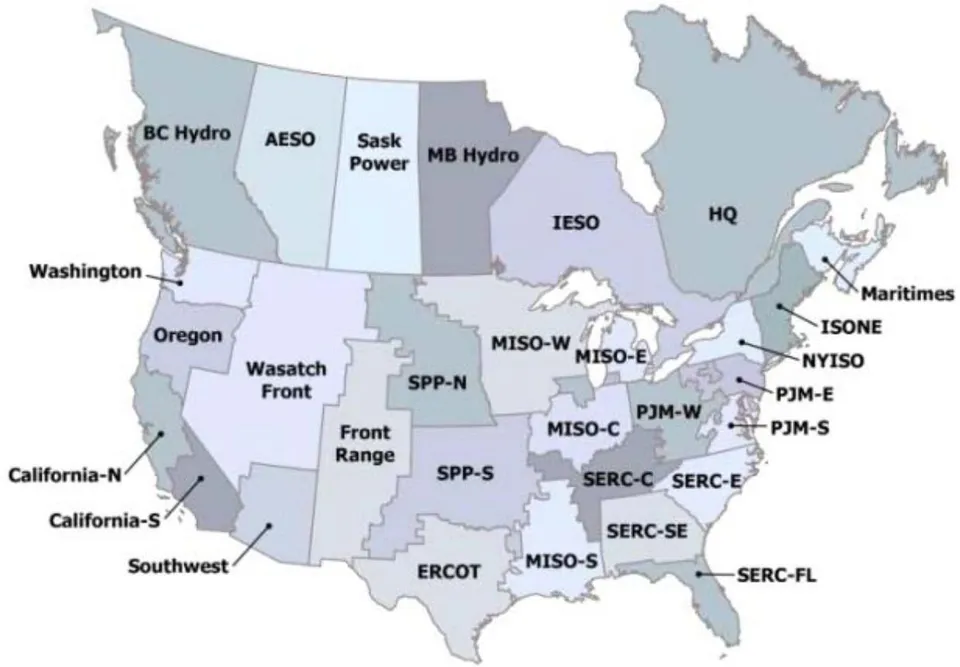
In Canada, these Transmission Planning Regions (TPR) are well defined by the provincial boundaries; the only TPR adjustment may be made to Atlantic Canada (AC) region including the Maritimes and the province of Newfoundland and Labrador.
Significance of Transfer Capability for Canada's Supergrid is well defined in [198]: "Adequate transfer capability is fundamental to the reliable operation of the BPS. Balancing Authorities may rely on their neighbors to supply energy for various purposes, including economic or policy reasons. Transfer capability is also essential under stressed operating conditions, allowing Balancing Authorities to maintain reliability by importing needed energy from their neighbors. As the resource mix becomes increasingly dependent on just-in-time and weather-dependent fuels, such as wind and solar, the ability to transfer electrical energy from areas of fuel adequacy to areas experiencing fuel constraints has become essential to maintaining reliable delivery of electricity to end-use customers."
"...A holistic view of the interconnected system and a thorough understanding of its behavior are essential when calculating or increasing transfer capability. When neighboring TPRs transfer energy over a highly interconnected system, the energy flows over many different lines based on the difficulty, or resistance, of traveling each route, unless there is specific equipment used to control flows. As a result, energy typically flows not only across the tie lines that
directly connect the exporting (source) TPR to the importing (sink) TPR, but over many routes, some of which may be running through third-party systems. The way electrical energy flows has broad implications for calculating and using transfer capability in an interconnected system, especially when traveling over long distances."
Implications of increasing Transfer Capability and its related limitations must include the following: "...Increased transfers of energy between TPRs can benefit reliability in some situations, but large transfers also have reliability implications that must be considered. When a large amount of energy is transferred, certain aspects of reliable system operations, such as system stability, voltage control, and minimizing the potential for cascading outages, must also be considered, including the ability to withstand unplanned facility outages. This evaluation is crucial as an increased transfer capability may benefit neighboring TPRs under stressed conditions, but it can also potentially create some reliability issues that must be carefully considered in the planning process."
b. Transfer Capability Analysis for Canada
In April 2025 NERC completed Interregional Transfer Capability Study (ITCS) for Canada with an analysis of transfer capability - the measure of the ability of interconnected electric systems to reliably move or transfer electric power from one area to another area by
way of all transmission lines (or paths) between those areas under specific system conditions. Transfer capability and energy margins were analysed to evaluate the reliability benefits of enhancing cross-border and cross-provincial transmission. This analysis complements NERC's Interregional Transfer Capability Study (ITCS) for the U.S. issued in 2024 [198].
The Canadian Analysis focused on energy adequacy - the ability of the bulk power system (BPS) to always meet customer demand. The conclusions of this Canadian Analysis align with those of the Canada Electricity Advisory Council, which "identified the reinforcement and expansion of inter-regional transmission as a critical measure to support the reliability of Canada's electricity system" [9], a finding that was incorporated into Canada's Clean Electricity Strategy [199].
The scope of the NERC's Interregional Transfer Capability Study included the following:
- A common modeling approach to study the North American grid independently and transparently
- Evaluation of the impact of extreme weather events on hourly energy adequacy using the calculated current transfer capability and 10-year resource and load futures
- Identifying additional transfer capability that could address energy deficits when surplus is available in neighboring regions
- Extensive consultation and collaboration with industry
- Reliability improvement as the sole consideration in evaluating additional transfer capability
According to [200], "NERC assessments identified the need for more transmission throughout North America and a strategically planned resource mix to address these changes and support the ongoing electrification of the economy, including the growing transportation sector, industrial loads, and data centers. More frequent extreme weather events may further compound the challenge. In the interest of public health, safety, and security, the need for a reliable energy supply becomes most pronounced under these extreme conditions. These factors emphasize the criticality of adequate and informed planning at a broad interregional level to support future grid reliability and resilience".
The Canadian Analysis highlighted an opportunity to optimize reserve use across multiple Transmission Planning Regions (TPRs) in Canada, showing how transmission can maximize the use of resources, including energy-limited storage and demand response. The analysis highlights the ongoing importance of holistic transmission and resource planning, as increasing transfer capability without surplus energy would be inefficient".
Being focused solely on reliability, specifically in terms of energy adequacy and reserve optimization, the Canadian Analysis indicates that transfer capability additions reduce energy deficits by transferring available excess energy from neighboring TPRs.
The transfer capability across the provincial transmission grids in Canada in summer and in winter is shown on Fig. 6.1.2 below:
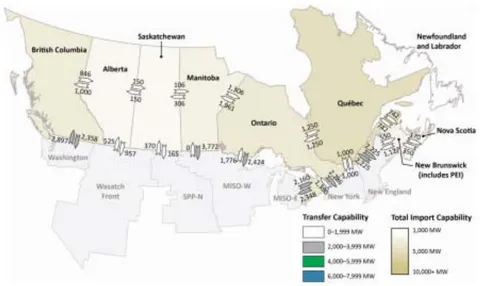
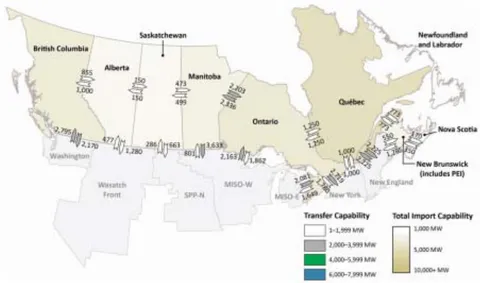
(b) Transfer Capability (Winter)
Fig. 6.1.2: Transfer Capability - NERC Canadian Analysis [200]
As indicated by NERC in [200], "These transfer capabilities represent the ability of the entire network to move energy from one TPR to another TPR, but are not synonymous with path ratings, which calculate the maximum flow that can be reliably attained over a selected set of transmission facilities. This study did not follow a path-based calculation method used in many
TPRs, so the results generally do not match individual facility ratings. Normally open ties, such as those between interconnections, were not considered in this evaluation."
The NERC's key findings of the transfer analysis for Canada are summarized in Fig. 6.1.3 below:
- Transfer capability varies seasonally and under different system conditions that limit transmission loading; it cannot be represented by a single number.
- Transfer capability is highly dependent on coordinated phase angle regulator settings, particularly in Saskatchewan, Manitoba, and Ontario.
- Prince Edward Island load impacts the transfer capability from New Brunswick to Nova Scotia.
- Transfer capability differs across Canada, with total import capability varying between and of peak load.
- Observed transfer capabilities are generally higher between Canada and the United States but relatively lower between provinces.
- The magnitude of transfer capability is not itself a measure of energy adequacy.
- Interregional transfer capability, as studied in this analysis, is not synonymous with path ratings.
Based on the NERC's ITCS methodology, the following summary can be proposed for Total Transfer Capabilities of provincial interties in Canada (see Table 6.1.1):
Table 6.1.1: Total Transfer Capabilities of provincial interties based on the ITCS analysis for Canada [200] a) Summer 2024
| Transfer, MW: | Province: | BC | AB | SK | MB | ON | QC | NB | NS | Total |
| In-flow | AB | 846 | 150 | 996 | ||||||
| Out-flow | 1,000 | 150 | 1,150 | |||||||
| In-flow | SK | 150 | 306 | 456 | ||||||
| Out-flow | 150 | 106 | 256 | |||||||
| In-flow | MB | 106 | 1,961 | 2,067 | ||||||
| Out-flow | 306 | 1,306 | 1,612 | |||||||
| In-flow | ON | 1,306 | 1,250 | 2,556 | ||||||
| Out-flow | 1,961 | 1,250 | 3,211 | |||||||
| In-flow | QC | 1,250 | 742 | 1,992 | ||||||
| Out-flow | 1,250 | 742 | 1,992 | |||||||
| In-flow | NB | 742 | 350 | 1,092 | ||||||
| Out-flow | 742 | 170 | 912 |
| Transfer, MW: | Province: | BC | AB | SK | MB | ON | QC | NB | NS | Total |
| In-flow | AB | 855 | 150 | 1,005 | ||||||
| Out-flow | 1,000 | 150 | 1,150 | |||||||
| In-flow | SK | 150 | 499 | 649 | ||||||
| Out-flow | 150 | 473 | 623 | |||||||
| In-flow | MB | 473 | 2,336 | 2,809 | ||||||
| Out-flow | 499 | 2,203 | 2,702 | |||||||
| In-flow | ON | 2,203 | 1,250 | 3,453 | ||||||
| Out-flow | 2,336 | 1,250 | 3,586 | |||||||
| In-flow | QC | 1,250 | 773 | 2,023 | ||||||
| Out-flow | 1,250 | 773 | 2,023 | |||||||
| In-flow | NB | 773 | 350 | 1,123 | ||||||
| Out-flow | 773 | 100 | 873 |
Also, the following summary can be proposed for Total Transfer Capabilities of international interconnections in Canada (see table 6.1.2):
Table 6.1.2: Total Transfer Capabilities of international interconnections based on the ITCS analysis for Canada [200]
a) Summer 2024
| Transfer, MW | Province/U.S. Region: | Washington | Wasatch Front | SPP North | MISO West | MISO East | New York | New England | Total |
| Import | BC | 2,897 | 2,897 | ||||||
| Export | 2,358 | 2,358 | |||||||
| Import | AB | 525 | 525 | ||||||
| Export | 957 | 957 | |||||||
| Import | SK | 370 | 370 | ||||||
| Export | 165 | 165 | |||||||
| Import | MB | 0 | 0 | ||||||
| Export | 3,772 | 2,160 | 1,390 | 3,772 | |||||
| Import | ON | 1,176 | 2,160 | 1,390 | 4,726 | ||||
| Export | 2,424 | 2,348 | 2,000 | 2,225 | 7,058 | ||||
| Import | QC | ||||||||
| Export | |||||||||
| Import | NB | 550 | 550 | ||||||
| Export | Total | 2,897 | 525 | 370 | 1,176 | 2,160 | 2,390 | 1,127 | 11,293 |
| Export | 2,358 | 957 | 165 | 6,196 | 2,348 | 3,286 | 3,352 | 18,662 |
ii. Coast-to-Coast Transfer Capability Target
To select a coast-to-coast Transcontinental Supergrid TTC target, the opportunities resulting from the ITCS analysis for Canada provided by NERC [200] were used as the next step.
The maximum total transfer capabilities for provincial interties based on "summer/winter" and "inflow/out-flow" limits based on [200] are defined in Table 6.2.1:
Table 6.2.1: Maximum Total Transfer Capability for provincial intertities, MW (winter/summer, in-flow/out-flow)
| Province: | BC | AB | SK | MB | ON | QC | AC |
| AB | 1,000 | 150 | |||||
| SK | 150 | 499 | |||||
| MB | 499 | 2,336 | |||||
| ON | 2,336 | 1,250 | |||||
| QC | 1,250 | 773 | |||||
| NB | 773 |
Opportunities provided by NERC [200] are defined by cross-seam interconnections limitations (Alberta-Saskatchewan path between the Western and Eastern interconnections, Ontario-Quebec and Quebec-New Brunswick (Atlantic Canada) paths between the Quebec and Eastern interconnections) highlighted in Table 6.2.1. In the Transcontinental Supergrid concept
the existing HVDC cross-seams should be upgraded and aligned to allow power flow coast-to-coast.
To maintain the Transcontinental Supergrid economically attractive at the initial stage of its deployment it is proposed to use the 1,250 MW coast-to-coast TTC level of the Supergrid, upgrading only the interties below this "threshold" level (see Table 6.2.2):
Table 6.2.2: Additional Total Transfer Capabilities, MW
| Province: | BC | AB | SK | MB | ON | QC | AC |
| AB | 250 | 1,100 | |||||
| SK | 1,100 | 750 | |||||
| MB | 750 | 1,250 | |||||
| ON | 1,250 | 0 | |||||
| QC | 0 | 500 | |||||
| NB | 500 |
A potential upgrade of the Manitoba-Ontario intertie's TTC to the 2,350 MW level indicated in [200] is proposed to be made at later stages of the Supergrid deployment.
iii. International Transfer Practices
Within the Supergrid's Total Transfer Capability upgrade for import/export operations with the wholesale
markets in the U.S. it is important to enable full control of the international interconnections.
The TTC opportunities for international power transmission import/export with the U.S. regional wholesale markets resulting from the ITCS analysis for
Canada provided by NERC [200] are indicated in Table 6.3.1 below and are based on the maximum total transfer capabilities for provincial interties based on "summer/winter" and "in-flow/out-flow" limits.
Table 6.3.1: Maximum Total Transfer Capability for international interconnections, MW (winter/summer, in-flow/out-flow)
| Province/ U.S. Region: | Washington | Wasatch Front | SPP North | MISO West | MISO East | New York | New England |
| BC | 2,897 | ||||||
| AB | 1,280 | ||||||
| SK* | 663 | ||||||
| MB** | 3,772 | ||||||
| ON | 2,424 | 2,348 | 2,719 | ||||
| QC | 1,000 | 2,225 | |||||
| NB | 1,265 |
*With expected 650 MW limit upgrade by 2027 (SaskPower contract with SPP) ** Based on MHEB Total Transfer Capability data [Manitoba Hydro - Transmission Interface Capability Report. 2022-05-19 [174], the figures include Manitoba import/export to North Dakota)
Import/Export capacity is over 2,500 MW in BC, MB, ON and QC. While it is fully controlled in QC, international interconnections in other provincial transmission grids may require HVDC solutions in the first phase of the Supergrid planning/deployment to keep interprovincial transmission anytime at required levels.
iv. Provincial Grid Wheeling
To understand existing opportunities with provincial grid wheeling enabling Transcontinental coast-to-coast Supergrid capabilities, intra-provincial transmission hub connections were reviewed.
BC Hydro, British Columbia: Well established transmission hubs connections using major 500 kV lines to connect a dedicated AESO substation via Path 1E for interprovincial trade flow out/in.
Also well connected to and substations in Bonneville Power Administration (BPA) for international export/import.
AESO, Alberta: While major substation hubs facing North for power generation and South for export/import market are well connected by 230 kV transmission lines, connection between the major substation hubs facing Path 1E West to BC Hydro and Path 2E East to SaskPower are weak.
Also, connection to McNeill HVDC station also demonstrates the weakness of Path 2E (the path between the Western and Eastern asynchronous interconnections in North America).
SaskPower, Saskatchewan: The key transmission hubs facing Path 2E to the West and Path 3E to the East are connected by single or double transmission lines.
The major hub substations facing electricity generation in the North, and facing export market to the
South (Southwest Power Pool/North Dakota) are also connected by single or double transmission lines.
Manitoba Hydro, Manitoba: The key transmission hubs facing Path 3E to the West and Path 4E to the East are connected by single or double transmission lines.
The major transmission hub substations facing power generation in the North and export market to the South (MISO, North Dakota/Minnesota) are also connected by single or double and transmission lines.
IESO, Ontario: The Ontario's internal power zones allowing for power flow between the path 4E with Manitoba and path 5E with Quebec are connected by major transmission lines. Specifically, IESO is connected to path 4E within the Northwest Zone by a line. The Northwest Zone facing West is connected to Ottawa Zone facing East via the East, Toronto, Essa, and Northeast zones. The Ottawa Zone is connected to the path 5E via the lines to the Outaouais back-to-back HVDC station in Quebec.
The power generation flow comes from the Bruce and Niagara zones to/ via the West and Southwest zones. Power export/import flow is provided via the Northwest zone to Minnesota, via the West zone to Michigan, and via the Niagara and East zones to New York state.
TransÉnergie, Quebec: The 735 kV power line loops in the South Shore region of Montreal and the Saint Lawrence River between Montreal and Quebec City allow for power flow between the path 5E with IESO, Ontario and 6E with NB Power, New Brunswick. These 735 kV loops also provide connection with dedicated intra- and extra-provincial power generation stations and

with export/import paths. Specifically, the transmission hubs are connected:
- With path 5E to IESO by a line;
- With path 6E to NB Power;
- With dedicated intra- and extra-provincial power generation stations.
- With export/import markets of ISO New England and New York ISO.
NB Power, New Brunswick: The 345 kV power line loop in New Brunswick allows for power flow between the substations in the West connected to TransÉnergie, Quebec, and a substation in the East connected to Nova Scotia Power, Nova Scotia. It also allows for power flow to Prince Edward Island.
This loop also allows for power flow from power generation stations, and to ISO New England and Northern Maine for power export/import.
NS Power, Nova Scotia: The 345 kV power line in Nova Scotia allows for power flow between the substation facing DC Maritime Link to Newfoundland and
Labrador Hydro in the East, and the substation facing New Brunswick. The 345 kV power line also includes the substations connected to power generation in the province.
v. HVDC Back-to-Back Stations Set as a Core Supergrid Solution
a. Choosing Back-to-Backs for Canada's Supergrid
A review of opportunities for using HVDC solutions merging HVAC and HVDC transmission capabilities for reliability, resilience and energy security of Canada's Supergrid, provided for this publication, highlights several important technical and economical reasons for using a set of HVDC back-to-back (B2B) stations as a Core Supergrid Solution to leverage prompt planning and deployment of Canada's Supergrid (see Fig. 6.5.1 where symbol represents B2B HVDC in provincial interties, and symbol - B2B HVDC in international interconnections).
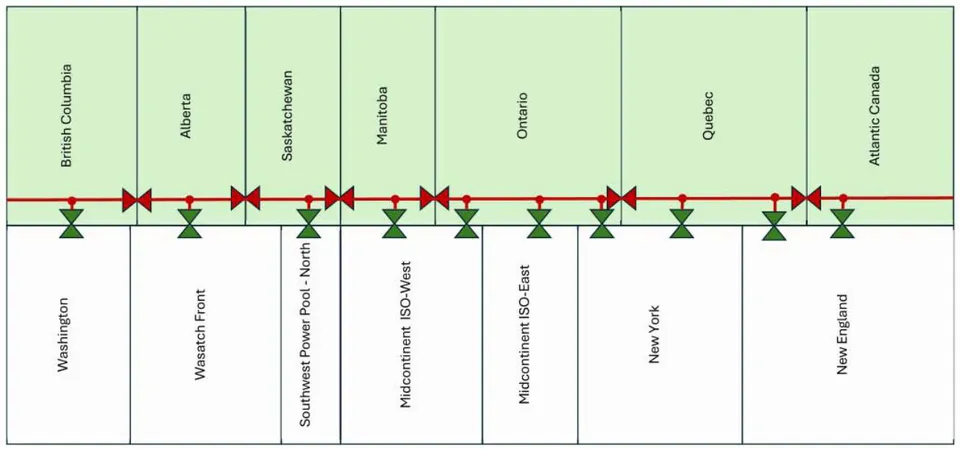
These reasons include:
No need for HVDC Transmission Lines: Two VSC converters in a back-to-back converter station representing neighbouring transmission grids are located at the same site, eliminating the need for a DC transmission line between them.
Independent Active and Reactive Power Control: VSC technology allows for independent control of both real and reactive power, making it beneficial for grid stability and power flow management in the neighbouring AC transmission grids.
Voltage Control: VSC systems can provide voltage support and control, enhancing grid stability.
Fast Response: The fast response of VSC technology allows for quicker adaptation to changes in grid conditions.
Bidirectional Power Flow: The back-to-back HVDC stations configuration can facilitate bidirectional power flow between the neighbouring AC transmission grids.
b. Back-to-Back Stations Selection
Based on the above list of AC substations merging/adding proposed new back-to-back stations in Canada's Supergrid, the following proposition for the number of back-to-back stations for provincial interties is made in Table 6.5.1 below:
Table 6.5.1: Proposed back-to-back HVDC stations for Provincial Interties
| Provincial Operator | Proposed back-to-back HVDC stations for Provincial Interties, # of stations | |||
| 138/144 kV | 230/240 kV | 345 kV | 500 kV | |
| BC Hydro– AESO | 1 | 1 | ||
| AESO– SaskPower | 1 | |||
| SaskPower– MHEB | 4 | |||
| MHEB – IESO | 1 | |||
| IESO– TransEnergie | N/A | established | N/A | N/A |
| TransEnergie–NB Power | N/A | established | established | N/A |
Decision on investment and operations of each of the new back-to-back stations for each intertie is expected to be made by the neighbouring provincial transmission operators in coordination with Canada Energy Regulator.
Upgrade of the provincial interties at the Alternate Current (AC) sides to bring them to the proposed Supergrid coast-to-coast power level addressing the existing Right of Way and/or necessary adjustments is expected to be done by the neighbouring provincial transmission operators in coordination with Canada Energy Regulator.
In the initial phases of the proposed Canada's Supergrid planning and deployment it is proposed to start with two interties: upgrade of the AB-SK intertie (transmission path 2E) strengthening North American Western and Eastern Interconnections, and MB-ON intertie (transmission path 4E) strengthening Western and Eastern Canada's connections.
Another proposition to add new back-to-back stations for international interconnections in Canada's Supergrid is made in Table 6.5.2 below:
Table 6.5.2: Proposed back-to-back HVDC stations for International Interconnections
| Provincial Operator | Proposed back-to-back HVDC station for International Interconnections | |||
| 138/144 kV | 230/240 kV | 345 kV | 500 kV+ | |
| BC Hydro-BPA | 1 | 1 | ||
| AESO-Berkshire Hathaway Energy | 1 | |||
| SaskPower-SPP | 1 | |||
| MHEB-MISO | 3 | Established1 | ||
| IESO-MISO IESO-NYISO4 | 1 | 1 | ||
| TransEnergie-NYISO TransEnergie-ISO-NE | N/A | N/A | N/A | Established2Established3 |
| NB Power-ISO-NE | 2 | |||
Decision on investment and operations of each of the new back-to-back stations for each international interconnection is expected to be made by the provincial transmission operators owning this interconnection in coordination with Canada Energy Regulator.
c. HVDC Converter Ratings
Based on the Canada's Supergrid total transfer capability target of 1,250 MW proposed in section 6.2
and applicable to every provincial intertie in the Supergrid, and according to the international interconnection practices described in section 6.3 within a 300 MW to 3000 MW export/import range, the indicated 300 MW - 3,000 MW range is proposed for Voltage Source Converter (VSC)-based HVDC back-to-back converter stations. A recommended converter rating of up to 1200 MW @ ± 320 kV, up to 1600 MW @
, and up to is presented in [201]. Other examples of selected converter ratings can be seen based on the references in [202].
Converter ratings considered for possible use in back-to-back station planning for the Supergrid interties and interconnections are shown in table 6.5.3 below.
Table 6.5.3: Converter ratings for back-to-back HVDC stations
| Power, MW | Voltage DC, kV | Rated Current, kA |
| 150 | ±140 | 0.54 |
| 325 | ±140 | 1.16 |
| 325 | ±200 | 0.81 |
| 325 | ±350 | 0.46 |
| 500 | ±200 | 1.25 |
| 500 | ±350 | 0.71 |
| 1000 | ±200 | 2.50 |
| 1000 | ±350 | 1.43 |
| 1000 | ±500 | 1.00 |
| 2000 | ±500 | 2.00 |
vi. Exploratory Cost Estimations of HVDC Back-to-Back (B2B) Transmission Converter Stations
An important step in reviewing opportunities in Canada's Transcontinental Supergrid transmission planning is related to an initial cost assessment of the necessary upgrade of the provincial interties and interprovincial interconnections to ensure the Supergrid reliability, resilience and energy security.
The section below provides exploratory cost estimations for:
- HVDC VSC-based back-to-back (B2B) Transmission Converter Stations for Supergrid applications,
- HVDC B2B components of the proposed provincial interties in the Supergrid, and
- HVDC B2B components of the proposed international interconnections in the Supergrid
a. Cost Estimation References
Exploratory cost estimates of HVDC VSC-based back-to-back (B2B) Transmission Converter Station in this section are based on the MISO Transmission Cost Estimation Guide of May 1, 2024 for the annual MISO Transmission Expansion Plan (MTEP) 2024 [203].
With relatively limited public data on current HVDC converter cost references for existing and planned HVDC projects globally, the data presented in the MISO Transmission Cost Estimation Guide presents a comprehensive approach matching other credible findings such as the "Unit Investment Cost Indicators - Project Support to ACER" report prepared by PricewaterhouseCoopers (PwC) for the European Union Agency for the Cooperation of Energy Regulators in
June 2023 [204], which involved collecting data on energy infrastructure projects.
With its transmission planning process focused on "making the benefits of an economically efficient electricity market available to customers by identifying transmission projects that provide access to electricity at the lowest total electric system cost" MISO "identifies essential transmission projects that will improve the reliability and efficiency of energy delivery in its region".
b. Cost Estimation Assumptions
In coordination with [203], all cost estimate data in this publication was presented in 2024 U.S. dollars. All applicable taxes were included within the cost subcategories.
Cost estimates that MISO provided was intended to be inclusive of all costs required to implement the project – the capital cost for a potential project. The capital cost estimate included the project cost, contingency, and Allowance for Funds Used During Construction (AFUDC).
Contingency is a cost adder to account for all the uncertainties/unpredictability and level of scope definition at the time of estimation; exploratory cost estimate contingency applied presents of project cost.
AFUDC is a cost adder to account for the cost of debt and/or the cost of equity required to develop and place the project in service. AFUDC is assumed to be the same value for all the cost estimates MISO provides and is assumed to be of the sum of the project cost and contingency.
HVDC substation unit costs also include:
- Project management includes project implementation scheduling, project management activities, and resources for the project. Project management costs are estimated to be of the project cost.
- Administrative and general overhead costs (A&G) are allocated to the project for the period prior to placing the project in service. A&G is estimated to be of the project cost.
- Engineering (including route and site evaluation), environmental studies, and testing and commissioning for the project comprise a cost category. Engineering, environmental studies, and testing and commissioning costs are estimated to be of the project cost.
According to [203], converter stations, in addition to HVDC converter equipment, include necessary AC substation equipment. E.g., a new converter station cost estimate includes a new four-position, breaker-and-a-half substation for the AC substation costs.
Typical interconnection voltages used are 230 kV AC for a ±250 kV HVDC transmission line; 345 kV AC for a ±400 kV HVDC transmission line; 500 kV AC for a
and HVDC transmission line; and 765 kV AC for a HVDC transmission line, with converter station power transfer of 500MW, 1,500MW, 2,000MW, 2,400MW and 3,000MW accordingly.
c. Exploratory Costs
Exploratory cost estimates (referenced in K/MW for
specific cost) are presented in Table 6.6.1. This includes information on VSC converter station for referenced one-end and calculated back-to-back converter station options.
Table 6.6.1: Exploratory cost estimate – HVDC back-to-back (B2B) Transmission Converter Station
| Voltage class, kV | ± 250 kV | ± 400 kV | ± 500 kV | ± 600 kV | ± 640 kV |
| Power Transfer, MW | 500 | 1,500 | 2,000 | 2,400 | 3,000 |
| VSC converter station cost (one-end) | |||||
| VSC converter station cost (one-end), $M | 159 | 461 | 620 | 750 | 914 |
| VSC converter station specific cost (one-end), $K/MW | 318 | 307 | 310 | 313 | 305 |
| VSC converter station specific voltage ratio (one-end), $K/MW/kV | 1.27 | 0.77 | 0.62 | 0.52 | 0.48 |
| Back-to-back station converter station | |||||
| Back-to-back station cost*, $M | 318 | 922 | 1240 | 1500 | 1828 |
| Back-to-back station cost per MW, $K/MW | 636 | 615 | 620 | 625 | 609 |
| Back-to-back station specific voltage ratio, $K/MW/kV | 2.54 | 1.54 | 1.24 | 1.04 | 0.95 |
The VSC station specific cost (one-end) within 318 0$ 0$ 035%$ 0$ /MW level in 2035.
Based on the back-to-back station cost range within 636 1$ 1$ K/MW (at 3,000 MW), and CAD/USD exchange rate of 0.73 in 2024, specific B2B cost for provincial interties and international interconnections was averaged to 850 CAD(K)/MW level.
d. HVDC B2B Estimates for Provincial Interties
Exploratory cost estimates for the provincial interties in CAD (thousands) are summarized in Table 6.6.2:
Table 6.6.2: Exploratory costs for the Proposed back-to-back HVDC stations for Provincial Interties
| Provincial Operator | Proposed back-to-back HVDC stations for Provincial Interties | ||||
| Power, MW | B2B stations cost assessment, CAD thousand | ||||
| 138/144 kV | 230/240 kV | 138/144 kV | 230/240 kV | Total | |
| BC Hydro – AESO | 315 | 935 | 267,750 | 794,750 | 1,062,500 |
| AESO – SaskPower | 1100 | 935,000 | 935,000 | ||
| SaskPower – MHEB | 4 x 315 | 1,071,000 | 1,071,000 | ||
| MHEB – IESO | 1250 | 1,062,500 | 1,062,500 | ||
| Total | 1,415 | 3,445 | 1,202,750 | 2,928,250 | 4,131,000 |
The HVDC back-to-back converter stations exploratory cost estimation total for the provincial interties of Canada' Transcontinental Supergrid is CAD 4.13 billion in 2024 dollars.
e. HVDC B2B Estimates for International Interconnections
Exploratory cost estimates for the international interconnections in CAD (thousands) are summarized in Table 6.6.3:
Table 6.6.3: Exploratory costs for the Proposed back-to-back HVDC stations for international interconnections
| Provincial Operator | Proposed back-to-back HVDC stations for International Interconnections | ||||||||
| Power, MW | B2B stations cost assessment, CAD thousand | ||||||||
| BC Hydro - BPA | 138/144kV | 230/240kV | 345kV | 500 +kV | 138/144kV | 230/240kV | 345kV | 500 +kV | Total |
| 640 | 2,560 | 544,000 | 2,176,000 | 2,720,000 | |||||
| AESO - BerkshireHathawayEnergy | 325 | 276,250 | 276,250 | ||||||
| SaskPower - SPP | 650 | 552,500 | 552,500 | ||||||
| MHEB - MISO | 600 | 510,000 | 510,000 | ||||||
| IESO - MISOIESO - NYISO | 300 | 2,000 | 255,000 | 1,700,000 | 1,955,000 | ||||
| TransEnergie- NYISO | |||||||||
| TransEnergie- ISO-NE | |||||||||
| NB Power - ISO-NE | 1,000 | 850,000 | 850,000 | ||||||
| Total | 2,515 | 3,000 | 2,137,750 | 2,550,000 | 6,863,750 | ||||
The HVDC back-to-back converter stations exploratory cost estimation total for the international interconnections of Canada' Transcontinental Supergrid based on the current international import/export practices varies from CAD 276 Million for Alberta to CAD 2,720 Million for British Columbia in 2024 dollars.
IV. CONCLUSIONS AND RECOMMENDATIONS ON CANADA'S TRANSCONTINENTAL SUPERGRID
1. Interconnecting Canadian provinces through Supergrid is a Must:
Uniting Canada's efforts to safeguard "One Canadian Economy" vision and supporting "a plan to build the strongest economy in the G7" 1 requires national-scale coordinated efforts and bold commitments. One of these critical efforts - to move Canada-made clean electricity "freely from coast to coast" - is related to Canada's Transcontinental Supergrid interconnecting all Canada's provinces and markets through highest-quality power transmission.
The proposed Canada's Supergrid would enable and ensure reliability, resilience and energy security of each of the provincial transmission grids and the Transcontinental Supergrid as a whole, strengthening Canada's leadership as the "energy superpower" in North America.
- Supergrid is the infrastructure for Canada's emerging national electricity market:
A competitive wholesale electricity market nationwide in the country is approaching.
Inter-regional scale wholesale experiences of the Australian National Electricity Market, European Internal Electricity Market and wholesale electricity markets administered by Regional Transmission Organizations in the U.S. have been clearly pointing out the multi-value of the national electricity market for Canada.
A Canadian National Electricity Market (CNEM) is seen as a crucial part of the country's energy sector, facilitating the wholesale trading of electricity across all the provinces and territories in the country.
The CNEM would administer and facilitate the trading of electricity across the Transcontinental Supergrid, integrating and managing dispatchable and non-dispatchable clean electricity generation, and ensuring a stable and competitive market environment.
The key parts of the CNEM multi-value include interconnected Transcontinental transmission, wholesale markets including also demand response and distributed energy resource-based electricity generation, and regional pricing.
CNEM would be governed by national market rules and regulations, ensuring a fair and efficient trading environment across the country.
3. HVDC is a key Supergrid segment leading in AC/DC Transmission Merge:
Advancements in power transmission leading to Canada's Transcontinental Supergrid and emerging CNEM are driven by HVDC transmission technology deployment that has evolved dramatically over the last 15 years making it ready for large-scale AC-DC merge. With the development of voltage-sourced converter technology, HVDC has demonstrated globally major improvements in its capabilities, increasingly needed to enhance the existing AC grid upgrade [145]. Today, HVDC provides flexibility in system operation, ensuring improved grid stability and control. For remote clean electricity generation and/or industrial consumption HVDC transmission offers higher-capacity, longer-distance, lower-loss transmission on a smaller right-of-way footprint than AC.
4. HVDC Multi-Value makes it highly competitive technically and economically:
High capacity, long-distance, controllable, multi-terminal HVDC technology is particularly valuable for Transcontinental transmission across multiple balancing areas.
To leverage HVDC capabilities within the Transcontinental Supergrid's AC-DC merge, multi-value HVDC planning is seen as critical [145].
- In the Transcontinental Supergrid HVDC would focus on the coast-to-coast transfer capability target:
Total transfer capability limits for interprovincial and international transmission paths, and related existing and currently planned HVDC transmission solutions have to be adjusted to establish an interprovincial coast-to-coast transfer capability target.
The major opportunities in the necessary upgrade of the provincial interties and interprovincial interconnections ensuring the Supergrid reliability, resilience and energy security can be addressed by selected HVDC solutions. Based on an initial cost assessment of the necessary upgrade of the provincial interties and interprovincial interconnections, HVDC back-to-back (B2B) converter stations are proposed as a trusted solution for Canada's Transcontinental Supergrid transmission planning.
6. HVDC Back-to-Back solution costs present a compelling case for the Supergrid planning:
As a starting point, a set of eight HVDC B2B stations, 4,860 MW in total, is proposed as a core Supergrid Solution to leverage prompt planning and deployment of Canada's Supergrid. Based on the exploratory cost estimation of HVDC back-to-back (B2B) converter stations at the specific rate of CAD850K/MW (USD623K/MW at 1.365 USD/CAD exchange rate) highlighted in this publication, a high-level exploratory cost estimation total for the provincial intertities of Canada' Transcontinental Supergrid is CAD 4.13 billion as of 2024. Also, a set of eleven B2B converter stations, 5,515 MW in total, based on the current international import/export practices is proposed for international interconnections to address the Supergrid reliability, resilience and energy security. An exploratory cost estimation varies from CAD 276 Million for Alberta to CAD 2,720 Million for British Columbia as of 2024.
7. Timing is of Essence: Transcontinental Supergrid must be built by 2035:
Clean Grid readiness is a major objective of and commitment to Canada's Clean Grid 2035 efforts to make all electricity generation in the country climate-neutral. It means that the grids will soon be able to reach all existing and planned clean electricity generation in the country and will bring clean electricity to competitive wholesale markets to make it available to any client.
Deployment of Canada's Transcontinental Supergrid is seen as the most efficient and productive path to make Canada's Clean Grid 2035 successful "coast-to-coast", achieving a tremendous goal in Canada's energy transition and low carbon economy growth.
8. Knowledge is already at hand:
Knowledge, experience and expertise for Supergrids and large-scale regional/inter-regional wholesale electricity markets in Canada and internationally is strongly required and absolutely available.
Learning from the comprehensive National Electricity Market experiences in Australia, practices and achievements strengthening a single European 'internal market' with HVDC multi-national and offshore wind interconnectors in the European Union, and advances in using HVDC transmission solutions in North-American regional and Inter-regional wholesale markets with established contacts already at hand would allow Canada to very promptly start the Transcontinental Supergrid "nation-building" infrastructure project.
9. Political and economical commitments must be aligned:
To make Canada's Transcontinental Supergrid completed and operational by the end of 2035, it is suggested that all political and economical considerations related to Canada's Transcontinental Supergrid are defined, agreed on and approved within successful "electric federalism" practices in Canada by the end of 2025, to ensure the Transcontinental Supergrid "nation-building" project's successful start in early 2026.
ACKNOWLEDGMENTS AND CONFLICTS OF INTEREST
Footnotes
Manitoba Hydro in its documentation considers two interfaces with Saskatchewan (south and north) to be separate, while this paper suggests using "path to a market" approach, keeping all the interfaces (and lines) related to a market included in the same Path to this market. Saskatchewan in this approach presents a single market for Manitoba with one "Saskatchewan to Manitoba" Path. (p.43) ↩ ↩2