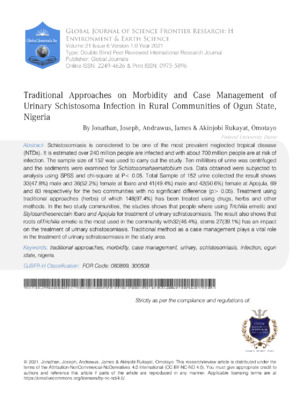
Traditional Approaches on Morbidity and Case Management of Urinary Schistosoma Infection in Rural Communities of Ogun State, Nigeria

1
Jonathan, Joseph
Jonathan, Joseph
2
Jonathan
Jonathan
3
Joseph
Joseph
4
Andrawus
Andrawus
5
James
James
6
Akinjobi Rukayat.
Akinjobi Rukayat.
7
Omotayo
Omotayo
1 Federal University Dutse

Send Message

To: Author

GJSFR Volume 21 Issue H6

Article Fingerprint

ReserarchID

81VY2

Traditional Approaches on Morbidity and Case Management of Urinary Schistosoma Infection in Rural Communities of Ogun State, Nigeria Banner
  • English
  • Afrikaans
  • Albanian
  • Amharic
  • Arabic
  • Armenian
  • Azerbaijani
  • Basque
  • Belarusian
  • Bengali
  • Bosnian
  • Bulgarian
  • Catalan
  • Cebuano
  • Chichewa
  • Chinese (Simplified)
  • Chinese (Traditional)
  • Corsican
  • Croatian
  • Czech
  • Danish
  • Dutch
  • Esperanto
  • Estonian
  • Filipino
  • Finnish
  • French
  • Frisian
  • Galician
  • Georgian
  • German
  • Greek
  • Gujarati
  • Haitian Creole
  • Hausa
  • Hawaiian
  • Hebrew
  • Hindi
  • Hmong
  • Hungarian
  • Icelandic
  • Igbo
  • Indonesian
  • Irish
  • Italian
  • Japanese
  • Javanese
  • Kannada
  • Kazakh
  • Khmer
  • Korean
  • Kurdish (Kurmanji)
  • Kyrgyz
  • Lao
  • Latin
  • Latvian
  • Lithuanian
  • Luxembourgish
  • Macedonian
  • Malagasy
  • Malay
  • Malayalam
  • Maltese
  • Maori
  • Marathi
  • Mongolian
  • Myanmar (Burmese)
  • Nepali
  • Norwegian
  • Pashto
  • Persian
  • Polish
  • Portuguese
  • Punjabi
  • Romanian
  • Russian
  • Samoan
  • Scots Gaelic
  • Serbian
  • Sesotho
  • Shona
  • Sindhi
  • Sinhala
  • Slovak
  • Slovenian
  • Somali
  • Spanish
  • Sundanese
  • Swahili
  • Swedish
  • Tajik
  • Tamil
  • Telugu
  • Thai
  • Turkish
  • Ukrainian
  • Urdu
  • Uzbek
  • Vietnamese
  • Welsh
  • Xhosa
  • Yiddish
  • Yoruba
  • Zulu

Schistosomiasis is considered to be one of the most prevalent neglected tropical disease (NTDs). It is estimated over 240 million people are infected and with about 700 million people are at risk of infection. The sample size of 152 was used to carry out the study. Ten milliliters of urine was centrifuged and the sediments were examined for Schistosomahaematobium ova. Data obtained were subjected to analysis using SPSS and chi-square at P 0.05). Treatment using traditional approaches (herbs) of which 148(97.4%) has been treated using drugs, herbs and other methods. In the two study communities, the studies shows that people where using Trichilia emetic and Stylosantheserectain Ibaro and Apojula for treatment of urinary schistosomiasis. The result also shows that roots ofTrichilia emetic is the most used in the community with32(46.4%), stems 27(39.1%) has an impact on the treatment of urinary schistosomiasis. Traditional method as a case management plays a vital role in the treatment of urinary schistosomiasis in the study area.


Funding

No external funding was declared for this work.

Conflict of Interest

The authors declare no conflict of interest.

Ethical Approval

No ethics committee approval was required for this article type.

Data Availability

Not applicable for this article.

Jonathan, Joseph. 2022. \u201cTraditional Approaches on Morbidity and Case Management of Urinary Schistosoma Infection in Rural Communities of Ogun State, Nigeria\u201d. Global Journal of Science Frontier Research - H: Environment & Environmental geology GJSFR-H Volume 21 (GJSFR Volume 21 Issue H6): .

Download Citation

Disease transmission and treatment of urinary schistosomiasis in Nigeria.
Issue Cover
GJSFR Volume 21 Issue H6
Pg. 75- 80
Journal Specifications

Crossref Journal DOI 10.17406/GJSFR

Print ISSN 0975-5896

e-ISSN 2249-4626

Keywords
Classification
GJSFR-H Classification: FOR Code: 060899, 300508
Version of record

v1.2

Issue date

January 25, 2022

Language

English

Experiance in AR

The methods for personal identification and authentication are no exception.

Read in 3D

The methods for personal identification and authentication are no exception.

Article Matrices
Total Views: 1833
Total Downloads: 846
2026 Trends
Research Identity (RIN)
Related Research

Published Article

Schistosomiasis is considered to be one of the most prevalent neglected tropical disease (NTDs). It is estimated over 240 million people are infected and with about 700 million people are at risk of infection. The sample size of 152 was used to carry out the study. Ten milliliters of urine was centrifuged and the sediments were examined for Schistosomahaematobium ova. Data obtained were subjected to analysis using SPSS and chi-square at P 0.05). Treatment using traditional approaches (herbs) of which 148(97.4%) has been treated using drugs, herbs and other methods. In the two study communities, the studies shows that people where using Trichilia emetic and Stylosantheserectain Ibaro and Apojula for treatment of urinary schistosomiasis. The result also shows that roots ofTrichilia emetic is the most used in the community with32(46.4%), stems 27(39.1%) has an impact on the treatment of urinary schistosomiasis. Traditional method as a case management plays a vital role in the treatment of urinary schistosomiasis in the study area.

Our website is actively being updated, and changes may occur frequently. Please clear your browser cache if needed. For feedback or error reporting, please email [email protected]
×

This Page is Under Development

We are currently updating this article page for a better experience.

Request Access

Please fill out the form below to request access to this research paper. Your request will be reviewed by the editorial or author team.
X

Quote and Order Details

Contact Person

Invoice Address

Notes or Comments

This is the heading

Lorem ipsum dolor sit amet, consectetur adipiscing elit. Ut elit tellus, luctus nec ullamcorper mattis, pulvinar dapibus leo.

High-quality academic research articles on global topics and journals.

Traditional Approaches on Morbidity and Case Management of Urinary Schistosoma Infection in Rural Communities of Ogun State, Nigeria

Jonathan
Jonathan
Joseph
Joseph
Andrawus
Andrawus
James
James
Akinjobi Rukayat.
Akinjobi Rukayat.
Omotayo
Omotayo

Research Journals