
I. INTRODUCTION
Food usually reflects the traditional tastes formed by many generations, although it is no less important that, that in this field there is an intensive process of mutual enrichment of cultures, to which restaurants largely contribute today (Kim and Eves, 2012). Eating pattern is known as a kind of connection between the experiences of people from different eras, making it possible to explain the past through the present. At the same time, we must mention that each era brings both new foods and experience, inherited elements, which intertwine with the innovative ones. Unlike other elements of material culture, food loans do not constrain the national cuisine, on the contrary, they enrich it or their assimilation takes place (Tregear, 2003). On the other hand, gastronomy has become an increasingly important motivation for choosing a destination, offering a growing potential to stimulate local economies (De Jong et al., 2018). Although currently, culinary tourism is practiced only by a niche of tourists, it manages to attract more and more tourists passionate about gastronomy and more, because through local cuisine you can discover some of the culture and history of a particular area, food being a basic service in any tourist package (Razpotnik Visković and Komac, 2021).
Moldovan cuisine is the result of synthesizing, over time, the tastes, ideas and gastronomic habits specific to the Moldovan population (Gutium, Olga et al., 2020). It has greatly influenced the traditional cuisines of other peoples on its territory and at the same time has been complemented by elements of Ukrainian, Bulgarian, Gagauz, Russian, and in past centuries Greek and Turkish cuisines (Baltsiotis, 2014; Jianu and Barbu, 2018). Moldovan cuisine is diverse: it includes countless culinary customs and traditions, specific dishes, along with customs from the intersection of gastronomic culture with the traditions of other peoples, with whom Moldovans have come into contact throughout history (Sturza and Ghendov-Moşanu, 2021). Although throughout history, Moldova has been under the leadership of many peoples (Turkey, member of the Soviet Union, etc.); pure Moldovan dishes can be still found in the Moldovan gastronomic arsenal.
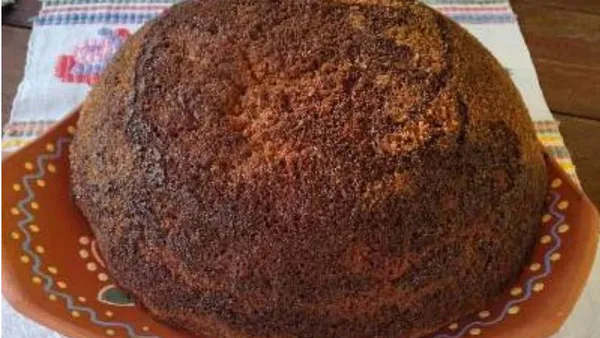
Baba neagra (Black baba) (Figure 1) is a traditional Moldovan food, which housewives in northern Moldova have been preparing for years and which is considered the "queen" of the 5 traditional Moldovan dishes (along with sarmale, placinte, mamaliga and chicken zama) without which a holyday meal is not considered complete and guests are looking forward to enjoying it at the end of the meal (Alozie, 2016). The name Baba neagra is used in Moldova and Romania. Regarding the word baba (grandmother, old women) there are some opinions, the most common of these is that grandmothers cooked this sweet dish for their grandchildren, hence the allegory. In some regions of Ukraine the desert is known as kapronka, due to its elasticity and porous structure. Nowadays, the baba neagra is less and less common on Moldovan tables, even if it is distinguished by the simplicity of the ingredients and a special taste and appearance. In this sense, the purpose of the current study is to revive the importance of this dessert, emphasizing some technological and cultural aspects attached to Baba Neagra in Republic of Moldova.
II. TECHNOLOGICAL ASPECTS
It is very difficult to say what this dessert looks like: not a cake, and not a toffee, and not a gingerbread, and not a biscuit, but just something really magical and bewitching. Moderately sweet, moist, very porous and firm dessert. It contains simple ingredients, even trivial at first glance, but the preparation technique is important and needs to be strictly followed. The taste of the dessert is balanced - moderately sweet, moderately moist, interesting and unusual, although it is made from the most common products. It is baked at low temperature for a full 6 hours, during which the sugar turns into caramel and gives the cake a rich brown color and delicious taste.
Unlike other desserts, the black baba goes through strange metamorphoses. It is about the fact that there are no dark products between its ingredients. On the contrary – all the ingredients- are all white as snow. And in order to obtain the necessary consistency and, even more importantly, the coveted small bubbles in the dough, the sequence of operations with the ingredients must be strictly observed.
a) Ingredients
As mentioned, the black grandmother is an old dessert, and the housewives of that time did not have to go to the store or the market for products to prepare it. Everything they needed for black baba could be found in the household: milk (500 ml), sour milk (300 ml), eggs (10 pcs), oil (200 ml), wheat flour (300 g), sugar (300 g), brandy (50 ml), and baking soda (8 g).
b) Preparation
First, the dried products are mixed - sifted flour and a similar amount of sugar or powdered sugar, to which baking soda is added. To this mixture, vegetable oil is added and mixed until a homogeneous mass is formed. Then the warm sour milk is gradually added - it serves as a catalyst for baking soda and easily starts the quenching reaction, which during baking will materialize in small bubbles frozen on cooling (Fordtran et al., 1984; Lansky, 2004). After sour milk, it's milk's turn, up to half a liter can be added. The last liquid ingredient is brandy or vodka, which is considered to compensate for the specific pronounced taste of baking soda in the final product. In the last stage, ten eggs must be beaten until a fluffy and frothy mixture is obtained. Then the beaten eggs are carefully placed in the dough.
Baba is baked in a bowl with a thick bottom, covered with a lid, for example a cast iron cauldron, which is richly greased with butter over which breadcrumbs are sprinkled, after which the mixture is poured into the bowl and covered with a lid or staniol foil (Figure 2). The bubbles that form during baking (Figure 3) are the result of adding the right amount of baking soda and vodka, or any other tasteless and odorless alcohol. During baking, carbon dioxide gas made from baking soda (or if you use vodka - alcohol vapor), helps to grow/lift the dessert up (Sumnu, 2008). For this reason the lid is not removed during baking, it helps to block the gases inside and to form bubbles, or craters specific to this dessert. Once upon a time, in the Moldovan villages, the black baba was baked in the brick oven - the cauldron was put in the oven in the evening on hot coals and was taken out only in the morning. In the contemporary oven in the first hour and a half the baba bakes at a temperature of , and in the next 90 minutes at .
The caramelized brown color is not from cocoa, but is due to the interaction between baking soda, sour milk and oil during the long cooking time. Also on one hand, due to the high baking temperature from the first baking stage, the caramelization of carbohydrates present in milk and sugar takes place. On the other hand, presence of baking soda speeds up the Maillard reaction that takes place due to egg proteins and sugars (Lersch, 2012).
The prepared dessert is as fine and soft as a classic soufflé. At the same time it is elastic and restores its shape when it is finger pressed.
III. CULTURAL ASPECTS
Several large portions of baba neagra are baked at once, because Moldovan feasts are a general gathering of numerous relatives, godfathers, friends. Baba neagra is served both at weddings, christenings and funerals. In this sense it can be called ritual food. It is served on the table with baba alba (white grandma) from homemade noodles on a wide platter, cut into cubes. White and black grandmothers complement each other, symbolizing the unity of opposites, the beginning of the feminine and masculine.
Specifically, it was served because it is currently being prepared less and less. And the food outlets that have it on the menu can be counted on fingers. It is difficult to find a justification and an explanation for this trend, because for many of the inhabitants of the country, the black grandmother is associated with the nostalgic taste of childhood.
ACKNOWLEDGMENT
The study was done within the State Project 20.80009.0807.17. "Education for the revitalization of the national cultural heritage through traditional processing technologies used in the Republic of Moldova in the context of multiculturalism, diversity and European integration", running at Technical University of Moldova.