## I. THE EDUCATION SYSTEM BETWEEN COLLAPSE AND RENEWAL
Globalized society travels fast, dragged along in its race by technological developments not permanently immune to economist and scientist logic, which hint at a future with uncertain, if not dystopian, scenarios. As summarized by the acronym 'VUCA', which stands for Volatility, Uncertainty, Complexity, Ambiguity, (Bennet, Lemoine, 2014) the society emerging from the ongoing processes of globalization is extremely mobile, fast, changing, hypercomplex and uncertain. In the face of the contemporary scenario, highlighted in its criticalities by the Covid pandemic19 and the responses produced to cope with it, institutional educational systems, for the most part and as a whole, have so far failed to operationalize on a large scale a pedagogical design capable of balancing and rebalancing the destructive potential of the changes taking place. Probably also because these changes, which are far from recent, also affect the great traditional educational agencies, primarily school and family, which have seen their authority eroded in conjunction with the rise of digital media, which have risen to the role of great wild educators.
The crisis of education and more traditional educational agencies has been talked about for years as part of a more complex crisis. Morin called it polycrisis (Morin, 2015, pp. 39-47), emphasizing its multidimensional character. It is a systemic crisis affecting the ontological, phenomenological, epistemological, axiological, and anthropological planes. A paradigmatic turmoil, which is both a crisis of civilization and a crisis of the foundations of the human being. Consequently it necessarily becomes a crisis of education, because as Edith Stein (1989) said, pedagogy builds castles in the air if it does not clarify which human being it proposes to form. Moreover, every educational proposal always conveys a specific worldview with all the baggage of assumptions, more or less explicit, that this entails. Pedagogy and the educational methods that flow from it are never neutral. That is why pedagogy "encompasses the art of education, the science of that art, and the philosophy of that science" (Laeng, 1992).
The good news is that from a systemic perspective every crisis can become functional for profound renewal. In Morin's words:
Every system, living or social, involves adjustments that maintain its stability. [...] If deviations develop, they tend to disrupt more and more seriously the stability, the organization and eventually disintegrate the system. [...] In human social systems, the tendency toward disintegration can be counterbalanced by the development of innovative or creative forces, which transform the system by regenerating it. (Morin, 2015, p.45).
This means that living systems are autopoietic, they have the possibility of renewing themselves and evolving precisely from a state of chaotic perturbation.
With its dual vocation, transmissive and emancipatory, a society's educational system can aggravate a crisis, or delay its overcoming, if it persists in reproducing obsolete models and practices. Still, it can also become a promoter of the new, take up the challenge of 'disruption' and assume an inspiring and evolutionary role.
Also chaos theory brings good news: the well-known 'butterfly effect,' shows that even small variations in the initial conditions of a system can produce far-reaching effects. According to Laszlo, who applies this principle to the human system, when a social system becomes unstable and chaotic, the consciousness of individuals, with their worldviews and aspirations, which are irrelevant under conditions of relative stability of a system, can also take on a driving role in promoting the evolution of the system itself (Laszlo, 2007, p.12).
An educational system reform is actually promised and long overdue, including policy documents and guidelines forward an educational renaissance.
By way of illustration, as early as 1972, UNESCO's Faure report, learning to be (Faure 1972), envisioned scenarios for the future described as "exciting and terrifying" and called for the promotion of a scientific humanism capable of fostering the development of a complete human being. This humanism would teach people to become themselves within an educating community. The document left it up to educational experts to follow up on this noble intent by developing methodologies up to the task.
Decades later, it can be seen how difficult it is to move from the programmatic and rhetorical level to actual reform of educational systems; especially those that preside over formal education, if it is true, as historian Harari notes in 2018, that most curricula in school systems around the world are still notional and what is taught today may no longer have any relevance in 2050 (Harari, 2018). In the meantime, however, we can also see the emergence of new pedagogical proposals. appropriate methodologies for "learning to be," as the basis for more conscious, compassionate, responsible, action. Transe Learning is one such proposal.
## II. TRANSE LEARNING
The expression Transe Learning denotes the learning theory and methodology of Biotransenergetics (or BTE), a psycho-spiritual discipline for Self-realization, founded in the 1980s by Pier Luigi Lattuada and Marlene Silveira and systematized later by Pier Luigi Lattuada. (Lattuada, 2013). The term was first proposed by Patrizia Pinoli (2012) in the context of an experience of creative adaptation of BTE to the elementary school context.
The term indicates the pedagogical core of BTE, more specifically it indicates the application of BTE to educational and training contexts aimed at people of all ages.
Transe Learning proposes a transpersonal and integral educational model cultivating a new humanism mastering state of consciousness, and awakening soft and life-skills, such as transpersonal qualities. (Lattuada 2010).
It is a post-conventional methodology, a further mode of learning and approaching life. A way starting from the experience of unity and interconnectedness of all things, involving the individual in his bio-psychospiritual wholeness. (Lattuada, Apr 24, 2019).
### a) Transe Learning as a new Paideia
Epistemologically, Transe Learning is based on the historical, cultural, and spiritual roots of BTE and shares its guarantees of validity. In addition, it is possible to highlight its harmony with the Paideia, the central foundational paradigm of Western pedagogy, which has its roots in Greco-Hellenistic culture.
The Paideia is a meta-model, an ideal educational paradigm, which has been handed down to contemporary times, taking different declinations, but fixing certain cardinal principles. Paideia from the ancient Greekπ αἰδεία, can be translated as 'human education', indicating that education should promote full human flourishing.
Paideia has often been disregarded but still stand as the main strands of the history of pedagogy which understands education as a process of full humanization, occurring throughout the course of life. (Pollo, 2008, lori, 2018).
It is based on the idea that humanity is unfinished and that education has the task of fostering its fulfillment, both on an individual and collective level.
Transe Learning can be considered a proposal consistent with the basic principles of classical Paideia, which Cambi and Frauenfelder have summarized as follows (Cambi, Frauenfelder, 1994, pp. 48-52): - the process of human formation is an intimate journey toward the Spirit;
- it is a dynamic process that is constantly renewed;
- it is a process that takes place through the overcoming of cleavages;
- it is a process that tends toward progressive harmonization;
- the formation of the human being is to be understood as comprehensive and integral; - human development includes multiple levels: it concerns the relationship with self, the relationship with others, and the relationship with the whole cosmos;
- human formation is a process that requires openness and personal commitment from the individual. Transe Learning also shares with the foundations of the Greco-Hellenistic Paideia some of its basic assumptions.
In keeping with Socratic and Platonic teachings, the process of human education is understood as a process of endogenous awakening aimed at sustaining a process of liberation and sublimation. As with Socrates, human education requires maieutic education, capable of awakening consciousness to knowledge, truth, and goodness. As with Plato, human education is anamnesis, as portrayed in the Myth of the Cave, which requires a pedagogy capable of stimulating self-remembrance. And, as narrated in the Myth of Er, it calls for heeding the vocational call of the Daimon with a eudaimonic pedagogy. (Plato 1997].
As with Aristotle, the process of humanization is understood as a natural process of 'entelechy,' which actualizes what is already present in potency. The resulting pedagogy, using BTE terminology, sustains and nurtures human development, preserving and awakening its 'naturalness'. (Barnes, 1991). As with Hippocrates and other physicians of classical times, the concept of human growth is not entirely unrelated to the concept of illness, for both are associated with the need to cope with and overcome a state of crisis. Hippocrates. (2015)
The result is a pedagogy that fully includes in the process of learning to become human, the confrontation with difficulty, confusion, problem, error or failure, considered not only as obstacles as ends in themselves, but doors for the emergence of other, unexpected learning, like any insight. Because, using BTE terminology, in the problem is also its solution.
### b) Transe Learning: a methodology for contemporary society
Transe Learning is a model in line with the training needs of the 21st century. It is consistent with the Learning Society paradigm (Hutchins, 1968). It lends itself to meeting the needs of a post-modern society, proposing the overcoming of its more relativistic and nihilistic drifts.
Elaborated since roughly the 1970s and developed to the present day in guidelines supported by the OECD and UNESCO, the Learning Society paradigm has revolutionized the foundations of more traditional pedagogy by shifting the focus of education from teaching content (what is learned) to promoting learning processes (how we learn, i.e., learning to learn). Consistent with this, Transe Learning is a methodology for learning, or better for learning how to learn.
Another critical aspect of the Learning Society paradigm concerns enhancing the concept of competence. According to Le Betorf (Le Betorf, 1994), competencies consist in the mobilization of resources from individual as well as from the context. Mobilizing resources therefore does not mean applying known and abstract knowledge, but taking part in a process of intentional knowing.
In *Transe Learning*, competencies are expressed in a dynamic, processual interrelationship that always takes place in a specific space-time that calls into question the operation of an individual intent in a field, which, in the background, is always also an archetypal and transpersonal field. The competent person recognizes the context in which they find themselves and responds effectively and proactively to the situation that arises even if it is new and unforeseen, by mobilizing with their intent, the inner resources and those present in the field, which are best suited to that context and that moment. To be competent one should understand how to be-there and how to act from there.
According to a widespread interpretation, competencies can be divided into hard and soft. Hard skills are the professional-technical skills specific to a given professional role. Soft skills are a set of knowledge and related personal skills and abilities applied in situations. In summary, hard skills define what we do and soft skills how (Niuko, 2017).
According to a more sophisticated distinction, it is possible to arrange hard skills and soft skills at the extremes of a continuum. The more the behavior is guided by technical rules, protocols and procedures, condensed into standardizable and easily transmitted products and services, the harder the skill will be. The more the behavior is process-driven, activated in a single context and generates knowledge and meaning for the involved people without being immediately transferable to others, the more the competence will be soft (Ciappei, Cinque, 2014, p.16).
In this regard, it can be assumed that hard skills lend themselves to being transferred to software and processes managed by artificial intelligence, in contrast soft skills identify that quid specifically human. According to the same authors, soft skills are what used to be called virtues (Ciappei and Cinque, 2014).
In ancient Greek culture, virtue was $\alpha \rho \varepsilon \tau \eta$ (aretè), the ability of every animate and inanimate entity to perform its task well, in the sense of bringing its nature to full fruition. To be virtuous for a human being is to get to fulfillment one's humanity.
In Transe Learning, soft skills or life skills are complex existential skills, emergent metacognitions, and transpersonal and archetypal qualities that can be recognized, awakened, radiated, and embodied. Their mastery enables the cultivation of that humanity, which is the ultimate goal of education. Life skills also include what Lanzara has called "negative capacity" (Lanzara, 1993): the patient ability to know how to stay in uncertainty, accepting the moments that seem directionless, surrendering to the loss of meaning as one surrenders to a mystery that will be revealed in due time, without being in a hurry to arrive at solutions or hasty interpretations, but letting the bewilderment itself, offer its contribution to the emergence of a new direction.
Finally, Transe Learning is also a model consistent with the Learning Society paradigm because it makes the Lifelong, Lifewide, Lifedeep Learning model its own.
Learning is considered to be a lifelong (Lifelong) process, involving and empowering adults as the protagonists of their educational itineraries and as the holders of the "educational power" to influence the younger generation, a power too often abused in the past and nowadays delegated irresponsibly. Learning is considered to be a diffuse (Lifewide) process, which makes use of multiple and differentiated settings (including, for example, online training and training in nature), taking place both in formal (institutionally recognized) and nonformal (noninstitutionalized training initiatives) learning settings.
Transe Learning also offers maps and methods for learning to recognize and value the learning that takes place in informal contexts, i.e., the contexts of everyday, non-professional life that are not explicitly designed with educational purposes in mind but teach a great deal to those who embrace the metaphor of life as school and take responsibility for wanting to learn from Life.
Finally, the lesser-known Life-Deep-Learning paradigm envisions giving education an ethical, value and meaning-preserving depth of human value. Consistent with this assumption, Transe Learning views learning as an adventure involving the deep dimension of being (Lifedeep), that authentically transformative dimension concerning learning and inner development.
The Life Deep dimension naturally lends itself to being declined within a transpersonal view of the world and human being. It allows for the correction of a possible instrumental use of the Life-Long-Wide Learning paradigm for the exclusive benefit of the productive and market needs of globalized society. With the integration of an authentically Life-Deep dimension, the Learning Society can become a Transpersonal Learning Society.
In addition to being in line with the demands of the Learning Society, as mentioned above, Transe Learning also answer to the educational needs of postmodern society.
As noted by Bauman, the educational needs of a post-modern, fluid society, which promotes "the universal liquefaction of identities," "the polyphony of value messages," and "the fragmentariness of life," invite to go beyond learning how to learn.
Educational system should need to learn to unlearn longer useful habits, to suspend expectations, to move beyond partial and provisional definitions of self, to let go of narrow and limiting worldviews. For Bauman, such learning must be integrated into educational goals, because given its fundamental adaptive value it is an "indispensable equipment for life." (Bauman, 2002, p.159).
There is a long tradition in pedagogy that associates the value of education with its paradoxical ability to teach unlearning (Cambi, 2006).
In Transe Learning we find this theme within a transpersonal context, which overcomes postmodern relativist nihilism and connects to the more original spiritual pedagogical tradition, purified of religious dogmatisms.
Learning to unlearn, becomes learning "the Passage from the Zero" (Lattuada, 2012, p.240). This art of disidentification from partial contents, which impose themselves in the space of consciousness, an art that allows making space for connection with the Self. In Patrizia Pinoli's words, "To educate, then, becomes to empty, that is, to bring out [...] the only true treasure hidden there, the kingdom of heaven, the divine spark. (Pinoli, 2012, p. 39).
### c) Trikaya in Transe Learning
Spiritual traditions are notoriously rich in pedagogical suggestions: how to transmit teachings has always been a crucial issue.
To better understand Transe Learning we may think to Vajrayana Buddhism, or Tantric Buddhism, where Pier Luigi Lattiada has taken the conception of the three kāyas called Nirmanakaya, Sambhogakaya, Dharmakaya, reinterpreting them as three different interconnected planes of the teaching/learning process. (Cleary 1986)
Nirmanakaya is the plane of transmission of teachings, which takes place on the plane of ordinary consciousness. It is the traditional plane of instructing, where student is seen as a vessel to be filled with content: data, ideas, information, theories, maps, models.
This view is also that of notionistic education, and regardless of the value of the content transmitted, it has to reckon with some significant limitations: it considers the learner a passive subject and neglects their active and complex processes of processing the information received; it is not functional in transmitting knowledge that quickly becomes obsolete and needs to be continually updated; and it does not reckon with the limits of the human mind in terms of its capacity to store and process data in the face of the enormous increase in information produced every day by human knowledge. Education, even understood in this way, is fundamental as a form of acculturation and social entrenchment. Still unless integrated synergistically with forms of learning on the other planes, it can produce the illusion of knowledge.
The plane called Sambhogakaya is a "strategic" plane. Here, the teacher operates from a metacognitive level, proposing methods that stimulate the dimension of learning to learn. The role of the teacher is not to offer content but to create conditions for direct understanding on the part of those who want to know. It requires the ability to create an environment, a field, that nurtures confidence; a field, that encourages exploration and discovery., where judgment gives way to a willingness to accept what emerges. Learner will experience firsthand the methodologies proposed by teacher and draw their own lessons. On this level, learning requires the willingness of learners to actively put themselves on the line, taking responsibility for their learning, accepting the commitment, and enjoying the fulfillment that comes from "first-hand knowledge."
In BTE and Transe Learning, the method of learning to learn is articulated in the "keys to awareness". In view of life as a school, different situations in life can also be seen as strategies of the Life-Master to stimulate awakening to new learning.
Dharmakaya is the plan of direct understanding. The learner has earned the right to learn and gathers the result of learning, which is not given from outside but flows directly as immediate knowledge. This is the plane of insight: when suddenly the meaning of what has happened is grasped, the solution to a problem emerges, or the problem itself dissolves, an issue is suddenly understood, a picture clarified, a knot untied. The light is turned on, the dots are "joined," and a unexpected, fresh, unprecedented, authentically creative emerges.
This way knowledge will come from within, true and certain, but radically contextual and therefore paradoxically unsharable in its essence. Insight belongs only to the knowers and they will not be able to transmit the experience as such, unless through the external, intellectual forms of Nirmanakaya, or by relying on the strategic forms of Sambogakaya.
### d) Speaking of education
Education should transcend and include instruction. Educating, from the Latin ex-ducere, literally means to bring out.
It indicates an endogenous movement.
Education is a maieutic art, an active but indirect practice: it facilitates the process of being born to oneself, it does not direct it. It promotes development, the coming out of 'viluzzles,' caverns cramped as a result of natural maturation. The function of education is to "prevent the chronicity of distress and facilitate its developmental outlet" (Brandani, Tramma, 2014). A preventive role that of education, complementary to that of therapeutic care, in accordance with the logic that:"If it comes at the right time, it is education, if it comes late, it is therapy."
In Transe Learning educating is complementary to the therapeutic one following a transpersonal maieutics which stimulates and encourages awakening to awareness and the secrets of the art of observing, which creates space for the emergence of archetypal qualities of the self. Qualities will be embodied, experienced in a integral, organismic experience on the physical, energetic, emotional, mental and spiritual planes.
From a transpersonal perspective, education carries revolutionary potential because it does not necessarily aim to foster the development of an average personality adapted to one's social environment. It accompanies and supports the formation of a personality in tune with the Daimon that inspires it (Hillman, 1997).
This is a high and challenging educational vision, it asks to be vigilant about expectations and projections, giving satisfaction to their vocation.
Educator will become a mentor, without forcing or making plans for the learners, trusting in their vocation even though it appears uncertain, multiple, faded, changing, or even mute and unmanifest. From this point of view, to educate is to accompany on the journey of discovering oneself and one's talents. It is a journey of awareness, which never ends and in which everyone educates and is educated.
Educating derives from edere, which pertains to the semantic area of nurture. In the mythology of ancient Rome, Edulia (or also Educa or Edulica) was a goddess who brought food (Pollo, 2008, p.20).
According to this etymological root, to educate is to give nourishment.
We come into the world dependent in every way on the care and nourishment that comes to us from others: from the feeding of milk to the clean diaper, to the comfort of a voice and contact, the first earthly home, because whoever was there to care for us, that too was already education. Educational care is the first form of nurturing, and the family, any kind of family, is still, despite of everything, the primary educational agency with which all other subsequent experiences of education must deal. The family is the primary place where one learns how to live (good or bad) and where one learns mostly unconsciously what will become one's unconscious educational styles, usually matured by imitation or opposition from the educational experiences experienced on one's own skin.
The literature on good educational care practices seems to converge on a constellation of genuinely human qualities: contact, active listening, openness, respect, benevolent and unconditional acceptance, sensitivity, mirroring skills, empathy, authenticity, honesty and generosity. Educating then become the art of caring (caring), of expressing, regardless of gender, the qualities of a "good enough mother" as Winnicott would say. (Winnicott, 2007).
If there is educational caring, it becomes easier and more effective to set rules and boundaries when needed. Educational action can also should integrate both the 'good enough mother' and the 'sufficiently authoritative father' into its expression.
Educational care is expressed from the heart's space, beyond the mind. There is much research now on the electromagnetic field emitted by the heart, which tells us that the heart is a complex center, rich in a dense neural network, capable of processing information and emitting an electromagnetic field far more potent than that of the brain; a field that, when operating harmoniously, has significant positive effects on personal well-being and that of those around us (McCraty, 2015). Think to a Maslow's eupsychic environment, able to offer nurture and foster evolutionary development. (Maslow, 1976).
Transe Learning cultivate the space of the heart, get in touch with its transformative power, of feeling and knowing. It is possible to experience the connection between Mind and Heart and enjoy the fruits of this alchemy. Mind integrated by the lucid detachment of love develop awareness. The Heart enlightened by the mind's lucidity, frees itself from sentimentalism, and develops compassion.
To conclude on a paradoxical note: landing place of education is to give way to Master Life and the processes of self-formation. That is why it celebrates its own ultimate fulfillment if it eventually renders itself useless and dissolves.
### e) Transe learning as a proposal for integral transpersonal education
Taking inspiration from Wilber's AQAL model, (Wilber 2000), BTE has proposed a four-folded model describing, four dimensions of the evolutionary process (Lattuada 2012, p.232). The I-Self dimension, define the intra-personal aspects such as inner education and Self-Mastery, promoting an integral organismic education, involving all levels of human being: physical, energetic, emotional, mental and spiritual levels.
The I-Thou dimension focuses on interpersonal communication. It identifies the territory of relationship with the other. Transl learning will offer the interpersonal and communication skills like: emotional and social intelligence, deep listening, respect, contact, intimacy, mutual understanding, compassion, the ability to understand the true nature of conflicts and to process them, the ability to communicate in a more conscious, authentic, honest, meaningful way.
The I-Us dimension focuses on the transcultural relationship which questions the worldview, the underlying anthropological idea, ideals, collective values, conditioning, stereotypes, cultural, epistemological, role prejudices. Bringing to awareness the educational myths that inspire, guide and condition one's educational actions enables educational action free from learned and internalized educational beliefs. Cultivating a more conscious relationship with the assumptions of one's home culture also facilitates understanding of other cultures and the possibility of collaboration in multicultural settings.
The I-They dimension focuses on the social plane. Here education fosters concrete insertion into the world through accompaniment to the assumption of a social and/or professional role. Formal education systems have often focused on this dimension, albeit with variable results, while neglecting the others. Educating on this level means fostering inclusion in the society in harmony with the inclinations of the self-i.e. through vocational training, guidance counseling or career counseling (declined within a transpersonal context).
### f) From cognition to Transcognition
Finally we may say that Transe Learning is based on Transe-cognition, a stage of thinking beyond the EGO closer to Self.
Actually the component of cognitive process are perception (feeling) and thinking (thinking).
The thinking function creates models of the world, that is, it forms concepts concerning the perceived process, accordingly with the level of attention, the stage of development, and state of consciousness of the thinker.
Wilber (Wilber, 2011) describes seven main stages of thinking developing along the evolutionary journey of human consciousness. They are: the archaic, magic, mythologic, rational, psychic, casual and non-dual.
Academy suggest critical thinking as a higher level of cognition consisting in thinking about one's thinking in order to make that thinking better.
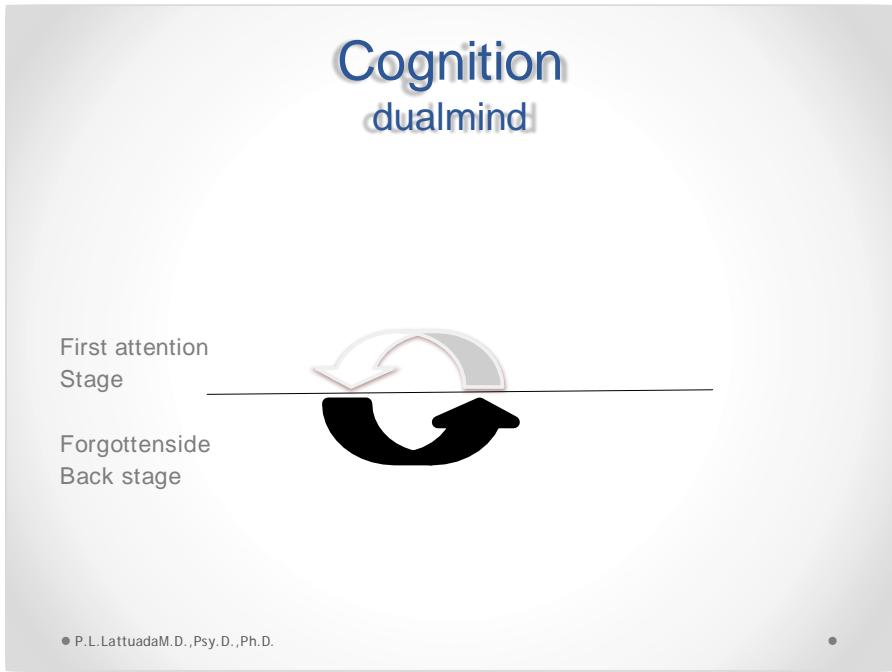 Fig. 1: Cognition
Ancient traditions as well as several psychologists (Arieti, 1967, Bruner 1986, Flavell 1963) pointed out several cognitive structures higher than critical thinking.
It has been called "dialectical," "integrative," "creative synthetic," or "vision-logic." following Wilber's description:
"It appears that whereas the formal mind establishes relationships, vision-logic establishes networks of those relationships.
Such vision or panoramic logic apprehends a mass network of ideas, how they influence each other and interrelate." (Wilber, 2011, 116) While cognition teaches, meta-cognition teaches how to learn.
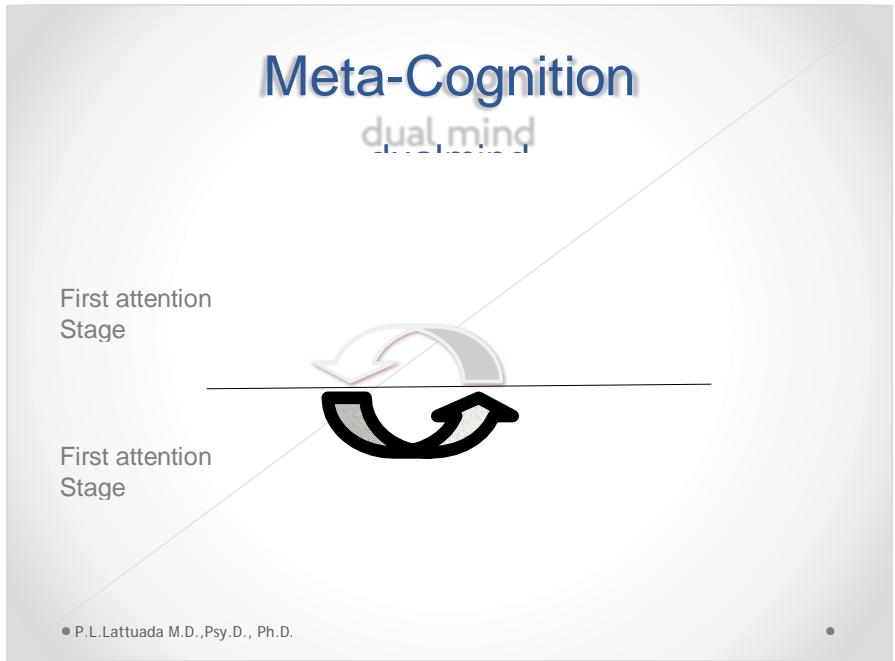 Fig. 2: Meta - cognition
The suggest way of thinking called Transe-cognition, thanks the Transe Learning, teaches how to grasp the structures and regularities, hidden beyond appearances, here and now.
Cognition, we may say get knowledge, metacognition reflects on knowledge, Transe-cognition get the awareness beyond knowledge.
Beeing aware means grasp the fundamental laws, structures and regularities of the process of the experience, here and now.
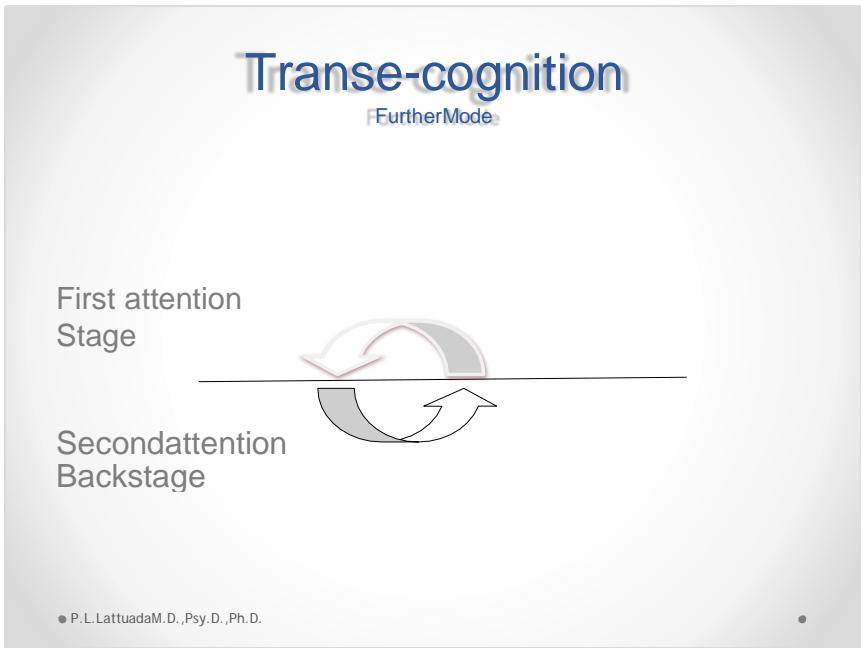 Fig. 3: Transe - cognition
Three are the capstones of Transcognition: Second Attention, Further Mode and Integral Thinking.
## i. Second Attention Epistemology (SAE)
SAE suggests an approach to the inner experience based on states of consciousness centered on the subject of the experience and on the guarantees of the validity of its statements, based on an integral stage of thinking.
SAE assumes that consciousness reaches the surface of contact with the boundary and that this always happens here and now. The boundary (this is not that) either indicates or precludes the essence of things (this is that).
The possibility of indicating or precluding is inherent in the boundary, the responsibility for indicating or precluding is inherent in the subject of the experience.
The hypothesis is that the ordinary first attention precludes, the second, which happens when we "do something" to our attention and get a look beyond, indicates, always here and always now. The epistemological fallacy happens when the first excludes the second or the second excludes the first. For the first attention i.e., the chair is not a tree, for the second attention chair and tree are here and now.
The second attention through the Further Mode, by grasping stage and back stage, the within and the without, offer the opportunity for a leap of consciousness.
## ii. The Further Mode
The Further Mode is defined as that special mode of knowledge which grasps the complementary polarity in any manifestation; for example, it grasps what reunites in separation and what separates in reunification; in what appears it unmask what is hidden. The Further Mode represents a mode of knowledge that transcends the dual perspective of ordinary consciousness as it integrates opposites and provides a unified vision of existence.
The Further Mode allows to unify the dualisms (light and shadow, emptiness and fullness, highness and lowness, within and without): by making the two (what is separate) the one (what is integrated) we access the essence, the dimension of the Self.
The Further Mode works to recognize both the figure and the background, what the facts show and what they veil, what a boundary precludes but also what it indicates, On the surface of every contact, in the presence of every boundary, in front of any event the Further Mode suggests, the pure unidentified presence, the zero, a way to grasp what appears, and what lay beyond.
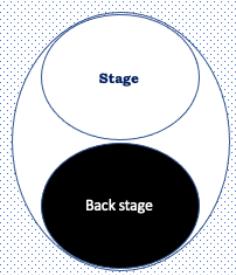
Further Mode Make the two become one. Fig. 4: The Further Mode
## iii. Integral Transpersonal Thinking (ITT)
Integral Transpersonal Thinking, (Lattuada, 20118) is a way of organizing the experience of the world through awareness, witnessing oneself, feeling-thinking-acting.
ITT arises from the synergistic use of some essential psychic functions, namely: observation, proprioception, exteroception, attention and consciousness.
The mastery of observation leads to the realization of the conscious observation of our identifications.
ITT master four components:
- What we feel inside (IEI),
- Our experience of the world (ECE).
- The listening to the field, the surrounding environment,
- The mastery of attention and consciousness through intent and contemplation.
ITT happens while we contemplate events (what - the phenomenon on the stage), we are aware beyond appearances (behind the scenes), we pay attention here and now, we expand the field of consciousness within, without, and all around (depth, breadth and height).
Integral Transpersonal Thinking
Data 1: ECE, Explicit Clinical Evidences
Data 2: IEI, Implicit Essential Inherences
States of Consciousness
The Field: Essence
P.L. Laiqadqi-M.D., PSY.D., Ph.D.
Fig. 5: Integral Transpersonal Thinking
## III. CONCLUSIONS
Humanity has evolved through stages of thinking and states of consciousness that have characterised its individual and collective experience.
The hegemony of rational thinking shows alongside the undeniable and often extraordinary evolutionary achievements a stagnation that renders obsolete the paradigm on which it was founded for over four hundred years.
The good news is that humanity has maps, models and methods to transcend and include the stage of rational thinking. Particularly in the field of learning and the evolution of consciousness, transe cognition emerges as a possible leap towards a transcultural, transpersonal, integral, world-centered, and inclusive system of thinking based on awareness and mastery of inner experience. Transe Learning springing directly from the Self, i.e. from the most authentic level of ourselves open up to a stage of thinking providing a new way of transformational learning.
### APPENDIX
Table 1: Transe Learning – Soft & Life Skills
<table><tr><td>1.</td><td>Confidence in one's own abilities and in a fundamental benevolence of life</td></tr><tr><td>2.</td><td>Freedom and responsibility for one's own intent</td></tr><tr><td>3.</td><td>Awakening to Awareness</td></tr><tr><td>4.</td><td>Development of Compassion</td></tr><tr><td>5.</td><td>Openness of Mind and Integral Thinking</td></tr><tr><td>6.</td><td>Insight-based understanding and inspired vision</td></tr><tr><td>7.</td><td>Sensitivity to context</td></tr><tr><td>8.</td><td>Creativity</td></tr><tr><td>9.</td><td>Pro activity</td></tr><tr><td>10.</td><td>Learning to learn and learning to unlearn</td></tr><tr><td>11.</td><td>Willingness to change</td></tr><tr><td>12.</td><td>Ability to deal with uncertainty and risk-taking</td></tr><tr><td>13.</td><td>Decision-making capacity</td></tr><tr><td>14.</td><td>Problem solving</td></tr><tr><td>15.</td><td>Conflict management skills</td></tr><tr><td>16.</td><td>Ability to understand polarised positions</td></tr><tr><td>17.</td><td>Courage for imperfection and vulnerability</td></tr><tr><td>18.</td><td>Courage to pause in difficulties and learn from life's obstacles, failures and setbacks</td></tr><tr><td>19.</td><td>Emotional and social intelligence</td></tr><tr><td>20.</td><td>Collaboration, sharing, community spirit, spirit of service</td></tr></table>
Table 2: Transe Learning – Transpersonal qualities
<table><tr><td>Acceptance</td><td>Dynamism</td><td>Integrity</td><td>Spontaneity</td></tr><tr><td>Acceptance</td><td>Discipline</td><td>Loyalty</td><td>Stability</td></tr><tr><td>Love</td><td>Gentleness</td><td>Lightness</td><td>Astonishment</td></tr><tr><td>Openness</td><td>Effectiveness</td><td>Freedom</td><td>Tenderness</td></tr><tr><td>Harmony</td><td>Efficiency</td><td>Wonderfulness</td><td>Humility</td></tr><tr><td>Surrender</td><td>Energy</td><td>Naturalness</td><td>Humour</td></tr><tr><td>Assertiveness</td><td>Enthusiasm</td><td>Honesty</td><td>Vitality</td></tr><tr><td>Authenticity</td><td>Balance</td><td>Order</td><td>Emptiness</td></tr><tr><td>Beauty</td><td>Fairness</td><td>Peace</td><td></td></tr><tr><td>Calm</td><td>Expressiveness</td><td>Patience</td><td></td></tr><tr><td>Clarity</td><td>Firmness</td><td>Readiness</td><td></td></tr><tr><td>Combativeness</td><td>Confidence</td><td>Protection</td><td></td></tr><tr><td>Compassion</td><td>Flexibility</td><td>Purity</td><td></td></tr><tr><td>Understanding</td><td>Fluidity</td><td>Respect</td><td></td></tr><tr><td>Communion</td><td>Brotherhood & Sisterhood</td><td>Wisdom</td><td></td></tr><tr><td>Courage</td><td>Generosity</td><td>Simplicity</td><td></td></tr><tr><td>Creativity</td><td>Kindness</td><td>Sensitivity</td><td></td></tr><tr><td>Curiosity</td><td>Playfulness</td><td>Sense of belonging</td><td></td></tr><tr><td>Delicacy</td><td>Joy</td><td>Sensuality</td><td></td></tr><tr><td>Determination</td><td>Gratitude</td><td>Serenity</td><td></td></tr><tr><td>Dignity</td><td>Grace</td><td>Silence</td><td></td></tr><tr><td></td><td>Innocence</td><td>Spirit of service</td><td></td></tr></table>
Pier Luigi has published twenty books and several scientific articles.
Generating HTML Viewer...
References
39 Cites in Article
A Di Brandan,W Tramma,S (2014). Dizionario del lavoro educativo.
S Arieti (1967). The Intrapsychic Self. Feeling, Cognition, and the Creativity in Health and Mental Illness.
Z Bauman (2008). The individualized society.
P Bélanger (2016). Self-construction and social transformation. Lifelong, Lifewide and Life-Deep Learning.
Bennet Lemoine,G (2014). What VUCA Really Means for You.
J Bruner (1986). Actual Minds, Possible Worlds.
Franco Cambi,E Frauenfelder (1994). Una breve riflessione sulla complessità della pedagogia oggi. Tra molte specializzazioni e visione unitaria/critica comune.
F Cambi (2006). Abitare il disincanto. Una pedagogia per il postmoderno.
C Ciappei,M Cinque (2014). Soft skills per il governo dell'agire.
J Cleary (1986). Trikaya and Trinity: The Mediation of the Absolute.
E Faure (1972). Learning to be. The world of education today and tomorrow.
Flavell John,H (1963). The Developmental Psychology of Jean Piaget.
G Gozzer (1972). Il Rapporto Faure sulla scuola nel mondo.
Y Harari (2018). 21 Lezioni per il XXI secolo, Bompiani, Milano 2018 -Kindle Edition.
J Hillman (1996). The Soul's Code.
R Hutchins (1968). The Learning society.
Hippocrates (2015). The Complete Works.
V Iori (2018). Educatori e pedagogisti.
M Laeng (1992). Unknown Title.
G Lanzara (1993). Capacità negativa.
E Laszlo (2010). The Chaos Point: The world at the crossroads, Pinkus.
P Lattuada (2013). Biotransenergetics. Milano-Ebook.
P Lattuada (2017). Movimento umanistico e relazione d'aiuto: verso una sensibilità collettiva.
Pier Lattuada,Regina Hess (2019). Towards an Organismic-Dynamic Epistemology and Research Methodology: The Further Mode of Knowing of Inner Experiences of States of Consciousness.
Pier Lattuada (2010). Second Attention Epistemology.
Le Betorf,G (1994). De la competence: essay sur un attracteur étrange.
A Maslow (1976). The Farther Reaches of Human Nature.
R Massa (1987). Educare o istruire? La fine della pedagogia nella cultura contemporanea.
R Mccraty (2015). Science of the Heart, Exploring the Role of the Heart in Human Performance.
E Morin (2005). Educare gli educatori.
E Morin (2015). Insegnare a vivere. Manifesto per cambiare l'educazione.
Fabiana Coluzzi (2017). Soft skills per una performance lavorativa di successo: studio comparativo interculturale sulle competenze trasversali nei Manager.
P Pinoli (2012). Facciamo che…Educazione transpersonale per i bambini.
Plato (1997). Complete works.
M Pollo (2008). Manuale di Pedagogia generale. Fondamenti di una pedagogia culturale dell'anima.
E Stein (1989). The Collected Works.
K Wilber (2000). Integral Psychology. Consciousness, Spirit, Psychology, Therapy.
K Wilber (2011). No Boundary: Eastern and Western Approaches to Personal Growth. Ken Wilber, 1979. U.S. $13.00, Canada $17.95, ISBN 0-394-74881-6. Available from Shambhala Publications, Inc., Horticultural Hall, 300 Massachusetts Avenue, Boston, MA 02115.
D Winnicott (2007). The Maturational Process and the Facilitating Environment.
Explore published articles in an immersive Augmented Reality environment. Our platform converts research papers into interactive 3D books, allowing readers to view and interact with content using AR and VR compatible devices.
Your published article is automatically converted into a realistic 3D book. Flip through pages and read research papers in a more engaging and interactive format.
Our website is actively being updated, and changes may occur frequently. Please clear your browser cache if needed. For feedback or error reporting, please email [email protected]
Thank you for connecting with us. We will respond to you shortly.